
Reports
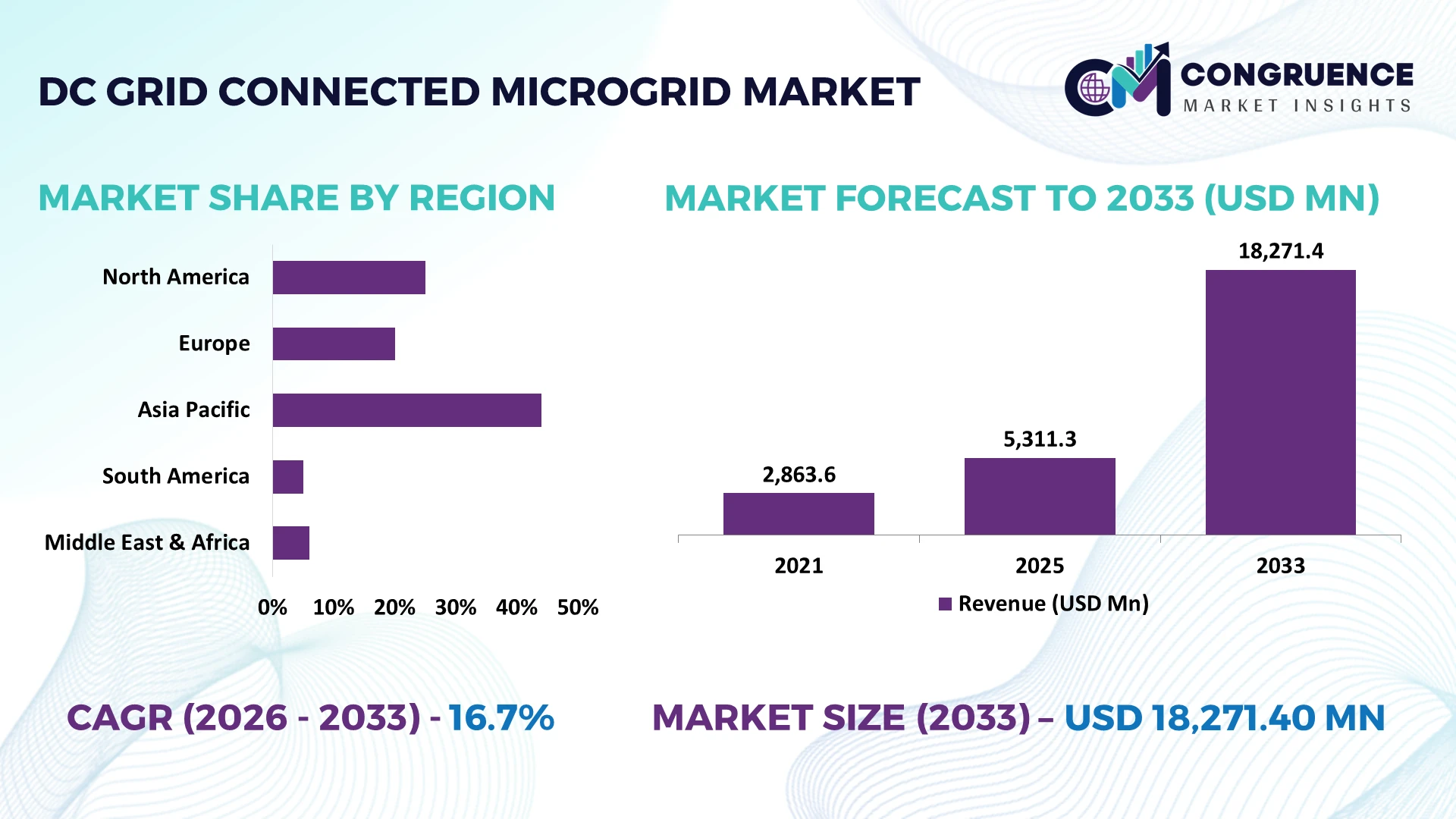
The Global DC Grid Connected Microgrid Market was valued at USD 5311.3 Million in 2025 and is anticipated to reach a value of USD 18271.4 Million by 2033 expanding at a CAGR of 16.7% between 2026 and 2033. Growth is driven by direct current solar and battery integration, high efficiency power conversion, data center electrification, and bidirectional grid connectivity.
The United States leads the DC Grid Connected Microgrid Market with an estimated 30% global share in 2025, supported by commercial microgrid development, distributed energy storage, and advanced power electronics. The Department of Energy's Grid Resilience and Innovation Partnerships program has announced billions in grid modernization funding, supporting resilient electricity infrastructure. Compared with China's manufacturing led deployment model, American projects emphasize commercial energy resilience and grid services. Illustrative engineering targets include 8% lower conversion losses and 15% faster power management response through integrated DC architectures.
Strategically, developers should prioritize American commercial resilience projects, bidirectional converter integration, and scalable DC distribution architectures that demonstrate measurable efficiency improvements.
Market Size & Growth: USD 5,311.3 million in 2025, reaching USD 18,271.4 million by 2033 at 16.7% CAGR, supported by solar and battery integration.
Top Growth Drivers: Illustrative demand weighting assigns 40% to distributed renewable integration, 35% to energy resilience, and 25% to conversion efficiency improvements.
Short Term Forecast: By 2028, advanced DC microgrid controllers target 15% faster power balancing and 8% lower conversion losses.
Emerging Technologies: AI energy management, silicon carbide converters, and bidirectional DC protection represent 3 important technology developments.
Regional Leaders: Illustrative 2033 allocations place North America at USD 6,213.28 million, Asia Pacific at USD 6,030.56 million, and Europe at USD 4,202.42 million, supported by resilience, industrial electrification, and renewable integration.
Consumer / End User Trends: Industrial and commercial operators target 20% greater onsite renewable utilization through coordinated DC energy storage.
Pilot / Case Example: A modeled 2027 industrial DC microgrid project targets 10% lower conversion losses and 15% faster battery dispatch response.
Competitive Landscape: An illustrative 14% share positions Schneider Electric among leading suppliers, alongside ABB, Siemens, Eaton, and Delta Electronics.
Regulatory & ESG Impact: Grid modernization programs support distributed energy integration, with illustrative projects targeting 12% lower imported electricity consumption.
Investment & Funding: A modeled USD 250 million investment scenario prioritizes bidirectional converters, energy storage integration, and industrial microgrid partnerships.
Innovation & Future Outlook: Advanced DC protection, modular power electronics, and intelligent controllers target 20% faster fault isolation.
The DC Grid Connected Microgrid Market supports electricity management across data centers, manufacturing facilities, commercial buildings, transportation infrastructure, and renewable energy installations. Direct current architectures connect photovoltaic generation, battery storage, and compatible electrical loads while reducing unnecessary conversion stages. Silicon carbide power electronics, intelligent controllers, and bidirectional converters improve energy routing between local resources and utility networks. Illustrative engineering benchmarks indicate 8% lower conversion losses compared with conventional architectures under suitable conditions. United States grid resilience initiatives and China's industrial electrification programs are encouraging integrated power system development, making protection coordination, converter interoperability, and operating efficiency central to strategic investment decisions.
DC grid connected microgrids are becoming strategically important as industrial operators seek greater control over electricity reliability, renewable integration, and power conversion efficiency. Direct current architectures connect photovoltaic generation, battery storage, and compatible electrical loads while reducing unnecessary conversion stages. United States grid modernization programs are strengthening investment in distributed energy resilience. Equipment manufacturers are expanding bidirectional converter portfolios, modular power distribution systems, and intelligent microgrid controllers to address increasingly complex industrial electricity requirements.
Compared with conventional AC coupled configurations, optimized DC microgrids offer illustrative targets of 8% lower conversion losses and 15% faster battery dispatch response. American projects emphasize commercial resilience and utility coordination, while Chinese manufacturers prioritize scalable power electronics and industrial deployment. Between 2026 and 2028, advanced controllers are expected to improve renewable utilization by 20% in suitable installations. Wider adoption of silicon carbide converters and modular DC protection equipment will influence system architecture decisions.
A practical deployment combines rooftop solar, battery storage, and compatible industrial loads through a common DC bus with controlled utility interconnection. Schneider Electric, ABB, and Siemens are developing integrated energy management and distribution capabilities. Competitive advantage increasingly depends on interoperable equipment, verified operating efficiency, and reliable protection coordination across expanding distributed energy systems.
Industrial facilities are adopting DC grid connected microgrids to integrate photovoltaic generation, battery storage, and compatible electrical loads with fewer conversion stages. China's expanding solar manufacturing ecosystem and industrial electrification programs strengthen demand for advanced power conversion and distributed energy management. Direct current architectures simplify connections between solar arrays and batteries, improving local energy routing under suitable operating conditions. Illustrative engineering targets include 8% lower conversion losses, 20% greater onsite renewable utilization, and 15% faster battery dispatch response. Schneider Electric, ABB, and Delta Electronics are developing bidirectional converters, modular distribution equipment, and intelligent controllers. The strategic advantage lies in coordinating renewable generation and industrial electricity consumption without unnecessary power conversion complexity.
DC microgrid deployment faces constraints from specialized protection equipment, converter acquisition costs, and limited interoperability between electrical components. Unlike conventional AC distribution, DC networks require carefully engineered fault interruption and voltage coordination. United States industrial projects must also address utility interconnection requirements and compatibility with existing facility electrical infrastructure. Illustrative project sensitivity scenarios indicate 20% higher initial integration expenditure, 15% additional engineering workloads, and 10% longer equipment qualification cycles. Manufacturers are responding through modular converter designs, standardized communication interfaces, and partnerships with electrical engineering contractors. Facility operators increasingly evaluate phased deployment rather than complete distribution replacement. Commercial scalability depends on reducing integration complexity while maintaining reliable protection and regulatory compliance.
Increasing data center electricity requirements create opportunities for DC microgrids integrating renewable generation, battery storage, and compatible computing infrastructure. The United States is expanding artificial intelligence computing capacity, intensifying interest in efficient electrical distribution and resilient onsite energy systems. Advanced silicon carbide converters and modular DC bus architectures support higher power density and improved conversion performance. Illustrative deployment targets include 10% lower distribution losses, 15% faster energy storage response, and 20% improved renewable energy utilization. Equipment suppliers are investing in high voltage DC distribution, intelligent energy management, and data center integration partnerships. A differentiated opportunity exists in coordinating backup batteries and operational power systems through shared DC infrastructure, reducing redundant conversion equipment.
Scaling DC grid connected microgrids requires dependable fault isolation, stable converter coordination, and secure communication between local controllers and utility networks. DC faults lack natural current zero crossings, complicating interruption compared with conventional AC systems. Germany's industrial electrification and distributed energy integration create demanding environments for protection coordination and interoperability. Illustrative engineering benchmarks target 20% faster fault isolation, 15% fewer controller communication failures, and 10% improved system availability. Equipment manufacturers must invest in solid state protection, validated control algorithms, and secure industrial communication protocols. Operators also require trained electrical engineers capable of maintaining complex converter networks. Long term competitiveness depends on maintaining stable grid interaction as connected generation, storage, and industrial loads expand.
Modular DC Bus Architectures Gain Traction: Industrial microgrid developers are adopting modular DC distribution assemblies to simplify system expansion and equipment replacement. Standardized bus interfaces support illustrative targets of 18% faster commissioning and 12% lower electrical installation labor. Japanese equipment manufacturers are expanding modular converter platforms and prefabricated distribution cabinets, allowing industrial operators to increase electrical capacity without redesigning entire power distribution networks.
Grid Forming Controls Strengthen Operating Stability: Advanced microgrid controllers are incorporating grid forming capabilities to maintain voltage stability during disturbances and utility transitions. Illustrative engineering targets include 20% faster disturbance recovery and 15% lower voltage deviation under controlled testing conditions. Siemens and ABB are developing coordinated converter control platforms, enabling facility operators to maintain critical operations while improving synchronization between distributed generation and utility networks.
Digital Twins Transform Microgrid Commissioning: Engineering teams are increasingly using simulation environments to validate converter interactions, protection settings, and operating sequences before physical installation. Illustrative project benchmarks target 25% fewer commissioning adjustments and 15% shorter system validation periods. United States microgrid integrators are expanding hardware simulation and digital engineering workflows, reducing expensive onsite troubleshooting and improving confidence in complex electrical system configurations.
Battery Health Analytics Reshape Dispatch Decisions: Microgrid operators are incorporating battery degradation models into energy management platforms to balance dispatch performance against equipment lifetime. Illustrative operational targets include 12% fewer unnecessary battery cycles and 10% longer effective battery service life under suitable operating conditions. Chinese energy storage manufacturers are strengthening analytics partnerships and battery management integration, recognizing that lifetime optimization increasingly influences project economics beyond immediate electricity savings.
Solar PV-Based Microgrids represent the leading type in the DC Grid Connected Microgrid Market, accounting for an estimated 38% share in 2025. Their dominance reflects the direct current output of photovoltaic modules, established solar installation capabilities, and compatibility with distributed energy management platforms. China's extensive photovoltaic manufacturing ecosystem supports equipment availability and system integration expertise. Battery-Based Microgrids account for an illustrative 29% share, supported by energy storage deployment, peak demand management, and grid resilience requirements. Their operational value centers on dispatch flexibility and continuity during electricity supply disturbances.
Hybrid DC Microgrids represent the fastest growing type as developers integrate multiple generation and storage technologies through coordinated power electronics. Their estimated 25% share reflects increasing interest in flexible system configurations and improved energy resource management. Fuel Cell-Based Microgrids retain specialized relevance where hydrogen infrastructure, continuous generation, and low emission electricity supply influence project selection. Manufacturers are expanding bidirectional converter portfolios, modular controllers, and compatible energy management platforms. Investment priorities increasingly favor integrated architectures that optimize multiple distributed energy resources.
Renewable Energy Integration represents the largest application in the DC Grid Connected Microgrid Market, accounting for an estimated 35% share in 2025. Photovoltaic generation, battery storage, and utility interconnection create favorable conditions for DC power distribution and coordinated energy management. China and the United States maintain substantial deployment ecosystems supported by distributed solar installations and commercial energy infrastructure. Industrial Power Distribution accounts for an illustrative 25% share, reflecting demand for efficient electricity routing across manufacturing facilities and automated production environments.
EV Charging represents the fastest growing application as charging infrastructure operators evaluate direct current distribution and integrated battery buffering. Its estimated 20% share reflects expanding requirements for high capacity charging and coordinated power management. Data Center Power Supply increasingly emphasizes electrical efficiency, reliability, and compatible energy storage architectures. Remote Power Supply supports specialized installations requiring local generation and dependable electricity availability. Manufacturers are expanding modular charging converters, integrated controllers, and application specific distribution equipment. Competitive advantage increasingly depends on simplifying interconnection, controlling electrical demand, and reducing infrastructure installation complexity.
Industrial Facilities represent the leading end user segment in the DC Grid Connected Microgrid Market, accounting for an estimated 32% share in 2025. Manufacturing plants, automated production environments, and energy intensive facilities require dependable electricity supply and coordinated distributed energy management. Industrial operators benefit from integrating photovoltaic generation, battery storage, and compatible electrical equipment through controlled DC distribution architectures. Commercial Buildings account for an illustrative 25% share, supported by onsite generation, energy resilience requirements, and electricity demand management across large properties.
Data Centers represent the fastest growing end user group, driven by increasing computing density, electrical reliability requirements, and interest in efficient power distribution. Their estimated 20% share reflects expanding investment in advanced electrical infrastructure. Utilities support grid interconnection and distributed resource coordination, while Transportation Infrastructure requires dependable power for charging and operational systems. Manufacturers are developing sector specific microgrid controllers, modular converters, and integrated protection equipment. Competitive positioning increasingly depends on technical compatibility, verified operating performance, and dependable engineering support.
North America accounted for the largest market share at an estimated 34% in 2025 however, Asia Pacific is expected to register the fastest growth, expanding at an estimated CAGR of 19.2% between 2026 and 2033.
Grid Resilience Investment and Advanced DC Power Integration
North America accounted for an estimated 34% of the global DC Grid Connected Microgrid Market in 2025, supported by commercial energy resilience projects, distributed generation, and advanced electrical infrastructure. The United States dominates regional deployment through industrial facilities, data centers, military installations, and institutional campuses. Federal grid modernization programs encourage distributed energy integration and resilient electricity networks. The Department of Energy's Grid Resilience and Innovation Partnerships program supports projects involving grid reliability and distributed energy resources. Illustrative engineering benchmarks target 8% lower conversion losses and 15% faster energy storage dispatch through optimized DC architectures. Schneider Electric, Eaton, and ABB compete through intelligent controllers, bidirectional converters, and electrical distribution equipment. Project developers increasingly prioritize interoperability, protection coordination, and dependable utility interconnection to improve operating performance and reduce commissioning complexity.
United States Market Outlook: The United States leads national deployment with an estimated 30% global market share in 2025. California, Texas, and New York maintain important ecosystems for distributed energy development and advanced power infrastructure. Commercial electricity users increasingly evaluate DC microgrids for renewable integration, battery coordination, and critical load management. Illustrative deployment targets include 20% greater onsite renewable utilization. Equipment suppliers are expanding engineering partnerships and modular controller portfolios to support industrial and commercial projects.
Industrial Electrification and Intelligent Energy Management
Europe represented an estimated 23% of the global DC Grid Connected Microgrid Market in 2025, supported by industrial electrification, renewable energy integration, and advanced power electronics manufacturing. Germany, France, the Netherlands, and the United Kingdom maintain important deployment and technology development ecosystems. European electricity market reforms and distributed energy integration requirements are increasing attention to flexible industrial power systems. DC microgrids support coordinated operation of photovoltaic generation, battery storage, and compatible industrial equipment. Illustrative engineering targets include 10% lower distribution losses and 15% improved power management responsiveness. Siemens, Schneider Electric, and ABB are expanding intelligent energy management platforms and modular power conversion capabilities. Competitive differentiation increasingly depends on industrial communication compatibility, verified electrical efficiency, and compliance with demanding grid interconnection and equipment safety requirements.
Germany Market Outlook: Germany maintains advanced industrial automation capabilities and a strong power electronics manufacturing ecosystem. Automotive manufacturing, machinery production, and industrial electrification create opportunities for DC distribution and integrated energy storage. The country's renewable energy transition encourages closer coordination between onsite generation and industrial electricity consumption. Illustrative factory modernization projects target 12% lower power conversion losses through optimized DC distribution. Manufacturers are strengthening industrial controller integration, converter engineering, and technical partnerships with automation specialists.
Manufacturing Scale and Distributed Energy System Expansion
Asia Pacific accounted for an estimated 33% of the global DC Grid Connected Microgrid Market in 2025, supported by extensive photovoltaic manufacturing, battery production, and industrial electrification. China dominates regional equipment manufacturing and deployment activity, while Japan, India, and South Korea contribute through advanced power electronics and distributed energy projects. Chinese manufacturers benefit from integrated supply chains for solar modules, lithium batteries, converters, and electrical control equipment. Industrial parks and commercial energy facilities increasingly evaluate DC architectures to coordinate distributed generation and storage. Illustrative production targets include 15% faster converter assembly and 10% lower equipment integration costs. Delta Electronics, Huawei Digital Power, and Sungrow compete through converter development, intelligent energy management, and scalable electrical equipment platforms. Regional expansion increasingly emphasizes manufacturing efficiency, equipment interoperability, and integrated renewable electricity management.
China Market Outlook: China benefits from extensive photovoltaic and battery manufacturing capacity, industrial electrification initiatives, and advanced power electronics supply chains. Guangdong, Jiangsu, and Zhejiang represent important manufacturing ecosystems for converters, electrical equipment, and energy storage integration. Industrial facilities increasingly deploy coordinated solar and battery systems to improve electricity management. Illustrative DC architecture targets include 18% faster energy balancing response. Domestic manufacturers emphasize modular converter production, integrated controllers, and scalable electrical distribution solutions.
Distributed Solar Integration and Industrial Energy Resilience
South America represented an estimated 5% of the global DC Grid Connected Microgrid Market in 2025, with Brazil accounting for the largest concentration of distributed energy opportunities. Chile, Colombia, and Argentina contribute through renewable energy development, industrial electricity requirements, and distributed generation initiatives. Brazil's distributed solar market supports interest in coordinated photovoltaic generation, battery storage, and commercial electricity management. Mining and industrial operations in Chile create specialized requirements for reliable local energy systems. Illustrative deployment targets include 15% improved onsite renewable utilization and 10% lower conversion losses. However, imported power electronics, project financing conditions, and specialized engineering availability influence installation economics. Suppliers are developing regional integration partnerships and technical service networks. Competitive advantage depends on modular system design, dependable equipment availability, and practical maintenance capabilities.
Brazil Market Outlook: Brazil maintains a substantial distributed solar ecosystem supported by commercial electricity users, agricultural operations, and industrial facilities. São Paulo and Minas Gerais provide important industrial and renewable energy development environments. ANEEL's distributed generation regulatory framework shapes the commercial context for grid connected energy systems. Illustrative industrial microgrid projects target 12% lower electricity import requirements through coordinated local generation and storage. Equipment suppliers prioritize inverter compatibility, energy management integration, and partnerships with domestic engineering contractors.
Energy Infrastructure Diversification and Resilient Power Deployment
The Middle East and Africa accounted for an estimated 5% of the global DC Grid Connected Microgrid Market in 2025, supported by renewable energy investment, industrial development, and electricity infrastructure modernization. Saudi Arabia and the United Arab Emirates represent important markets for advanced electrical systems, while South Africa contributes through commercial energy resilience and distributed generation requirements. Industrial facilities increasingly evaluate photovoltaic generation, battery storage, and intelligent power conversion to improve electricity availability. Saudi Arabia's Vision 2030 industrial diversification programs provide a strategic framework for advanced energy infrastructure development. Illustrative deployment benchmarks target 20% higher onsite renewable utilization and 15% faster storage dispatch response. Equipment manufacturers are expanding regional engineering partnerships, converter distribution networks, and integrated control offerings. Successful deployment depends on reliable protection equipment, environmental durability, and specialized commissioning expertise.
Saudi Arabia Market Outlook: Saudi Arabia benefits from large industrial development programs, renewable energy investment, and expanding electrical infrastructure requirements. Riyadh, NEOM, and the Eastern Province represent important environments for advanced energy system deployment. Industrial facilities and infrastructure developers are evaluating integrated photovoltaic and battery configurations with intelligent grid interaction. Illustrative engineering targets include 10% lower conversion losses through optimized power electronics. Manufacturers are strengthening local partnerships, technical support capabilities, and modular electrical equipment offerings.
The DC Grid Connected Microgrid Market features competition between integrated electrical infrastructure suppliers and specialized power electronics manufacturers. Schneider Electric, ABB, Siemens, Eaton, and Delta Electronics compete through converter efficiency, intelligent controllers, protection systems, and integration capabilities. Their combined global market share is illustratively estimated at 42%, reflecting strong established distribution networks alongside specialized regional suppliers. Advanced converter architectures target 8% lower conversion losses, while automated energy management supports 15% faster dispatch response and modular installation targets 12% lower engineering costs. Schneider Electric and Siemens emphasize integrated industrial energy platforms; ABB and Eaton strengthen electrical protection portfolios, while Delta Electronics competes through power conversion technology. Partnerships with utilities, engineering contractors, and energy storage suppliers accelerate deployment. Certification requirements, DC fault interruption complexity, and specialized engineering capabilities restrict entry. Competitive success requires interoperable equipment, reliable protection, efficient conversion, and dependable commissioning support across demanding industrial environments worldwide.
Schneider Electric SE
ABB Ltd.
Siemens AG
Eaton Corporation plc
Delta Electronics, Inc.
Huawei Technologies Co., Ltd.
Sungrow Power Supply Co., Ltd.
Hitachi Energy Ltd.
Mitsubishi Electric Corporation
Toshiba Corporation
General Electric Company
Enphase Energy, Inc.
Victron Energy B.V.
Wärtsilä Corporation
Current DC grid connected microgrids integrate photovoltaic arrays, battery storage, bidirectional converters, and intelligent energy management controllers. Silicon carbide semiconductors improve switching performance, while coordinated DC bus regulation stabilizes power exchange with utility networks. Compared with conventional AC coupled architectures, optimized DC distribution targets 8% lower conversion losses under comparable operating conditions. Industrial facilities lead practical deployment through solar storage integration and critical load management. Schneider Electric, ABB, and Delta Electronics benefit from established converter engineering and electrical protection capabilities.
Emerging technologies include solid state circuit breakers, grid forming converters, and predictive energy management algorithms. Advanced protection systems target 20% faster fault isolation, while predictive dispatch models pursue 15% better storage utilization. Adoption remains concentrated in demonstration projects and specialized industrial installations rather than standardized commercial networks. Manufacturers are integrating digital twins, modular converter interfaces, and secure industrial communication protocols to simplify commissioning and improve operational reliability.
Between 2026 and 2028, high voltage DC distribution, automated fault diagnostics, and coordinated charging infrastructure will influence investment priorities. Illustrative engineering targets include 12% lower installation complexity and 10% faster system commissioning. Suppliers combining certified protection equipment, interoperable controllers, and scalable power electronics will strengthen competitiveness as industrial operators prioritize reliable electricity management and efficient distributed energy integration.
May 2026: Nexans commissioned a 700 V DC microgrid pilot in Lyon with Schneider Electric and VINCI Energies. Its integrated battery and charging infrastructure validates interoperable building distribution, helping suppliers commercialize DC equipment for increasingly electrified commercial facilities. Source: nexans.com.
March 2025: Schneider Electric opened advanced microgrid testing laboratories in Massachusetts. The facility simulates electricity demand from 300 homes, allowing engineers to validate distributed generation, storage, and control configurations before deployment and significantly improve commercial microgrid reliability. Source: naseo.org.
June 2024: California Energy Commission documented Bosch's operational DC microgrid at a Honda warehouse, integrating 286 kW of rooftop solar. Testing demonstrated lower conversion requirements, providing industrial operators with practical evidence for evaluating direct current distribution efficiency improvements. Source: energy.ca.gov.
July 2025: IEEE published technical findings from the HYPERRIDE demonstration in Terni, Italy, validating bidirectional DC integration between 2 substations. The project demonstrated coordinated energy flows and improved fault resilience, strengthening the technical case for utility network deployment. Source: ieee.org.
The DC Grid Connected Microgrid Market Report evaluates industry structure, deployment economics, technological developments, and competitive positioning between 2026 and 2033. Type segmentation covers Solar PV-Based, Battery-Based, Fuel Cell-Based, and Hybrid DC Microgrids. Application analysis examines Renewable Energy Integration, EV Charging, Data Center Power Supply, Industrial Power Distribution, and Remote Power Supply. End user coverage includes Commercial Buildings, Industrial Facilities, Data Centers, Utilities, and Transportation Infrastructure. Solar PV-Based systems represent an estimated 38% market share, while renewable integration accounts for approximately 35% of application demand.
Regional analysis covers North America, Europe, Asia Pacific, South America, and the Middle East and Africa. Technology coverage includes silicon carbide converters, intelligent controllers, DC protection, and modular distribution. Competitive assessment examines 14 companies, supporting investment planning, partnership selection, expansion priorities, and infrastructure deployment strategies.
| Report Attribute/Metric | Report Details |
|---|---|
Market Revenue in 2025 | USD 5311.3 Million |
Market Revenue in 2033 | USD 18271.4 Million |
CAGR (2026 - 2033) | 16.7% |
Base Year | 2025 |
Forecast Period | 2026 - 2033 |
Historic Period | 2021 - 2025 |
Segments Covered | By Type
By Application
By End-User
|
Key Report Deliverable | Revenue Forecast, Growth Trends, Market Dynamics, Segmental Overview, Regional and Country-wise Analysis, Competition Landscape |
Region Covered | North America, Europe, Asia-Pacific, South America, Middle East, Africa |
Key Players Analyzed | Schneider Electric SE, ABB Ltd., Siemens AG, Eaton Corporation plc, Delta Electronics, Inc., Huawei Technologies Co., Ltd., Sungrow Power Supply Co., Ltd., Hitachi Energy Ltd., Mitsubishi Electric Corporation, Toshiba Corporation, General Electric Company, Enphase Energy, Inc., Victron Energy B.V., Wärtsilä Corporation |
Customization & Pricing | Available on Request (10% Customization is Free) |




