
Reports
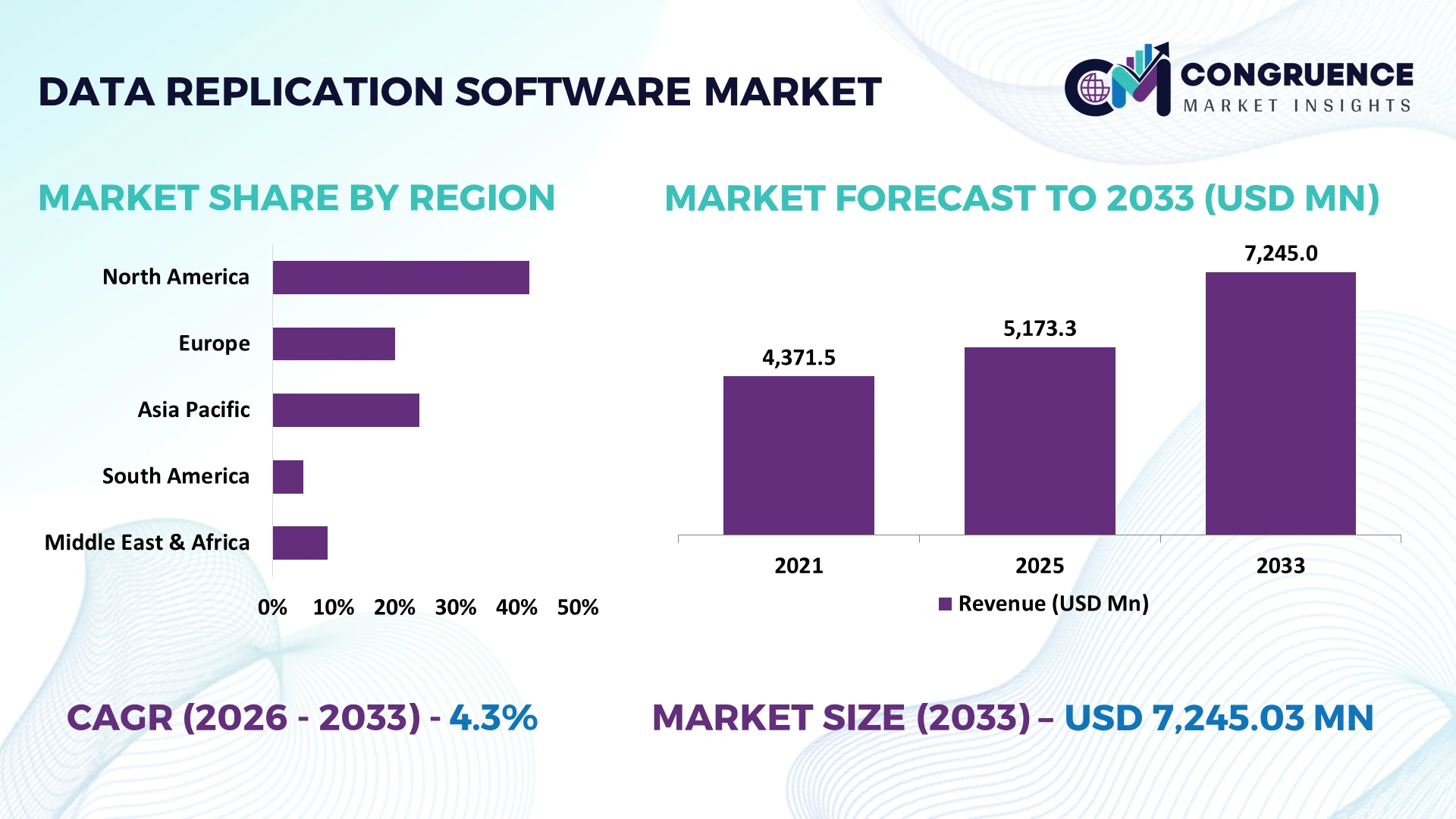
The Global Data Replication Software Market was valued at USD 5173.28 Million in 2025 and is anticipated to reach a value of USD 7245.03 Million by 2033 expanding at a CAGR of 4.3% between 2026 and 2033. Hybrid cloud adoption, cross cloud disaster recovery, real time database synchronization, and AI data pipelines are increasing enterprise requirements for continuous replication across distributed infrastructure.
The United States represents the dominant country market, supported by hyperscale cloud infrastructure, financial services, healthcare, technology, and retail data estates. In 2025, 55% of organizational workloads operated in public clouds, while AWS handled significant workloads for 53% of surveyed enterprises. India provides a contrasting high growth environment as rapid cloud adoption intersects with cybersecurity pressure, including a 13% increase in average breach costs during 2025. Global geopolitical pressure around data sovereignty is simultaneously strengthening demand for controlled replication across domestic and international infrastructure.
Data infrastructure vendors should prioritize low latency replication, heterogeneous database support, automated failover, and policy controlled data movement to capture enterprise hybrid cloud modernization spending.
Market Size & Growth: USD 5173.28 million in 2025 is projected to reach USD 7245.03 million by 2033 at 4.3% CAGR, driven by hybrid cloud and continuous data availability.
Top Growth Drivers: Hybrid cloud adoption reaches 73%, public cloud workload penetration exceeds 55%, and cross cloud data integration adoption reached 45%.
Short Term Forecast: By 2028, modern replication architectures will increasingly target recovery point objectives approaching zero for mission critical transactional workloads.
Emerging Technologies: Change data capture, streaming replication, and AI assisted automation are converging as 58% of organizations already use generative AI cloud services.
Regional Leaders: North America, Europe, and Asia Pacific remain principal demand centers as enterprise public cloud data penetration reaches 51% among large organizations.
End User Trends: 78% of organizations with more than 5,000 employees operate hybrid cloud environments, intensifying synchronization requirements across private and public infrastructure.
Pilot/Case Example: Cross cloud data integration adoption increased from 37% to 45% in 2024 as enterprises connected distributed platforms for analytics and application portability.
Competitive Landscape: AWS leads significant enterprise cloud workloads at 53%, while Microsoft, Oracle, IBM, Google, and specialized replication vendors compete around data mobility and resilience.
Regulatory & ESG Impact: EU Data Act implementation from 2025 strengthens cloud portability, while switching charges including data egress become fully removable from January 2027.
Investment & Funding: Large enterprises increasingly support replication intensive architectures, with 76% of major organizations spending more than USD 5 million monthly on public cloud services.
Innovation & Future Outlook: Disaster recovery as a service leads planned cloud adoption at 18%, positioning automated replication, continuous failover, and policy driven data mobility as strategic infrastructure priorities.
Data Replication Software Market demand is strengthening across banking, healthcare, retail, telecommunications, SaaS, government, and data intensive technology operations where uninterrupted access and synchronized databases are operational requirements. Current innovation centers on change data capture, log based replication, automated schema handling, streaming pipelines, and hybrid cloud orchestration. Hybrid cloud usage reached 73% in 2026, expanding requirements for consistent data movement between private infrastructure and multiple cloud platforms. The EU Data Act is simultaneously strengthening portability requirements, while enterprises increasingly integrate replication with disaster recovery, analytics, and AI pipelines, creating a strategic transition toward continuously synchronized data architectures.
Multicloud Replication Becomes Standardized: Hybrid cloud usage reached 73% in 2026, while 78% of enterprises with more than 5,000 employees operate hybrid environments and 53% run significant workloads on AWS. Enterprises are replacing point to point replication with centralized orchestration across heterogeneous databases and clouds. Vendors are expanding connector libraries, automated schema mapping, and cross cloud replication to reduce migration friction and operational dependence on individual infrastructure providers.
Streaming Data Replaces Batch Transfers: Real time replication is moving deeper into analytics and operational workflows as 45% of organizations use cross cloud data integration, up from 37%. Generative AI cloud service adoption has simultaneously reached 58%, increasing demand for continuously refreshed datasets. Enterprises are deploying change data capture and event streaming architectures that transfer incremental changes instead of repeatedly copying complete datasets, reducing latency and processing overhead.
Data Portability Reshapes Architecture: The EU Data Act became applicable in September 2025, while data egress switching charges are scheduled for complete removal from January 2027. Despite repatriation discussions, only 21% of cloud workloads have moved back from public infrastructure. Enterprises are therefore designing portable replication layers rather than abandoning cloud platforms. Providers are strengthening interoperability, migration automation, and policy controlled data movement to address regulatory switching requirements.
Recovery Automation Gains Priority: Disaster recovery as a service represents an 18% planned cloud adoption priority, while 27% of public cloud expenditure is identified as wasted and 84% of organizations consider cloud cost management their leading challenge. Replication strategies are consequently combining continuous synchronization with automated failover and consumption controls. Vendors are embedding monitoring, orchestration, and policy automation to reduce recovery administration while improving infrastructure utilization.
Database Replication leads the type segment with an estimated 35% share, reflecting its central role in transactional continuity, analytics synchronization, distributed applications, and database modernization. Enterprises depend on log based replication and change data capture to synchronize structured information without repeatedly moving complete datasets. Storage Replication remains established for infrastructure resilience and volume level protection, while File Replication serves distributed file systems and branch operations. Cloud Replication has expanded alongside hybrid infrastructure, with 73% of organizations operating hybrid cloud strategies, increasing requirements for movement between private environments and public platforms.
Real Time Replication is the fastest advancing type as enterprises require continuously updated information for AI, fraud detection, customer applications, and operational analytics. Cross cloud data integration adoption increased from 37% to 45%, reinforcing demand for low latency replication across heterogeneous environments. Vendors are responding by integrating Database Replication, Cloud Replication, Real Time Replication, File Replication, and Storage Replication within unified management platforms, shifting investment toward automation, observability, schema evolution, and simplified cross platform deployment.
Disaster Recovery leads application demand with an estimated 30% share because continuous data protection directly determines recovery point performance following infrastructure failure, ransomware, or service disruption. Replication enables organizations to maintain synchronized secondary environments without relying exclusively on periodic backups. Data Backup remains a mature application for retention and restoration, while Business Continuity extends replication across critical applications and operating locations. High Availability concentrates on minimal interruption for transactional systems where downtime immediately affects customer service, production, or financial operations.
Cloud Migration is the fastest advancing application as enterprises distribute workloads across private infrastructure and multiple public clouds. Public cloud accounts for 55% of organizational workloads, increasing requirements for synchronized migration without prolonged service interruption. Data Integration is also becoming operationally important as analytics and AI systems require consistent information across applications. Providers are expanding automated failover, migration orchestration, continuous validation, and cross cloud synchronization, enabling customers to consolidate Disaster Recovery, High Availability, Data Backup, and migration workflows within fewer operational platforms.
Banking represents the leading end user with an estimated 24% share, reflecting continuous transaction processing, strict recovery requirements, geographically distributed infrastructure, and extensive regulatory controls over data availability. Financial institutions use replication across payment systems, customer databases, fraud platforms, and disaster recovery environments. IT & Telecom follows through large distributed data estates and service availability requirements. Healthcare emphasizes clinical system continuity, while Retail uses synchronized information for inventory, transactions, and omnichannel operations. Government adoption remains strongly influenced by sovereignty, cybersecurity, and continuity requirements.
IT & Telecom is the fastest advancing end user as cloud native applications, AI workloads, telecommunications platforms, and managed services multiply data movement requirements. Large organizations now report 78% hybrid cloud adoption, while 58% use generative AI services in public cloud environments. Manufacturing increasingly replicates operational and enterprise data, while telecommunications operators prioritize distributed availability. Vendors are responding with industry specific security controls, consumption pricing, managed replication services, compliance capabilities, and partnerships with cloud providers to capture increasingly specialized enterprise workloads.
North America accounted for the largest market share at 38% in 2025 however, Asia Pacific is expected to register the fastest growth, expanding at a CAGR of 5.8% between 2026 and 2033. Pasted markdown
Hybrid Infrastructure Reshapes Data Resilience
North America represents about 38% of the Data Replication Software Market, supported by extensive cloud infrastructure, large enterprise database estates, stringent availability requirements, and concentrated technology adoption across banking, healthcare, retail, telecommunications, and government. The United States anchors deployment as organizations distribute transactional workloads between private infrastructure and hyperscale clouds. Public cloud accounts for 55% of organizational workloads, while 78% of enterprises with more than 5,000 employees operate hybrid cloud architectures. This infrastructure mix increases demand for continuous synchronization, automated failover, database migration, and cross platform replication. Enterprises are shifting from standalone backup tools toward integrated resilience platforms combining change data capture, recovery orchestration, observability, and policy based data movement across heterogeneous environments.
United States Market Outlook: The United States remains the region’s primary deployment center because of its hyperscale cloud footprint and concentration of data intensive enterprises. AWS handles significant workloads for 53% of surveyed organizations, reinforcing demand for replication architectures connecting public cloud databases with private infrastructure, secondary clouds, analytics platforms, and disaster recovery environments.
Data Portability Redefines Cloud Architecture
Europe accounts for about 27% of market activity, with Germany, the United Kingdom, France, Italy, and the Netherlands supporting substantial enterprise deployment. Regulatory requirements increasingly influence architecture decisions as organizations balance cloud modernization with data sovereignty, operational resilience, and provider portability. In 2025, 52.7% of European Union enterprises purchased cloud computing services, creating a substantial installed base requiring synchronization between cloud and existing systems. The EU Data Act, applicable from September 2025, strengthens switching and interoperability requirements for data processing services, increasing strategic value for replication technologies that support controlled data movement. Enterprises are consequently prioritizing heterogeneous database connectivity, migration automation, encryption, and policy management rather than replication speed alone, making compliance functionality an important procurement criterion.
Germany Market Outlook: Germany combines a large industrial economy with strict enterprise governance requirements and growing cloud adoption. In 2025, 54.7% of German enterprises purchased cloud services, supporting replication demand across manufacturing, financial services, retail, healthcare, and professional services where organizations increasingly require resilient data movement without sacrificing regulatory control or infrastructure flexibility.
Cloud Expansion Accelerates Distributed Data Movement
Asia Pacific represents about 24% of market activity, with China, Japan, India, Australia, Singapore, and South Korea driving cloud and data infrastructure expansion. Enterprises are increasing deployment of replication software as transactional applications, analytics platforms, and AI workloads become distributed across domestic data centers and cloud environments. Data localization requirements in several jurisdictions create additional demand for policy controlled synchronization that keeps regulated information within approved infrastructure. India is becoming particularly important as banking digitization, telecommunications expansion, digital commerce, and enterprise cloud migration increase requirements for continuous database availability. Japan and Australia maintain mature disaster recovery environments, while Singapore functions as a major data center and cloud hub. Vendors are responding through local cloud partnerships, expanded regional infrastructure, managed replication services, and stronger cross platform connectivity.
India Market Outlook: India combines rapidly expanding digital services with increasingly stringent resilience requirements. The Reserve Bank of India requires regulated payment system data to be stored domestically, strengthening demand for replication architectures capable of maintaining local copies while supporting distributed applications, disaster recovery, analytics, and high availability across banking infrastructure.
Brazil Concentrates Enterprise Cloud Demand
South America accounts for about 6% of market activity, with Brazil representing the principal deployment center and Chile, Argentina, and Colombia contributing expanding cloud workloads. Banking, telecommunications, retail, government, and digital commerce create the strongest replication requirements because these industries depend on persistent application availability and synchronized customer information. Brazil’s established data center ecosystem supports hybrid architectures connecting enterprise systems with public cloud infrastructure, while local data protection requirements increase emphasis on governance and controlled information movement. Infrastructure maturity remains uneven outside major technology centers, encouraging enterprises to adopt managed cloud replication rather than maintain extensive secondary infrastructure. Vendors are strengthening relationships with cloud providers and local integrators while introducing consumption based deployment models that lower implementation complexity for midmarket organizations.
Brazil Market Outlook: Brazil provides the region’s deepest enterprise technology base and strongest concentration of hyperscale infrastructure. Banking digitization and instant payment activity generate substantial availability requirements, with Pix processing more than 60 billion transactions during 2024, reinforcing the operational importance of continuously synchronized databases, resilient transaction systems, and automated recovery capabilities.
Sovereign Cloud Investment Expands Replication Demand
Middle East and Africa represent about 5% of market activity, with the United Arab Emirates, Saudi Arabia, Israel, and South Africa providing the strongest enterprise deployment environments. Government digitization, financial services modernization, cloud infrastructure construction, and sovereign data initiatives are increasing requirements for replication between domestic facilities and distributed cloud platforms. Saudi Arabia and the UAE are attracting hyperscale infrastructure investment as enterprises seek lower latency and stronger local data control. Banking, government, telecommunications, healthcare, and energy organizations require replication architectures capable of supporting business continuity while maintaining jurisdiction specific data policies. Vendors are responding through local cloud regions, sovereign cloud partnerships, managed services, and encryption capabilities designed to support regulated workloads without compromising availability.
Saudi Arabia Market Outlook: Saudi Arabia is strengthening domestic digital infrastructure through Vision 2030 and cloud localization initiatives. Government and regulated enterprise workloads increasingly require locally hosted data environments, creating opportunities for replication vendors that combine automated disaster recovery, database synchronization, encryption, and policy based control across sovereign and global infrastructure.
Microsoft, Oracle, IBM, SAP, AWS, and specialized replication providers compete across database synchronization, cloud migration, disaster recovery, and real time data integration. The top five vendors account for about 42% of market activity, leaving substantial demand accessible to specialists focused on heterogeneous environments. Competition centers on replication latency, platform coverage, automation, and deployment economics. Real time platforms target latency reductions exceeding 80% compared with scheduled batch transfers, while change data capture can reduce transferred data volumes by more than 90% for transaction intensive databases. Cloud providers integrate native replication into infrastructure ecosystems, whereas independent vendors compete through multicloud portability and broader database compatibility. Partnerships with hyperscalers and systems integrators increasingly determine enterprise reach. Proprietary database interfaces, security certification, and complex consistency requirements remain significant entry barriers. Competitive advantage depends on supporting heterogeneous infrastructure while delivering predictable recovery, low latency synchronization, automated management, and minimal production overhead.
Microsoft
Oracle
IBM
SAP
Amazon Web Services
Google Cloud
Qlik
Informatica
Fivetran
Rubrik
Veeam Software
Commvault
Cloudera
Couchbase
Current replication architecture centers on log based change data capture, continuous database synchronization, cloud replication, and automated failover. Modern CDC processes only changed records instead of repeatedly copying complete datasets, reducing source overhead and network movement. Hybrid cloud adoption has reached 73%, reinforcing heterogeneous replication across distributed infrastructure. High volume platforms now sustain more than 16,000 transactions per second with throughput above 250 GB per hour.
Emerging platforms combine serverless replication, open table formats, metadata automation, and vector data synchronization for AI workloads. Compared with legacy batch replication, which commonly operates on 30 to 60 minute schedules, modern incremental pipelines can maintain latency below 15 minutes, improving data freshness by at least 50%. Open Mirroring, Apache Iceberg integration, and automated schema evolution reduce duplicated pipelines and accelerate analytics availability. Cloud intensive enterprises gain the strongest operational advantage.
From 2026 through 2028, replication will increasingly integrate AI assisted monitoring, policy driven orchestration, zero ETL architectures, and automated recovery. Database mirroring can eliminate dedicated replication compute charges within supported cloud environments, while binary log processing reduces production database impact. Vendors supporting multicloud portability, real time AI data, and unified observability will gain competitive leverage as enterprises standardize replication as core resilience infrastructure.
April 2024 Oracle released GoldenGate 23ai with more than 100 enhancements, adding real time vector replication across Oracle and non Oracle databases. The upgrade supports distributed generative AI applications while improving security, observability, resilience, and heterogeneous synchronization capabilities. Source: oracle.com
November 2024 Microsoft made Azure SQL Database Mirroring generally available in Fabric, providing near real time replication into OneLake with zero ETL. F64 capacity includes 64 terabytes of mirroring storage, reducing duplicated pipeline infrastructure and accelerating analytics access. Source: microsoft.com
October 2025 Fivetran launched Oracle Binary Log Reader for high volume replication. Benchmarking demonstrates throughput above 500 GB per hour for historical synchronization and more than 16,000 transactions per second for incremental workloads, strengthening analytics and AI pipelines. Source: fivetran.com
June 2026 Qlik expanded Replicate with three new endpoints and sixteen enhancements, including IBM IMS, Db2 for LUW, and Cloudera Iceberg connectivity. A documented enterprise SAP HANA deployment reduced data latency from ten hours to under 30 minutes. Source: qlik.com
The report evaluates Database Replication, File Replication, Cloud Replication, Real Time Replication, and Storage Replication across Disaster Recovery, Data Backup, Business Continuity, Cloud Migration, Data Integration, and High Availability applications. Database Replication represents about 35% of type demand, while Disaster Recovery accounts for about 30% of application deployment, reflecting enterprise concentration on continuous data availability and transactional resilience.
End user coverage includes Banking, Healthcare, Retail, Telecommunications, Manufacturing, Government, and IT & Telecom across North America, Europe, Asia Pacific, South America, and Middle East & Africa. Banking contributes about 24% of end user demand, while emerging analysis covers change data capture, serverless replication, zero ETL, vector synchronization, and open table formats. The 2026 to 2033 assessment supports investment prioritization, geographic expansion, technology partnerships, competitive positioning, and identification of replication architectures aligned with increasingly distributed enterprise data estates.
| Report Attribute/Metric | Report Details |
|---|---|
Market Revenue in 2025 | USD 5173.28 Million |
Market Revenue in 2033 | USD 7245.03 Million |
CAGR (2026 - 2033) | 4.3% |
Base Year | 2025 |
Forecast Period | 2026 - 2033 |
Historic Period | 2021 - 2025 |
Segments Covered | By Type
By Application
By End-User
|
Key Report Deliverable | Revenue Forecast, Growth Trends, Market Dynamics, Segmental Overview, Regional and Country-wise Analysis, Competition Landscape |
Region Covered | North America, Europe, Asia-Pacific, South America, Middle East, Africa |
Key Players Analyzed | Microsoft, Oracle, IBM, SAP, Amazon Web Services, Google Cloud, Qlik, Informatica, Fivetran, Rubrik, Veeam Software, Commvault, Cloudera, Couchbase |
Customization & Pricing | Available on Request (10% Customization is Free) |




