
Reports
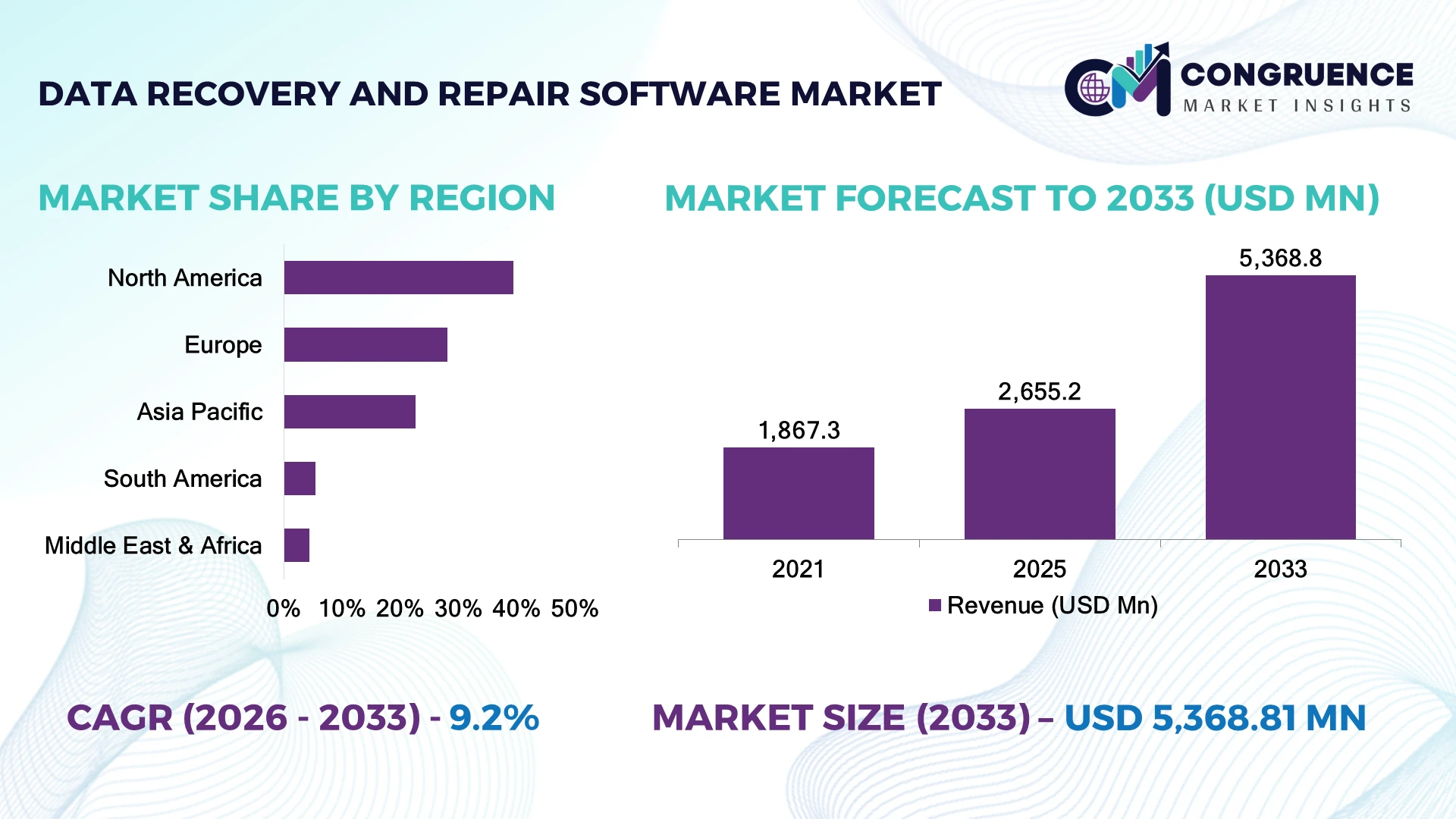
The Global Data Recovery and Repair Software Market was valued at USD 2,655.2 Million in 2025 and is anticipated to reach a value of USD 5,368.8 Million by 2033 expanding at a CAGR of 9.2% between 2026 and 2033. Growth is driven by rising ransomware incidents, expanding hybrid cloud deployments, AI-assisted recovery automation, and enterprise demand for rapid restoration of mission-critical data.
The United States leads the Data Recovery and Repair Software market with approximately 35% of global enterprise deployments, supported by strong cybersecurity investment, hyperscale cloud infrastructure, and a mature software ecosystem. Compared with Germany, the U.S. hosts over 2.8 times more enterprise disaster recovery deployments, while nearly 64% of large organizations integrate automated recovery tools into cyber resilience strategies. Increasing geopolitical cyber threats and stricter digital resilience regulations are accelerating investments in intelligent recovery platforms across financial services, healthcare, and government sectors.
Software providers combining AI-driven recovery, cloud-native architecture, and compliance-ready platforms are establishing durable competitive advantages in the evolving digital resilience landscape.
Market Size & Growth: USD 2,655.2 million in 2025 to USD 5,368.8 million by 2033 at 9.2% CAGR, driven by cyber resilience investments.
Top Growth Drivers: Ransomware recovery (+41%), hybrid cloud adoption (+36%), compliance automation (+28%).
Short-Term Forecast: By 2028, recovery time declines approximately 32% through AI-enabled automation.
Emerging Technologies: AI analytics, immutable backup validation, and cloud-native recovery platforms accelerate restoration.
Regional Leaders: North America, Europe, and Asia-Pacific lead enterprise deployment and cloud-based recovery adoption.
Consumer/End-User Trends: Around 67% of enterprises prioritize automated recovery over manual restoration workflows.
Pilot/Case Example: A 2026 financial services deployment reduced recovery time by approximately 45%.
Competitive Landscape: Leading vendors collectively account for nearly 46% of enterprise software deployments.
Regulatory & ESG Impact: Compliance automation lowers audit preparation effort by approximately 24%.
Investment & Funding: More than USD 2.4 billion supports cyber resilience, SaaS expansion, and AI integration.
Innovation & Future Outlook: Predictive recovery and autonomous repair engines redefine enterprise continuity strategies.
The Data Recovery and Repair Software market is rapidly evolving through AI-assisted diagnostics, cloud-native recovery orchestration, and immutable data protection technologies that strengthen operational resilience. Approximately 58% of enterprise recovery platforms now incorporate automated anomaly detection to accelerate restoration accuracy. Increasing cyber resilience mandates and expanding hybrid cloud environments are encouraging organizations to modernize recovery infrastructure, setting the foundation for the strategic market analysis that follows.
The Data Recovery and Repair Software market has become strategically important as organizations shift from reactive recovery toward continuous cyber resilience and operational continuity. Competitive differentiation increasingly depends on automated recovery speed, cloud interoperability, and regulatory readiness rather than standalone recovery capabilities. Expanding digital infrastructure, evolving cyber regulations, and enterprise-wide cloud migration are transforming software procurement priorities across regulated industries.
Modern AI-powered recovery platforms restore corrupted or encrypted datasets approximately 38% faster than traditional rule-based recovery tools while reducing manual intervention by nearly 30%. North America leads enterprise-scale deployment through mature cloud ecosystems, whereas Japan is advancing intelligent recovery solutions for industrial automation and critical infrastructure. During the next two to three years, approximately 61% of newly deployed enterprise recovery platforms are expected to integrate autonomous remediation, predictive diagnostics, and ransomware-specific recovery workflows.
Financial institutions, healthcare providers, and managed service providers are increasingly deploying unified recovery platforms that combine backup validation, forensic analysis, and disaster recovery automation. Software vendors are expanding strategic partnerships with cloud service providers and cybersecurity companies to deliver integrated resilience ecosystems. Organizations investing in AI-enabled recovery orchestration, zero-trust compatibility, and multi-cloud resilience will strengthen operational continuity, accelerate regulatory compliance, and secure long-term competitive positioning in an increasingly cyber-dependent business environment.
The rapid shift toward AI-assisted recovery orchestration is transforming enterprise data protection strategies as organizations prioritize resilience against ransomware, accidental deletion, and infrastructure failures. Approximately 63% of large enterprises now automate portions of recovery workflows, while AI-assisted diagnostics reduce recovery time by nearly 37% and improve successful data restoration rates by approximately 24%. The implementation of digital resilience regulations across the European Union is encouraging enterprises to modernize disaster recovery architectures. Software providers are responding through AI engine development, cloud platform partnerships, and expanded cyber recovery capabilities. A key strategic shift is the convergence of backup, recovery, and threat detection into unified resilience platforms that improve operational continuity while reducing infrastructure complexity.
Fragmented IT environments and incompatible legacy storage architectures continue restricting seamless deployment of modern data recovery and repair software. Approximately 46% of medium-sized enterprises still operate hybrid infrastructures with inconsistent recovery policies, while cross-platform integration increases deployment effort by nearly 21%. Japan's manufacturing sector continues facing interoperability challenges between operational technology systems and modern cloud-native recovery platforms. These limitations increase implementation costs, delay enterprise-wide deployment, and reduce operational scalability. Software vendors are mitigating these constraints through open API frameworks, hybrid deployment models, strategic cloud alliances, and standardized recovery orchestration that simplify integration across heterogeneous enterprise environments.
Autonomous recovery platforms integrating AI, predictive analytics, and policy-driven orchestration are opening new business opportunities beyond conventional backup restoration. Approximately 57% of enterprise security teams are evaluating autonomous remediation capabilities, while predictive failure analytics reduce storage-related incidents by nearly 19% and optimize infrastructure utilization by approximately 16%. Singapore continues strengthening digital infrastructure initiatives that encourage adoption of intelligent cyber resilience platforms across regulated industries. Software developers are expanding research partnerships, embedding machine learning into recovery engines, and integrating recovery workflows with cybersecurity ecosystems. An emerging opportunity lies in Recovery-as-a-Service platforms that combine subscription delivery with automated compliance validation and continuous resilience monitoring.
Managing consistent recovery policies across hybrid and multi-cloud environments has become a major execution challenge as enterprises distribute critical workloads across multiple infrastructure providers. Approximately 54% of organizations operate workloads across three or more cloud environments, while policy inconsistencies increase recovery validation effort by nearly 23%. The United States continues witnessing rising enterprise demand for standardized resilience frameworks as cloud ecosystems become increasingly fragmented. Vendors must address workload portability, automated policy enforcement, and cross-cloud orchestration without affecting recovery speed or security. Sustained investment in interoperability, intelligent automation, cloud-native architecture, and ecosystem partnerships will determine long-term competitiveness as enterprise infrastructures continue evolving.
AI Restores Data Faster: Approximately 61% of newly deployed enterprise recovery platforms now incorporate AI-assisted diagnostics, reducing recovery time by nearly 34% while improving recovery accuracy by approximately 22%. Growing cyber insurance requirements are encouraging organizations to automate restoration workflows, prompting vendors to expand intelligent recovery capabilities through strategic technology partnerships.
Immutable Storage Expands Rapidly: Around 49% of enterprise backup environments now integrate immutable storage architectures, lowering ransomware-related data compromise by approximately 28%. Enterprises are restructuring data protection policies to satisfy stricter digital resilience mandates, while software providers strengthen integration with cloud object storage and zero-trust security frameworks.
Cloud-Native Recovery Accelerates: Approximately 58% of new deployments prioritize cloud-native recovery orchestration, improving workload mobility by nearly 20% while reducing infrastructure management effort by approximately 17%. Organizations increasingly consolidate fragmented recovery tools into unified SaaS platforms, encouraging vendors to expand multi-cloud interoperability and managed recovery services.
Cyber Recovery Gains Priority: Nearly 44% of enterprise recovery implementations now integrate forensic validation before restoration, reducing reinfection risk by approximately 25%. Shortages of experienced cybersecurity professionals are driving demand for automated recovery workflows, leading vendors to embed threat intelligence, recovery verification, and continuous resilience testing into enterprise software platforms.
Cloud-based data recovery and repair software accounts for approximately 54% of the market due to its scalability, centralized management, rapid deployment, and seamless integration with hybrid IT environments. Enterprises increasingly favor cloud-native platforms because they simplify disaster recovery, enable remote administration, and reduce infrastructure maintenance costs. On-premises solutions remain strategically important for highly regulated sectors requiring complete data sovereignty, while hybrid deployment models continue gaining traction among organizations balancing compliance with operational flexibility.
Hybrid recovery software represents the fastest-growing type as enterprises modernize legacy environments without disrupting critical workloads. Approximately 48% of large organizations now operate hybrid recovery architectures, while cloud-integrated recovery workflows improve operational efficiency by nearly 26% and reduce recovery orchestration effort by approximately 19%. Software vendors are expanding SaaS offerings, strengthening hyperscale cloud partnerships, and embedding AI-driven automation into hybrid platforms. Investment priorities increasingly favor flexible deployment models that deliver resilience, regulatory compliance, and workload portability across distributed enterprise infrastructures.
A 2026 enterprise resilience assessment published by the Uptime Institute found that hybrid recovery architectures are becoming the preferred deployment strategy as organizations seek greater operational flexibility while maintaining compliance across multi-environment infrastructures.
Enterprise backup recovery accounts for approximately 43% of application demand as organizations prioritize business continuity, ransomware resilience, and uninterrupted access to mission-critical information. Large enterprises increasingly integrate recovery software with backup orchestration, cyber resilience platforms, and cloud infrastructure to minimize operational disruption. File repair remains a core application for day-to-day business operations, while database recovery continues supporting transaction-intensive industries requiring high data integrity and rapid restoration capabilities.
Ransomware recovery is the fastest-growing application as organizations strengthen cyber resilience strategies and automate post-attack restoration. Approximately 61% of enterprise security teams now integrate dedicated ransomware recovery capabilities, while automated restoration workflows reduce system recovery time by nearly 34% and lower manual intervention by approximately 22%. Vendors are expanding AI-assisted recovery, immutable storage integration, and cyber recovery orchestration to strengthen business continuity. Demand is increasingly shifting toward unified platforms that combine detection, validation, and rapid recovery within a single operational workflow.
According to a 2025 enterprise cyber resilience survey conducted by ISACA, organizations increasingly prioritize integrated ransomware recovery capabilities as a core requirement for business continuity and digital risk management.
Large enterprises account for approximately 58% of Data Recovery and Repair Software adoption due to complex IT ecosystems, multi-cloud operations, and stringent business continuity requirements. These organizations deploy enterprise-wide recovery platforms to protect high-value digital assets while ensuring regulatory compliance and operational resilience. Small and medium-sized enterprises remain significant adopters through cloud-delivered recovery services, although deployment priorities are typically centered on affordability, simplified administration, and managed security integration.
Managed service providers represent the fastest-growing end-user group as organizations increasingly outsource recovery operations to address cybersecurity skill shortages and operational complexity. Approximately 46% of mid-sized organizations now utilize managed recovery services, while automated service delivery reduces incident response time by nearly 29% and improves recovery consistency by approximately 18%. Software vendors are expanding channel partnerships, subscription-based pricing, and integrated cybersecurity ecosystems to strengthen customer retention and recurring service opportunities.
A 2026 enterprise technology assessment by the Enterprise Strategy Group reported that organizations increasingly rely on managed recovery partners to improve cyber resilience, accelerate recovery operations, and reduce internal administrative complexity.
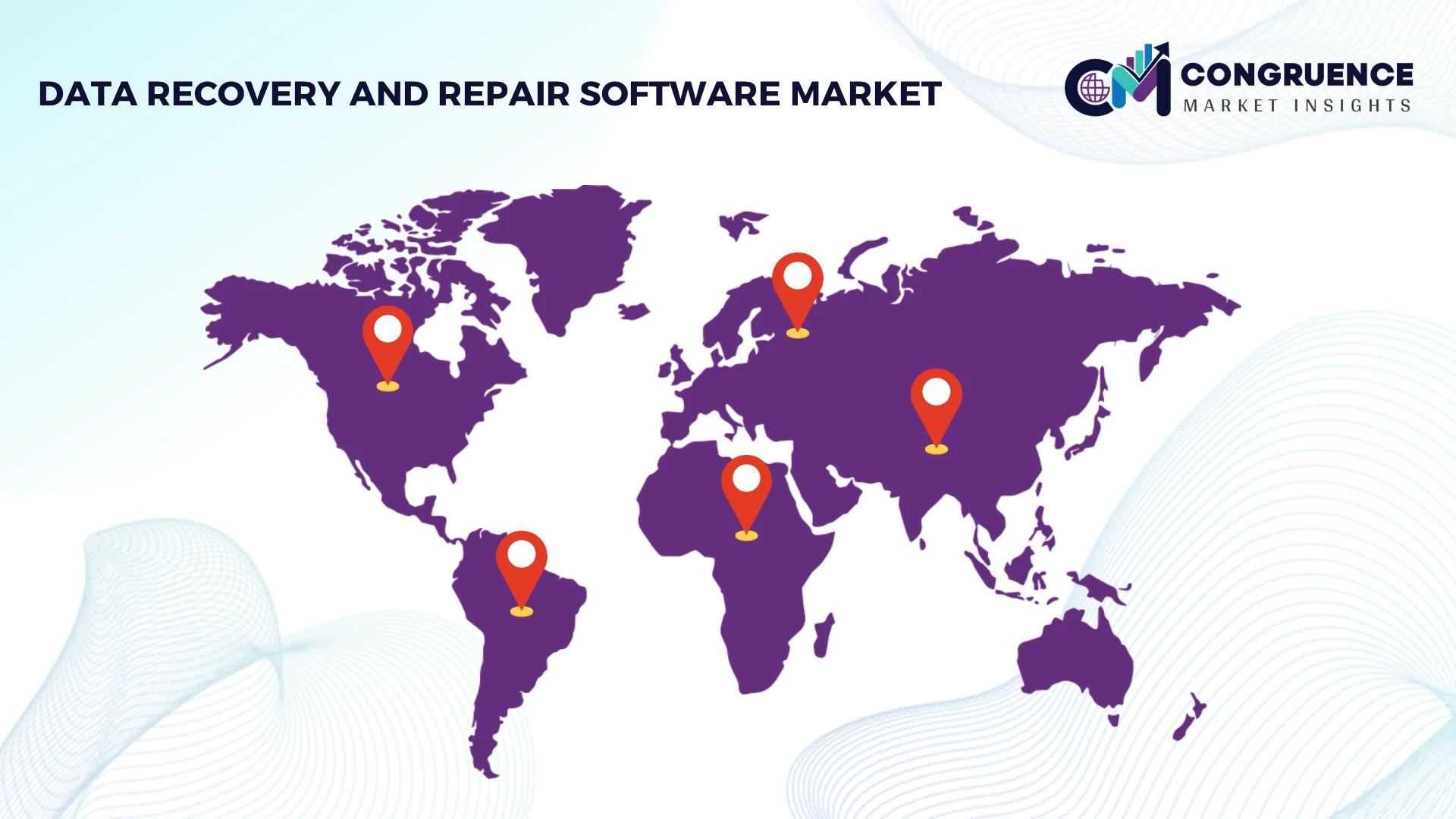
North America accounted for the largest market share at 39.4% in 2025 however, Asia-Pacific is expected to register the fastest growth, expanding at a CAGR of 10.5% between 2026 and 2033.
AI-Driven Cyber Resilience Reshapes Enterprise Recovery
North America contributes approximately 39.4% of the Data Recovery and Repair Software market, supported by mature cloud infrastructure, high cybersecurity spending, and widespread enterprise adoption of automated recovery platforms. Organizations increasingly integrate recovery software with zero-trust security frameworks, ransomware response systems, and multi-cloud backup environments to strengthen operational resilience. Approximately 66% of enterprise recovery deployments now utilize AI-assisted automation for recovery orchestration and data validation. Software vendors are expanding managed recovery services, strengthening cloud partnerships, and embedding predictive analytics into recovery platforms to reduce downtime and improve business continuity. Digital resilience regulations and growing cyber threats continue driving modernization of enterprise recovery infrastructure across critical industries.
United States Market Outlook: The United States dominates the regional market through its advanced cloud ecosystem, concentration of cybersecurity software providers, and large enterprise IT infrastructure. Financial institutions, healthcare organizations, and government agencies continue expanding automated recovery capabilities to strengthen operational resilience. Approximately 71% of Fortune 1000 organizations now deploy cloud-integrated recovery platforms supporting automated disaster recovery and ransomware response, reinforcing the country's leadership in enterprise resilience technologies.
Regulatory Compliance Accelerates Platform Modernization
Europe represents approximately 28.1% of the global Data Recovery and Repair Software market as enterprises modernize recovery infrastructure to satisfy increasingly stringent digital resilience and data governance requirements. Organizations are replacing fragmented recovery tools with integrated platforms capable of supporting hybrid environments and automated compliance workflows. Nearly 52% of enterprise recovery upgrades now include immutable storage integration and centralized policy management. Software vendors continue strengthening partnerships with cloud service providers while expanding regional support capabilities to address evolving operational and regulatory requirements.
Germany Market Outlook: Germany leads the European market through its strong industrial digitalization strategy, advanced enterprise software adoption, and highly regulated manufacturing sector. Industrial organizations continue investing in automated recovery platforms that protect operational technology and enterprise applications. Approximately 49% of large manufacturing enterprises have integrated centralized recovery orchestration with cyber resilience frameworks, improving operational continuity and reducing recovery complexity across mission-critical production systems.
Cloud Expansion Fuels Enterprise Deployment
Asia-Pacific accounts for approximately 22.6% of the market, driven by accelerating cloud adoption, digital transformation programs, and expanding enterprise data infrastructure. Organizations are increasingly implementing cloud-native recovery platforms to support distributed workforces, digital banking, manufacturing automation, and government modernization initiatives. Approximately 57% of newly deployed enterprise workloads now incorporate integrated recovery capabilities within hybrid cloud environments. Software providers are expanding regional data infrastructure partnerships and localized service delivery to support rising enterprise resilience requirements.
China Market Outlook: China remains the region's largest market through rapid enterprise digitalization, expanding cloud infrastructure, and strong investment in cybersecurity technologies. Domestic organizations continue modernizing recovery capabilities to support large-scale digital operations across finance, manufacturing, and public services. Approximately 54% of newly deployed enterprise recovery platforms are integrated with cloud-native infrastructure, strengthening business continuity across increasingly complex digital ecosystems.
Digital Banking Expands Recovery Investments
South America is steadily strengthening demand for Data Recovery and Repair Software through rapid digital banking expansion, cloud adoption, and modernization of enterprise IT infrastructure. Organizations increasingly prioritize automated recovery capabilities to protect critical business operations while addressing growing cyber risks. Approximately 38% of medium and large enterprises have modernized recovery infrastructure with cloud-integrated platforms. Software vendors are expanding regional channel partnerships, managed services, and localized support capabilities to improve implementation efficiency despite uneven digital infrastructure across several markets.
Brazil Market Outlook: Brazil leads the regional market through its large financial services sector, expanding cloud adoption, and increasing cybersecurity investment. Enterprises continue replacing legacy backup environments with integrated recovery platforms capable of supporting hybrid operations. Approximately 47% of enterprise recovery modernization projects within South America are concentrated in Brazil, reflecting the country's leadership in digital transformation and operational resilience initiatives.
Critical Infrastructure Modernization Drives Adoption
The Middle East & Africa market is advancing through digital government initiatives, financial sector modernization, and investment in national cybersecurity capabilities. Organizations are deploying integrated recovery platforms to strengthen operational continuity across public services, healthcare, energy, and telecommunications. Approximately 35% of newly implemented cyber resilience programs now include automated recovery orchestration and centralized disaster recovery management. Software vendors are expanding regional partnerships, cloud infrastructure integration, and managed resilience services to support evolving enterprise requirements.
Saudi Arabia Market Outlook: Saudi Arabia leads regional market development through extensive digital transformation initiatives, cloud infrastructure investment, and modernization of government and enterprise IT systems. Organizations continue implementing intelligent recovery platforms aligned with national cybersecurity priorities to improve operational resilience. Approximately 42% of large enterprise digital resilience programs now incorporate AI-assisted recovery automation, reinforcing the country's position as a regional leader in advanced cyber recovery deployment.
Veeam, Commvault, Rubrik, Cohesity, and Acronis compete aggressively for enterprise cyber resilience contracts, while cloud-native recovery providers challenge traditional backup vendors through AI-driven automation and SaaS-first delivery. The top five vendors collectively control approximately 48% of the global market. Competition focuses on recovery speed, ransomware resilience, cloud interoperability, and automation rather than licensing alone. AI-assisted recovery reduces restoration time by nearly 35%, immutable backup architectures lower ransomware exposure by approximately 27%, and automated policy orchestration improves operational efficiency by around 22%. Vendors are expanding hyperscale cloud partnerships, embedding threat intelligence into recovery workflows, and strengthening unified cyber resilience platforms through acquisitions and ecosystem integration. The competitive landscape is shifting from conventional backup software toward intelligent recovery ecosystems combining security, compliance, and automation. Enterprise integration complexity, regulatory certification, and multi-cloud compatibility remain key entry barriers. Winning requires autonomous recovery capabilities, validated cyber resilience, seamless cloud integration, and continuous platform innovation.
Veeam Software
Commvault Systems
Rubrik Inc.
Cohesity
Acronis International GmbH
EaseUS
Stellar Data Recovery
Ontrack
Disk Drill (CleverFiles)
R-Studio (R-Tools Technology)
Wondershare Recoverit
Zerto
NAKIVO
Arcserve
AI-powered recovery orchestration, immutable backup architecture, cloud-native recovery, and continuous data protection define the current technology landscape. Approximately 64% of enterprise recovery platforms now incorporate AI-assisted diagnostics, improving recovery accuracy by nearly 28% while reducing restoration time by approximately 34%. Immutable storage adoption continues expanding across regulated industries because it strengthens ransomware resilience and minimizes operational disruption. Organizations deploying integrated recovery platforms achieve stronger cyber resilience through unified backup, detection, and restoration workflows.
Emerging technologies include autonomous recovery engines, predictive failure analytics, zero-trust integration, and recovery validation using machine learning. Compared with traditional rule-based recovery platforms, AI-driven recovery systems improve incident response efficiency by approximately 39% while lowering manual administrative effort by nearly 31%. Vendors offering unified cyber resilience platforms combining backup, compliance, security analytics, and cloud orchestration gain stronger competitive positioning than providers focused solely on data restoration because enterprises increasingly prioritize integrated resilience ecosystems.
Between 2026 and 2028, autonomous cyber recovery, AI-powered workload prioritization, and multi-cloud recovery orchestration will become standard enterprise capabilities. More than 69% of newly deployed enterprise recovery solutions are expected to include automated ransomware validation, intelligent policy enforcement, and cloud-native resilience features. Organizations investing early in predictive recovery, AI-assisted compliance, zero-trust integration, and cross-cloud interoperability will strengthen operational continuity, reduce recovery complexity, and secure long-term competitive advantage as digital resilience becomes a board-level priority.
February 2025 Veeam announced a strategic investment from Microsoft to accelerate AI-enabled data resilience, expanding joint product development and cloud integration. The company protects more than 550,000 customers globally, strengthening enterprise cyber recovery capabilities. Source: Reuters
October 2025 Veeam agreed to acquire Securiti AI for approximately USD 1.73 billion, integrating AI-driven data security with backup and recovery platforms to strengthen cloud data protection and enterprise cyber resilience. Source: Reuters
May 2026 Veeam launched the DataAI™ Command Platform, combining data resilience, AI trust, and security into a unified enterprise platform supporting operations in 150+ countries, expanding intelligent recovery and governance capabilities. Source: Veeam
June 2026 Rubrik introduced Autonomous Business Recovery for cloud applications, enabling agentic recovery with dependency mapping and automated restoration of minimum viable business environments, significantly accelerating enterprise cyber recovery workflows. Source: Rubrik
This report provides a comprehensive assessment of the Data Recovery and Repair Software market across deployment types, enterprise applications, end-user industries, and major regional markets. It evaluates cloud-based, on-premises, and hybrid recovery platforms supporting enterprise backup, ransomware recovery, database restoration, file repair, and disaster recovery. The study also examines AI-assisted recovery, immutable storage, autonomous remediation, predictive analytics, zero-trust integration, and multi-cloud orchestration technologies transforming enterprise resilience strategies.
The report delivers strategic insights into competitive positioning, deployment trends, technology adoption, procurement priorities, and regional digital infrastructure developments between 2026 and 2033. Approximately 60% of enterprise recovery modernization initiatives now emphasize cloud-native automation and integrated cyber resilience capabilities, reflecting evolving operational requirements. The analysis supports investment planning, product development, expansion strategy, partnership evaluation, and competitive benchmarking by identifying high-value deployment models, emerging enterprise use cases, evolving compliance priorities, and long-term opportunities across the global Data Recovery and Repair Software market.
| Report Attribute/Metric | Report Details |
|---|---|
|
Market Revenue in 2025 |
USD 2,655.2 Million |
|
Market Revenue in 2033 |
USD 5,368.8 Million |
|
CAGR (2026 - 2033) |
9.2% |
|
Base Year |
2025 |
|
Forecast Period |
2026 - 2033 |
|
Historic Period |
2021 - 2025 |
|
Segments Covered |
By Type
By Application
By End-User
|
|
Key Report Deliverable |
Revenue Forecast, Growth Trends, Market Dynamics, Segmental Overview, Regional and Country-wise Analysis, Competition Landscape |
|
Region Covered |
North America, Europe, Asia-Pacific, South America, Middle East, Africa |
|
Key Players Analyzed |
Veeam Software, Commvault Systems, Rubrik Inc., Cohesity, Acronis International GmbH, EaseUS, Stellar Data Recovery, Ontrack, Disk Drill (CleverFiles), R-Studio (R-Tools Technology), Wondershare Recoverit, Zerto, NAKIVO, Arcserve |
|
Customization & Pricing |
Available on Request (10% Customization is Free) |




