
Reports
The Global Data Quality Management Market was valued at USD 2800 Million in 2025 and is anticipated to reach a value of USD 6045.83 Million by 2033 expanding at a CAGR of 10.1% between 2026 and 2033. Growth is being accelerated by enterprise-wide AI deployment, stricter data governance mandates, cloud migration programs, and the need to improve analytics accuracy across financial services, healthcare, retail, and manufacturing operations.
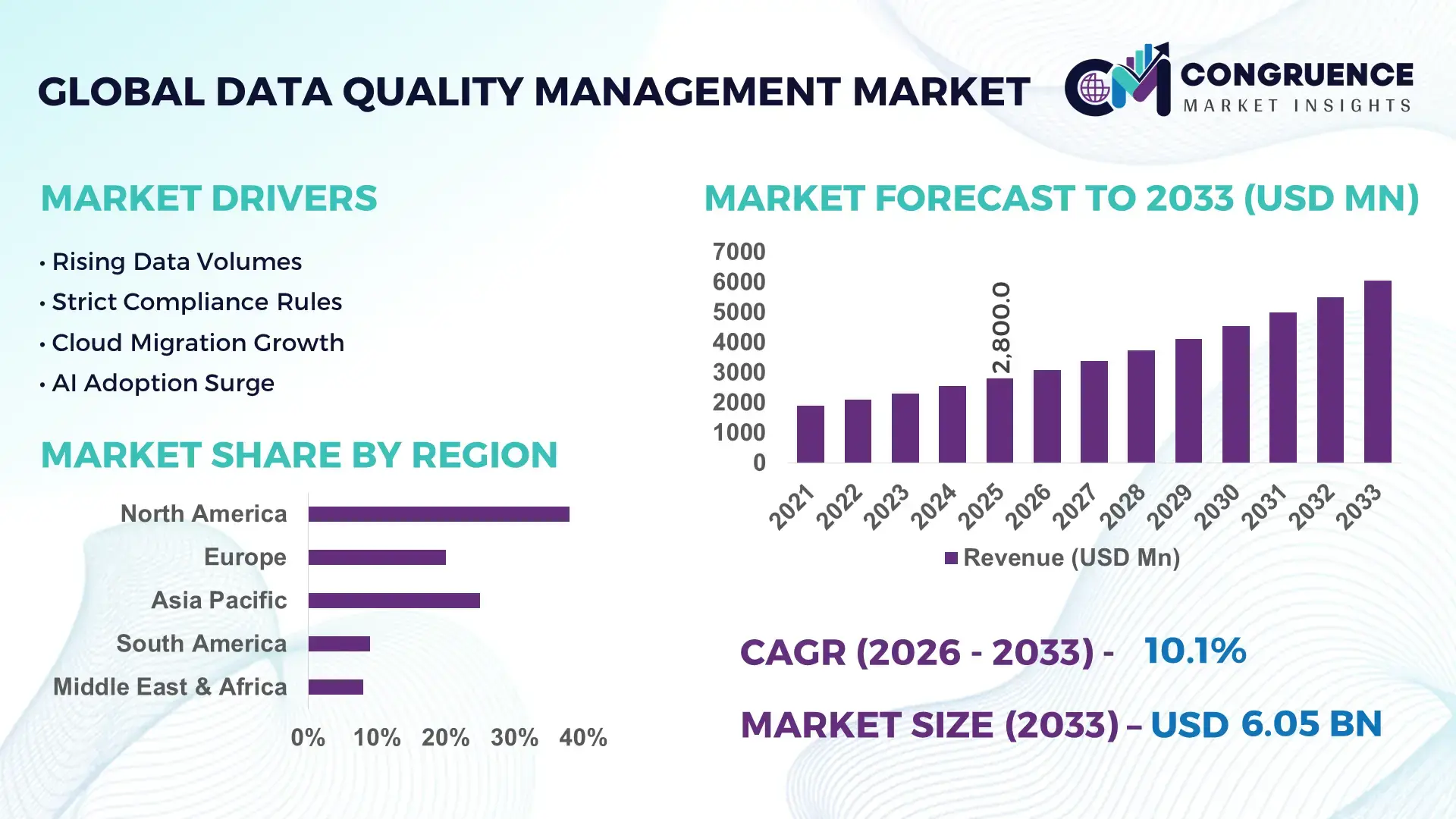
The United States remains the dominant market, accounting for approximately 38% of global deployment activity, supported by large-scale investments in AI governance, cloud data platforms, and regulatory compliance initiatives across banking and healthcare sectors. China follows with nearly 18% share, driven by industrial digitalization and smart manufacturing programs. U.S. enterprises report data accuracy rates exceeding 92% in advanced implementations, compared with approximately 85% across emerging Asia-Pacific deployments. Ongoing global data sovereignty requirements and evolving AI governance frameworks continue to accelerate adoption of advanced data quality management solutions.
Organizations prioritizing scalable data quality architectures and automated governance capabilities are strengthening decision intelligence, compliance readiness, and operational efficiency across increasingly complex digital ecosystems.
Market Size & Growth: USD 2800 Million in 2025, reaching USD 6045.83 Million by 2033 at 10.1% CAGR, driven by enterprise AI governance and cloud-based data modernization initiatives.
Top Growth Drivers: AI adoption (+34%), cloud migration (+31%), and regulatory compliance spending (+27%) remain the three strongest market accelerators.
Short-Term Forecast: By 2028, automated data quality workflows are expected to reduce manual validation costs by 25% and improve reporting efficiency by 30%.
Emerging Technologies: AI-powered data observability, machine learning anomaly detection, and real-time metadata management improve data accuracy by 20–35%.
Regional Leaders: North America exceeds USD 2.3 Billion, Europe approaches USD 1.7 Billion, and Asia-Pacific surpasses USD 1.5 Billion, supported by cloud-first adoption strategies.
Consumer/End-User Trends: More than 68% of large enterprises integrate data quality tools directly into analytics and business intelligence environments.
Pilot/Case Example: In 2026, a multinational banking transformation program improved customer data accuracy by 32% and reduced duplicate records by 45%.
Competitive Landscape: Leading vendors collectively control nearly 42% market share, with competition centered on AI-enabled governance and automation capabilities.
Regulatory & ESG Impact: Enhanced governance frameworks improve compliance audit efficiency by 28% while strengthening enterprise data transparency initiatives.
Investment & Funding: Global investment activity exceeds USD 1.2 Billion, with partnerships, platform expansion, and AI integration leading funding priorities.
Innovation & Future Outlook: Next-generation autonomous data quality engines deliver 40% faster issue resolution, supporting global digital transformation and regional data sovereignty strategies.
Data Quality Management Market demand is expanding across financial services, healthcare, retail, telecommunications, and public-sector digital transformation programs where trusted data directly impacts operational performance. AI-enabled data monitoring platforms now automate up to 35% of quality remediation tasks, while real-time data observability is becoming a standard enterprise requirement. Increasing regulatory scrutiny of data governance and cross-border data management is accelerating adoption of intelligent quality frameworks, setting the foundation for deeper strategic evaluation of competitive and investment opportunities.
Data quality management has become a strategic enterprise capability as organizations increasingly rely on AI, automation, and real-time analytics for operational and investment decisions. Competitive differentiation now depends on trusted data assets rather than data volume alone. Regulatory expansion around data governance, AI accountability, and cross-border data handling is accelerating deployment across financial services, healthcare, telecommunications, and manufacturing. More than 70% of large enterprises are integrating data quality controls directly into digital transformation programs to improve decision accuracy and reduce operational risk.
Technology modernization is reshaping deployment economics. AI-driven data quality platforms reduce manual data validation workloads by approximately 35% compared with legacy rule-based systems while improving issue detection speed by over 40%. The United States leads large-scale enterprise deployment, whereas Germany is emphasizing industrial data governance for smart manufacturing environments. Japan continues investing in automated master data management to support connected supply chains. Over the next two to three years, enterprise adoption of automated data observability solutions is expected to exceed 60% among large organizations.
A practical example is the integration of data quality engines within cloud analytics environments, enabling continuous monitoring of customer, supplier, and operational datasets. Companies are increasing investments in AI-enabled governance platforms, strategic partnerships, and industry-specific solutions. Organizations that establish scalable data trust frameworks today will strengthen operational resilience, improve regulatory readiness, and secure a measurable competitive advantage.
The rapid expansion of AI-powered decision-making is increasing demand for advanced data quality management capabilities. Approximately 68% of large enterprises now prioritize data quality programs within digital transformation strategies, while organizations implementing automated quality controls report up to 30% improvement in analytics accuracy. In the United States, stricter governance requirements for AI applications and sensitive data management are accelerating enterprise investments. The cause-and-effect relationship is clear: higher dependence on AI systems increases the cost of inaccurate data, driving organizations toward automated validation, monitoring, and remediation solutions. Companies are responding through platform expansion, cloud-native innovation, and strategic partnerships with analytics providers. A notable operational insight is that organizations increasingly view data quality as a business-performance investment rather than a compliance expense.
A major constraint remains the complexity of integrating data quality platforms across fragmented enterprise architectures. Large organizations often manage data across more than 20 operational systems, creating interoperability challenges and increasing implementation costs. Nearly 45% of enterprises report difficulties standardizing data definitions across departments, while poor legacy system compatibility can extend deployment timelines by over 25%. In the United Kingdom and Germany, stringent governance requirements further increase operational complexity during system modernization projects. These limitations directly affect scalability, project budgets, and return on technology investments. Companies are mitigating exposure through phased deployment models, localized data governance frameworks, and long-term technology partnerships. A key strategic insight is that integration readiness increasingly determines project success more than software functionality itself.
Emerging opportunities are centered on AI-driven data observability, autonomous remediation, and sector-specific governance solutions. Organizations deploying real-time monitoring capabilities have reported up to 40% faster identification of critical data issues, while automated correction workflows can reduce remediation effort by nearly 30%. India and Singapore are becoming important deployment hubs as enterprises modernize digital infrastructure and expand cloud-based operations. New governance requirements for AI transparency are encouraging demand for continuous data validation technologies. Companies are positioning through R&D investments, ecosystem partnerships, and industry-focused platforms tailored for banking, healthcare, and manufacturing environments. A less obvious opportunity lies in supplier and partner data quality management, where improved accuracy enhances procurement efficiency and strengthens broader digital supply-chain performance.
As enterprises expand cloud adoption and AI deployments, maintaining consistent data quality across distributed environments becomes increasingly difficult. More than 50% of organizations report challenges managing data quality across multi-cloud ecosystems, while cybersecurity-related data integrity concerns have increased by approximately 20% in complex enterprise environments. In Japan and the United States, growing volumes of machine-generated and real-time operational data are placing pressure on governance frameworks and workforce capabilities. The challenge extends beyond technology to maintaining long-term operational consistency at scale. Companies must invest in automated governance architectures, specialized talent, and advanced monitoring capabilities. A critical strategic insight is that sustainable competitive advantage increasingly depends on scaling trusted data management faster than the growth of enterprise data complexity.
• AI-Driven Data Observability Expansion Enterprises are shifting from periodic data audits to continuous monitoring environments. More than 60% of large organizations now deploy automated observability tools, while anomaly detection accuracy has improved by nearly 35% compared with traditional monitoring methods. Growing AI adoption and stricter governance requirements are accelerating deployment. Companies are integrating observability directly into cloud data pipelines, reducing issue resolution times by approximately 40% and improving operational reliability across analytics-driven workflows.
• Cloud-Native Governance Acceleration Cloud-based data quality architectures are replacing fragmented on-premise environments as organizations modernize infrastructure. Nearly 70% of new deployments are cloud-oriented, and automated governance workflows have reduced manual intervention requirements by about 30%. In the United States, enterprise cloud consolidation initiatives are driving platform standardization. Vendors are responding through strategic partnerships, embedded governance modules, and scalable deployment models that improve implementation speed while lowering operational complexity.
• Master Data Consolidation Initiatives Organizations are increasingly prioritizing enterprise-wide master data consistency to support AI, customer analytics, and supply-chain visibility. Data duplication rates have fallen by nearly 25% among companies implementing centralized quality frameworks, while cross-functional data sharing efficiency has improved by over 20%. German manufacturers and Japanese industrial firms are expanding master data programs to improve operational synchronization. Solution providers are enhancing integration capabilities and industry-specific templates to accelerate deployment outcomes.
• Compliance-Centric Automation Strategies Regulatory scrutiny around data accuracy, privacy, and AI governance is reshaping investment priorities. More than 55% of enterprises have expanded automated compliance monitoring capabilities, reducing reporting preparation efforts by approximately 28%. A notable shift is the convergence of quality management and regulatory controls within a single governance framework. Companies are restructuring data operations, deploying policy-based automation, and strengthening ecosystem partnerships to improve audit readiness and reduce compliance-related operational burdens.
Data Monitoring represents the leading segment due to its ability to provide continuous visibility into data accuracy, integrity, and operational performance across complex enterprise ecosystems. Organizations increasingly require real-time issue detection as cloud adoption and AI deployment expand. More than 58% of large enterprises now prioritize continuous monitoring capabilities within data quality programs. Its scalability, automation potential, and integration with analytics platforms make it a critical operational layer. Data Cleansing remains a mature and essential segment, particularly in financial services and healthcare where data accuracy directly impacts compliance and decision-making. Data Matching continues supporting customer identity resolution and enterprise master data initiatives.
Data Enrichment is emerging as the fastest-growing type as organizations seek contextual intelligence to improve analytics, personalization, and operational planning. Adoption has increased by approximately 30% among customer-focused industries integrating external and internal datasets. Data Profiling is gaining relevance during cloud migration projects, helping organizations identify structural inconsistencies before large-scale modernization. Vendors are expanding AI-enabled enrichment tools, strengthening ecosystem partnerships, and introducing automation capabilities. Investment priorities are gradually shifting from corrective quality processes toward predictive and real-time quality management frameworks that support faster business decisions.
Data Governance remains the dominant application because organizations increasingly require centralized control over data quality, ownership, lineage, and policy enforcement. Approximately 62% of enterprise deployments are linked directly to governance initiatives supporting digital transformation and regulatory compliance objectives. The application benefits from broad integration across analytics, cloud infrastructure, and operational systems. Compliance Management continues to maintain strong demand as enterprises address evolving governance frameworks and audit requirements. Business Intelligence applications rely heavily on high-quality data inputs, making quality management a foundational component of reporting and advanced analytics environments.
Customer Data Management is emerging as the fastest-growing application as enterprises seek unified customer views across digital channels. Organizations implementing integrated customer data strategies have reported up to 28% improvement in customer record accuracy and more efficient personalization capabilities. Risk Management adoption is also expanding within banking and insurance institutions where data quality directly influences decision models and regulatory reporting. Companies are increasing automation investments, integrating governance tools with analytics platforms, and expanding deployment across business units to improve operational consistency and decision confidence.
BFSI represents the largest end-user segment due to extensive regulatory obligations, transaction-intensive operations, and dependence on accurate customer and risk data. More than 30% of enterprise data quality spending is concentrated within banking, financial services, and insurance institutions. Data quality platforms support fraud detection, compliance reporting, customer onboarding, and risk assessment activities. Healthcare remains a major adopter as organizations manage expanding clinical, operational, and patient datasets. IT and Telecom companies continue investing heavily in automated quality controls to support cloud services, network operations, and customer experience management requirements.
Healthcare is the fastest-growing end-user segment as digital health initiatives, electronic records expansion, and AI-assisted diagnostics increase data governance requirements. Adoption of automated quality frameworks within healthcare organizations has increased by approximately 27% over recent years. Retail companies are strengthening customer data quality capabilities to support personalization and omnichannel strategies, while manufacturing firms focus on operational and supply-chain data consistency. Government agencies continue modernizing digital services through centralized governance platforms. Vendors are responding through sector-specific solutions, strategic partnerships, and flexible deployment models tailored to industry requirements.
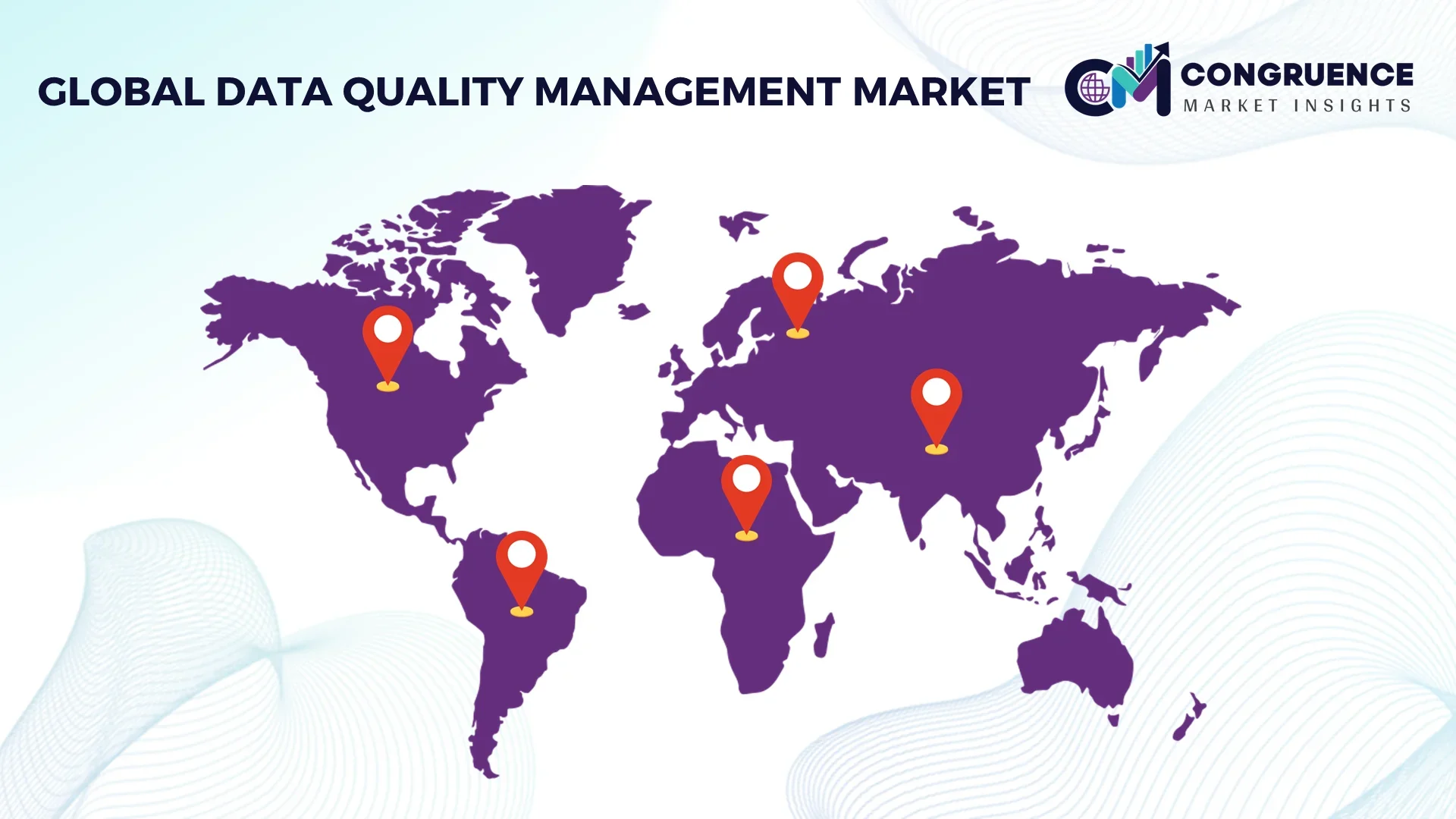
North America accounted for the largest market share at 38% in 2025 however, Asia-Pacific is expected to register the fastest growth, expanding at a CAGR of 12.4% between 2026 and 2033.
Enterprise AI Governance Driving Deployment Scale
North America maintains leadership through high enterprise digitalization, advanced cloud infrastructure, and extensive AI adoption programs. The region accounts for approximately 38% of global deployment activity, supported by strong demand from BFSI, healthcare, and telecommunications organizations. Large enterprises increasingly embed data quality controls into analytics, governance, and automation workflows to improve decision accuracy and compliance performance. More than 65% of major enterprise modernization initiatives now include dedicated data quality management capabilities. Strategic partnerships between cloud providers, analytics vendors, and governance platform developers continue accelerating implementation speed while strengthening operational visibility across complex data ecosystems.
United States Market Outlook: The United States remains the primary growth engine due to its concentration of large enterprises, advanced cloud adoption, and expanding AI governance requirements. Financial institutions, healthcare networks, and technology firms are investing heavily in automated monitoring and data observability platforms. More than 70% of large organizations have formal data governance programs supporting operational analytics and AI deployment. Enterprise demand is increasingly focused on real-time quality management, automated remediation, and scalable governance architectures capable of supporting multi-cloud environments.
Regulatory Modernization Reshaping Data Operations
Europe represents a mature and governance-driven market characterized by stringent data protection requirements and increasing investment in enterprise modernization. The region accounts for roughly 28% of global deployment activity, with strong adoption across manufacturing, financial services, and public-sector institutions. Organizations are prioritizing data lineage, compliance automation, and master data governance to support operational resilience. Nearly 60% of large enterprises have expanded governance investments as regulatory scrutiny around data transparency intensifies. Technology providers are enhancing localization capabilities and industry-specific governance frameworks to align with evolving operational requirements.
Germany Market Outlook: Germany serves as the region’s most strategically significant market due to its industrial scale, manufacturing leadership, and Industry 4.0 initiatives. Enterprises increasingly integrate data quality solutions into industrial analytics, supply-chain visibility, and smart factory environments. More than half of large manufacturing organizations have expanded data governance investments to improve operational synchronization and predictive maintenance accuracy. The country's emphasis on industrial digitization continues creating demand for scalable, automated quality management platforms.
Digital Infrastructure Expansion Accelerating Adoption
Asia-Pacific is emerging as the fastest-expanding market due to large-scale cloud adoption, enterprise digital transformation, and growing investments in AI-enabled business processes. The region accounts for nearly 24% of global deployment activity and continues strengthening its position through infrastructure modernization programs. Organizations are deploying automated governance and monitoring solutions to manage rapidly expanding data volumes. Cloud-based quality management adoption has increased by more than 30% among large enterprises. Technology vendors are expanding regional partnerships, local delivery capabilities, and industry-focused offerings to address rising demand from banking, manufacturing, and telecommunications sectors.
China Market Outlook: China leads regional deployment activity through extensive digital infrastructure investments, industrial modernization programs, and large-scale enterprise transformation initiatives. Manufacturing, e-commerce, and financial services organizations increasingly rely on advanced data governance frameworks to support automation and analytics. Enterprise cloud adoption rates continue rising across key industries, while AI integration programs are increasing demand for continuous data monitoring and quality assurance capabilities. The country's scale advantage provides strong momentum for long-term platform deployment.
Enterprise Modernization Supporting Market Expansion
South America is experiencing steady adoption as organizations modernize legacy systems and improve governance capabilities across critical industries. The region contributes approximately 5% of global market activity, with demand concentrated in financial services, retail, and telecommunications sectors. Enterprises are prioritizing cloud-based deployment models to improve scalability and reduce infrastructure complexity. Data governance investments have increased noticeably among large organizations seeking greater operational transparency. While infrastructure disparities and integration challenges remain, strategic partnerships and managed-service approaches are helping accelerate implementation across key markets.
Brazil Market Outlook: Brazil represents the region’s largest and most influential market due to its sizable enterprise sector and accelerating digital transformation initiatives. Banking, retail, and telecommunications organizations are expanding investments in governance automation and customer data management capabilities. More than 50% of large enterprises are pursuing cloud modernization strategies that require stronger data quality controls. Local organizations increasingly focus on operational efficiency, compliance readiness, and analytics performance as core deployment priorities.
Digital Transformation Investments Strengthening Adoption
The Middle East & Africa market is benefiting from expanding digital government programs, cloud infrastructure investments, and enterprise modernization strategies. The region accounts for approximately 5% of global deployment activity, with adoption concentrated in financial services, public administration, and telecommunications sectors. Organizations are implementing governance frameworks to improve data transparency and support digital service delivery. Several national transformation programs have accelerated demand for enterprise data management capabilities. Vendors are strengthening local partnerships and regional delivery networks to support growing implementation requirements and improve deployment effectiveness.
United Arab Emirates Market Outlook: The United Arab Emirates is the leading regional market due to its advanced digital infrastructure, smart government initiatives, and technology-focused economic diversification strategy. Financial institutions, government agencies, and large enterprises are deploying advanced governance and monitoring platforms to improve operational visibility and regulatory alignment. More than 60% of major digital transformation projects incorporate data governance components. Continued investments in cloud ecosystems and AI-enabled services are reinforcing demand for scalable data quality management solutions.
The Data Quality Management market is led by IBM, SAP, Informatica, Oracle, and SAS Institute, which collectively control approximately 48% of global market activity. Competition is primarily between global platform providers and specialized data governance innovators focused on automation and AI-enabled quality management. Technology leadership remains the key differentiator, with automated monitoring reducing manual remediation efforts by nearly 30% and AI-powered anomaly detection improving issue identification accuracy by more than 35%. Leading vendors compete through cloud-native platform expansion, ecosystem partnerships, industry-specific solution development, and deeper integration with analytics environments. Informatica and IBM emphasize enterprise-scale governance, while SAP and Oracle leverage broader enterprise software ecosystems. Emerging specialists focus on deployment flexibility and faster implementation cycles. Market competition is increasingly shifting toward real-time observability, autonomous remediation, and AI governance capabilities. High integration complexity and enterprise trust requirements create significant entry barriers. Success depends on delivering scalable automation, governance depth, interoperability, and measurable operational outcomes.
IBM
Informatica
SAP
Oracle
SAS Institute
Ataccama
Precisely
Talend
Experian
Syniti
Data Ladder
Melissa
TIBCO Software
Alteryx
Data quality management platforms are increasingly built around AI-driven data observability, automated profiling, and real-time monitoring technologies. More than 60% of large enterprises now deploy continuous quality monitoring solutions, reducing data issue detection times by approximately 35%. Cloud-native architectures improve operational scalability while lowering infrastructure management effort by nearly 25%. Integration with analytics, governance, and master data management environments is becoming standard practice, allowing organizations to strengthen decision accuracy and improve enterprise-wide data consistency.
Emerging technologies are shifting the market from reactive correction toward predictive quality management. Machine learning models now automate anomaly detection, metadata enrichment, and root-cause analysis, improving remediation efficiency by roughly 30%. Adoption of data observability platforms has exceeded 45% among advanced digital enterprises. AI-assisted quality engines can identify quality exceptions over 40% faster than traditional rule-based frameworks. Organizations in banking, healthcare, and telecommunications are expanding deployment of automated governance workflows to support growing data volumes and increasingly complex regulatory requirements.
Between 2026 and 2028, agentic data management, autonomous remediation engines, and context-aware governance platforms are expected to become key competitive differentiators. Enterprises adopting autonomous quality frameworks report up to 50% lower manual intervention requirements compared with legacy approaches. Market leaders benefit through faster AI deployment, improved compliance readiness, and stronger analytics performance. Companies that invest early in intelligent automation, trusted data ecosystems, and interoperability frameworks are securing measurable operational and competitive advantages.
May 2026 – Informatica expanded its strategic partnership with Google Cloud by integrating CLAIRE GPT and headless data management capabilities directly into enterprise workflows. The initiative enables natural-language quality management and metadata enrichment, supporting faster data operations and improved governance productivity.
May 2026 – Informatica strengthened collaboration with Databricks through native headless data management integration for AI agent workflows. The deployment supports governed metadata services and enterprise-grade quality controls, helping organizations accelerate trusted AI implementation while reducing custom integration requirements.
June 2025 – IBM introduced software that unified AI governance and security across enterprise environments through enhanced watsonx.governance capabilities. The development improved oversight of AI agents and governance processes, enabling organizations to strengthen risk management and operational control at scale. Source: (https://newsroom.ibm.com)
May 2026 – Informatica expanded its Microsoft collaboration by integrating headless Intelligent Data Management Cloud capabilities into Microsoft Foundry and strengthening Microsoft Fabric connectivity. The initiative supports trusted enterprise data access and accelerates large-scale AI and analytics deployment across business environments. Source: (https://www.informatica.com)
This report provides comprehensive analysis of the Data Quality Management market across core solution types including Data Cleansing, Data Profiling, Data Matching, Data Monitoring, and Data Enrichment. It evaluates demand patterns across Data Governance, Compliance Management, Customer Data Management, Risk Management, and Business Intelligence applications while assessing adoption trends across BFSI, Healthcare, Retail, IT and Telecom, Government, and Manufacturing sectors. The study covers North America, Europe, Asia-Pacific, South America, and Middle East & Africa, representing more than 95% of global enterprise deployment activity.
The report examines technology adoption trends including AI-driven observability, automated governance, machine learning-based quality controls, cloud-native deployment models, and autonomous remediation capabilities. It analyzes competitive positioning across major platform providers, specialist vendors, and emerging innovators. Coverage includes enterprise deployment patterns, operational efficiency benchmarks, industry-specific adoption strategies, partnership activity, and investment priorities. Strategic insights support market entry planning, geographic expansion decisions, product development initiatives, competitive benchmarking, and long-term growth strategies between 2026 and 2033.
| Report Attribute/Metric | Report Details |
|---|---|
|
Market Revenue in 2025 |
USD 2800 Million |
|
Market Revenue in 2033 |
USD 6045.83 Million |
|
CAGR (2026 - 2033) |
10.1% |
|
Base Year |
2025 |
|
Forecast Period |
2026 - 2033 |
|
Historic Period |
2021 - 2025 |
|
Segments Covered |
By Type
By Application
By End-User
|
|
Key Report Deliverable |
Revenue Forecast, Growth Trends, Market Dynamics, Segmental Overview, Regional and Country-wise Analysis, Competition Landscape |
|
Region Covered |
North America, Europe, Asia-Pacific, South America, Middle East, Africa |
|
Key Players Analyzed |
IBM, Informatica, SAP, Oracle, SAS Institute, Ataccama, Precisely, Talend, Experian, Syniti, Data Ladder, Melissa, TIBCO Software, Alteryx |
|
Customization & Pricing |
Available on Request (10% Customization is Free) |




