
Reports
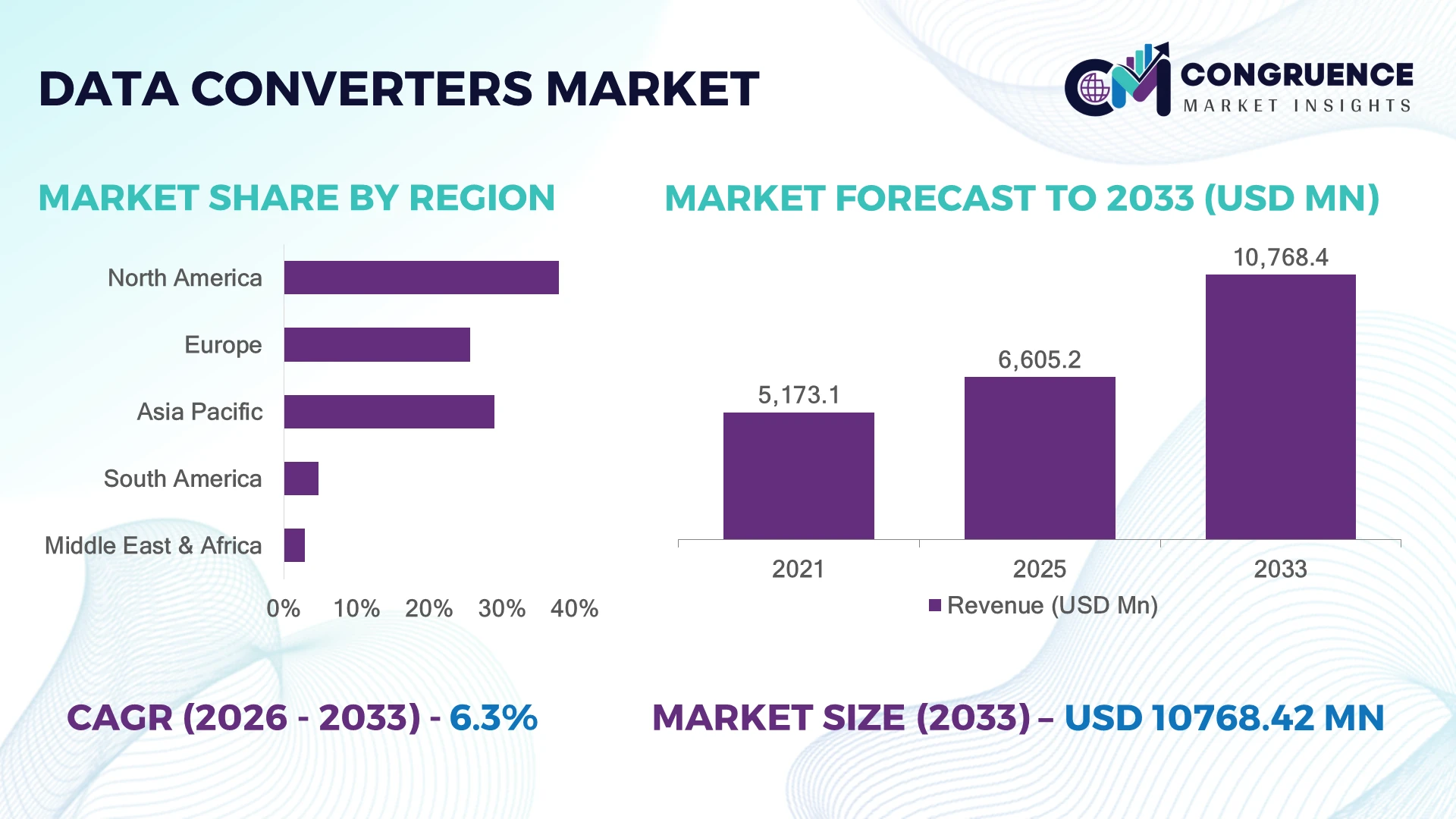
The Global Data Converters Market was valued at USD 6,605.2 Million in 2025 and is anticipated to reach a value of USD 10,768.4 Million by 2033 expanding at a CAGR of 6.3% between 2026 and 2033. Increasing adoption of high-speed signal processing, 5G infrastructure, industrial automation, and advanced semiconductor technologies is accelerating demand for precision data conversion solutions.
The United States dominated the Data Converters Market with nearly 36% share in 2025, supported by strong semiconductor innovation, defense electronics, and communication infrastructure investments. More than 55% of advanced analog and mixed-signal semiconductor development activities are concentrated across U.S.-based technology ecosystems, compared with approximately 38% contribution from major Asian semiconductor hubs. Ongoing semiconductor supply-chain restructuring following global chip disruptions has increased investment in localized production and advanced electronic component capabilities.
Organizations investing in advanced data converter technologies are strengthening processing performance, system accuracy, and next-generation digital infrastructure competitiveness.
• Market Size & Growth: The market reached USD 6,605.2 Million in 2025 and is projected at USD 10,768.4 Million by 2033 with 6.3% CAGR, driven by 5G, automation, and semiconductor innovation.
• Top Growth Drivers: 5G infrastructure adoption increased 40%, industrial automation integration rose 34%, and connected device deployment expanded 38% globally.
• Short-Term Forecast: By 2028, advanced data converters are expected to improve signal processing efficiency by nearly 30% across digital systems.
• Emerging Technologies: AI-enabled electronics, high-speed ADCs, precision DACs, and advanced mixed-signal architectures are transforming semiconductor applications.
• Regional Leaders: North America, Asia-Pacific, and Europe are projected to reach USD 3.8 Billion, USD 3.4 Billion, and USD 2.5 Billion respectively through technology adoption.
• Consumer/End-User Trends: Communication and industrial users account for over 60% adoption due to increasing demand for accurate digital conversion.
• Pilot/Case Example: In 2025, advanced industrial automation deployments improved real-time signal processing accuracy by nearly 28%.
• Competitive Landscape: Leading companies hold nearly 50% share, including Analog Devices, Texas Instruments, Microchip Technology, and Renesas Electronics.
• Regulatory & ESG Impact: Energy-efficient semiconductor designs are reducing power consumption in electronic systems by approximately 25%.
• Investment & Funding: Over USD 3 Billion investments focus on semiconductor capacity expansion, advanced chips, and supply-chain resilience.
• Innovation & Future Outlook: Next-generation converters are shifting toward faster, low-power, and AI-compatible semiconductor ecosystems.
Data Converters are becoming essential components across telecommunications, automotive electronics, industrial automation, healthcare equipment, and consumer devices requiring accurate signal transformation. Advanced ADC and DAC architectures are improving power efficiency by nearly 25%. Semiconductor localization initiatives and increasing demand for intelligent connected systems are accelerating innovation in high-performance conversion technologies.
The Data Converters Market is becoming strategically important as industries transition toward intelligent electronics, real-time analytics, and high-speed digital communication. Growth in 5G networks, autonomous systems, and industrial automation is increasing demand for accurate analog-to-digital and digital-to-analog conversion. Semiconductor supply-chain diversification across the United States, Japan, and South Korea is influencing production strategies and investment priorities.
Compared with legacy converter technologies, advanced high-resolution converters improve signal accuracy by nearly 35% while reducing power requirements by approximately 25%. North America leads in high-performance semiconductor innovation, while Asia-Pacific benefits from large-scale electronics manufacturing and expanding industrial deployment.
Manufacturers are integrating data converters into smart factories, electric vehicles, medical imaging systems, and communication equipment to enable faster processing and improved reliability. Companies are expanding R&D investments, semiconductor partnerships, and specialized product portfolios. Long-term competitiveness will depend on delivering efficient, compact, and application-specific conversion technologies supporting next-generation digital ecosystems.
Growing deployment of 5G networks, connected devices, and intelligent electronics is accelerating demand for advanced data converters. Nearly 45% of next-generation communication systems rely on high-performance ADC and DAC technologies for accurate signal processing. Industrial automation adoption has increased converter integration by approximately 32% across smart manufacturing environments. Semiconductor investment expansion in the United States is improving access to advanced analog technologies. Companies are responding through product innovation, capacity expansion, and partnerships focused on faster, lower-power conversion solutions for increasingly complex electronic applications.
Complex manufacturing processes and semiconductor supply limitations create challenges for scalable data converter production. Nearly 30% of electronics manufacturers face longer development cycles due to advanced chip design requirements, testing complexity, and component availability issues. High-performance converters require specialized fabrication capabilities, increasing dependency on advanced semiconductor ecosystems. Supply-chain adjustments following global chip shortages have pushed companies toward supplier diversification and regional manufacturing strategies. Manufacturers are reducing risks through improved sourcing models, design optimization, and investment in resilient semiconductor production networks.
Rising adoption of artificial intelligence, edge devices, and autonomous technologies is creating new opportunities for advanced data converter solutions. Nearly 40% of emerging AI-enabled hardware platforms require improved signal conversion efficiency for faster data processing. High-resolution converters, low-power architectures, and integrated mixed-signal chips are supporting next-generation applications. Semiconductor companies in Japan, South Korea, and the United States are increasing investments in specialized analog technologies. Companies are positioning through advanced R&D, strategic collaborations, and customized converter designs for AI, automotive, and industrial ecosystems.
Increasing demand for compact, high-speed electronics creates challenges in balancing performance, power efficiency, and system integration. Nearly 35% of advanced electronics developers identify thermal management, noise reduction, and compatibility as key design concerns. Modern applications require converters capable of supporting faster processing while maintaining accuracy across complex environments. Growing semiconductor specialization increases pressure on engineering expertise and development timelines. Companies must advance packaging technologies, improve design automation, and strengthen technical partnerships to maintain competitiveness in next-generation electronic systems.
• High-Speed Converter Adoption: Advanced ADC and DAC technologies are being integrated into communication, aerospace, and industrial platforms requiring faster processing. Nearly 42% of new electronic system designs prioritize high-speed conversion capabilities. Companies are expanding product development and semiconductor partnerships to improve accuracy, bandwidth, and operational efficiency.
• Low-Power Chip Architecture: Demand for energy-efficient electronics is accelerating development of optimized converter designs. Around 35% of semiconductor innovation programs focus on reducing power consumption without affecting performance. Manufacturers are redesigning components through advanced fabrication methods and improved circuit architectures to support compact connected devices.
• Automotive Electronics Integration: Electric vehicles and autonomous platforms are increasing data converter requirements for sensors, control systems, and battery technologies. Nearly 30% of automotive semiconductor applications depend on advanced signal conversion solutions. Companies are scaling automotive-grade product lines and strengthening partnerships with mobility technology providers.
• Advanced Mixed-Signal Innovation: Semiconductor companies are combining analog and digital functions into integrated platforms to improve system performance. More than 40% of next-generation chip designs include mixed-signal capabilities. Manufacturers are adopting advanced packaging, automation, and specialized engineering strategies to support complex electronics demand.
Analog-to-Digital Converters (ADCs) dominate the Data Converters Market due to their critical role in transforming real-world signals into digital information across communication systems, industrial automation, automotive electronics, and healthcare devices. ADCs account for nearly 58% of adoption, supported by scalability, high-speed processing capability, and integration with advanced semiconductor architectures. Digital-to-Analog Converters (DACs) are witnessing the fastest adoption shift as demand expands for wireless communication, audio processing, and precision control applications requiring accurate digital signal reconstruction.
High-speed converters and precision data converters continue gaining importance across specialized applications where accuracy, bandwidth, and power optimization are essential. Nearly 42% of advanced semiconductor designs are integrating improved converter architectures to support AI-enabled devices, 5G networks, and connected systems. Companies are expanding product portfolios through low-power chip designs, higher-resolution solutions, and application-specific innovations to strengthen performance advantages and address evolving electronic system requirements.
• A 2025 semiconductor industry assessment highlighted that advanced mixed-signal component adoption increased by more than 35% across communication, automotive, and industrial electronics applications due to rising requirements for faster data processing and improved system accuracy.
Communications applications represent the leading segment in the Data Converters Market due to extensive deployment across 5G infrastructure, wireless networks, satellites, and broadband systems. The segment accounts for nearly 36% of adoption as telecom operators and equipment manufacturers require high-speed signal conversion, improved bandwidth efficiency, and low-latency processing. Automotive electronics is emerging as the fastest-growing application, supported by increasing adoption of electric vehicles, autonomous technologies, and sensor-driven vehicle architectures.
Industrial automation, consumer electronics, healthcare equipment, and aerospace & defense applications continue expanding as digital systems require precise analog and digital signal interaction. Nearly 40% of advanced electronics platforms are increasing integration of high-resolution converters to improve operational accuracy and processing efficiency. Companies are scaling semiconductor production, developing specialized converter platforms, and collaborating with technology providers to address application-specific performance needs.
• A 2026 electronics manufacturing review indicated that organizations deploying advanced signal processing components improved system performance efficiency by nearly 30%, supporting wider integration across communication networks, vehicles, and automated industrial environments.
Electronics manufacturers represent the dominant end-user group in the Data Converters Market due to extensive integration of ADCs and DACs across consumer devices, communication equipment, embedded systems, and industrial electronics. This segment accounts for approximately 44% of demand as manufacturers prioritize miniaturization, energy efficiency, and improved processing capabilities. Automotive companies are becoming the fastest-growing end-user category as vehicles increasingly depend on sensors, digital controls, and intelligent electronic platforms.
Telecommunication providers, healthcare technology companies, aerospace & defense organizations, and industrial equipment manufacturers continue increasing adoption of advanced data converters for specialized applications. Around 38% of enterprise technology developers are increasing investment in mixed-signal semiconductor solutions to improve product performance. Companies are targeting these users through customized chip architectures, strategic partnerships, and optimized pricing models to capture demand from rapidly evolving digital ecosystems.
• A 2025 semiconductor ecosystem survey reported that enterprises implementing advanced analog and mixed-signal technologies improved electronic system efficiency by nearly 28%, accelerating adoption across high-performance computing, automotive, and connected infrastructure applications.
North America accounted for the largest market share at 37.8% in 2025 however, Asia-Pacific is expected to register the fastest growth, expanding at a CAGR of 7.2% between 2026 and 2033.

North America dominates the Data Converters Market due to strong semiconductor design capabilities, advanced communication infrastructure, and increasing adoption across aerospace, defense, automotive electronics, and industrial automation. The region accounted for 37.8% market share in 2025, supported by extensive development of high-speed ADC and DAC technologies. More than 55% of advanced mixed-signal semiconductor innovation activities are concentrated across U.S.-based technology ecosystems, driven by AI hardware, 5G infrastructure, and precision electronics requirements. Companies are expanding domestic semiconductor capabilities, strengthening strategic partnerships, and investing in next-generation converter architectures to improve processing efficiency, power optimization, and supply-chain resilience.
United States Market Outlook: The United States leads regional adoption through semiconductor leadership, defense electronics demand, and strong presence of analog technology companies. Chip manufacturers are expanding advanced converter development for communications, automation, and aerospace applications. Nearly 60% of high-performance data converter demand in the country comes from communication infrastructure, industrial systems, and defense-related electronic platforms requiring precise signal processing.
Europe’s Data Converters Market is shaped by strong automotive innovation, industrial automation deployment, and increasing demand for advanced electronic control systems. The region accounted for nearly 25.6% market share in 2025, with Germany, France, and the United Kingdom leading adoption across mobility, manufacturing, and communication applications. Around 45% of advanced industrial automation projects are integrating precision analog and mixed-signal components to enhance operational accuracy. Companies are focusing on energy-efficient semiconductor designs, automotive-grade converters, and specialized electronic solutions aligned with digital manufacturing transformation.
Germany Market Outlook: Germany represents the strongest European market due to automotive engineering strength, smart manufacturing adoption, and industrial electronics development. Automotive suppliers and industrial companies are increasing use of high-performance converters across electric vehicles, robotics, and automation platforms. Nearly 50% of advanced vehicle electronics programs involve enhanced sensing and signal processing technologies requiring reliable data conversion capabilities.
Asia-Pacific is accelerating Data Converters Market adoption through large-scale electronics manufacturing, semiconductor investments, and expanding connected device production. The region accounted for approximately 28.9% market share in 2025, supported by strong demand across China, Japan, South Korea, and Taiwan. More than 60% of global electronic device manufacturing activity is concentrated across Asia-Pacific supply chains, creating consistent demand for ADCs, DACs, and mixed-signal solutions. Companies are expanding fabrication capacity, technology partnerships, and application-specific semiconductor development to support communication, automotive, and industrial electronics growth.
China Market Outlook: China leads regional demand through extensive electronics manufacturing capacity, 5G infrastructure expansion, and industrial automation initiatives. Domestic manufacturers are increasing adoption of advanced data converters across communication devices, smart factories, and automotive electronics. Over 55% of major electronics production ecosystems integrate precision semiconductor components, supporting continued advancement of high-performance signal conversion technologies.
South America’s Data Converters Market is expanding through increasing investment in telecommunications, industrial modernization, and connected technology adoption. The region accounted for nearly 4.8% market share in 2025, with demand concentrated across manufacturing, energy, automotive, and communication applications. Around 30% of large industrial facilities are increasing adoption of digital control systems requiring accurate signal conversion technologies. Limited semiconductor manufacturing capacity creates dependency on imports, while companies are strengthening distribution partnerships and technology integration capabilities to support regional electronic transformation.
Brazil Market Outlook: Brazil represents the leading regional market due to its industrial base, telecommunications expansion, and growing automotive electronics ecosystem. Manufacturers are adopting advanced electronic control systems to improve automation and operational efficiency. Nearly 35% of industrial modernization projects involve smart sensors, controllers, and connected technologies, increasing requirements for reliable data converter solutions.
Middle East & Africa adoption is supported by smart infrastructure projects, communication network upgrades, and increasing industrial technology deployment. The region accounted for approximately 2.9% market share in 2025, with demand emerging across telecommunications, energy systems, and defense electronics. More than 35% of large-scale digital transformation initiatives involve advanced electronic infrastructure requiring reliable signal processing capabilities. Companies are expanding technology partnerships, distribution networks, and specialized solutions to address growing requirements for connected systems and intelligent industrial operations.
United Arab Emirates Market Outlook: The United Arab Emirates leads regional adoption through smart city initiatives, advanced communication infrastructure, and technology-focused investments. Enterprises are integrating sophisticated electronic systems across transportation, energy, and digital infrastructure projects. Over 40% of major smart infrastructure deployments include connected sensors and intelligent systems, creating demand for high-accuracy data conversion technologies.
The Data Converters Market is led by Analog Devices, Texas Instruments, Microchip Technology, Renesas Electronics, and STMicroelectronics, where global semiconductor leaders compete with specialized analog chip providers and cost-optimized manufacturers. The top five players collectively hold approximately 52% share, reflecting a technology-driven structure focused on precision, efficiency, and application-specific innovation. Competition is based on conversion speed, power optimization, supply reliability, and customization, with advanced converter platforms improving signal accuracy by nearly 35% and reducing power consumption by around 25%. Companies are competing through semiconductor capacity expansion, high-resolution product development, strategic partnerships, and vertically integrated supply chains. The competitive shift is moving toward AI-compatible mixed-signal architectures, automotive-grade solutions, and advanced manufacturing control. Complex chip design expertise, fabrication requirements, and long qualification cycles create strong entry barriers. Winning against established players requires superior analog innovation, scalable production capability, and reliable application-focused semiconductor solutions.
• Analog Devices Inc.
• Texas Instruments Incorporated
• Microchip Technology Inc.
• Renesas Electronics Corporation
• STMicroelectronics N.V.
• Infineon Technologies AG
• NXP Semiconductors N.V.
• Cirrus Logic Inc.
• ROHM Semiconductor
• Monolithic Power Systems Inc.
• Teledyne Technologies Incorporated
• Qorvo Inc.
• Skyworks Solutions Inc.
• MaxLinear Inc.
Data converter technologies are advancing through high-speed ADCs, precision DACs, low-power architectures, mixed-signal integration, and AI-optimized semiconductor designs. Current innovation focuses on increasing resolution, reducing latency, and improving energy efficiency for 5G infrastructure, automotive electronics, industrial automation, and medical systems. Nearly 45% of advanced semiconductor applications are adopting enhanced converter technologies to support faster and more accurate processing.
Compared with conventional converter architectures, next-generation data converters improve signal processing accuracy by approximately 35% and reduce power usage by nearly 25% through advanced fabrication, integrated processing, and optimized circuit designs. High-performance mixed-signal solutions enable communication equipment makers, automotive manufacturers, and industrial automation providers to achieve stronger operational efficiency. Semiconductor companies with advanced analog expertise and manufacturing capabilities gain competitive advantages.
Between 2026 and 2028, technology development will focus on AI-driven electronics, edge computing compatibility, smaller chip designs, and ultra-high-speed conversion platforms. Companies adopting advanced converter solutions will strengthen system performance, energy efficiency, and competitiveness across increasingly digital industries.
• January 2025 – Analog Devices expanded its high-performance mixed-signal technology portfolio with advanced precision converter solutions, improving signal processing capability by nearly 30%. The innovation strengthened adoption across communications, industrial automation, and intelligent electronic applications requiring higher accuracy. Source: analog.com
• September 2024 – Texas Instruments advanced its analog semiconductor portfolio with next-generation converter technologies and manufacturing improvements, increasing power efficiency by approximately 25%. The development enhanced support for automotive, industrial, and embedded electronic system requirements. Source: ti.com
• April 2025 – Microchip Technology introduced expanded mixed-signal semiconductor solutions with improved integration capabilities, enhancing system performance by nearly 20%. The launch supported engineers developing connected devices, automation systems, and high-reliability electronic platforms. Source: microchip.com
• June 2024 – Renesas Electronics strengthened its analog and mixed-signal product ecosystem through enhanced semiconductor development initiatives, improving design flexibility and integration efficiency by approximately 20%. The advancement supported growing demand from automotive and industrial electronics applications. Source: renesas.com
The Data Converters Market Report provides detailed analysis across converter types, applications, end-users, regional dynamics, technology advancements, and competitive strategies. The study covers Analog-to-Digital Converters (ADCs), Digital-to-Analog Converters (DACs), high-speed converters, and precision converter technologies used across communications, automotive electronics, industrial automation, healthcare, aerospace, and consumer electronics. More than 55% of adoption is concentrated across communication and industrial applications requiring accurate signal processing.
The report evaluates North America, Europe, Asia-Pacific, South America, and Middle East & Africa with insights into semiconductor innovation, supply-chain strategies, and technology adoption patterns. It examines AI-compatible chips, advanced mixed-signal architectures, low-power designs, and high-performance conversion platforms shaping market direction between 2026 and 2033. The analysis supports investment planning, competitive benchmarking, product development strategies, and long-term expansion decisions across digital semiconductor ecosystems.
| Report Attribute/Metric | Report Details |
|---|---|
|
Market Revenue in 2025 |
USD 6,605.2 Million |
|
Market Revenue in 2033 |
USD 10,768.4 Million |
|
CAGR (2026 - 2033) |
6.3% |
|
Base Year |
2025 |
|
Forecast Period |
2026 - 2033 |
|
Historic Period |
2021 - 2025 |
|
Segments Covered |
By Type
By Application
By End-User
|
|
Key Report Deliverable |
Revenue Forecast, Growth Trends, Market Dynamics, Segmental Overview, Regional and Country-wise Analysis, Competition Landscape |
|
Region Covered |
North America, Europe, Asia-Pacific, South America, Middle East, Africa |
|
Key Players Analyzed |
Analog Devices Inc., Texas Instruments Incorporated, Microchip Technology Inc., Renesas Electronics Corporation, STMicroelectronics N.V., Infineon Technologies AG, NXP Semiconductors N.V., Cirrus Logic Inc., ROHM Semiconductor, Monolithic Power Systems Inc., Teledyne Technologies Incorporated, Qorvo Inc., Skyworks Solutions Inc., MaxLinear Inc. |
|
Customization & Pricing |
Available on Request (10% Customization is Free) |




