
Reports
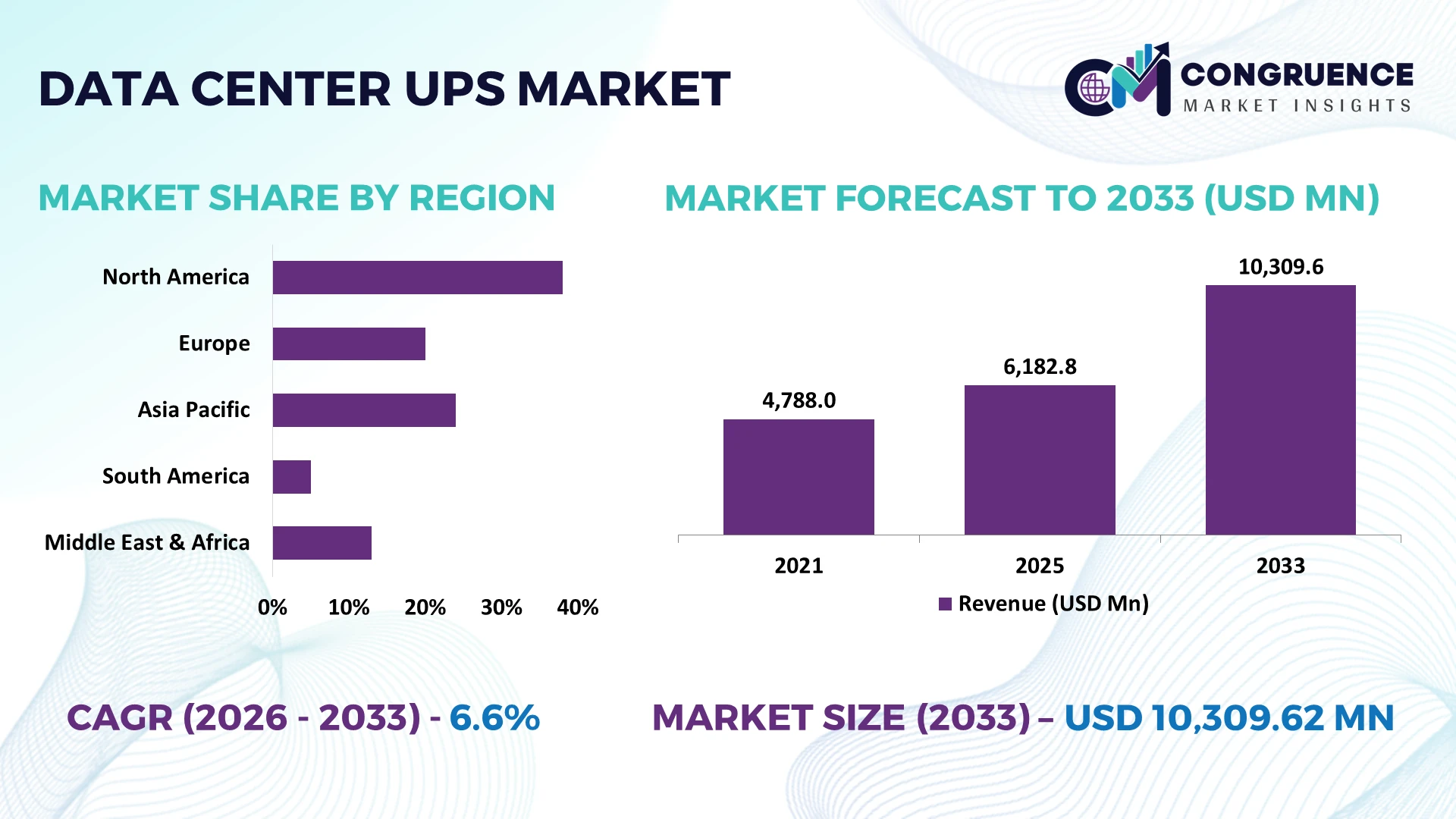
The Global Data Center UPS Market was valued at USD 6182.8 Million in 2025 and is anticipated to reach a value of USD 10309.62 Million by 2033 expanding at a CAGR of 6.6% between 2026 and 2033. Growth is driven by AI-ready hyperscale expansion, rising rack power density, and the shift toward modular lithium-ion UPS architectures that support faster deployment and higher power efficiency.
The United States remains the dominant country, representing about 60% of globally installed data center capacity, with more than 5,400 facilities and over 50 GW of in-service capacity. Data centers consumed about 4.9% of U.S. electricity in 2025, compared with 1.1% in China, reflecting substantially higher power-protection requirements. The U.S.-China technology and infrastructure competition is accelerating investment in high-density AI facilities and resilient electrical systems.
Strategic implication: suppliers should prioritize high-density modular UPS, lithium-ion storage, intelligent monitoring, and scalable architectures for AI-focused data center deployments.
Market Size & Growth: The market reaches USD 10,309.62 million by 2033 at 6.6% CAGR, driven by AI infrastructure and high-density data center expansion.
Top Growth Drivers: AI workloads contribute 35%, hyperscale expansion 30%, and cloud infrastructure modernization 22% of identified growth drivers.
Short-Term Forecast: By 2028, modular UPS deployment is positioned to reduce installation complexity by 15% and improve power-system scalability by 20%.
Emerging Technologies: AI predictive diagnostics, lithium-ion batteries, and silicon-carbide power electronics are reshaping UPS efficiency, monitoring, and high-density load management.
Regional Leaders: North America reaches USD 5,170.2 million by 2033 with hyperscale expansion; Asia Pacific reaches USD 5,289.5 million with distributed deployments; Europe reaches USD 3,192.3 million through efficiency-focused upgrades.
Consumer/End-User Trends: Large data centers above 500 kVA hold a 46.6% share, reinforcing demand for high-capacity centralized and modular UPS architectures.
Pilot/Case Example: In 2025, Northern Virginia absorbed 1,102 MW of new data center capacity, more than doubling from 451.7 MW in 2024 and directly expanding demand for resilient power infrastructure.
Competitive Landscape: Schneider Electric held approximately 24.3% in 2024, while Eaton, Vertiv, ABB, and Delta Electronics formed the core competitive group; the top five represented about 60%.
Regulatory & ESG Impact: U.S. data centers consumed about 4.9% of national electricity in 2025 versus 1.5% globally, increasing pressure for higher-efficiency UPS systems and energy-aware infrastructure.
Investment & Funding: Global data center projects under construction exceeded 47,000 MW, representing approximately USD 550 billion in estimated end value and creating substantial demand for power-continuity equipment.
Innovation & Future Outlook: Next-generation UPS platforms are shifting toward modular frames, lithium-ion or alternative chemistries, grid interaction, predictive maintenance, and cooling-system integration as AI racks reach 132 kW and future designs approach 1 MW.
The Data Center UPS Market is increasingly concentrated around AI hyperscale facilities, colocation campuses, cloud platforms, BFSI infrastructure, and high-availability enterprise systems. Double-conversion UPS remains central to mission-critical protection, while modular architectures are gaining traction for capacity scaling and faster deployment. AI-driven load profiles are also changing UPS design requirements, with GPU racks already reaching 132 kW and planned architectures approaching 1 MW. North American data center supply expanded 36% in 2025, reinforcing the need for scalable power protection and tighter coordination between UPS, cooling, and electrical distribution systems.
Data Center UPS systems are becoming strategic infrastructure as AI workloads turn electricity availability and power quality into competitive constraints. Global data center electricity consumption is projected to rise from 485 TWh in 2025 to about 950 TWh by 2030, while AI-focused facilities are expected to triple their consumption. This shift is restructuring procurement toward scalable power architectures, energy-efficient UPS, and battery systems rather than conventional capacity additions.
Technology selection is also changing operating economics. Modern modular UPS platforms achieve up to 97.5% double-conversion efficiency, compared with sub-90% efficiency reported for replaced legacy equipment in operational deployments, reducing electrical losses and cooling requirements. The United States remains the largest high-density deployment market, while China is expanding rapidly and Southeast Asian hubs are scaling from smaller installed bases.
Over the next 2–3 years, procurement will increasingly prioritize modularity, lithium-ion storage, predictive monitoring, and rapid commissioning. Northern Virginia added 1,102 MW of absorption in 2025 while vacancy reached only 0.5%, demonstrating how power availability directly affects expansion schedules. Operators are securing equipment earlier, diversifying suppliers, and integrating UPS vendors with electrical and cooling partners. Competitive positioning will increasingly depend on delivering resilient power at higher efficiency with shorter deployment cycles.
AI infrastructure is increasing the power intensity of individual data halls, making UPS capacity, efficiency, and modular scaling central investment priorities. AI-focused data center electricity consumption is projected to triple between 2025 and 2030, while U.S. data centers are expected to represent almost 50% of national electricity-demand growth through 2030. Modern UPS systems reaching 97–99% efficiency reduce conversion losses and associated cooling loads. Northern Virginia's 1,102 MW of 2025 absorption demonstrates the operational scale behind this demand. Companies are responding with modular UPS platforms, lithium-ion storage, and higher-capacity power blocks that allow capacity to track AI deployment schedules without rebuilding entire electrical systems.
Data Center UPS deployment is constrained by concentrated power-equipment demand, grid bottlenecks, and limited infrastructure availability in established hubs. Northern Virginia ended 2025 with only 21.5 MW of available data center supply and a 0.5% vacancy rate, while asking rates for requirements above 10 MW reached $155–$185 per kW. These conditions increase project economics pressure and encourage operators to secure electrical equipment earlier. Supply-chain exposure also remains important because transformer, switchgear, battery, and UPS procurement must align with commissioning schedules. Companies are reducing disruption through multi-vendor sourcing, longer-term procurement contracts, localized service capacity, and modular architectures that allow phased installation rather than single-stage capacity deployment.
The strongest opportunity is shifting UPS value from backup capacity toward efficiency, density, and intelligent energy management. Advanced platforms already reach 97.5% double-conversion efficiency, while some systems achieve 99% in energy-saving modes, creating measurable operating-cost and cooling advantages. India is particularly relevant as electricity demand is projected to grow 6.4% annually through 2030, supporting additional digital infrastructure requirements. Lithium-ion and silicon-carbide architectures also reduce footprint and improve power-density management. Vendors are expanding modular portfolios and pairing UPS systems with digital monitoring, storage, and grid-management capabilities. The non-obvious opportunity is low-load efficiency: AI facilities with variable utilization can monetize modular architectures by matching active UPS capacity more closely with real-time electrical demand.
Long-term execution increasingly depends on integrating UPS equipment with rapidly changing AI electrical architectures rather than simply adding capacity. Data center electricity consumption is projected to approach 950 TWh globally by 2030, while AI-focused consumption triples, intensifying requirements for power-quality management and dynamic load response. Grid constraints are particularly difficult because data centers concentrate large loads in specific locations, making integration more challenging than dispersed electricity demand. Cybersecure monitoring, interoperability between UPS controls and facility-management platforms, battery safety, and skilled commissioning teams therefore become operational differentiators. Companies must invest in intelligent controls, standardized interfaces, workforce training, and joint engineering programs with data center developers and electrical-system integrators to maintain deployment consistency as rack densities increase.
Modular Deployment Accelerates: Modular UPS adoption is rising as operators target 15–25% faster capacity additions and up to 50% lower footprint versus comparable standalone configurations. Colocation operators are shifting toward scalable power blocks, reducing overprovisioning as tenant loads change rapidly.
Lithium-Ion Adoption Expands: Lithium-ion batteries are replacing legacy VRLA systems, with centralized UPS adoption increasing by 56% among surveyed data-center technology deployments. Longer service life and faster recharge cycles are reducing maintenance interventions by roughly 20–30%, prompting vendors to expand integrated battery portfolios.
Intelligent Monitoring Becomes Standard: Digital monitoring and predictive diagnostics are moving into routine UPS workflows, with DCIM adoption reported at 59%. Operators are integrating condition-based maintenance, remote diagnostics, and automated alerts to reduce service visits and identify battery degradation before availability is affected.
Supply Chains Move Closer: Transformer and electrical-equipment bottlenecks are forcing earlier procurement, longer contracts, and supplier diversification. Data-center electricity demand increased 17% in 2025, while AI-focused facilities rose 50%, pushing operators to reserve UPS, switchgear, and battery capacity earlier and coordinate procurement with construction schedules.
Online UPS remains the leading type, estimated at approximately 48% of Data Center UPS deployments, because double-conversion architecture provides continuous voltage regulation, frequency stability, and isolation for sensitive servers. Its established position is strongest in hyperscale, enterprise, and colocation facilities where power-quality tolerance is minimal. Standby UPS retains a smaller role in lower-criticality installations, while Line-Interactive UPS serves cost-sensitive facilities requiring voltage regulation without full online conversion. Rotary UPS remains strategically relevant for large facilities requiring high-power continuity and mechanical energy storage.
Modular UPS is the fastest-expanding type, with adoption estimated to increase by 18–22% across new capacity projects as operators prioritize incremental scaling and maintainability. Modular architectures can reduce unused capacity by roughly 15–20% compared with oversized fixed systems. Manufacturers are therefore increasing modular product ranges, integrating lithium-ion batteries, and forming partnerships with data-center integrators. Investment is shifting from maximum installed capacity toward flexible capacity that tracks actual IT-load growth.
Backup Power represents the leading application, estimated at approximately 42% of demand, because uninterrupted electricity remains the primary UPS requirement across mission-critical facilities. Emergency Power follows as a complementary protection layer, particularly where generator transfer sequences require short-duration bridging. Power Conditioning maintains strong adoption at roughly 25%, protecting servers from voltage fluctuations, harmonics, and frequency disturbances. These mature applications increasingly operate as integrated electrical-protection layers rather than isolated UPS functions.
Power Quality Management is the fastest-expanding application, with adoption rising approximately 16–20% in high-density facilities as AI accelerators create more sensitive and variable electrical loads. Load Protection is also gaining importance as rack densities increase. Operators are integrating UPS controls with power-distribution monitoring and automated alarms, while vendors are developing systems capable of granular load visibility. This shifts purchasing criteria from simple backup duration toward measurable power-quality performance and coordinated facility control.
Hyperscale Data Centers represent the leading end-user group, estimated at approximately 34% of Data Center UPS demand, reflecting enormous electrical loads, strict availability requirements, and concentrated AI infrastructure investment. Cloud Service Providers closely overlap with this demand profile but increasingly prioritize standardized UPS platforms across multiple campuses. Colocation Data Centers account for a substantial share because multi-tenant facilities require scalable capacity and predictable maintenance windows. Enterprise Data Centers remain important but increasingly favor modernization over large greenfield installations.
Edge Data Centers are the fastest-growing end-user category, with deployment activity increasing approximately 18–24% as latency-sensitive computing moves closer to users and industrial assets. Their smaller footprints favor compact, remotely monitored UPS configurations rather than large centralized systems. Vendors are responding with standardized modular packages, remote service contracts, and battery-integrated systems. Meanwhile, hyperscale operators are negotiating larger framework agreements and multi-site partnerships, shifting competitive advantage toward suppliers capable of delivering consistent architectures across geographically dispersed projects.
North America accounted for the largest market share at 37.2% in 2025 however, Asia-Pacific is expected to register the fastest growth, expanding at a CAGR of 10.6% between 2026 and 2033.
AI Infrastructure Is Reshaping Power Deployment
North America accounts for the largest share of global Data Center UPS demand, supported by concentrated hyperscale capacity, AI infrastructure spending, and rapid electrical-system upgrades. The region represented about 37% of the market in 2025, while North American data-center capacity expanded 36% during the year. Northern Virginia alone absorbed 1,102 MW, reinforcing UPS demand around high-density campuses. Operators are prioritizing modular three-phase systems, lithium-ion storage, and digitally monitored power trains to shorten commissioning cycles and manage variable AI loads. Equipment suppliers are responding with larger modular frames, local service networks, and framework agreements that secure delivery capacity for multi-site expansions. Power availability is increasingly determining project sequencing, making UPS procurement an early-stage infrastructure decision rather than a final equipment purchase.
United States Market Outlook: The United States remains the region’s primary UPS demand center because hyperscale, colocation, cloud, and AI campuses are concentrated across Northern Virginia, Texas, Georgia, and Arizona. Northern Virginia recorded 1,102 MW of net data-center absorption in 2025, demonstrating the scale of electrical infrastructure being commissioned. U.S. operators are increasingly pairing UPS systems with advanced power distribution, lithium-ion battery cabinets, and predictive monitoring. Domestic infrastructure investment and tighter grid interconnection schedules are also pushing developers toward earlier equipment reservations and multi-year supplier agreements, strengthening suppliers with manufacturing access, engineering capacity, and nationwide field-service coverage.
Efficiency Rules Are Reshaping Modernization
Europe is shifting Data Center UPS procurement toward energy efficiency, grid compatibility, and modernization of constrained facilities. Europe represented roughly 23% of global UPS demand in 2025, while live data-center IT capacity reached about 10.8 GW. Frankfurt, London, Amsterdam, Dublin, and Paris remain major deployment hubs, but power-allocation constraints are pushing projects toward secondary locations. Carbon-accounting requirements and electricity-price volatility are increasing the value of high-efficiency UPS operating modes and intelligent load management. Vendors are responding with modular architectures, lithium-ion systems, and integrated monitoring. The strategic shift is from simply adding backup capacity toward reducing electrical losses and fitting new installations within tighter power and sustainability limits. Developers are also evaluating brownfield upgrades where grid connections and land availability restrict greenfield expansion.
Germany Market Outlook: Germany is a major European UPS market because Frankfurt combines dense enterprise infrastructure, hyperscale activity, and industrial power demand. Frankfurt’s live data-center IT capacity reached approximately 868 MW in 2025, creating sustained requirements for high-capacity UPS and power-distribution equipment. German operators are emphasizing energy efficiency, modular expansion, and low-maintenance battery technologies as electricity costs and environmental requirements influence facility design. Manufacturers and integrators are increasingly combining UPS, switchgear, monitoring, and service contracts into coordinated packages, giving suppliers with strong engineering support an advantage in modernization projects and new capacity additions.
Manufacturing Scale Meets Hyperscale Expansion
Asia-Pacific combines rapid data-center deployment with a deep electronics and power-equipment manufacturing base, making it a critical UPS production and consumption center. The region represented about 33% of global UPS demand in 2025, while live IT capacity reached roughly 14.8 GW. China, Japan, India, Singapore, South Korea, and Australia anchor deployment, with Southeast Asia adding new hyperscale and colocation capacity. Manufacturers are increasing modular UPS production and localizing service capabilities to meet shorter build schedules. The region’s strategic advantage is the combination of semiconductor, battery, power-electronics, and equipment ecosystems, allowing suppliers to shorten component lead times and tailor systems to high-density deployments. Singapore, Malaysia, and Indonesia are also attracting distributed facilities where compact UPS architectures and remote monitoring reduce operating complexity.
China Market Outlook: China combines large-scale cloud infrastructure, domestic power-electronics manufacturing, and expanding AI computing capacity, creating a substantial internal market for advanced UPS equipment. National data-center strategies increasingly emphasize efficient computing infrastructure, while major campuses require high-capacity power protection and coordinated electrical controls. Domestic suppliers are strengthening localized UPS platforms, battery integration, and service coverage, reducing dependence on imported components. China’s manufacturing depth also supports faster customization for high-density facilities, giving local vendors an important advantage where procurement schedules, equipment integration, and after-sales support must align with rapidly changing computing requirements.
Brazil Anchors Colocation-Led Demand
South America remains a smaller UPS market, but Brazil is creating a stronger demand base through colocation expansion, cloud adoption, and concentration of digital infrastructure around São Paulo. The region represented roughly 3% of global UPS demand in 2025, while South American live IT capacity reached about 1.1 GW. Power reliability requirements are increasing UPS deployment in financial services, telecom, and enterprise facilities, while renewable-energy availability is influencing new data-center site selection. Suppliers are responding with scalable three-phase systems, local service partnerships, and inventory planning that reduces exposure to import lead times. The key constraint is uneven grid quality, which increases the value of power conditioning alongside backup capability. Operators are increasingly evaluating UPS efficiency alongside generator integration and renewable-energy procurement when designing new campuses.
Brazil Market Outlook: Brazil is the strategic center of South American data-center development because São Paulo concentrates cloud, colocation, financial, and telecom infrastructure. São Paulo’s live data-center IT capacity reached approximately 1 GW in 2025, creating recurring demand for high-capacity UPS, batteries, and power-quality systems. Operators are favoring modular configurations that allow phased capacity additions without oversized initial installations. Local integrators and international equipment vendors are strengthening service partnerships to manage maintenance and imported-component lead times. Brazil’s expanding renewable-energy base also supports data-center projects seeking lower-carbon electricity, increasing the importance of high-efficiency UPS architectures in new facilities.
Gulf AI Campuses Accelerate Infrastructure Investment
Middle East & Africa is shifting from isolated enterprise installations toward large digital-infrastructure campuses, government cloud programs, and AI-oriented projects. The region represented about 5% of global UPS demand in 2025, while live IT capacity increased sharply in Gulf hubs. Riyadh and Abu Dhabi are becoming important deployment centers, with Riyadh’s live capacity rising from 43 MW in 2024 to 110 MW in 2025. Extreme heat, grid resilience requirements, and rapid project schedules are driving higher-specification UPS and thermal-management integration. Vendors are expanding local partnerships, service teams, and regional inventory to support shorter commissioning windows. The competitive advantage increasingly rests on heat-tolerant equipment, fast deployment, and reliable local maintenance coverage. Africa remains more fragmented, with South Africa serving as an important entry point for telecom-led edge deployments.
Saudi Arabia Market Outlook: Saudi Arabia is emerging as a major Middle Eastern UPS demand center through sovereign digital infrastructure, cloud expansion, and AI-focused development programs. Riyadh’s live data-center IT capacity reached about 110 MW in 2025, more than doubling from 43 MW in 2024. High ambient temperatures make thermal performance and battery-management reliability important selection criteria. Operators are increasingly specifying modular UPS, remote monitoring, and integrated electrical packages to support rapid campus deployment. International suppliers are building local partnerships and service capabilities, while project developers prioritize equipment availability and commissioning support alongside efficiency and resilience.
Schneider Electric, Vertiv, Eaton, ABB, and Delta Electronics compete as the core global supplier group, while Mitsubishi Electric, Huawei, and regional power-electronics specialists challenge them in selected countries and price-sensitive projects. The top five players collectively held about 60% of market share in 2024, indicating a concentrated structure shaped by installed-base relationships and service networks. Competition increasingly centers on efficiency, modularity, battery integration, and deployment speed: advanced systems target roughly 97–99% operating efficiency, while modular designs can cut capacity-installation time by 15–25%. Schneider Electric and Vertiv emphasize integrated digital power platforms; Eaton and ABB leverage electrical-system portfolios; Delta competes through power-electronics efficiency and manufacturing scale. Players are expanding local service capacity, partnering with integrators, and securing component supply. High certification requirements, engineering expertise, installed bases, and global maintenance coverage remain entry barriers. Winning requires reliable high-density systems, fast commissioning, supply assurance, and lifecycle support, and lifecycle economics remain decisive differentiators.
Schneider Electric SE
Vertiv Holdings Co.
Eaton Corporation plc
ABB Ltd.
Delta Electronics Inc.
Mitsubishi Electric Corporation
Huawei Technologies Co., Ltd.
Toshiba Corporation
Legrand SA
Socomec Group
Riello Elettronica S.p.A.
Fuji Electric Co., Ltd.
AEG Power Solutions
Kehua Tech Co., Ltd.
Current UPS architectures are shifting from fixed-capacity systems toward modular, transformerless platforms with intelligent paralleling. Modern systems reach up to 97.5% double-conversion efficiency and 99% in dynamic online mode, while compact designs reduce footprint by 32% versus previous generations. Lithium-ion batteries and integrated battery-management systems are replacing maintenance-intensive VRLA configurations, improving recharge performance and monitoring. Adoption is strongest in hyperscale and colocation facilities where high-density loads make partial-load efficiency commercially important.
Emerging medium-voltage UPS technology is changing electrical architecture by reducing low-voltage distribution complexity and enabling larger power blocks. ABB reports that its medium-voltage approach can reduce power-infrastructure CAPEX by up to 30%. Compared with conventional low-voltage architectures, fewer larger UPS blocks reduce cabling, equipment count, and maintenance points. AI-aware controls are also becoming important because rapid GPU load swings require faster power conditioning. These technologies particularly benefit hyperscale operators and suppliers capable of integrating UPS, switchgear, batteries, and monitoring into a single power train.
By 2026–2028, disruptive UPS development will center on AI-load management, fault-ride-through controls, silicon-carbide power electronics, and direct integration with digital energy platforms. Vertiv’s latest high-density platforms support up to 1.8 MW per UPS. Medium-voltage architectures and modular scaling will shorten commissioning cycles while improving space utilization. Companies investing now gain stronger positioning where AI rack density, constrained electrical rooms, and power-quality requirements converge.
June 2025 ABB partnered with Applied Digital for a 400 MW AI-ready data-center campus in North Dakota, deploying HiPerGuard medium-voltage UPS architecture. The partnership targets faster, efficient power delivery while ABB’s supply-chain capacity supports large-scale AI infrastructure deployment.
December 2025 ABB completed a 25 MVA medium-voltage UPS deployment with Ark Data Centres at Surrey, UK, achieving 98% efficiency at high load. The project supports dense AI workloads while reducing space requirements and generator dependence across the facility.
December 2024 Vertiv launched PowerUPS 9000 for high-density data centers, supporting 250–1,250 kW per unit and reaching 97.5% double-conversion efficiency. Its 32% smaller footprint enables faster installation and greater power density where electrical-room space is constrained.
March 2026 Vertiv introduced PowerUPS 6000 Industrial for manufacturing, pharmaceuticals, oil and gas, and other harsh environments, supporting input-voltage variation from -40% to +25%. The platform expands UPS applications beyond conventional data centers into Industry 4.0 infrastructure.
The Data Center UPS Market Report covers technology and demand across Standby UPS, Line-Interactive UPS, Online UPS, Modular UPS, and Rotary UPS, with applications spanning Backup Power, Power Conditioning, Load Protection, Emergency Power, and Power Quality Management. End-user analysis includes Colocation, Enterprise, Hyperscale, Edge, and Cloud Service Provider facilities. Coverage extends across North America, Europe, Asia-Pacific, South America, and Middle East & Africa, with country-level assessment of major deployment hubs.
The report evaluates current UPS architectures, lithium-ion storage, modular power systems, medium-voltage UPS, intelligent monitoring, AI-load management, and high-density power protection. It also examines deployment concentration, infrastructure modernization, supplier positioning, and technology adoption patterns through 2026–2033. The analysis supports investment planning, product prioritization, geographic expansion, partnership decisions, competitive positioning, procurement strategy, and identification of emerging opportunities where AI infrastructure and higher rack densities are changing power-protection requirements.
| Report Attribute/Metric | Report Details |
|---|---|
Market Revenue in 2025 | USD 6182.8 Million |
Market Revenue in 2033 | USD 10309.62 Million |
CAGR (2026 - 2033) | 6.6% |
Base Year | 2025 |
Forecast Period | 2026 - 2033 |
Historic Period | 2021 - 2025 |
Segments Covered | By Type
By Application
By End-User
|
Key Report Deliverable | Revenue Forecast, Growth Trends, Market Dynamics, Segmental Overview, Regional and Country-wise Analysis, Competition Landscape |
Region Covered | North America, Europe, Asia-Pacific, South America, Middle East, Africa |
Key Players Analyzed | Schneider Electric SE, Vertiv Holdings Co., Eaton Corporation plc, ABB Ltd., Delta Electronics Inc., Mitsubishi Electric Corporation, Huawei Technologies Co., Ltd., Toshiba Corporation, Legrand SA, Socomec Group, Riello Elettronica S.p.A., Fuji Electric Co., Ltd., AEG Power Solutions, Kehua Tech Co., Ltd. |
Customization & Pricing | Available on Request (10% Customization is Free) |




