
Reports
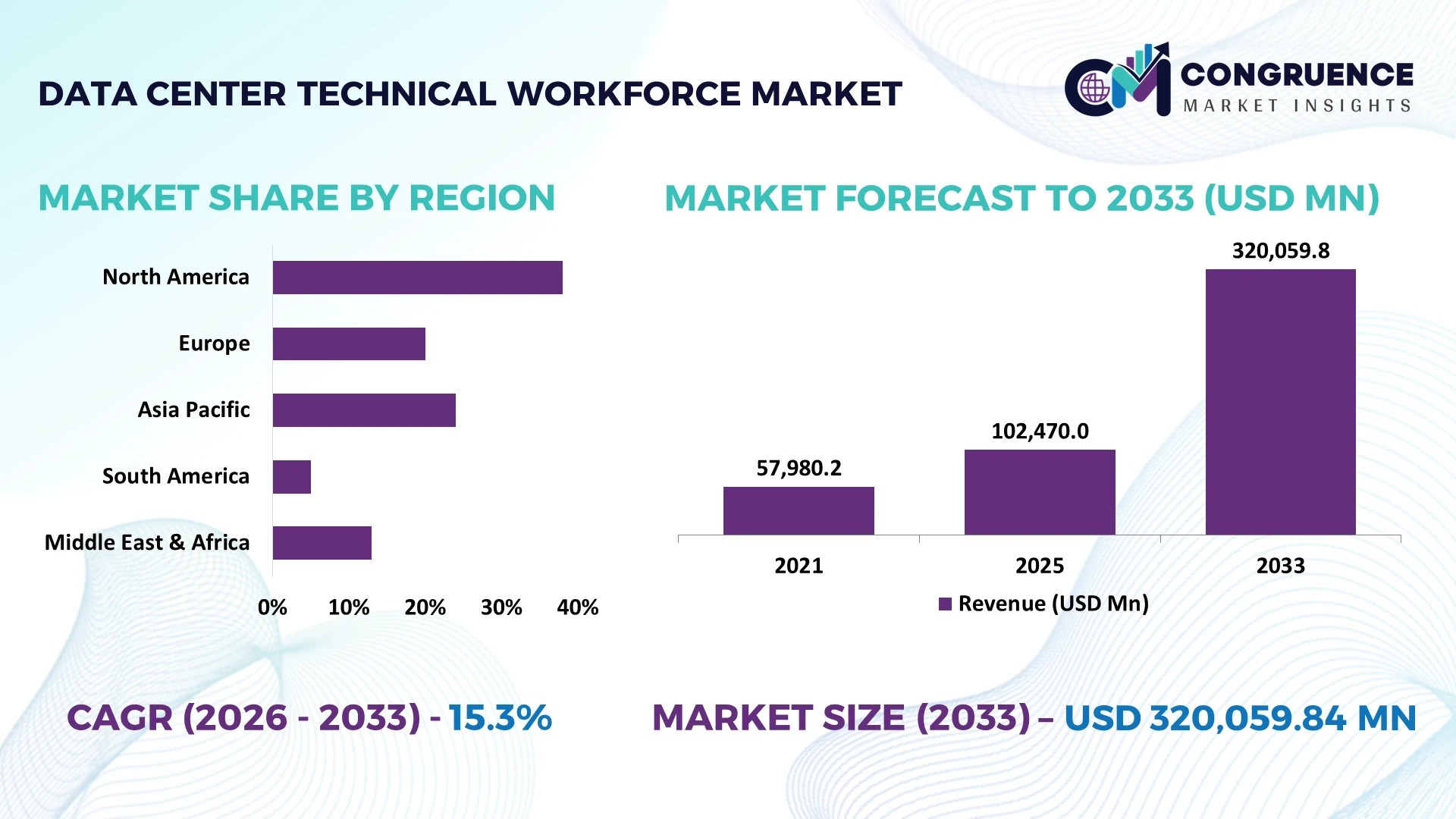
The Global Data Center Technical Workforce Market was valued at USD 102470 Million in 2025 and is anticipated to reach a value of USD 320059.84 Million by 2033 expanding at a CAGR of 15.3% between 2026 and 2033. Growth is driven by AI infrastructure commissioning, high-density computing deployments, electrical and cooling-system complexity, and persistent shortages of qualified facilities engineers, critical-environment technicians, and data center operations specialists.
The United States remains a leading workforce hub, supported by established hyperscale operators, cloud infrastructure, semiconductor ecosystems, and advanced engineering services. U.S. data center employment increased from approximately 306,000 workers in 2016 to 501,000 in 2023, representing growth of more than 60%. Investment in AI-ready facilities is intensifying competition for electrical, mechanical, controls, and power-management talent. The expansion also carries geopolitical significance as the United States strengthens domestic computing infrastructure and grid resilience, while India attracts major infrastructure commitments, including Amazon's announced USD 21 billion investment through 2030. Compared with mature U.S. hiring markets, India's expansion creates opportunities to develop technical training pipelines alongside new capacity.
Strategic implication: operators should prioritize regional workforce planning, technical certification, retention, and apprenticeship programs before staffing constraints delay commissioning or compromise operational reliability.
Market Size & Growth: USD 102.47 billion in 2025 to USD 320.06 billion by 2033, at a 15.3% CAGR, driven by AI infrastructure expansion and specialist staffing requirements.
Top Growth Drivers: 64% growth in U.S. data center job postings from 2023 to 2025; rising AI workloads; increasing demand for electrical and mechanical specialists.
Short-Term Forecast: By 2028, workforce investment should target measurable reductions in vacancy duration, overtime, and commissioning delays; operators must establish baseline KPIs before setting improvement targets.
Emerging Technologies: AI-assisted monitoring, automated diagnostics, and liquid-cooling systems are increasing demand for technicians skilled in controls, thermal management, and high-density infrastructure.
Regional Leaders: North America benefits from hyperscale expansion; Asia-Pacific recorded a 19.4 GW development pipeline in 2025; Europe prioritizes energy-efficient operations and environmental compliance.
Consumer/End-User Trends: 45% of IT workloads remain in corporate facilities, sustaining demand for enterprise data center engineers alongside cloud and colocation specialists.
Pilot/Case Example: In 2025, staffing research found that 74% of surveyed businesses reported customer data center delays or disruptions linked to staff shortages, reinforcing the need for workforce planning.
Competitive Landscape: Major employers include Amazon Web Services, Microsoft, Google, Equinix, and Digital Realty; no reliable consolidated workforce market-share estimate is available.
Regulatory & ESG Impact: European sustainability reporting and tightening power constraints increase demand for energy-management, cooling, and environmental-compliance specialists.
Investment & Funding: Amazon announced USD 21 billion in additional investment in India through 2030, reinforcing demand for locally available technical and operational talent.
Innovation & Future Outlook: Predictive maintenance, AI-ready facilities, and advanced power systems are shifting recruitment toward multidisciplinary skills, continuous certification, and retention-led workforce strategies.
The Data Center Technical Workforce Market is increasingly shaped by hyperscale facilities, AI computing infrastructure, cloud services, and colocation operations, where electrical reliability, thermal management, and uptime directly influence operating performance. Demand is concentrating around technicians trained in high-voltage systems, liquid cooling, building management systems, cybersecurity, and predictive maintenance. In 2025, 46% of surveyed data center operators reported difficulty finding qualified candidates, highlighting the gap between infrastructure expansion and technical talent availability. Power-grid constraints and equipment delivery delays further increase the value of workforce readiness. The emerging trend is skills-based recruitment combined with structured technical training, creating a strategic foundation for workforce investment and operational resilience.
The Data Center Technical Workforce Market has become a competitive infrastructure priority because AI deployment, high-density computing, and power-intensive facilities depend on specialized personnel as much as capital investment. Staffing capacity directly affects commissioning schedules, service availability, and the speed at which operators monetize new infrastructure. The United States faces intense competition for electrical engineers, controls specialists, and critical-environment technicians, while India is expanding its talent pipeline alongside cloud and data center investment.
A major market shift is the transition from conventional server facilities toward AI-ready infrastructure requiring advanced power distribution, liquid cooling, and automated monitoring. Modern monitoring and predictive maintenance can reduce unplanned equipment downtime by approximately 20–40% in suitable deployments compared with reactive maintenance, although results depend on asset condition and implementation quality. This transition increases demand for technicians who combine mechanical and electrical expertise with data analytics skills.
Over the next two to three years, operators will prioritize training throughput, certification coverage, retention, and contractor readiness to reduce vacancies and commissioning bottlenecks. For example, a new hyperscale facility requires coordinated deployment of power, cooling, network, and controls teams before service activation. Companies are therefore strengthening technical education partnerships, internal academies, and specialist maintenance contracts. Competitive advantage will increasingly depend on workforce readiness, not just available land, electricity, or construction funding.
AI infrastructure expansion is increasing demand for technicians capable of managing high-density racks, electrical distribution, advanced cooling, and automated facility controls. In 2025, 86% of surveyed data center operators planned to build new facilities, expand existing sites, or both, while 46% reported difficulty finding qualified candidates. These pressures are shifting recruitment from general facilities experience toward specialized power, mechanical, and controls expertise. In the United States, hyperscale expansion is intensifying competition for experienced engineers, while India offers opportunities to develop technical training pipelines around new infrastructure projects. Operators are responding through apprenticeship programs, engineering partnerships, and internal certification pathways. The strategic advantage lies in developing qualified talent before commissioning schedules create expensive staffing bottlenecks.
Workforce expansion faces structural constraints from equipment costs, extended procurement cycles, and limited availability of specialized technicians. In 2025, 57% of data center projects experienced construction delays of at least three months, while average equipment lead times reached approximately 33 weeks globally. U.S. equipment lead times remained 83% above 2019 levels, complicating workforce scheduling and contractor utilization. When transformers, switchgear, or cooling equipment arrive late, operators risk paying for mobilized teams before facilities are ready for installation. Developers are responding through advance procurement, multivendor sourcing, longer-term supplier agreements, and phased hiring aligned with equipment delivery. Workforce budgets must therefore be synchronized with procurement milestones rather than construction schedules alone.
Automation, predictive maintenance, and advanced cooling create opportunities to develop higher-value technical roles while improving operational productivity. In 2025, 45% of surveyed IT workloads remained in corporate facilities, sustaining demand for enterprise infrastructure specialists alongside hyperscale and colocation technicians. Meanwhile, 46% of operators reported difficulty recruiting qualified staff, highlighting the commercial value of expanding training capacity instead of relying exclusively on experienced hires. India's expanding infrastructure ecosystem creates opportunities for vocational institutes, equipment manufacturers, and operators to establish joint certification programs. Companies can also develop specialized training for liquid cooling, digital twins, and AI-assisted diagnostics. The strongest opportunity is to standardize transferable technical skills across facilities, reducing onboarding time and dependence on a narrow pool of experienced personnel.
The transition toward AI-ready infrastructure increases execution complexity because electrical systems, cooling equipment, network architecture, and automated controls must operate as an integrated environment. High-density AI racks exceeding 100 kW intensify thermal-management requirements and demand precise coordination between power and cooling specialists. Operational discipline remains equally important: in 2025, approximately one in ten reported data center outages caused serious or severe disruption. In the United States and other mature markets, experienced personnel must manage increasingly complex installations while supporting uninterrupted operations. Companies need competency-based authorization, realistic simulation exercises, standardized maintenance procedures, and cybersecurity training for connected operational technology. Long-term competitiveness depends on combining workforce depth with verifiable technical competence, ensuring that faster deployment does not undermine reliability or safety.
Data Center Engineers are central to infrastructure integration, system reliability, and commissioning, while Facilities Engineers and Data Center Technicians maintain electrical distribution, cooling systems, and equipment availability. A verified public breakdown of workforce spending by the seven specified types is unavailable, so assigning precise segment shares would be misleading. Network Engineers sustain connectivity and traffic performance, while Systems Administrators manage server configurations, operating environments, and service continuity. These established roles remain essential as operators expand infrastructure and manage increasingly complex installations.
Cloud Engineers and Cybersecurity Specialists are gaining importance as hybrid infrastructure, automated provisioning, and connected operational technology expand. Cloud Engineers support workload orchestration and infrastructure integration, whereas Cybersecurity Specialists strengthen access governance and protect connected systems. Companies are responding with cross-functional training, specialist recruitment, and partnerships with technical education providers. Investment priorities are shifting toward teams that combine traditional facilities expertise with cloud, automation, and security capabilities, reducing operational silos and improving deployment readiness.
Server Management remains fundamental to maintaining compute availability, configuration consistency, and workload performance. Network Operations supports connectivity and fault resolution, while Cloud Infrastructure Management is expanding alongside hybrid deployment and automated provisioning. A standardized public dataset establishing market shares across the seven specified applications is unavailable, making precise rankings unreliable. Data Center Security is also becoming more integrated with infrastructure operations as access controls, monitoring systems, and operational technology increasingly intersect.
Power and Cooling Management is gaining importance as AI workloads increase rack density and thermal complexity. Hardware Maintenance continues to support preventive servicing and equipment lifecycle management, while Disaster Recovery protects continuity during system failures. In its 2026 survey, Uptime Institute reported that a growing number of operators were managing peak rack densities of at least 30 kW. Companies are responding by strengthening cooling expertise, integrating monitoring systems, and coordinating maintenance across electrical and mechanical teams. These changes favor application-specific training and integrated operations over isolated technical responsibilities.
Cloud Service Providers require technical teams to maintain large-scale compute infrastructure, electrical systems, cooling, and network availability. Colocation Providers need specialists who can support multiple customers, equipment installations, and contractual uptime requirements. Enterprise Data Centers continue to employ engineers and administrators for hybrid infrastructure and legacy-system integration. Publicly verified workforce market shares across these seven end-user groups are unavailable, so precise percentages would create false accuracy.
Telecommunications Companies require network and facilities specialists, while Financial Institutions prioritize secure, resilient infrastructure and recovery capabilities. Government Agencies emphasize controlled access and dependable public-sector systems, and Healthcare Organizations need reliable infrastructure for sensitive information and essential digital services. Uptime Institute's 2025 staffing research found that 48% of surveyed colocation operators identified hiring new staff as a key organizational challenge, compared with 37% of enterprise operators. This difference highlights the pressure of scaling tenant-facing services. Providers are responding through technical apprenticeships, workforce partnerships, specialized service contracts, and stronger retention programs.
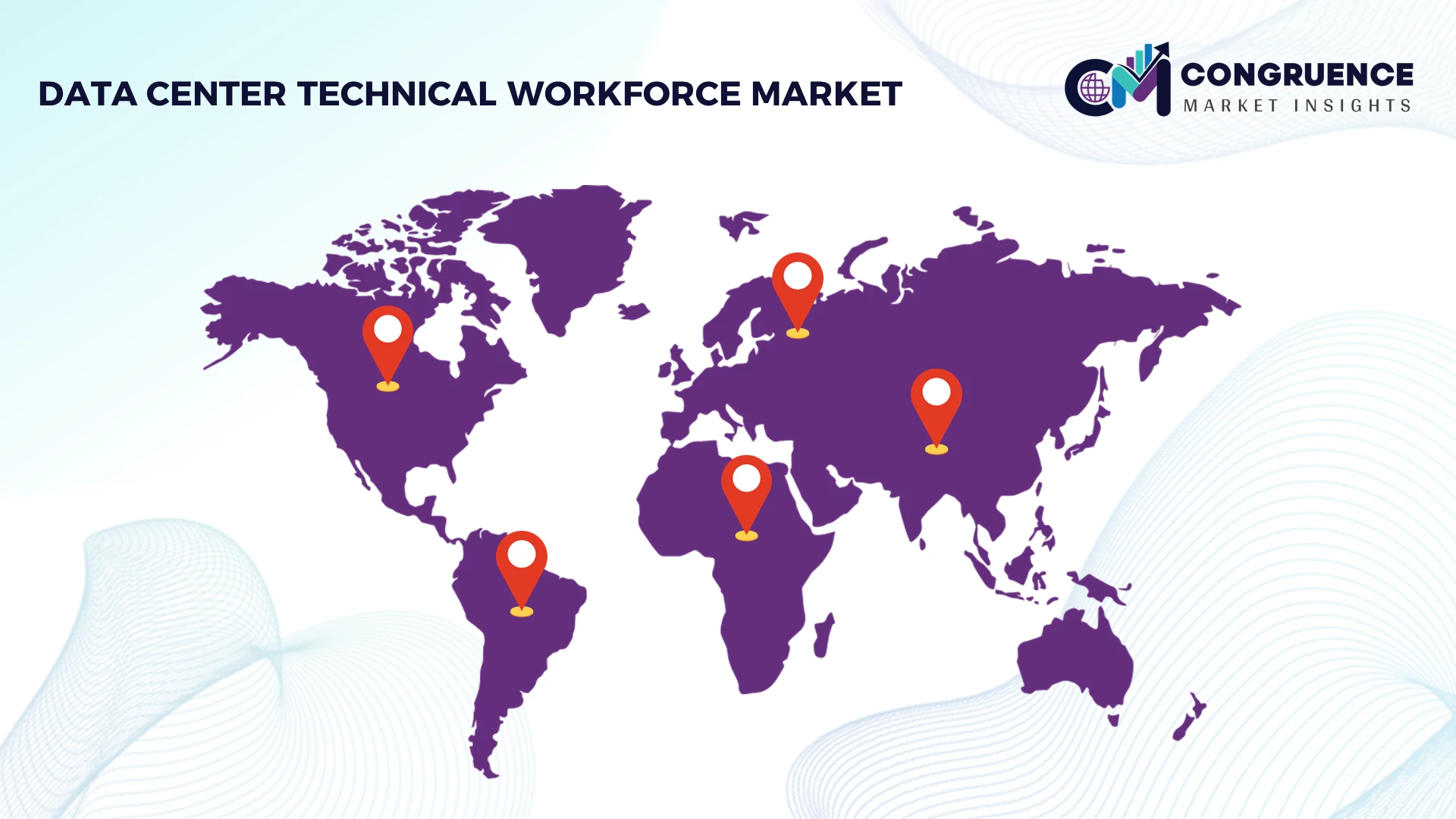
North America accounted for the largest market share at 37.78% in 2025 however, Asia-Pacific is expected to register the fastest growth, expanding at a CAGR of 18.84% between 2026 and 2033.
Hyperscale Expansion and AI Infrastructure Intensify Talent Competition
North America leads through its concentration of hyperscale campuses, cloud platforms, colocation facilities, and advanced engineering ecosystems. The United States dominates regional deployment, with approximately 50.4 GW of installed data center capacity at the end of 2025. This infrastructure base sustains demand for electrical engineers, commissioning specialists, network professionals, cooling technicians, and critical-facility operators. AI infrastructure expansion is also increasing demand for expertise in high-density power distribution and liquid cooling. However, grid interconnection constraints and intense competition for skilled trades are making workforce availability a commissioning priority. Operators are expanding technical apprenticeships, partnering with engineering contractors, and aligning recruitment with construction milestones. Canada benefits from established cloud infrastructure and access to lower-carbon electricity in selected markets, while Mexico offers opportunities linked to nearshoring and enterprise digitalization. Competitive advantage increasingly depends on securing qualified personnel before facilities become operational.
United States Market Outlook: The United States remains the region's principal workforce hub because of its concentration of hyperscale operators, major cloud providers, and large construction pipelines. Northern Virginia, Texas, Georgia, and Arizona require technicians with expertise in electrical systems, cooling, controls, and commissioning. Companies are expanding training partnerships and strengthening retention programs to address hiring pressure and avoid project delays.
Energy Efficiency and Regulatory Compliance Reshape Skills Demand
Europe's workforce market is shaped by established data center hubs, stricter energy-performance expectations, and increasing investment in efficient digital infrastructure. Frankfurt, London, Amsterdam, Paris, and Dublin remain important deployment centers, while Nordic markets attract projects seeking suitable power availability and lower-carbon electricity. European operational capacity reached approximately 10.3 GW in the first half of 2025, reflecting a 21% increase year over year across the markets covered by a regional industry update. This expansion supports recruitment across facilities engineering, electrical maintenance, cooling optimization, and compliance management. Energy reporting requirements are also increasing the importance of technicians who can monitor power usage effectiveness and document operational performance. Operators are investing in automation, specialist training, and recruitment beyond saturated metropolitan hubs. The strategic shift is toward workforce models that combine reliability with energy efficiency, helping facilities meet environmental expectations without compromising service availability.
Germany Market Outlook: Germany benefits from its industrial engineering base, enterprise computing demand, and established Frankfurt data center cluster. Workforce requirements center on electrical infrastructure, thermal management, network reliability, and energy optimization. As operators expand facilities and modernize existing installations, partnerships with technical training institutions and engineering service providers will be essential to maintaining commissioning capacity and operational consistency.
Rapid Capacity Deployment Expands Technical Talent Requirements
Asia-Pacific is emerging as a high-growth workforce market as hyperscale investment, cloud adoption, and AI infrastructure development accelerate across established and emerging digital hubs. The region's data center development pipeline reached 19.4 GW in 2025, including 3.7 GW under construction and 15.7 GW in planning. Southeast Asia accounted for 31% of the region's under-construction capacity, increasing demand for commissioning engineers, electrical specialists, cooling technicians, and network operations personnel. Singapore's mature ecosystem emphasizes specialized operations and energy efficiency, while Malaysia, Indonesia, and Thailand are attracting new infrastructure projects. India's expanding digital economy supports additional demand for cloud engineering, facilities maintenance, and technical operations. Companies are developing local training partnerships, expanding contractor networks, and standardizing technical certifications. The central workforce challenge is converting rapid construction activity into a sustainable supply of qualified personnel who can operate increasingly complex facilities after commissioning.
China Market Outlook: China benefits from its extensive digital infrastructure, domestic technology ecosystem, and established engineering workforce. Demand spans facilities operations, server management, electrical systems, and network engineering. Domestic infrastructure investment and the development of AI computing capacity reinforce the importance of specialized technical training. Operators prioritize local recruitment, automation, and standardized maintenance procedures to support reliable operations across large-scale deployments.
Cloud Expansion Strengthens Brazil's Infrastructure Talent Demand
South America's workforce market is concentrated in Brazil, where cloud adoption, enterprise modernization, and investment in colocation facilities support demand for technical personnel. São Paulo serves as a major infrastructure hub, attracting data center development and strengthening requirements for electrical engineers, facilities technicians, network specialists, and systems administrators. Chile and other markets offer additional opportunities as businesses expand digital services and cloud connectivity. However, uneven power infrastructure, financing constraints, and shortages of experienced critical-facility professionals can complicate project delivery outside established hubs. Operators are responding through technical training partnerships, outsourced maintenance arrangements, and phased recruitment aligned with commissioning schedules. Demand is also increasing for professionals who understand backup power, cooling efficiency, and service continuity. The region's workforce advantage will depend on developing local technical capabilities that reduce reliance on imported expertise and support consistent operational standards across new and existing facilities.
Brazil Market Outlook: Brazil leads regional workforce demand through its large enterprise economy, established telecommunications infrastructure, and concentration of cloud and colocation facilities around São Paulo. Technical recruitment focuses on electrical maintenance, cooling systems, network operations, and facility reliability. Operators are strengthening relationships with engineering contractors and training providers to expand qualified labor availability as new facilities enter service.
Digital Infrastructure Investment Accelerates Specialized Hiring
The Middle East and Africa workforce market is developing around cloud adoption, government digitalization, AI infrastructure investment, and telecommunications modernization. Saudi Arabia's operational data center capacity increased from 68 MW in 2021 to 440 MW in 2025, demonstrating the scale of its infrastructure expansion. The United Arab Emirates is also strengthening its position through hyperscale investment and AI-focused computing projects. These developments increase demand for electrical engineers, cooling specialists, commissioning teams, cybersecurity professionals, and facilities operators. South Africa remains an important African hub, while other markets are developing digital infrastructure from a smaller base. Power availability, water-efficient cooling, and the availability of experienced technicians influence project selection and operating costs. Companies are responding through international technology partnerships, local workforce development, and specialist service agreements. The strategic priority is building operational expertise alongside physical capacity, particularly where advanced infrastructure is expanding faster than established training systems.
Saudi Arabia Market Outlook: Saudi Arabia is strengthening its data center ecosystem through digital transformation initiatives, AI infrastructure development, and investment in domestic cloud capabilities. Riyadh and Dammam are important deployment centers, creating demand for facilities engineers, electrical specialists, cooling technicians, and network professionals. Operators are expanding technical recruitment and training to support new capacity while improving power reliability, maintenance readiness, and operational resilience.
The Data Center Technical Workforce Market is fragmented across global engineering service providers, specialist staffing firms, technical training organizations, and regional contractors. Global providers such as Schneider Electric, Vertiv, and CBRE compete through integrated infrastructure expertise and maintenance capabilities, while Equinix and Digital Realty strengthen in-house technical operations to protect facility uptime. Specialist recruitment firms compete with regional engineering contractors on hiring speed, certification coverage, and labor availability. A defensible combined market share for the top five players cannot be established because workforce services lack a standardized market definition and comparable company-level share disclosures.
Competition centers on technical specialization, deployment readiness, and service reliability rather than hourly pricing alone. Operators prioritize reducing vacancy duration, commissioning delays, and dependence on scarce electrical and cooling specialists. Providers respond through training academies, contractor partnerships, workforce planning, and automation-enabled maintenance. AI-ready facilities are shifting demand toward multidisciplinary expertise and liquid-cooling skills. Entry barriers include certification requirements, safety compliance, and proven critical-facility experience. Winning requires scalable talent pipelines, verified competencies, and rapid deployment without compromising uptime.
CBRE Group
Jones Lang LaSalle (JLL)
Schneider Electric
Vertiv
Siemens
Johnson Controls
Cushman & Wakefield
NTT DATA
Kyndryl
Equinix
Digital Realty
Amazon Web Services
AI-assisted data center infrastructure management is reshaping technical operations through predictive fault detection, automated alerts, and integrated telemetry. Predictive maintenance can reduce unplanned downtime by 20–40% in suitable deployments, while automated monitoring can improve maintenance productivity by 1–2% when workflows are effectively integrated. Adoption increasingly combines facility-management platforms with electrical, cooling, and server telemetry. Technicians consequently need diagnostic and controls expertise alongside conventional maintenance skills.
Digital twins and remote operations are extending workforce capabilities by allowing teams to monitor equipment conditions, simulate operating scenarios, and coordinate maintenance across distributed facilities. Compared with reactive maintenance, predictive approaches can reduce equipment failures and unnecessary service interventions, although results depend on system maturity and asset criticality. Operators benefit from improved maintenance planning, faster fault isolation, and more consistent service delivery. Multidisciplinary training is becoming essential.
Between 2026 and 2028, AI-assisted diagnostics, liquid-cooling controls, robotics, and cybersecurity-integrated operational technology will increase demand for specialized technicians. Hyperscale operators and infrastructure providers with established automation platforms and structured training programs stand to benefit most. Companies should prioritize interoperable monitoring systems, practical simulation training, and measurable competency development to reduce commissioning friction and maintain reliability as computing density rises.
The Data Center Technical Workforce Market Report examines workforce demand, technical specialization, and operational staffing requirements across the global data center ecosystem. Coverage includes seven workforce types: Data Center Engineers, Network Engineers, Systems Administrators, Cloud Engineers, Cybersecurity Specialists, Facilities Engineers, and Data Center Technicians. Application analysis spans Server Management, Network Operations, Cloud Infrastructure Management, Data Center Security, Power and Cooling Management, Hardware Maintenance, and Disaster Recovery. End-user coverage includes Cloud Service Providers, Colocation Providers, Enterprise Data Centers, Telecommunications Companies, Financial Institutions, Government Agencies, and Healthcare Organizations.
Regional analysis evaluates North America, Europe, Asia-Pacific, South America, and the Middle East and Africa, highlighting country-level infrastructure development, hiring constraints, and investment priorities. Technology coverage includes AI-assisted monitoring, predictive maintenance, liquid cooling, automation, and cybersecurity-integrated operations. The report supports workforce planning, recruitment investment, training partnerships, geographic expansion, competitive positioning, and strategic decisions for 2026–2033, with emphasis on technical skills gaps, operational reliability, and emerging infrastructure requirements.
| Report Attribute/Metric | Report Details |
|---|---|
Market Revenue in 2025 | USD 102470 Million |
Market Revenue in 2033 | USD 320059.84 Million |
CAGR (2026 - 2033) | 15.3% |
Base Year | 2025 |
Forecast Period | 2026 - 2033 |
Historic Period | 2021 - 2025 |
Segments Covered | By Type
By Application
By End-User
|
Key Report Deliverable | Revenue Forecast, Growth Trends, Market Dynamics, Segmental Overview, Regional and Country-wise Analysis, Competition Landscape |
Region Covered | North America, Europe, Asia-Pacific, South America, Middle East, Africa |
Key Players Analyzed | CBRE Group, Jones Lang LaSalle (JLL), Schneider Electric, Vertiv, Siemens, Johnson Controls, Cushman & Wakefield, NTT DATA, Kyndryl, Equinix, Digital Realty, Amazon Web Services |
Customization & Pricing | Available on Request (10% Customization is Free) |




