
Reports
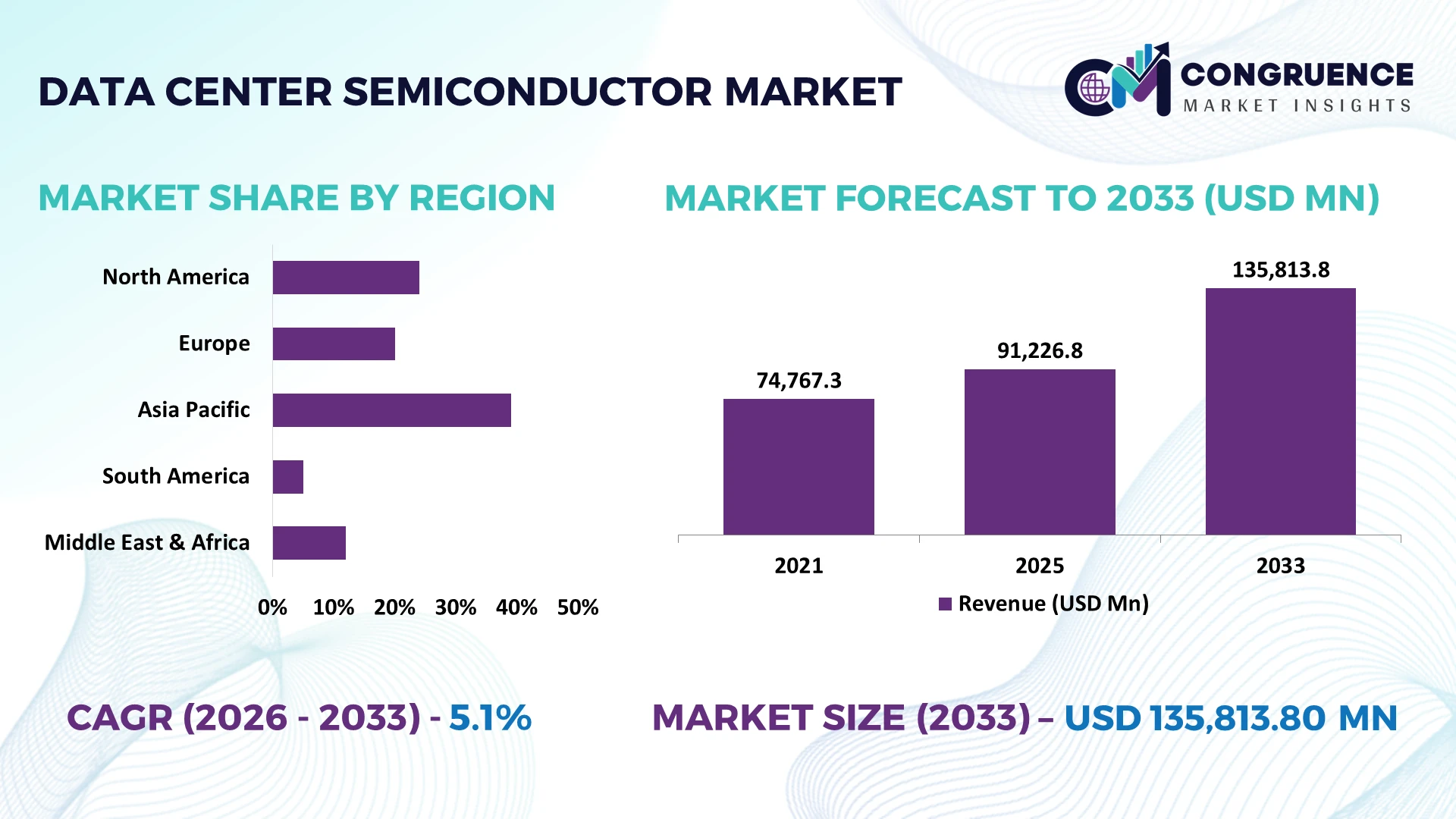
The Global Data Center Semiconductor Market was valued at USD 91226.8 Million in 2025 and is anticipated to reach a value of USD 135813.8 Million by 2033 expanding at a CAGR of 5.1% between 2026 and 2033. Growth is being accelerated by AI-optimized server deployments, advanced packaging technologies, high-bandwidth memory integration, and hyperscale data center expansion supporting next-generation computing infrastructure.
The United States remains the dominant country, accounting for approximately 39% of global hyperscale data center capacity, supported by multi-billion-dollar semiconductor manufacturing investments and widespread AI infrastructure deployment across cloud, financial, and enterprise sectors. Compared with China, which holds nearly 16% of hyperscale capacity, the U.S. benefits from stronger advanced chip design capabilities and over 70% enterprise AI server adoption. Ongoing semiconductor localization initiatives following global supply-chain realignment continue strengthening production resilience and technology leadership.
For market participants, prioritizing advanced AI accelerators, energy-efficient chip architectures, and resilient manufacturing partnerships will define long-term competitive positioning.
Market Size & Growth: USD 91226.8 Million in 2025, projected to reach USD 135813.8 Million by 2033 at a CAGR of 5.1%, driven by AI server expansion and advanced semiconductor packaging.
Top Growth Drivers: AI workload deployment (+34%), hyperscale infrastructure expansion (+22%), and high-bandwidth memory integration (+18%) continue strengthening global market demand.
Short-Term Forecast: By 2028, advanced semiconductor platforms improve data center computing efficiency by approximately 27% while reducing power consumption per workload by nearly 16%.
Emerging Technologies: Chiplet architecture, silicon photonics, AI accelerators, and 3D advanced packaging increase processing density by over 30% across high-performance data centers.
Regional Leaders: North America exceeds USD 52 Billion through AI adoption, Asia Pacific approaches USD 43 Billion with semiconductor capacity expansion, while Europe surpasses USD 21 Billion through energy-efficient infrastructure deployment.
Consumer/End-User Trends: More than 68% of hyperscale operators prioritize AI-ready processors and memory-intensive semiconductor platforms for new infrastructure investments.
Pilot/Case Example: During 2026, AI-optimized server deployments improved inference throughput by approximately 35% while reducing infrastructure latency by nearly 20%.
Competitive Landscape: Leading manufacturers collectively control around 56% of the global market, with NVIDIA, Intel, AMD, Broadcom, and Samsung maintaining technology leadership.
Regulatory & ESG Impact: Energy-efficiency regulations and sustainable infrastructure programs lower facility-level semiconductor power usage by approximately 14% while supporting regional supply-chain diversification.
Investment & Funding: More than USD 70 Billion in manufacturing expansion, strategic partnerships, and advanced fabrication projects strengthens long-term semiconductor resilience amid global supply-chain shifts.
Innovation & Future Outlook: Next-generation AI accelerators, CXL-enabled memory ecosystems, and advanced heterogeneous integration establish the strategic foundation for high-growth data center semiconductor platforms.
The Data Center Semiconductor Market is advancing through AI accelerator integration, chiplet-based processor architectures, and high-bandwidth memory innovations supporting cloud computing, enterprise AI, and hyperscale infrastructure. More than 60% of new AI-focused server platforms now prioritize energy-efficient semiconductor designs, while ongoing semiconductor supply-chain localization and manufacturing expansion strengthen production resilience. These developments establish a strong foundation for the strategic market assessment that follows.
The Data Center Semiconductor Market has become strategically important as artificial intelligence computing, sovereign digital infrastructure, and enterprise cloud modernization redefine global technology competition. Semiconductor supply-chain restructuring and domestic manufacturing incentives are reshaping procurement strategies, encouraging operators to diversify sourcing while reducing dependence on single-country production. This shift strengthens operational resilience and accelerates deployment of AI-ready computing platforms across hyperscale and enterprise facilities.
Modern chiplet-based processors combined with advanced packaging deliver nearly 28% higher computing efficiency and around 18% lower power consumption than conventional monolithic architectures, improving rack-level performance while reducing operating costs. The United States continues leading large-scale AI infrastructure deployment through hyperscale investment, while Japan emphasizes energy-efficient semiconductor integration and advanced packaging innovation for high-density computing environments. Over the next two to three years, AI-enabled server installations are expected to represent more than 45% of newly commissioned high-performance data center capacity.
Cloud operators are deploying liquid-cooled AI clusters integrated with high-bandwidth memory to improve workload density and optimize energy utilization, while semiconductor manufacturers expand packaging capacity through strategic technology partnerships and localized production. Companies prioritizing advanced architectures, manufacturing resilience, and ecosystem collaboration will secure stronger competitive positioning as AI infrastructure becomes the foundation of enterprise digital transformation.
Enterprise adoption of generative AI, large language models, and high-performance computing is accelerating demand for advanced data center semiconductors. AI server deployments are increasing by approximately 32%, while high-bandwidth memory integration has expanded by nearly 25% across new hyperscale installations. The United States continues strengthening domestic semiconductor manufacturing through strategic industrial policies, encouraging greater investment in advanced fabrication and packaging capabilities. This structural shift increases demand for AI accelerators, networking chips, and power-efficient processors. Semiconductor companies are responding by expanding advanced packaging facilities, forming long-term cloud partnerships, and accelerating custom chip development. A notable strategic advantage is the growing preference for workload-specific processors that improve computing efficiency while lowering infrastructure operating costs for hyperscale operators.
Advanced semiconductor production remains constrained by high fabrication costs, packaging complexity, and concentrated manufacturing capacity. More than 70% of leading-edge chip production is still dependent on a limited number of fabrication ecosystems, while advanced packaging lead times have increased by approximately 20% during periods of peak demand. Export control measures and technology restrictions continue affecting cross-border semiconductor availability for selected markets. These structural limitations delay AI infrastructure deployment, increase procurement costs, and reduce operational flexibility for cloud providers. Companies are reducing exposure by diversifying suppliers, expanding localized packaging facilities, securing multi-year procurement agreements, and investing in alternative component qualification to improve supply continuity and manufacturing resilience.
Next-generation chiplet architectures, silicon photonics, and CXL-enabled memory technologies are creating new opportunities for higher-performance data center infrastructure. Chiplet-based platforms improve design flexibility by nearly 30%, while advanced interconnect technologies reduce communication latency by approximately 22% in AI-intensive workloads. India is emerging as an important semiconductor design and advanced electronics hub through manufacturing incentives and engineering talent expansion. Companies are strengthening R&D investments, collaborating with cloud providers, and developing integrated hardware-software ecosystems for AI optimization. A valuable strategic opportunity lies in customized accelerators tailored to specific enterprise workloads, enabling lower energy consumption, faster deployment cycles, and differentiated computing performance beyond traditional general-purpose processors.
Long-term competitiveness depends on scaling advanced semiconductor infrastructure without compromising operational efficiency or sustainability. AI-enabled data centers can increase rack power density by more than 40%, requiring significant upgrades in cooling systems, power delivery, and facility engineering. The shortage of advanced semiconductor packaging specialists and AI hardware engineers continues affecting deployment schedules in technology-intensive markets such as the United States. Maintaining cybersecurity across increasingly heterogeneous computing architectures further increases operational complexity. Companies must expand workforce development, strengthen infrastructure partnerships, invest in liquid-cooling technologies, and standardize interoperable semiconductor platforms. Organizations that successfully balance performance, energy efficiency, and deployment consistency will establish durable competitive advantages in next-generation AI infrastructure.
Advanced Packaging Becomes Standard Advanced packaging and chiplet integration are moving into mainstream data center deployments, with chiplet-enabled processors improving compute density by approximately 30% and reducing interconnect latency by nearly 20%. Growing AI infrastructure demand and packaging capacity constraints are pushing U.S. and Taiwanese manufacturers to expand outsourced assembly partnerships. Companies are restructuring supply chains, increasing packaging investments, and accelerating heterogeneous integration to improve product availability while shortening qualification cycles.
Liquid Cooling Hardware Integration AI servers exceeding 40 kW per rack are driving semiconductor optimization alongside liquid-cooling adoption. Nearly 45% of newly planned hyperscale AI deployments are designed for liquid-cooled environments, reducing cooling energy requirements by approximately 18%. Enterprise operators are redesigning server architectures around power-efficient processors, while semiconductor vendors collaborate with cooling technology providers to improve thermal performance, operational reliability, and infrastructure utilization under increasingly demanding AI workloads.
Custom Silicon Deployment Accelerates Enterprise demand for application-specific processors continues expanding, with customized accelerator adoption increasing by approximately 27% across hyperscale operators and workload efficiency improving by nearly 24% compared with standard CPU-centric environments. Digital sovereignty initiatives and AI optimization requirements are encouraging cloud providers to strengthen long-term semiconductor design partnerships. Companies are scaling custom silicon programs to lower operating costs while differentiating cloud service performance.
Memory-Centric Computing Expansion High-bandwidth memory deployment has increased by nearly 35% in advanced AI servers as larger foundation models require greater memory bandwidth and lower latency. More than 60% of enterprise AI infrastructure planning now prioritizes memory optimization alongside processor selection. Semiconductor manufacturers are expanding memory production capacity, strengthening packaging ecosystems, and integrating next-generation interconnect technologies to improve system throughput while reducing infrastructure bottlenecks created by increasingly data-intensive computing environments.
Processors remain the leading segment, accounting for approximately 46% of the Data Center Semiconductor Market due to their central role in AI computing, virtualization, cloud workloads, and high-performance enterprise applications. Continuous architectural improvements, advanced packaging, and workload-specific optimization enable higher computing density and lower power consumption. Memory Chips represent the fastest-growing segment, supported by increasing adoption of high-bandwidth memory for AI training and inference, where memory bandwidth has become as critical as processor performance. Semiconductor manufacturers continue investing in processor-roadmap expansion while strengthening memory partnerships to improve integrated platform performance.
Power Semiconductors and Networking ICs continue strengthening their strategic relevance as rack power density and data traffic increase. Power semiconductor demand is expanding alongside higher-efficiency power delivery systems, while Networking ICs support low-latency communication across AI clusters and hyperscale infrastructure. Networking bandwidth requirements have increased by nearly 30%, and advanced memory adoption has exceeded 35% within AI-focused server platforms. Companies are accelerating product innovation, expanding advanced packaging capabilities, and developing tightly integrated processor-memory-networking ecosystems to strengthen long-term competitive differentiation.
Servers remain the largest application segment with approximately 48% market share because every hyperscale, enterprise, and AI deployment depends on increasingly powerful computing platforms. AI Infrastructure represents the fastest-growing application as organizations deploy dedicated accelerator clusters for generative AI, scientific computing, and large-scale analytics. AI-enabled server deployments have increased by nearly 33%, while average processor density per rack continues rising to support higher-performance workloads. Semiconductor vendors are expanding accelerator portfolios and strengthening integration with memory and networking technologies.
Storage Systems continue evolving through faster controller semiconductors supporting AI datasets and real-time analytics, while Networking Equipment gains importance as east-west traffic expands across distributed AI clusters. Networking bandwidth demand has increased by approximately 28%, supporting higher-speed switching and interconnect technologies. Companies are scaling manufacturing, automating validation processes, and optimizing complete platform architectures to improve deployment speed, workload efficiency, and infrastructure scalability across enterprise and cloud environments.
Cloud Service Providers dominate the end-user landscape with approximately 52% market share because of continuous hyperscale infrastructure expansion, AI service deployment, and enterprise cloud migration. Telecommunications is the fastest-growing end-user segment as 5G expansion, edge computing, and distributed AI processing require advanced networking and accelerator semiconductors. AI-enabled cloud infrastructure deployments have increased by approximately 30%, while semiconductor utilization across hyperscale environments continues improving through workload optimization and custom silicon integration. Manufacturers are prioritizing long-term cloud partnerships and customized semiconductor development.
Colocation Providers remain strategically important by expanding AI-ready facilities for enterprise customers requiring scalable infrastructure without direct capital investment. Enterprises continue modernizing private infrastructure using energy-efficient processors and advanced memory technologies to support hybrid AI workloads. More than 40% of large enterprise deployments now integrate AI-optimized semiconductor platforms. Companies are strengthening ecosystem partnerships, introducing tailored platform solutions, and expanding service-based semiconductor offerings to address increasingly diverse infrastructure requirements across cloud, enterprise, and telecommunications environments.
North America accounted for the largest market share at 41.8% in 2025 however, Asia-Pacific is expected to register the fastest growth, expanding at a CAGR of 6.4% between 2026 and 2033.
AI Infrastructure Leadership and Advanced Semiconductor Ecosystems
North America remains the operational center of the Data Center Semiconductor Market, supported by hyperscale cloud providers, advanced semiconductor design capabilities, and rapid AI infrastructure deployment. The region contributes approximately 42% of global hyperscale data center capacity, while AI server installations continue expanding across enterprise and cloud environments. Advanced packaging investments and domestic semiconductor manufacturing initiatives strengthen supply resilience and reduce dependency on overseas production. Strategic collaborations between semiconductor vendors and cloud operators accelerate deployment of customized AI accelerators, networking ICs, and high-bandwidth memory platforms. More than 65% of newly deployed enterprise AI infrastructure incorporates advanced semiconductor architectures optimized for performance, energy efficiency, and large-scale workload execution, reinforcing the region's technology leadership.
United States Market Outlook: The United States dominates regional demand through large hyperscale operators, semiconductor innovation, and advanced manufacturing investments. More than 70% of North American hyperscale facilities are located in the country, supporting continuous deployment of AI processors, advanced networking chips, and high-performance memory. Domestic fabrication expansion, packaging capacity investments, and long-term cloud partnerships strengthen operational resilience while accelerating commercialization of next-generation semiconductor platforms.
Energy-Efficient Digital Infrastructure Transformation
Europe continues strengthening its position through sustainable digital infrastructure, semiconductor modernization, and energy-efficient computing initiatives. Enterprise cloud modernization and AI deployment are increasing demand for processors, power semiconductors, and networking ICs designed for lower power consumption. Approximately 24% of new regional data center developments integrate advanced liquid-cooling infrastructure to support high-density AI workloads. Industrial digitalization, stricter energy-efficiency requirements, and semiconductor ecosystem collaboration encourage technology upgrades across enterprise and colocation facilities. Companies continue expanding design capabilities while investing in resilient semiconductor supply chains and advanced packaging partnerships that improve deployment flexibility.
Germany Market Outlook: Germany leads the regional market through strong industrial automation, engineering expertise, and enterprise digital transformation. AI adoption across manufacturing and automotive industries continues increasing demand for advanced data center processors and networking semiconductors. More than 30% of enterprise digital infrastructure modernization projects incorporate AI-ready computing platforms, encouraging semiconductor suppliers to strengthen local partnerships and application-specific product development.
Manufacturing Scale and AI Deployment Expansion
Asia-Pacific represents the fastest-evolving market due to its integrated semiconductor manufacturing ecosystem, expanding hyperscale infrastructure, and accelerating AI adoption. The region produces more than 60% of global semiconductor manufacturing output while rapidly increasing advanced packaging capacity for AI-oriented processors and memory technologies. Cloud operators continue expanding regional infrastructure, supported by enterprise digital transformation and government-backed semiconductor initiatives. Export-oriented manufacturing, electronics production, and growing demand for AI computing platforms encourage continuous investment across fabrication, testing, and advanced assembly operations. Companies are strengthening cross-border partnerships to improve production flexibility and shorten technology commercialization timelines.
Taiwan Market Outlook: Taiwan remains strategically critical because of its advanced foundry ecosystem and leadership in semiconductor manufacturing technologies. A significant share of leading-edge processors supporting AI data centers is manufactured within the country, while advanced packaging expansion continues accelerating. Strong collaboration between chip designers, fabrication companies, and equipment suppliers enables rapid commercialization of next-generation semiconductor platforms for hyperscale infrastructure worldwide.
Cloud Infrastructure Drives Regional Demand
South America is experiencing increasing semiconductor demand as cloud adoption, enterprise digitalization, and colocation investments expand regional data center infrastructure. Brazil and neighboring markets continue deploying modern facilities supporting financial services, retail, and public-sector digital transformation. Enterprise cloud migration has increased by approximately 26%, encouraging investment in processors, networking ICs, and energy-efficient power semiconductors. Infrastructure limitations and imported semiconductor dependency remain operational constraints, yet strategic partnerships with international technology providers continue improving deployment capability. Companies increasingly prioritize localized technical support and infrastructure optimization to strengthen operational efficiency.
Brazil Market Outlook: Brazil leads regional demand through its expanding cloud ecosystem, financial technology sector, and enterprise modernization initiatives. More than 55% of South America's large-scale data center capacity is concentrated in Brazil, supporting continued deployment of AI-ready server infrastructure. International cloud providers and semiconductor vendors are expanding partnerships to improve computing capacity, infrastructure resilience, and service availability across major metropolitan markets.
Digital Infrastructure Investment Accelerates Deployment
The Middle East & Africa market is strengthening through digital transformation strategies, hyperscale investments, and expanding cloud infrastructure. Governments and private investors continue supporting advanced data center projects to strengthen digital sovereignty and enterprise computing capabilities. AI-ready infrastructure deployment has increased by approximately 22% across major technology hubs, encouraging higher demand for processors, networking ICs, and power management semiconductors. International technology partnerships, modernization initiatives, and improved connectivity continue supporting regional deployment despite varying infrastructure maturity. Companies increasingly establish strategic alliances to accelerate technology transfer and improve operational reliability.
United Arab Emirates Market Outlook: The United Arab Emirates leads regional development through advanced digital infrastructure, cloud investment, and AI adoption initiatives. Large-scale technology parks and enterprise modernization programs continue increasing semiconductor demand for hyperscale facilities and government digital services. Continued investment in smart infrastructure and international technology partnerships strengthens the country's position as a regional hub for advanced data center deployment and semiconductor-enabled computing.
The market is led by NVIDIA, Intel, AMD, Broadcom, and Samsung Electronics, while Marvell Technology, Micron Technology, and Qualcomm compete aggressively in specialized networking, memory, and accelerator segments. Global technology leaders compete against regional manufacturing specialists through architecture performance, supply-chain resilience, customization, and production scalability. The top five companies collectively control approximately 56% of the market. Competition increasingly centers on AI accelerator performance, where processing efficiency improvements above 25% and power optimization nearing 18% create measurable enterprise advantages. Vendors strengthen competitive positions through advanced packaging expansion, custom silicon partnerships with hyperscale cloud providers, vertical integration, and long-term manufacturing agreements. Supply-chain localization and advanced packaging capacity have become decisive competitive differentiators, accelerating consolidation around technology leadership rather than price alone. High capital requirements, advanced fabrication expertise, and ecosystem integration create substantial entry barriers. Sustained leadership depends on delivering AI-optimized architectures, resilient manufacturing capacity, rapid product commercialization, and strategic cloud partnerships.
NVIDIA Corporation
Intel Corporation
Advanced Micro Devices (AMD)
Broadcom Inc.
Samsung Electronics Co., Ltd.
Micron Technology, Inc.
Marvell Technology, Inc.
Qualcomm Incorporated
SK hynix Inc.
MediaTek Inc.
Renesas Electronics Corporation
Infineon Technologies AG
Texas Instruments Incorporated
STMicroelectronics N.V.
AI accelerators, advanced CPUs, high-bandwidth memory (HBM), chiplet architectures, and silicon photonics define the current technology landscape across hyperscale data centers. More than 68% of newly deployed AI servers now integrate heterogeneous computing platforms combining CPUs, GPUs, and specialized accelerators. HBM adoption improves memory bandwidth by approximately 35%, while silicon photonics lowers interconnect latency by nearly 18%, enabling faster AI training and large-scale inference. Companies increasingly integrate processors, networking ICs, and advanced packaging into unified computing platforms to improve workload efficiency and infrastructure utilization.
Emerging technologies between 2026 and 2028 include CXL-enabled memory expansion, liquid-cooled semiconductor platforms, optical interconnects, and 3D chip stacking. Compared with conventional monolithic processor designs, chiplet-based architectures deliver approximately 28% higher compute efficiency while reducing manufacturing costs by nearly 15% through modular production. More than 45% of hyperscale AI infrastructure projects are expected to deploy advanced packaging and liquid-cooling integration, improving rack density and reducing operational power requirements across next-generation computing environments.
Disruptive innovation is shifting competition toward integrated AI ecosystems rather than standalone chips. Leading semiconductor innovators benefit through faster product deployment, customized accelerator platforms, and resilient packaging ecosystems, while traditional processor suppliers face increasing pressure to diversify architectures. Organizations investing early in heterogeneous computing, advanced memory integration, and packaging automation will strengthen operational scalability, reduce deployment bottlenecks, and secure competitive advantages as enterprise AI infrastructure rapidly expands through 2028.
March 2024 NVIDIA introduced the Blackwell platform featuring next-generation AI GPUs capable of reducing large language model inference cost and energy consumption by up to 25× while expanding support across major cloud providers, strengthening hyperscale AI infrastructure adoption.
September 2024 Intel launched Xeon 6 processors and Gaudi 3 AI accelerators, delivering up to 20% higher AI inference throughput and 2× price-performance versus NVIDIA H100 for selected workloads, expanding enterprise AI deployment choices.
September 2024 Broadcom confirmed accelerating AI semiconductor expansion driven by Ethernet networking and custom AI accelerators supporting hyperscale data centers, highlighting an expected AI semiconductor business of approximately USD 12 billion for fiscal 2024, reinforcing custom silicon leadership. Source: Broadcom
May 2026 Broadcom released VMware Cloud Foundation 9.1 with integrated support for AMD, Intel, and NVIDIA platforms, enabling lower-cost enterprise AI deployment through an open hardware ecosystem and strengthening private AI infrastructure modernization.
The report delivers comprehensive analysis of the Data Center Semiconductor Market across Processors, Memory Chips, Power Semiconductors, and Networking ICs, covering applications including Servers, Storage Systems, Networking Equipment, and AI Infrastructure. It evaluates demand across Cloud Service Providers, Colocation Providers, Enterprises, and Telecommunications while assessing operational trends across North America, Europe, Asia-Pacific, South America, and the Middle East & Africa. More than 65% of recent enterprise infrastructure deployments emphasize AI-ready semiconductor platforms, reflecting accelerating technology integration and evolving deployment priorities.
The study examines advanced packaging, AI accelerators, chiplet architectures, silicon photonics, high-bandwidth memory, and energy-efficient semiconductor technologies alongside competitive positioning, manufacturing strategies, and supply-chain developments. Strategic insights support investment planning, product expansion, ecosystem partnerships, infrastructure modernization, and capacity optimization between 2026 and 2033, enabling stakeholders to identify high-priority growth segments, deployment opportunities, emerging technology transitions, and long-term competitive advantages across the global semiconductor value chain.
| Report Attribute/Metric | Report Details |
|---|---|
Market Revenue in 2025 | USD 91226.8 Million |
Market Revenue in 2033 | USD 135813.8 Million |
CAGR (2026 - 2033) | 5.1% |
Base Year | 2025 |
Forecast Period | 2026 - 2033 |
Historic Period | 2021 - 2025 |
Segments Covered | By Type
By Application
By End-User
|
Key Report Deliverable | Revenue Forecast, Growth Trends, Market Dynamics, Segmental Overview, Regional and Country-wise Analysis, Competition Landscape |
Region Covered | North America, Europe, Asia-Pacific, South America, Middle East, Africa |
Key Players Analyzed | NVIDIA Corporation, Intel Corporation, Advanced Micro Devices (AMD), Broadcom Inc., Samsung Electronics Co., Ltd., Micron Technology, Inc., Marvell Technology, Inc., Qualcomm Incorporated, SK hynix Inc., MediaTek Inc., Renesas Electronics Corporation, Infineon Technologies AG, Texas Instruments Incorporated, STMicroelectronics N.V. |
Customization & Pricing | Available on Request (10% Customization is Free) |




