
Reports
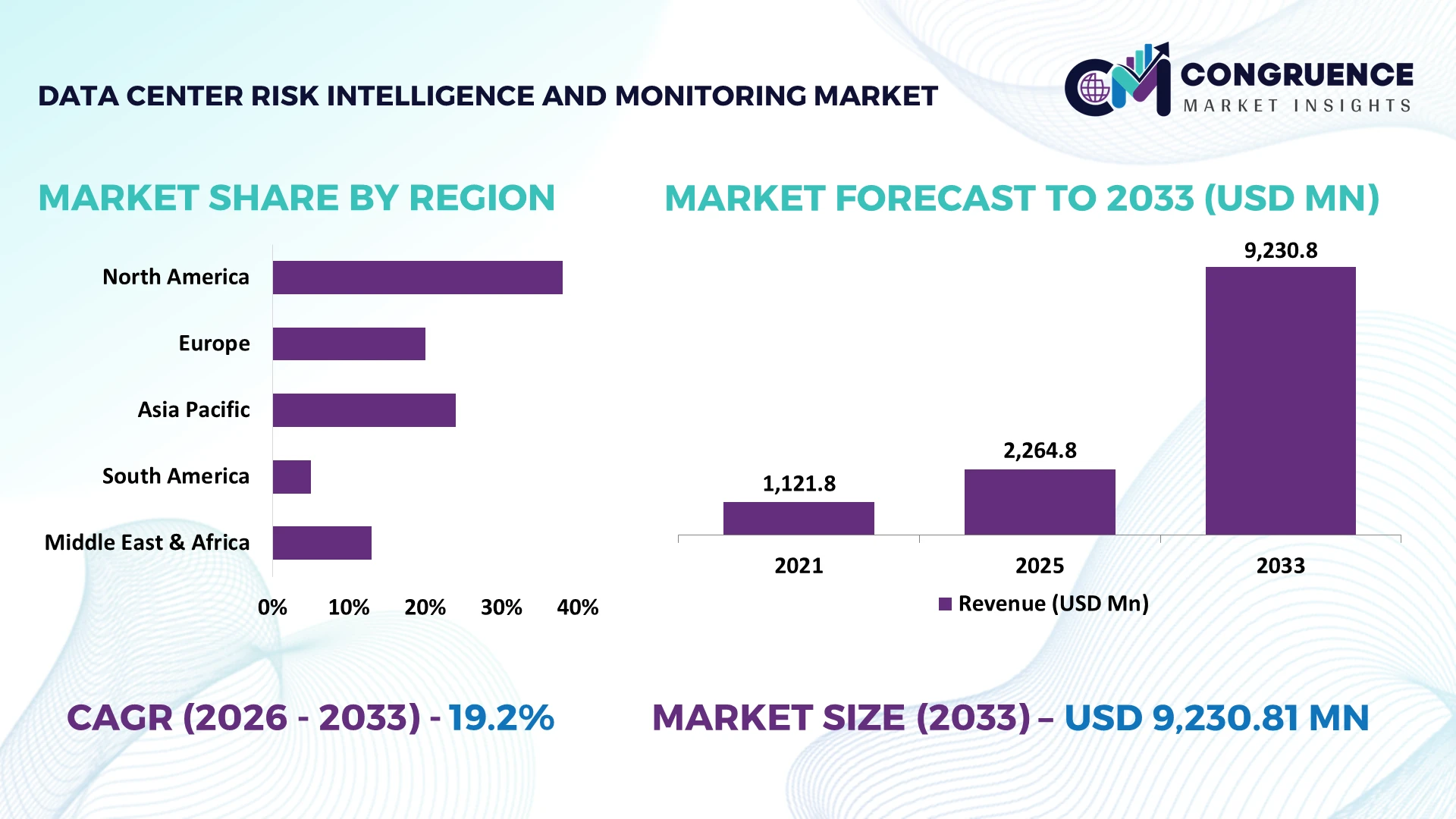
The Global Data Center Risk Intelligence and Monitoring Market was valued at USD 2264.8 Million in 2025 and is anticipated to reach a value of USD 9230.81 Million by 2033 expanding at a CAGR of 19.2% between 2026 and 2033. Growth is driven by the 48% global data center capacity share held by hyperscale operators, 57% of major outages costing over USD 100,000, and increasing adoption of AI-powered predictive infrastructure monitoring.
The United States dominates the global data center infrastructure landscape, accounting for 45% of worldwide data center electricity consumption, compared with China's 25% and Europe's 15%. In 2026, 15 of the world's 20 largest hyperscale markets were located in the United States, while Northern Virginia and Greater Beijing collectively represented 17% of global hyperscale capacity. Global data center investment reached USD 500 billion in 2024, supporting AI computing, cloud services, financial technology, and advanced infrastructure monitoring deployment.
Strategically, operators should prioritize the 48% hyperscale capacity segment and address the 57% high-cost outage exposure through integrated power monitoring, predictive analytics, and automated risk intelligence.
Market Size & Growth: USD 2,264.8 million in 2025, reaching USD 9,230.81 million by 2033 at 19.2% CAGR, driven by AI infrastructure monitoring.
Top Growth Drivers: Hyperscale facilities represent 48% of global capacity, 57% of major outages exceed USD 100,000, and 80% of operators identify preventable downtime.
Short-Term Forecast: By 2028, global market revenue reaches an estimated USD 3,837.6 million, representing 69.4% cumulative growth from 2025 under the stated CAGR.
Emerging Technologies: AI predictive analytics, digital twins, and automated DCIM platforms address 3 critical risk categories: electrical failures, cooling instability, and equipment degradation.
Regional Leaders: North America leads infrastructure demand with 45% of global data center electricity consumption attributable to the United States, followed by China at 25% and Europe at 15%. Regional monitoring revenue estimates require separate validation.
Consumer/End-User Trends: Hyperscale operators control 48% of global capacity, colocation represents 20%, and enterprise facilities account for 32%, supporting differentiated monitoring deployments.
Pilot/Case Example: In 2025, global data center outage analysis identified 80% preventability through improved management and procedures, highlighting automation opportunities rather than a measured pilot result.
Competitive Landscape: Schneider Electric, Siemens, ABB, Vertiv, and Johnson Controls compete in advanced infrastructure monitoring; the top five vendors' combined market share is not publicly verified.
Regulatory & ESG Impact: Data centers consumed 415 TWh in 2024, representing 1.5% of global electricity demand, strengthening energy reporting and efficiency monitoring requirements.
Investment & Funding: Global data center investment reached USD 500 billion in 2024, nearly doubling since 2022, supporting hyperscale construction and monitoring technology integration.
Innovation & Future Outlook: Hyperscale capacity is projected to reach 67% of total data center capacity by 2031, accelerating centralized AI monitoring and autonomous infrastructure operations.
The Global Data Center Risk Intelligence and Monitoring Market is increasingly shaped by hyperscale expansion, AI workload concentration, and the financial consequences of infrastructure failures. With 57% of surveyed major outages exceeding USD 100,000 and 20% surpassing USD 1 million, operators are investing in predictive fault detection, intelligent power distribution monitoring, digital twins, and automated incident management. The concentration of 60% of hyperscale capacity across 20 global markets intensifies infrastructure resilience requirements. Grid constraints, liquid cooling deployment, and European energy efficiency regulations are accelerating the transition toward integrated risk intelligence, establishing clear strategic priorities for infrastructure operators and technology suppliers.
Data center risk intelligence and monitoring has become strategically essential as hyperscale infrastructure, artificial intelligence workloads, and increasingly concentrated computing capacity raise the financial consequences of operational disruption. Global data center electricity consumption reached 415 TWh in 2024, representing 1.5% of worldwide electricity demand. Power distribution modernization and liquid cooling adoption are shifting infrastructure management from periodic equipment inspections toward continuous risk assessment. Operators increasingly prioritize predictive maintenance, thermal anomaly detection, and integrated cybersecurity monitoring to protect critical computing assets.
AI-enabled monitoring offers measurable advantages over conventional threshold-based systems through earlier fault identification and automated incident classification. A 20% reduction in incident detection time represents a practical deployment target, although actual improvements depend on infrastructure configuration. The United States leads hyperscale deployment, while China emphasizes large computing clusters and Singapore prioritizes energy-efficient infrastructure. Through 2028, operators are expected to expand sensor coverage, consolidate monitoring dashboards, and strengthen automated response capabilities across power, cooling, and network infrastructure.
Practical deployments integrate electrical switchgear sensors, cooling telemetry, and predictive analytics into centralized data center infrastructure management platforms. With significant outages frequently exceeding USD 100,000 in associated costs, operators are strengthening technology partnerships and prioritizing infrastructure resilience investments. Competitive advantage increasingly depends on converting operational telemetry into actionable risk intelligence before equipment failures interrupt services.
Hyperscale infrastructure expansion is accelerating demand for continuous risk intelligence as AI workloads increase power density and operational complexity. Data centers accounted for 1.5% of global electricity consumption in 2024, while hyperscale operators represented approximately 44% of worldwide data center capacity. Uptime Institute findings indicate that more than 50% of significant outages exceed USD 100,000 in associated costs, reinforcing the financial importance of predictive maintenance. In the United States, Northern Virginia's concentrated computing infrastructure faces growing electricity delivery constraints. Operators are responding by integrating intelligent power distribution units, automated thermal monitoring, and AI-based fault analytics. Monitoring vendors are expanding partnerships with cooling specialists and electrical equipment manufacturers to improve infrastructure visibility.
Legacy equipment compatibility and infrastructure modernization costs constrain advanced risk monitoring adoption, particularly across enterprise-owned facilities. Approximately 54% of significant data center outages involve power-related problems, exposing limitations in fragmented electrical monitoring architectures. Meanwhile, data center electricity consumption represents 1.5% of global demand, increasing pressure to optimize existing facilities without disrupting operations. In Germany, grid connection constraints and stringent energy efficiency requirements complicate modernization planning. Proprietary building management protocols, aging sensors, and inconsistent telemetry formats increase integration expenditure and commissioning time. Operators are addressing these constraints through modular monitoring gateways, phased sensor replacement, and standardized communication interfaces. Suppliers offering backward-compatible platforms gain an operational advantage by reducing retrofit complexity and avoiding unnecessary infrastructure replacement.
AI-driven infrastructure monitoring presents opportunities as hyperscale operators increase their share of global data center capacity from 48% in 2025 toward a projected 67% by 2031. Enterprise facilities currently represent 32%, creating an addressable modernization segment for modular predictive analytics. In Malaysia, expanding AI computing infrastructure and proximity to Singapore create opportunities for integrated cooling intelligence, power quality analytics, and automated equipment diagnostics. Data center electricity consumption across Southeast Asia is projected to more than double by 2030, strengthening the case for energy-aware monitoring. Technology suppliers are developing digital twin platforms, intelligent sensor networks, and predictive maintenance partnerships. Vendors combining thermal optimization with equipment failure forecasting gain differentiated access to hyperscale and colocation contracts.
Maintaining reliable automated monitoring across interconnected infrastructure creates significant execution challenges. In 2025, 87% of surveyed operators experiencing significant outages considered their incidents preventable through improved management and processes, compared with 80% in 2024. Additionally, 11% of surveyed organizations reported outages affecting AI training or inference applications, demonstrating emerging workload vulnerabilities. In the United States, increasingly interconnected operational technology, building management systems, and cloud monitoring platforms expand cybersecurity exposure. AI models must distinguish genuine equipment anomalies from fluctuating workloads without generating excessive false alarms. Operators need validated telemetry, secure network segmentation, and coordinated incident response procedures. Suppliers must invest in explainable analytics, cybersecurity partnerships, and continuous model validation to maintain monitoring accuracy as infrastructure complexity increases.
Liquid Cooling Telemetry Becomes Standardized: AI server racks increasingly exceed 40 kW, while advanced configurations approach 100 kW or higher, requiring continuous coolant flow, pressure, and leak monitoring. Operators are integrating cooling distribution units with centralized management software and automated valve controls. Schneider Electric and Vertiv are expanding liquid cooling ecosystems to improve thermal visibility, minimize cooling interruptions, and simplify maintenance across high-density computing installations.
Energy Reporting Drives Monitoring Modernization: The European Union requires qualifying data centers with installed IT power demand of at least 500 kW to report operational sustainability indicators. Data centers consumed approximately 415 TWh globally in 2024, representing 1.5% of electricity demand. Operators in Germany and France are integrating metering, energy dashboards, and standardized performance reporting to reduce compliance workloads and strengthen electricity procurement planning.
Grid Constraints Reshape Operational Workflows: Ireland's data centers accounted for approximately 22% of metered electricity consumption in 2024, intensifying scrutiny of grid connections and flexible power usage. Operators are deploying real-time load monitoring, battery dispatch analytics, and automated capacity allocation. This transition connects infrastructure risk management with electricity market participation, allowing operators to identify peak-load exposure and improve energy resilience without expanding physical computing capacity.
Unified Infrastructure Data Platforms Expand: Global data center electricity consumption is projected to reach approximately 945 TWh by 2030, more than doubling from 2024 levels. Monitoring vendors are consolidating 3 operational data streams: electrical telemetry, cooling performance, and equipment condition. Companies are adopting standardized application interfaces and cloud-connected dashboards to reduce fragmented reporting, accelerate cross-facility comparisons, and improve maintenance coordination across geographically distributed infrastructure portfolios.
Operational Risk Monitoring Leads Infrastructure Intelligence Adoption
Operational Risk Monitoring represents the leading type, with an indicative 35% share of the global Data Center Risk Intelligence and Monitoring Market, reflecting its central role in equipment availability, incident management, and infrastructure continuity. This analyst estimate is based on the relative operational scope of monitoring deployments, not a published segment census. Physical Risk Monitoring follows with an estimated 27%, supported by surveillance, access control, and facility protection requirements. Operators in the United States are integrating operational telemetry with physical security platforms to improve incident correlation and reduce fragmented infrastructure oversight.
Cybersecurity Risk Monitoring is positioned as the fastest-growing type, driven by increasing connectivity between operational technology, building management systems, and enterprise security platforms. Its indicative 23% share reflects expanding requirements for continuous threat assessment and network segmentation. Environmental Risk Monitoring accounts for an estimated 15%, covering temperature, humidity, water leakage, and cooling conditions. Vendors including Schneider Electric, Siemens, and ABB are strengthening integrated monitoring capabilities, while cybersecurity specialists expand industrial network protection. Investment priorities increasingly favor platforms that connect operational reliability with cyber resilience and environmental performance.
Infrastructure Performance Monitoring Maintains Market Leadership
Infrastructure Performance Monitoring leads the application landscape with an indicative 32% market share, supported by continuous supervision of electrical distribution, cooling efficiency, equipment utilization, and infrastructure availability. This estimated allocation reflects the application's broad deployment across existing facilities rather than independently reported market revenue. Threat Detection accounts for an estimated 25%, driven by increasing demand for physical security analytics, cybersecurity surveillance, and infrastructure anomaly identification. Operators are consolidating monitoring interfaces to connect asset performance with incident management and reduce operational response delays.
Predictive Maintenance is the fastest-growing application, with an estimated 21% share, as companies transition from scheduled servicing toward condition-based maintenance and equipment failure forecasting. Compliance Monitoring represents an indicative 13%, supporting energy reporting, operational audits, and regulatory documentation. Disaster Risk Management contributes the remaining 9%, addressing emergency preparedness, infrastructure redundancy, and recovery planning. In Germany, mandatory sustainability reporting strengthens demand for automated compliance dashboards. Monitoring suppliers are expanding predictive analytics, asset diagnostics, and integrated reporting capabilities, positioning infrastructure intelligence platforms as essential tools for improving reliability and maintenance efficiency.
Hyperscale Data Centers Dominate Monitoring Investments
Hyperscale Data Centers represent the leading end-user segment, with an indicative 42% share of global risk intelligence and monitoring expenditure, reflecting extensive infrastructure footprints, centralized operations, and demanding availability requirements. This estimated market allocation differs from physical data center capacity shares. Colocation Data Centers account for an estimated 26%, supported by multi-tenant infrastructure management, service-level agreements, and continuous environmental monitoring. Operators are prioritizing integrated monitoring platforms that provide customer-specific reporting, equipment performance visibility, and standardized incident management across multiple facilities.
Cloud Service Providers represent the fastest-growing end-user category, with an indicative 20% share, driven by distributed computing infrastructure, AI workload orchestration, and increasingly complex service availability requirements. Enterprise Data Centers contribute approximately 12%, maintaining demand for cybersecurity integration, infrastructure modernization, and hybrid IT monitoring. In the United States, cloud infrastructure operators are strengthening partnerships with electrical equipment suppliers and monitoring software developers. Technology vendors are introducing scalable subscription models, centralized analytics, and customized monitoring architectures. Competitive positioning increasingly depends on supporting high-density infrastructure while maintaining consistent risk visibility across geographically distributed facilities.
North America accounted for the largest market share at an estimated 39% in 2025; however, Asia-Pacific is expected to register the fastest growth, expanding at an indicative CAGR of 22.5% between 2026 and 2033.
Hyperscale Infrastructure Concentration Accelerates Integrated Risk Monitoring
North America maintains the strongest market position, supported by an estimated 39% share of global data center risk intelligence and monitoring demand. The United States dominates infrastructure deployment, particularly across Northern Virginia, Dallas, Phoenix, and Silicon Valley, where hyperscale computing expansion increases requirements for power quality surveillance, thermal management, and operational risk analytics. Canada's Toronto and Montréal markets strengthen regional adoption through cloud infrastructure investments and access to relatively low-carbon electricity. The International Energy Agency estimates that the United States accounts for approximately 45% of global data center electricity consumption, highlighting the scale of infrastructure requiring continuous monitoring. Operators increasingly integrate electrical distribution telemetry, liquid cooling diagnostics, and centralized incident management. Schneider Electric, Vertiv, and Eaton are strengthening monitoring capabilities alongside power infrastructure modernization, supporting higher equipment availability and more efficient facility operations.
United States Market Outlook: The United States benefits from concentrated hyperscale campuses, advanced semiconductor infrastructure, and established cloud computing ecosystems. Northern Virginia remains a critical deployment hub, while Texas and Arizona attract new facilities through land availability and infrastructure development. The Department of Energy projects data centers could consume 6.7% to 12% of national electricity by 2028, strengthening requirements for predictive power monitoring, grid coordination, and automated capacity management.
Energy Efficiency Regulation Reshapes Infrastructure Monitoring Priorities
Europe represents an estimated 25% of global market demand, with Germany, the United Kingdom, France, the Netherlands, and Ireland supporting substantial enterprise and colocation infrastructure. The European Union's Energy Efficiency Directive requires qualifying data centers with installed IT power demand of at least 500 kW to report sustainability performance information. This requirement accelerates adoption of automated energy metering, power usage effectiveness monitoring, and standardized operational reporting. Frankfurt, London, Amsterdam, Paris, and Dublin remain important infrastructure concentrations, although electricity availability and permitting constraints increasingly influence expansion decisions. European operators are integrating energy management platforms with facility monitoring to improve compliance efficiency and operational transparency. Siemens, Schneider Electric, and ABB are positioning integrated electrical monitoring and automation solutions to address increasingly demanding infrastructure efficiency requirements and support long-term asset modernization.
Germany Market Outlook: Germany maintains a strategic position through Frankfurt's financial services infrastructure, enterprise cloud adoption, and industrial digitalization. National energy efficiency legislation requires qualifying data centers to achieve a power usage effectiveness of 1.3 or lower for new facilities entering operation from July 2026. This strengthens demand for continuous electricity metering, cooling optimization, and automated compliance reporting, supporting specialized infrastructure monitoring providers.
AI Infrastructure Expansion Strengthens Intelligent Monitoring Deployment
Asia-Pacific accounts for an estimated 27% of global market demand, supported by large-scale computing infrastructure across China, Japan, India, Singapore, and Australia. China remains the region's largest infrastructure base, while India's Mumbai, Chennai, and Hyderabad clusters attract hyperscale and colocation investment. Singapore's constrained land and electricity availability encourage higher-density deployments and advanced cooling management. China's East Data, West Computing initiative is restructuring computing capacity across designated national hubs, creating demand for distributed infrastructure supervision and centralized operational intelligence. Japan's seismic exposure strengthens requirements for equipment resilience and disaster risk monitoring. Technology providers are integrating intelligent power sensors, automated cooling controls, and predictive maintenance software into new facility designs. Regional deployment priorities increasingly emphasize operational reliability, energy efficiency, and scalable monitoring across geographically dispersed computing environments.
China Market Outlook: China benefits from extensive cloud infrastructure, domestic equipment manufacturing, and government-supported computing development. Its national computing network initiative encompasses 8 computing hubs and 10 data center clusters, supporting geographically distributed capacity expansion. These deployments increase demand for centralized equipment diagnostics, electrical fault detection, and environmental monitoring. Domestic technology suppliers are strengthening integrated management capabilities to support large-scale AI computing infrastructure.
Colocation Expansion Drives Infrastructure Reliability Investments
South America represents an estimated 5% of global market demand, with Brazil accounting for the largest concentration of hyperscale and colocation infrastructure. São Paulo remains the principal deployment hub, supported by enterprise cloud migration, financial services modernization, and telecommunications infrastructure. Chile's Santiago market attracts facilities through renewable electricity availability and international connectivity, while Colombia develops enterprise and colocation capacity around Bogotá. Electricity distribution reliability, equipment import dependencies, and infrastructure financing constraints influence monitoring deployment strategies. Operators increasingly prioritize remote equipment diagnostics, intelligent power management, and standardized facility performance monitoring to reduce operational interruptions. Regional providers are partnering with international infrastructure technology companies to improve monitoring capabilities. Expansion strategies emphasize modular equipment deployment and centralized supervision, allowing operators to manage distributed facilities without proportionately increasing onsite engineering requirements.
Brazil Market Outlook: Brazil leads regional data center development through São Paulo's financial technology ecosystem, cloud infrastructure concentration, and enterprise digitalization. The country's electricity generation mix derives more than 80% from renewable sources in recent years, strengthening the appeal of energy-conscious computing infrastructure. Operators are investing in power redundancy monitoring, cooling optimization, and remote facility diagnostics to address operational reliability and electricity distribution challenges.
Sovereign Cloud Investment Accelerates Infrastructure Modernization
The Middle East & Africa accounts for an estimated 4% of global market demand, supported by sovereign cloud programs, digital infrastructure investment, and expanding enterprise computing requirements. Saudi Arabia and the United Arab Emirates are developing hyperscale facilities linked to artificial intelligence, financial services, and government digital transformation. South Africa maintains an established colocation ecosystem, particularly around Johannesburg and Cape Town. High ambient temperatures increase cooling system complexity, strengthening requirements for continuous thermal monitoring and automated equipment diagnostics. Microsoft announced a USD 5.4 billion investment commitment for Qatar's cloud and AI infrastructure ecosystem in 2025, illustrating the scale of regional digital infrastructure initiatives. Operators are prioritizing intelligent cooling controls, electrical resilience, and centralized monitoring platforms. Technology partnerships increasingly connect international infrastructure suppliers with domestic cloud and telecommunications operators.
Saudi Arabia Market Outlook: Saudi Arabia is expanding computing infrastructure through Vision 2030, sovereign digital transformation, and artificial intelligence development. The government-backed HUMAIN initiative announced plans in 2025 to develop up to 6.6 GW of data center capacity by 2034. Such high-density infrastructure ambitions strengthen demand for advanced cooling diagnostics, predictive electrical monitoring, and integrated operational risk management across emerging computing campuses.
The Data Center Risk Intelligence and Monitoring Market features competition between integrated infrastructure leaders Schneider Electric, Vertiv, Siemens, Eaton, and Johnson Controls and specialized monitoring providers such as Sunbird Software and Datadog. The five leading DCIM suppliers collectively held approximately 41.8% of the adjacent infrastructure management market in 2025, providing a competitive concentration benchmark rather than a verified risk intelligence market share. Schneider Electric differentiates through integrated power analytics, while Vertiv emphasizes thermal management and equipment diagnostics. Siemens and Eaton compete through electrical automation and intelligent energy monitoring. Specialized vendors prioritize interoperability, cloud analytics, and deployment flexibility. With hyperscale operators controlling 48% of global capacity and significant outage costs exceeding USD 100,000 in 54% of surveyed cases, competitive priorities increasingly favor predictive reliability. Partnerships with hyperscale developers and cooling specialists strengthen deployment capabilities. Winning requires secure integration, measurable operational improvements, scalable analytics, and dependable lifecycle support.
Schneider Electric SE
Vertiv Holdings Co.
Siemens AG
Eaton Corporation plc
Johnson Controls International plc
ABB Ltd.
Honeywell International Inc.
Cisco Systems, Inc.
IBM Corporation
Huawei Technologies Co., Ltd.
Sunbird Software, Inc.
Datadog, Inc.
Delta Electronics, Inc.
FNT GmbH
Current monitoring technologies combine intelligent power distribution units, environmental sensors, DCIM software, and building management systems to supervise electrical reliability and cooling performance. Real-time telemetry enables operators to track power usage effectiveness, equipment loading, and thermal conditions across distributed facilities. Hyperscale operators control approximately 48% of global data center capacity, reinforcing centralized monitoring adoption. Replacing periodic inspections with continuous sensor-based monitoring can target 20% faster incident identification, although deployment-specific improvements require validation. Integrated dashboards reduce fragmented workflows and strengthen operational accountability.
Emerging technologies include AI anomaly detection, digital twins, and liquid cooling telemetry. Advanced AI racks exceeding 100 kW require continuous coolant pressure, flow, and leakage surveillance. Predictive models combine equipment vibration, temperature, and electrical signatures to identify deterioration before failure. A 15% reduction in maintenance intervention time represents a realistic optimization target rather than verified industry performance. Schneider Electric, Vertiv, and Siemens benefit from combining infrastructure hardware with predictive analytics and automated incident management.
Disruptive developments increasingly connect cybersecurity intelligence, autonomous controls, and infrastructure simulation. Through 2026–2028, operators are prioritizing standardized telemetry interfaces, secure edge analytics, and automated fault isolation. Vendors offering interoperable platforms gain advantages in retrofit projects, while hyperscale developers prioritize predictive resilience, measurable efficiency, and operational scalability.
December 2025: ABB announced an agreement to acquire IPEC, strengthening electrical failure detection for data centers. Its predictive maintenance portfolio targets up to 90% less downtime and 85% lower maintenance costs, improving infrastructure reliability. Source: ABB News Resources
November 2025: Siemens partnered with Delta to develop prefabricated data center power infrastructure, targeting 50% faster deployment, 20% lower capital expenditure, and 27% fewer carbon emissions. Integrated digital monitoring strengthens commissioning efficiency and infrastructure reliability. Source: Siemens
January 2026: Vertiv introduced Next Predict, an AI-powered maintenance service integrating anomaly detection, root cause analysis, and prescriptive interventions across 3 infrastructure domains: power, cooling, and IT. The launch strengthens proactive risk management and equipment reliability. Source: investors.vertiv.com
September 2025: Eaton repositioned its Brightlayer software portfolio, strengthening unified monitoring across IT and operational technology environments. Its modular approach integrates 3 capabilities: infrastructure management, electrical monitoring, and distributed IT supervision, improving visibility and operational coordination. Source: poweradvantage.eaton.com
The Data Center Risk Intelligence and Monitoring Market Report evaluates industry developments from 2026 to 2033, covering Physical Risk Monitoring, Cybersecurity Risk Monitoring, Operational Risk Monitoring, and Environmental Risk Monitoring. Application analysis includes Threat Detection, Infrastructure Performance Monitoring, Predictive Maintenance, Compliance Monitoring, and Disaster Risk Management. End-user coverage examines Colocation Data Centers, Hyperscale Data Centers, Enterprise Data Centers, and Cloud Service Providers. The report assesses AI analytics, digital twins, intelligent sensors, and automated infrastructure management technologies.
Regional analysis covers North America, Europe, Asia-Pacific, South America, and the Middle East & Africa, examining deployment concentration, regulatory requirements, and infrastructure modernization. With hyperscale operators controlling approximately 48% of global data center capacity, the report evaluates investment priorities, competitive positioning, technology partnerships, and emerging opportunities in liquid cooling intelligence, cybersecurity integration, and predictive infrastructure maintenance.
| Report Attribute/Metric | Report Details |
|---|---|
Market Revenue in 2025 | USD 2264.8 Million |
Market Revenue in 2033 | USD 9230.81 Million |
CAGR (2026 - 2033) | 19.2% |
Base Year | 2025 |
Forecast Period | 2026 - 2033 |
Historic Period | 2021 - 2025 |
Segments Covered | By Type
By Application
By End-User
|
Key Report Deliverable | Revenue Forecast, Growth Trends, Market Dynamics, Segmental Overview, Regional and Country-wise Analysis, Competition Landscape |
Region Covered | North America, Europe, Asia-Pacific, South America, Middle East, Africa |
Key Players Analyzed | Schneider Electric SE, Vertiv Holdings Co., Siemens AG, Eaton Corporation plc, Johnson Controls International plc, ABB Ltd., Honeywell International Inc., Cisco Systems, Inc., IBM Corporation, Huawei Technologies Co., Ltd., Sunbird Software, Inc., Datadog, Inc., Delta Electronics, Inc., FNT GmbH |
Customization & Pricing | Available on Request (10% Customization is Free) |




