
Reports
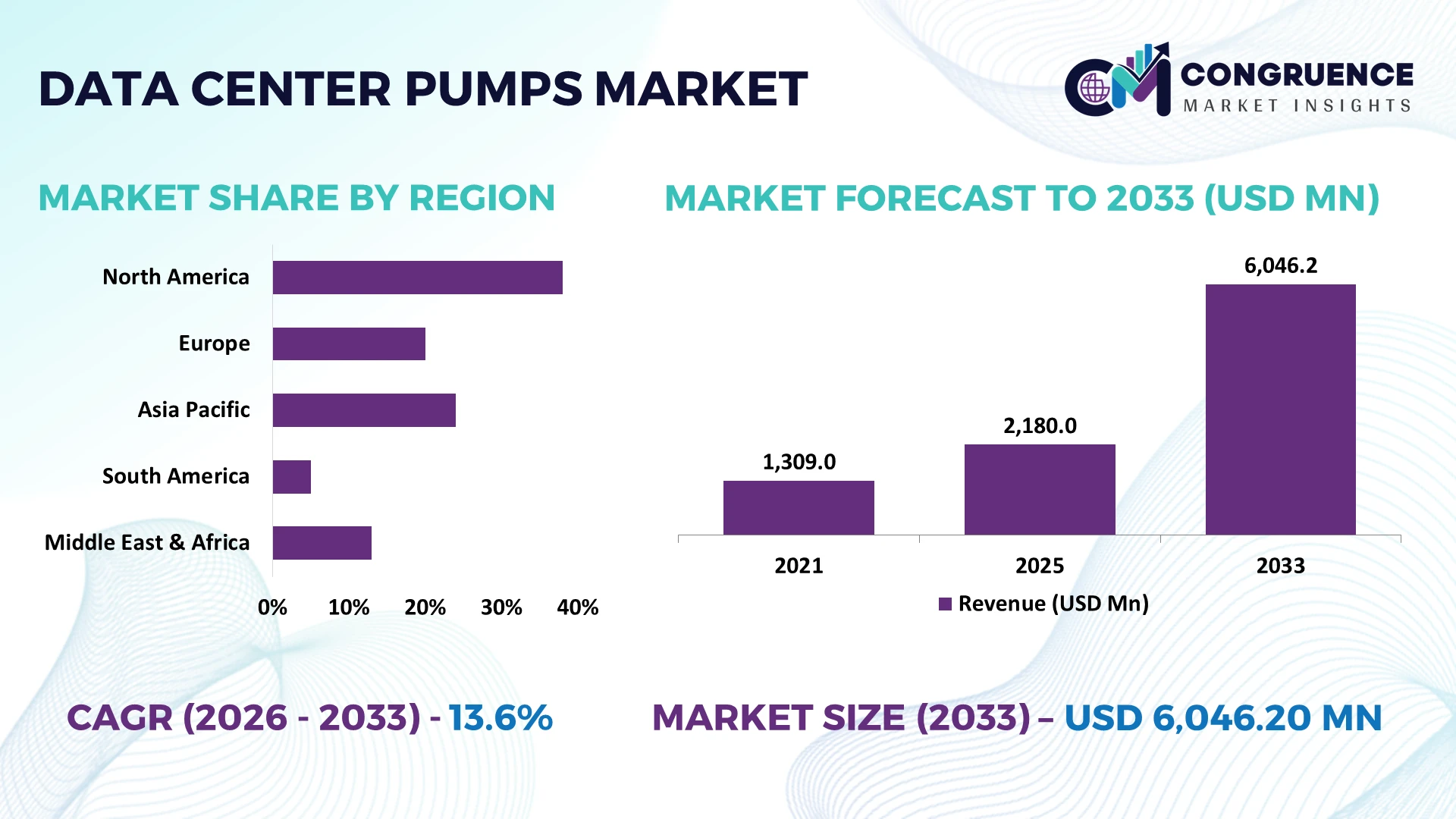
The Global Data Center Pumps Market was valued at USD 2180 Million in 2025 and is anticipated to reach a value of USD 6046.2 Million by 2033 expanding at a CAGR of 13.6% between 2026 and 2033. Growth is accelerating through rapid deployment of liquid cooling infrastructure, AI-ready hyperscale facilities, high-density server racks, and energy-efficient cooling upgrades across enterprise and colocation data centers.
The United States dominates the global Data Center Pumps Market with approximately 36% of installed hyperscale data center capacity, supported by multi-billion-dollar AI infrastructure investments and advanced liquid-cooling adoption exceeding 28% in new high-density facilities during 2026. Compared with Germany, which leads European industrial digital infrastructure, the U.S. deploys nearly three times more hyperscale capacity, while ongoing semiconductor supply-chain localization and AI infrastructure expansion strengthen equipment demand across critical cooling systems.
For market participants, prioritizing high-efficiency pump technologies and liquid-cooling partnerships in leading hyperscale regions will strengthen competitive positioning and long-term infrastructure opportunities.
Market Size & Growth: USD 2180 Million in 2025, reaching USD 6046.2 Million by 2033 at a CAGR of 13.6%, driven by rapid AI-ready liquid cooling deployment.
Top Growth Drivers: Liquid cooling adoption +31%, hyperscale expansion +27%, edge data center deployment +19% supporting advanced pump demand.
Short-Term Forecast: By 2028, energy consumption for cooling systems declines by approximately 18% through intelligent pumping and variable-speed technologies.
Emerging Technologies: AI-based monitoring, smart automation, and high-efficiency magnetic-drive pumps improve operational efficiency by nearly 22%.
Regional Leaders: North America exceeds USD 2200 Million, Asia Pacific approaches USD 1850 Million, Europe surpasses USD 1200 Million, supported by accelerated hyperscale expansion and liquid cooling integration.
Consumer/End-User Trends: More than 40% of new hyperscale facilities integrate liquid cooling systems for high-density AI workloads.
Pilot/Case Example: In 2026, a hyperscale liquid-cooling deployment reduced cooling energy usage by approximately 24% through advanced pump optimization.
Competitive Landscape: Xylem holds approximately 15% market share alongside Grundfos, KSB, Flowserve, and Wilo serving global high-performance cooling applications.
Regulatory & ESG Impact: Energy-efficiency regulations reduce cooling-related power demand by nearly 14%, supporting sustainable infrastructure investment.
Investment & Funding: Over USD 9 Billion in infrastructure expansion supports manufacturing capacity, strategic partnerships, and resilient regional supply chains.
Innovation & Future Outlook: Digital twin monitoring, predictive maintenance, and intelligent pumping platforms increase asset utilization by approximately 20%, strengthening next-generation data center operations.
The Data Center Pumps Market is advancing through demand from hyperscale facilities, AI computing clusters, and edge infrastructure requiring precision liquid-cooling systems with higher reliability. Advanced variable-speed pumps, predictive monitoring, and smart control platforms are improving cooling efficiency by approximately 20%. Regional manufacturing expansion and resilient component supply strategies across major technology markets are strengthening equipment availability, setting the stage for broader strategic market developments.
The Data Center Pumps Market has become strategically important as AI infrastructure, hyperscale computing, and high-density server deployments redefine cooling architecture across global digital infrastructure. Infrastructure modernization and supply-chain diversification are accelerating procurement of high-efficiency pumping systems that support liquid cooling environments while improving operational resilience. Equipment suppliers are increasingly aligning with modular data center developers to shorten deployment cycles and strengthen localized manufacturing capabilities.
Electronically commutated variable-speed pumps deliver approximately 18% higher energy efficiency than conventional fixed-speed systems while reducing maintenance frequency through intelligent flow optimization. The United States leads large-scale deployment through hyperscale campuses and advanced liquid cooling integration, whereas Japan emphasizes compact, high-reliability systems for space-constrained facilities with faster adoption of precision monitoring technologies. During the next two to three years, liquid-cooled server installations are expected to exceed 35% of newly commissioned AI-focused facilities, increasing demand for digitally connected pumping solutions.
A 2026 hyperscale expansion integrating intelligent pump controls and predictive maintenance reduced cooling downtime by nearly 20% while improving energy optimization across mission-critical operations. Manufacturers are expanding engineering partnerships, investing in smart monitoring platforms, and strengthening localized supply networks to support faster project execution. Companies that integrate advanced pumping technologies with digital cooling ecosystems will secure stronger operational differentiation and long-term competitive positioning.
The rapid transition toward liquid-cooled AI servers is becoming the primary structural driver for advanced data center pump deployment. Nearly 40% of newly designed hyperscale facilities are integrating liquid cooling, while intelligent pumping systems improve hydraulic efficiency by approximately 20% and reduce cooling energy demand by around 15%. The United States continues expanding AI infrastructure through large-scale data center investments, increasing demand for precision cooling equipment and redundant pumping architectures. In response, manufacturers are expanding production capacity, introducing digitally monitored pump platforms, and forming technology partnerships with cooling system integrators. This transition strengthens lifecycle performance while creating opportunities for differentiated service contracts and predictive maintenance solutions that improve operational reliability.
Price fluctuations in stainless steel, specialty alloys, and electronic control components continue affecting procurement strategies for high-performance data center pumps. Material costs remain approximately 12% above historical averages in several industrial supply chains, while lead times for advanced motor controllers have improved but still exceed conventional equipment by nearly 18%. Germany and other manufacturing hubs are increasing localized production to reduce dependence on imported components and improve delivery consistency. Companies are responding through multi-supplier procurement strategies, long-term sourcing agreements, and greater inventory planning. These actions improve supply stability but require additional working capital, directly influencing deployment schedules and operating margins for large infrastructure projects.
Smart pumping technologies integrated with AI-driven monitoring platforms are creating high-value opportunities beyond traditional hardware supply. Predictive maintenance solutions reduce unplanned maintenance events by approximately 25%, while digital optimization improves cooling efficiency by nearly 17% across high-density facilities. Singapore is accelerating deployment of intelligent infrastructure through stricter efficiency standards and advanced digital facility management practices, encouraging wider adoption of integrated cooling platforms. Companies are increasing R&D investment, expanding software partnerships, and developing connected pump ecosystems capable of continuous performance optimization. The strongest strategic opportunity lies in combining hardware, analytics, and lifecycle services into long-term operational solutions that generate recurring customer value.
Deploying advanced pumping systems across rapidly expanding AI facilities introduces significant execution complexity. High-density server environments require precision hydraulic balancing, continuous monitoring, and interoperability between pumps, sensors, and building management platforms. Integration activities account for nearly 22% of cooling system implementation time, while demand for specialized commissioning engineers has increased by approximately 30%. The United States faces growing pressure to accelerate deployment without compromising operational reliability as AI infrastructure expands. Companies are addressing these challenges through workforce development, standardized modular cooling architectures, and closer collaboration with automation providers. Organizations that simplify system integration and strengthen technical expertise will achieve more consistent deployment quality and stronger long-term operational competitiveness.
Advanced Liquid Cooling Integration High-density AI server deployments are increasing liquid-cooling integration above 35% in newly commissioned hyperscale facilities, while precision pump controls improve thermal efficiency by nearly 18% and reduce cooling energy use by approximately 15%. Rising rack power density and stricter energy-performance requirements are accelerating system redesigns across the United States. Equipment manufacturers are expanding partnerships with liquid-cooling specialists and embedding intelligent monitoring capabilities to improve operational continuity and shorten commissioning timelines.
Localized Manufacturing Expansion Supply-chain restructuring is shifting production closer to major data center markets, reducing equipment lead times by approximately 20% while improving component availability by nearly 16%. Germany, the United States, and Japan are strengthening domestic manufacturing capabilities following infrastructure resilience initiatives. Pump suppliers are diversifying component sourcing, expanding regional assembly facilities, and increasing inventory buffers, enabling faster project execution and reducing dependence on long international logistics networks during large-scale infrastructure deployments.
Predictive Maintenance Becomes Standard Digital monitoring platforms now identify performance anomalies with nearly 30% greater accuracy while lowering unexpected maintenance events by around 22%. Enterprise operators are integrating pump telemetry with building management systems to automate maintenance scheduling and optimize hydraulic performance. Companies are investing in cloud-based analytics, remote diagnostics, and automation partnerships that improve equipment availability while reducing lifecycle operating costs across mission-critical cooling infrastructure.
Modular Cooling System Adoption Prefabricated cooling modules reduce installation time by approximately 25% and improve deployment consistency by nearly 18%, supporting rapid hyperscale expansion. Growing labor shortages in specialized mechanical installation are encouraging standardized modular designs across large data center projects. Pump manufacturers are redesigning product portfolios for plug-and-play compatibility, increasing collaboration with modular infrastructure providers, and standardizing interfaces to accelerate deployments while simplifying long-term maintenance and facility expansion.
Centrifugal Pumps account for approximately 46% of the Data Center Pumps Market due to their high flow capacity, continuous-duty performance, and compatibility with hyperscale cooling infrastructure. Their proven efficiency, lower maintenance requirements, and seamless integration with chilled water and liquid cooling systems make them the preferred choice for large facilities. Inline Pumps remain strategically important for compact installations where space optimization and simplified piping layouts reduce installation complexity. Circulation Pumps continue supporting precision cooling loops with stable flow regulation across mission-critical environments.
Booster Pumps represent the fastest-growing segment as high-density AI racks require higher pressure and consistent coolant delivery across multi-level cooling architectures. Adoption is increasing by nearly 24% in newly designed liquid-cooled facilities, while product efficiency improvements approach 18% through intelligent variable-speed control. Manufacturers are expanding high-pressure product portfolios, investing in digitally controlled pumping technologies, and strengthening engineering partnerships to address evolving cooling requirements. Investment priorities increasingly favor adaptable pump platforms capable of supporting modular infrastructure expansion and advanced thermal management.
Liquid Cooling leads the application landscape with approximately 43% share as AI infrastructure and high-density computing require superior thermal management beyond conventional air cooling. Precision coolant distribution, lower energy consumption, and support for increased rack densities make this application operationally critical for hyperscale operators. Chilled Water Systems continue serving large enterprise campuses through mature infrastructure, while Heat Rejection systems remain essential for maintaining stable facility-wide thermal performance under varying operational loads.
Coolant Circulation is the fastest-growing application, supported by increasing deployment of direct-to-chip and immersion cooling technologies. Intelligent circulation control improves thermal efficiency by nearly 19%, while automated flow balancing reduces energy losses by approximately 15%. Operators are integrating smart sensors, digital control platforms, and predictive monitoring to optimize cooling performance. Equipment suppliers are scaling integrated pump packages and automation capabilities to meet rising demand from AI-ready infrastructure where uninterrupted coolant movement directly influences computing performance and equipment lifespan.
Cloud Service Providers represent approximately 48% of total demand as continuous hyperscale expansion, AI computing, and digital service growth require advanced cooling infrastructure with high operational reliability. Their large-scale deployments create sustained demand for intelligent pumping systems capable of supporting round-the-clock workloads. Colocation Providers remain significant buyers by upgrading shared facilities with liquid-cooling capabilities, while Enterprises continue modernizing mission-critical infrastructure to improve energy efficiency and computing capacity.
Telecommunications is the fastest-growing end-user segment as edge computing expansion and distributed digital infrastructure increase cooling requirements across decentralized facilities. Adoption of advanced pumping technologies is rising by nearly 21%, while automated cooling management improves infrastructure utilization by approximately 16%. Manufacturers are responding through customized product configurations, long-term service agreements, and strategic partnerships with cloud operators and colocation specialists. Competitive positioning increasingly depends on delivering scalable, digitally connected pumping solutions tailored to different operational environments and infrastructure footprints.
North America accounted for the largest market share at 38.4% in 2025 however, Asia-Pacific is expected to register the fastest growth, expanding at a CAGR of 15.2% between 2026 and 2033.
Advanced Liquid Cooling Drives Infrastructure Leadership
North America remains the largest regional market due to its concentration of hyperscale campuses, AI computing infrastructure, and enterprise cloud investments. Nearly 45% of hyperscale facilities under active expansion are located within the region, creating sustained demand for high-performance pumping systems supporting liquid cooling and chilled water infrastructure. Operators increasingly deploy intelligent pump monitoring to improve cooling efficiency by approximately 18% while reducing maintenance interventions through predictive diagnostics. Strategic partnerships between cooling equipment manufacturers and data center developers are shortening deployment cycles, while modular infrastructure projects accelerate equipment standardization. Continued investment in AI-ready facilities and digital infrastructure modernization reinforces demand for precision pumping technologies that improve uptime, thermal stability, and operational resilience across mission-critical environments.
United States Market Outlook: The United States leads regional deployment through extensive hyperscale expansion, semiconductor manufacturing investments, and advanced AI infrastructure development. More than one-third of newly commissioned high-density facilities integrate next-generation liquid cooling architectures requiring intelligent pumping platforms. Domestic manufacturing expansion, engineering partnerships, and localized component sourcing strengthen supply resilience while supporting rapid project execution and long-term infrastructure modernization.
Efficiency Regulations Accelerate Cooling Modernization
Europe continues strengthening its market position through sustainable infrastructure modernization and increasing deployment of energy-efficient cooling technologies. The region contributes approximately 27% of global installations, supported by stricter efficiency standards and rapid modernization of enterprise and colocation facilities. Intelligent pump systems improve hydraulic efficiency by nearly 16%, while digital monitoring reduces operating costs through continuous optimization. Operators increasingly replace legacy equipment with electronically controlled pumping solutions compatible with advanced cooling architectures. Strategic collaborations between engineering companies and technology providers accelerate deployment while supporting environmental performance objectives. Investment remains concentrated in resilient digital infrastructure capable of balancing energy efficiency with growing computational demand.
Germany Market Outlook: Germany serves as Europe's industrial and engineering center for advanced pumping technologies through strong manufacturing capabilities and expanding digital infrastructure. Approximately 30% of regional hyperscale expansion projects include high-efficiency liquid cooling systems incorporating digitally controlled pumps. Manufacturers continue investing in automation, localized production, and research partnerships that improve product innovation while strengthening supply-chain resilience for critical cooling equipment.
Hyperscale Expansion Reshapes Regional Demand
Asia-Pacific represents the fastest-expanding market as governments and technology enterprises accelerate cloud infrastructure, AI deployment, and digital transformation initiatives. The region accounts for approximately 31% of global hyperscale construction activity, while liquid-cooling adoption in new AI facilities exceeds 32%. Rapid deployment of modular data centers and localized manufacturing capacity supports increasing demand for advanced circulation and booster pumps. Equipment suppliers are expanding production facilities, strengthening regional engineering support, and integrating intelligent monitoring capabilities to improve deployment efficiency. Infrastructure investment across industrial technology hubs continues strengthening the regional supply ecosystem and operational competitiveness.
China Market Outlook: China leads regional deployment through large-scale cloud expansion, domestic equipment manufacturing, and government-supported digital infrastructure initiatives. More than 40% of newly approved hyperscale developments incorporate advanced cooling architectures requiring precision pumping technologies. Domestic manufacturers continue expanding production capacity and automation capabilities while strengthening local component ecosystems to improve delivery speed and industrial competitiveness.
Digital Infrastructure Expands Enterprise Demand
South America is steadily increasing deployment of advanced data center infrastructure as enterprise digitalization and cloud adoption strengthen regional demand. The region contributes approximately 6% of global deployment activity, with infrastructure investment increasingly concentrated in major metropolitan technology hubs. Cooling modernization projects improve operational efficiency by nearly 14%, while modular facility construction reduces implementation timelines by approximately 17%. Infrastructure limitations and power availability remain operational considerations, yet growing investment from international cloud providers supports continued equipment demand. Manufacturers are expanding regional distribution networks, technical support capabilities, and strategic partnerships to improve deployment consistency.
Brazil Market Outlook: Brazil represents the largest regional market through expanding cloud infrastructure, enterprise digital transformation, and increasing hyperscale investment. Data center operators are integrating intelligent cooling technologies into newly developed facilities while improving operational reliability through digitally monitored pumping systems. Strategic investment in domestic engineering services and regional logistics continues strengthening implementation capabilities for advanced cooling infrastructure.
Strategic Infrastructure Investment Accelerates Adoption
The Middle East & Africa market is advancing through government-backed digital infrastructure initiatives, hyperscale investments, and expanding enterprise cloud capacity. The region contributes approximately 5% of global deployment activity while increasing investment in sustainable cooling technologies for high-temperature operating environments. Intelligent pumping systems improve cooling performance by nearly 17% under demanding climatic conditions, supporting operational reliability for mission-critical facilities. Technology partnerships, infrastructure modernization programs, and localized engineering services are improving deployment quality while strengthening long-term market development. Demand increasingly focuses on resilient cooling infrastructure capable of supporting future AI and cloud workloads.
United Arab Emirates Market Outlook: The United Arab Emirates has emerged as the regional technology hub through sustained investment in digital infrastructure, smart city initiatives, and hyperscale data center development. Advanced cooling systems are becoming standard across new facilities, with intelligent pump integration supporting higher thermal efficiency and operational resilience. International technology partnerships and infrastructure expansion continue positioning the country as a strategic gateway for regional digital infrastructure growth.
Global manufacturers including Xylem, Grundfos, KSB, Flowserve, Wilo, and Ebara compete directly for hyperscale, cloud, and enterprise cooling projects, while regional engineering firms challenge them through localized manufacturing and service responsiveness. The top five players collectively control approximately 52% of the market, competing primarily on hydraulic efficiency, digital intelligence, lifecycle reliability, and delivery capability rather than price alone. Intelligent pump platforms improve operating efficiency by nearly 20%, while predictive monitoring reduces maintenance requirements by approximately 22%, making technology differentiation a decisive advantage. Companies continue expanding manufacturing capacity, forming liquid-cooling partnerships, integrating digital monitoring software, and strengthening localized supply chains to shorten delivery cycles. Competition is shifting toward integrated cooling ecosystems where hardware, software, and lifecycle services are delivered together. Strict performance certification, engineering expertise, and established customer relationships remain major barriers for new entrants. Sustainable competitive advantage depends on advanced technology integration, reliable execution, localized production, and long-term service capabilities.
Xylem Inc.
Grundfos Holding A/S
KSB SE & Co. KGaA
Flowserve Corporation
Wilo SE
Ebara Corporation
Sulzer Ltd.
Pentair plc
ITT Inc.
Armstrong Fluid Technology
SPX FLOW, Inc.
Tsurumi Manufacturing Co., Ltd.
Kirloskar Brothers Limited
CIRCOR International, Inc.
Advanced variable-speed pumps, electronically commutated motors, and intelligent hydraulic controls define current Data Center Pumps Market technology. More than 42% of newly commissioned hyperscale facilities now deploy digitally controlled pumping systems, improving cooling efficiency by approximately 18% while lowering energy consumption by nearly 15%. Integration with building management platforms enables real-time flow optimization and predictive diagnostics, reducing maintenance interventions and supporting higher rack power densities without compromising operational reliability.
Emerging technologies between 2026 and 2028 include AI-driven pump optimization, digital twin simulation, edge-connected sensors, and smart coolant management platforms. Direct-to-chip and immersion cooling architectures are accelerating adoption, with intelligent pump controls integrated into nearly 35% of new AI-focused liquid-cooling deployments. Compared with conventional fixed-speed pumps, next-generation intelligent systems improve hydraulic performance by around 20% while reducing lifecycle operating costs by approximately 16%. Manufacturers are embedding remote diagnostics and automated balancing capabilities to simplify commissioning and improve cooling consistency across modular facilities.
Disruptive innovation is shifting competition toward integrated cooling ecosystems combining pumps, software, analytics, and predictive maintenance services. Global technology leaders with intelligent monitoring platforms gain faster deployment cycles and stronger lifecycle service opportunities than suppliers focused solely on mechanical equipment. Organizations investing in connected pumping infrastructure during 2026–2028 will strengthen energy efficiency, operational resilience, and competitive differentiation as AI-driven digital infrastructure expands.
January 2026 Grundfos became a Global Partner of Infrastructure Masons (iMasons) to advance water- and energy-efficient digital infrastructure, promoting demand-driven pumping systems that improve cooling-related energy performance. The partnership supports infrastructure projects spanning more than 130 countries. Business impact: stronger ecosystem positioning in hyperscale data centers.
July 2025 EBARA highlighted continued investment in its building and industrial equipment business, maintaining its domestic No. 1 position in standard pumps while strengthening technologies serving advanced cooling applications. Business impact: reinforced manufacturing leadership and expanded capability for mission-critical infrastructure markets. Source: EBARA
July 2025 Xylem expanded its AI data center cooling portfolio, promoting hydronic intelligence and closed-loop cooling technologies capable of reducing freshwater use by up to 70% while improving cooling optimization. Business impact: stronger sustainability positioning for hyperscale and enterprise operators. Source: Xylem
July 2026 Grundfos detailed deployment of KPVS pumps as the primary cooling solution for a major U.S. hyperscale data center operator, with primary chilled-water pumps drawing 13 horsepower less than the previous specification. Business impact: lower operating energy and stronger long-term supplier integration. Source: Grundfos Case Study
This report provides comprehensive analysis of the Data Center Pumps Market across centrifugal pumps, inline pumps, booster pumps, and circulation pumps, covering liquid cooling, chilled water systems, heat rejection, and coolant circulation applications. It evaluates demand across cloud service providers, colocation providers, enterprises, and telecommunications operators while assessing deployment trends across North America, Europe, Asia-Pacific, South America, and the Middle East & Africa. More than 40% of new hyperscale facilities adopting advanced liquid cooling reflects the market's ongoing technology transition.
The study examines competitive positioning, technology innovation, intelligent pumping systems, predictive maintenance, and digital monitoring platforms while identifying operational shifts shaping investment priorities between 2026 and 2033. It delivers strategic insights into regional deployment patterns, enterprise adoption, supply-chain developments, partnership strategies, and product innovation, enabling stakeholders to strengthen expansion planning, optimize infrastructure investments, identify emerging opportunity areas, and improve competitive decision-making in high-performance digital cooling environments.
| Report Attribute/Metric | Report Details |
|---|---|
Market Revenue in 2025 | USD 2180 Million |
Market Revenue in 2033 | USD 6046.2 Million |
CAGR (2026 - 2033) | 13.6% |
Base Year | 2025 |
Forecast Period | 2026 - 2033 |
Historic Period | 2021 - 2025 |
Segments Covered | By Type
By Application
By End-User
|
Key Report Deliverable | Revenue Forecast, Growth Trends, Market Dynamics, Segmental Overview, Regional and Country-wise Analysis, Competition Landscape |
Region Covered | North America, Europe, Asia-Pacific, South America, Middle East, Africa |
Key Players Analyzed | Xylem Inc., Grundfos Holding A/S, KSB SE & Co. KGaA, Flowserve Corporation, Wilo SE, Ebara Corporation, Sulzer Ltd., Pentair plc, ITT Inc., Armstrong Fluid Technology, SPX FLOW, Inc., Tsurumi Manufacturing Co., Ltd., Kirloskar Brothers Limited, CIRCOR International, Inc. |
Customization & Pricing | Available on Request (10% Customization is Free) |




