
Reports
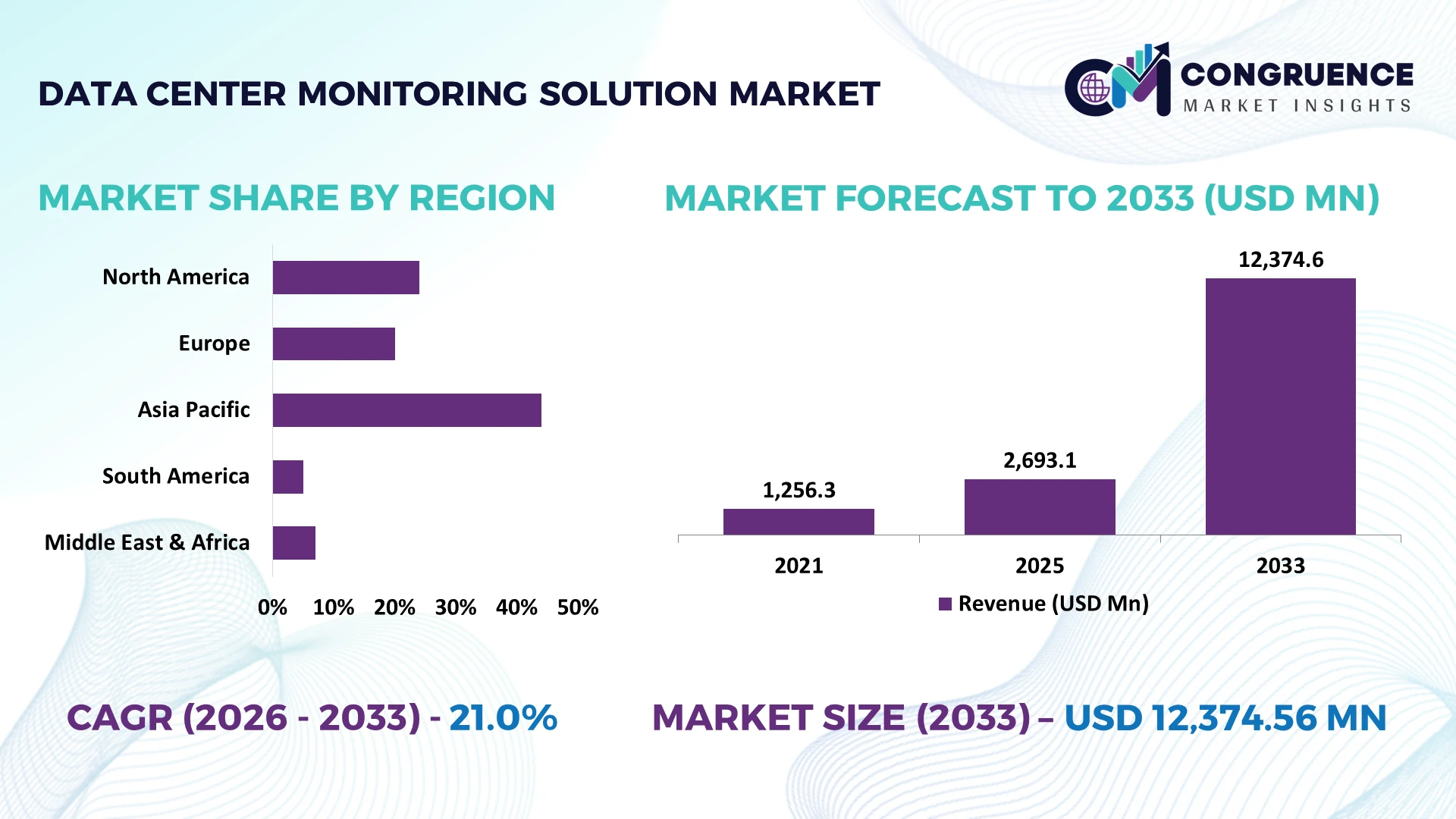
The Global Data Center Monitoring Solution Market was valued at USD 2693.06 Million in 2025 and is anticipated to reach a value of USD 12374.56 Million by 2033 expanding at a CAGR of 21% between 2026 and 2033. Growth is driven by AI-cluster power densities exceeding 100 kW per rack, liquid-cooling deployment, hyperscale capacity expansion, and real-time monitoring requirements for power, thermal conditions, water usage, and infrastructure failures.
The United States dominates deployment, supported by roughly 5,400 data centers and about 45% of global hyperscale capacity, compared with China at approximately 25%. Virginia alone operates more than 5 GW of data-center capacity, while AI infrastructure investment is accelerating across cloud, semiconductor, financial-services, and digital-platform operators. U.S.–China semiconductor controls are simultaneously reshaping where advanced AI capacity and monitoring infrastructure are deployed.
Operators prioritizing AI-ready DCIM, predictive maintenance, granular power telemetry, and liquid-cooling monitoring will secure stronger uptime, capacity utilization, and energy-management advantages as rack densities intensify.
Market Size & Growth: USD 2.69 billion in 2025 reaches USD 12.37 billion by 2033 at 21%, driven by AI-ready high-density infrastructure monitoring.
Top Growth Drivers: Hyperscale capacity concentration at 45%, AI rack densities rising above 100 kW, and cooling consuming approximately 40% of data-center electricity sharpen monitoring requirements.
Short-Term Forecast: By 2028, AI-assisted infrastructure monitoring can reduce unplanned downtime by approximately 20–30% through predictive fault detection and automated incident prioritization.
Emerging Technologies: AI anomaly detection, digital twins, and autonomous DCIM increasingly combine millions of telemetry points to optimize thermal, electrical, and equipment performance.
Regional Leaders: By 2033, North America approaches USD 4.8 billion, Asia-Pacific USD 4.0 billion, and Europe USD 2.5 billion, led respectively by hyperscale, AI, and sustainability deployments.
Consumer/End-User Trends: Hyperscalers account for roughly 45% of global capacity, increasing demand for standardized monitoring across distributed, multi-megawatt campuses.
Pilot/Case Example: Google reported AI-based cooling controls delivering approximately 30% average energy savings compared with manually operated cooling systems.
Competitive Landscape: Schneider Electric holds an estimated 12% specialist position, competing with Vertiv, Siemens, ABB, and Johnson Controls across advanced infrastructure monitoring.
Regulatory & ESG Impact: EU data-center reporting rules capture facilities with installed IT power demand of at least 500 kW, strengthening granular energy and sustainability measurement.
Investment & Funding: Microsoft planned approximately USD 80 billion of AI-enabled data-center investment during fiscal 2025, intensifying demand for power, cooling, and infrastructure telemetry.
Innovation & Future Outlook: Liquid cooling can reduce facility energy consumption by around 10% as monitoring shifts toward rack-level thermal intelligence, automated capacity management, and digital-twin optimization.
Data center monitoring solutions are becoming essential across hyperscale cloud campuses, colocation facilities, enterprise data centers, and AI compute clusters. With cooling representing approximately 40% of facility electricity consumption, operators are deploying AI analytics, digital twins, rack-level sensors, and liquid-cooling telemetry. Rising GPU density and energy-reporting requirements are now shifting infrastructure management from reactive alarms toward predictive, autonomous operations, establishing the strategic context for deeper market analysis.
Data center monitoring solutions are becoming strategic infrastructure as AI workloads push rack density, power demand, cooling complexity, and outage risk beyond the limits of traditional alarm-based management. The operating shift is visible: the modal rack density reached 11 kW in 2026, up from 9 kW in 2025, while 46% of IT workloads now run in third-party facilities. Operators are therefore prioritizing unified telemetry across power, cooling, network, and facility systems.
AI-assisted monitoring materially improves operational control versus legacy threshold-based systems. Predictive analytics can cut fault-detection and diagnostic time by roughly 20–30%, while intelligent cooling optimization can reduce energy use by about 10–30% in suitable deployments. North America leads in hyperscale deployment and AI-cluster density, while Europe emphasizes energy reporting and sustainability compliance. Asia-Pacific is scaling rapidly through cloud, colocation, and semiconductor infrastructure expansion.
Over the next two to three years, monitoring will shift toward digital twins, automated capacity forecasting, liquid-cooling telemetry, and AI-based anomaly detection. A practical example is predictive thermal monitoring that identifies rack hotspots before throttling or failure occurs. Operators are increasing investment in sensor density, DCIM integration, and technology partnerships. Competitive advantage will increasingly depend on converting infrastructure data into automated, preventive operating decisions.
AI computing is sharply increasing the operational complexity that data center monitoring platforms must manage. The modal rack density rose from 9 kW in 2025 to 11 kW in 2026, while 64% of operators report concern over power availability and 76% over capacity forecasting. GPU-intensive clusters are also accelerating direct-liquid-cooling deployment, creating new requirements for flow, pressure, leak, thermal, and coolant-quality telemetry. In the United States, hyperscale operators are redesigning campuses around higher-density power and cooling architectures rather than simply adding conventional server halls. Monitoring vendors are responding with rack-level sensing, AI-assisted anomaly detection, and integrated electrical-thermal analytics. The strategic insight is that monitoring demand now scales with infrastructure complexity, not merely with floor-space expansion.
Existing facilities remain a structural constraint because many were designed before high-density AI workloads, granular telemetry, and modern DCIM integration became operational priorities. Around 79% of operators report cost concerns, while 72% cite supply-chain disruption and 64% identify power availability as significant management issues. Retrofitting older U.S. and European sites with intelligent meters, environmental sensors, networked cooling controls, and interoperable software can require shutdown planning and substantial systems integration. Legacy protocol fragmentation also limits real-time correlation across power, cooling, and IT equipment. Operators are reducing exposure through phased retrofits, gateway-based protocol conversion, standardized sensor networks, and long-term equipment contracts. The key constraint is not sensor availability but the cost and operational disruption of converting fragmented physical infrastructure into a unified monitoring environment.
The strongest opportunity lies in shifting data center monitoring from visualization toward autonomous optimization. In 2025, 89% of surveyed operators identified improved facility efficiency as a leading benefit of AI in data center operations, while 51% cited reduced human error and 48% higher staff productivity. Digital twins, predictive maintenance, AI-based capacity forecasting, and liquid-cooling analytics are therefore moving into higher-value operational roles. Singapore, Japan, and major U.S. data center hubs are investing heavily in high-density capacity where real-time thermal and power optimization becomes economically critical. Vendors are expanding machine-learning models, open APIs, and control-layer partnerships with cooling, UPS, and building-management suppliers. The non-obvious opportunity is monetizing actionable optimization rather than dashboards, turning monitoring platforms into operational decision engines.
Long-term deployment depends on securing increasingly connected operational technology while maintaining enough skilled staff to validate automated decisions. In 2026, 53% of operators reported difficulty finding qualified candidates, up from 46% in 2025, while 47% experienced an impactful outage within the previous three years. One in ten outages still produces serious or severe disruption, and expanding sensor, DCIM, BMS, and remote-management connectivity enlarges the cyberattack surface. Operators remain more willing to use AI for sensor analysis and predictive maintenance than for direct equipment control, reflecting trust and governance limitations. Companies must invest in zero-trust OT segmentation, secure telemetry gateways, workforce training, and human-in-the-loop automation. Competitive sustainability will depend on scaling intelligence without creating new operational or cybersecurity failure points.
High-Density Telemetry Moves Rack-Level: Average modal rack density reached almost 9 kW in 2025 versus 8.3 kW in 2024, while 7% of facilities reported typical densities above 20 kW. Operators are increasing branch-circuit metering, temperature sensing, and rack-level telemetry as GPU clusters create localized hotspots. Vendors are scaling high-frequency monitoring and integrated power-thermal analytics to improve utilization without compromising availability.
Liquid Cooling Expands Monitoring Scope: AI training infrastructure is accelerating cooling instrumentation, with 27% of surveyed training deployments operating above 50 kW per rack and another 20% at 31–50 kW. Facilities are adding coolant-flow, pressure, leak, and supply-return temperature sensors alongside traditional environmental monitoring. Equipment suppliers are integrating cooling telemetry with DCIM platforms, creating demand beyond conventional room-level temperature and humidity monitoring.
Colocation Capacity Becomes Scarcer: North American colocation vacancy fell to 2.3% in 2025 as installed inventory reached 15.5 GW, while new facilities were approximately 72% pre-leased before construction. Operators are responding with tighter capacity forecasting, real-time utilization analytics, and power-allocation monitoring. The non-obvious shift is that monitoring increasingly supports commercial capacity decisions, not simply infrastructure reliability.
Sustainability Telemetry Gains Operational Weight: More than half of operators tracked water consumption by 2026, while one in ten outages remained serious or severe. Energy, water, and resilience metrics are therefore converging inside operational dashboards. European reporting requirements and grid constraints are pushing operators to integrate PUE, water, power-quality, and availability data; vendors are expanding automated reporting and cross-system analytics.
Infrastructure Monitoring leads the market with approximately 29% share, reflecting its central role in tracking servers, racks, UPS systems, cooling equipment, physical infrastructure, and facility health from a unified operational layer. Its dominance stems from broad applicability across enterprise, colocation, and hyperscale facilities where infrastructure availability directly affects service continuity. DCIM Software follows at approximately 24%, increasingly consolidating equipment telemetry, capacity information, alarms, and analytics. Power Monitoring represents about 19%, supported by rising electrical constraints and the need for rack-level consumption visibility.
Environmental Monitoring and Network Monitoring remain essential at approximately 15% and 13%, respectively, particularly for temperature, humidity, airflow, connectivity, and fault identification. DCIM Software is the fastest-growing type as operators replace fragmented monitoring consoles with integrated platforms combining digital twins, predictive analytics, asset data, and automated workflows. Suppliers are consequently prioritizing open APIs, AI-assisted analytics, and interoperable platforms. Investment is shifting from isolated sensors toward software layers capable of translating multiple telemetry streams into infrastructure decisions.
Power Management leads applications with approximately 28% market share as constrained grid access, rising rack density, and AI computing make electrical capacity a primary operational variable. Operators increasingly monitor UPS loading, branch circuits, rack consumption, power quality, and stranded capacity rather than relying solely on facility-level measurements. Server Monitoring accounts for approximately 23%, supporting availability and workload health, while Cooling Monitoring holds nearly 20% as higher-density equipment increases thermal variability across individual racks and aisles.
Capacity Management is the fastest-growing application, representing roughly 17% of current deployment activity as operators seek better forecasting of power, cooling, floor-space, and rack availability. Asset Management retains approximately 12%, supporting equipment lifecycle, maintenance, and inventory control. Monitoring providers are integrating capacity simulation, digital twins, and real-time electrical-thermal data to improve allocation decisions. This changes the purchasing rationale: monitoring platforms increasingly determine where additional computing equipment can be safely deployed, making capacity intelligence commercially important for heavily pre-leased colocation campuses.
Colocation Providers account for approximately 31% of Data Center Monitoring Solution Market demand because multi-tenant facilities require continuous SLA monitoring, customer-level power measurement, capacity allocation, environmental control, and uptime management. Cloud Service Providers represent approximately 28%, combining hyperscale infrastructure with extensive internally developed monitoring capabilities. Enterprises hold roughly 21%, particularly across financial services, manufacturing, healthcare, and large digital operations where hybrid architectures preserve significant privately operated infrastructure.
Cloud Service Providers represent the fastest-growing end-user segment as AI training, inference, and distributed cloud services increase computing density and infrastructure complexity. Telecommunications Companies account for approximately 12%, using monitoring across central facilities and distributed network infrastructure, while Government Data Centers represent around 8%, emphasizing resilience and controlled deployment. Technology suppliers are differentiating through hyperscale integrations, tenant-level dashboards, API-based telemetry, and flexible licensing. Future purchasing power is shifting toward operators managing shared infrastructure because monitoring increasingly supports SLA enforcement, energy allocation, customer billing, and capacity monetization simultaneously.
North America accounted for the largest market share at 39% in 2025 however, Asia-Pacific is expected to register the fastest growth, expanding at a CAGR of 23.8% between 2026 and 2033.
AI Clusters Intensify Infrastructure Visibility
North America represents approximately 39% of Data Center Monitoring Solution Market activity, anchored by hyperscale campuses, colocation clusters, and accelerated GPU infrastructure deployment. Northern Virginia, Dallas, Phoenix, Atlanta, and Silicon Valley concentrate large power-intensive facilities where rack-level electrical and thermal visibility is becoming essential. North American colocation inventory reached approximately 15.5 GW in 2025, while vacancy compressed to 2.3%, increasing the operational value of capacity analytics. AI clusters exceeding 50 kW per rack are accelerating deployment of liquid-cooling telemetry, intelligent PDUs, branch-circuit monitoring, and predictive thermal analytics. Operators are integrating DCIM with building-management and IT-service platforms rather than maintaining separate infrastructure consoles. Grid interconnection delays are also shifting monitoring priorities toward power forecasting, stranded-capacity identification, and granular utilization management.
United States Market Outlook: The United States combines hyperscale leadership with the world's deepest concentration of AI infrastructure. Northern Virginia alone operates data-center capacity measured in multiple gigawatts, while major cloud providers are expanding GPU campuses across Texas, Georgia, Ohio, and Arizona. Monitoring investment increasingly targets power availability, liquid-cooling performance, equipment health, and predictive maintenance, making infrastructure intelligence central to maximizing constrained energized capacity.
Energy Accountability Reshapes Monitoring Architecture
Europe accounts for approximately 25% of global market activity, with Frankfurt, London, Paris, Amsterdam, and Dublin forming major deployment hubs. Energy constraints and regulatory reporting increasingly influence monitoring architecture alongside traditional uptime requirements. EU rules require data centers with at least 500 kW installed IT power demand to report energy-performance information, strengthening adoption of granular electricity, temperature, cooling, water, and utilization telemetry. Operators are integrating PUE tracking, environmental sensors, intelligent metering, and automated sustainability reporting into DCIM environments. Grid congestion in Ireland and constrained power availability around established FLAP-D hubs are simultaneously encouraging capacity expansion into secondary markets. Monitoring vendors are adapting through interoperable energy dashboards, automated compliance reporting, and digital-twin functionality. The operational shift is clear: facility monitoring increasingly determines whether operators can demonstrate efficient capacity utilization before securing additional infrastructure.
Germany Market Outlook: Germany remains a strategic data-center location because Frankfurt combines dense fiber connectivity, financial-services demand, cloud availability zones, and DE-CIX infrastructure. Power constraints and energy-efficiency requirements are raising the value of granular telemetry. Operators increasingly deploy intelligent power monitoring and thermal analytics to improve PUE, manage high-density equipment, and demonstrate infrastructure efficiency across increasingly constrained metropolitan campuses.
Hyperscale Expansion Meets Power Constraints
Asia-Pacific represents approximately 24% of global Data Center Monitoring Solution Market activity, supported by rapid capacity deployment across China, Japan, India, Australia, Singapore, and Malaysia. AI computing, sovereign-cloud programs, digital platforms, and hyperscale expansion are increasing demand for automated infrastructure visibility. Singapore's operating data-center capacity exceeds 1.4 GW, while Johor has emerged as a major overflow and hyperscale destination as operators seek land and power beyond established hubs. High-density facilities increasingly combine DCIM, intelligent PDUs, liquid-cooling monitoring, and AI-based capacity forecasting. China adds enormous cloud and digital-platform scale, while Japan's earthquake resilience requirements strengthen physical infrastructure monitoring. Vendors are expanding local integration partnerships and multilingual platforms. Power availability is becoming the decisive deployment variable, pushing monitoring from equipment supervision toward site-level energy optimization and capacity allocation.
China Market Outlook: China provides exceptional monitoring scale through hyperscale cloud infrastructure, telecommunications networks, internet platforms, and government-backed computing projects. Its national “East Data, West Computing” initiative redirects workloads toward western provinces with stronger energy availability. This geographic redistribution increases requirements for remotely managed facilities, centralized telemetry, network monitoring, predictive maintenance, and standardized DCIM across geographically dispersed data-center fleets.
Brazil Anchors Hyperscale Infrastructure Demand
South America represents approximately 7% of global Data Center Monitoring Solution Market activity, led decisively by Brazil, followed by Chile and Colombia. São Paulo remains the principal colocation hub, supported by cloud availability zones, financial institutions, telecommunications infrastructure, and large digital-service populations. Operators are increasing monitoring investment as hyperscale campuses expand beyond traditional metropolitan facilities and require centralized management across distributed sites. Brazil's electricity system provides a relatively high renewable-energy contribution, making real-time power-source, consumption, and efficiency monitoring commercially relevant for sustainability-focused operators. Chile combines strong international connectivity with emerging hyperscale infrastructure but faces water and environmental constraints that elevate cooling telemetry requirements. Vendors are building local implementation partnerships and cloud-connected monitoring platforms, although power-grid quality, equipment costs, and specialist workforce availability still complicate standardized deployment outside primary hubs.
Brazil Market Outlook: Brazil offers the strongest regional demand base through São Paulo's concentration of hyperscalers, colocation operators, banks, fintechs, retailers, and telecommunications companies. Renewable electricity contributes more than 80% of national generation, strengthening the sustainability case for large computing facilities. Monitoring platforms increasingly combine energy analytics, equipment diagnostics, SLA tracking, and remote operations as providers expand into secondary Brazilian locations.
Sovereign AI Drives Infrastructure Modernization
Middle East & Africa accounts for approximately 5% of global market activity, with the UAE, Saudi Arabia, South Africa, and Israel providing the strongest deployment bases. Sovereign cloud programs, AI infrastructure, government digitization, and hyperscale investment are changing facility requirements across Gulf markets. Saudi Arabia and the UAE are developing increasingly large computing campuses where extreme ambient temperatures make cooling performance, power quality, and environmental telemetry critical. Operators are integrating intelligent cooling controls, digital twins, DCIM, and remote operations from initial facility design rather than retrofitting them later. South Africa remains the principal sub-Saharan hub through Johannesburg and Cape Town, although grid reliability increases dependence on backup-power monitoring. Technology suppliers are responding with regional service partnerships, localized cloud infrastructure, and monitoring platforms engineered around high-temperature environments and resilient power architectures.
United Arab Emirates Market Outlook: The UAE combines sovereign AI investment, strong international connectivity, cloud regions, and rapidly expanding high-density infrastructure. Abu Dhabi and Dubai are attracting increasingly sophisticated AI and cloud deployments, raising requirements for liquid-cooling telemetry and automated power management. Operators are prioritizing integrated monitoring from design stage, creating favorable conditions for advanced DCIM, predictive maintenance, and digital-twin adoption.
Schneider Electric, Vertiv, Siemens, ABB, and Johnson Controls compete through integrated power, cooling, building, and monitoring portfolios, while Sunbird Software and FNT challenge hardware-led incumbents with software-centric DCIM platforms. The top five suppliers collectively represent approximately 43% of market activity. Competition increasingly centers on interoperability, predictive analytics, deployment speed, and lifecycle service: AI-assisted monitoring can reduce diagnostic time by 20–30%, while optimized cooling controls deliver roughly 10–30% energy savings and intelligent capacity management improves infrastructure utilization by approximately 15–20%. Schneider Electric and Vertiv leverage integrated electrical and thermal portfolios; Siemens and Johnson Controls connect facility automation with digital infrastructure; software specialists emphasize vendor-neutral visibility. Partnerships with hyperscalers, liquid-cooling providers, and colocation operators are intensifying as AI racks reshape monitoring requirements. Integration across heterogeneous BMS, DCIM, network, and power systems remains the principal entry barrier. Winning requires open interoperability, high-density telemetry, predictive intelligence, cybersecurity, and global service capability at scale.
Schneider Electric
Vertiv
Siemens
ABB
Johnson Controls
Eaton
Honeywell
Huawei
Sunbird Software
FNT
Nlyte Software
Paessler
Device42
Rittal
Current monitoring stacks combine DCIM, intelligent PDUs, environmental sensors, BMS integration, and cloud analytics to correlate power, cooling, capacity, and equipment health. AI-assisted sensor analytics is trusted by 73% of operators, while predictive maintenance reaches 70% acceptance. Compared with threshold-based legacy monitoring, integrated analytics can reduce diagnostic effort by approximately 25%, improving uptime and technician productivity across distributed facilities.
Emerging architectures add digital twins, computational fluid dynamics, liquid-cooling telemetry, and machine-learning anomaly detection. Digital twins connect live electrical and thermal data with simulation, while adaptive cooling can improve energy efficiency by 10–20% under suitable operating conditions. Secure SNMPv3 monitoring is scaling toward 4,000 devices per server, enabling operators to consolidate larger estates while maintaining granular visibility and stronger cybersecurity controls.
Disruptive development centers on AI-driven operations that predict failures, prioritize alarms, recommend setpoints, and eventually orchestrate closed-loop infrastructure. Only 35% of operators currently trust AI to control equipment, highlighting substantial governance headroom. Between 2026 and 2028, adoption will shift from dashboards toward autonomous optimization and data agents. Hyperscalers, colocation providers, and high-density AI operators benefit most because automated intelligence converts constrained power and cooling capacity into measurable operational advantage without proportionally increasing facility staffing requirements, making investment urgent.
March 2024 — Schneider Electric added automated sustainability reporting to EcoStruxure IT, covering roughly 80% of EU Energy Efficiency Directive reporting requirements for data centers above 500 kW. The upgrade converts regulatory monitoring data into standardized automated compliance workflows. Source: DCD.
November 2025 — Siemens and Delta formalized a global partnership for prefabricated modular data-center power systems, cutting deployment time by up to 50%, capital expenditure by 20%, and carbon emissions by 27%. Integrated monitoring supports faster global infrastructure scaling. Source: Siemens.
February 2026 — Schneider Electric expanded EcoStruxure IT monitoring, simplifying Data Center Expert from more than 300 commercial references to 9 and targeting 4,000 SNMPv3 devices per server, improving secure monitoring scalability for large distributed infrastructure estates. Source: Schneider.
September 2025 — European Commission advanced Energy Efficiency Directive data-center reporting with operational guidance for its European database, covering facilities above 500 kW. The framework institutionalizes energy and water telemetry, increasing compliance-driven demand for automated infrastructure monitoring platforms significantly. Source: EC.
The Data Center Monitoring Solution Market report evaluates Infrastructure Monitoring, Environmental Monitoring, Power Monitoring, Network Monitoring, and DCIM Software across Server Monitoring, Cooling Monitoring, Power Management, Capacity Management, and Asset Management applications. End-user coverage includes Colocation Providers, Cloud Service Providers, Enterprises, Telecommunications Companies, and Government Data Centers. Infrastructure Monitoring represents approximately 29% of deployment activity, while Colocation Providers account for roughly 31% of end-user demand.
Regional analysis covers North America, Europe, Asia-Pacific, South America, and Middle East & Africa, including major hyperscale and emerging data-center hubs. Technology coverage examines AI anomaly detection, predictive maintenance, digital twins, intelligent PDUs, liquid-cooling telemetry, environmental sensing, and integrated BMS/DCIM architectures. The report assesses competitive positioning, regulatory shifts, high-density AI infrastructure, edge monitoring, and autonomous operations, supporting investment planning, geographic expansion, technology partnerships, portfolio strategy, and long-term market positioning between 2026 and 2033.
| Report Attribute/Metric | Report Details |
|---|---|
Market Revenue in 2025 | USD 2693.06 Million |
Market Revenue in 2033 | USD 12374.56 Million |
CAGR (2026 - 2033) | 21% |
Base Year | 2025 |
Forecast Period | 2026 - 2033 |
Historic Period | 2021 - 2025 |
Segments Covered | By Type
By Application
By End-User
|
Key Report Deliverable | Revenue Forecast, Growth Trends, Market Dynamics, Segmental Overview, Regional and Country-wise Analysis, Competition Landscape |
Region Covered | North America, Europe, Asia-Pacific, South America, Middle East, Africa |
Key Players Analyzed | Schneider Electric, Vertiv, Siemens, ABB, Johnson Controls, Eaton, Honeywell, Huawei, Sunbird Software, FNT, Nlyte Software, Paessler, Device42, Rittal |
Customization & Pricing | Available on Request (10% Customization is Free) |




