
Reports
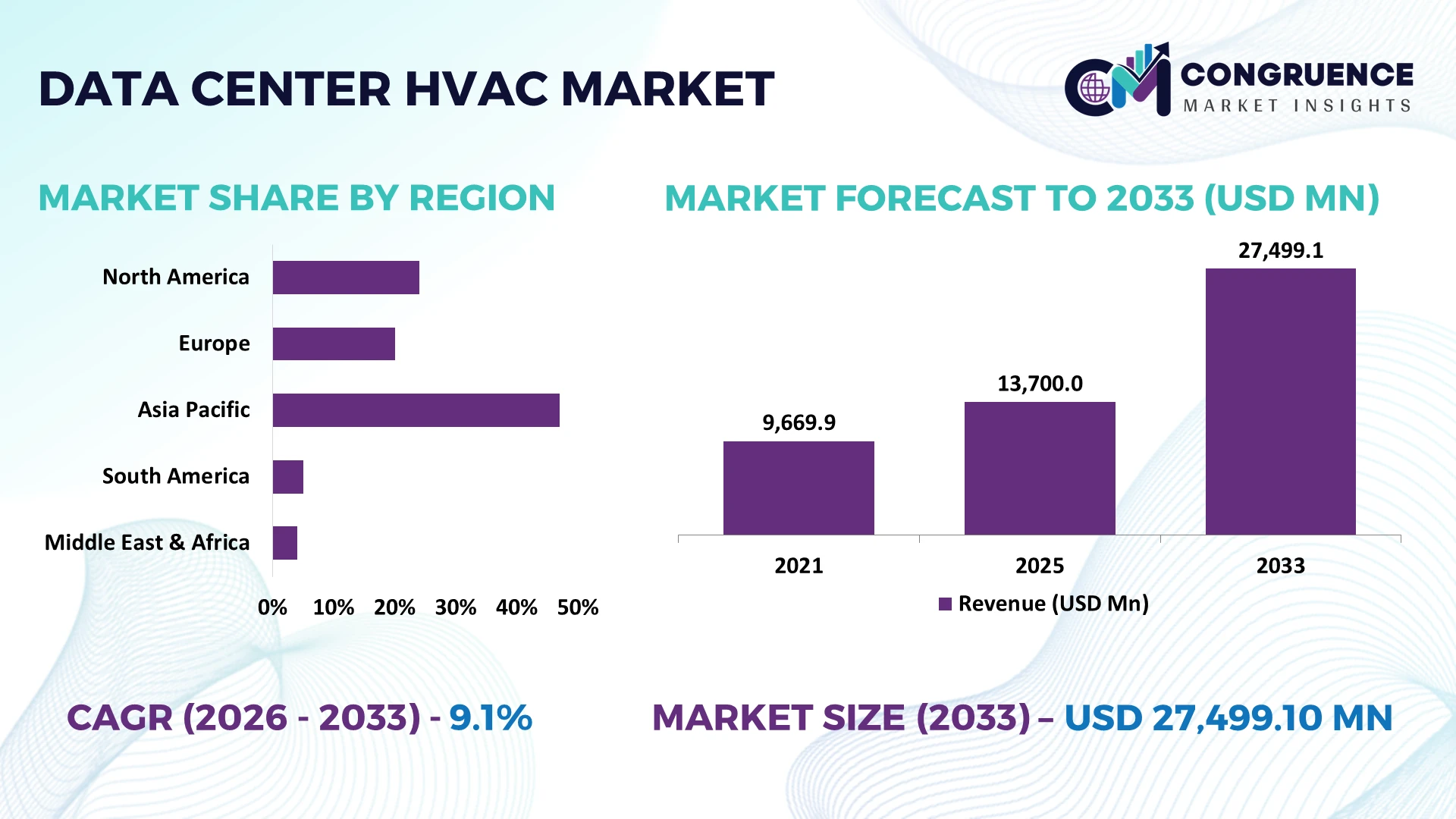
The Global Data Center HVAC Market was valued at USD 13700 Million in 2025 and is anticipated to reach a value of USD 27499.1 Million by 2033 expanding at a CAGR of 9.1% between 2026 and 2033. Growth is primarily driven by hyperscale AI data center expansion, high-density rack deployments above 30 kW, and accelerated adoption of liquid-ready cooling infrastructure to improve energy efficiency and operational resilience.
The United States leads the global Data Center HVAC Market with approximately 39% of installed hyperscale data center capacity, supported by over USD 90 billion in ongoing digital infrastructure investments and widespread AI workload deployment across cloud, financial, and technology sectors. Compared with Germany, where sustainability-focused cooling modernization is expanding rapidly, U.S. facilities operate significantly larger average campus capacities, while advanced HVAC optimization improves cooling energy efficiency by nearly 18%. Continued semiconductor supply-chain diversification and strategic digital infrastructure investments reinforce long-term deployment momentum.
Organizations prioritizing scalable, energy-efficient HVAC platforms with AI-enabled thermal management will secure stronger operational resilience and competitive infrastructure performance.
Market Size & Growth: USD 13700 Million in 2025, reaching USD 27499.1 Million by 2033 at a 9.1% CAGR, driven by AI-ready hyperscale infrastructure and high-density computing expansion.
Top Growth Drivers: AI workload growth (+34%), liquid cooling adoption (+28%), and hyperscale construction activity (+22%) continue accelerating advanced HVAC deployment.
Short-Term Forecast: By 2028, intelligent cooling controls reduce energy consumption by 15% while improving thermal efficiency by approximately 18%.
Emerging Technologies: AI-driven cooling optimization, liquid cooling integration, and digital twin monitoring improve operational performance by nearly 20% across advanced facilities.
Regional Leaders: North America exceeds USD 10.5 billion, Asia-Pacific approaches USD 8.8 billion, and Europe surpasses USD 5.9 billion, supported by regional digital infrastructure expansion.
Consumer/End-User Trends: More than 60% of new hyperscale projects specify liquid-ready or hybrid HVAC systems for high-density server environments.
Pilot/Case Example: In 2026, an AI-focused data center modernization project lowered cooling energy demand by 17% through predictive thermal management automation.
Competitive Landscape: Leading suppliers collectively control about 45% of the global market, with strong competition among Vertiv, Schneider Electric, Johnson Controls, Trane Technologies, and Daikin.
Regulatory & ESG Impact: Advanced cooling modernization cuts facility carbon emissions by roughly 16% while supporting stricter energy-efficiency compliance requirements.
Investment & Funding: More than USD 40 billion in global digital infrastructure investments support strategic partnerships, regional expansion, and resilient cooling supply chains.
Innovation & Future Outlook: High-density liquid cooling, AI automation, and modular HVAC architectures define the next competitive phase as regional infrastructure diversification accelerates.
The Data Center HVAC Market is advancing through liquid cooling integration, AI-based thermal optimization, and modular precision cooling systems that support increasingly dense computing environments. Nearly 35% of new hyperscale developments now incorporate hybrid cooling architectures to improve energy performance and uptime. Growing localization of equipment manufacturing and stricter efficiency standards are reshaping procurement strategies, creating a strong foundation for the strategic market analysis that follows.
The Data Center HVAC Market has become strategically important as AI infrastructure, hyperscale expansion, and national digital infrastructure programs redefine competitive positioning across cloud, telecommunications, and enterprise computing. Infrastructure modernization and localized manufacturing strategies are reshaping procurement decisions as operators seek resilient cooling ecosystems with lower operating costs and improved thermal performance. Energy-efficiency regulations are also accelerating investment in intelligent HVAC platforms capable of supporting high-density computing environments.
Modern AI-enabled HVAC systems deliver approximately 18% higher cooling efficiency and reduce maintenance costs by nearly 15% compared with conventional rule-based cooling architectures through predictive controls and dynamic airflow optimization. The United States continues deploying large hyperscale campuses at a faster pace, while Japan emphasizes high-efficiency retrofits and precision environmental control for space-constrained facilities. During the next two to three years, more than 40% of newly commissioned enterprise data centers are expected to integrate hybrid air-and-liquid cooling configurations to support increasing rack densities.
A practical example is the deployment of AI-driven thermal management across large colocation facilities, where automated cooling orchestration has reduced energy consumption while maintaining consistent equipment reliability. Equipment manufacturers are expanding regional production, strengthening technology partnerships, and integrating digital monitoring capabilities into HVAC portfolios. Companies that combine intelligent cooling, localized supply resilience, and scalable deployment strategies will establish stronger competitive positioning as data center infrastructure continues evolving toward higher-density, sustainability-focused operations.
Rapid deployment of AI computing clusters and hyperscale facilities is fundamentally increasing demand for advanced Data Center HVAC solutions. Rack densities exceeding 30 kW have increased by nearly 32% over the past two years, while intelligent cooling platforms improve energy efficiency by approximately 18% and reduce unplanned maintenance by around 14%. The United States continues expanding AI infrastructure under large-scale digital investment programs, encouraging suppliers to redesign thermal management systems for higher computational loads. In response, leading companies are increasing manufacturing capacity, investing in liquid-ready HVAC technologies, and forming engineering partnerships to deliver modular cooling platforms. This structural transition strengthens long-term operational resilience while creating differentiated service capabilities for high-performance data center operators.
Advanced HVAC deployment remains constrained by high equipment costs, specialized component availability, and extended procurement timelines. Precision cooling systems typically require 20–25% higher upfront investment than conventional commercial HVAC installations, while imported compressors and control electronics account for nearly 35% of critical component sourcing in several manufacturing markets. Periodic semiconductor and industrial equipment supply disruptions continue affecting delivery schedules and project sequencing. Companies are reducing exposure through supplier diversification, localized assembly, and multi-year procurement contracts for critical thermal management components. Strengthening domestic manufacturing ecosystems also improves inventory stability, enabling operators to maintain deployment schedules while protecting long-term operational margins and project execution efficiency.
Next-generation intelligent cooling technologies are creating significant opportunities beyond traditional HVAC replacement cycles. AI-enabled optimization platforms can reduce cooling energy consumption by approximately 20%, while digital twin applications shorten commissioning time by nearly 15%. India is rapidly expanding hyperscale and colocation infrastructure, generating demand for modular, scalable cooling architectures optimized for high-density facilities. Companies are increasing R&D investment, collaborating with automation specialists, and developing integrated liquid-ready HVAC platforms that combine predictive maintenance with real-time environmental analytics. A less obvious opportunity lies in retrofitting existing enterprise facilities with intelligent controls, allowing operators to extend infrastructure life while achieving measurable efficiency improvements without complete facility reconstruction.
Scaling advanced HVAC technologies across geographically distributed data center portfolios presents growing execution complexity. Integrating AI controls, liquid cooling interfaces, and legacy building management systems increases engineering requirements, while skilled thermal infrastructure specialists remain in limited supply. More than 40% of operators report integration complexity as a major implementation challenge, and commissioning advanced cooling environments can require approximately 25% longer validation periods than conventional facilities. Germany's stringent energy-performance standards further increase technical design requirements for complex deployments. Companies must strengthen engineering capabilities, expand workforce training, and build strategic partnerships with automation and controls providers to ensure consistent performance, sustainability compliance, and reliable long-term infrastructure operation across increasingly sophisticated computing environments.
AI-Optimized Thermal Control Intelligent HVAC platforms using AI-based predictive analytics are becoming standard across high-density facilities. More than 48% of newly commissioned hyperscale sites now deploy automated thermal optimization, reducing cooling energy use by approximately 17% while improving equipment availability by 9%. Rising AI workloads and stricter power utilization targets are accelerating software-driven cooling management. Vendors are expanding automation portfolios, integrating digital twins, and partnering with infrastructure software providers to improve operational responsiveness.
Liquid Cooling Integration Accelerates Hybrid air-and-liquid cooling deployments have increased by nearly 31% across AI-ready facilities as rack densities frequently exceed 35 kW. Traditional air-only architectures are increasingly reserved for lower-density workloads, while operators redesign mechanical infrastructure for liquid-ready environments. Equipment manufacturers are restructuring product portfolios, scaling coolant distribution technologies, and collaborating with server manufacturers to support faster deployment and improved thermal efficiency under evolving computing requirements.
Localized Manufacturing Gains Priority Supply-chain diversification has become an operational priority following component disruptions affecting compressors, controls, and heat exchangers. Nearly 42% of enterprise procurement programs now include regional sourcing requirements, reducing average equipment lead times by approximately 18%. Manufacturers are expanding localized assembly operations, increasing strategic inventory, and strengthening supplier partnerships to improve project certainty while reducing logistics-related deployment delays.
Modular Cooling Deployment Expands Prefabricated HVAC modules are transforming deployment workflows by reducing installation time by nearly 25% and lowering onsite commissioning requirements by about 16%. This trend is particularly visible in India's rapidly expanding colocation market, where standardized infrastructure shortens construction schedules. Companies are investing in factory-built cooling solutions, modular engineering capabilities, and integrated monitoring platforms to improve scalability while maintaining consistent operational performance.
Precision Air Conditioners remain the leading segment, accounting for approximately 41% of the Data Center HVAC Market because they provide precise temperature and humidity management for mission-critical computing environments. Their compatibility with intelligent monitoring platforms and high-density server rooms makes them the preferred solution for hyperscale and enterprise operators. Chillers represent the fastest-growing segment as AI workloads and higher rack densities increase demand for centralized, energy-efficient cooling systems capable of supporting hybrid air-and-liquid architectures. Manufacturers continue improving compressor efficiency, variable-speed operation, and intelligent controls to enhance operating performance.
Air Handling Units remain strategically important for maintaining airflow consistency across large facilities, while Cooling Towers continue supporting large-scale chilled-water infrastructure with improved water management technologies. Chiller adoption has increased by approximately 28% in newly designed hyperscale campuses, while advanced Precision Air Conditioners improve thermal stability by nearly 18% compared with conventional comfort cooling. Equipment suppliers are expanding modular product portfolios, strengthening engineering partnerships, and prioritizing integrated cooling ecosystems that simplify deployment while supporting scalable digital infrastructure investment.
Hyperscale Data Centers lead the market with an estimated 46% share as AI computing, cloud infrastructure, and digital platform expansion require highly efficient thermal management systems operating at unprecedented scale. Their continuous infrastructure investment and increasing rack densities make advanced HVAC deployment operationally essential. Edge Data Centers represent the fastest-growing application as low-latency digital services, industrial automation, and distributed computing accelerate localized infrastructure development. Modular cooling systems are increasingly selected because they simplify deployment in space-constrained facilities while maintaining operational reliability.
Colocation Data Centers continue expanding through enterprise outsourcing strategies, while Enterprise Data Centers increasingly focus on modernization rather than large-scale capacity additions. More than 40% of newly commissioned hyperscale facilities now integrate hybrid cooling architectures, and modular edge deployments reduce commissioning time by approximately 20%. HVAC suppliers are adapting through standardized product platforms, AI-enabled monitoring, and expanded service partnerships to support both centralized campuses and distributed computing environments with flexible deployment models.
IT & Telecom remains the dominant end-user segment with approximately 52% market share, supported by continuous cloud expansion, hyperscale infrastructure investment, and increasing demand for high-performance computing environments. The sector requires uninterrupted cooling performance to maintain network availability and AI processing efficiency. Healthcare is emerging as the fastest-growing end-user because digital diagnostics, connected medical platforms, and healthcare data management require secure, temperature-controlled computing infrastructure. Specialized cooling systems are increasingly deployed to support continuous digital healthcare operations.
BFSI continues modernizing mission-critical infrastructure for digital banking and cybersecurity operations, while Government investments focus on sovereign digital infrastructure and secure computing environments. Retail demand is expanding through omnichannel platforms and real-time analytics. Around 37% of IT and Telecom operators now deploy AI-assisted cooling optimization, while healthcare infrastructure modernization has increased advanced HVAC adoption by approximately 24%. Suppliers are responding through sector-specific system customization, managed service offerings, strategic partnerships, and integrated lifecycle support to strengthen competitive positioning.
North America accounted for the largest market share at 39% in 2025 however, Asia-Pacific is expected to register the fastest growth, expanding at a 10.8% CAGR between 2026 and 2033.
Dominance Through AI Infrastructure Expansion
North America maintains the leading position in the Data Center HVAC Market due to extensive hyperscale deployment, AI infrastructure investment, and mature cloud ecosystems. The region represents approximately 39% of global demand, supported by large enterprise campuses and high-density computing facilities. Rack densities exceeding 30 kW continue accelerating adoption of precision cooling and hybrid liquid-ready HVAC platforms. More than 55% of newly commissioned hyperscale projects incorporate AI-enabled thermal optimization to improve cooling efficiency and operational resilience. Equipment suppliers are strengthening engineering partnerships, expanding regional manufacturing, and integrating predictive maintenance technologies to support increasing deployment complexity. Continued investment in digital infrastructure modernization reinforces demand for scalable, intelligent cooling solutions across cloud, telecommunications, and colocation operators.
United States Market Outlook: The United States remains the region's operational center due to its concentration of hyperscale campuses, advanced semiconductor ecosystems, and large-scale AI infrastructure investments. More than 40% of global hyperscale facilities are located in the country, driving continuous deployment of precision cooling, liquid cooling integration, and AI-assisted HVAC controls. Domestic manufacturers are expanding localized production while operators prioritize modular cooling systems that reduce deployment time and improve long-term infrastructure efficiency.
Efficiency-Led Infrastructure Modernization
Europe continues strengthening its market position through sustainability regulations, modernization of legacy facilities, and widespread adoption of energy-efficient thermal management technologies. The region contributes approximately 25% of global market demand, supported by expanding colocation infrastructure and strict efficiency standards. Intelligent building management integration has improved cooling energy performance by nearly 16% across newly upgraded facilities. Operators increasingly deploy free-cooling technologies, advanced chillers, and digital monitoring systems to meet operational and environmental objectives. Equipment manufacturers are investing in localized engineering capabilities and strategic partnerships to accelerate deployment while maintaining compliance with evolving efficiency requirements across enterprise and hyperscale environments.
Germany Market Outlook: Germany leads the European market through its advanced industrial engineering base, strong digital infrastructure, and rigorous energy-performance standards. More than 45% of newly modernized enterprise facilities now incorporate intelligent HVAC optimization platforms. Manufacturers continue investing in high-efficiency chillers, modular cooling technologies, and predictive maintenance solutions to improve operational reliability while supporting expanding cloud and industrial digitalization initiatives.
Hyperscale Construction Drives Regional Momentum
Asia-Pacific is the fastest-expanding market as cloud computing, AI deployment, and digital infrastructure programs accelerate large-scale data center construction. The region accounts for approximately 30% of global installations, with India, Japan, Singapore, and Australia driving significant deployment activity. Modular cooling adoption has increased by nearly 29%, while localized manufacturing reduces equipment lead times by approximately 18%. Rapid expansion of hyperscale campuses encourages suppliers to develop scalable HVAC platforms optimized for high-density computing. Companies continue strengthening regional production networks, expanding service capabilities, and introducing integrated thermal management technologies to support accelerating infrastructure deployment.
India Market Outlook: India has emerged as one of the most dynamic data center investment destinations due to expanding cloud services, enterprise digitalization, and favorable infrastructure policies. More than 35% of newly announced facilities are designed with liquid-ready or hybrid cooling configurations. HVAC suppliers are increasing domestic manufacturing, establishing engineering centers, and partnering with colocation operators to deliver modular, energy-efficient cooling systems tailored to rapidly expanding digital infrastructure.
Digital Infrastructure Strengthens Demand
South America is experiencing consistent growth as enterprise digital transformation, cloud migration, and colocation expansion increase demand for reliable cooling infrastructure. The region contributes approximately 4% of global market activity, with Brazil accounting for the majority of large-scale deployments. Modernization projects have improved cooling efficiency by nearly 14% in recently upgraded facilities. While electricity costs and infrastructure limitations influence deployment schedules, operators increasingly adopt modular HVAC systems that simplify installation and reduce operational complexity. Manufacturers are expanding regional distribution partnerships and localized technical support to strengthen project execution across growing digital infrastructure investments.
Brazil Market Outlook: Brazil dominates the regional market through its concentration of enterprise data centers, expanding cloud investments, and growing financial technology ecosystem. Approximately 60% of South America's large colocation facilities are located in Brazil, encouraging suppliers to introduce precision cooling technologies and intelligent monitoring systems. Continued investment in metropolitan digital infrastructure supports long-term demand for advanced HVAC modernization.
Infrastructure Investment Accelerates Transformation
The Middle East & Africa market is gaining strategic importance through national digital transformation programs, hyperscale investment, and expanding cloud infrastructure. The region contributes approximately 2% of global installations but records strong deployment momentum in new enterprise facilities. More than 30% of recently announced projects include modular cooling architectures designed for high ambient temperatures and improved operational efficiency. Technology providers are expanding regional partnerships, localized engineering support, and intelligent cooling solutions tailored for demanding climatic conditions. Government-backed infrastructure initiatives continue strengthening long-term deployment opportunities for advanced HVAC technologies.
United Arab Emirates Market Outlook: The United Arab Emirates leads regional deployment through ambitious smart city programs, expanding hyperscale infrastructure, and advanced digital economy initiatives. AI-enabled building management systems are increasingly integrated into newly commissioned facilities, while high-efficiency cooling technologies reduce operational energy demand by approximately 15%. Equipment manufacturers continue expanding regional partnerships and service capabilities to support resilient, high-performance data center infrastructure.
Global leaders including Vertiv, Schneider Electric, Daikin, Johnson Controls, and Trane Technologies compete directly with regional HVAC specialists and precision-cooling manufacturers, while OEMs increasingly challenge integrated thermal solution providers through AI-enabled platforms. The top five players collectively control approximately 48% of the market, with competition centered on cooling efficiency, deployment speed, lifecycle cost, and intelligent automation rather than pricing alone. AI-driven optimization improves cooling efficiency by nearly 18%, while modular systems shorten deployment schedules by approximately 20%, creating measurable differentiation. Leading suppliers are expanding manufacturing capacity, strengthening engineering partnerships, integrating liquid-ready technologies, and pursuing selective vertical integration to secure critical component availability. Regional manufacturers compete through localized service, faster customization, and shorter delivery cycles. Technology convergence between HVAC suppliers and digital infrastructure providers is reshaping competitive dynamics. High engineering complexity, certification requirements, and integrated software capabilities remain significant entry barriers. Winning requires scalable innovation, resilient supply chains, rapid deployment capability, and advanced lifecycle service excellence.
Vertiv
Schneider Electric
Johnson Controls
Trane Technologies
Daikin Industries
STULZ GmbH
Rittal
Mitsubishi Electric
Delta Electronics
Munters
Airedale International Air Conditioning
Carrier Global
CoolIT Systems
Fujitsu General
AI-enabled thermal management, precision cooling, and intelligent building management platforms currently define the technological foundation of the Data Center HVAC Market. AI-driven cooling optimization improves energy efficiency by approximately 15–20%, while predictive maintenance reduces unplanned downtime by nearly 18%. Around 55% of newly commissioned hyperscale facilities now integrate automated cooling controls with real-time monitoring. These technologies allow operators to maintain stable thermal conditions under rapidly increasing rack densities while lowering operating costs and improving equipment reliability, creating measurable competitive advantages for cloud providers and colocation operators.
Emerging technologies are shifting investment toward hybrid air-and-liquid cooling, digital twins, and direct-to-chip cooling architectures. Hybrid cooling systems support rack densities above 50 kW while improving thermal performance by approximately 25% compared with conventional air-only systems. Digital twin integration has reached nearly 30% adoption across large enterprise modernization projects, enabling continuous optimization of airflow, cooling loads, and maintenance scheduling. Compared with legacy rule-based HVAC operations, intelligent integrated platforms reduce commissioning time by about 20% and improve cooling responsiveness through automated workload balancing.
Between 2026 and 2028, adaptive liquid cooling, AI-powered orchestration, and modular factory-built HVAC systems will become major competitive differentiators. Vendors investing in integrated software, localized manufacturing, and scalable cooling ecosystems will benefit from faster deployment cycles and stronger service capabilities. Early adopters are expected to improve infrastructure utilization by approximately 15%, while modular cooling deployments increase by nearly 35%, positioning technology leaders ahead of conventional HVAC suppliers serving high-density AI infrastructure.
November 2024 Vertiv and Compass Datacenters introduced a combined liquid-and-air cooling platform for AI-ready facilities, supporting mixed-density workloads and accelerating liquid cooling deployment for high-density computing. Business impact: faster AI infrastructure deployment and greater cooling flexibility.
October 2024 Johnson Controls launched the YORK Mission Critical Vertical Computer Room Air Handler featuring high-efficiency EC motors designed to improve cooling efficiency and operational flexibility for mission-critical facilities. Business impact: stronger sustainable cooling performance for hyperscale deployments. Source: https://www.johnsoncontrols.com
January 2026 Vertiv released its Frontiers technology outlook highlighting adaptive liquid cooling, digital twins, and gigawatt-scale AI infrastructure as strategic priorities shaping next-generation facilities. Business impact: accelerated investment in advanced cooling architectures supporting extreme computing densities. Source: https://www.vertiv.com
July 2026 Johnson Controls raised its annual outlook following sustained demand from AI-driven data center projects, with shares rising approximately 6% after reporting stronger HVAC demand. Business impact: confirms expanding commercial investment in advanced mission-critical cooling infrastructure. Source: https://www.reuters.com
This report provides comprehensive analysis of the Data Center HVAC Market across Precision Air Conditioners, Chillers, Air Handling Units, and Cooling Towers, together with application coverage spanning Colocation, Enterprise, Hyperscale, and Edge Data Centers. It also evaluates demand across IT & Telecom, BFSI, Healthcare, Government, and Retail, while assessing deployment patterns across North America, Europe, Asia-Pacific, South America, and the Middle East & Africa. Approximately 60% of current market activity is concentrated in hyperscale and enterprise infrastructure, reflecting the shift toward high-density digital facilities.
The study examines technology transitions including AI-enabled thermal management, liquid cooling, digital twins, predictive maintenance, and modular HVAC architectures while profiling leading industry participants and competitive strategies. It delivers actionable insights into adoption trends, infrastructure modernization, investment priorities, regional deployment dynamics, and operational benchmarking between 2026 and 2033, supporting expansion planning, product positioning, partnership strategies, and long-term competitive decision-making across the global data center cooling ecosystem.
| Report Attribute/Metric | Report Details |
|---|---|
Market Revenue in 2025 | USD 13700 Million |
Market Revenue in 2033 | USD 27499.1 Million |
CAGR (2026 - 2033) | 9.1% |
Base Year | 2025 |
Forecast Period | 2026 - 2033 |
Historic Period | 2021 - 2025 |
Segments Covered | By Type
By Application
By End-User
|
Key Report Deliverable | Revenue Forecast, Growth Trends, Market Dynamics, Segmental Overview, Regional and Country-wise Analysis, Competition Landscape |
Region Covered | North America, Europe, Asia-Pacific, South America, Middle East, Africa |
Key Players Analyzed | Vertiv, Schneider Electric, Johnson Controls, Trane Technologies, Daikin Industries, STULZ GmbH, Rittal, Mitsubishi Electric, Delta Electronics, Munters, Airedale International Air Conditioning, Carrier Global, CoolIT Systems, Fujitsu General |
Customization & Pricing | Available on Request (10% Customization is Free) |




