
Reports
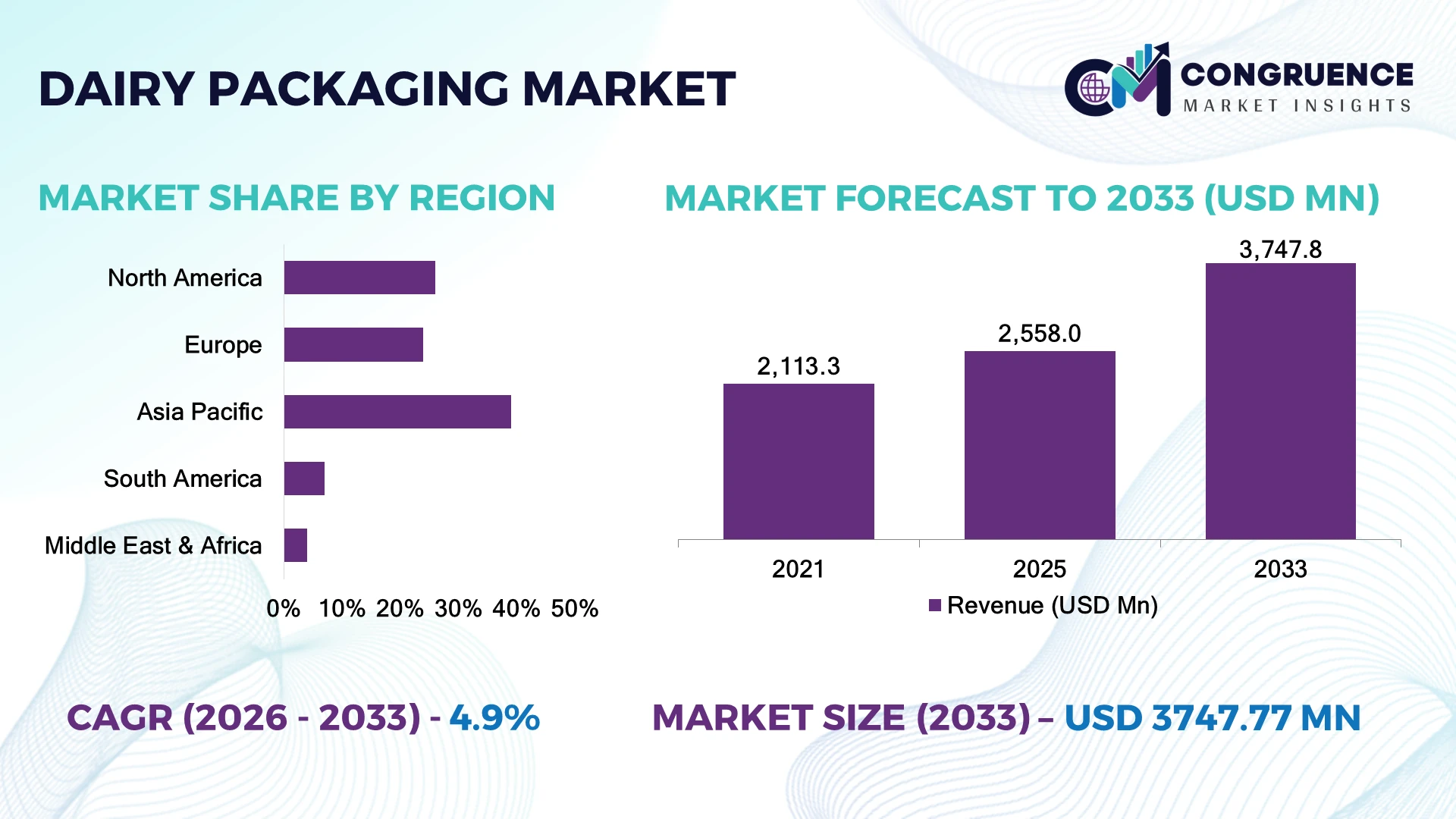
The Global Dairy Packaging Market was valued at USD 2,558.0 Million in 2025 and is anticipated to reach a value of USD 3,747.8 Million by 2033 expanding at a CAGR of 4.89% between 2026 and 2033. Growth is primarily driven by rapid adoption of recyclable barrier packaging, extended shelf-life technologies, and increasing investments in automated dairy processing and cold-chain infrastructure.
China dominates the global dairy packaging landscape with approximately 27% of regional packaging production capacity, supported by investments exceeding USD 6 billion in modern food processing infrastructure and widespread adoption of high-speed aseptic filling systems across the dairy sector. Compared with India, where packaged dairy penetration remains below 40%, China exceeds 70%, reflecting stronger industrial integration and technology deployment despite evolving Asia-Pacific supply-chain adjustments.
This leadership reinforces Asia-Pacific as the preferred destination for capacity expansion, sustainable packaging innovation, and long-term manufacturing investments.
Market Size & Growth: USD 2,558.0 Million in 2025, reaching USD 3,747.8 Million by 2033 at 4.89%, supported by advanced recyclable packaging and aseptic processing.
Top Growth Drivers: Sustainable packaging adoption (+38%), aseptic packaging deployment (+32%), automated filling lines (+26%).
Short-Term Forecast: By 2028, production waste declines by nearly 15% through smart packaging optimization and automated quality inspection.
Emerging Technologies: AI-enabled quality control, mono-material barrier films, and digital printing accelerate packaging efficiency and traceability.
Regional Leaders: Asia-Pacific approaches USD 1.5 billion with manufacturing expansion; Europe exceeds USD 0.9 billion through recyclable formats; North America surpasses USD 0.8 billion via premium dairy packaging adoption.
Consumer/End-User Trends: More than 58% of consumers prefer recyclable or reusable dairy packaging across retail channels.
Pilot/Case Example: In 2024, a European dairy packaging modernization project improved production efficiency by 18% while reducing material waste by 12%.
Competitive Landscape: The top supplier group controls approximately 34% of the market, led by Amcor, Tetra Pak, SIG, Berry Global, and Sealed Air.
Regulatory & ESG Impact: Packaging redesign lowers virgin plastic consumption by nearly 20% while aligning with expanding circular economy regulations.
Investment & Funding: More than USD 1.8 billion supports capacity expansion, strategic partnerships, and sustainable packaging technologies worldwide.
Innovation & Future Outlook: Smart labels, lightweight barrier materials, and circular packaging systems strengthen operational resilience amid ongoing global supply-chain diversification.
Dairy Packaging Market demand continues to strengthen across fresh milk, yogurt, cheese, and value-added dairy products as manufacturers prioritize longer shelf life, product safety, and premium presentation. Advanced mono-material barrier structures and intelligent labeling solutions are becoming mainstream, while recyclable packaging adoption has exceeded 35% across several developed dairy markets. Ongoing packaging localization and resilient sourcing strategies are also reshaping procurement priorities, setting the stage for broader strategic transformation.
The Dairy Packaging Market has become strategically important as dairy manufacturers compete through product quality, sustainability, and supply-chain resilience rather than production scale alone. Circular packaging regulations, modern processing infrastructure, and regional manufacturing expansion are accelerating investment decisions while encouraging greater collaboration between packaging suppliers, dairy processors, and material innovators.
Advanced aseptic packaging systems process products up to 20% more efficiently than conventional filling technologies while reducing material losses and improving production consistency. Asia-Pacific leads in manufacturing scale and new capacity additions, whereas Europe focuses on recyclable packaging innovation and regulatory compliance. During the next two to three years, recyclable material utilization is expected to exceed 50% across several leading dairy packaging operations as digital quality monitoring becomes standard.
Manufacturers are expanding automated packaging facilities, forming strategic partnerships with material suppliers, and deploying lightweight barrier packaging to improve operational performance. A recent production line modernization reduced downtime by nearly 16% through automated inspection and predictive maintenance. Companies prioritizing sustainable packaging design, manufacturing flexibility, and regional production capabilities will secure stronger competitive positioning and long-term operational advantages across the evolving dairy packaging industry.
Mandatory sustainability targets, premium dairy consumption, and automated processing are reshaping packaging investment priorities. More than 58% of dairy manufacturers now prioritize recyclable or mono-material packaging, while aseptic packaging adoption has increased by nearly 32% across high-volume milk and yogurt facilities. In Germany, extended producer responsibility regulations continue to accelerate the transition toward lightweight, recyclable packaging formats. This regulatory and operational shift improves shelf life, lowers logistics costs, and strengthens supply-chain efficiency. Packaging companies are responding through capacity expansion, advanced barrier-film development, and partnerships with dairy processors to deliver high-speed filling compatibility. A notable strategic outcome is the integration of packaging design with production automation, reducing material waste while improving operational consistency across large-scale dairy manufacturing.
Fluctuating prices of polymer resins, paperboard, and aluminum continue to pressure packaging economics and procurement planning. Packaging material costs have experienced periodic swings exceeding 18%, while compliance-related redesign expenses have increased by approximately 12% as food-contact and recycling regulations tighten. The European packaging waste framework has required manufacturers to accelerate packaging modifications, increasing qualification timelines and operational costs. These structural constraints reduce margin flexibility, particularly for mid-sized converters serving multiple dairy brands. Companies are mitigating exposure through localized sourcing strategies, long-term supplier agreements, recycled material integration, and portfolio diversification. A critical operational insight is that procurement resilience has become as strategically important as manufacturing efficiency for maintaining stable production performance.
Digital traceability, intelligent packaging, and recyclable material innovation are creating new competitive advantages across dairy value chains. Smart labeling technologies improve inventory visibility by nearly 20%, while lightweight mono-material packaging can reduce packaging weight by approximately 15% without compromising product protection. India is witnessing rapid investment in modern dairy processing infrastructure, creating favorable conditions for automated packaging deployment and digital quality management. Companies are expanding research programs focused on high-barrier recyclable films, QR-enabled consumer engagement, and advanced sealing technologies that improve operational efficiency. A distinctive strategic opportunity lies in combining digital packaging intelligence with circular material design, enabling stronger regulatory compliance alongside measurable productivity improvements.
Deploying next-generation dairy packaging consistently across multiple production facilities remains operationally complex due to equipment compatibility, workforce capability, and evolving regulatory standards. Nearly 30% of packaging lines require equipment upgrades before processing advanced recyclable materials, while changeover time can increase by approximately 14% during new packaging implementation. The United States continues to face interoperability challenges as processors integrate legacy filling equipment with modern sustainable packaging systems. These execution barriers affect production continuity, quality assurance, and standardization across geographically distributed facilities. Companies must strengthen automation, workforce training, digital quality monitoring, and collaborative equipment development with technology providers. Long-term competitive leadership will depend on scalable manufacturing integration rather than packaging innovation alone.
Smart Packaging Gains Momentum Intelligent QR-enabled labels, NFC tracking, and digital authentication are expanding across premium dairy products, with smart packaging adoption increasing by nearly 28% and inventory visibility improving by approximately 22%. Large processors in Germany are integrating digital traceability into filling operations to simplify compliance and strengthen recall management. Packaging suppliers are scaling software-enabled packaging platforms and automation partnerships to improve operational transparency while reducing manual inspection time.
Mono-Material Packaging Expansion Mono-material polyethylene and polypropylene structures now account for more than 35% of newly launched recyclable dairy packaging formats, while package weight has declined by nearly 15% through lightweight engineering. Regulatory pressure on difficult-to-recycle laminates is accelerating material substitution across European production sites. Companies are restructuring packaging portfolios, investing in advanced barrier technologies, and expanding compatible converting capacity to improve recyclability without compromising shelf-life performance.
Automation Reshapes Production Lines Automated filling, robotic palletizing, and AI-enabled visual inspection have increased packaging line utilization by approximately 18% while reducing production downtime by nearly 16%. Dairy processors in China are modernizing high-speed packaging facilities to address labor shortages and improve throughput consistency. Packaging manufacturers are deploying predictive maintenance platforms and integrated inspection systems that optimize equipment availability and lower operating costs across multi-site manufacturing networks.
Localized Supply Networks Strengthen Regional sourcing initiatives have reduced average packaging material lead times by nearly 20%, while local procurement of recycled polymers has expanded by approximately 24% across major dairy manufacturing hubs. Supply-chain disruptions have encouraged companies to diversify converter partnerships and establish localized packaging inventories. A notable operational shift is the growing co-development of packaging materials between converters and dairy producers, enabling faster product launches and greater resilience against logistics disruptions.
Rigid packaging remains the leading segment with an estimated 56% market share, driven by its superior structural integrity, product protection, and compatibility with high-speed filling systems used for milk, yogurt, and cultured dairy products. HDPE bottles, PET containers, cartons, glass bottles, and rigid tubs continue to dominate retail distribution because they provide excellent stacking performance, extended shelf life, and efficient cold-chain handling. Flexible packaging is emerging as the fastest-growing type as manufacturers prioritize lightweight structures, lower transportation costs, and improved sustainability performance. Adoption of recyclable pouches and flexible films has increased by approximately 27%, while lightweight packaging initiatives have reduced material consumption by nearly 14%. Rigid packaging continues to serve premium and long-shelf-life dairy applications, whereas flexible packaging is expanding rapidly in portion packs and value-oriented products. Companies are investing in recyclable polymers, lightweight container designs, and advanced barrier technologies while expanding production capacity to address changing retailer and consumer requirements. Strategic investments increasingly focus on balancing product protection with circular packaging objectives.
Milk packaging represents the largest application with approximately 42% of overall demand due to continuous production volumes, extensive retail distribution, and strict product safety requirements. High-speed aseptic processing, durable containers, and advanced barrier materials remain essential for preserving freshness throughout increasingly complex supply chains. Cheese packaging is the fastest-growing application as premium dairy consumption and export-oriented processing expand. Modified atmosphere packaging adoption has increased by nearly 24%, while vacuum packaging utilization has improved product shelf life by approximately 30% in commercial cheese operations. Yogurt, butter, cream, and dairy desserts continue to strengthen packaging demand through convenient portion sizes and premium product positioning. Manufacturers are deploying automated packaging lines, digital quality inspection, and lightweight packaging formats to improve operational efficiency and reduce packaging waste. Investment priorities increasingly emphasize product differentiation, extended freshness, and optimized logistics for diverse dairy product categories.
Large dairy processors account for approximately 68% of total packaging demand, supported by integrated production facilities, high processing capacity, and continuous investment in automated filling and packaging infrastructure. Their operational scale enables rapid adoption of advanced barrier materials, intelligent packaging technologies, and sustainable packaging formats. Contract dairy manufacturers represent the fastest-growing end-user group as outsourcing strategies and private-label dairy production continue expanding. Automated contract packaging capacity has increased by nearly 21%, while customized packaging solutions have improved production flexibility by approximately 18%. Artisanal dairy producers and specialty dairy brands are also increasing investments in premium, recyclable, and visually differentiated packaging to strengthen brand positioning. Packaging companies are responding with customized product portfolios, flexible production runs, collaborative development programs, and value-added technical services that address diverse customer requirements. Competitive strategies increasingly focus on delivering scalable solutions across both industrial-scale and specialty dairy production environments.
Asia-Pacific accounted for the largest market share at 39% in 2025 however, Middle East & Africa is expected to register the fastest growth, expanding at a CAGR of 6.1% between 2026 and 2033.
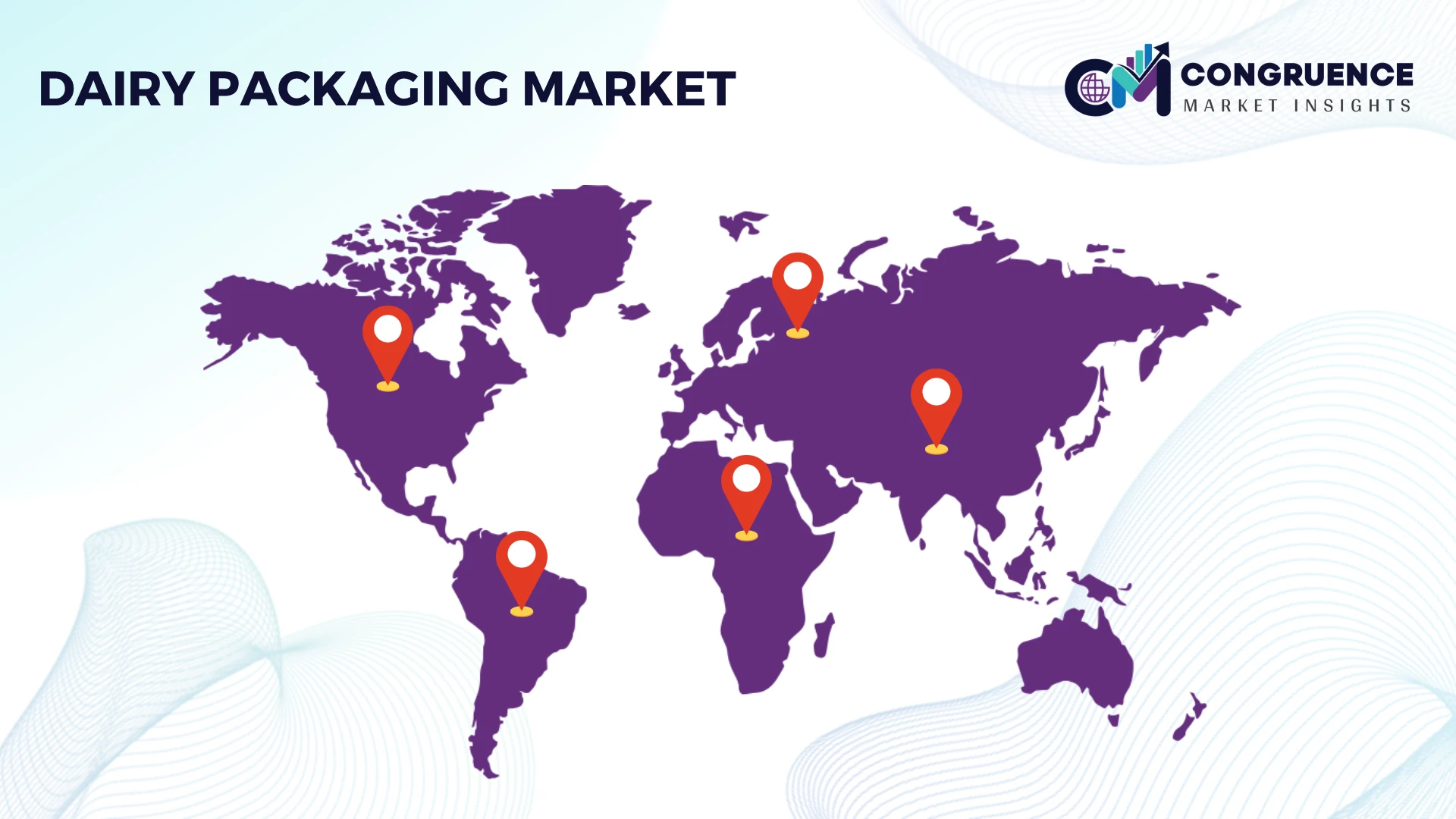
North America represents approximately 26% of the global Dairy Packaging Market, supported by highly automated dairy processing facilities, premium product demand, and established cold-chain infrastructure. Dairy manufacturers continue upgrading high-speed filling systems, digital quality inspection, and recyclable packaging formats to improve operational efficiency while meeting stricter sustainability requirements. More than 65% of large dairy processing facilities utilize automated packaging lines, enabling higher throughput and lower production losses. Continued investments in recycled-content packaging, lightweight containers, and intelligent labeling technologies are strengthening manufacturing productivity. Strategic collaborations between dairy processors and packaging suppliers are accelerating commercialization of mono-material packaging while improving compatibility with existing production infrastructure.
United States Market Outlook: The United States remains the largest regional market due to its extensive dairy processing capacity, advanced packaging technology deployment, and mature retail distribution network. More than 70% of commercial dairy processing plants operate automated filling and packaging systems capable of supporting multiple packaging formats. Manufacturers continue investing in recyclable packaging materials, digital inspection technologies, and production line modernization to improve manufacturing flexibility, regulatory compliance, and operational efficiency across premium and mass-market dairy products.
Europe accounts for nearly 24% of the Dairy Packaging Market, driven by advanced recycling infrastructure, strict packaging regulations, and continuous innovation in sustainable materials. Dairy packaging manufacturers are replacing multi-layer structures with recyclable mono-material alternatives while expanding lightweight packaging solutions for milk, cheese, and yogurt applications. More than 48% of newly introduced dairy packaging formats emphasize improved recyclability and material reduction. Production facilities increasingly integrate digital printing and automated inspection systems that improve traceability while reducing packaging waste. Strategic investments in circular material technologies continue strengthening regional competitiveness across premium dairy packaging segments.
Germany Market Outlook: Germany leads the European market through advanced dairy manufacturing infrastructure, strong engineering capabilities, and early adoption of recyclable packaging technologies. Automated packaging equipment is installed across a significant majority of large dairy processing facilities, supporting high-volume production with consistent quality. Manufacturers continue expanding investments in recyclable barrier materials, intelligent packaging solutions, and resource-efficient production technologies to strengthen operational performance while complying with evolving environmental standards.
Asia-Pacific contributes approximately 39% of global demand, supported by expanding dairy consumption, large-scale processing investments, and rapidly modernizing packaging infrastructure. China, India, and Southeast Asian manufacturing hubs continue expanding high-speed filling capacity while adopting lightweight and recyclable packaging technologies. More than 60% of newly commissioned dairy packaging facilities across major manufacturing economies include automated production systems with integrated quality monitoring. Local production of packaging materials and growing investment in food processing infrastructure continue improving supply-chain resilience. Companies are strengthening regional manufacturing footprints through capacity expansion, localized sourcing, and technology partnerships that reduce logistics costs and improve production responsiveness.
China Market Outlook: China remains the dominant country due to its large dairy processing industry, integrated packaging supply chain, and continuous investment in advanced manufacturing technologies. Approximately 27% of global dairy packaging production capacity is concentrated within China, supported by high-speed aseptic packaging systems and extensive packaging material manufacturing. Domestic companies continue expanding recyclable packaging production while increasing automation and digital manufacturing capabilities to improve efficiency and product consistency.
South America represents approximately 7% of the global Dairy Packaging Market, supported by increasing consumption of packaged dairy products and modernization of food processing facilities. Brazil and neighboring countries continue investing in packaging automation, cold-chain improvements, and lightweight packaging materials that improve operational efficiency. Packaging line productivity has increased by nearly 16% following automation upgrades at several commercial dairy facilities. Despite logistics and infrastructure limitations affecting distribution efficiency, manufacturers are expanding local converting operations and strengthening supplier partnerships to reduce transportation costs and improve production continuity.
Brazil Market Outlook: Brazil leads the regional market through its extensive dairy production network, expanding food manufacturing sector, and growing investment in modern packaging technologies. Large dairy processors continue upgrading filling equipment, recyclable packaging capabilities, and integrated production systems to improve product quality and operational efficiency. Strong domestic consumption and improving manufacturing infrastructure continue supporting broader deployment of advanced dairy packaging solutions.
The Middle East & Africa contributes approximately 4% of the Dairy Packaging Market while demonstrating strong momentum through food security initiatives, dairy processing investments, and manufacturing modernization. Countries across the Gulf region continue expanding dairy production capacity alongside automated packaging operations designed to improve product quality and reduce import dependence. More than 20% of newly established dairy processing facilities incorporate advanced packaging automation and digital quality control systems. Companies are strengthening regional manufacturing through joint ventures, localized production, and investments in recyclable packaging technologies that enhance operational efficiency and long-term supply stability.
Saudi Arabia Market Outlook: Saudi Arabia represents the region's most strategically significant market due to continued investment in domestic dairy production, integrated processing infrastructure, and advanced packaging technology. Large dairy enterprises continue expanding automated production facilities capable of supporting high-speed filling, intelligent quality inspection, and sustainable packaging materials. National industrial diversification programs and expanding food manufacturing investments continue strengthening long-term packaging demand while improving local manufacturing capabilities.
The Dairy Packaging Market is led by Amcor, Tetra Pak, SIG, Berry Global, and Sealed Air, while regional converters compete through cost efficiency and localized manufacturing. Global packaging leaders compete with regional specialists on technology integration, sustainability performance, and production scale rather than price alone. The top five companies collectively control approximately 48% of the market, creating moderate consolidation with strong innovation intensity. Competition increasingly centers on recyclable packaging, where advanced mono-material solutions reduce material usage by nearly 15%, while automated production lines improve manufacturing efficiency by around 18%. High-speed filling compatibility and supply-chain reliability remain decisive differentiators. Leading companies are expanding production capacity, forming strategic partnerships with dairy processors, investing in digital quality inspection, and strengthening vertical integration across packaging materials. Consolidation among multinational packaging companies is reshaping procurement power and accelerating technology commercialization. High capital requirements, regulatory compliance, and advanced converting capabilities remain significant entry barriers. Sustainable innovation, manufacturing scale, operational agility, and customer integration define long-term competitive success.
Tetra Pak International S.A.
SIG Group AG
Berry Global Inc.
Sealed Air Corporation
Sonoco Products Company
Smurfit Westrock plc
Huhtamaki Oyj
Mondi plc
Stora Enso Oyj
Winpak Ltd.
Elopak ASA
Advanced barrier packaging, AI-enabled quality inspection, and mono-material structures are redefining dairy packaging operations. Automated vision systems now improve defect detection by approximately 25%, while digital inspection reduces manual quality verification by nearly 20%. More than 55% of newly commissioned dairy packaging lines incorporate automated monitoring systems, enabling faster product changeovers, improved traceability, and greater production consistency across high-volume manufacturing facilities.
Emerging technologies include aluminum-free aseptic cartons, smart QR-enabled packaging, lightweight barrier polymers, and predictive maintenance platforms. Compared with conventional multilayer packaging, next-generation mono-material solutions reduce packaging weight by around 15% while improving recyclability and maintaining barrier performance. Large multinational packaging suppliers benefit through faster commercialization and stronger regulatory alignment, whereas dairy processors achieve lower material consumption, simplified recycling processes, and enhanced operational efficiency across integrated production networks.
Between 2026 and 2028, digital twins, machine learning-based process optimization, and intelligent packaging are expected to become standard across premium dairy production facilities. Deployment of connected packaging equipment is projected to exceed 65% among large-scale processors, strengthening predictive maintenance, inventory visibility, and production flexibility. Companies investing early in digital manufacturing integration, recyclable material innovation, and smart packaging ecosystems will secure stronger competitive differentiation, lower operating costs, and faster response to evolving sustainability and retail requirements.
April 2025 – Amcor completed its combination with Berry Global, creating a broader global packaging portfolio with identified synergies of approximately USD 650 million by FY2028, strengthening innovation capabilities, production scale, and customer reach across food and dairy packaging markets. Source: www.amcor.com
October 2025 – SIG launched aluminum-free full-barrier aseptic cartons with Seoul Dairy, introducing Korea's first recyclable aseptic dairy carton. Removing the aluminum layer, previously about 5% of pack weight, cuts roughly 25% of the package carbon footprint while improving recyclability. Source: www.sig.biz
February 2025 – Amcor and Berry Global shareholders approved the proposed merger, accelerating consolidation within global packaging markets and strengthening combined material science, manufacturing, and sustainability capabilities before transaction completion. Source: www.packagingsolutions.amcor.com
February 2024 – SIG delivered its three billionth aluminum-free aseptic carton for the European dairy industry, demonstrating large-scale commercialization of recyclable carton technology while supporting lower-carbon packaging and expanded adoption of fiber-based aseptic packaging solutions.
The report provides comprehensive analysis across rigid and flexible packaging formats, covering major dairy applications including milk, cheese, yogurt, butter, cream, and value-added dairy products, together with key end-user groups ranging from large dairy processors to contract manufacturers and specialty producers. It evaluates operational trends across North America, Europe, Asia-Pacific, South America, and the Middle East & Africa while assessing packaging automation, recyclable materials, aseptic processing, intelligent packaging, and digital manufacturing technologies. More than 55% of modern production facilities are transitioning toward automated packaging operations, reflecting accelerating industrial modernization.
The study delivers strategic insights into competitive positioning, regional manufacturing capabilities, technology adoption patterns, sustainability initiatives, and enterprise investment priorities between 2026 and 2033. It examines evolving procurement strategies, deployment trends, packaging innovation, and market participation across leading global manufacturers, enabling stakeholders to identify expansion opportunities, optimize product portfolios, strengthen supply-chain resilience, evaluate competitive dynamics, and support informed long-term business planning across the global dairy packaging ecosystem.
| Report Attribute / Metric | Details |
|---|---|
| Market Revenue (2025) | USD 2,558.0 Million |
| Market Revenue (2033) | USD 3,747.8 Million |
| CAGR (2026–2033) | 4.89% |
| Base Year | 2025 |
| Forecast Period | 2026–2033 |
| Historic Period | 2021–2025 |
| Segments Covered |
By Type
By Application
By End-User
|
| Key Deliverables | Revenue Forecast; Market Trends; Growth Drivers & Restraints; Technology Insights; Segmentation Analysis; Regional Insights; Competitive Landscape; Regulatory & ESG Overview; Recent Developments |
| Regions Covered | North America; Europe; Asia-Pacific; South America; Middle East & Africa |
| Companies Profiled | Amcor plc; Tetra Pak International S.A.; SIG Group AG; Berry Global Inc.; Sealed Air Corporation; Sonoco Products Company; Smurfit Westrock plc; Huhtamaki Oyj; Mondi plc; Stora Enso Oyj; Winpak Ltd.; Elopak ASA |
| Customization & Pricing | Available on Request (10% Customization Free) |




