
Reports
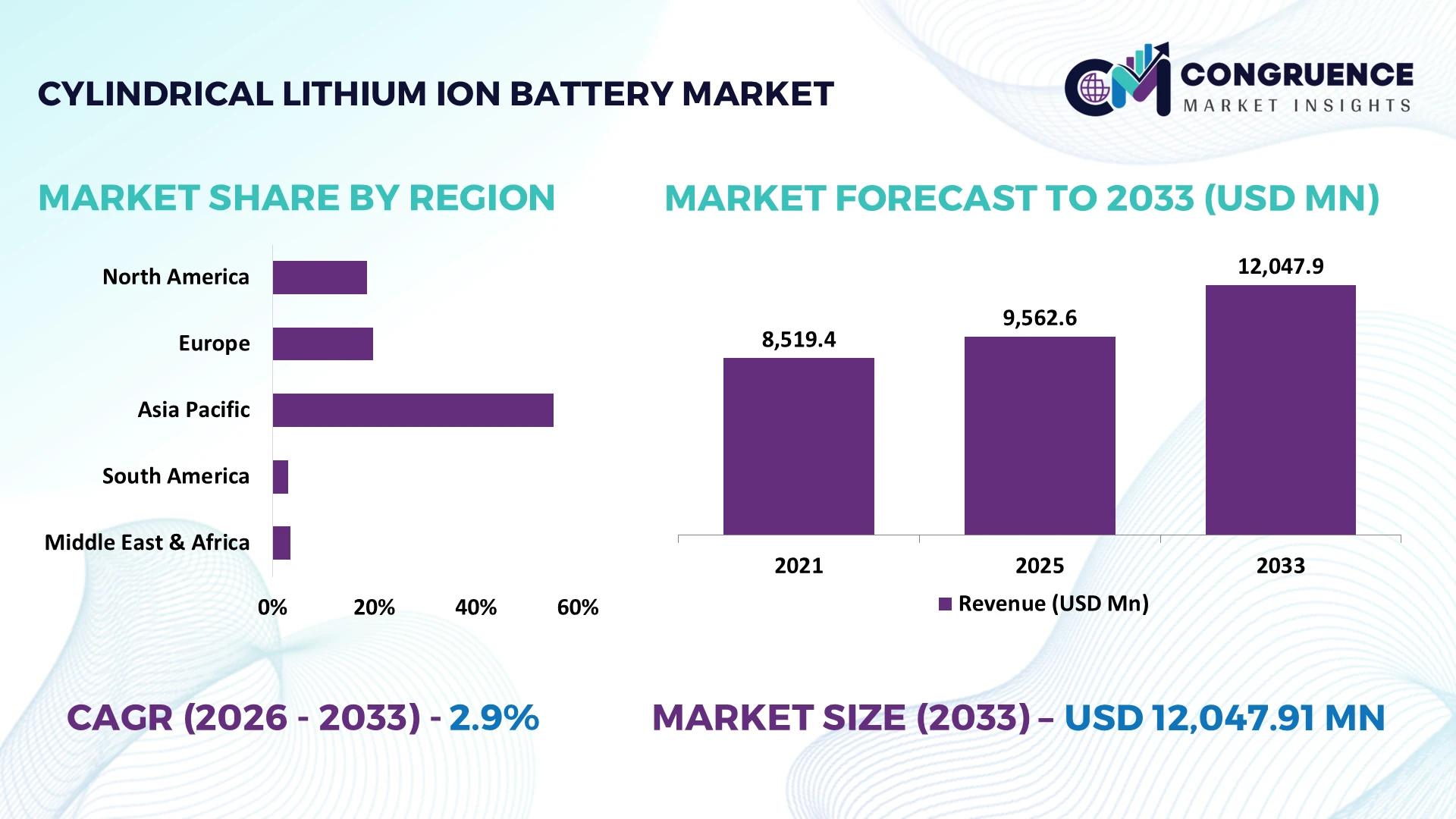
The Global Cylindrical Lithium Ion Battery Market was valued at USD 9,562.6 Million in 2025 and is anticipated to reach a value of USD 12,047.9 Million by 2033 expanding at a CAGR of 2.93% between 2026 and 2033. Market growth is driven by electric mobility adoption, cordless power tool electrification, advanced tabless cell architectures, and increasing deployment of high-density battery packs in industrial equipment.
China dominates the cylindrical lithium ion battery manufacturing ecosystem, supported by approximately 85% of global lithium-ion battery cell manufacturing capacity in 2024. China's electric car sales exceeded 11 million units in 2024, compared with approximately 1.6 million in the United States. Domestic battery investments, automated production facilities, and integrated material supply chains reinforce its manufacturing advantage amid escalating international trade restrictions.
Strategic competitiveness increasingly depends on localized manufacturing, advanced cell engineering, production yield optimization, and long-term automotive supply agreements.
Market Size & Growth: Valued at USD 9,562.6 million in 2025, reaching USD 12,047.9 million by 2033 at 2.93% CAGR, supported by industrial electrification.
Top Growth Drivers: Indicative driver weightings: electric mobility (45%), cordless equipment (30%), and portable electronics (25%).
Short-Term Forecast: By 2028, advanced manufacturing lines target production cost reductions of 10–15% through automation.
Emerging Technologies: Tabless electrodes, silicon-enhanced anodes, and advanced 46 mm cylindrical cell architectures reshape product development.
Regional Leaders: Illustrative 2033 projections: Asia Pacific USD 6,746.8 million (manufacturing), Europe USD 2,409.6 million (electromobility), and North America USD 2,168.6 million (localization).
Consumer/End-User Trends: Electric cars represented over 20% of global new car sales in 2024, strengthening battery demand.
Pilot/Case Example: BMW's 2022 Gen6 cylindrical cell announcement targeted 20% higher volumetric energy density.
Competitive Landscape: Panasonic remains a major cylindrical cell supplier, competing with LG Energy Solution, Samsung SDI, Murata, and EVE Energy; its precise market share remains unverified.
Regulatory & ESG Impact: EU battery regulations mandate 70% lithium-based battery recycling efficiency by 2030.
Investment & Funding: Panasonic's approximately USD 4 billion Kansas battery facility strengthens localized cylindrical cell manufacturing.
Innovation & Future Outlook: Advanced 4680 cells support higher capacity, simplified pack architectures, and reduced interconnection requirements.
The Cylindrical Lithium Ion Battery Market is evolving through high-capacity cell formats, improved thermal management, and automated electrode manufacturing. Demand remains concentrated across electric vehicles, cordless power tools, robotics, and portable industrial equipment. Next-generation cylindrical designs target approximately 20% higher energy density, while manufacturing localization under emerging battery supply-chain policies strengthens the strategic importance of scalable cell production and application-specific engineering.
Cylindrical lithium ion batteries are becoming strategically important as manufacturers prioritize standardized cell architectures, scalable production systems, and flexible battery pack configurations across mobility and industrial applications. Supply-chain restructuring in the United States and Europe is accelerating investment in domestic manufacturing, reducing dependence on imported cells while strengthening relationships between automotive manufacturers and battery technology suppliers.
Advanced cylindrical cells offer measurable performance advantages over conventional designs. BMW's sixth-generation cylindrical battery technology targets more than 20% higher volumetric energy density and approximately 30% faster charging compared with its previous battery generation. China maintains manufacturing scale advantages, while Japan emphasizes cell reliability and the United States prioritizes localized automotive battery production. Through 2028, manufacturers are targeting double-digit improvements in manufacturing efficiency through automated inspection and electrode processing.
Panasonic's Kansas manufacturing facility illustrates the industry's transition toward geographically diversified cylindrical cell production. Battery manufacturers are aligning capacity expansion with automotive procurement agreements, advanced material development, and automated quality control. Competitive advantage increasingly depends on delivering consistent electrochemical performance, minimizing manufacturing losses, and integrating cylindrical cells into cost-efficient battery pack architectures without compromising operational reliability.
Increasing electrification across transportation, power tools, and industrial machinery is strengthening demand for standardized cylindrical lithium ion battery cells. Electric vehicles accounted for more than 20% of global new car sales in 2024, while electric cars represented nearly 50% of China's domestic car sales. Cylindrical cells provide modular pack configurations, established manufacturing processes, and mechanical durability suitable for high-discharge applications. Automotive electrification in China and the United States is encouraging manufacturers to expand 21700 and 4680 cell production capabilities. Panasonic, LG Energy Solution, and EVE Energy are pursuing capacity expansion and automotive supply partnerships. Standardized cell dimensions additionally enable manufacturers to diversify customer portfolios without completely redesigning production infrastructure.
Geographical concentration of battery-grade raw material processing creates structural procurement and profitability constraints for cylindrical lithium ion battery manufacturers. China accounts for approximately 65% of global lithium refining and more than 90% of battery-grade graphite processing, creating substantial dependence on concentrated upstream supply networks. Meanwhile, global lithium-ion battery pack prices declined approximately 20% in 2024, intensifying pricing pressure on manufacturers with higher production costs. International trade restrictions and domestic sourcing requirements further complicate material procurement strategies. Japanese, South Korean, and American manufacturers are diversifying suppliers, securing long-term material contracts, and investing in localized processing capabilities. Procurement flexibility increasingly determines whether manufacturers can maintain competitive pricing without sacrificing operating margins.
Large-format cylindrical battery architectures create opportunities to improve pack-level energy density, manufacturing economics, and system integration across premium electric vehicles and industrial mobility platforms. BMW's sixth-generation battery technology targets approximately 20% higher volumetric energy density, 30% faster charging, and up to 50% lower battery costs compared with its previous generation. Advanced tabless electrode configurations and silicon-enhanced anodes further support improved electrical performance and thermal characteristics. German automotive manufacturers are collaborating with battery suppliers, including EVE Energy and CATL, to commercialize next-generation cylindrical formats. The strongest opportunity extends beyond cell capacity improvements, as fewer individual cells per battery pack reduce welding requirements, electrical interconnections, and assembly complexity, supporting system-level cost optimization.
Scaling advanced cylindrical battery production requires stringent control over electrode uniformity, welding precision, electrolyte distribution, and thermal stability. Larger cell formats increase the operational consequences of manufacturing defects, making automated inspection and process validation essential for consistent production yields. European battery regulations require lithium recovery rates of 50% by 2027 and 80% by 2031, alongside 70% recycling efficiency for lithium-based batteries by 2030. These requirements increase lifecycle traceability and recycling integration responsibilities for manufacturers supplying European customers. Battery producers must invest in machine-vision inspection, digital manufacturing records, and specialized recycling partnerships. Competitive scalability depends on achieving repeatable cell quality while controlling warranty exposure, material recovery costs, and regulatory compliance throughout the battery lifecycle.
Localized Battery Manufacturing Networks: Battery manufacturers are restructuring production footprints to reduce cross-border procurement exposure. Panasonic's Kansas facility represents approximately 32 GWh of annual production capacity, while the United States offers eligible battery cell manufacturers production tax credits of USD 35/kWh. Companies are aligning domestic manufacturing with automotive procurement contracts, reducing logistics exposure and improving supply continuity.
Automated Cell Quality Inspection: Manufacturers are integrating machine vision, inline X-ray inspection, and digital process monitoring across electrode winding and cell assembly. At a hypothetical 99% production yield, improving performance to 99.5% halves rejected output. Battery producers are deploying automated defect detection and predictive maintenance systems to improve material utilization, production consistency, and warranty cost management.
Application-Specific Cell Chemistry Diversification: Lithium iron phosphate batteries accounted for nearly 50% of global electric car battery demand in 2024, while lithium-ion battery pack prices declined approximately 20%. Cylindrical cell manufacturers are diversifying chemistry portfolios, balancing nickel-rich formulations for performance-intensive equipment with lower-cost alternatives for applications prioritizing durability, safety, and affordability.
Battery Traceability And Material Recovery: European battery regulations require digital battery passports for qualifying batteries from February 2027 and mandate 80% lithium recovery by 2031. Manufacturers are integrating batch-level material tracking, supplier documentation, and recycling partnerships. Traceability is increasingly becoming a procurement qualification criterion rather than merely a regulatory reporting requirement.
The 21700 cylindrical lithium ion battery segment leads the market by cell volume, accounting for approximately 45.0% in 2024, supported by its balanced energy capacity, manufacturing scalability, and compatibility with automotive and industrial battery packs. Commercial 21700 cells typically offer capacities of 4,000–5,000 mAh, compared with 2,500–3,500 mAh for conventional 18650 cells. The 18650 segment maintains established demand across consumer electronics, portable equipment, and cordless power tools, benefiting from mature manufacturing infrastructure, standardized dimensions, and extensive supplier networks.
The 4680 cylindrical lithium ion battery segment represents the fastest-growing type, supported by automotive manufacturers transitioning toward larger cell architectures and simplified battery pack assembly. Its geometric volume is approximately 5.5 times that of a 21700 cell, creating opportunities to reduce individual cell interconnections. Other cylindrical battery types, including 26650 and specialized smaller formats, serve industrial equipment and application-specific requirements. Panasonic, Samsung SDI, LG Energy Solution, and EVE Energy are diversifying production portfolios, balancing established cell demand with next-generation manufacturing investments and customer-specific qualification requirements.
The electric vehicles segment dominates cylindrical lithium ion battery applications, with an indicative 2025 market share of approximately 40.0%, supported by large-scale battery pack requirements, modular cell integration, and established automotive manufacturing partnerships. Cylindrical cells support flexible vehicle platform configurations and automated battery assembly. Power tools represent another established application, where high-discharge performance, mechanical durability, and interchangeable battery platforms influence purchasing decisions. Consumer electronics maintain demand through portable computing devices, rechargeable accessories, and cordless household appliances, although compact pouch batteries increasingly compete for space-sensitive applications.
Electric vehicles also represent the anticipated fastest-growing application, driven by next-generation vehicle platforms and larger cylindrical cell adoption. Global electric vehicle battery deployment increased nearly 30% in 2025, while electric trucks accounted for approximately 8% of deployment. Energy storage systems offer specialized opportunities in modular residential and commercial installations, while medical devices prioritize reliability, compact dimensions, and discharge consistency. Manufacturers are expanding automotive-grade production while maintaining specialized cell portfolios for power tools, healthcare equipment, and distributed storage applications.
Automotive OEMs and Tier-1 suppliers constitute the leading end-user segment, with an indicative market share of approximately 42.0% in 2025, reflecting extensive battery procurement requirements, stringent cell qualification standards, and long-term manufacturing agreements. Automotive buyers prioritize energy density, thermal stability, production consistency, and guaranteed supply availability. Tool and appliance manufacturers maintain established purchasing relationships with cylindrical cell suppliers, emphasizing high-discharge capabilities and compatibility with interchangeable battery platforms. Their procurement strategies increasingly favor standardized cell specifications that support multiple product categories without extensive redesign requirements.
Automotive OEMs and Tier-1 suppliers are also positioned for the fastest expansion as electric mobility platforms transition toward advanced cylindrical formats. Battery pack integrators are gaining strategic relevance through customized solutions, while ESS providers and solar OEMs target modular storage applications. Medical device manufacturers maintain specialized demand for validated, high-reliability cells. With global electric vehicle battery deployment increasing approximately 30% in 2025 and light-duty vehicles accounting for over 85% of deployment, manufacturers are strengthening direct automotive partnerships while expanding application-specific engineering support for smaller industrial customers.
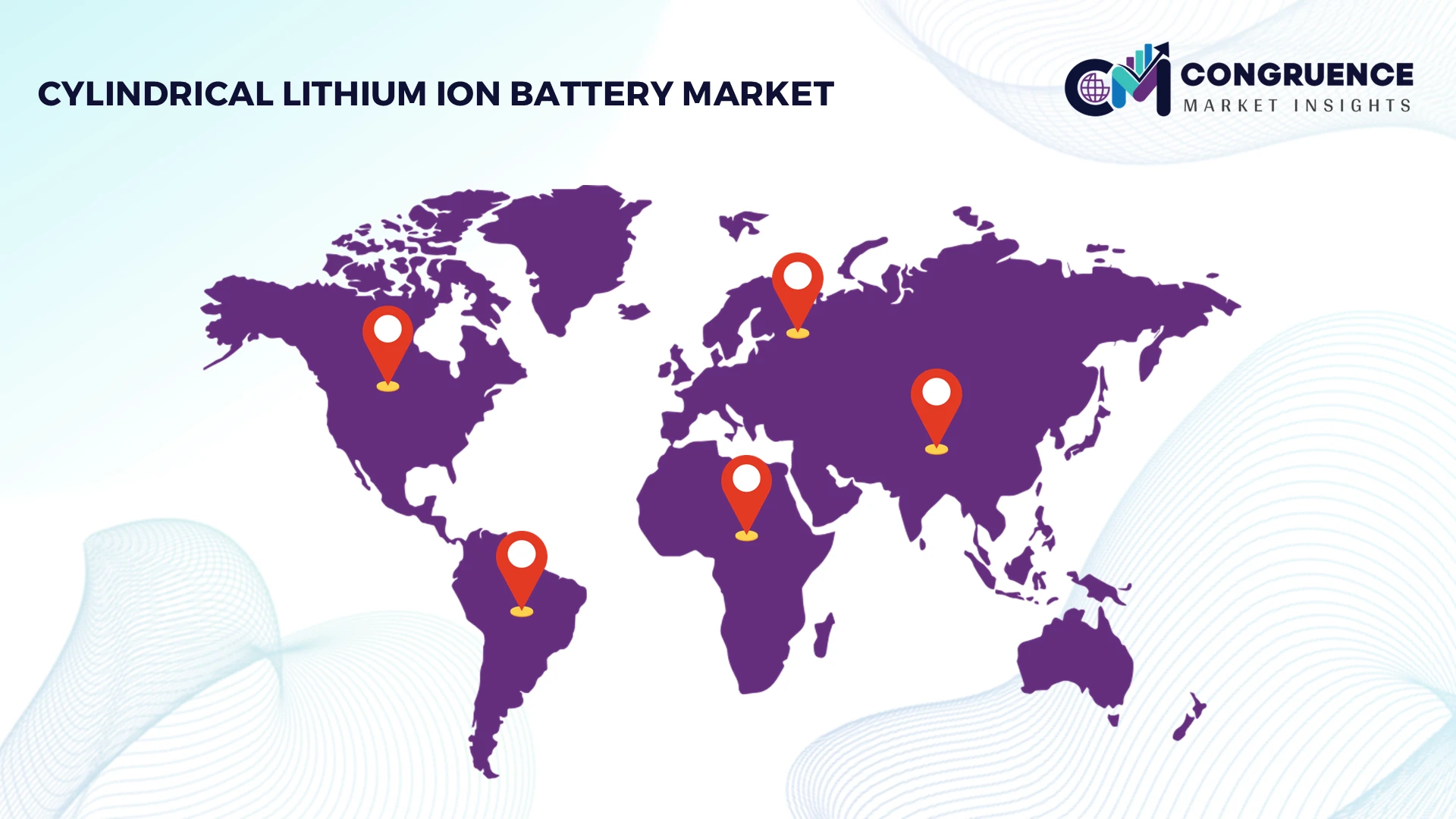
Asia Pacific accounted for the largest market share at 55.2% in 2025 however, North America is expected to register the fastest growth, expanding at a CAGR of 4.5% between 2026 and 2033.
North America accounted for approximately 18.5% of the global Cylindrical Lithium Ion Battery Market in 2025, supported by automotive electrification, advanced manufacturing investments, and established demand for cordless industrial equipment. Battery manufacturers are expanding domestic production capabilities to strengthen procurement security and reduce dependence on imported cells. Panasonic's Kansas manufacturing facility, inaugurated in July 2025, targets approximately 32 GWh of annual cylindrical battery production capacity. Automotive manufacturers are increasingly integrating advanced cylindrical cells into vehicle platforms to improve energy density and battery pack assembly efficiency. Demand from aerospace equipment, medical devices, robotics, and professional power tools further diversifies regional consumption. Manufacturing automation and domestic sourcing initiatives are encouraging closer collaboration between cell producers, automotive OEMs, and battery pack integrators, strengthening regional production resilience and long-term supply reliability.
United States Market Outlook: The United States leads regional cylindrical battery demand through established electric vehicle manufacturing, advanced battery research, and industrial equipment electrification. Tesla's 4680 battery manufacturing operations in Texas demonstrate the country's transition toward vertically integrated cell production. Federal manufacturing incentives offering eligible battery cell producers USD 35/kWh strengthen domestic investment economics, while established automotive technology ecosystems support commercial deployment.
Europe accounted for approximately 19.8% of the global Cylindrical Lithium Ion Battery Market in 2025, supported by automotive engineering capabilities, transportation electrification, and increasingly stringent battery sustainability requirements. Premium automotive manufacturers are transitioning toward advanced cylindrical cell architectures to improve vehicle performance and simplify battery pack integration. BMW's sixth-generation battery technology targets approximately 20% higher volumetric energy density and 30% faster charging compared with its previous generation. European battery regulations are encouraging manufacturers to strengthen material traceability, recycling integration, and lifecycle documentation. Industrial automation, professional power tools, and portable medical equipment provide additional demand diversification. Battery suppliers are establishing closer partnerships with European automotive manufacturers to secure long-term procurement agreements. Competitive positioning increasingly depends on meeting application-specific performance requirements while maintaining regulatory compliance and reliable manufacturing standards.
Germany Market Outlook: Germany represents a strategically significant cylindrical battery market through its automotive manufacturing ecosystem, advanced engineering capabilities, and established industrial equipment sector. Battery development partnerships involving BMW, CATL, and EVE Energy support the commercialization of 46 mm cylindrical cell formats. Germany's extensive automotive component supplier network facilitates battery pack integration, manufacturing equipment development, and specialized testing capabilities for next-generation mobility platforms.
Asia Pacific accounted for approximately 55.2% of the global Cylindrical Lithium Ion Battery Market in 2025, supported by extensive battery manufacturing infrastructure, integrated material supply chains, and established consumer electronics production. China, Japan, and South Korea maintain strong positions across electrode processing, cell assembly, and advanced battery technology development. China represented approximately 85% of global lithium-ion battery cell manufacturing capacity in 2024, demonstrating the scale of the broader regional battery ecosystem. Japanese and South Korean manufacturers maintain established expertise in high-performance cylindrical cells for automotive and industrial applications. Expanding electric two-wheeler production, cordless equipment manufacturing, and industrial robotics deployment further strengthen regional consumption. Manufacturers are optimizing production yields, diversifying cell chemistry portfolios, and expanding overseas partnerships to maintain cost competitiveness while addressing increasingly specialized customer requirements.
China Market Outlook: China dominates regional battery manufacturing through integrated raw material processing, automated production facilities, and extensive electric mobility supply chains. Domestic electric car sales exceeded 11 million units in 2024, creating substantial demand across battery formats. Companies including EVE Energy and BAK Battery are advancing large-format cylindrical cell development while strengthening manufacturing partnerships with domestic and international automotive customers.
South America accounted for approximately 3.0% of the global Cylindrical Lithium Ion Battery Market in 2025, supported by emerging electric mobility adoption, portable industrial equipment demand, and expanding consumer electronics consumption. Brazil, Chile, and Argentina represent strategically important markets through automotive manufacturing, mineral resources, and industrial modernization. Chile accounted for approximately 20% of global lithium mine production in 2024, strengthening the region's upstream relevance within international battery supply chains. However, limited domestic cylindrical cell manufacturing infrastructure maintains dependence on imported battery products. Electric motorcycles, portable power systems, agricultural equipment, and professional power tools offer additional application opportunities. Battery distributors and equipment manufacturers are expanding localized assembly, technical support, and distribution partnerships. Regional competitiveness depends on improving supply availability, reducing import-related costs, and developing stronger battery integration capabilities.
Brazil Market Outlook: Brazil leads regional battery consumption through its automotive manufacturing base, industrial equipment sector, and expanding electric mobility ecosystem. Electrified vehicle sales exceeded 177,000 units in 2024, including hybrid and battery-electric models. Domestic automotive investments and growing demand for rechargeable industrial equipment are encouraging battery suppliers to strengthen distribution networks, localized pack assembly, and application-specific technical support.
Middle East & Africa accounted for approximately 3.5% of the global Cylindrical Lithium Ion Battery Market in 2025, supported by infrastructure modernization, industrial equipment deployment, and emerging electric mobility initiatives. Saudi Arabia, the United Arab Emirates, and South Africa represent important demand centers for rechargeable industrial systems, portable electronics, and specialized battery-powered equipment. Saudi Arabia's target of achieving 30% electric vehicle penetration in Riyadh by 2030 highlights increasing policy support for transportation electrification. Telecommunications modernization, portable power solutions, and remote industrial operations create additional opportunities for cylindrical battery deployment. Limited domestic cell manufacturing maintains dependence on international suppliers, while elevated operating temperatures increase the importance of thermal management. Battery manufacturers and distributors are strengthening regional partnerships, application-specific product offerings, and technical support capabilities to address demanding environmental and operational conditions.
Saudi Arabia Market Outlook: Saudi Arabia is emerging as a strategically significant battery market through industrial diversification, automotive manufacturing investments, and infrastructure modernization under Vision 2030. Lucid's Saudi Arabian manufacturing facility was established with an initial annual assembly capacity of 5,000 vehicles. Expanding automotive supply networks, industrial automation, and rechargeable equipment deployment are encouraging international battery suppliers to develop localized distribution and integration partnerships.
Panasonic Energy, LG Energy Solution, Samsung SDI, EVE Energy, and Murata compete through manufacturing scale, electrochemical performance, and application-specific cell engineering. The top five suppliers collectively represent an estimated 60.0% market share, reflecting established automotive procurement relationships and manufacturing concentration. Competition increasingly centers on production economics, energy density, charging performance, and supply reliability. Advanced cylindrical architectures target 20% higher volumetric energy density and 30% faster charging, while next-generation battery systems target cost reductions approaching 50%. Panasonic Energy is expanding American manufacturing capacity, while LG Energy Solution and Samsung SDI are advancing large-format cylindrical cell commercialization. EVE Energy is strengthening automotive partnerships, leveraging China's integrated material supply chains. Competitive differentiation is shifting from individual cell specifications toward integrated battery system performance and localized procurement capabilities. Stringent automotive qualification requirements and capital-intensive manufacturing infrastructure restrict market entry. Winning requires consistent production yields, proprietary cell engineering, competitive pricing, and dependable long-term customer supply commitments.
Panasonic Energy Co., Ltd.
LG Energy Solution Ltd.
Samsung SDI Co., Ltd.
EVE Energy Co., Ltd.
Murata Manufacturing Co., Ltd.
Contemporary Amperex Technology Co., Limited (CATL)
Tesla, Inc.
BAK Battery Co., Ltd.
Tianjin Lishen Battery Joint-Stock Co., Ltd.
Highpower International Inc.
Molicel (E-One Moli Energy Corp.)
Shenzhen Great Power Energy and Technology Co., Ltd. (Great Power)
VARTA AG
SVOLT Energy Technology Co., Ltd.
Established cylindrical lithium ion battery technologies incorporate nickel-rich cathodes, graphite anodes, precision electrode winding, and automated cell assembly. Commercial 21700 cells provide capacities approaching 5,000 mAh, representing approximately 43% improvement over conventional 3,500 mAh 18650 cells. Standardized manufacturing architectures support scalable deployment across electric vehicles, professional power tools, and industrial equipment. Automated inspection strengthens production consistency, reduces material losses, and improves operational reliability across manufacturing facilities.
Emerging technologies include tabless electrode configurations, silicon-enhanced anodes, advanced electrolyte formulations, and large-format cylindrical architectures. BMW's sixth-generation cylindrical battery technology targets approximately 20% higher volumetric energy density and 30% faster charging compared with previous-generation batteries. Larger cell dimensions reduce individual electrical connections, simplifying battery pack integration. Automotive suppliers benefit through improved assembly economics, while equipment manufacturers gain opportunities to develop compact, higher-performance rechargeable systems.
Disruptive manufacturing approaches increasingly combine dry electrode processing, artificial intelligence-based defect detection, and direct cell-to-pack integration. Tesla's commercial 4680 deployment demonstrates the transition toward vertically integrated battery engineering. Between 2026 and 2028, manufacturers are expected to prioritize process validation, automated quality assurance, and advanced thermal management. Companies combining proprietary electrode technologies with scalable production infrastructure will strengthen procurement relationships, reduce manufacturing inefficiencies, and establish differentiated positions across performance-intensive battery applications worldwide.
The Cylindrical Lithium Ion Battery Market Report provides comprehensive coverage across battery types, applications, end-users, and five major geographical regions. Type segmentation includes 18650, 21700, 4680, and other cylindrical battery formats, while application analysis encompasses electric vehicles, power tools, consumer electronics, energy storage systems, and medical devices. End-user coverage includes automotive OEMs and Tier-1 suppliers, tool and appliance manufacturers, battery pack integrators, ESS providers and solar OEMs, and medical device manufacturers.
The report evaluates competitive positioning, manufacturing capacity expansion, supply-chain dynamics, regulatory developments, and emerging technologies, including tabless electrodes, silicon-enhanced anodes, and automated cell production. Regional analysis covers North America, Europe, Asia Pacific, South America, and Middle East & Africa. Strategic insights support investment planning, product portfolio optimization, geographical expansion, procurement decisions, and competitive differentiation throughout the 2026–2033 forecast period.
| Report Attribute / Metric | Details |
|---|---|
| Market Revenue (2025) | USD 9,562.6 Million |
| Market Revenue (2033) | USD 12,047.9 Million |
| CAGR (2026–2033) | 2.93% |
| Base Year | 2025 |
| Forecast Period | 2026–2033 |
| Historic Period | 2021–2025 |
| Segments Covered |
By Type
By Application
By End-User
|
| Key Report Deliverables | Revenue Forecast; Market Trends; Growth Drivers & Restraints; Technology Insights; Segmentation Analysis; Regional Insights; Competitive Landscape; Regulatory & ESG Overview; Recent Developments |
| Regions Covered | North America; Europe; Asia-Pacific; South America; Middle East & Africa |
| Key Players Analyzed | Panasonic Energy Co., Ltd.; LG Energy Solution Ltd.; Samsung SDI Co., Ltd.; EVE Energy Co., Ltd.; Murata Manufacturing Co., Ltd.; Contemporary Amperex Technology Co., Limited (CATL); Tesla, Inc.; BAK Battery Co., Ltd.; Tianjin Lishen Battery Joint-Stock Co., Ltd.; Highpower International Inc.; Molicel (E-One Moli Energy Corp.); Shenzhen Great Power Energy and Technology Co., Ltd. (Great Power); VARTA AG; SVOLT Energy Technology Co., Ltd. |
| Customization & Pricing | Available on Request (10% Customization Free) |




