
Reports
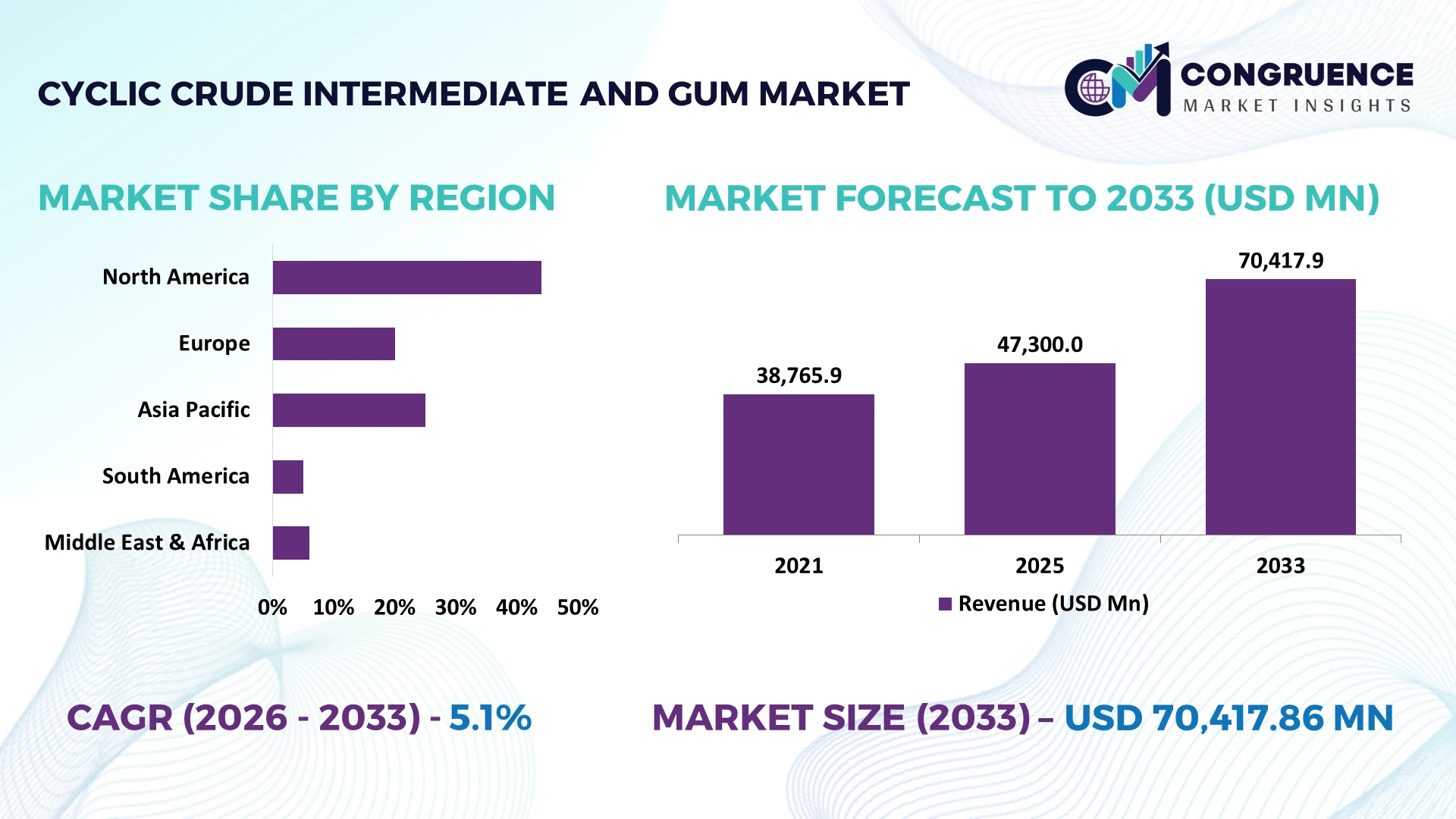
The Global Cyclic Crude Intermediate and Gum Market was valued at USD 47300 Million in 2025 and is anticipated to reach a value of USD 70417.86 Million by 2033 expanding at a CAGR of 5.1% between 2026 and 2033. Growth is driven by demand for aromatic chemical intermediates in pharmaceuticals, dyes, agrochemicals and specialty chemical manufacturing, alongside investments in integrated petrochemical production.
China is a major manufacturing center for aromatic chemical intermediates, supported by integrated refining facilities, extensive downstream chemical production and established export infrastructure. Its position reflects substantial industrial capacity and demand from pharmaceutical, pigment, polymer and agricultural chemical manufacturers. India provides an important comparison, with its specialty chemical industry expanding domestic manufacturing capabilities and pursuing opportunities created by global supply chain diversification. China's scale supports bulk production, while India's manufacturing expansion offers opportunities for specialized intermediates and export diversification.
For manufacturers and investors, integrated production capacity, feedstock security and geographic diversification are central considerations when evaluating competitive positioning.
The supplied market forecast establishes the overall growth trajectory. Additional regional revenue, company share, investment and technology performance figures require verification before publication.
Market Size & Growth: USD 47,300 million in 2025, reaching USD 70,417.86 million by 2033 at a 5.1% CAGR, supported by specialty chemical manufacturing.
Top Growth Drivers: Three demand centers include pharmaceutical intermediates, agrochemical synthesis and aromatic chemical production. Their individual growth contributions remain unverified.
Short Term Forecast: By 2028, production efficiency, feedstock utilization and energy consumption will be important operational indicators for evaluating manufacturing investments.
Emerging Technologies: Three relevant technologies include advanced catalytic processing, automated process control and artificial intelligence applications for chemical production optimization.
Regional Leaders: Asia Pacific, Europe and North America represent three important manufacturing and consumption regions. Regional market valuations require independently validated estimates.
Consumer and End User Trends: Pharmaceutical, agrochemical and specialty chemical manufacturers represent three significant downstream customer categories with distinct purity and production requirements.
Pilot and Case Example: Advanced process monitoring provides opportunities to measure improvements in material recovery, process stability and energy consumption against conventional production methods.
Competitive Landscape: Competition centers on three operational capabilities: reliable aromatic feedstock procurement, integrated manufacturing and consistent intermediate product quality. Verified company market shares are unavailable.
Regulatory and ESG Impact: European REACH compliance and industrial emissions requirements influence chemical production, creating incentives for cleaner processing and improved environmental monitoring.
Investment and Funding: Capital allocation focuses on integrated chemical manufacturing, downstream processing facilities and production modernization. Verified aggregate investment figures are unavailable.
Innovation and Future Outlook: Advanced catalysts, digital process optimization and circular chemical feedstocks represent three technological priorities shaping future manufacturing strategies.
The global Cyclic Crude Intermediate and Gum Market encompasses chemical intermediates used in pharmaceutical synthesis, agrochemical production, dyes, pigments and specialty chemical manufacturing. Technological developments include advanced catalytic conversion, automated separation systems and digital process monitoring. Manufacturers increasingly prioritize feedstock integration and production flexibility to manage raw material volatility. European chemical regulations and changing Asian manufacturing networks reinforce the importance of environmental compliance and supply chain resilience. These developments establish the strategic importance of manufacturing efficiency, downstream product diversification and regional production capabilities when assessing future investment opportunities.
The Cyclic Crude Intermediate and Gum Market is becoming strategically important as chemical manufacturers strengthen feedstock security, improve processing efficiency and diversify downstream production. Aromatic intermediates support pharmaceutical synthesis, agrochemical formulations, dyes and specialty polymers, making consistent material availability essential for industrial competitiveness. China's integrated petrochemical infrastructure provides manufacturing scale, while India's specialty chemical expansion creates opportunities for diversified sourcing. Supply chain restructuring is encouraging manufacturers to establish alternative procurement networks and strengthen domestic processing capabilities.
Advanced catalytic processing, automated separation and digital process monitoring are reshaping production economics. Compared with conventional processing, modern integrated systems offer opportunities to reduce energy consumption and improve material recovery, although performance depends on feedstock composition and plant configuration. Predictive maintenance and continuous process monitoring help manufacturers identify equipment deterioration, stabilize product quality and reduce unplanned shutdowns. European producers emphasize regulatory compliance and process innovation, whereas Chinese manufacturers benefit from extensive refining integration and established downstream infrastructure.
Between 2026 and 2028, investment priorities will increasingly focus on process automation, catalyst optimization and flexible production infrastructure. For example, integrating continuous composition monitoring with automated distillation controls enables chemical facilities to adjust operating conditions when feedstock quality changes. Manufacturers are strengthening technology partnerships and prioritizing modernization projects that improve production reliability. Competitive positioning will increasingly depend on processing flexibility, reliable feedstock access and the ability to manufacture consistent intermediate grades efficiently.
Growing consumption of aromatic intermediates across pharmaceutical manufacturing, agrochemical synthesis and specialty chemical production supports industrial demand. China's integrated petrochemical complexes provide established feedstock infrastructure, while India's pharmaceutical and chemical manufacturing sectors create additional downstream opportunities. Three important demand categories are pharmaceutical intermediates, agricultural chemicals and industrial dyes. Increasing product specialization requires manufacturers to improve purification capabilities and maintain consistent chemical composition. India's Production Linked Incentive initiatives for selected chemical and pharmaceutical manufacturing activities reinforce domestic production priorities. Companies are expanding downstream processing capabilities, establishing long term procurement agreements and investing in advanced separation technologies. Integrated manufacturers gain an operational advantage by coordinating feedstock availability with customer specific intermediate production requirements.
Dependence on petroleum derived aromatic feedstocks exposes manufacturers to crude oil price fluctuations, refinery operating disruptions and transportation constraints. Three important cost components are feedstock procurement, energy consumption and chemical purification. China's substantial petrochemical manufacturing capacity provides integration advantages, but international buyers remain exposed to changes in export availability and logistics conditions. European chemical producers face additional operating requirements associated with REACH registration and industrial emissions regulations. These conditions increase working capital requirements and complicate procurement planning. Manufacturers are responding through diversified sourcing, contractual feedstock arrangements and localized processing investments. Facilities capable of processing alternative feedstock specifications achieve greater procurement flexibility and reduce dependence on individual suppliers.
Advanced catalytic technologies and automated purification systems create opportunities to improve production efficiency while expanding access to specialized chemical applications. Three promising technology areas include selective catalysis, continuous separation and intelligent process optimization. India's expanding specialty chemical manufacturing ecosystem provides opportunities for companies developing pharmaceutical intermediates, agricultural chemical precursors and customized aromatic compounds. Digital process monitoring supports tighter control of temperature, pressure and chemical composition, improving production consistency. Between 2026 and 2028, manufacturers can prioritize modular processing infrastructure and partnerships with technology providers. Investment in flexible production systems allows facilities to manufacture multiple intermediate grades without developing entirely separate production lines, improving equipment utilization and customer responsiveness.
Scaling advanced chemical processing technologies requires precise coordination between reaction systems, separation equipment, analytical instrumentation and downstream purification facilities. Three critical execution requirements are process stability, consistent chemical specifications and reliable equipment performance. China's large petrochemical complexes demonstrate the importance of integrating upstream feedstock processing with downstream chemical manufacturing. However, introducing advanced catalysts or automated control systems into existing facilities requires extensive process validation and operator training. Manufacturers must also manage catalyst degradation, equipment compatibility and variations in incoming feedstock composition. Investment in pilot facilities, advanced analytical systems and technical workforce development supports successful commercialization. Companies that standardize operating procedures and validate production performance across multiple facilities strengthen manufacturing consistency and long term competitiveness.
Growing Emphasis on Feedstock Traceability: Chemical manufacturers are strengthening material traceability as international customers demand greater transparency across industrial supply chains. China's chemical industry accounts for approximately 46% of global chemical sales, highlighting its influence on international procurement. European chemical producers are responding by improving supplier documentation, batch identification and material certification. Digital traceability systems connect procurement records with production batches, reducing the administrative burden of customer audits and supporting faster investigation of product quality deviations.
Increasing Focus on Production Rationalization: European chemical manufacturers are reassessing production portfolios as energy costs and international competition reshape operating economics. European natural gas prices remain approximately three times higher than American levels, while chemical capacity utilization is 9.5% below historical averages. Manufacturers are consolidating selected production activities, reviewing energy intensive processing stages and concentrating resources on products with differentiated specifications. These adjustments increase the importance of plant utilization and disciplined production scheduling.
Greater Specialization in Product Specifications: Industrial customers increasingly distinguish between chemical intermediates based on purity, viscosity, thermal stability and compatibility with downstream formulations. European adhesive manufacturers serve a market containing more than 250,000 adhesive and sealant products, illustrating the complexity of formulation requirements. Chemical suppliers are strengthening application testing and technical service capabilities. Customized product specifications support closer customer relationships and reduce the commercial dependence associated with supplying interchangeable commodity materials.
Changing Inventory and Procurement Practices: International chemical supply chains are placing greater emphasis on inventory visibility and coordinated procurement. China's approximately 46% share of global chemical sales contrasts with Europe's 13%, illustrating the geographic concentration of chemical manufacturing. European buyers are reassessing inventory policies and introducing more structured supplier qualification procedures. Manufacturers are coordinating production schedules with customer forecasts to reduce emergency procurement, improve delivery reliability and maintain continuity during international logistics disruptions.
Aromatic Intermediates represent an important segment of the Cyclic Crude Intermediate and Gum Market because they provide essential chemical building blocks for downstream industrial manufacturing. Their commercial importance reflects established production infrastructure, extensive chemical processing applications and integration with petrochemical facilities. Cyclic Hydrocarbons provide upstream materials for chemical conversion, making feedstock availability and refining integration important competitive considerations. However, verified market shares for these segments are unavailable, preventing a defensible identification of the largest segment by percentage.
Hydrocarbon Resins and Resin Gums serve applications requiring controlled adhesion, compatibility and thermal performance. Terpene Gums offer additional formulation options for manufacturers seeking specific tackifying characteristics and alternative raw material sources. Product specialization creates opportunities for differentiated resin grades, although available evidence does not establish which segment has the highest growth rate. Manufacturers are prioritizing application testing, consistent product specifications and customer qualification. Investment decisions increasingly depend on downstream formulation requirements, production flexibility and the commercial advantages of specialized intermediate grades.
Adhesives represent an important application for resin gums, hydrocarbon resins and terpene gums because these materials influence tack, adhesion and formulation compatibility. Industrial adhesive manufacturers require consistent resin characteristics to maintain production efficiency and finished product performance. Coatings and Printing Inks also consume specialized resin materials, although their requirements differ in terms of viscosity, pigment compatibility and film formation. Verified application shares are unavailable, so the leading application cannot be established quantitatively for this specific market.
Specialty Chemicals represent another important application, particularly where aromatic intermediates support customized chemical synthesis and downstream processing. Rubber Compounds utilize selected resin products to modify processing and material characteristics, while Fragrances represent a more specialized application for appropriate terpene derived materials. Increasing formulation complexity encourages closer collaboration between raw material suppliers and downstream manufacturers. Companies are responding through application specific product development, technical qualification and improved batch consistency. These capabilities strengthen customer relationships and help suppliers distinguish specialized products from conventional industrial materials.
Chemical Manufacturers represent a strategically important customer group because their operations connect upstream cyclic hydrocarbons and aromatic intermediates with downstream chemical conversion. Integrated manufacturing facilities benefit from coordinated feedstock procurement, processing infrastructure and established industrial distribution networks. Adhesive Producers constitute another important customer category, purchasing specialized resin materials to meet formulation and performance requirements. However, verified purchasing volumes and market shares are unavailable, preventing a defensible numerical ranking of these customer groups.
Paint Manufacturers and Printing Ink Producers require consistent resin properties to maintain formulation stability and finished product quality. Rubber Producers purchase selected resin materials according to processing requirements, while Fragrance Manufacturers prioritize appropriate chemical composition and consistent ingredient specifications. Demand patterns differ considerably between large integrated chemical facilities and specialized formulation businesses. Suppliers are responding by developing differentiated product grades, establishing technical partnerships and adapting procurement agreements to customer requirements. Future competitive positioning depends on balancing high volume industrial supply with technically demanding applications where product consistency and customer qualification create stronger commercial relationships.
Asia Pacific holds a significant manufacturing position in the Cyclic Crude Intermediate and Gum Market, supported by China's integrated petrochemical infrastructure. Asia Pacific also presents substantial expansion opportunities through China's downstream chemical investments and India's specialty chemical manufacturing development. Verified regional market shares and regional growth rates for this specific market are unavailable.
Integrated Petrochemical Manufacturing and Advanced Processing Infrastructure
North America's Cyclic Crude Intermediate and Gum Market benefits from established petrochemical infrastructure, domestic hydrocarbon resources and extensive downstream chemical manufacturing. The United States maintains significant aromatic chemical production capabilities along the Gulf Coast, where integrated refining and petrochemical facilities support feedstock availability. Industrial demand originates from adhesive manufacturing, protective coatings, rubber processing and specialty chemical production. The region benefits from established chemical transportation networks and access to industrial research facilities. Manufacturers are implementing automated process controls, advanced analytical instrumentation and improved separation technologies to strengthen production consistency. Canada's chemical manufacturing industry provides additional processing capabilities and cross border supply relationships. Investment priorities increasingly emphasize production reliability, equipment modernization and closer integration between feedstock processing and specialized chemical manufacturing, supporting operational flexibility and industrial competitiveness.
United States Market Outlook: The United States maintains substantial chemical manufacturing infrastructure concentrated in Texas and Louisiana. Established refinery networks support aromatic feedstock processing and downstream chemical production. Manufacturers benefit from domestic energy resources, specialized engineering expertise and established industrial distribution infrastructure. Investment in advanced process monitoring and chemical purification supports consistent product specifications and efficient manufacturing operations.
Specialty Chemical Manufacturing and Regulatory Modernization
Europe's Cyclic Crude Intermediate and Gum Market is characterized by established chemical manufacturing clusters, specialized processing capabilities and stringent environmental regulations. Germany, France, Belgium and the Netherlands maintain significant industrial infrastructure supporting aromatic intermediates, hydrocarbon resins and specialized chemical formulations. European chemical manufacturing accounts for approximately 13% of global chemical sales, demonstrating its importance within international chemical supply chains. Elevated energy costs and international competition are encouraging manufacturers to optimize production portfolios and improve operational efficiency. REACH regulations influence chemical registration, material documentation and downstream product development. Manufacturers are prioritizing energy management, automated production monitoring and specialized chemical processing. Established industrial clusters facilitate infrastructure sharing, technical collaboration and integrated chemical logistics. Companies are concentrating investments on differentiated products, production reliability and compliance capabilities to maintain international competitiveness.
Germany Market Outlook: Germany maintains an established chemical manufacturing ecosystem supported by industrial research institutions, advanced processing infrastructure and specialized engineering capabilities. The Ludwigshafen chemical complex demonstrates the country's integrated manufacturing model. German chemical producers emphasize advanced purification, automated process monitoring and specialized resin formulations. Environmental regulations encourage improvements in energy efficiency, chemical traceability and industrial production management.
Integrated Petrochemical Expansion Strengthens Manufacturing Scale
Asia Pacific occupies a substantial position in the Cyclic Crude Intermediate and Gum Market through extensive petrochemical manufacturing infrastructure and expanding downstream chemical production. China maintains significant aromatic intermediate manufacturing capabilities, supported by integrated refining facilities and established industrial supply networks. The country accounts for approximately 46% of global chemical sales, highlighting its influence on international chemical manufacturing. India contributes additional opportunities through expanding pharmaceutical intermediates, agrochemical manufacturing and specialty chemical production. Japan and South Korea maintain advanced chemical processing capabilities, emphasizing specialized formulations and consistent product quality. Manufacturers are strengthening feedstock integration, improving separation efficiency and expanding downstream production capabilities. China's established petrochemical clusters support large industrial production volumes, while India's expanding chemical manufacturing ecosystem creates opportunities for diversified procurement and specialized intermediate production.
China Market Outlook: China benefits from extensive integrated petrochemical manufacturing infrastructure concentrated in Zhejiang, Jiangsu and Guangdong. Large industrial complexes combine refining operations with downstream chemical processing, supporting coordinated feedstock procurement and production scheduling. Manufacturers are investing in specialized aromatic intermediates, advanced separation technologies and automated quality monitoring. Established industrial logistics infrastructure strengthens domestic distribution and international chemical supply capabilities.
Industrial Chemical Demand Supports Localized Processing
South America's Cyclic Crude Intermediate and Gum Market is influenced by industrial manufacturing activity, petrochemical infrastructure and demand for specialized chemical formulations. Brazil maintains established chemical production capabilities, supporting downstream applications in adhesives, coatings, rubber compounds and industrial chemical manufacturing. Argentina contributes additional petrochemical processing capabilities, supported by domestic hydrocarbon resources and industrial manufacturing infrastructure. Regional chemical manufacturers face operational constraints associated with imported specialty feedstocks, transportation costs and currency fluctuations. These conditions encourage localized procurement, improved inventory management and closer relationships with international chemical suppliers. Manufacturers are prioritizing production efficiency and reliable raw material availability rather than extensive capacity expansion. Brazil's established industrial manufacturing base supports opportunities for specialized resin production and downstream chemical processing, although infrastructure limitations remain important investment considerations.
Brazil Market Outlook: Brazil maintains one of South America's established petrochemical manufacturing ecosystems, supported by industrial facilities concentrated in São Paulo, Bahia and Rio Grande do Sul. Domestic demand from automotive manufacturing, industrial coatings and packaging supports chemical processing activity. Manufacturers are strengthening supplier relationships, improving production scheduling and evaluating specialized chemical manufacturing investments to reduce dependence on imported materials.
Petrochemical Integration Accelerates Downstream Industrial Development
The Middle East and Africa Cyclic Crude Intermediate and Gum Market benefits from established hydrocarbon resources, integrated refining infrastructure and expanding downstream chemical manufacturing capabilities. Saudi Arabia and the United Arab Emirates maintain significant petrochemical production infrastructure, supporting aromatic chemical processing and industrial feedstock availability. Saudi Arabia's industrial diversification strategy encourages greater integration between petroleum refining and downstream chemical manufacturing. The United Arab Emirates contributes established chemical logistics infrastructure and international distribution capabilities. African chemical manufacturing remains concentrated in selected industrial economies, including South Africa and Egypt. Manufacturers are evaluating specialized chemical processing investments, improved industrial logistics and stronger partnerships with international technology providers. Regional competitiveness depends on converting feedstock availability into differentiated chemical products while strengthening technical capabilities and downstream manufacturing infrastructure.
Saudi Arabia Market Outlook: Saudi Arabia maintains extensive petrochemical infrastructure supported by integrated refining facilities and established industrial clusters in Jubail and Yanbu. National industrial diversification initiatives encourage investment in downstream chemical processing and specialized manufacturing capabilities. Chemical producers benefit from established feedstock infrastructure and international distribution networks. Expansion priorities increasingly emphasize specialized chemical production, industrial integration and advanced manufacturing technologies.
The Cyclic Crude Intermediate and Gum Market features competition between integrated petrochemical manufacturers, specialty chemical producers and specialized resin suppliers. ExxonMobil, Shell, BASF, Eastman Chemical and Kolon Industries compete through feedstock integration, manufacturing infrastructure and differentiated chemical portfolios. Their combined market share cannot be reliably established without market specific production and sales data. Integrated producers leverage refining infrastructure to manage raw material procurement, while specialty manufacturers emphasize product purity, formulation compatibility and technical support. Competition increasingly centers on production efficiency, supply reliability and customized resin characteristics. Manufacturers are strengthening downstream integration, developing specialized formulations and establishing long term industrial supply agreements. Asian producers emphasize manufacturing scale, while European and American suppliers compete through technical differentiation and established customer relationships. Capital intensive processing infrastructure, environmental compliance and product qualification create substantial entry barriers. Sustained competitiveness requires reliable feedstock access, efficient processing technologies, consistent product specifications and established downstream customer partnerships.
Advanced catalytic processing, automated distillation and integrated petrochemical manufacturing are transforming cyclic hydrocarbon and aromatic intermediate production. Modern catalytic systems improve reaction selectivity, while continuous separation technologies strengthen product purity and feedstock utilization. Electrically heated cracking represents an emerging alternative to conventional combustion furnaces. Industrial demonstration technology has established a potential reduction of at least 90% in process emissions when renewable electricity replaces conventional heating. These technologies are particularly relevant to integrated manufacturers seeking greater production flexibility and improved environmental performance.
Digital process optimization introduces additional operational advantages through predictive maintenance, automated composition monitoring and intelligent production scheduling. Advanced sensors continuously measure temperature, pressure and chemical composition, enabling faster identification of processing deviations. Compared with conventional manual monitoring, integrated digital systems support earlier fault detection and more consistent operating conditions. Industrial adoption remains uneven, with established automated control systems operating commercially while advanced artificial intelligence applications require facility specific validation. Manufacturers benefit from reduced operational uncertainty, improved quality assurance and better coordination between production and downstream customers.
Between 2026 and 2028, investment priorities will emphasize electrification, catalyst development and integrated digital manufacturing. Large petrochemical producers benefit from existing infrastructure, while specialized resin manufacturers gain advantages through precise formulation control. Technology partnerships and pilot validation will determine commercialization readiness. Companies establishing measurable performance benchmarks and reliable process integration will strengthen competitive positioning.
April 2024: BASF, SABIC and Linde inaugurated an electrically heated steam cracking demonstration facility in Germany. The 6 megawatt installation targets at least 90% lower process emissions, establishing an industrial testing platform for electrification of upstream chemical production.
January 2024: SABIC approved its Fujian petrochemical complex through a joint venture with Fujian Fuhua Gulei Petrochemical. The planned facility includes 1.8 million tons of annual ethylene capacity, strengthening integrated chemical manufacturing infrastructure and expanding access to Chinese downstream markets.
February 2025: Eastman Chemical announced a North American pricing adjustment for selected specialty plasticizers, effective March 2025. The increase of USD 0.11 per kilogram demonstrates commercial pricing adjustments within downstream chemical materials, affecting procurement costs for industrial formulation customers.
January 2026: ExxonMobil reported that its 2025 specialty materials expansion had more than tripled Proxxima resin production capacity. The expansion supports applications across coatings, automotive components and industrial construction, demonstrating commercial investment in differentiated resin technologies and downstream material substitution.
The Cyclic Crude Intermediate and Gum Market Report evaluates industrial production, technological developments, downstream applications and competitive positioning between 2026 and 2033. Segmentation covers five product categories: Cyclic Hydrocarbons, Aromatic Intermediates, Resin Gums, Hydrocarbon Resins and Terpene Gums. Application analysis examines Adhesives, Coatings, Printing Inks, Rubber Compounds, Fragrances and Specialty Chemicals. End user coverage includes Chemical Manufacturers, Adhesive Producers, Paint Manufacturers, Rubber Producers, Printing Ink Producers and Fragrance Manufacturers.
Geographic analysis examines North America, Europe, Asia Pacific, South America, and the Middle East and Africa. Technology coverage addresses catalytic processing, advanced separation, production automation and petrochemical electrification. The report evaluates manufacturing infrastructure, feedstock integration, regulatory requirements and specialized product development. These assessments support investment planning, geographic expansion, supplier diversification and competitive positioning throughout the forecast period.
| Report Attribute/Metric | Report Details |
|---|---|
Market Revenue in 2025 | USD 47300 Million |
Market Revenue in 2033 | USD 70417.86 Million |
CAGR (2026 - 2033) | 5.1% |
Base Year | 2025 |
Forecast Period | 2026 - 2033 |
Historic Period | 2021 - 2025 |
Segments Covered | By Type
By Application
By End-User
|
Key Report Deliverable | Revenue Forecast, Growth Trends, Market Dynamics, Segmental Overview, Regional and Country-wise Analysis, Competition Landscape |
Region Covered | North America, Europe, Asia-Pacific, South America, Middle East, Africa |
Key Players Analyzed | ExxonMobil, Shell, BASF, Eastman Chemical Company, Kolon Industries, TotalEnergies, Sinopec, SABIC, Mitsubishi Chemical Group, DIC Corporation, Zeon Corporation, Arakawa Chemical Industries, Kraton Corporation, Rain Carbon |
Customization & Pricing | Available on Request (10% Customization is Free) |




