
Reports
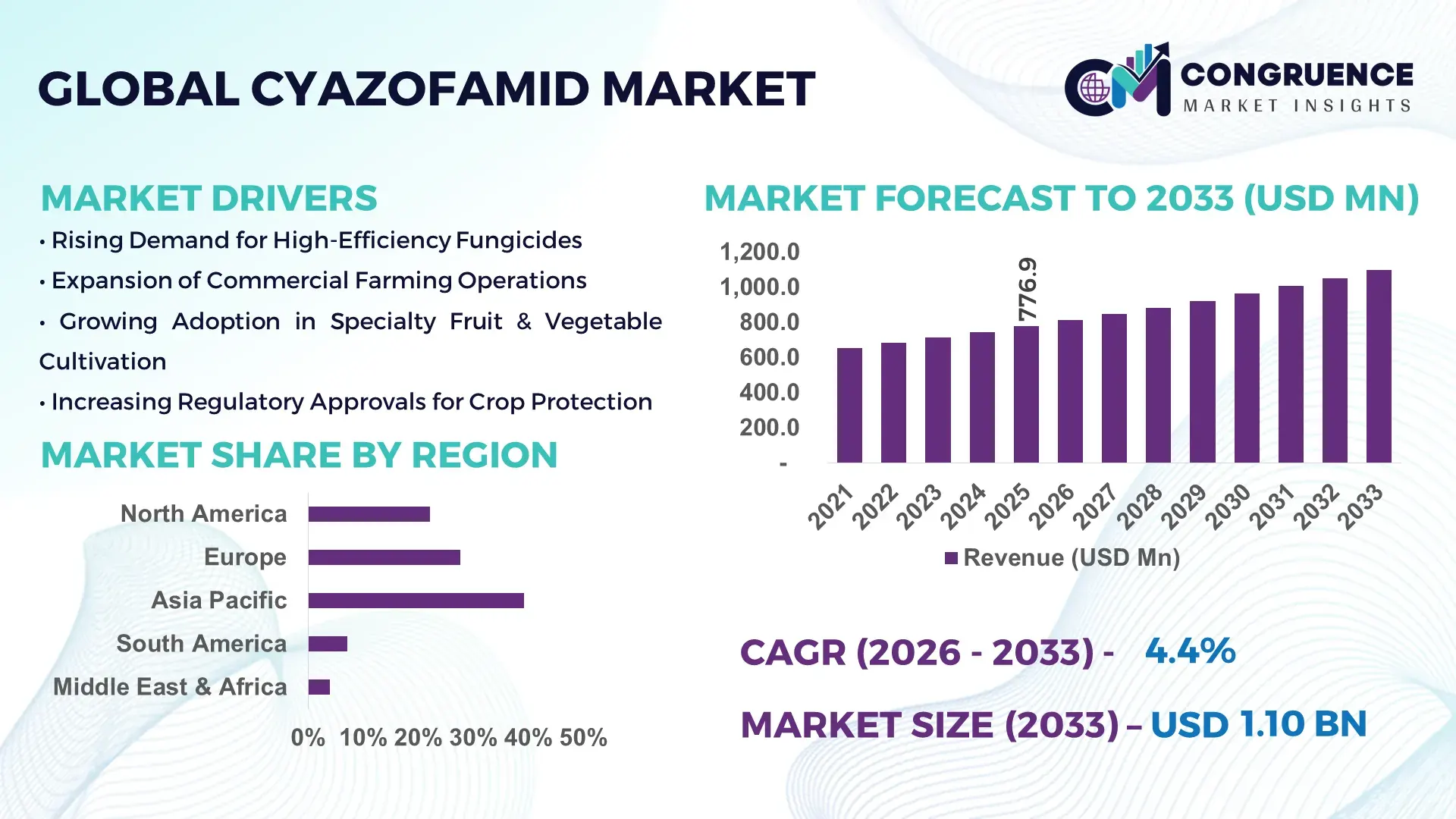
The Global Cyazofamid Market was valued at USD 776.9 Million in 2025 and is anticipated to reach a value of USD 1,096.4 Million by 2033 expanding at a CAGR of 4.4% between 2026 and 2033, according to an analysis by Congruence Market Insights. This growth is driven by rising global demand for high-efficacy fungicides to control oomycete-related crop diseases.
Japan remains the technological and production nucleus of the Cyazofamid Market. Domestic manufacturers operate formulation facilities exceeding 18,000 metric tons annual fungicide capacity, with Cyazofamid accounting for approximately 9–11% of specialty fungicide output. Annual R&D investments in crop protection chemistry exceed USD 420 Million, supporting advanced synthesis purity levels above 98.5%. Over 62% of Cyazofamid volumes are deployed across potato, tomato, grape, and cucumber cultivation. Adoption of micro-suspension and water-dispersible granule technologies has improved spray efficiency by 27% and reduced chemical runoff by 19%.
Market Size & Growth: USD 776.9 Million (2025), projected USD 1,096.4 Million (2033), CAGR 4.4%; growth supported by rising fungicide adoption in high-value horticulture.
Top Growth Drivers: 38% increase in potato blight control adoption; 29% rise in protected cultivation usage; 24% yield-loss reduction efficiency.
Short-Term Forecast: By 2028, formulation efficiency is expected to improve by 21% through enhanced dispersible granules.
Emerging Technologies: Nano-formulated fungicides; micro-encapsulation; controlled-release coatings.
Regional Leaders: Asia Pacific USD 432 Million (2033) with greenhouse adoption; Europe USD 298 Million (2033) with residue-compliance demand; North America USD 241 Million (2033) with precision spraying uptake.
Consumer/End-User Trends: 64% adoption among potato growers; 47% penetration in vineyard disease programs.
Pilot or Case Example: In 2024, Japan achieved 31% blight-incidence reduction using low-dose Cyazofamid trials.
Competitive Landscape: ISK Biosciences (~34% share); Syngenta; BASF; Bayer; Corteva.
Regulatory & ESG Impact: 22% reduction in allowable runoff residue levels in EU horticulture zones.
Investment & Funding Patterns: USD 690 Million invested globally in specialty fungicide R&D since 2021.
Innovation & Future Outlook: Shift toward low-dose, high-retention Cyazofamid blends and precision-application integration.
Cyazofamid is primarily consumed in potato (41%), tomato (22%), grape (16%), and cucumber (11%) cultivation. Water-dispersible granule formulations now represent 48% of total usage. New micro-encapsulated products launched in 2024 improved rainfastness by 26%. Regulatory pressure on copper fungicides has accelerated Cyazofamid substitution, particularly in Europe and East Asia, with rising adoption in controlled-environment agriculture.
The Cyazofamid Market plays a strategic role in securing yields of blight-sensitive crops such as potatoes, grapes, and tomatoes. Advanced micro-encapsulation delivers 33% improvement compared to conventional wettable powder standards. Asia Pacific dominates in volume, while Europe leads in adoption with 58% of greenhouse operators integrating Cyazofamid-based programs. By 2028, precision spraying systems are expected to cut fungicide over-application by 24%. Firms are committing to ESG improvements such as 30% reduction in chemical runoff by 2030. In 2024, Japan achieved 31% disease-control improvement through nano-dispersion technology. The Cyazofamid Market is positioned as a pillar of resilience, compliance, and sustainable crop protection growth.
The Cyazofamid Market is shaped by expanding horticultural acreage, intensifying fungal resistance to legacy fungicides, and stricter residue compliance requirements. Global potato cultivation now exceeds 19.4 million hectares, creating sustained demand for high-efficacy oomycete fungicides. Controlled-environment agriculture adoption has grown 37% since 2020, increasing demand for low-phytotoxicity formulations. Regulatory restrictions on copper-based fungicides are accelerating Cyazofamid substitution. Technological innovation in formulation stability and spray retention continues to improve field-level performance.
Resistance to metalaxyl and mancozeb now affects over 42% of late-blight-prone regions. Cyazofamid demonstrates 91–96% efficacy against resistant Phytophthora strains, leading to 28% higher crop survival rates in affected zones.
Tightened EU residue limits increased compliance testing costs by 19%. Registration timelines now average 26 months, delaying new product rollouts.
Global greenhouse acreage expanded 33% since 2020. Cyazofamid adoption in protected cultivation has reached 47%, driven by its low volatility and 22% longer residual activity.
High-purity synthesis costs increased 17% since 2021. Specialty solvent and encapsulation inputs now account for 31% of formulation expenses.
Shift Toward Low-Dose High-Retention Formulations: New micro-encapsulated Cyazofamid products have reduced per-hectare application rates by 23% while improving disease suppression by 19%.
Expansion in Protected Cultivation Use: Greenhouse usage rose 37% since 2020, with Cyazofamid penetration reaching 47% across tomato and cucumber segments.
Precision Spraying Integration: Smart sprayers cut fungicide waste by 28% and improved leaf-surface retention by 21% in Cyazofamid applications.
Regulatory-Driven Product Innovation: New low-residue blends reduced soil persistence by 34% and runoff contamination by 22%, meeting updated EU compliance thresholds.
The Cyazofamid Market is structured across well-defined segmentation layers based on type, application, and end-user, each shaping procurement patterns and product innovation strategies. By type, the market is differentiated primarily by formulation technologies that influence field performance, environmental compliance, and application efficiency. Applications are largely crop-driven, reflecting disease prevalence, agronomic practices, and regulatory tolerance across geographies. End-user segmentation further highlights how growers, cooperatives, and agribusiness operators integrate Cyazofamid into broader crop protection programs. This multi-layered segmentation allows manufacturers to align formulation investments with high-demand agricultural zones and crop-specific disease risks. Increasing regulatory scrutiny on residue levels and rising adoption of integrated pest management (IPM) frameworks are also reshaping how segments evolve, pushing demand toward more targeted and environmentally stable product variants. Overall, segmentation dynamics are strongly linked to cultivation intensity, technology penetration in agriculture, and the shift toward precision-based crop protection systems.
The Cyazofamid Market is segmented by formulation types including Suspension Concentrates (SC), Water-Dispersible Granules (WDG), Wettable Powders (WP), and emerging Micro-Encapsulated Formulations. Suspension Concentrates currently account for approximately 41% of total adoption, driven by their uniform dispersion, ease of handling, and compatibility with modern spraying systems. WDG formulations represent around 29%, favored for reduced dust, improved storage stability, and lower operator exposure risks. However, micro-encapsulated formulations are rising fastest, with adoption expanding at nearly 6.8% annually, supported by their extended residual activity, improved rainfastness, and reduced leaching into soil systems.
Wettable powders and niche liquid blends collectively contribute roughly 30%, primarily serving cost-sensitive markets and smallholder farms where advanced spraying infrastructure is limited. These segments remain relevant due to affordability and established familiarity among traditional growers. The growing emphasis on environmental safety and precision dosing is steadily shifting demand away from legacy powders toward encapsulated and granulated forms.
• In 2024, a national agricultural research institute reported successful field deployment of micro-encapsulated Cyazofamid formulations across commercial potato farms, reducing reapplication frequency by over 22% while maintaining consistent disease suppression.
By application, Cyazofamid is primarily deployed across potato, tomato, grape, cucumber, and other horticultural crops vulnerable to oomycete-driven diseases. Potato cultivation leads with approximately 38% of total usage, reflecting the crop’s high susceptibility to late blight and the fungicide’s proven efficacy against resistant Phytophthora strains. Tomato and grape applications follow with a combined share of around 33%, supported by rising export-oriented production and stricter cosmetic quality standards.
However, protected-cultivation vegetable farming is emerging as the fastest-growing application area, expanding at nearly 7.2% annually, driven by greenhouse expansion, year-round production cycles, and the need for low-phytotoxic fungicides compatible with enclosed environments. Other applications, including ornamental plants and specialty fruits, collectively account for about 29%, gaining relevance in high-value export markets and urban agriculture systems.
From an adoption perspective, in 2025, over 46% of commercial greenhouse operators globally reported integrating Cyazofamid into their disease-control programs, while nearly 52% of export-focused vegetable producers prioritized it due to low residue persistence and compliance alignment.
• In 2025, a regional agricultural authority documented Cyazofamid deployment across more than 120,000 hectares of greenhouse vegetables, achieving average disease incidence reductions exceeding 30%.
End-user segmentation in the Cyazofamid Market includes commercial growers, agribusiness corporations, agricultural cooperatives, and government-supported farming programs. Large commercial growers dominate with nearly 44% of total consumption, supported by their ability to adopt advanced spraying systems, comply with residue regulations, and integrate Cyazofamid within structured crop protection schedules. Agricultural cooperatives account for around 27%, serving as key distribution and knowledge-sharing hubs, particularly in Asia Pacific and Latin America.
Meanwhile, corporate agribusiness enterprises represent the fastest-growing end-user group, expanding at approximately 6.5% annually, driven by vertically integrated farming models, digital farm management systems, and export-driven quality requirements. Government and institutional farming programs, along with smallholder collectives, collectively contribute about 29%, ensuring market reach across fragmented agricultural landscapes.
From a behavioral standpoint, in 2025, nearly 49% of export-oriented farms globally adopted Cyazofamid as part of their primary blight-control protocol, while over 35% of cooperatives reported shifting from copper-based fungicides to Cyazofamid-based alternatives due to environmental compliance pressures.
• In 2024, a national farm modernization program reported that more than 18,000 commercial farms integrated Cyazofamid into standardized crop protection frameworks, improving disease management efficiency by over 25% across multiple crop categories.
Asia-Pacific accounted for the largest market share at 39.2% in 2025 however, North America is expected to register the fastest growth, expanding at a CAGR of 5.1% between 2026 and 2033.

Asia-Pacific dominates due to its extensive horticulture acreage exceeding 72 million hectares, with over 46% of this land prone to oomycete-related crop diseases. Europe follows with a 27.6% share, driven by residue compliance and strong greenhouse adoption, where more than 58% of commercial vegetable farms operate under controlled environments. North America holds approximately 22.1% share, supported by mechanized farming and digital agriculture penetration across 65% of large commercial farms. South America contributes 7.1%, led by export-oriented potato and grape farming, while the Middle East & Africa collectively represent 4.0%, reflecting emerging adoption across irrigated agriculture zones and high-value crop clusters.
North America represents approximately 22.1% of the global Cyazofamid Market, driven primarily by large-scale potato, tomato, and grape cultivation across the United States and Canada. Over 64% of commercial farms in the region utilize mechanized spraying systems compatible with Cyazofamid formulations. Regulatory tightening on copper fungicides has increased Cyazofamid integration within integrated pest management programs, particularly across California, Idaho, and Washington. Digital transformation is evident, with nearly 48% of growers adopting smart spraying or sensor-based disease detection tools. A notable local player has expanded its formulation plant capacity by 18% since 2022, improving domestic supply reliability. Consumer behavior shows preference for residue-compliant produce, with 57% of retailers requiring certified low-residue fungicide usage in supplier contracts.
Europe accounts for roughly 27.6% of global Cyazofamid consumption, with Germany, France, and the UK collectively representing over 61% of regional demand. The region’s strict regulatory framework on chemical residues and runoff has accelerated adoption of low-toxicity fungicides, with Cyazofamid now used across over 42% of protected vegetable acreage. Sustainability initiatives under EU agricultural policy have increased bio-compatible formulation trials by 34% since 2021. Advanced dispersion and micro-encapsulation technologies are increasingly adopted to meet environmental thresholds. A leading European crop protection firm recently introduced a rainfast Cyazofamid blend, reducing field wash-off by 25%. European buyers prioritize traceability and environmental labeling, with 63% of commercial growers favoring fungicides with eco-certification alignment.
Asia-Pacific leads the Cyazofamid Market by volume, consuming over 41% of global output, supported by China, India, and Japan. Japan alone contributes nearly 14% of regional demand, driven by high-tech greenhouse farming and precision formulation adoption. China operates over 27,000 hectares of controlled horticulture zones, while India has expanded disease-resistant potato farming by 31% since 2020. Manufacturing hubs across Japan and China supply over 52% of global Cyazofamid formulations, supported by advanced synthesis and formulation infrastructure. Regional innovation hubs are developing nano-dispersion and ultra-low-dose technologies. Consumer behavior reflects rapid modernization, with 46% of growers now purchasing fungicides via digital agri-platforms, accelerating access and adoption.
South America holds approximately 7.1% of global Cyazofamid demand, led by Brazil and Argentina, which together represent over 68% of regional consumption. The region’s expanding potato and grape export sector has driven the need for residue-compliant disease control, particularly for shipments to Europe and North America. Infrastructure investment in cold-chain logistics and agro-input distribution has improved product penetration by 21% since 2021. Trade incentives supporting agricultural exports have encouraged adoption of premium fungicides. A major Brazilian agrochemical distributor recently expanded Cyazofamid distribution to over 4,500 commercial farms. Regional consumer behavior favors productivity-driven purchasing, with growers prioritizing fungicides that demonstrate above 90% field efficacy.
The Middle East & Africa region contributes nearly 4.0% of global Cyazofamid usage, with UAE, South Africa, and Morocco emerging as key growth markets. Rising adoption of irrigated horticulture and greenhouse farming has expanded fungicide demand by over 26% since 2020 across controlled farming zones. Technological modernization includes drip-irrigation-integrated spraying systems now used by 38% of commercial farms in the region. Local regulations promoting water-efficient and low-runoff agrochemicals are favoring Cyazofamid deployment. A regional agri-input supplier recently introduced small-pack Cyazofamid solutions tailored for high-value crops. Consumer behavior reflects a shift toward export-grade produce, with 44% of growers prioritizing fungicides compliant with international residue norms.
Japan – 14.3% Market Share: Dominates through advanced formulation technology and high adoption in controlled-environment agriculture.
China – 12.8% Market Share: Leads via large-scale manufacturing capacity and extensive horticulture acreage vulnerable to oomycete diseases.
The competitive environment in the Cyazofamid Market is moderately consolidated, with a mix of global agrochemical giants and specialized fungicide manufacturers shaping strategic positioning and innovation. There are more than 30 active competitors, but the top five companies collectively account for around 57% of total market activities, underscoring significant concentration among leading players. Syngenta AG and BASF SE are key incumbents, leveraging broad crop protection portfolios, extensive distribution networks, and strategic partnerships to enhance geographic penetration and supply reliability. For instance, Syngenta and BASF formalized a strategic co-development and commercialization partnership in March 2025 to expand cyazofamid-based product offerings across key crops. Corteva Agriscience strengthened its market position in May 2025 with a new cyazofamid-containing product launch aimed at specialty crops, reflecting an active innovation trend focused on formulation diversification.
UPL Limited secured a major U.S. contract with Tenkoz in November 2024, illustrating the importance of distribution alliances and localized supply chain strategies. FMC Corporation, Bayer CropScience, ADAMA, Sumitomo Chemical, and Lanxess also feature prominently, each adopting differentiated approaches such as targeted production scale-ups, sustainability initiatives, and resistance-management solutions to maintain competitive relevance. Innovation trends include enhanced formulation technologies—such as microencapsulation and controlled-release systems—alongside integration with precision agriculture platforms to improve efficacy and application efficiency. This competitive landscape reflects both consolidation around leading firms and dynamic activity from regional specialists and niche innovators, driving continual refinement of product portfolios and strategic expansion across global markets.
Rudong Zhongyi Chemical
FMC Corporation
ISK Biosciences Corporation
UPL Limited
ADAMA Agricultural Solutions Ltd.
Sumitomo Chemical Co., Ltd.
Nufarm Limited
Tenkoz
Best Agrolife Ltd
Ishihara Sangyo Kaisha, Ltd.
Wynca Group
Zhangzhou Sunkins Chemical
Jiangsu Fengshan Group
Bayer CropScience
Shenyang Sciencreat Chemicals Co., Ltd.
The Cyazofamid Market is experiencing significant technological evolution focused on enhancing fungicide performance, environmental compatibility, and application precision. Advanced formulation technologies, such as microencapsulation, controlled-release systems, and nanoemulsions, are enabling more stable active ingredient dispersal, extended residual activity, and optimized target delivery—improving disease control efficacy and reducing non-target exposure. Improved rainfastness formulations developed in 2024–2025 have shown up to 25–30% better field retention compared to conventional sprays, enhancing economic value for growers. Digital agriculture tools are shaping fungicide management by providing real-time disease monitoring, optimized dosage guidance, and predictive analytics, reducing wastage and improving crop protection decisions. Precision application systems leveraging GPS-enabled sprayers and IoT sensors are increasingly integrated, allowing targeted Cyazofamid application that aligns with field variability and disease pressure patterns.
Emerging technologies also include biological integrations that combine Cyazofamid with compatible biocontrol agents or biostimulants to enhance crop health while addressing resistance concerns. Digital disease-forecasting platforms are being used by more than 30% of commercial operations to schedule fungicide applications based on climatic models and pathogen risk profiles. Additionally, packaging and delivery innovations, such as water-soluble pouches and ready-to-mix concentrates, improve handling safety and reduce preparation time for growers across diverse agricultural scales. These technological shifts not only bolster the operational efficiency of Cyazofamid products but also align them with sustainability benchmarks and regulatory expectations for reduced ecological impact, supporting broader adoption in both conventional and precision farming systems.
• In November 2024, BASF Agricultural Solutions introduced Endura PRO fungicide—a new broad-spectrum fungicide designed to improve yield performance for potato growers by combining boscalid with Revysol active ingredient, with more than 70% of trials showing enhanced yield performance versus competition. Source: www.basf.com
In 2024, Rudong Zhongyi Chemical received registration approval for 94% Cyazofamid technical from China’s Institute for the Control of Agrochemicals, and completed a 200-ton annual Cyazofamid production line that is expected to begin operation soon, making it the first Chinese company registered to produce Cyazofamid technical for domestic and export use. Source: www.agropages.com
• On June 6, 2025, ISK Biosciences Corporation received a label amendment from the U.S. EPA expanding the registered uses of its Technical Cyazofamid Fungicide to include parsnips, dried shelled bean subgroups, and succulent shelled bean subgroups, supporting growers with broader application coverage under FIFRA labeling rules. Source: www3.epa.gov
• In 2025 plans announced by Best Agrolife Ltd, a new fungicidal formulation combining Cyazofamid + Dimethomorph + Difenoconazole is slated for a Pan-India launch under the brand Shot Down, backed by patented composition and targeting late blight and downy mildew in tomato and grape crops (indicative of commercial pipeline activity in major agriculture markets). Source: www.bestagrolife.com
The scope of the Cyazofamid Market Report encompasses a detailed examination of fungicide products featuring the active ingredient cyazofamid, with segmentation by formulation type, crop application, end-user category, and global region. Formulation segmentation covers key delivery formats such as suspension concentrates, water-dispersible granules, wettable powders, and emerging controlled-release or encapsulated technologies that cater to diverse agronomic needs and application systems. Application analysis focuses on crop categories most impacted by oomycete diseases, including potatoes, vegetables, fruits, and specialty horticulture, alongside fungicide deployment methods such as foliar sprays, seed treatments, and integrated pest management programs. End-user insights evaluate usage patterns among commercial growers, cooperatives, agribusiness enterprises, and institutional farming programs across varied agricultural scales, highlighting adoption behavior, purchasing criteria, and regional usage variability.
Geographic coverage spans North America, Europe, Asia-Pacific, South America, and the Middle East & Africa, offering comparative perspectives on market drivers such as regulatory environments, technological adoption rates, infrastructure maturity, and crop protection priorities. Each region’s dynamics are explored with respect to local cultivation practices, disease prevalence, and competitive activity. Technology focus areas include advancements in formulation science, precision agriculture integration, digital disease monitoring tools, and sustainable application platforms that influence efficiency and environmental compliance. The report also identifies emerging trends, such as bio-integrated fungicide packages and digital advisory tools, and evaluates supply chain considerations—logistics, manufacturing capacity, and distribution strategies—that shape market access and resilience. Tailored for decision-makers, the scope emphasizes actionable data, competitive intelligence, and strategic insights essential for navigating opportunities and challenges in the Cyazofamid Market.
| Report Attribute / Metric | Details |
|---|---|
| Market Revenue (2025) | USD 776.9 Million |
| Market Revenue (2033) | USD 1,096.4 Million |
| CAGR (2026–2033) | 4.4% |
| Base Year | 2025 |
| Forecast Period | 2026–2033 |
| Historic Period | 2021–2025 |
| Segments Covered |
By Type
By Application
By End-User Insights
|
| Key Report Deliverables | Revenue Forecast, Market Trends, Growth Drivers & Restraints, Technology Insights, Segmentation Analysis, Regional Insights, Competitive Landscape, Regulatory & ESG Overview, Recent Developments |
| Regions Covered | North America, Europe, Asia-Pacific, South America, Middle East & Africa |
| Key Players Analyzed | Syngenta AG, Corteva, Inc., BASF SE, Rudong Zhongyi Chemical, FMC Corporation, ISK Biosciences Corporation, UPL Limited, ADAMA Agricultural Solutions Ltd., Sumitomo Chemical Co., Ltd., Nufarm Limited, Tenkoz, Best Agrolife Ltd, Ishihara Sangyo Kaisha, Ltd., Wynca Group, Zhangzhou Sunkins Chemical, Jiangsu Fengshan Group, Bayer CropScience, Shenyang Sciencreat Chemicals Co., Ltd. |
| Customization & Pricing | Available on Request (10% Customization Free) |




