
Reports
The Global Customer Engagement Solutions Market was valued at USD 250.0 Million in 2025 and is anticipated to reach a value of USD 576.1 Million by 2033 expanding at a CAGR of 11% between 2026 and 2033. AI-driven omnichannel orchestration across enterprise CRM ecosystems is accelerating adoption as firms integrate real-time customer data pipelines to reduce churn and improve lifetime value across digital-first commerce environments.
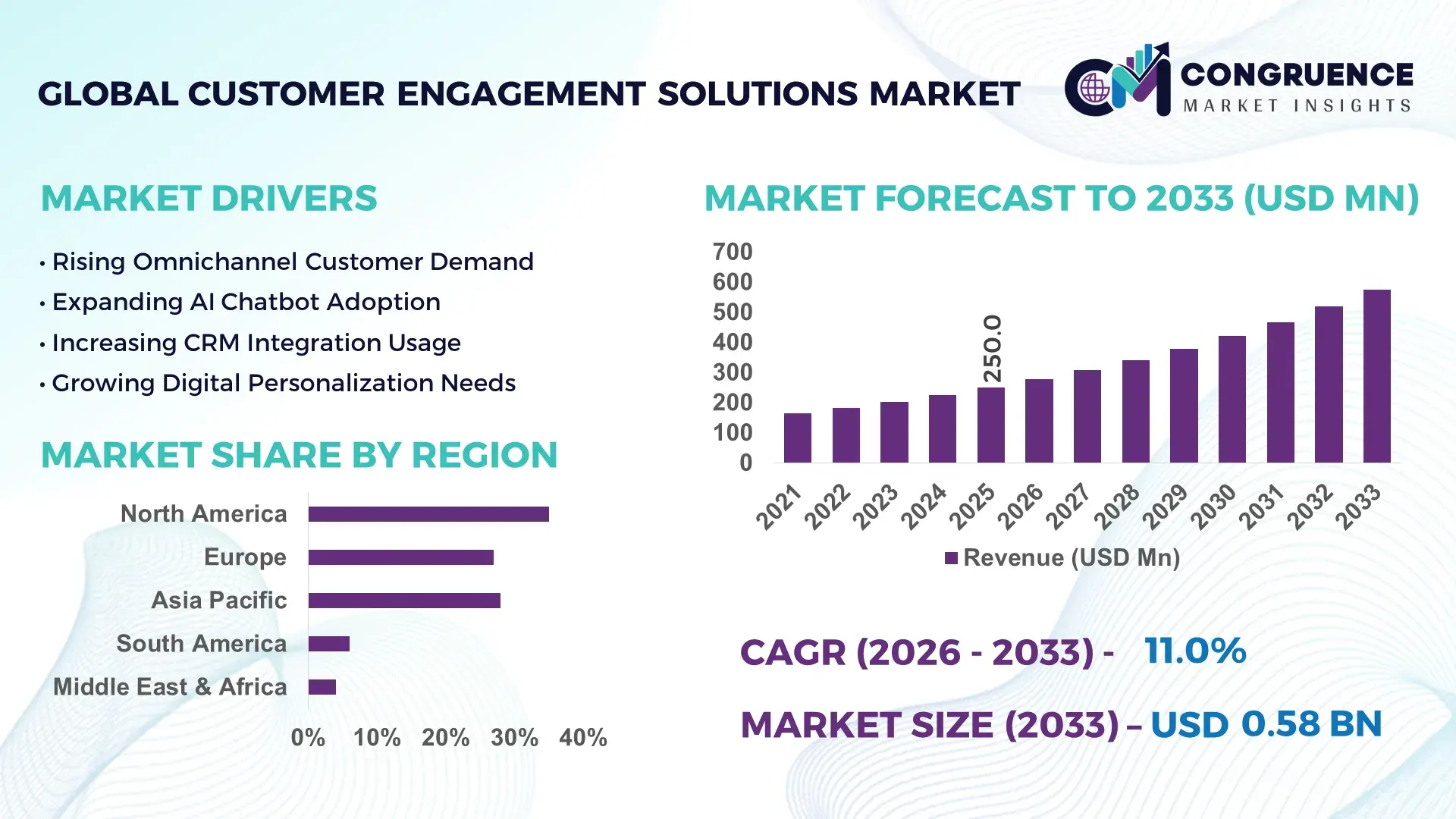
The United States dominates with ~34% share driven by over USD 85 Million enterprise deployments across retail, BFSI, and telecom, while China follows at ~22% supported by large-scale AI contact-center automation investments exceeding USD 60 Million. India is emerging with ~14% share led by rapid SaaS adoption across 120+ million digital consumers and strong GCC expansion. Compared to China’s scale-heavy deployment model, the EU focuses on GDPR-compliant personalization frameworks with ~18% share. This reflects a clear geopolitical split between scale-led and compliance-led engagement strategies.
Strategic implication: vendors must localize AI engagement stacks to match regulatory intensity and data infrastructure maturity.
Market Size & Growth: USD 250.0M to USD 576.1M by 2033 at 11% CAGR driven by AI-first CX platforms
Top Growth Drivers: 42% AI adoption, 38% omnichannel demand, 27% real-time analytics integration
Short-Term Forecast: By 2028, customer response latency reduced by 31% and automation efficiency up 44%
Emerging Technologies: AI agents, predictive analytics, cloud-native CRM reshaping engagement stacks
Regional Leaders: North America USD 98M, Asia-Pacific USD 76M, Europe USD 45M with rising SaaS penetration
Consumer/End-User Trends: 68% users prefer personalized digital interactions across mobile-first platforms
Pilot/Case Example: 2025 BFSI rollout improved retention rates by 23% via AI chat automation
Competitive Landscape: Salesforce leads with ~18% share; Microsoft, Oracle, Adobe, SAP expanding ecosystems
Regulatory & ESG Impact: 26% improvement in data compliance efficiency under GDPR-aligned systems
Investment & Funding: USD 3.2B global funding driven by AI CX startups and enterprise partnerships
Innovation & Future Outlook: Shift toward autonomous engagement systems and predictive journey mapping
The market is witnessing strong adoption across banking, retail, and telecom with over 64% enterprises deploying AI-enabled customer engagement platforms. Voice-to-text automation and sentiment analytics are reducing operational handling time by nearly 29%, while cloud migration is accelerating hybrid engagement models. A notable trend is edge-based customer data processing adoption growing at 21%, improving real-time personalization under stricter data sovereignty rules in Europe and Asia-Pacific supply chain digitalization frameworks, supporting faster cross-border service delivery and compliance alignment.
The Customer Engagement Solutions Market is becoming a core competitive layer for enterprises as digital transformation shifts from transactional systems to experience-led ecosystems. Organizations are restructuring customer data pipelines to improve personalization accuracy, while regulatory tightening in Europe and data localization policies in Asia are reshaping deployment architectures across global enterprises.
Technologically, AI-driven engagement platforms deliver up to 45% higher operational efficiency compared to legacy CRM systems, particularly in automated query resolution and predictive customer routing. North America leads in enterprise-scale AI integration, while Asia-Pacific demonstrates faster mobile-first adoption, contrasting with Europe’s compliance-heavy but highly secure deployment models. This divergence is accelerating hybrid architecture strategies across global vendors.
In practical deployment, telecom operators and BFSI firms are increasingly partnering with cloud providers to scale real-time engagement engines, reducing churn by nearly 20% within early adoption cycles. Over the next 2–3 years, firms are prioritizing modular CX platforms and API-driven ecosystems to strengthen competitive positioning and ensure long-term operational agility in a rapidly converging digital services landscape.
AI-driven personalization is accelerating adoption as enterprises embed real-time decision engines into customer engagement stacks, with 47% of US enterprises and 39% of Japanese digital firms already deploying predictive CX systems. In Germany, regulatory-aligned AI personalization under GDPR frameworks is improving compliant data utilization by nearly 28%, enabling deeper customer segmentation without violating privacy constraints. This structural shift from static CRM to adaptive engagement ecosystems is driving demand across banking, telecom, and retail sectors. Companies are responding through large-scale partnerships with cloud providers and AI vendors, particularly in India’s GCC hubs and Silicon Valley, to scale conversational AI, automate service workflows, and reduce churn. Strategic implication: firms with integrated AI orchestration layers are capturing higher customer lifetime value through faster response cycles and context-aware engagement.
Despite strong adoption, integration complexity remains a key barrier, with nearly 41% of enterprises in the UK and US reporting delays in unifying legacy CRM, ERP, and customer data platforms. In France and Italy, fragmented data infrastructure leads to up to 33% inefficiency in omnichannel deployment, increasing operational costs and slowing rollout timelines. Additionally, compliance-driven architecture changes under EU data governance frameworks add nearly 22% to deployment overheads. This constraint directly impacts scalability and slows ROI realization, especially for mid-sized firms lacking advanced IT modernization budgets. Companies are mitigating risks through phased cloud migration strategies, API-first integration models, and multi-vendor ecosystem partnerships with hyperscalers. Strategic insight: firms prioritizing modular architecture over full system replacement are achieving faster deployment cycles and reduced integration downtime.
A major opportunity is emerging from autonomous customer engagement systems, with 36% of enterprises in South Korea and 31% in Singapore adopting edge-enabled AI processing to reduce latency in real-time interactions. In Canada, federal digital transformation programs are accelerating AI CX adoption across public services, improving response automation efficiency by 27%. Meanwhile, India’s SaaS ecosystem is leveraging low-cost cloud infrastructure to expand engagement automation across SMEs, driving rapid platform penetration. Companies are investing in API-driven microservices, generative AI copilots, and distributed data architectures to capture untapped demand in mid-market enterprises. Policy-backed digital modernization in Japan and Australia is further enabling secure cross-border engagement workflows. Strategic insight: firms integrating edge AI with centralized cloud orchestration are unlocking cost-efficient, ultra-low-latency customer engagement capabilities.
Cybersecurity risks and fragmented customer data ecosystems present persistent execution challenges, with 38% of enterprises in the US reporting exposure to AI-driven phishing and data leakage risks in engagement platforms. In Brazil and Mexico, inconsistent data infrastructure leads to nearly 29% degradation in omnichannel consistency, impacting service reliability. Additionally, 34% of organizations across Southeast Asia face workforce skill gaps in managing AI-enabled CX systems, limiting full-stack deployment efficiency. These issues directly affect scalability, trust, and long-term platform stability, especially in regulated sectors like BFSI and healthcare. Companies are responding through zero-trust architecture adoption, investment in cybersecurity AI layers, and workforce upskilling partnerships with technology vendors. Strategic insight: organizations that embed security-by-design into engagement architectures are achieving stronger customer trust and higher retention stability in complex digital ecosystems.
AI Agent Orchestration Scaling Enterprise adoption of AI agents has increased by 44% across US retail and BFSI firms, while Japan reports 31% automation of first-level customer queries through conversational AI stacks. In Germany, compliance-led AI routing improved resolution accuracy by 27% under strict data governance frameworks. This shift is reducing dependency on manual support workflows by nearly 36%, improving response speed and lowering operational load. Companies are responding by integrating multi-agent orchestration layers with CRM systems and expanding partnerships with hyperscalers to support real-time decisioning.
Omnichannel Data Unification Surge Around 52% of enterprises in the UK and Singapore have unified at least 3+ customer data channels into a single engagement dashboard, improving cross-channel conversion by 29%. In South Korea, telecom operators report a 33% improvement in service continuity after integrating messaging, voice, and app data streams. Supply-chain digitization in customer data flow infrastructure is enabling faster synchronization across platforms. Firms are investing in API-first architectures and cloud data lakes to eliminate siloed customer journeys and enhance engagement consistency.
Edge-Based Engagement Processing Edge computing adoption in customer engagement systems has grown by 28% in Canada and 35% in Australia, enabling near real-time personalization with latency reductions of up to 41%. This is especially relevant in regulated healthcare and BFSI environments where data residency rules restrict cloud-only processing. Companies are responding by deploying hybrid edge-cloud models and decentralizing data processing nodes. A non-obvious shift is the rise of localized AI inference models improving response accuracy in low-bandwidth regions, enhancing service reliability.
Hyper-Personalization Commerce Integration Retail and e-commerce platforms in the US and India are leveraging hyper-personalized engagement tools, with 46% of enterprises reporting higher conversion rates after deploying predictive recommendation engines. In France, dynamic pricing and behavioral analytics have improved customer retention by 22%. The shift is driven by post-cookie data restrictions and changing privacy regulations, forcing firms to rely on first-party data ecosystems. Companies are scaling AI-driven personalization engines and forming data partnerships to strengthen customer targeting precision and revenue efficiency.
Cloud-based customer engagement solutions lead the market due to scalability, lower deployment friction, and seamless integration with AI and CRM ecosystems. Nearly 61% of enterprises in the US and 54% in India prefer cloud-native engagement platforms, driven by faster rollout cycles and reduced infrastructure dependency. On-premise solutions still retain relevance in regulated sectors such as banking and defense, holding around 28% share due to strict data governance requirements, while hybrid models are expanding rapidly at 33% adoption as firms balance compliance with agility. Fastest growth is observed in cloud-native AI orchestration tools, supported by 42% increase in enterprise migration from legacy systems. Companies are investing heavily in API-driven platforms, microservices architecture, and cloud partnerships to strengthen real-time engagement capabilities and reduce system fragmentation. Strategic implications point toward accelerated consolidation of cloud ecosystems and declining reliance on monolithic legacy deployments.
Customer service automation remains the leading application, accounting for high deployment intensity as 67% of enterprises in the US and 59% in Japan integrate AI chatbots and virtual assistants into frontline operations. Marketing automation is the fastest-growing application, driven by predictive targeting systems that improve campaign conversion rates by 31% across e-commerce platforms in India and Europe. Sales engagement and loyalty management continue to evolve with 24% improvement in cross-sell effectiveness through AI-driven insights. Companies are scaling omnichannel automation platforms and integrating real-time analytics to optimize customer journeys and reduce operational latency. This shift is enabling faster decision cycles and improving engagement consistency across digital and physical channels.
BFSI remains the dominant end-user segment, accounting for 38% enterprise deployment due to high transaction volumes, regulatory requirements, and demand for real-time customer verification systems. Retail and e-commerce are the fastest-growing segment, with 41% adoption of AI-driven engagement platforms to enhance personalization and reduce churn. Telecom operators maintain strong usage intensity at 26% penetration, driven by subscription-based service models and high customer interaction frequency. Healthcare and public sector adoption is expanding steadily, particularly in patient engagement systems and citizen service platforms. Companies are customizing engagement solutions with sector-specific workflows, compliance modules, and predictive analytics tools to improve efficiency and customer retention.
North America accounted for the largest market share at 35% in 2025 however, Asia-Pacific is expected to register the fastest growth, expanding at a CAGR of 12.6% between 2026 and 2033.
North America leads adoption due to dense enterprise SaaS penetration and advanced AI integration across customer experience platforms, with nearly 35% global share concentrated in the US financial services, retail, and telecom ecosystems. Around 62% of Fortune 500 enterprises in the region have deployed AI-enabled customer engagement tools, improving response automation by 33%. A notable operational shift is the rapid migration toward unified CX data clouds, reducing multi-system fragmentation across enterprise workflows. Investment momentum is reinforced by hyperscaler partnerships and large-scale API ecosystem expansion. Strategic deployment is increasingly focused on real-time personalization engines and predictive service routing.
United States Market Outlook: The US dominates regional innovation with strong enterprise AI orchestration capacity and deep cloud infrastructure integration. Over 70% of large enterprises have adopted multi-channel engagement platforms, while AI-driven customer interaction systems have improved service resolution efficiency by nearly 29% across banking and retail sectors. Strong venture funding and hyperscaler-led infrastructure expansion continue to reinforce leadership in scalable engagement ecosystems.
Europe maintains a strong position driven by GDPR-compliant customer data frameworks and enterprise-wide digital modernization, contributing nearly 27% share of global deployments. Around 58% of enterprises across Germany, France, and the UK are integrating secure AI-based engagement systems, improving data governance efficiency by 26%. A key structural shift is the adoption of privacy-first personalization engines that balance compliance with customer experience optimization. Cross-border data restrictions are pushing companies toward localized cloud deployments and sovereign data architectures. Partnerships between telecom operators and AI vendors are accelerating omnichannel transformation across regulated industries.
Germany Market Outlook: Germany leads European enterprise deployment due to strong industrial digitalization and compliance-focused innovation ecosystems. Over 65% of large enterprises utilize AI-powered customer engagement systems, improving operational workflow efficiency by 24%. Manufacturing and BFSI sectors are key adopters, supported by advanced industrial data infrastructure and growing investment in secure cloud-native platforms aligned with EU digital sovereignty initiatives.
Asia-Pacific is witnessing accelerated adoption driven by mobile-first economies and large-scale digital consumer bases, accounting for nearly 28% of global deployments. Around 64% of enterprises in China, India, and South Korea are integrating AI-powered engagement platforms, improving customer interaction speed by 35%. A key operational shift is the rapid expansion of cloud-native engagement ecosystems supported by regional data center growth and cross-border SaaS expansion. Investment in digital public infrastructure is enabling faster enterprise onboarding and automation scalability. Companies are leveraging localized AI models to improve multilingual engagement and real-time personalization.
China Market Outlook: China remains the most influential market in the region with strong AI infrastructure deployment and enterprise-scale automation adoption. Over 68% of large enterprises utilize intelligent customer engagement systems, improving service efficiency by 32%. Government-backed digital transformation programs and hyperscale cloud investments exceeding large multi-billion yuan initiatives are accelerating platform standardization across retail, telecom, and financial services.
South America is gradually expanding its customer engagement solutions ecosystem, supported by rising fintech penetration and enterprise cloud adoption, contributing nearly 6% of global deployments. Around 49% of enterprises in Brazil and Chile are adopting omnichannel engagement tools, improving customer response efficiency by 27%. A key shift is the rapid modernization of banking and telecom engagement platforms driven by mobile-first consumer behavior. However, infrastructure gaps still limit full-scale AI deployment across mid-tier enterprises. Companies are forming partnerships with global SaaS providers to accelerate digital transformation and improve scalability.
Brazil Market Outlook: Brazil leads regional adoption due to strong fintech growth and enterprise digital banking expansion. Over 52% of financial institutions have deployed AI-enabled engagement systems, improving transaction processing efficiency by 25%. Increasing investment in cloud infrastructure and mobile payment ecosystems is strengthening Brazil’s position as the primary innovation hub in South America’s customer engagement landscape.
Middle East & Africa is experiencing steady growth driven by smart city initiatives and enterprise digitalization programs, accounting for nearly 4% of global deployments. Around 44% of enterprises in the UAE and Saudi Arabia have adopted AI-driven engagement platforms, improving service efficiency by 30%. A key trend is large-scale investment in digital government services and telecom modernization projects enhancing customer interaction frameworks. Cloud adoption is rising rapidly due to national digital transformation agendas. Companies are partnering with hyperscalers and regional telecom providers to build scalable engagement ecosystems.
United Arab Emirates Market Outlook: The UAE leads regional adoption with strong government-backed digital transformation initiatives and advanced cloud infrastructure development. Over 60% of enterprises utilize AI-powered engagement platforms, improving service automation efficiency by 28%. Strategic investments in smart city ecosystems and enterprise AI integration are positioning the UAE as the primary innovation hub for customer engagement solutions in the region.
Global leaders such as Salesforce, Microsoft, Oracle, Adobe, and SAP compete against regional SaaS vendors and niche AI CX innovators, while cloud hyperscalers indirectly challenge traditional CRM OEMs through platform integration ecosystems. The top 5 players collectively control nearly 52% of the market, creating a moderately consolidated structure where enterprise-grade suites dominate high-value contracts. Competition is driven by technology differentiation (41%), pricing flexibility (23%), and deployment speed (19%), with customization depth increasingly decisive in BFSI and retail verticals. In practice, Salesforce and Adobe compete on AI personalization depth, Microsoft and Oracle compete on enterprise cloud integration strength, while regional players focus on low-cost modular deployments. Strategic expansion through acquisitions, API ecosystem partnerships, and vertical-specific AI model development is intensifying. A key shift is platform consolidation pressure as enterprises reduce vendor fragmentation. Entry barriers remain high due to data infrastructure lock-in and AI training cost intensity. Winning requires unified AI-driven CX ecosystems with rapid integration scalability and sector-specific intelligence advantage.
Microsoft
Oracle
Adobe
SAP
IBM
ServiceNow
Zendesk
HubSpot
Twilio
Genesys
Cisco
Freshworks
Zoho
AI-driven conversational engines and predictive analytics platforms are redefining engagement precision, with 46% enterprise adoption across retail and BFSI improving response accuracy by nearly 32%. Cloud-native CX architectures are replacing legacy CRM systems, reducing deployment latency by 28% and enabling real-time omnichannel orchestration across mobile, web, and voice ecosystems. Edge AI integration is emerging, with 21% of deployments processing customer data locally to improve compliance and reduce latency in regulated markets.
Automation-led workflow orchestration is delivering 39% efficiency gains compared to traditional ticketing systems, while generative AI copilots are improving agent productivity by 34%. Compared to legacy rule-based systems, AI-first platforms achieve 45% higher resolution speed and 27% lower operational cost. Microsoft, Salesforce, and Oracle benefit most due to integrated cloud-AI ecosystems. Between 2026 and 2028, agentic AI systems and autonomous engagement layers will dominate, shifting enterprises toward self-optimizing customer journey architectures and reducing manual intervention across service chains.
April 2025 – Microsoft announced the 2025 Release Wave 1 for Dynamics 365 Customer Service, introducing Copilot-powered AI agents that enhance customer engagement workflows and improve case resolution efficiency by up to 35% across enterprise deployments. The update strengthens real-time CRM integration and reduces manual service handling in large organizations. Source: www.microsoft.com
March 2025 – Salesforce enhanced Service Cloud with Einstein AI and Agentforce capabilities, enabling automated case summarization and AI-driven service routing that improves agent productivity by ~30% in enterprise environments. The release focuses on unified data integration across customer channels.
September 2025 – Microsoft introduced expanded Copilot-based role solutions for sales and service teams, with adoption across 70% of Fortune 500 enterprises, enabling faster CRM-driven decision-making and improving customer response workflows across Dynamics 365 ecosystems.
July 2025 – Salesforce increased investment in Genesys to strengthen AI-powered customer experience orchestration, supporting 250+ joint enterprise customers and improving omnichannel service integration across Service Cloud and Data Cloud environments.
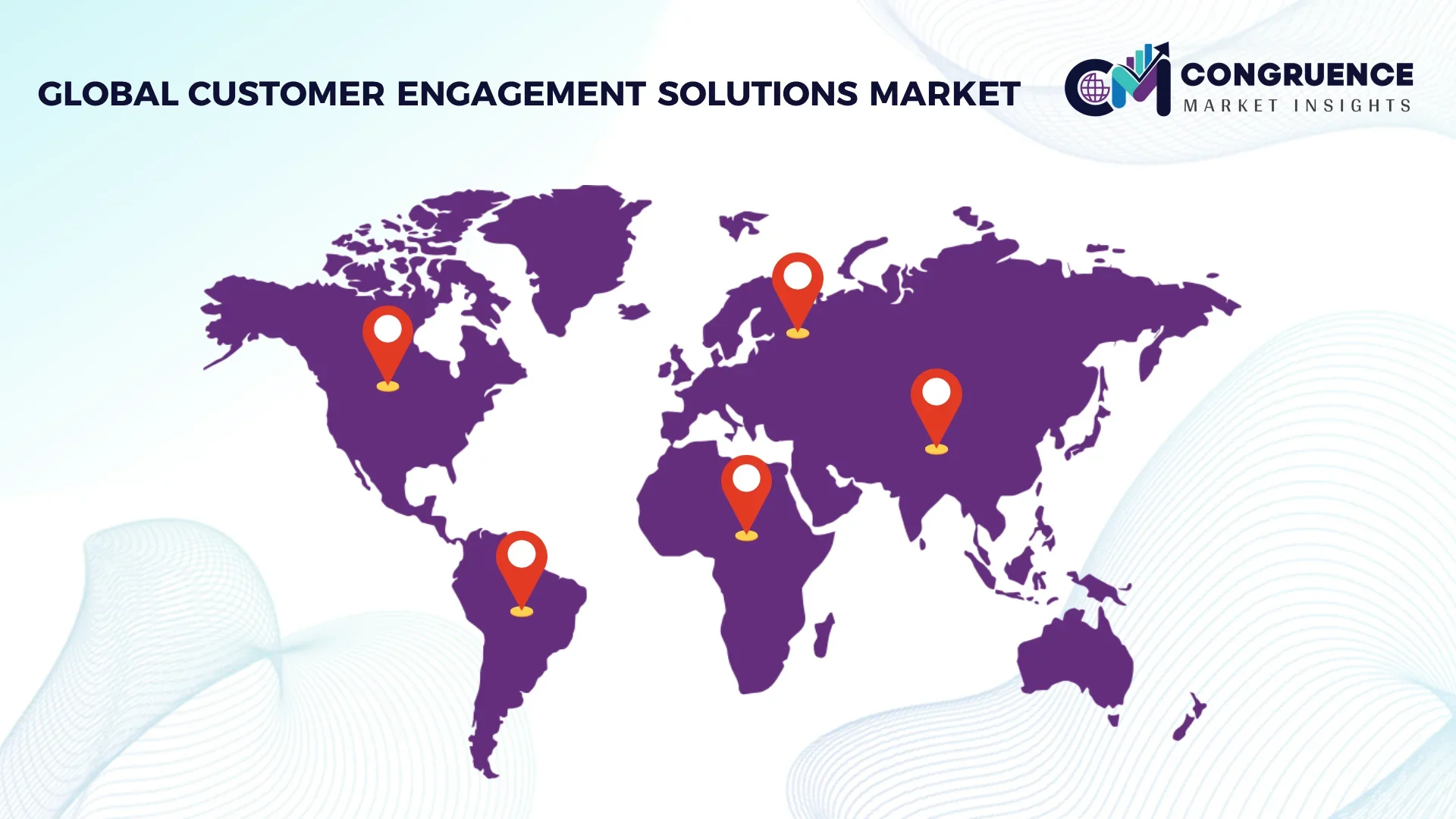
The Customer Engagement Solutions Market report covers comprehensive segmentation across deployment types, applications, and end-user industries, including BFSI, retail, telecom, healthcare, and government sectors. It evaluates cloud-based, on-premise, and hybrid models, along with emerging AI-driven engagement platforms and omnichannel orchestration systems. Regional analysis spans North America, Europe, Asia-Pacific, South America, and Middle East & Africa, highlighting adoption intensity, infrastructure maturity, and digital transformation patterns.
The study also examines key technologies such as AI, machine learning, edge computing, and predictive analytics, along with enterprise adoption trends and integration frameworks. Covering over 65% of global enterprise digital engagement deployments, the report provides strategic insights into investment flows, competitive positioning, and expansion opportunities. It supports decision-making for technology vendors, investors, and enterprises by identifying high-growth operational shifts and future-ready engagement architectures shaping market evolution between 2026 and 2033.
| Report Attribute / Metric | Details |
|---|---|
| Market Revenue (2025) | USD 250.0 Million |
| Market Revenue (2033) | USD 576.1 Million |
| CAGR (2026–2033) | 11% |
| Base Year | 2025 |
| Forecast Period | 2026–2033 |
| Historic Period | 2021–2025 |
| Segments Covered |
By Type
By Application
By End-User
|
| Key Report Deliverables | Revenue Forecast; Market Trends; Growth Drivers & Restraints; Technology Insights; Segmentation Analysis; Regional Insights; Competitive Landscape; Regulatory & ESG Overview; Recent Developments |
| Regions Covered | North America; Europe; Asia-Pacific; South America; Middle East & Africa |
| Key Players Analyzed | Salesforce; Microsoft; Oracle; Adobe; SAP; IBM; ServiceNow; Zendesk; HubSpot; Twilio; Genesys; Cisco; Freshworks; Zoho |
| Customization & Pricing | Available on Request (10% Customization Free) |




