Global Cryptographic Identity Management Market Report Overview
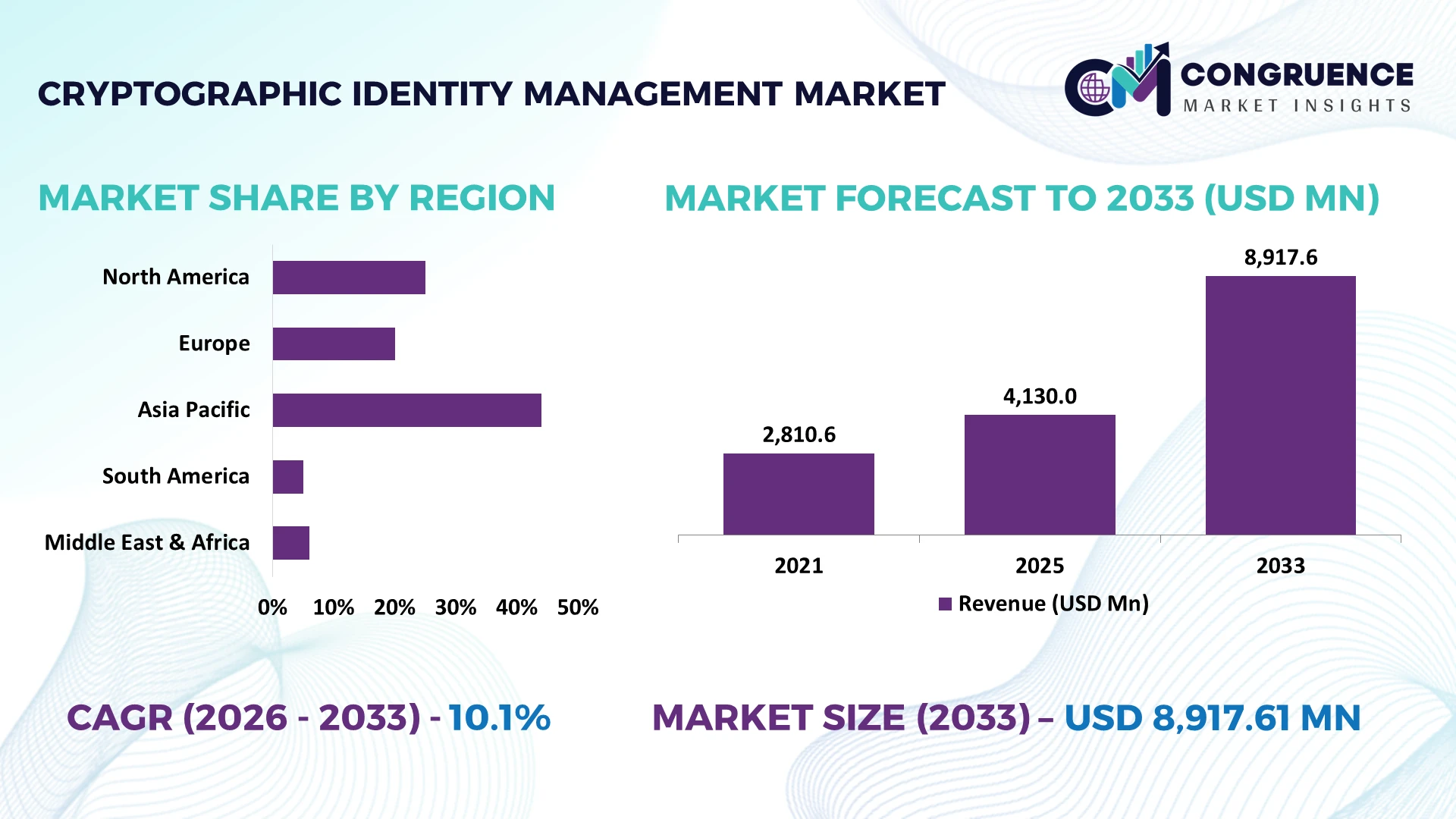
The Global Cryptographic Identity Management Market was valued at USD 4130 Million in 2025 and is anticipated to reach a value of USD 8917.61 Million by 2033 expanding at a CAGR of 10.1% between 2026 and 2033. Growth is driven by automated certificate lifecycle management, expanding machine identities, post-quantum cryptography migration, and stricter authentication requirements across cloud infrastructure and enterprise networks.
The United States leads the global cryptographic identity management landscape, supported by concentrated cybersecurity investment, cloud infrastructure, and advanced identity security vendors. More than 50% of surveyed organizations experienced certificate-related outages in 2024, highlighting operational demand for automated credential management. The NIST finalization of three post-quantum cryptography standards in August 2024 strengthened enterprise migration planning. Compared with China, where domestic cryptographic standards influence procurement, American financial institutions, cloud operators, and federal agencies increasingly prioritize cryptographic agility, hardware security modules, and automated public key infrastructure.
Strategically, vendors integrating certificate discovery, machine identity governance, and quantum-resistant cryptography gain stronger positioning in enterprise security modernization programs.
Key Highlights of the Global Cryptographic Identity Management Market
-
Market Size & Growth: USD 4,130 million in 2025, projected to reach USD 8,917.61 million by 2033 at 10.1% CAGR, supported by automated machine identity protection.
-
Top Growth Drivers: Certificate-related outages affect over 50% of surveyed organizations; machine identity volumes are expanding; and 100% certificate lifecycle visibility is becoming a security objective.
-
Short-Term Forecast: By 2028, publicly trusted TLS certificate validity will fall to 47 days, increasing renewal frequency and automation requirements.
-
Emerging Technologies: Three technologies dominate product development: post-quantum cryptography, automated certificate lifecycle management, and hardware-backed cryptographic identity verification.
-
Regional Leaders: North America prioritizes automated PKI, Europe strengthens eIDAS 2.0 digital identity compliance, and Asia-Pacific expands cloud authentication infrastructure across three major deployment environments.
-
Consumer/End-User Trends: Organizations increasingly manage thousands of certificates and machine credentials, accelerating demand for centralized inventory, automated renewal, and policy-based identity governance.
-
Pilot/Case Example: In 2024, NIST finalized three post-quantum cryptography standards, establishing a technical foundation for quantum-resistant identity infrastructure migration.
-
Competitive Landscape: DigiCert, Entrust, Sectigo, Keyfactor, and CyberArk compete across five capabilities: certificate automation, PKI management, machine identity security, cryptographic discovery, and enterprise integration.
-
Regulatory & ESG Impact: Europe's eIDAS 2.0 framework establishes digital identity wallet obligations, while three finalized NIST cryptographic standards support security modernization.
-
Investment & Funding: Enterprise spending prioritizes three areas: cryptographic asset discovery, automated certificate operations, and post-quantum migration readiness.
-
Innovation & Future Outlook: By 2033, quantum-resistant credentials, automated key rotation, and identity-aware workload authentication will reshape enterprise cryptographic governance.
The Cryptographic Identity Management Market is transitioning from manually administered digital certificates toward automated governance of machine credentials, cryptographic keys, and workload identities. Financial institutions, cloud service providers, telecommunications operators, and government agencies require reliable authentication across increasingly distributed infrastructure. The planned reduction of publicly trusted TLS certificate validity to 47 days by 2028 significantly increases renewal frequency, strengthening the operational case for automated certificate lifecycle management. Emerging innovations include quantum-resistant certificate architectures, hardware-backed key protection, and continuous cryptographic asset discovery. These developments establish the foundation for evaluating strategic investment priorities and competitive differentiation in enterprise identity security.
What Is the Strategic Relevance and Future Pathways of the Cryptographic Identity Management Market?
Cryptographic identity management is becoming essential to enterprise resilience as digital certificates, machine credentials, and encryption keys govern access across cloud infrastructure, financial transactions, and connected devices. Google's 2025 proposal to reduce publicly trusted TLS certificate lifetimes established a significant infrastructure modernization requirement. The approved industry transition will progressively shorten certificate validity from 398 days to 47 days by 2029, increasing renewal frequency and strengthening demand for automated public key infrastructure.
Automated certificate lifecycle management replaces spreadsheet-based tracking and manual renewals with continuous discovery, policy enforcement, and programmable issuance. Moving from 398-day to 47-day validity increases annual renewal frequency approximately 8.5 times, making manual administration increasingly impractical. The United States leads commercial machine identity security innovation, while European enterprises emphasize eIDAS 2.0 compliance and qualified trust services. For example, a multinational bank can integrate certificate automation with Kubernetes workloads, hardware security modules, and centralized security operations to prevent authentication disruptions.
Between 2026 and 2028, enterprises will prioritize cryptographic asset inventories, automated key rotation, and post-quantum migration assessments. Vendors are expanding cloud-native PKI integrations, strengthening certificate authority partnerships, and developing cryptographic discovery platforms. Competitive differentiation will increasingly depend on automation reliability, interoperability, and demonstrable cryptographic agility.
Cryptographic Identity Management Market Dynamics
DRIVER:
Accelerating Certificate Renewal and Machine Identity Automation
Shortening certificate validity periods is transforming enterprise cryptographic identity operations. The CA/Browser Forum approved a phased reduction in publicly trusted TLS certificate lifetimes from 398 days to 200 days in 2026, 100 days in 2027, and 47 days in 2029. These changes represent approximately 50%, 75%, and 88% reductions from the previous maximum validity period. American cloud providers, financial institutions, and digital commerce platforms must manage increasingly frequent certificate issuance, renewal, and revocation activities. Manual workflows create operational bottlenecks and increase service interruption exposure. DigiCert, Sectigo, and Keyfactor are strengthening automated certificate lifecycle platforms, API integrations, and enterprise PKI orchestration. Providers delivering reliable automation gain stronger customer retention through integration into critical infrastructure workflows.
RESTRAINT:
Legacy PKI Fragmentation and Integration Costs
Fragmented certificate authority infrastructure and proprietary key management systems constrain cryptographic identity modernization. Enterprises operating traditional public key infrastructure frequently maintain separate certificate inventories across on-premises applications, cloud services, and industrial devices. The transition from 398-day certificate validity to 200 days in 2026 increases renewal frequency by approximately 99%, while the subsequent 100-day limit in 2027 nearly quadruples the original annual renewal workload. Germany's industrial enterprises face additional interoperability constraints involving legacy manufacturing systems and embedded controllers that lack automated certificate enrollment capabilities. Replacing hardware security modules, updating application trust stores, and integrating incompatible APIs increase deployment costs. Vendors are introducing connector libraries, phased migration services, and centralized certificate discovery to reduce implementation expenditure and preserve existing infrastructure investments.
OPPORTUNITY:
Post-Quantum Identity Infrastructure and Cryptographic Agility
Post-quantum cryptography creates opportunities for identity management vendors beyond conventional certificate automation. NIST finalized three foundational post-quantum cryptographic standards in August 2024, establishing technical specifications for quantum-resistant key establishment and digital signatures. The standards include ML-KEM, ML-DSA, and SLH-DSA, enabling organizations to evaluate cryptographic migration pathways. The United States federal transition toward quantum-resistant security strengthens demand for cryptographic discovery, algorithm inventory management, and hardware-backed key protection. Enterprises must identify vulnerable encryption dependencies before replacing certificates and authentication mechanisms. Vendors are expanding cryptographic agility platforms, developing hybrid certificate capabilities, and partnering with cloud infrastructure providers. The strongest commercial opportunity lies in managing algorithm transitions across applications without requiring wholesale infrastructure replacement.
CHALLENGE:
Machine Identity Scale and Cryptographic Migration Complexity
Maintaining cryptographic identity integrity across rapidly expanding machine environments presents a substantial execution challenge. Publicly trusted TLS certificate lifetimes will decline to 47 days by 2029, requiring approximately 8.5 times more frequent renewals than under the previous 398-day maximum. NIST's three finalized post-quantum standards introduce additional requirements for algorithm compatibility, certificate processing, and key management infrastructure. In Japan, industrial automation and connected manufacturing systems depend on embedded cryptographic implementations with extended equipment lifecycles. Updating device firmware, validating certificate chains, and coordinating trust anchor changes across suppliers creates operational risk. Vendors must invest in automated certificate discovery, hybrid cryptographic testing, and resilient key rotation mechanisms. Competitive sustainability depends on maintaining authentication continuity while migrating heterogeneous enterprise and industrial systems.
Cryptographic Identity Management Market Latest Trends
-
Certificate Discovery Becomes Continuous Infrastructure Monitoring: Enterprises are integrating certificate inventories with cloud asset management and configuration monitoring. Publicly trusted TLS certificates previously carried a 398-day maximum validity, while the 2026 limit falls to 200 days. Vendors are deploying continuous discovery agents and automated ownership mapping, helping security teams identify unmanaged certificates before they disrupt applications or authentication services.
-
Hardware-Backed Credentials Strengthen Enterprise Authentication: Financial institutions are expanding cryptographic key protection through hardware security modules and secure enclaves. FIPS 140-3 defines four security levels for cryptographic modules, while PCI DSS 4.0 requirements became fully effective in March 2025. Vendors are integrating tamper-resistant key storage with centralized identity platforms, reducing exposure from exported private keys and improving audit consistency.
-
Digital Identity Wallet Interoperability Advances: European identity infrastructure is shifting toward reusable, cryptographically verifiable credentials under eIDAS 2.0. EU member states must provide at least one European Digital Identity Wallet by the end of 2026. Technology providers are developing wallet interfaces, credential verification services, and standardized trust frameworks, reducing repeated identity checks and improving cross-border digital service onboarding.
-
Workload Identity Replaces Persistent Secrets: Cloud operators are adopting short-lived workload credentials instead of static application secrets. SPIFFE-based architectures use cryptographic identities and automated workload attestation, while OAuth 2.0 supports scoped authorization. Platform providers are integrating certificate issuance with container orchestration and service meshes, limiting credential persistence and improving application-to-application authentication across distributed environments.
Segmentation Analysis
By Type
Public Key Infrastructure Anchors Enterprise Cryptographic Governance
Public Key Infrastructure (PKI) represents the leading type within the Cryptographic Identity Management Market, supported by established enterprise dependence on certificate authorities, cryptographic trust chains, and centralized key governance. PKI enables scalable authentication across enterprise applications, connected devices, and secure communications. Digital Certificates constitute another major segment, supporting identity verification, encrypted connections, and trusted electronic transactions. The reduction in publicly trusted TLS certificate validity from 398 days to 200 days in 2026 increases annual renewal frequency by approximately 99%, strengthening demand for integrated certificate lifecycle management. Vendors are expanding automated enrollment interfaces, centralized certificate inventories, and managed PKI offerings to address growing administrative workloads.
Decentralized Identity Systems represent an emerging high-growth segment as enterprises explore verifiable credentials and user-controlled digital identities. Europe's requirement for member states to provide digital identity wallets by the end of 2026 supports ecosystem development. Hardware Security Modules remain strategically important for protecting cryptographic keys and enabling tamper-resistant signing operations. Providers are combining hardware-backed trust infrastructure with software-based credential orchestration, shifting investment toward interoperable cryptographic identity platforms.
- The CA/Browser Forum's 2025 decision established a phased reduction in publicly trusted TLS certificate lifetimes, beginning with a 200-day maximum in 2026. This directly increases the operational importance of automated PKI administration and certificate lifecycle governance.
By Application
User Authentication Leads Enterprise Identity Protection
User Authentication represents the leading application within the Cryptographic Identity Management Market, supported by enterprise requirements for secure workforce access, customer verification, and cryptographically protected digital transactions. Financial institutions, government agencies, and cloud service providers increasingly deploy certificate-based authentication and hardware-backed credentials to reduce dependence on passwords. FIDO authentication standards support phishing-resistant access through public-key cryptography, while digital identity modernization strengthens demand for interoperable authentication mechanisms. Access Control remains important for enforcing authorization policies across sensitive enterprise systems. Vendors are integrating certificate authentication with identity governance platforms, privileged access controls, and centralized credential management to improve security consistency.
Device Identity Management is emerging as a rapidly expanding application as cloud workloads, industrial equipment, and connected devices require unique cryptographic credentials. Digital Signatures support document authenticity, software integrity, and legally recognized electronic transactions. The European Digital Identity Wallet framework establishes implementation requirements for member states by the end of 2026, strengthening demand for interoperable verification services. Technology providers are developing automated device enrollment, cryptographic attestation, and scalable credential provisioning platforms. Investment increasingly favors machine identity automation alongside established human authentication infrastructure.
- The FIDO Alliance's 2025 Passkey Index reported that passkeys achieved an average 93% authentication success rate, compared with 63% for traditional authentication methods. This performance advantage strengthens enterprise adoption of cryptographic authentication and passwordless identity systems.
By End-User
Banking and Financial Services Drive Cryptographic Identity Investment
Banking and Financial Services represent a leading end-user category within the Cryptographic Identity Management Market because payment processing, digital banking, and financial messaging require reliable cryptographic authentication and key protection. Financial institutions deploy PKI, digital certificates, and hardware security modules to secure transaction infrastructure and sensitive customer information. PCI DSS 4.0 requirements became fully effective in March 2025, strengthening operational attention to cryptographic controls and authentication governance. Government organizations maintain substantial demand through national digital identity programs and secure public service delivery. IT and Telecommunications enterprises require scalable certificate management across cloud platforms, communications infrastructure, and distributed applications. Vendors are expanding managed PKI services, compliance-oriented key management, and financial infrastructure partnerships.
Manufacturing represents an emerging expansion segment as connected industrial equipment requires cryptographic device identities and authenticated machine communications. Healthcare organizations increasingly protect clinical applications, connected medical devices, and patient information through certificate-based security. The United States' 2024 finalization of three post-quantum cryptographic standards is influencing long-term technology planning across critical infrastructure sectors. Providers are developing industry-specific credential provisioning, hardware-backed authentication, and cryptographic inventory platforms to address differentiated operational requirements.
- The FIDO Alliance's 2025 authentication research identified a 93% average success rate for passkeys, highlighting measurable usability improvements from cryptographic authentication. This supports adoption across digital banking, government services, healthcare portals, and enterprise access environments.
Region-Wise Market Insights
North America accounted for the largest market share at an estimated 39% in 2025 however, Asia-Pacific is expected to register the fastest growth, expanding at a CAGR of an estimated 12.4% between 2026 and 2033.
North America Cryptographic Identity Management Market
Enterprise PKI Modernization and Automated Machine Identity Governance
North America maintains a leading position in cryptographic identity management through concentrated cybersecurity technology development, extensive cloud infrastructure, and established enterprise identity security platforms. The United States dominates regional deployment, while Canada contributes through financial services modernization and government digital identity initiatives. Enterprises increasingly integrate certificate lifecycle automation, hardware security modules, and cryptographic asset discovery into centralized security operations. The CA/Browser Forum's approved certificate validity transition introduces a 200-day maximum for publicly trusted TLS certificates in 2026, accelerating enterprise migration from manual renewal processes. Technology vendors including DigiCert, Entrust, and Keyfactor are expanding automated PKI capabilities, cloud integrations, and machine identity governance platforms. Regional procurement increasingly prioritizes cryptographic agility, multicloud interoperability, and reliable certificate issuance across distributed application environments.
United States Market Outlook: The United States benefits from advanced cybersecurity research, federal cryptographic modernization initiatives, and established cloud technology providers. NIST finalized three post-quantum cryptographic standards in August 2024, establishing technical foundations for quantum-resistant identity infrastructure. American financial institutions, defense contractors, and federal agencies are strengthening cryptographic inventories, hardware-backed key protection, and automated certificate provisioning to support secure infrastructure modernization.
Europe Cryptographic Identity Management Market
Digital Identity Regulation Accelerates Trusted Credential Infrastructure
Europe's cryptographic identity management market is shaped by harmonized digital identity regulations, trusted electronic transactions, and stringent enterprise cybersecurity requirements. Germany, France, the Netherlands, and the United Kingdom represent important deployment centers, supported by financial services, industrial manufacturing, and government digitization programs. The revised eIDAS framework requires European Union member states to provide at least one European Digital Identity Wallet by the end of 2026, strengthening demand for verifiable credentials and trusted authentication infrastructure. Financial institutions are also strengthening cryptographic governance under the Digital Operational Resilience Act. Vendors are developing interoperable certificate services, qualified electronic signature platforms, and hardware-backed credential management. European enterprises increasingly prioritize cross-border identity verification, data protection compliance, and auditable cryptographic controls, creating opportunities for specialized trust service providers.
Germany Market Outlook: Germany's industrial manufacturing infrastructure and established electronic identification ecosystem support demand for cryptographic authentication and machine identity protection. The country's electronic identity card infrastructure enables secure digital identification through cryptographic credentials. German automotive, engineering, and financial enterprises are expanding certificate-based access controls, industrial device authentication, and qualified electronic signature adoption. Technology providers are strengthening integrations with regulated identity services and enterprise PKI platforms.
Asia-Pacific Cryptographic Identity Management Market
Cloud Infrastructure Scale Strengthens Machine Credential Management
Asia-Pacific is emerging as a major expansion environment for cryptographic identity management, supported by digital infrastructure investment, manufacturing connectivity, and expanding enterprise cloud adoption. China, India, Japan, South Korea, and Singapore represent important deployment markets with distinct cryptographic governance requirements. China emphasizes domestic cryptographic standards and secure digital infrastructure, while Japan prioritizes reliable device authentication across industrial automation and telecommunications networks. Singapore's digital identity infrastructure supports cryptographically secured access to government and commercial services. Enterprises are expanding automated certificate provisioning, hardware-backed key management, and application identity verification across distributed computing environments. Regional technology providers are developing localized PKI services, integrating cryptographic controls into cloud platforms, and strengthening partnerships with telecommunications operators. Competitive differentiation increasingly depends on scalable credential issuance, domestic regulatory compatibility, and secure machine-to-machine communications.
China Market Outlook: China's extensive industrial manufacturing base, cloud infrastructure, and connected device ecosystem support large-scale cryptographic identity deployment. The country's Commercial Cryptography Law establishes requirements for commercial cryptographic technologies and their regulated applications. Chinese technology enterprises are expanding certificate authority infrastructure, hardware security module integration, and cryptographic device authentication. Domestic standards influence procurement across financial services, telecommunications, and critical information infrastructure.
South America Cryptographic Identity Management Market
Digital Financial Infrastructure Expands Trusted Identity Adoption
South America's cryptographic identity management market is developing around digital banking expansion, electronic government services, and increasing adoption of secure online transactions. Brazil represents the principal deployment center, while Chile, Colombia, and Argentina contribute through financial technology development and electronic signature modernization. Banking institutions increasingly deploy cryptographic certificates, hardware-backed authentication, and secure transaction signing to protect digital financial infrastructure. Government agencies are strengthening electronic identification and document verification systems, creating demand for trusted certificate authorities and digital signature services. Regional providers are expanding managed PKI offerings, localized credential issuance, and integration with financial technology platforms. Implementation constraints include uneven enterprise security maturity and limited specialist cryptographic engineering resources. Vendors offering simplified certificate administration and compliance-oriented services are strengthening their position among midmarket customers.
Brazil Market Outlook: Brazil benefits from its established ICP-Brasil public key infrastructure, which supports legally recognized digital certificates and electronic signatures. The country's extensive financial technology ecosystem reinforces demand for secure authentication and cryptographic transaction protection. Brazil's Pix payment infrastructure processed more than 6 billion transactions during a single month in 2025, demonstrating the operational scale requiring reliable digital identity and secure financial communications.
Middle East & Africa Cryptographic Identity Management Market
Government Digital Transformation Strengthens Cryptographic Trust Infrastructure
The Middle East & Africa cryptographic identity management market is shaped by national digital identity initiatives, financial services modernization, and expanding government cloud infrastructure. Saudi Arabia and the United Arab Emirates represent important investment centers, while South Africa contributes through established banking and telecommunications networks. Government modernization programs are strengthening requirements for secure digital credentials, electronic signatures, and cryptographic protection of public services. The UAE's digital identity ecosystem supports authentication across government and private sector applications, encouraging integration of trusted identity verification technologies. Saudi Arabia's cybersecurity regulatory framework reinforces enterprise requirements for cryptographic key protection and secure information exchange. Vendors are developing localized certificate management services, expanding cloud security partnerships, and integrating hardware security modules with enterprise authentication platforms. Regional demand increasingly emphasizes trusted transactions and regulatory interoperability.
Saudi Arabia Market Outlook: Saudi Arabia's Vision 2030 digital transformation programs are strengthening demand for secure government identity services and enterprise cryptographic infrastructure. The National Cybersecurity Authority's Essential Cybersecurity Controls establish 114 controls across five domains, supporting structured cybersecurity governance. Saudi financial institutions, telecommunications operators, and government agencies are expanding cryptographic authentication, secure key management, and certificate-based access controls. Local technology partnerships are strengthening implementation capabilities for regulated digital services.
Market Competition Landscape
DigiCert, Sectigo, Entrust, Keyfactor, and CyberArk compete across certificate automation, enterprise PKI, hardware-backed security, and machine identity governance. Established certificate authorities challenge software-led identity platforms through trusted issuance infrastructure, while specialist vendors differentiate through cryptographic discovery and automated credential orchestration. A defensible combined market share for the five leaders requires comparable standalone segment disclosures. Competition increasingly reflects the 50% reduction in maximum TLS certificate validity during 2026 and the approximately 88% reduction scheduled by 2029. Vendors are expanding cloud integrations, acquiring automation capabilities, and partnering with hardware security providers. Post-quantum migration is shifting purchasing decisions toward algorithm agility rather than certificate issuance alone. Enterprise switching costs, trusted root infrastructure, and complex application integrations restrict entry. Providers must demonstrate reliable certificate automation, interoperable key management, and measurable operational continuity to displace established suppliers across regulated enterprise environments while maintaining consistent cryptographic controls and scalable service delivery.
Companies Profiled in the Cryptographic Identity Management Market Report
-
DigiCert, Inc.
-
Sectigo Limited
-
Entrust Corporation
-
Keyfactor, Inc.
-
CyberArk Software Ltd.
-
Thales Group
-
Microsoft Corporation
-
IBM Corporation
-
HID Global Corporation
-
GlobalSign
-
SwissSign AG
-
Yubico AB
Technology Insights for the Cryptographic Identity Management Market
Enterprise cryptographic identity platforms integrate public key infrastructure, certificate lifecycle automation, hardware security modules, and centralized key governance. Automated certificate enrollment replaces manual tracking with continuous discovery, programmable issuance, and policy validation. The 2026 reduction in maximum publicly trusted TLS certificate validity from 398 to 200 days increases annual renewal frequency approximately 99%, making automation operationally essential. Financial institutions benefit from hardware-backed private key protection, while cloud operators gain consistent workload authentication across distributed infrastructure.
Emerging technologies include cryptographic asset discovery, decentralized identifiers, verifiable credentials, and post-quantum cryptographic algorithms. NIST standardized three foundational post-quantum algorithms in 2024, enabling structured migration assessments. Compared with legacy password authentication, passkey implementations demonstrated approximately 93% authentication success against 63% for traditional methods, representing a 30-percentage-point improvement. Identity providers are integrating FIDO authentication, hardware-backed credentials, and enterprise access governance to improve security without increasing user friction.
Between 2026 and 2028, cryptographic agility platforms will prioritize automated algorithm inventories, hybrid certificate testing, and secure key rotation. Cloud-native PKI integrations support scalable credential provisioning, while hardware security modules protect sensitive signing operations. Vendors combining certificate automation with quantum-readiness assessments gain stronger enterprise positioning. Competitive differentiation depends on interoperability, cryptographic lifecycle visibility, and reliable authentication continuity across heterogeneous applications and devices.
Recent Developments in the Global Cryptographic Identity Management Market
-
October 2026: DigiCert reported 38% year-over-year growth in Trust Lifecycle Manager recurring subscriptions, reflecting enterprise adoption of automated certificate operations. Its platform integrates certificate discovery, policy governance, and renewal automation, strengthening operational continuity across complex digital infrastructure. Source: digicert.com
-
July 2026: Keyfactor announced a strategic growth investment exceeding USD 1 billion, led by Summit Partners. The funding supports international expansion, cryptographic identity innovation, recruitment, and acquisitions, strengthening its position in machine identity security and post-quantum infrastructure. Source: keyfactor.com
-
September 2025: Sectigo completed the migration of Entrust's public certificate business, transferring more than 500,000 certificates to Sectigo Certificate Manager. The integration consolidated certificate infrastructure, expanded automated lifecycle management, and strengthened operational readiness for shorter certificate validity periods. Source: sectigo.com
-
August 2024: NIST finalized three post-quantum cryptographic standards, FIPS 203, 204, and 205, covering quantum-resistant key establishment and digital signatures. The standardization provides technology vendors with implementation specifications for upgrading cryptographic identity infrastructure and strengthening long-term authentication security. Source: nist.gov
Scope of the Cryptographic Identity Management Market Report
The Cryptographic Identity Management Market Report provides comprehensive industry analysis for 2026–2033, covering four technology segments: Public Key Infrastructure (PKI), Digital Certificates, Hardware Security Modules, and Decentralized Identity Systems. Application coverage includes User Authentication, Access Control, Digital Signatures, and Device Identity Management. End-user assessment examines Banking and Financial Services, Government, Healthcare, IT and Telecommunications, and Manufacturing. The report evaluates certificate lifecycle automation, cryptographic key governance, post-quantum migration readiness, and enterprise authentication infrastructure.
Regional analysis encompasses North America, Europe, Asia-Pacific, South America, and the Middle East & Africa, highlighting regulatory developments, deployment concentration, and digital identity modernization. Competitive assessment profiles 12 influential market participants, examining technology differentiation, partnerships, and infrastructure capabilities. The report supports investment planning, geographical expansion, competitive positioning, and strategic technology adoption through 2033.
Cryptographic Identity Management Market Report Summary
| Report Attribute/Metric | Report Details |
|---|
Market Revenue in 2025 | USD 4130 Million |
Market Revenue in 2033 | USD 8917.61 Million |
CAGR (2026 - 2033) | 10.1% |
Base Year | 2025 |
Forecast Period | 2026 - 2033 |
Historic Period | 2021 - 2025 |
Segments Covered | By TypePublic Key Infrastructure (PKI) Hardware Security Modules Decentralized Identity Systems
By ApplicationDevice Identity Management
By End-UserBanking and Financial Services IT and Telecommunications
|
Key Report Deliverable | Revenue Forecast, Growth Trends, Market Dynamics, Segmental Overview, Regional and Country-wise Analysis, Competition Landscape |
Region Covered | North America, Europe, Asia-Pacific, South America, Middle East, Africa |
Key Players Analyzed | DigiCert, Inc., Sectigo Limited, Entrust Corporation, Keyfactor, Inc., CyberArk Software Ltd., Thales Group, Microsoft Corporation, IBM Corporation, HID Global Corporation, GlobalSign, SwissSign AG, Yubico AB |
Customization & Pricing | Available on Request (10% Customization is Free) |





