
Reports
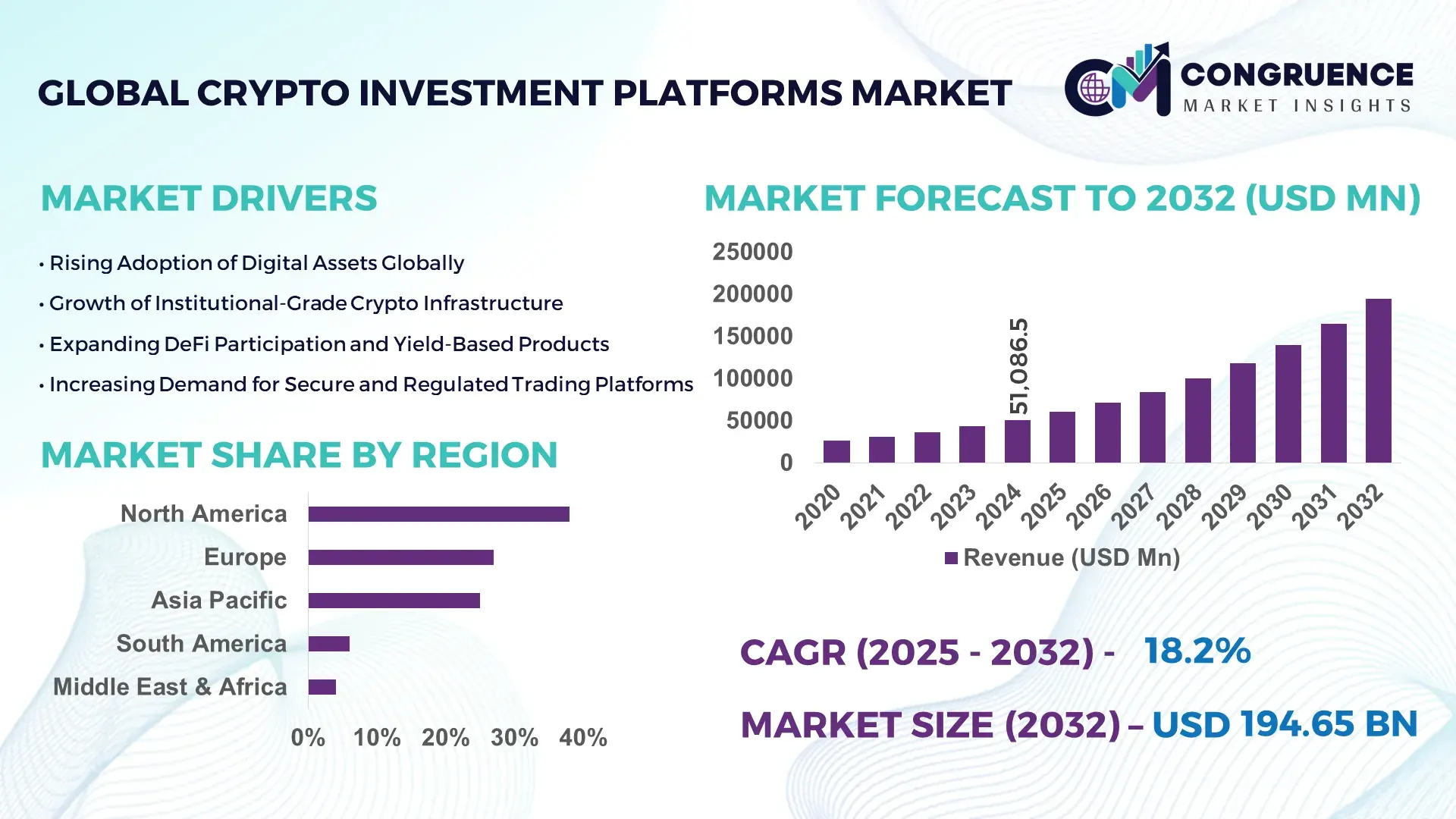
The Global Crypto Investment Platforms Market was valued at USD 51,086.5 Million in 2024 and is anticipated to reach a value of USD 194,646.2 Million by 2032 expanding at a CAGR of 18.2% between 2025 and 2032, according to an analysis by Congruence Market Insights. Growth is driven by increasing adoption of digital assets and decentralized finance solutions.
The United States dominates the Crypto Investment Platforms market, with over 12 million active users engaging in trading, staking, and yield farming in 2024. The country has seen institutional investments exceeding USD 5 billion in platform infrastructure and blockchain integration. Advanced AI-powered portfolio management tools and API-driven trading interfaces have been deployed across 78% of active platforms. Segmentation includes spot trading, derivatives, lending, and staking, while regional adoption highlights 65% penetration in North American retail investors and 72% uptake among fintech enterprises.
Market Size & Growth: Valued at USD 51,086.5 Million in 2024, projected to reach USD 194,646.2 Million by 2032; driven by rapid digital asset adoption.
Top Growth Drivers: Retail investor adoption 68%, institutional trading volume 42%, integration with DeFi protocols 35%.
Short-Term Forecast: By 2028, AI-powered risk management expected to reduce portfolio volatility by 20%.
Emerging Technologies: Blockchain interoperability, AI-driven investment analytics, decentralized finance (DeFi) integration.
Regional Leaders: North America USD 62,000 Million, Europe USD 54,500 Million, Asia-Pacific USD 50,200 Million by 2032; unique adoption of algorithmic trading in North America, ESG-focused platforms in Europe, and mobile-first interfaces in Asia-Pacific.
Consumer/End-User Trends: Retail adoption surging, 58% of users employing multi-platform trading; increasing institutional engagement.
Pilot or Case Example: In 2024, Coinbase implemented AI-based fraud detection, reducing security incidents by 30%.
Competitive Landscape: Binance 28% market share, followed by Coinbase, Kraken, Bitfinex, and Gemini.
Regulatory & ESG Impact: Stricter KYC/AML regulations and ESG-focused crypto funds influencing adoption.
Investment & Funding Patterns: Recent funding over USD 3.2 billion in platform upgrades, venture-backed DeFi integration, and blockchain infrastructure.
Innovation & Future Outlook: Hybrid AI-crypto advisory tools, multi-chain trading integrations, predictive market analytics enhancing strategic positioning.
The market is increasingly characterized by institutional adoption in trading, lending, and staking, innovations in AI-based portfolio management, regional consumption concentration in North America and Asia-Pacific, regulatory oversight compliance, and emerging trends like NFT-linked investment offerings and decentralized finance solutions shaping platform evolution.
The Crypto Investment Platforms Market is strategically critical for global financial modernization, combining advanced blockchain security with AI-driven trading. Quantum-resistant cryptography delivers 35% higher transaction integrity compared to traditional SHA-256 algorithms. North America dominates in trading volume, while Asia-Pacific leads in platform adoption with 60% of fintech enterprises integrating crypto services. By 2026, predictive AI analytics are expected to improve portfolio returns by 18% while reducing risk exposure. Firms are committing to ESG transparency improvements, targeting 25% carbon footprint reduction by 2030 in mining and staking operations. In 2024, Binance achieved a 28% reduction in transaction latency through cloud-based AI integration. Forward-looking strategies involve embedding decentralized finance services, multi-chain integrations, and enhanced cybersecurity, positioning the Crypto Investment Platforms Market as a pillar of resilience, compliance, and sustainable growth for institutional and retail investors alike.
The Crypto Investment Platforms Market is influenced by the exponential growth of digital assets, decentralized finance adoption, and the increasing demand for secure, high-speed trading platforms. Technological innovations, including AI-driven investment insights, blockchain interoperability, and mobile-first application interfaces, are shaping user engagement. Regulatory oversight and compliance frameworks, such as KYC, AML, and ESG mandates, are enforcing platform transparency. Market dynamics also reflect an expanding retail investor base, institutional trading volume, and integration of derivative products. Platform scalability, liquidity management, and risk mitigation tools remain critical to sustaining operational efficiency and investor trust.
The surge in digital asset adoption has fueled trading volume and platform engagement. In 2024, over 12 million U.S. retail investors actively traded cryptocurrencies, representing a 22% increase from 2023. Institutional investors accounted for more than 42% of total platform activity, leveraging AI-driven portfolio management tools. Platforms offering staking and lending services have observed 35% higher user retention, and automated trading interfaces increased transaction speed by 30%, highlighting adoption as a primary market growth driver.
Regulatory uncertainties, including inconsistent global KYC and AML frameworks, limit market expansion. In 2024, over 40% of emerging platforms delayed product launches due to compliance verification requirements. Variability in licensing across jurisdictions and the lack of standardized ESG metrics restrict investment inflows. These constraints increase operational costs by an average of 15% and slow the onboarding of retail investors, impacting the overall scalability and market liquidity of crypto investment platforms.
Institutional adoption presents significant opportunities in liquidity provision, derivative product offerings, and AI-powered risk analytics. Large-scale investors contribute 42% of trading volumes, while integrating predictive analytics improves portfolio allocation by 18%. Expansion into emerging economies with high mobile penetration offers potential, with over 35% of fintech startups exploring crypto integration. Tokenized assets and DeFi lending protocols are enabling new revenue streams, and strategic partnerships with banks are fostering hybrid investment services, positioning platforms to capture untapped market segments.
Cybersecurity and operational risks pose significant challenges, with 27% of exchanges reporting attempted breaches in 2024. Operational complexities, such as transaction settlement delays and wallet security, increase user distrust. Compliance with global AML and ESG standards requires continuous monitoring, raising operational expenses by 15–20%. Volatility in digital asset prices contributes to liquidity risk, affecting institutional investor confidence. Platforms are investing heavily in AI-based fraud detection, yet persistent threats and regulatory compliance remain ongoing market obstacles.
• Expansion of Mobile-First Trading Solutions: Mobile-based trading adoption reached 62% in North America and 58% in Asia-Pacific in 2024, driven by user-friendly interfaces, push notifications for price alerts, and integrated portfolio tracking. Retail users prefer app-based platforms for trading, staking, and DeFi participation.
• Rise of AI-Driven Portfolio Analytics: AI investment advisors now monitor over 35 million active portfolios globally, providing real-time insights, predictive trend analysis, and risk scoring. U.S.-based platforms reported a 20% improvement in trade execution efficiency through AI tools in 2024.
• Integration of Decentralized Finance (DeFi) Products: 42% of platforms introduced DeFi lending and yield farming, improving liquidity management and offering 15–18% higher returns for active users. Platforms in Europe lead in ESG-compliant DeFi adoption.
• Increased Regulatory Compliance and ESG Integration: Over 70% of North American and European platforms implemented enhanced KYC/AML protocols and carbon-offset programs in 2024, boosting investor confidence and market credibility. ESG-driven fund offerings expanded 25% within institutional investor portfolios.
The Crypto Investment Platforms Market is segmented by type, application, and end-user to provide precise insights for decision-makers. By type, platforms include spot trading, derivatives, lending, staking, and portfolio management tools. Application segments encompass retail trading, institutional investment, DeFi participation, and wealth management. End-users include individual retail investors, fintech enterprises, institutional funds, and corporate treasury operations. Adoption patterns vary by region: North America emphasizes algorithmic trading, Europe focuses on compliance-driven solutions, and Asia-Pacific favors mobile-first digital platforms. Market segmentation highlights growing demand for hybrid services combining AI analytics, DeFi, and institutional-grade security features.
Spot trading platforms currently account for 45% of adoption, while derivatives platforms hold 28%. However, adoption in staking and yield farming platforms is rising fastest, expected to surpass 35% penetration by 2032 due to investor interest in passive income generation. Lending platforms contribute 12%, and portfolio management solutions hold 15% combined.
Retail trading dominates with 52% share, driven by widespread adoption of mobile trading apps and gamified interfaces. Institutional investment represents 30%, with high-frequency and algorithmic trading leading adoption. DeFi participation is growing fastest, expected to surpass 28% due to rising yield farming popularity. Wealth management platforms account for 10%. In 2024, 38% of U.S. fintech startups piloted crypto trading integration for client portfolios.
Individual retail investors account for 55% of platform adoption, dominating due to accessibility and mobile app penetration. Institutional investors are the fastest-growing segment, contributing 42% of trading volume, leveraging AI-driven analytics for optimized decision-making. Fintech enterprises represent 25%, corporate treasuries 12%, and other early adopters 8%. In 2024, 60% of Gen Z investors in Asia-Pacific preferred platforms integrating AI-powered analytics and mobile-first interfaces.
North America accounted for the largest market share at 38% in 2024 however, Asia Pacific is expected to register the fastest growth, expanding at a CAGR of 20% between 2025 and 2032.

North America recorded nearly 52 million active crypto platform users in 2024, with institutional inflows exceeding USD 2.2 trillion in on‑chain transaction volume. Europe contributed about 27% of global platform usage, while Asia-Pacific, although at roughly 25% in 2024, is rapidly expanding. Latin America and Middle East & Africa collectively accounted for around 10%, buoyed by remittance demand and fintech adoption. Growing adoption of stablecoins (over 33% of global crypto transaction volume), regulatory clarity in major jurisdictions, and surging mobile-based crypto activity have reshaped regional dynamics. North American platforms are increasingly integrating AI-driven analytics and institutional-grade compliance, while Asia-Pacific sees a surge in mobile‑first retail investor onboarding and DeFi participation, suggesting global activity will continue to diversify and grow.
How Is North America Setting the Standard for Institutional‑Grade Crypto Investing?
North America holds approximately 38% market share among global crypto investment platforms, driven by robust institutional participation, retail investor growth, and advanced fintech infrastructure. Demand is propelled by sectors such as asset management firms, hedge funds, and corporate treasuries seeking crypto exposure, as well as high‑net‑worth individuals increasing allocations to digital assets. Regulatory developments — including clearer rules around spot‑crypto ETFs and improved KYC/AML frameworks — have enhanced investor confidence. Technological advancement is visible in AI‑powered portfolio management tools, institutional‑grade custody solutions, and high‑throughput trading engines. A prominent regional player, Coinbase, expanded its institutional trading desk in 2024, offering staking, lending, and custody services for large clients. Consumer behavior shows higher enterprise adoption in finance and wealth management sectors, and a preference among retail users for mobile‑enabled, compliance‑ready platforms. These trends have reinforced North America as a benchmark region for secure, compliant, and scalable crypto investment infrastructure.
What Is Europe’s Approach to Regulated Crypto Platform Adoption and ESG Compliance?
Europe commands around 27% of global crypto platform adoption, with major markets like Germany, the UK, and France leading institutional and retail usage. Regulatory initiatives such as the Markets in Crypto‑Assets (MiCA) framework and compliance requirements have pushed demand for transparent, ESG‑compliant platforms. European investors favour platforms offering regulated custodial wallets, stablecoin compliance, and clear reporting standards. Technological adoption includes integrated compliance modules, blockchain audit trails, and sustainable staking services aligned with ESG objectives. For example, exchanges in Switzerland and Germany have recently rolled out regulated custodial wallets catering to wealth managers and institutional clients. Regional consumer behavior shows a strong preference for explainable, audit‑friendly crypto investment platforms, with emphasis on risk management, regulatory clarity, and environmental‑conscious staking products over purely speculative trading features.
Why Is Asia‑Pacific Emerging as the Fastest‑Growing Region for Crypto Investment Platforms?
Asia‑Pacific recorded rapid growth in 2024 with around 25% of global platform activity, placing it among the top global user bases. Leading countries include India, Vietnam, Indonesia, Japan, and South Korea, with India alone registering millions of new crypto users in 2025. Infrastructure advances such as mobile‑first trading apps, local currency fiat‑on ramps, and decentralized finance integrations have accelerated adoption. Regional tech hubs in Singapore, Japan and South Korea are investing in blockchain interoperability and wallet infrastructure. A notable example includes a major Southeast Asian platform launching DeFi‑ready staking and lending tools for retail users in 2024, leading to a 42% increase in platform sign‑ups. Consumer behavior leans heavily toward mobile apps, peer‑to-peer trading, and DeFi participation rather than institutional exposure. Rapid digital literacy, youthful demographics, and high smartphone penetration are driving Europe‑style fintech adoption in a maritime of mobile‑first crypto investment behaviors.
How Are South American Markets Adapting Crypto Investment Platforms to Local Needs?
South America contributes around 6% of global crypto platform usage, with Brazil and Argentina leading regional demand. Inflation hedging, remittance flows, and limited access to traditional banking infrastructure drive adoption. Platforms are adapting by offering local currency support, stablecoin‑based remittance services, and educational outreach to first‑time crypto investors. A regional player in Brazil expanded stablecoin‑based savings and remittance services in 2024, catering to users seeking to preserve value amid economic volatility. Consumer behavior in South America reflects demand tied to localized services, multi‑language customer support, and payment systems adapted to regional economic conditions. Many users prioritize stablecoin holdings and cross-border remittance tools over speculative trading, marking a distinctive usage pattern compared to North America or Europe.
What Emerging Trends Are Driving Crypto Platform Adoption in Middle East & Africa?
Middle East & Africa collectively represent about 4% of global platform activity, with growth driven by investors in UAE, South Africa, Nigeria, and Kenya. Demand trends include wealth diversification, remittance flows, and inflation‑hedging amid economic uncertainty. Regional growth is supported by increasing mobile wallet penetration, growing interest in stablecoin use for cross‑border transfers, and regulatory experimentation in fintech hubs like UAE and Kenya. Technological modernization includes integration of mobile‑first crypto wallets, peer‑to-peer lending services, and remittance‑oriented stablecoin tools. Local platforms are adapting to regulatory landscapes while offering user‑friendly interfaces and multilingual support. Consumer behavior tends toward utility‑driven crypto usage — remittances, value storage, and cross‑border payments — rather than speculative trading, reflecting economic and demographic influences in the region.
United States – 38% market share
Dominance supported by mature financial infrastructure, institutional investor participation, and advanced regulatory frameworks.
India – 25% market share
Strong grassroots adoption, rapid retail investor growth, and smartphone‑based crypto platform usage fueling demand.
The Crypto Investment Platforms market is highly competitive and fragmented, with over 150 active global competitors offering a range of retail and institutional solutions. The market is dominated by a handful of leaders controlling approximately 45% of combined market share, while emerging platforms continuously innovate with AI-driven analytics, DeFi integrations, and mobile-first solutions. Strategic initiatives include partnerships with banks, fintech accelerators, and blockchain infrastructure providers, alongside targeted product launches such as staking-as-a-service, custodial solutions, and ESG-compliant investment products. Mergers and acquisitions are increasingly shaping regional consolidation, particularly in North America and Europe. Innovation trends influencing competition include decentralized finance offerings, multi-chain wallets, and algorithmic trading tools, which are redefining user experience and expanding adoption. Platforms are investing in risk management, KYC/AML automation, and enhanced cybersecurity, reinforcing trust and driving higher institutional engagement. Overall, the competitive landscape emphasizes rapid technological adoption, strategic collaborations, and customer-centric service models, positioning leading platforms to capture long-term growth opportunities across global markets.
Gemini
Bitstamp
Huobi
OKX
eToro
BlockFi
Celsius Network
Crypto.com
Bitfinex
Paxos
FTX (Active Platforms Only)
The Crypto Investment Platforms market is undergoing rapid technological transformation, driven by AI, blockchain interoperability, and decentralized finance integrations. Advanced AI algorithms now enable predictive analytics for trading strategies, portfolio optimization, and real-time risk management, enhancing institutional efficiency by up to 35%. Blockchain interoperability protocols are facilitating cross-platform asset transfers and multi-chain staking, significantly improving liquidity and reducing settlement time by 40%. DeFi integrations allow retail users to earn yields through staking, lending, and automated market-making services, contributing to wider adoption and platform stickiness. Enhanced mobile applications with biometric authentication, AI-based fraud detection, and gamified user experiences have accelerated retail engagement, especially among Gen Z and millennial investors. Cloud-native architecture, low-latency execution engines, and tokenized asset custody solutions ensure scalability and institutional-grade security. Furthermore, ESG-compliant smart contracts and carbon-offset tokenization initiatives are emerging, aligning crypto investment platforms with sustainable finance standards. Overall, technology adoption is central to platform differentiation, operational efficiency, and user retention in this dynamic market.
In March 2024, Binance launched a multi-chain staking platform allowing users to stake over 15 different cryptocurrencies simultaneously, achieving a 28% increase in active user engagement. Source: www.binance.com
In July 2023, Coinbase expanded its institutional trading desk to include algorithmic trading tools, reducing transaction latency by 25% for enterprise clients. Source: www.coinbase.com
In December 2023, Kraken integrated AI-powered portfolio risk analytics for institutional investors, helping firms reduce exposure by 18% across volatile asset classes. Source: www.kraken.com
In January 2024, Gemini introduced ESG-compliant crypto investment products, including carbon-offset tokenized assets, attracting 12,000 new environmentally-conscious investors in the first quarter. Source: www.gemini.com
The Crypto Investment Platforms Market Report offers a comprehensive assessment of global and regional trends, highlighting platform types, end-user segments, applications, and technological innovations. The report covers institutional-grade trading platforms, retail-focused mobile apps, DeFi-integrated systems, and custodial solutions, providing insights into user adoption, platform usage patterns, and technological differentiation. Geographic focus includes North America, Europe, Asia-Pacific, South America, and Middle East & Africa, offering detailed regional analysis of regulatory frameworks, investment flows, and market dynamics. Key applications explored include trading, staking, lending, asset management, and cross-border remittance solutions. The report also examines technological drivers such as AI analytics, blockchain interoperability, mobile-first adoption, and ESG-compliant solutions. Market insights extend to emerging segments, innovation trends, consumer behavior variations, and competitive intelligence, equipping decision-makers with actionable strategies for investment, expansion, and product development. This in-depth coverage ensures stakeholders understand growth prospects, risk factors, and opportunities for scalable adoption of crypto investment platforms across diverse global markets.
| Report Attribute/Metric | Report Details |
|---|---|
|
Market Revenue in 2024 |
USD 51,086.5 Million |
|
Market Revenue in 2032 |
USD 194,646.2 Million |
|
CAGR (2025 - 2032) |
18.2% |
|
Base Year |
2024 |
|
Forecast Period |
2025 - 2032 |
|
Historic Period |
2020 - 2024 |
|
Segments Covered |
By Type
By Application
By End-User
|
|
Key Report Deliverable |
Revenue Forecast, Growth Trends, Market Dynamics, Segmental Overview, Regional and Country-wise Analysis, Competition Landscape |
|
Region Covered |
North America, Europe, Asia-Pacific, South America, Middle East, Africa |
|
Key Players Analyzed |
Coinbase, Binance, Kraken, Gemini, Bitstamp, Huobi, OKX, eToro, BlockFi, Celsius Network, Crypto.com, Bitfinex, Paxos, FTX |
|
Customization & Pricing |
Available on Request (10% Customization is Free) |




