
Reports
The Global Cryogenic Tank Market was valued at USD 7,411.6 Million in 2025 and is anticipated to reach a value of USD 11,461.0 Million by 2033 expanding at a CAGR of 5.6% between 2026 and 2033.
Growth is being driven by LNG infrastructure expansion, hydrogen mobility, industrial-gas distribution, and higher-capacity storage requirements that demand lower boil-off and improved thermal containment.
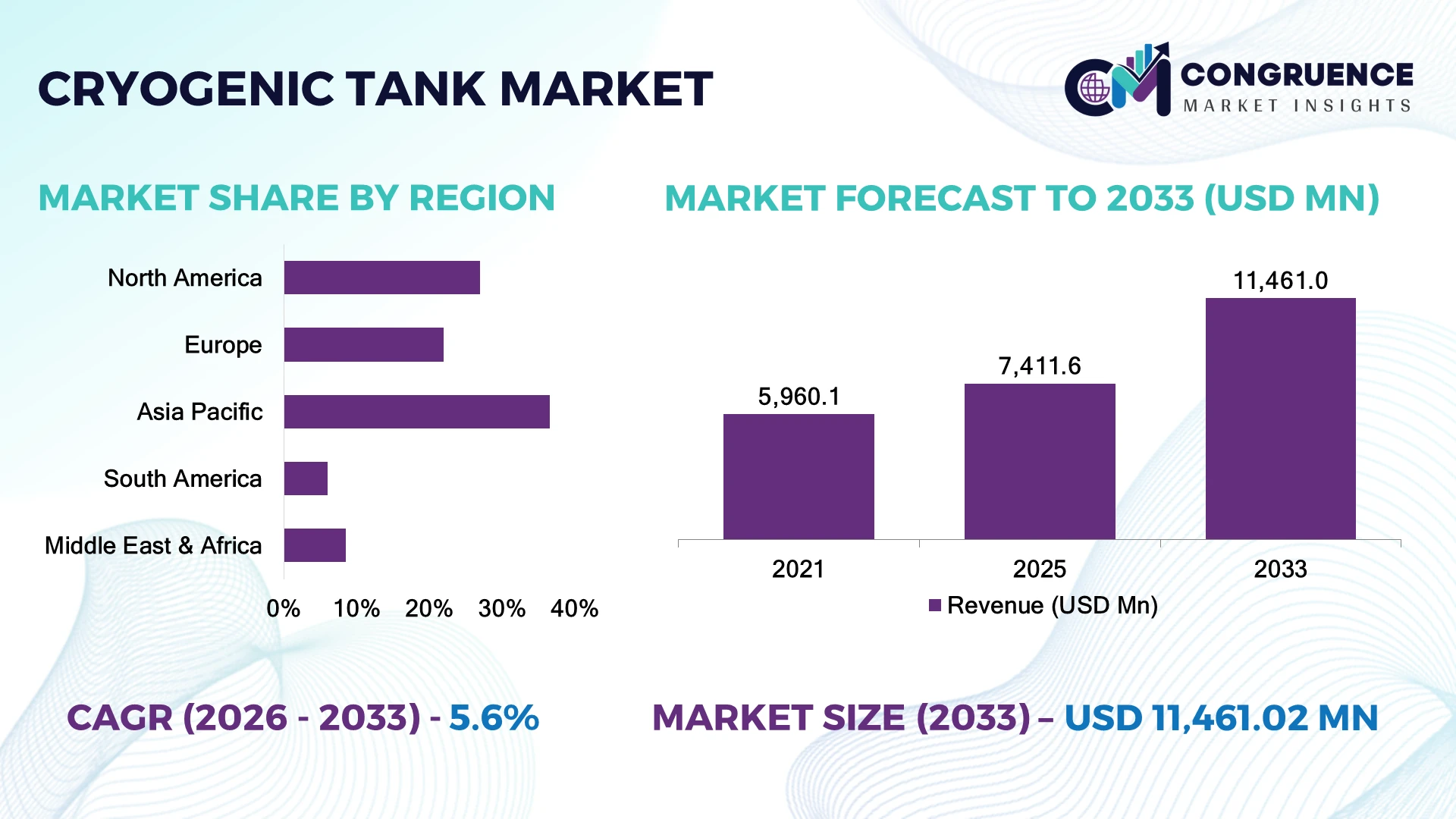
China remains a dominant manufacturing hub, supported by extensive LNG infrastructure, industrial-gas production, and hydrogen-equipment investment; its cryogenic equipment ecosystem benefits from integrated stainless-steel fabrication and component supply. The United States combines large LNG infrastructure with aerospace and hydrogen applications, while India is accelerating gas-network and clean-energy investment. Modern vacuum-insulated tanks can achieve boil-off rates below 0.1% per day in large configurations, strengthening lifecycle economics.
The strategic priority is to invest in manufacturers combining low-loss insulation, scalable fabrication, and hydrogen/LNG-ready engineering.
Market Size & Growth: USD 7.41 billion in 2025 to USD 11.46 billion by 2033 at a 5.6% CAGR, driven by LNG, hydrogen, and industrial-gas infrastructure.
Top Growth Drivers: LNG infrastructure 34%; industrial gases 27%; hydrogen applications 18%.
Short-Term Forecast: By 2028, advanced insulation can reduce boil-off losses by 10–20% versus conventional configurations.
Emerging Technologies: Vacuum insulation, multilayer insulation, aerogel barriers, digital monitoring, and hydrogen-compatible materials are reshaping tank design.
Regional Leaders: Asia-Pacific approaches USD 4.0 billion; North America about USD 3.0 billion; Europe approximately USD 2.5 billion, led by LNG and hydrogen deployment.
End-User Trends: Industrial-gas and energy operators account for more than 60% of large-capacity deployments, prioritizing uptime and containment performance.
Pilot/Case Example: 2025 cryogenic insulation testing demonstrated approximately 20% lower LNG economic losses using advanced aerogel-based insulation under modeled sloshing conditions.
Competitive Landscape: Leading suppliers include Chart Industries, Linde, Air Liquide, Air Products, and INOX India, competing through engineering depth and thermal-performance differentiation.
Regulatory & ESG Impact: Hydrogen and LNG containment standards increasingly emphasize leak prevention, with improved insulation targeting 10–20% lower product losses.
Investment & Funding: Global LNG and hydrogen infrastructure programs are directing multi-billion-dollar capital toward storage, transportation, and refueling infrastructure.
Innovation & Future Outlook: 2026–2028 priorities center on hydrogen-ready vessels, digital condition monitoring, lightweight insulation, and modular tank systems.
The Cryogenic Tank Market is being reshaped by LNG storage, hydrogen mobility, industrial-gas logistics, and aerospace applications requiring tighter thermal control. Advanced insulation is gaining traction, with selected aerogel configurations demonstrating approximately 7–20% lower boil-off than conventional perlite systems under modeled operating conditions. Supply-chain localization is also strengthening as manufacturers seek greater control over stainless steel, valves, insulation, and pressure-management components.
The market is moving toward modular, digitally monitored, high-efficiency cryogenic tanks capable of handling multiple low-temperature media. Hydrogen projects are increasing the importance of material compatibility, leak detection, vacuum integrity, and repeated thermal cycling, creating new opportunities for specialized tank manufacturers.
Cryogenic tanks are becoming strategically important because energy and industrial-gas supply chains increasingly depend on storing molecules that must remain at extremely low temperatures. LNG terminals, hydrogen refueling networks, semiconductor-gas facilities, aerospace programs, and medical-gas infrastructure are raising requirements for thermal containment, transport efficiency, and reliable pressure management. Geopolitical restructuring of LNG supply chains is also increasing the value of flexible storage capacity.
Technology differentiation is moving beyond conventional vacuum-perlite systems. Advanced aerogel insulation has demonstrated approximately 20% lower modeled economic losses from LNG boil-off than a conventional configuration, while newer multilayer and hybrid insulation systems target improved vacuum retention. North America emphasizes LNG and hydrogen infrastructure, Europe prioritizes decarbonization and hydrogen systems, while Asia-Pacific combines manufacturing scale with rapidly expanding gas infrastructure.
During 2026–2028, manufacturers are expected to prioritize modular fabrication, digital monitoring, hydrogen compatibility, and lower-loss insulation. Large industrial operators are increasingly favoring suppliers capable of engineering tanks, valves, monitoring systems, and maintenance support as an integrated package. Competitive advantage will therefore depend on thermal performance, lifecycle reliability, certification capability, and the ability to scale production without compromising containment quality.
Cryogenic tank demand is accelerating as hydrogen, LNG, industrial gases, and medical oxygen infrastructure require higher-capacity storage with tighter boil-off control. Double-wall vacuum-insulated systems can reduce thermal losses by roughly 15–25% versus older configurations, while automated pressure monitoring is improving operating consistency by 10–15%. In the United States, hydrogen-hub development and LNG infrastructure expansion are strengthening demand for engineered storage systems. European energy-security policies are also sustaining LNG-related investment despite diversification away from Russian pipeline gas. Manufacturers are responding with modular tank designs, advanced insulation, digital instrumentation, and localized fabrication. The strategic advantage is shifting toward suppliers that combine low heat ingress, faster commissioning, and lifecycle monitoring rather than competing on vessel price alone.
Cryogenic tank economics remain exposed to stainless-steel, nickel-alloy, insulation, and specialized fabrication costs, with material inputs often representing 30–45% of project expenditure. Engineering-intensive tanks can also carry installation and certification costs 10–20% above standardized pressure-vessel systems. In India and Southeast Asia, limited availability of highly specialized cryogenic fabrication capacity can extend procurement schedules by 8–15%. Stringent pressure, welding, vacuum, and transport requirements further increase qualification expenditure. These constraints directly compress project margins and favor suppliers with established manufacturing ecosystems. Leading manufacturers are mitigating exposure through long-term metal contracts, dual sourcing, modular fabrication, and regional assembly. The non-obvious pressure point is not tank availability alone; it is the ability to synchronize certified fabrication, insulation quality, logistics, and commissioning without creating costly project delays.
Digital cryogenic tanks create a higher-value opportunity by combining pressure, temperature, vacuum, and inventory sensing with predictive maintenance. Remote monitoring can reduce manual inspection requirements by approximately 20–30%, while predictive analytics can improve abnormal-condition detection by 15–25%. Hydrogen infrastructure presents an especially attractive niche as liquid-hydrogen storage increasingly requires tighter thermal management and automated safety controls. In Japan and South Korea, compact storage configurations are gaining relevance where land efficiency and high utilization matter. Manufacturers are therefore investing in sensor-integrated vessels, digital twins, advanced multilayer insulation, and standardized modular platforms. Companies that package tanks with monitoring software and service contracts can capture recurring operational value beyond equipment sales. The strongest opportunity lies in converting cryogenic storage from a passive asset into a continuously optimized infrastructure component.
Scaling cryogenic tank deployment requires integration across refrigeration, transfer pumps, valves, instrumentation, safety systems, and facility controls, making commissioning substantially more complex than conventional storage. Automated monitoring can involve 20–30% more instrumentation points, increasing integration and cybersecurity requirements. Hydrogen installations face additional challenges because leakage detection, ventilation, pressure relief, and material compatibility must operate as a coordinated safety architecture. Skilled cryogenic engineering capacity remains uneven, with workforce shortages capable of extending specialized commissioning schedules by 10–15%. Companies must therefore strengthen digital control architectures, technician training, standardized interfaces, and third-party validation. The strategic challenge is achieving repeatable deployment without sacrificing safety performance: suppliers that reduce integration complexity through pre-engineered modules and interoperable control packages will gain an advantage as projects become larger and more technologically connected.
Smart Monitoring Moves Onsite: Connected pressure, temperature, vacuum, and level sensors are moving from premium installations toward mainstream cryogenic storage, with digital monitoring penetration estimated near 30–40% of new advanced systems. Predictive alerts can reduce manual inspection activity by 20–25%, improving asset utilization and response speed. Manufacturers are integrating edge analytics and remote dashboards directly into tank packages, making lifecycle service a stronger competitive differentiator.
Vacuum Insulation Gets More Precise: Manufacturers are improving multilayer insulation, vacuum integrity, and thermal barriers to curb product loss. Newer configurations can deliver approximately 15–25% lower heat ingress than conventional insulated designs, while improved vacuum diagnostics shorten maintenance interventions by nearly 10–15%. U.S. hydrogen and LNG projects are accelerating specification of high-performance vessels, pushing suppliers toward tighter fabrication tolerances and automated quality inspection.
Hydrogen Changes Tank Design: Liquid-hydrogen applications are forcing greater attention to material compatibility, pressure cycling, boil-off management, and compact footprint. Hydrogen-oriented designs are incorporating roughly 10–20% more instrumentation than conventional industrial-gas tanks, increasing monitoring capability but also integration complexity. Companies are responding with modular storage packages, advanced sensors, and dedicated engineering partnerships as hydrogen hubs move from demonstration planning toward infrastructure deployment.
Modular Fabrication Gains Ground: Standardized cryogenic tank platforms are increasingly replacing heavily customized configurations where project repetition supports faster procurement and installation. Modular approaches can reduce fabrication and assembly time by approximately 15–25%, particularly for distributed industrial-gas and LNG applications. Manufacturers are expanding regional fabrication and pre-engineered packages to manage supply-chain volatility, while buyers increasingly prioritize commissioning speed alongside vessel specifications.
Horizontal cryogenic tanks remain the leading type, accounting for approximately 55% of global demand, supported by high-volume storage, stable installation geometry, simplified loading access, and compatibility with industrial gas and LNG infrastructure. Their established fabrication ecosystem keeps lifecycle costs roughly 10–15% lower than highly customized configurations in comparable capacity ranges. Vertical tanks represent about 30%, with stronger adoption where land availability is constrained, particularly in Japan, South Korea, and dense Indian industrial clusters. Mobile tanks account for the remaining share but are the fastest-growing type, driven by decentralized LNG distribution, medical-gas logistics, and remote industrial operations. Their demand is rising approximately 8–10% annually in application volumes, reflecting greater preference for flexible supply models.
Manufacturers are increasingly balancing standardized horizontal platforms with compact vertical and mobile designs. The investment priority is shifting toward modular vessels, lightweight construction, enhanced vacuum insulation, and integrated monitoring rather than simply increasing tank capacity.
A 2025 market assessment identified horizontal tanks as the dominant configuration because of their stability, installation flexibility, and suitability for bulk cryogenic storage, while vertical tanks were identified as the faster-expanding configuration in space-constrained facilities.
Storage dominates cryogenic tank demand at approximately 62%, reflecting the concentration of permanent LNG, industrial-gas, healthcare, and manufacturing installations requiring continuous onsite inventory. Storage demand is particularly strong because fixed tanks reduce replenishment frequency and provide tighter control over supply continuity. Transportation represents roughly 38% but is the faster-growing application, with deployment expanding around 8–10% as LNG distribution, medical-gas delivery, and decentralized industrial-gas networks become more geographically dispersed. Transportation systems increasingly require advanced insulation, pressure monitoring, and lightweight construction to control product losses during transit.
The mature storage segment is shifting toward higher-capacity automated installations, while transportation is moving toward modular and trailer-integrated systems. Companies are expanding transport portfolios, regional assembly, and fleet partnerships while adding telemetry to improve utilization. The business implication is significant: storage remains the volume anchor, but transportation is becoming the flexibility layer that enables cryogenic supply chains to penetrate smaller and remote consumption points.
A 2025 industry assessment placed storage at approximately 61.8% of cryogenic tank demand, citing LNG terminals, hospitals, and industrial plants as major sources of sustained storage requirements.
Energy & power represents the largest end-user group at approximately 40–45% of cryogenic tank demand, reflecting LNG import, export, regasification, and industrial fuel infrastructure. Its large-capacity projects create substantially higher tank requirements than smaller healthcare or laboratory installations. Industrial manufacturing and chemicals together account for roughly 30%, supported by continuous nitrogen, oxygen, argon, and other cryogenic-gas consumption. Healthcare is the fastest-expanding end-user cluster, with demand increasing approximately 7–9% as hospitals, biotechnology facilities, and medical-gas networks expand. Food and beverage, metallurgy, electronics, and other users remain strategically important niche consumers.
Buying behavior is also changing. Energy companies prioritize capacity, boil-off performance, and project integration, whereas healthcare and electronics customers emphasize reliability, footprint, monitoring, and uninterrupted supply. Manufacturers are responding with application-specific engineering, service contracts, local partnerships, and standardized modular systems. Future competitive positioning will increasingly depend on serving specialized operating requirements rather than selling a uniform tank platform.
A 2026 cryogenic-equipment assessment reported the oil and gas segment at 44.84% of end-user demand, reinforcing the concentration of large-scale cryogenic equipment requirements around LNG and energy infrastructure.
Asia Pacific accounted for the largest market share at 36.5% in 2025 moroover, Asia Pacific is also expected to register the fastest growth, expanding at a CAGR of 7.2% between 2026 and 2033.
LNG Scale and Hydrogen Infrastructure Reshape Tank Demand
North America represented approximately 26–30% of global cryogenic tank demand in 2025, supported by U.S. LNG export infrastructure, industrial-gas networks, healthcare facilities, and emerging hydrogen projects. Deployment is concentrated along the U.S. Gulf Coast, where large LNG terminals require high-capacity storage and increasingly sophisticated boil-off management. The United States is also strengthening domestic cryogenic manufacturing for LNG and hydrogen applications, reducing dependence on extended international supply chains. By 2028, U.S. liquefaction capacity is projected at around 21.2 Bcf/d, reinforcing requirements for storage and transfer equipment. Manufacturers are responding through capacity expansion, modular tank platforms, and integrated monitoring systems.
United States Market Outlook: The United States remains the region's strategic anchor because of its LNG export ecosystem, advanced pressure-vessel manufacturing, and hydrogen infrastructure development. Gulf Coast concentration gives suppliers proximity to major terminal projects and established engineering contractors. The country's expanding industrial-gas and semiconductor ecosystem also supports smaller, high-specification cryogenic systems, creating a diversified demand base beyond LNG.
Energy Security Accelerates Storage Modernization
Europe accounted for approximately 22–26% of global cryogenic tank demand in 2025, with Germany, France, Italy, and the United Kingdom driving deployment across LNG, industrial gases, healthcare, and hydrogen infrastructure. Germany is particularly important because its LNG import infrastructure reached approximately 15 billion cubic meters of annual terminal capacity in 2025, with planned expansion toward 25 billion cubic meters by 2027. This infrastructure shift is sustaining demand for storage, transfer, and regasification equipment despite efficiency pressure on conventional gas assets. European manufacturers are emphasizing lower boil-off, digital diagnostics, and hydrogen-compatible materials, while buyers increasingly favor flexible equipment capable of serving multiple cryogenic applications.
Germany Market Outlook: Germany offers the strongest combination of LNG infrastructure, industrial-gas consumption, engineering capability, and energy-security investment. Four FSRU locations were operating in regular service, while additional land-based terminals were progressing. This installed infrastructure creates recurring demand for tank upgrades, maintenance, instrumentation, and replacement equipment rather than relying exclusively on new-build projects.
China-Led Manufacturing Scale Drives Capacity Expansion
Asia-Pacific held approximately 36.5% of global cryogenic tank demand in 2025, making it the largest regional market. China accounts for a substantial portion of regional deployment, supported by LNG terminals, industrial gases, petrochemicals, electronics, and healthcare. China commissioned a 270,000-cubic-meter LNG storage tank in 2025, demonstrating the region's movement toward ultra-large storage configurations and domestic engineering capability. India, Japan, and South Korea are simultaneously expanding LNG, hydrogen, semiconductor, and medical-gas infrastructure. Manufacturers are responding with localized fabrication, larger standardized vessels, and advanced insulation technologies. The strategic advantage is shifting toward suppliers capable of combining scale manufacturing with application-specific engineering.
China Market Outlook: China is the region's most strategically significant country because of its extensive LNG infrastructure and domestic tank-engineering capabilities. In 2025, five new bonded LNG storage tanks entered operation, while national bonded LNG storage reached approximately 2.8 million cubic meters. The successful deployment of the 270,000-cubic-meter CNOOC tank further demonstrates domestic capability in ultra-large cryogenic storage, strengthening local supplier competitiveness.
LNG Flexibility and Industrial Gas Networks Expand
South America represented roughly 6% of global cryogenic tank demand in 2025, with Brazil accounting for the largest share because of its LNG import infrastructure, industrial-gas consumption, healthcare network, and expanding energy system. Demand is concentrated around coastal terminals and major industrial corridors, where cryogenic storage supports flexible gas procurement and uninterrupted industrial supply. Brazil's LNG infrastructure increasingly requires equipment capable of handling variable import volumes rather than only large baseload operations. Suppliers are therefore emphasizing modular tanks, transport-compatible systems, and integrated monitoring. The region still faces uneven pipeline connectivity and specialized fabrication capacity, which encourages international manufacturers to partner with local engineering and service providers. This favors companies offering turnkey installation, maintenance, and localized technical support rather than standalone tank supply.
Brazil Market Outlook: Brazil provides the strongest addressable market because its industrial base and LNG infrastructure are concentrated around major coastal and metropolitan hubs. The country is particularly attractive for suppliers targeting flexible LNG storage and industrial-gas applications, where modular systems can address infrastructure constraints more effectively than large fixed installations. Local partnerships and service networks remain important competitive differentiators.
LNG Expansion and Industrial Diversification Drive Investment
Middle East & Africa contributed approximately 8% of global cryogenic tank demand in 2025, led by Qatar, Saudi Arabia, the UAE, and South Africa. LNG infrastructure remains the dominant deployment base, while hydrogen, petrochemicals, healthcare, and industrial-gas projects are broadening demand. Qatar's North Field expansion increased LNG production capacity from 77 million tonnes per annum to 110 million tonnes, alongside new LNG storage tanks and terminal infrastructure. Saudi Arabia and the UAE are simultaneously developing lower-carbon industrial ecosystems, creating requirements for hydrogen-compatible storage and specialized cryogenic equipment. Suppliers are responding through regional partnerships, project-specific engineering, and local service capabilities. The market's strategic differentiator is increasingly the ability to support large energy projects while adapting equipment for emerging hydrogen applications.
Qatar Market Outlook: Qatar remains the region's most strategically significant country because of its exceptional LNG infrastructure concentration and large-scale storage requirements. The North Field expansion includes three LNG storage tanks alongside additional LNG trains and berths, reinforcing demand for high-capacity cryogenic systems. Equipment suppliers with proven ultra-large LNG tank engineering, commissioning, and maintenance capabilities are best positioned to participate in this project ecosystem.
Chart Industries, Linde, Air Products, Air Liquide, and INOX India compete at the premium global end, while CIMC ENRIC, Cryofab, FIBA Technologies, Wessington Cryogenics, and other regional manufacturers compete through customization and cost efficiency. The top five players collectively command approximately 35% of the broader cryogenic-equipment market, indicating a moderately concentrated structure. Competition centers on technology, supply reliability, customization, and project execution, with advanced insulation and monitoring delivering roughly 10–20% efficiency advantages over conventional configurations. Global leaders are expanding manufacturing footprints and integrating tanks with liquefaction, distribution, and service capabilities, while Asian suppliers leverage localized production to improve cost competitiveness. The competitive shift is toward vertically integrated, hydrogen-ready platforms and larger LNG systems. Certification, precision fabrication, safety engineering, and capital-intensive manufacturing remain major entry barriers. Winning suppliers must combine proven cryogenic performance with faster delivery, localized service, modular customization, and integrated lifecycle support.
Chart Industries, Inc.
Linde plc
Air Liquide
Air Products and Chemicals, Inc.
INOX India Limited
CIMC ENRIC Holdings Limited
Air Water Inc.
Cryofab, Inc.
FIBA Technologies, Inc.
Wessington Cryogenics
Cryolor
Taylor-Wharton
SURETANK
ISISAN A.Ş.
Cryogenic tank technology is shifting from conventional vacuum-insulated vessels toward higher-performance multilayer insulation, advanced vacuum monitoring, and sensor-integrated pressure management. Multilayer insulation can achieve thermal conductivity near 0.01 W/m·K under high vacuum, while improved insulation configurations can reduce boil-off losses by roughly 10–20% versus less optimized systems. Adoption is strongest in LNG, industrial gases, and hydrogen installations where product loss directly affects operating economics. Companies are increasingly integrating temperature, pressure, vacuum, and inventory sensors for continuous condition monitoring.
Liquid-hydrogen storage is becoming a critical technology frontier. Linde offers customer-site liquid-hydrogen tanks from 3,000 to more than 100,000 liters, while its liquefaction technology spans capacities from 0.25 to more than 34 tonnes per day. Compared with gaseous hydrogen storage, liquefaction substantially improves volumetric efficiency, while modern monitoring reduces manual intervention and improves operational visibility. This favors suppliers combining tank engineering with liquefaction, transfer, and control capabilities.
Between 2026 and 2028, digital twins, predictive maintenance, automated vacuum diagnostics, advanced aerogel or hybrid insulation, and modular hydrogen storage will increasingly influence procurement. Digitized systems can reduce inspection requirements by approximately 20% and improve fault detection by 15–25%. Chart Industries and other vertically integrated suppliers benefit from combining vessels with process equipment and controls. The immediate priority is technology standardization: buyers increasingly want interoperable tanks that can be monitored remotely, adapted to new cryogenic fluids, and serviced without extensive plant shutdowns.
November 2024 — INOX India secured a Highview Power contract for five 690-kL vertical vacuum-insulated tanks for a liquid-air energy-storage facility in Manchester. The project represents five large-scale vessels and expands cryogenic tanks into commercial clean-energy storage. Source: INOXCVA
2025 — INOX India received IATF 16949 certification for cryogenic fuel-tank manufacturing, becoming India’s first cryogenic equipment manufacturer to achieve the automotive quality standard. The certification strengthens its positioning for high-volume mobility applications and OEM-linked supply programs. Source: INOXCVA
2025 — CIMC ENRIC completed a critical roof-lifting milestone for the second 150,000-m³ cryogenic concrete full-capacity LNG tank at Zhejiang Jiahua Energy. The project demonstrates execution capability for ultra-large storage infrastructure and reinforces its position in China’s LNG construction ecosystem. Source: CIMC ENRIC
2025–2026 — CIMC ENRIC expanded integrated LNG and hydrogen infrastructure offerings, including stations equipped with 12 hydrogen storage tanks and 2 LNG storage tanks, supporting hydrogen refueling capacity of 1,000 kg/12 hours and LNG handling of 24,000 Nm³/day. Source: CIMC ENRIC
The Cryogenic Tank Market Report covers the industry across major tank configurations, storage and transportation applications, and key end-user industries including energy, industrial gases, chemicals, healthcare, electronics, food and beverage, and metallurgy. Geographic coverage spans North America, Europe, Asia-Pacific, South America, and the Middle East & Africa, with country-level analysis emphasizing the United States, China, India, Germany, Japan, South Korea, Brazil, and Qatar.
The report evaluates established LNG and industrial-gas storage alongside emerging liquid-hydrogen, clean-energy storage, and decentralized cryogenic distribution applications. It examines vacuum insulation, multilayer insulation, digital monitoring, modularization, and hydrogen-compatible technologies, alongside competitive positioning of 10+ major companies. The analysis supports investment planning, manufacturing expansion, partnership decisions, market-entry strategy, technology prioritization, and competitive positioning through 2026–2033.
| Report Attribute/Metric | Report Details |
|---|---|
|
Market Revenue in 2025 |
USD 7,411.6 Million |
|
Market Revenue in 2033 |
USD 11,461.0 Million |
|
CAGR (2026 - 2033) |
5.6% |
|
Base Year |
2025 |
|
Forecast Period |
2026 - 2033 |
|
Historic Period |
2021 - 2025 |
|
Segments Covered |
By Type
By Application
By End-User
|
|
Key Report Deliverable |
Revenue Forecast, Growth Trends, Market Dynamics, Segmental Overview, Regional and Country-wise Analysis, Competition Landscape |
|
Region Covered |
North America, Europe, Asia-Pacific, South America, Middle East, Africa |
|
Key Players Analyzed |
Chart Industries, Inc., Linde plc, Air Liquide, Air Products and Chemicals, Inc., INOX India Limited, CIMC ENRIC Holdings Limited, Air Water Inc., Cryofab, Inc., FIBA Technologies, Inc., Wessington Cryogenics, Cryolor, Taylor-Wharton, SURETANK, ISISAN A.Ş. |
|
Customization & Pricing |
Available on Request (10% Customization is Free) |




