
Reports
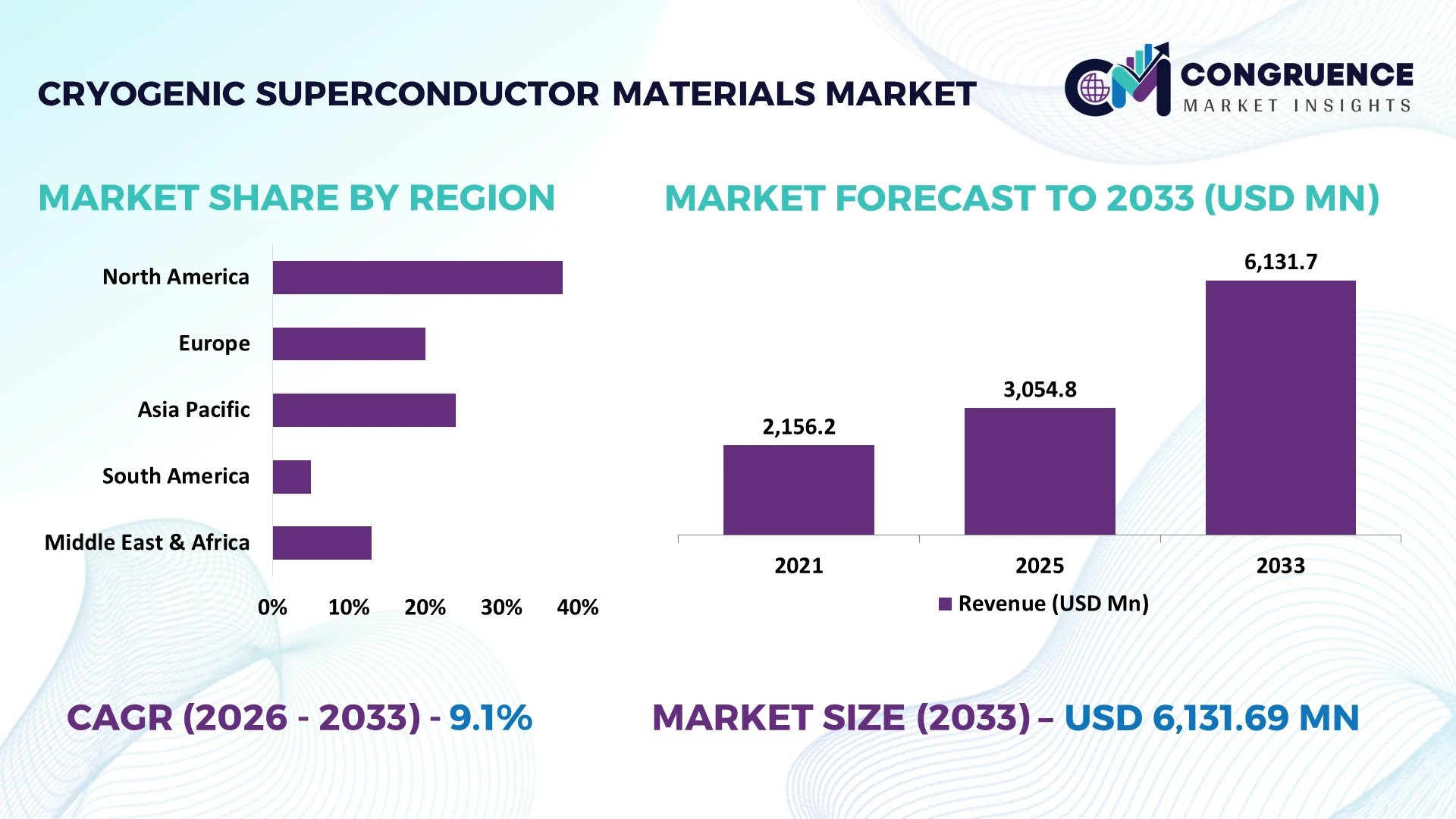
The Global Cryogenic Superconductor Materials Market was valued at USD 3054.8 Million in 2025 and is anticipated to reach a value of USD 6131.69 Million by 2033 expanding at a CAGR of 9.1% between 2026 and 2033. Growth is driven by superconducting MRI magnet deployment, fusion reactor construction, quantum computing infrastructure, and adoption of Nb3Sn and REBCO conductors for higher magnetic field applications.
The United States represents a major demand center, supported by more than 13,000 MRI systems, expanding fusion programs, particle physics infrastructure, and quantum technology investment. China provides the strongest competitive comparison, with domestic superconducting material capacity expanding alongside its fusion and medical imaging programs. China supplied about 65% of the NbTi strand required for ITER poloidal field coils, highlighting its growing manufacturing position. The United States committed USD 134 million to fusion research initiatives in 2025, reinforcing the geopolitical competition surrounding advanced magnet technology and strategic superconducting supply chains.
Material suppliers with scalable NbTi, Nb3Sn, and REBCO production capabilities are positioned to capture higher value procurement as healthcare, fusion, quantum, and scientific systems transition toward stronger magnetic fields.
Market Size & Growth: USD 3054.8 million in 2025 is projected to reach USD 6131.69 million by 2033 at 9.1% CAGR, driven by superconducting MRI systems, fusion magnets, quantum infrastructure, and advanced scientific equipment.
Top Growth Drivers: Superconducting wires represented about 45% of material demand, while MRI expansion, fusion investment, and high field magnet deployment remain the three strongest commercialization drivers.
Short Term Forecast: By 2028, advanced Nb3Sn deployment will strengthen as accelerator magnets increase operating fields from about 8.3 tesla with conventional NbTi systems to around 11.3 tesla.
Emerging Technologies: REBCO coated conductors, Nb3Sn magnets, and MgB2 systems are reshaping cryogenic applications, with advanced HTS fusion magnet demonstrations reaching magnetic fields of 20 tesla.
Regional Leaders: North America maintains strong healthcare and fusion adoption, Asia Pacific is expanding superconducting manufacturing capacity, and Europe is advancing accelerator infrastructure through multibillion dollar scientific programs.
Consumer/End User Trends: Medical imaging remains a critical application base, with superconducting MRI systems representing more than 90% of MRI installations in China during 2024.
Pilot/Case Example: In 2024, China advanced CFETR magnet development with a model coil operating at 48 kA and 12 tesla, demonstrating industrial readiness for large fusion magnet systems.
Competitive Landscape: Bruker Energy & Supercon Technologies holds about 6% market share, while American Superconductor, Sumitomo Electric Industries, SuperPower, and SuperOx strengthen competition across advanced superconducting conductor technologies.
Regulatory & ESG Impact: Helium conservation is reshaping MRI magnet design, with Philips BlueSeal architecture requiring only 7 liters of helium compared with roughly 1,500 liters in conventional systems, reducing helium requirements by more than 99%.
Investment & Funding: The United States announced USD 107 million for six fusion research collaborations in 2025, strengthening domestic magnet development, superconducting material qualification, and associated advanced manufacturing capabilities.
Innovation & Future Outlook: CERN accelerator upgrades are moving superconducting magnets toward fields above 11 tesla, while next generation HTS fusion systems target 20 tesla, increasing strategic emphasis on conductor performance and manufacturing scalability.
Cryogenic superconductor materials are increasingly critical across MRI systems, fusion energy, particle accelerators, quantum computing, and specialized power infrastructure. NbTi remains the established material for mature cryogenic magnet applications, while Nb3Sn and REBCO are gaining adoption where higher magnetic fields and current density justify advanced manufacturing. Next generation accelerator magnets are moving beyond 11 tesla, representing more than 30% higher field capability than established 8.3 tesla NbTi systems. At the same time, helium supply constraints are accelerating sealed magnet architectures and efficient cryogenic technologies, shifting procurement priorities toward material performance, scalable production, and secure superconducting supply chains.
HTS Magnets Enter Industrial Scaling: Fusion developers are moving REBCO based high temperature superconducting magnets from demonstration into repeatable manufacturing. Commonwealth Fusion Systems validated a 20 tesla magnet storing 110 MJ, while its full scale SPARC magnets are entering production. Partnerships with Type One Energy and Realta Fusion are extending this technology into stellarator and mirror configurations, shifting suppliers toward higher throughput conductor qualification, automated winding, and dedicated magnet manufacturing capacity.
Nb3Sn Moves Into Series Production: Accelerator programs are converting Nb3Sn from specialized development into qualified production. CERN’s HL LHC quadrupoles operate at an 11.3 tesla conductor peak field with 7.2 meter magnetic length. By September 2026, all 8 installation magnets had qualified, while 70% of new magnet cryo assemblies were completed. Manufacturers are tightening coil fabrication, conductor stress control, and thermal qualification processes to improve production consistency.
Helium Exposure Drives Magnet Redesign: MRI manufacturers are reducing dependence on volatile helium supply chains through sealed cryogenic architectures. Philips BlueSeal systems contain just 7 liters of helium versus roughly 1,500 liters in conventional magnets, cutting inventory requirements by more than 99%. This shift reduces venting infrastructure, installation complexity, and helium replenishment exposure, encouraging equipment manufacturers to integrate low helium superconducting magnets into hospital replacement and expansion programs.
Quantum Cryogenics Becomes Modular: Scaling superconducting quantum processors is forcing cryogenic infrastructure toward modular designs. IBM’s 2026 architecture supports thousands of qubits per cryostat, while connected modules reached 4 kelvin within five days and subsequently cooled below 15 millikelvin. Each enclosure provides up to 12 times more wiring space. Quantum developers are consequently redesigning cryostats around modular processor connectivity, serviceability, and expansion rather than isolated processor capacity.
Niobium Titanium remains the leading material type with an estimated 55% share, reflecting its mature manufacturing base, ductility, predictable fabrication, and extensive integration across MRI and conventional superconducting magnet platforms. Its ability to support magnetic fields around 8 tesla makes NbTi economically attractive for established cryogenic equipment. Niobium Tin occupies a smaller but strategically important position because it supports fields exceeding 11 tesla, directing supplier investment toward accelerator and advanced research magnets.
High Temperature Materials represent the fastest expanding type as REBCO conductors transition into fusion magnet manufacturing and other extreme field applications. Demonstrated HTS magnets have reached 20 tesla, substantially exceeding mature NbTi operating ranges and shifting investment toward tape production, winding technologies, and conductor qualification. Magnesium Diboride is gaining relevance in superconducting links and lower temperature power applications, while Iron Based Materials remain predominantly research focused. Manufacturers are responding through specialized conductor portfolios, production partnerships, and capacity expansion rather than replacing established NbTi lines outright.
MRI Systems remain the leading application, accounting for an estimated 45% of cryogenic superconductor material consumption, supported by a large installed base of superconducting scanners and recurring magnet production. Superconducting Magnets used across laboratory and industrial systems provide another established demand pool. Particle Accelerators increasingly require higher performance conductors, with CERN’s Nb3Sn quadrupoles reaching an 11.3 tesla peak conductor field compared with the 8.33 tesla nominal field of established LHC NbTi magnets.
Fusion Reactors represent the fastest expanding application as developers move from prototype HTS coils toward full scale magnet manufacturing. Commonwealth Fusion Systems demonstrated 20 tesla magnet capability, creating a performance pathway for compact fusion machines and driving REBCO procurement. Quantum Computing is simultaneously increasing demand for materials and components compatible with millikelvin environments, while Power Systems remain selective applications where cryogenic economics determine deployment. Suppliers are adapting through dedicated HTS production, magnet partnerships, improved conductor processing, and tighter integration with cryogenic engineering specialists.
Healthcare remains the largest end user, representing an estimated 45% of material demand because superconducting MRI platforms require dependable magnet conductors, cryogenic stability, and long equipment lifetimes. Hospital procurement increasingly favors lower helium designs: modern sealed systems can operate with 7 liters compared with roughly 1,500 liters in conventional architectures, materially reducing cryogen exposure. Research Institutes remain important buyers through accelerator, high field laboratory, and quantum infrastructure programs.
Nuclear Facilities represent the fastest expanding end user category as fusion developers progress toward larger demonstration machines and commercial plant architectures. Aerospace & Defense organizations continue procuring specialized high field magnet technologies, while Energy Utilities evaluate superconducting materials for advanced power equipment. Semiconductor Industry demand is emerging through quantum computing ecosystems and cryogenic research infrastructure. Suppliers are therefore separating commercial strategies: standardized and serviceable conductors target healthcare, while customized Nb3Sn and REBCO solutions address research and fusion customers through joint engineering, qualification partnerships, and application specific magnet development.
North America accounted for the largest market share at 35% in 2025 however, Asia Pacific is expected to register the fastest growth, expanding at a CAGR of 16.8% between 2026 and 2033. Pasted markdown
Fusion and Quantum Infrastructure Deepen Material Demand
North America holds the leading position at about 35% of the global market, with the United States concentrating superconducting material consumption across MRI equipment, fusion development, quantum computing, particle accelerators, and defense research. The region benefits from established NbTi and HTS technology ecosystems connecting national laboratories, magnet developers, universities, and specialized material manufacturers. The United States accounted for roughly 26% of global market activity in 2024, illustrating its disproportionate purchasing concentration. Private fusion programs are also moving REBCO conductors from laboratory qualification into industrial magnet manufacturing, while national laboratories continue deploying Nb3Sn in accelerator systems. This combination supports specialized suppliers capable of maintaining conductor uniformity, cryogenic reliability, and application specific engineering as customers transition toward higher magnetic field systems.
United States Market Outlook: The United States combines mature MRI infrastructure with rapidly expanding fusion and quantum programs. Commonwealth Fusion Systems demonstrated a 20 tesla HTS magnet, while Department of Energy programs continue funding fusion material and magnet development. Domestic suppliers consequently gain strategic value where procurement requires qualified conductors, engineering collaboration, and secure supply availability.
Accelerator Modernization Anchors Advanced Conductor Deployment
Europe represents an established cryogenic superconductor materials market centered on accelerator infrastructure, fusion research, medical imaging, and advanced magnet engineering. CERN provides a major technology pull for Nb3Sn conductors as the High Luminosity LHC program moves higher field magnets toward operational deployment. The new quadrupoles achieve conductor peak fields around 11.3 tesla, substantially above conventional NbTi based accelerator configurations. ITER related activities reinforce demand for superconducting strands, coils, cryogenic systems, and specialized manufacturing expertise across the European industrial network. Germany, France, Italy, and the United Kingdom maintain capabilities spanning coated conductors, scientific magnets, cryogenic engineering, and research infrastructure. Procurement increasingly favors suppliers capable of documented conductor consistency and long qualification cycles, creating stronger barriers for unproven manufacturers while supporting established specialists with accelerator and fusion references.
Germany Market Outlook: Germany has a strategically important superconducting materials ecosystem spanning HTS coated conductors, accelerator research, medical technology, and cryogenic engineering. THEVA and research organizations support advanced conductor development, while Germany’s participation in European fusion and accelerator programs provides a commercialization pathway for high performance materials beyond traditional MRI centered NbTi applications.
Manufacturing Scale Shifts Toward Advanced Conductors
Asia Pacific accounts for roughly 30% of global superconducting materials activity and is strengthening its position through conductor manufacturing, medical imaging expansion, fusion programs, quantum infrastructure, and magnetic transportation research. China provides the strongest scale advantage, supported by domestic NbTi and Nb3Sn manufacturing and strategic investment in advanced superconducting technologies. Japan contributes established HTS expertise through Sumitomo Electric and other specialized manufacturers, while South Korea maintains significant superconducting research capabilities. China’s EAST fusion program has demonstrated plasma operation beyond 100 million degrees Celsius, reinforcing domestic requirements for high performance magnet technologies. Regional suppliers are increasingly integrating conductor processing, tape manufacturing, magnet engineering, and cryogenic system expertise, reducing dependence on imported technology and creating stronger competition for established Western material producers.
China Market Outlook: China leads regional deployment through fusion research, MRI manufacturing, quantum technology, and domestic conductor production. Its superconducting supply chain supported about 65% of the NbTi strand used for ITER poloidal field coils. This manufacturing depth strengthens China’s ability to combine strategic infrastructure investment with localized material qualification and scalable magnet production.
Healthcare Modernization Shapes Selective Material Adoption
South America remains a smaller but increasingly relevant demand center, with procurement concentrated in MRI infrastructure, university research systems, energy experimentation, and specialized scientific equipment. Brazil dominates regional activity because its healthcare network, research universities, and energy sector support the largest installed base of advanced cryogenic applications. Material demand remains predominantly import dependent, limiting local control over conductor pricing and lead times. Brazil operates more than 6 MRI units per million inhabitants, establishing a meaningful recurring requirement for superconducting magnet maintenance and equipment replacement. Argentina contributes through nuclear and scientific research, while other markets remain dependent on imported finished systems. Suppliers are responding through distributor networks, technical service partnerships, and equipment led market access rather than capital intensive regional conductor manufacturing.
Brazil Market Outlook: Brazil combines the region’s largest healthcare system with established nuclear, accelerator, and energy research capabilities. The Sirius synchrotron operates with 3 GeV electron energy, supporting sophisticated scientific infrastructure that requires advanced magnet technologies. Suppliers able to combine imported superconducting components with local engineering and service coverage hold a stronger procurement position.
Healthcare Investment Expands Cryogenic Equipment Base
Middle East and Africa demand is concentrated around advanced medical imaging, scientific infrastructure, energy research, and emerging quantum technology programs. Saudi Arabia and the UAE are expanding high specification healthcare and research facilities, increasing requirements for superconducting MRI magnets and associated cryogenic systems. South Africa provides the region’s strongest established scientific research base, including accelerator and nuclear research capabilities. Gulf procurement is shifting toward integrated technology partnerships that combine equipment installation, service, training, and long term infrastructure support rather than standalone material purchases. The UAE’s growing quantum research ecosystem and Saudi investment in specialized healthcare infrastructure create additional channels for advanced superconducting technologies. Limited regional conductor manufacturing keeps supply chains import dependent, giving internationally qualified manufacturers and magnet OEMs a structural advantage.
Saudi Arabia Market Outlook: Saudi Arabia is strengthening demand through hospital modernization, research investment, and localization programs under Vision 2030. Healthcare expenditure represents more than 5% of national economic output, supporting continued acquisition of advanced diagnostic systems. Suppliers offering reliable cryogenic service infrastructure alongside superconducting equipment can secure stronger institutional relationships and replacement demand.
Competition centers on Bruker Energy & Supercon Technologies, American Superconductor, Sumitomo Electric Industries, SuperPower, and SuperOx, with established conductor specialists competing against HTS technology innovators for fusion, healthcare, accelerator, and power applications. The top five collectively control 39.7% of the market, while Bruker holds about 6%, leaving meaningful scope for specialized suppliers. Technology performance increasingly outweighs pure price: advanced HTS conductors support magnetic fields exceeding 20 tesla, while conventional NbTi remains commercially attractive around 8 tesla applications. Producers compete through conductor uniformity, customized architectures, manufacturing scale, and qualification partnerships. Sumitomo Electric emphasizes HTS wire expertise, while American Superconductor and SuperPower target high performance coated conductors. Vertical integration is strengthening as manufacturers seek tighter control over substrates, coating, processing, and quality assurance. Qualification cycles, capital intensive manufacturing, material purity, and cryogenic reliability remain decisive entry barriers. Winning requires scalable production combined with proven field performance and application specific engineering.
American Superconductor Corporation
Bruker Energy & Supercon Technologies
Sumitomo Electric Industries
SuperPower
SuperOx
Hyper Tech Research
THEVA Dünnschichttechnik
Western Superconducting Technologies
SAMRI Advanced Material
Sam Dong
Cryomagnetics
Fujikura
Furukawa Electric
Shanghai Superconductor Technology
Niobium titanium remains the commercial technology for MRI and established cryogenic magnets, supported by mature multifilament wire processing and dependable operation near 4 kelvin. Nb3Sn extends practical magnet fields from 8 tesla toward 12 tesla, delivering about 50% higher field capability. Automated cabling, winding, heat treatment, and quality control are improving conductor consistency by 10% while reducing production variability for accelerator and research magnet programs.
REBCO coated conductors are the emerging technology because they operate at higher temperatures and magnetic fields than conventional low temperature superconductors. Demonstrated REBCO fusion magnets have exceeded 20 tesla, representing more than 70% higher field performance than 12 tesla Nb3Sn systems. Adoption is moving from prototypes toward industrial deployment, with automated tape deposition, no insulation winding, and modular cryogenic integration enabling compact fusion, power, and quantum infrastructure.
Between 2026 and 2028, scalable REBCO manufacturing, improved Nb3Sn architectures, and MgB2 current links will reshape procurement priorities. HTS systems operating around 20 kelvin reduce refrigeration intensity versus 4 kelvin platforms, improving cryogenic efficiency by over 30% in suitable designs. Suppliers controlling substrate quality, coating uniformity, conductor testing, and magnet integration gain the strongest competitive advantage as buyers prioritize higher current density, compact equipment, and qualified production capacity.
September 2026 Bruker Energy & Supercon Technologies and Luvata formed a strategic collaboration to expand RRP Nb3Sn superconductor capacity for fusion magnets operating across 12 to 20 tesla, strengthening industrial supply resilience for demonstration and first commercial plants.
November 2025 Tokamak Energy validated its Demo4 REBCO magnet system at 11.8 tesla and seven million ampere turns, proving integrated HTS performance under fusion relevant conditions and advancing commercial magnet engineering beyond isolated coil demonstrations today.
June 2025 Fujikura and Kyoto Fusioneering completed Phase One of UKAEA’s STEP magnet program, fabricating seven HTS prototype coils whose current carrying performance matched simulations, validating REBCO manufacturing consistency for next generation fusion magnet engineering.
January 2024 China’s Institute of Plasma Physics energized an REBCO magnet to 26.8 tesla, surpassing the previous 26.4 tesla record using Shanghai Superconductor tape, strengthening China’s position in superconducting material commercialization.
The report evaluates cryogenic superconductor materials across Niobium Titanium, Niobium Tin, Magnesium Diboride, High Temperature Materials, and Iron Based Materials, alongside MRI Systems, Particle Accelerators, Fusion Reactors, Quantum Computing, Superconducting Magnets, and Power Systems. Coverage extends across Healthcare, Research Institutes, Nuclear Facilities, Aerospace & Defense, Energy Utilities, and the Semiconductor Industry, with analysis spanning North America, Europe, Asia Pacific, South America, and Middle East & Africa.
Strategic assessment examines conductor performance, cryogenic integration, manufacturing scalability, material qualification, supply security, and competitive positioning. NbTi currently anchors mature magnet deployment, while REBCO systems exceeding 20 tesla signal accelerating investment in compact fusion and advanced research magnets. The report maps adoption shifts, regional production capabilities, emerging HTS applications, company strategies, and technology transitions to support investment planning, capacity expansion, partnership selection, competitive benchmarking, and market direction through 2033.
| Report Attribute/Metric | Report Details |
|---|---|
Market Revenue in 2025 | USD 3054.8 Million |
Market Revenue in 2033 | USD 6131.69 Million |
CAGR (2026 - 2033) | 9.1% |
Base Year | 2025 |
Forecast Period | 2026 - 2033 |
Historic Period | 2021 - 2025 |
Segments Covered | By Type
By Application
By End-User
|
Key Report Deliverable | Revenue Forecast, Growth Trends, Market Dynamics, Segmental Overview, Regional and Country-wise Analysis, Competition Landscape |
Region Covered | North America, Europe, Asia-Pacific, South America, Middle East, Africa |
Key Players Analyzed | American Superconductor Corporation, Bruker Energy & Supercon Technologies, Sumitomo Electric Industries, SuperPower, SuperOx, Hyper Tech Research, THEVA Dünnschichttechnik, Western Superconducting Technologies, SAMRI Advanced Material, Sam Dong, Cryomagnetics, Fujikura, Furukawa Electric, Shanghai Superconductor Technology |
Customization & Pricing | Available on Request (10% Customization is Free) |




