
Reports
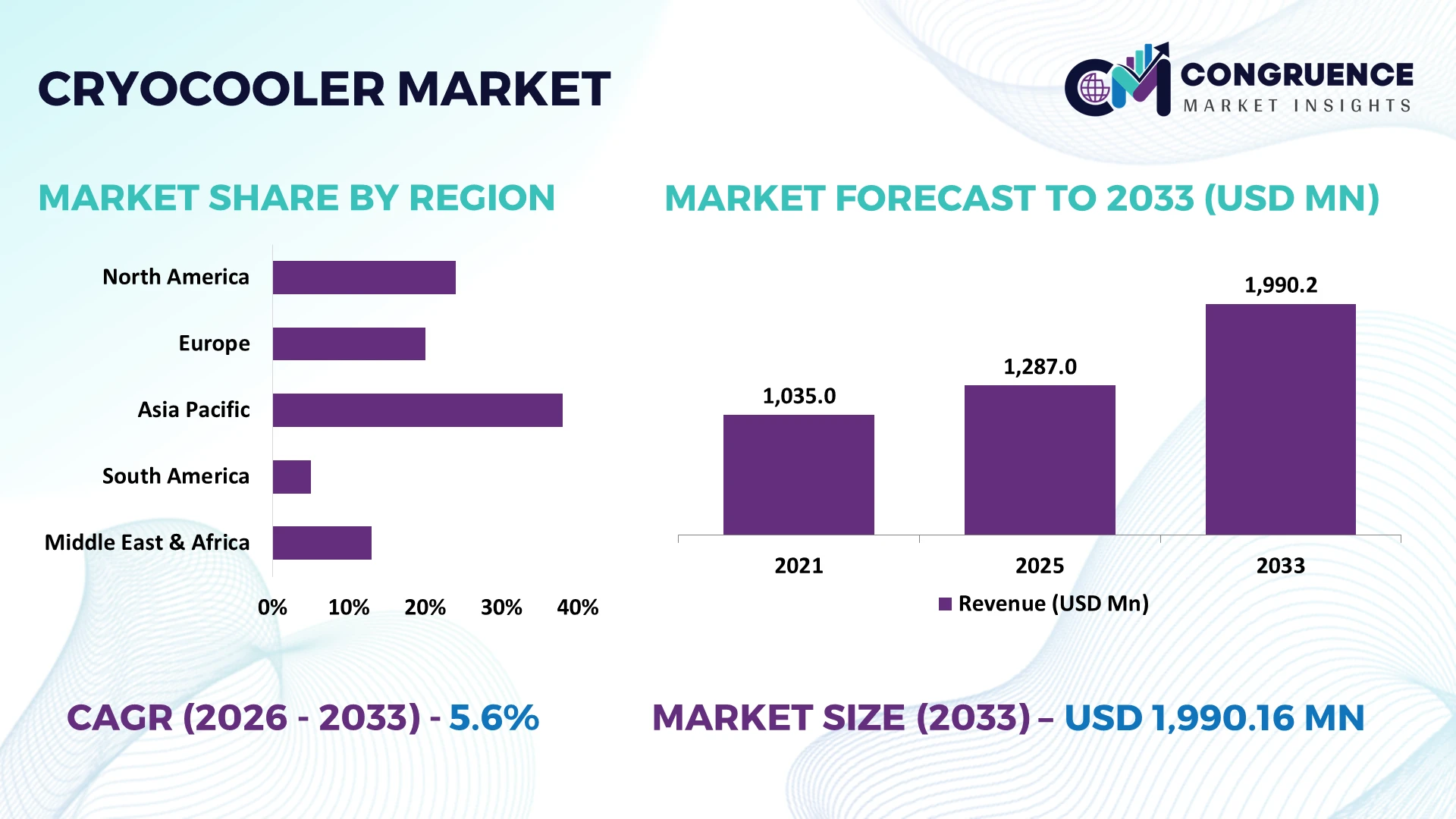
The Global Cryocooler Market was valued at USD 1287 Million in 2025 and is anticipated to reach a value of USD 1990.16 Million by 2033 expanding at a CAGR of 5.6% between 2026 and 2033. Growth is primarily supported by rising deployment of infrared imaging systems, quantum computing infrastructure, satellite payloads, superconducting technologies, and advanced medical diagnostics requiring reliable low-temperature cooling.
The United States remains the dominant country, accounting for approximately 34% of global cryocooler demand, supported by sustained defense modernization, space exploration, semiconductor research, and quantum technology investments. More than 65% of advanced infrared defense platforms integrate compact cryocoolers, while Japan strengthens precision manufacturing with over 18% higher production efficiency in miniature cryogenic systems. The expanding strategic competition in space and defense programs across major economies continues to accelerate technology adoption and localized manufacturing.
Manufacturers should prioritize high-performance, energy-efficient cryocooler platforms and regional production capabilities to strengthen long-term competitiveness in defense, aerospace, healthcare, and advanced electronics markets.
Market Size & Growth: USD 1287 Million in 2025, reaching USD 1990.16 Million by 2033 at a 5.6% CAGR, driven by expanding quantum computing and advanced defense applications.
Top Growth Drivers: Defense demand contributes about 32%, aerospace 27%, and semiconductor manufacturing 21% of incremental market expansion.
Short-Term Forecast: By 2028, next-generation systems improve cooling efficiency by 14% while reducing power consumption by nearly 10%.
Emerging Technologies: AI-enabled monitoring, pulse tube cryocoolers, and advanced lightweight materials improve operational reliability by approximately 18%.
Regional Leaders: North America exceeds USD 700 Million, Asia-Pacific approaches USD 610 Million, and Europe surpasses USD 420 Million, supported by regional manufacturing expansion and localized supply chains.
Consumer/End-User Trends: More than 58% of new aerospace and defense thermal imaging platforms integrate compact high-performance cryocoolers.
Pilot/Case Example: During 2026, advanced cryogenic integration programs improved mission-system reliability by approximately 16% in aerospace testing environments.
Competitive Landscape: Leading manufacturers collectively hold around 48% market share, with key participants including Sumitomo Heavy Industries, Thales, Ricor, Cryomech, and Northrop Grumman.
Regulatory & ESG Impact: High-efficiency system designs reduce operational energy use by nearly 12% while supporting stricter environmental compliance standards.
Investment & Funding: More than USD 1.2 Billion in public and private investments supports advanced manufacturing, defense partnerships, and semiconductor expansion worldwide.
Innovation & Future Outlook: Miniaturized cryogenic platforms, digital diagnostics, and high-reliability space-grade systems accelerate strategic product differentiation across global markets.
The Cryocooler Market is advancing through stronger demand from quantum technologies, satellite payloads, medical imaging, and high-performance infrared sensing applications. Manufacturers are introducing compact, low-vibration systems with efficiency gains exceeding 15%, while localized component sourcing strengthens supply resilience amid evolving geopolitical trade priorities. This technology evolution is reshaping procurement strategies and sets the foundation for the following strategic market discussion.
The Cryocooler Market has become strategically important as governments and industrial manufacturers accelerate investments in quantum technologies, satellite systems, advanced semiconductor fabrication, and high-performance defense electronics. Supply-chain restructuring is driving localization of precision components, reducing dependence on single-country sourcing while strengthening procurement resilience. This shift supports faster product qualification cycles and improved manufacturing continuity for mission-critical cryogenic applications across aerospace, healthcare, and scientific research.
Modern pulse tube cryocoolers deliver approximately 18% higher energy efficiency and up to 22% lower maintenance requirements than conventional Stirling-based legacy platforms in continuous-duty applications, improving lifecycle operating costs. The United States leads large-scale deployment through defense and space programs, while Japan emphasizes compact precision manufacturing and South Korea expands cryogenic infrastructure for semiconductor research. Over the next two to three years, digital monitoring integration is expected to exceed 45% of newly deployed industrial cryocooler systems, improving predictive maintenance and operational uptime.
A practical example is the integration of compact cryocoolers into next-generation infrared surveillance payloads, where reduced vibration improves sensor accuracy and mission reliability. Manufacturers are expanding strategic partnerships with semiconductor equipment suppliers, defense contractors, and research institutions while increasing localized production capacity. Companies that combine high-efficiency engineering, resilient supply networks, and application-specific product development will secure stronger competitive positioning and long-term operational advantage.
The accelerating deployment of cryogenic technologies in defense, quantum computing, and semiconductor manufacturing is reshaping demand for high-performance cryocoolers. More than 62% of newly commissioned infrared surveillance platforms now incorporate compact closed-cycle cooling systems, while advanced semiconductor facilities have improved cryogenic process utilization by approximately 19%. The United States continues expanding defense modernization programs, encouraging domestic sourcing of precision cryogenic components and reducing import dependence. This structural shift increases demand for highly reliable cooling systems with extended operating lifecycles. In response, manufacturers are expanding production capacity, investing in low-vibration platform development, and forming engineering partnerships with aerospace and research organizations. Companies integrating application-specific designs with localized manufacturing gain stronger procurement advantages and faster qualification across strategic industries.
Cryocooler manufacturing remains constrained by dependence on precision compressors, rare specialty materials, and advanced machining capabilities. Critical component lead times have remained nearly 20% above pre-disruption levels in several industrial supply chains, while production costs for specialized alloys fluctuate by approximately 12%. Japan and Germany continue supplying key precision-engineered components, creating concentration risks for global manufacturers during logistics disruptions. These structural constraints increase production planning complexity, delay equipment delivery, and pressure operating margins in long-cycle contracts. Companies are responding through supplier diversification, localized assembly facilities, multi-year procurement agreements, and increased inventory optimization. Firms that strengthen vertical integration and reduce single-source dependency achieve greater operational stability and improved customer delivery performance.
Rapid commercialization of quantum computing, superconducting electronics, and advanced medical imaging is creating high-value opportunities for specialized cryocooler manufacturers. More than 35% of new quantum hardware programs prioritize compact low-vibration cooling solutions, while AI-enabled predictive diagnostics improve equipment availability by nearly 16%. South Korea and Singapore continue expanding advanced research infrastructure, creating demand for precision cryogenic systems supporting next-generation laboratories and semiconductor innovation. Companies are increasing R&D spending, collaborating with quantum hardware developers, and developing digitally connected cryogenic platforms with remote performance analytics. An emerging strategic advantage lies in modular cryocooler architectures that shorten installation time, simplify servicing, and enable faster deployment across multiple high-value industrial applications.
Scaling production while maintaining micron-level manufacturing tolerances remains a critical execution challenge for cryocooler suppliers. Failure rates can increase by approximately 9% when precision assembly consistency declines, while advanced engineering talent shortages exceed 15% across specialized cryogenic manufacturing disciplines in several developed economies. Increasing integration with digital control systems also requires higher software validation and system reliability throughout operational lifecycles. These execution pressures affect deployment consistency, qualification timelines, and long-term customer confidence. Manufacturers must invest in automated precision assembly, workforce development, digital quality inspection, and collaborative engineering partnerships with research institutions. Companies that industrialize advanced manufacturing processes while maintaining stringent reliability standards will strengthen competitive differentiation in mission-critical cryogenic applications.
Digital Monitoring Becomes Standard: Manufacturers are embedding AI-enabled diagnostics and predictive maintenance into cryocoolers, with nearly 46% of newly deployed industrial systems featuring remote health monitoring and uptime improvements of around 15%. Digital workflow integration shortens maintenance cycles by approximately 18%, reducing operational interruptions. In response to higher reliability requirements from defense and semiconductor programs, companies are expanding software partnerships and integrating cloud-based lifecycle management into next-generation cryogenic platforms.
Localized Precision Manufacturing Expansion: Supply-chain restructuring continues to accelerate localized production of compressors and precision-machined components. Domestic sourcing has increased by roughly 21% across strategic manufacturing programs, while average procurement lead times have declined by nearly 14%. The United States and Japan are prioritizing resilient manufacturing ecosystems for critical technologies. Companies are investing in regional production facilities, supplier qualification, and automated inspection systems to improve delivery reliability and reduce dependency on single-country component networks.
Miniaturization Drives Product Innovation: Compact cryocooler platforms are replacing larger legacy systems across satellite payloads, infrared imaging, and portable medical equipment. New-generation designs reduce equipment weight by approximately 17% while lowering vibration levels by nearly 20%, improving imaging accuracy and operational stability. Engineering teams are increasing investment in lightweight materials and modular architectures, enabling faster product integration and lower installation complexity across mission-critical applications.
Application-Specific Platform Development: Customers increasingly demand customized cryogenic solutions rather than standardized equipment, with application-specific configurations representing almost 38% of recent procurement programs. Modular engineering shortens deployment timelines by approximately 16% and improves serviceability across multiple industries. Tightening export controls on advanced technologies have encouraged manufacturers to strengthen collaborative development programs, expand engineering partnerships, and accelerate specialized product portfolios tailored to aerospace, semiconductor, and scientific research requirements.
Stirling cryocoolers remain the leading product category, accounting for approximately 39% of total market deployment due to their proven reliability, compact design, and broad integration across aerospace, infrared imaging, and defense systems. Their mature manufacturing ecosystem and lower lifecycle servicing requirements continue to support large-scale procurement. Pulse Tube cryocoolers represent the fastest-growing segment as demand shifts toward low-vibration and maintenance-friendly solutions for quantum computing and advanced semiconductor applications. Adoption of Pulse Tube technology has increased by nearly 24% in newly commissioned research facilities, reflecting stronger investment in high-precision cooling environments.
Gifford-McMahon systems continue serving scientific laboratories and industrial cryogenic infrastructure where continuous cooling performance remains essential, while Joule-Thomson cryocoolers retain strategic importance in compact defense payloads and portable sensing equipment. Companies are expanding Pulse Tube manufacturing capacity, improving Stirling system efficiency, and strengthening collaborations with research organizations to diversify product portfolios. Investment priorities increasingly favor technologies offering lower operational vibration, improved energy efficiency, and simplified maintenance, supporting broader adoption across mission-critical applications.
Aerospace & Defense remains the largest application, representing approximately 36% of cryocooler deployment because infrared targeting systems, surveillance payloads, satellites, and missile guidance platforms require dependable long-duration cryogenic cooling. Procurement programs continue emphasizing compact systems with high operational reliability, while deployment of advanced thermal imaging equipment has expanded by nearly 18%. Semiconductor Manufacturing is the fastest-growing application as advanced fabrication nodes and quantum hardware require increasingly stable low-temperature operating environments.
Medical Equipment maintains consistent demand through MRI systems and specialized diagnostic technologies, while Scientific Research continues expanding across national laboratories and university-based cryogenic programs. Infrared Imaging also records sustained deployment across industrial inspection, border security, and environmental monitoring applications. Manufacturers are increasing production flexibility, integrating intelligent monitoring capabilities, and strengthening engineering partnerships with aerospace contractors and semiconductor equipment suppliers to address evolving application-specific performance requirements and accelerate product qualification.
Aerospace & Defense represents the dominant end-user group with approximately 35% of total procurement, supported by sustained investment in satellite systems, missile platforms, surveillance equipment, and secure sensing technologies. Mission-critical operating conditions require highly reliable cryogenic cooling, driving long-term equipment replacement and modernization programs. The Semiconductor Industry is the fastest-growing buyer segment, with deployment activity increasing by roughly 23% as manufacturers expand advanced fabrication capacity and invest in quantum computing infrastructure.
Healthcare continues generating stable procurement through MRI and specialized imaging systems, while Research Institutes strengthen demand for precision cryogenic equipment supporting superconductivity and quantum experiments. Industrial Manufacturing increasingly adopts cryocoolers for advanced process control and specialized testing applications. Companies are responding through customized product development, strategic pricing models, localized engineering support, and collaborative technology partnerships that improve customer retention and accelerate adoption across diversified industrial ecosystems.
North America accounted for the largest market share at 38% in 2025 however, Asia-Pacific is expected to register the fastest growth, expanding at a CAGR of 6.8% between 2026 and 2033.
High-Value Defense and Semiconductor Integration
North America maintains its leadership through extensive deployment of cryocoolers across defense electronics, satellite programs, semiconductor fabrication, and quantum research infrastructure. The region contributes approximately 38% of global demand, supported by strong procurement from aerospace contractors and national laboratories. More than 60% of newly deployed military infrared imaging platforms incorporate advanced closed-cycle cryogenic cooling systems, reinforcing sustained equipment replacement cycles. Semiconductor expansion and increased investment in quantum technologies are strengthening demand for low-vibration cryocoolers with intelligent monitoring capabilities. Companies continue expanding domestic manufacturing, qualifying local suppliers, and investing in automated precision production to improve supply resilience and shorten delivery schedules. Strategic collaboration between equipment manufacturers and research organizations is accelerating commercialization of advanced cryogenic technologies.
United States Market Outlook: The United States remains the regional leader due to its concentration of aerospace, defense, semiconductor, and scientific research activities. More than 65% of North America's advanced cryogenic system deployments originate from U.S.-based defense and research programs. Federal investment in quantum computing, space exploration, and domestic semiconductor manufacturing encourages suppliers to expand production capacity, strengthen engineering partnerships, and localize precision component manufacturing for long-term operational security.
Precision Engineering and Research Infrastructure Expansion
Europe continues strengthening its position through advanced engineering capabilities, scientific research infrastructure, and growing investment in satellite technologies. The region accounts for approximately 27% of global deployment, supported by established manufacturers and collaborative innovation programs. Nearly 28% of new cryogenic equipment orders are linked to research laboratories, advanced medical systems, and aerospace projects. Industrial modernization initiatives encourage adoption of energy-efficient cryocoolers with improved lifecycle performance and lower maintenance requirements. Manufacturers are increasing automation, expanding precision machining capabilities, and forming cross-border technology partnerships to improve competitiveness while meeting stringent engineering standards for mission-critical applications.
Germany Market Outlook: Germany leads the European market through its strong precision engineering ecosystem, advanced manufacturing expertise, and industrial research capabilities. Around 32% of Europe's high-precision cryogenic component production is concentrated in Germany, supporting aerospace, semiconductor, and scientific applications. Companies continue investing in automated production technologies and collaborative R&D programs that strengthen product reliability while improving manufacturing efficiency for complex cryogenic systems.
Manufacturing Scale Accelerates Technology Adoption
Asia-Pacific is emerging as the fastest-expanding regional market, supported by rapid semiconductor investment, expanding electronics manufacturing, and government-backed research initiatives. The region represents approximately 30% of global deployment while accounting for more than 42% of precision component manufacturing capacity supporting cryogenic equipment. Demand continues rising across semiconductor fabrication, quantum technology development, and advanced medical imaging. Companies are strengthening localized production, investing in automation, and expanding strategic supplier networks to improve production flexibility and reduce procurement risks. Export-oriented manufacturing capabilities further enhance the region's strategic importance within the global cryocooler value chain.
Japan Market Outlook: Japan remains the region's technology leader due to decades of expertise in precision compressors, cryogenic engineering, and advanced manufacturing. Nearly 40% of Asia-Pacific's premium cryogenic component production is supported by Japanese manufacturers. Continuous investment in semiconductor equipment, quantum research, and compact engineering solutions enables companies to deliver high-performance cryocoolers with exceptional reliability for industrial and scientific applications.
Scientific Infrastructure Supports Emerging Demand
South America remains a developing market where adoption is primarily driven by scientific research institutions, healthcare modernization, and selective aerospace investments. The region contributes approximately 3% of global demand, with deployment expanding through laboratory upgrades and specialized medical imaging facilities. Public-sector investment in research infrastructure has increased by nearly 12% across selected countries, supporting procurement of advanced cryogenic systems. Limited local manufacturing capacity continues to constrain rapid deployment, encouraging reliance on international technology providers. Suppliers are responding through regional partnerships, technical service expansion, and distributor networks that improve equipment availability while strengthening long-term customer support.
Brazil Market Outlook: Brazil represents the largest national market in South America due to its expanding research institutions, healthcare infrastructure, and aerospace manufacturing capabilities. More than 45% of the region's advanced scientific cryogenic installations are located in Brazil. Organizations are increasing collaboration with international technology providers to improve local engineering expertise, maintenance capabilities, and operational reliability for specialized cryogenic applications.
Infrastructure Modernization Expands Specialized Deployment
The Middle East & Africa market is progressing through investments in advanced healthcare infrastructure, scientific research, and national security modernization. The region contributes approximately 2% of global deployment while increasing adoption of cryogenic technologies for medical imaging, defense surveillance, and laboratory applications. More than 18% of recent procurement programs have focused on modernizing research facilities and diagnostic infrastructure. Dependence on imported high-precision equipment remains significant, encouraging technology partnerships and regional service expansion. Companies are strengthening technical support capabilities, expanding training programs, and establishing localized maintenance networks to improve operational continuity for mission-critical installations.
Saudi Arabia Market Outlook: Saudi Arabia leads regional investment through healthcare modernization, defense capability enhancement, and national research initiatives. Approximately 35% of large-scale cryogenic infrastructure projects within the Middle East are concentrated in the country. Strategic investment programs continue supporting advanced laboratory development, medical technology deployment, and specialized engineering partnerships that improve long-term operational capability while strengthening domestic technical expertise.
The competitive landscape is led by Sumitomo Heavy Industries, Thales, Ricor, Cryomech, and Northrop Grumman, competing against specialized cryogenic equipment manufacturers and precision component suppliers. The top five companies collectively control approximately 48% of global market activity through technology leadership, defense relationships, and advanced manufacturing capabilities. Competition centers on cooling efficiency, lifecycle reliability, vibration reduction, and delivery speed, with next-generation systems improving energy performance by nearly 18% and maintenance intervals by approximately 20%. Global leaders compete through product innovation and vertically integrated manufacturing, while regional manufacturers emphasize customization, responsive engineering support, and cost-efficient production. Strategic partnerships with aerospace contractors, semiconductor equipment suppliers, and research institutions are accelerating commercialization of application-specific cryocoolers. Increasing localization of precision components is reshaping procurement strategies and strengthening supply resilience. High engineering complexity, strict qualification standards, and precision manufacturing requirements remain significant entry barriers. Success depends on superior engineering, resilient supply networks, rapid customization, and proven reliability across mission-critical applications.
Sumitomo Heavy Industries Ltd.
Thales
Ricor Systems
Cryomech Inc.
Northrop Grumman Corporation
Sunpower Inc.
Chart Industries Inc.
AIM Infrarot-Module GmbH
Superconductor Technologies Inc.
Advanced Research Systems Inc.
DH Industries B.V.
Brooks Automation Inc.
Janis Research Company LLC
SHI Cryogenics Group
Pulse Tube, Stirling, and Gifford-McMahon cryocoolers remain the core technologies supporting aerospace, semiconductor, medical imaging, and scientific research applications. Pulse Tube systems now account for approximately 34% of new high-performance installations because they reduce vibration by nearly 20% while improving operational efficiency by around 15% compared with conventional designs. More than 55% of advanced semiconductor and quantum research facilities are integrating digitally monitored cryogenic systems, enabling predictive maintenance, longer service intervals, and higher equipment availability. These capabilities reduce operating disruptions while strengthening reliability for mission-critical environments.
Emerging technologies focus on AI-enabled performance optimization, miniature cryogenic compressors, advanced heat exchangers, and smart sensor integration. Digital diagnostics improve fault detection accuracy by approximately 18%, while optimized thermal control lowers energy consumption by nearly 10%. Compared with legacy cryocoolers, next-generation low-vibration Pulse Tube platforms reduce maintenance requirements by around 22%, making them increasingly attractive for quantum computing and infrared sensing. Companies investing in intelligent cryogenic platforms gain faster product qualification, stronger lifecycle performance, and improved competitiveness across precision manufacturing and defense applications.
Between 2026 and 2028, technology leadership will increasingly depend on modular architectures, localized precision manufacturing, and integrated digital control platforms. Deployment of intelligent cryogenic monitoring is expected to exceed 45% of newly installed industrial systems, while automation accelerates production consistency by approximately 16%. Manufacturers that combine AI-driven diagnostics, advanced materials, and compact engineering will strengthen competitive differentiation, shorten deployment timelines, and secure strategic positions in rapidly expanding quantum, satellite, and semiconductor ecosystems.
May 2025 Sumitomo Heavy Industries announced a hydrogen recondensation cryocooler that completely eliminates boil-off gas losses in liquid hydrogen storage, preventing daily losses of 0.5–1.0% while improving storage efficiency. Business impact: expands cryocooler applications into hydrogen infrastructure. Source: shi.co.jp
March 2025 Bluefors completed the integration of Cryomech technologies to strengthen its quantum cryogenic portfolio, delivering approximately 2× higher cooling power at 3 K for advanced quantum computing systems. Business impact: strengthens end-to-end quantum infrastructure capabilities. Source: bluefors.com
April 2025 SHI Cryogenics presented next-generation high-capacity GM cryocoolers with improved cycle efficiency and optimized circulating cooling systems for high-temperature superconducting applications. Business impact: enhances industrial cryogenic performance for advanced research and energy systems. Source: sciencedirect.com
July 2025 Honeywell Aerospace secured U.S. Department of Defense production programs supporting quantum-sensor navigation technologies using advanced cryogenic systems, accelerating transition from prototype to production deployment. Business impact: reinforces defense-grade cryogenic manufacturing and long-term technology adoption.
This report provides comprehensive analysis of the Cryocooler Market across Stirling, Gifford-McMahon, Pulse Tube, and Joule-Thomson technologies, covering applications in medical equipment, aerospace and defense, semiconductor manufacturing, scientific research, and infrared imaging. It evaluates demand across healthcare, semiconductor industries, research institutes, industrial manufacturing, and defense organizations while assessing deployment trends, with advanced low-vibration systems representing over 30% of new installations and digital monitoring adoption exceeding 45% in high-performance applications.
The assessment covers North America, Europe, Asia-Pacific, South America, and the Middle East & Africa, highlighting country-level manufacturing strengths, technology adoption, competitive positioning, and investment priorities. It examines innovation in AI-enabled diagnostics, precision cryogenic engineering, compact system architectures, and localized manufacturing strategies. The report supports expansion planning, supplier evaluation, product development, partnership strategies, and competitive benchmarking while identifying emerging opportunities in quantum computing, hydrogen infrastructure, advanced semiconductor fabrication, and next-generation space technologies between 2026 and 2033.
| Report Attribute/Metric | Report Details |
|---|---|
Market Revenue in 2025 | USD 1287 Million |
Market Revenue in 2033 | USD 1990.16 Million |
CAGR (2026 - 2033) | 5.6% |
Base Year | 2025 |
Forecast Period | 2026 - 2033 |
Historic Period | 2021 - 2025 |
Segments Covered | By Type
By Application
By End-User
|
Key Report Deliverable | Revenue Forecast, Growth Trends, Market Dynamics, Segmental Overview, Regional and Country-wise Analysis, Competition Landscape |
Region Covered | North America, Europe, Asia-Pacific, South America, Middle East, Africa |
Key Players Analyzed | Sumitomo Heavy Industries Ltd., Thales, Ricor Systems, Cryomech Inc., Northrop Grumman Corporation, Sunpower Inc., Chart Industries Inc., AIM Infrarot-Module GmbH, Superconductor Technologies Inc., Advanced Research Systems Inc., DH Industries B.V., Brooks Automation Inc., Janis Research Company LLC, SHI Cryogenics Group |
Customization & Pricing | Available on Request (10% Customization is Free) |




