
Reports
The Global Crotonaldehyde Market was valued at USD 375.6 Million in 2025 and is anticipated to reach a value of USD 506.2 Million by 2033 expanding at a CAGR of 3.8% between 2026 and 2033. Growth is driven by expanding sorbic acid, agrochemical, pharmaceutical-intermediate, and specialty chemical production, alongside cleaner acetaldehyde condensation and continuous-flow conversion technologies.
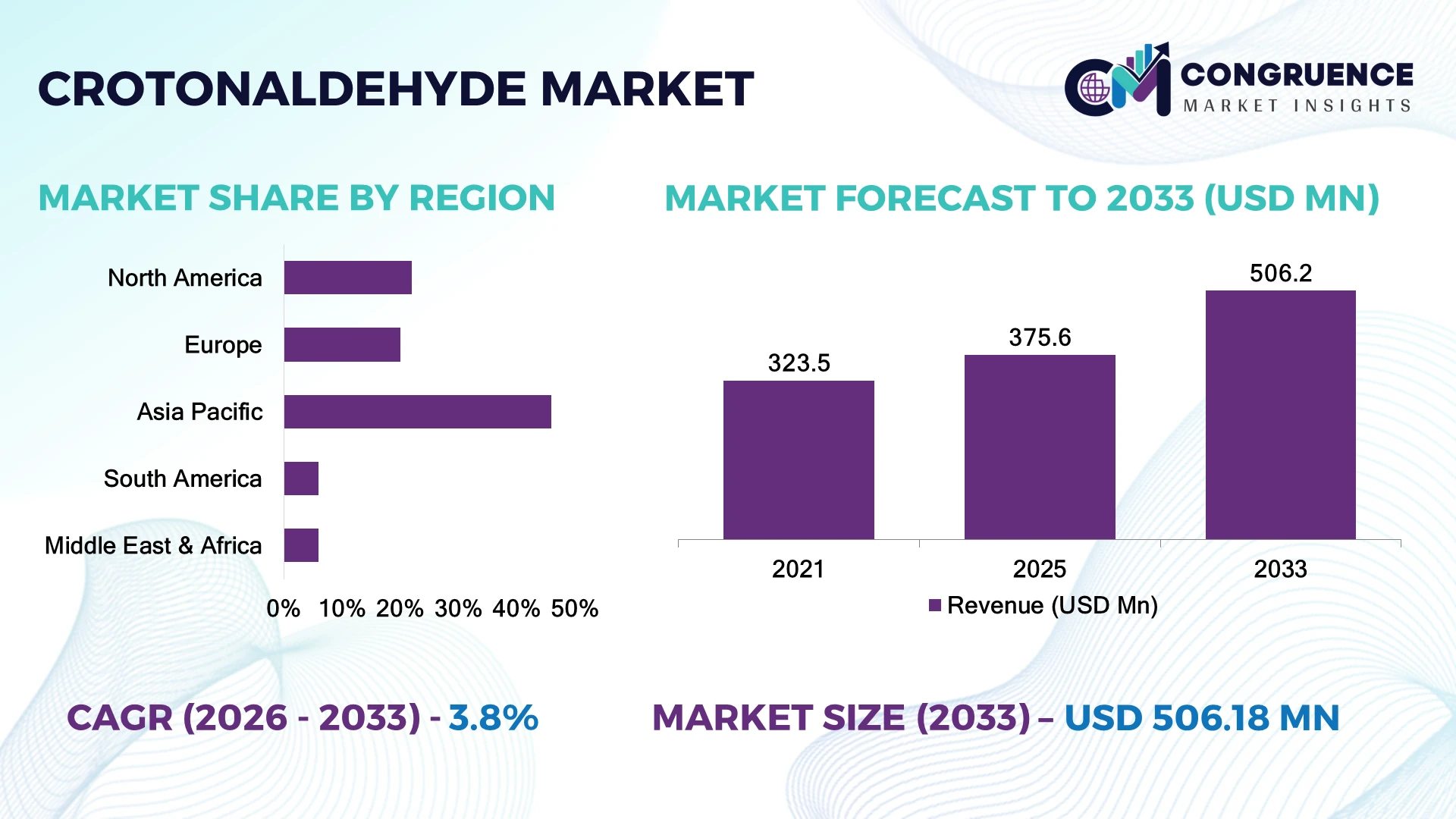
China remains the dominant production and consumption base, with Asia holding more than 60% of global production capacity and China estimated at roughly 45–50%; India is emerging rapidly, led by 12,000 MTPA domestic capacity. India’s market reached 4,046 MT in 2023, while advanced heterogeneous catalysts now demonstrate 94% selectivity and 99.92% product purity. Supply-chain restructuring following Red Sea disruptions is reinforcing regional sourcing and inventory strategies.
Strategically, investors should prioritize integrated acetaldehyde feedstock, high-purity output, catalyst modernization, and downstream links to sorbic acid and agrochemicals.
Market Size & Growth: USD 375.6 Million in 2025 to USD 506.2 Million by 2033 at 3.8% CAGR, driven by sorbic acid and agrochemical intermediate demand.
Top Growth Drivers: Sorbic acid 40%, agrochemicals 28%, and specialty chemical intermediates 17%, concentrating procurement around higher-purity grades.
Short-Term Forecast: By 2028, heterogeneous catalyst adoption targets 10–15% lower wastewater generation and 5–8% higher process efficiency versus conventional alkaline systems.
Emerging Technologies: Zr-β zeolite catalysis, continuous-flow oxidation, and AI-assisted process control are advancing selectivity, separation, and real-time quality management.
Regional Leaders: Asia-Pacific approaches USD 300 Million, Europe USD 85 Million, and North America USD 65 Million, with Asian producers accelerating integrated catalyst deployment.
Consumer/End-User Trends: Approximately 83% of India’s 2023 demand was linked to chemical-intermediate applications, highlighting strong industrial utilization.
Pilot/Case Example: A 2024 Zr-β zeolite process achieved 94% selectivity, 99.92% purity, and water below 10 ppm, eliminating salt wastewater.
Competitive Landscape: China leads at roughly 45–50% of global capacity, with Zibo Xinglu, Wuhan Youji, Godavari Biorefineries, and Japanese producers competing on cost and purity.
Regulatory & ESG Impact: Heterogeneous catalysis eliminates saline wastewater, while continuous-flow oxidation delivers over 91% yield and 99.5% purity.
Investment & Funding: India’s largest producer operates 12,000 MTPA capacity, while acetaldehyde-linked investments strengthen feedstock security and integrated chemical production.
Innovation & Future Outlook: 2026–2028 priorities center on recyclable catalysts, continuous processing, digital quality control, and bio-based feedstocks, shifting competition toward cleaner, higher-purity production.
Crotonaldehyde demand is concentrated in sorbic acid, agrochemical intermediates, pharmaceuticals, rubber chemicals, and specialty synthesis, with chemical-intermediate applications representing 83% of India’s 2023 market. Cleaner heterogeneous catalysis and continuous-flow processing are improving purity and reducing waste. As supply chains regionalize after Red Sea disruptions, integrated acetaldehyde-to-crotonaldehyde production is becoming more commercially attractive, setting up the strategic discussion.
Crotonaldehyde is becoming strategically important as manufacturers seek tighter control over acetaldehyde-derived intermediates used in sorbic acid, agrochemicals, pharmaceuticals, and specialty chemicals. Supply-chain restructuring is increasing the value of integrated production, particularly where acetaldehyde availability, purification, and downstream conversion can be coordinated within one industrial footprint.
Technology is moving from conventional homogeneous alkaline condensation toward heterogeneous catalysts and continuous processing. A Zr-β zeolite route has demonstrated 94% selectivity and 99.92% purity, while reducing water to below 10 ppm and eliminating saline wastewater; conventional processes face separation and wastewater burdens. Asia retains the largest production base, while India is expanding faster through integrated biorefinery capacity and downstream chemical demand.
During 2026–2028, practical deployment will center on recyclable catalysts, process intensification, online quality monitoring, and heat-integrated separation. Continuous-flow conversion of crotonaldehyde to crotonic acid has already demonstrated more than 91% yield and 99.5% purity. Producers are therefore prioritizing catalyst partnerships, debottlenecking, and feedstock integration. Competitive advantage will favor operators combining reliable acetaldehyde supply, high-purity output, lower waste intensity, and flexible downstream conversion.
Sorbic acid production remains the strongest structural demand driver, accounting for approximately 40% of crotonaldehyde consumption, while agrochemical intermediates contribute about 28%. China’s food-preservative manufacturing base is increasing demand for consistent crotonaldehyde feedstock, with advanced catalytic conversion improving selectivity by 5–8% versus conventional processes. Producers are responding by integrating acetaldehyde sourcing with downstream sorbic-acid conversion and upgrading catalyst systems. India is also expanding domestic intermediate production to reduce import exposure. The non-obvious advantage is tighter upstream-downstream integration: producers can stabilize crotonaldehyde utilization while capturing additional margin through higher-value derivatives rather than relying on merchant intermediate sales.
Acetaldehyde feedstock represents a major cost exposure, with raw materials and utilities often comprising 60–70% of crotonaldehyde production economics. A 10–15% movement in acetaldehyde pricing can materially compress conversion margins, particularly for standalone producers. European manufacturers also face higher energy intensity than integrated Chinese facilities, while freight disruptions can increase landed chemical costs by 8–12%. Companies are mitigating volatility through indexed procurement contracts, localized storage, diversified suppliers, and integration with acetaldehyde-producing assets. The operational pressure is strongest for smaller plants lacking captive feedstock. Strategic sourcing therefore matters more than nominal production capacity: reliable acetaldehyde access can determine whether additional crotonaldehyde capacity remains commercially viable during feedstock price swings.
Heterogeneous catalysis creates an attractive efficiency opportunity by reducing wastewater and simplifying downstream purification. Zirconium-based zeolite systems have demonstrated approximately 94% selectivity and 99.92% product purity, while reducing water content below 10 ppm. Compared with conventional homogeneous routes, optimized catalytic systems can reduce wastewater-handling requirements by more than 20% and improve separation efficiency by 10–15%. Japanese and Indian chemical producers are positioned to commercialize higher-purity intermediate production through catalyst partnerships and process intensification. The distinctive opportunity lies in retrofitting existing condensation assets rather than constructing entirely new plants, allowing producers to improve environmental performance, product quality, and operating economics simultaneously while expanding qualification potential in pharmaceutical and specialty-chemical applications.
Continuous crotonaldehyde processing introduces tighter requirements for temperature, residence time, catalyst activity, and inhibitor management. Small deviations can reduce conversion efficiency by 5–8%, while catalyst deactivation can increase maintenance frequency by 10–15% in poorly optimized systems. Indian and Chinese facilities are increasingly deploying online analytical monitoring and automated control loops to stabilize reaction conditions. The long-term challenge is integrating advanced catalytic reactors with purification and downstream oxidation without creating control bottlenecks. Companies must invest in distributed-control architecture, predictive maintenance, operator training, and corrosion-resistant equipment. The strategic risk is uneven technology integration: higher-performing reactors deliver limited value when downstream separation cannot maintain equivalent throughput, purity, and safety performance.
Catalyst Selectivity Is Improving: Commercial interest is shifting toward heterogeneous zeolite catalysts that deliver approximately 94% selectivity and 99.92% purity while reducing water below 10 ppm. Indian and Asian chemical producers are evaluating catalyst-intensive routes to lower separation burdens, eliminate saline wastewater, and improve product qualification for higher-value downstream synthesis.
Continuous Conversion Is Advancing: Continuous-flow oxidation and condensation systems are gaining traction, with optimized processes achieving above 91% yield and approximately 99.5% purity. Compared with batch-oriented workflows, continuous operation reduces residence-time variability and can improve selected process efficiency by 10–15%. Producers are pairing intensified reactors with automated analytical controls.
Domestic Supply Is Strengthening: India is increasing local crotonaldehyde availability, supported by approximately 12,000 MTPA capacity at its largest producer and expanding chemical-intermediate consumption. Import substitution is encouraging longer-term feedstock contracts and localized inventory, reducing exposure to freight volatility and improving delivery reliability for sorbic acid and agrochemical manufacturers.
Wastewater Reduction Shapes Upgrades: Environmental performance is increasingly influencing process investment as manufacturers target 20% or greater reductions in wastewater-handling requirements through heterogeneous catalysis. European and Asian producers are prioritizing recyclable catalysts, solvent recovery, and closed-loop utilities, turning environmental compliance from a cost center into an operational-efficiency lever.
Trans-crotonaldehyde is the leading type, accounting for approximately 95% of commercial composition, because its established reactivity, availability, and compatibility with downstream synthesis make it the default industrial grade. Cis-crotonaldehyde remains a niche segment at below 5%, primarily relevant to specialized chemical research and controlled synthesis. Stabilized cis-trans mixtures retain commercial relevance where buyers prioritize handling stability and standardized bulk specifications. Commercial grades generally range from 90–99% purity, while premium trans grades exceed 99%, supporting higher-value pharmaceutical and specialty-chemical applications. Companies are prioritizing purification, inhibitor control, and consistent isomer specifications rather than developing large-scale cis capacity.
The fastest-growing shift is toward higher-purity trans material, where demand is strengthening as downstream manufacturers tighten impurity and traceability requirements. Producers are investing in distillation, analytical quality control, and dedicated storage, while integrated suppliers are linking crotonaldehyde production with sorbic acid and specialty-intermediate operations. The business implication is clear: investment is moving toward specification control and reliable bulk supply rather than broader isomer diversification.
A current National Academies/NCBI technical assessment confirms that commercial crotonaldehyde contains more than 95% trans isomer and less than 5% cis isomer, reinforcing the structural dominance of trans-crotonaldehyde in commercial supply.
Chemical intermediates represent the leading application at approximately 52% of global consumption, reflecting crotonaldehyde's broad role in producing sorbic acid, crotonic acid, pyridine derivatives, rubber chemicals, and other synthesis intermediates. Sorbic acid production remains a major established pathway, while agrochemical intermediates are the fastest-growing application at roughly 10–12% annual demand expansion in active industrial programs. Pharmaceuticals, rubber accelerators, alcohol denaturants, warning agents, and specialty synthesis account for the remaining demand base.
India illustrates the changing application mix: chemical-intermediate uses represented 83% of its 2023 consumption, while alcohol denaturants and warning agents accounted for approximately 8% and 6%, respectively. Companies are therefore prioritizing higher-purity grades, downstream partnerships, and integrated production. The strategic shift is toward multifunctional intermediate supply, allowing producers to balance food-preservative exposure with faster-expanding agrochemical and pharmaceutical synthesis requirements.
Frost & Sullivan analysis places Indian crotonaldehyde consumption at 4,046 MT in 2023 and identifies pesticides and agrochemicals as major end-use applications, highlighting the importance of crop-protection chemistry in downstream demand.
Chemical manufacturers represent the dominant end-user group, accounting for approximately 52% of global crotonaldehyde consumption because they operate the largest synthesis chains for sorbic acid, agrochemical intermediates, crotonic acid, and specialty chemicals. Agrochemical producers form the fastest-growing buyer group at approximately 10–12%, supported by increasing intermediate requirements for crop-protection formulations. Pharmaceutical companies, food-preservative manufacturers, rubber producers, and specialty chemical firms constitute the remaining demand base, with procurement increasingly specification-driven.
Established chemical buyers prioritize bulk availability, feedstock continuity, and cost efficiency, whereas pharmaceutical and specialty-chemical customers place greater emphasis on purity, trace impurities, and batch consistency. India demonstrates the importance of industrial buyers, with approximately 83% of domestic consumption classified as chemical-intermediate use. Producers are responding through long-term contracts, integrated acetaldehyde sourcing, customized purity grades, and downstream partnerships. Competitive positioning is shifting toward suppliers capable of serving both high-volume industrial accounts and technically demanding specialty customers.
A 2026 market assessment identifies chemical manufacturing as the leading crotonaldehyde end-use industry, while pharmaceutical applications are gaining momentum through increased use in specialty intermediate synthesis.
Asia-Pacific accounted for the largest market share at 46.0% in 2025 however, Middle East & Africa is expected to register the fastest growth, expanding at a CAGR of 4.6% between 2026 and 2033. Asia-Pacific leadership reflects concentrated chemical manufacturing, while North America and Europe retain strong specialty-chemical infrastructure.

Specialty-chemical infrastructure supports selective domestic production
North America represents approximately 22% of the global Crotonaldehyde Market, with the United States accounting for most regional demand and production. U.S. production has become comparatively specialized, with reported 2023 production below 250,000 pounds, reflecting a shift toward targeted intermediate supply rather than commodity-scale output. Pharmaceutical, food-chemical, agrochemical, and specialty synthesis users support stable purchasing. Producers increasingly emphasize high-purity grades, contracted supply, and inventory optimization as domestic production remains concentrated. The region's established chemical infrastructure also supports rapid qualification of imported material when domestic availability tightens.
United States Market Outlook: The United States remains strategically important because of its mature specialty-chemical manufacturing base and established regulatory infrastructure for hazardous intermediates. Historical production was substantially higher, reaching 10–50 million pounds annually during several periods before declining sharply. Current procurement is therefore increasingly focused on dependable specialty supply, technical qualification, and downstream integration rather than large-volume expansion.
Specialty chemistry and stringent handling standards reshape supply
Europe accounts for approximately 20% of global Crotonaldehyde demand, supported by established chemical manufacturing in Germany, France, Italy, and Benelux. European buyers place greater emphasis on purity, controlled handling, emissions management, and traceable chemical supply. The region's mature chemical infrastructure favors specialized applications rather than large-scale commodity production. Companies are strengthening supplier qualification and inventory planning, while process improvements increasingly target lower wastewater loads and tighter product specifications. This structure creates opportunities for technically differentiated producers capable of meeting stringent handling and quality requirements.
Germany Market Outlook: Germany is the region's most strategically significant production and chemical-processing hub, supported by dense specialty-chemical infrastructure and downstream formulation capabilities. European production includes established crotonaldehyde manufacturing capacity, while German chemical producers benefit from integrated logistics, analytical laboratories, and access to downstream intermediates. The country's emphasis on controlled chemical handling strengthens demand for consistent, specification-grade material and reliable contracted supply.
Integrated chemical capacity reinforces production leadership
Asia-Pacific holds more than 40% of global Crotonaldehyde demand and remains the principal production center, led by China and India. China benefits from extensive acetaldehyde-linked chemical infrastructure, competitive manufacturing economics, and large downstream intermediate consumption. India is strengthening its position through domestic capacity and biorefinery integration. Godavari Biorefineries operates approximately 12,000 MTPA of crotonaldehyde capacity, providing a significant domestic supply platform. Producers are increasingly combining catalyst modernization, purification, and downstream conversion to improve utilization and reduce import exposure.
China Market Outlook: China remains the strategically dominant Asian market because of its large chemical manufacturing base and concentrated downstream demand. Chinese producers benefit from established acetaldehyde availability, extensive chemical parks, and export-oriented logistics. China and India together account for more than 40% of global demand, reinforcing the importance of Asian sourcing strategies. Producers are increasingly upgrading capacity and redirecting output toward higher-value chemical intermediates.
Agrochemical demand strengthens Brazil-centered consumption
South America contributes approximately 6% of global Crotonaldehyde demand, with Brazil and Mexico representing the principal markets. Brazil's large agrochemical, food-processing, and chemical industries create demand for crotonaldehyde-derived intermediates, while regional manufacturers continue to rely more heavily on imported specialty chemicals than Asian producers. Modernization of chemical facilities and stronger distribution networks are improving supply reliability. Companies are using longer-term procurement arrangements and regional inventories to manage currency and freight volatility. The key opportunity is downstream integration into crop-protection and preservative chemistry rather than standalone crotonaldehyde production.
Brazil Market Outlook: Brazil is the most strategically significant South American market because of its scale in agriculture, food processing, and chemical formulation. Agrochemical production provides a particularly important downstream demand base, while established industrial infrastructure around São Paulo and other chemical corridors supports distribution. Regional market analysis places Latin America's contribution near 6%, with Brazil and Mexico leading consumption. Producers and distributors are therefore prioritizing reliable imported supply, localized storage, and customer-specific delivery arrangements.
Downstream chemical diversification is building regional demand
Middle East & Africa accounts for approximately 4% of global Crotonaldehyde demand, with Saudi Arabia, the UAE, and South Africa providing the strongest commercial platforms. Saudi Arabia benefits from integrated petrochemical infrastructure and chemical-industry diversification, while the UAE functions as an important distribution and re-export hub. Regional regulation requires stronger controls for hazardous chemical handling, storage, labeling, and transportation. Companies are responding through specialized distribution networks, compliance systems, and partnerships with Asian suppliers. The region's strategic advantage is logistics: proximity to Asian, European, and African markets can support shorter delivery routes and diversified customer coverage.
Saudi Arabia Market Outlook: Saudi Arabia is the region's strongest strategic market because of its petrochemical infrastructure, industrial diversification programs, and established chemical-processing clusters. The domestic Crotonaldehyde market is estimated at approximately USD 10 million, with demand linked to chemical manufacturing and agrochemicals. Regulatory requirements covering emissions, waste treatment, and compliance audits are increasing the importance of controlled handling systems. Producers and distributors are therefore positioned around industrial hubs such as Riyadh, Jeddah, and Dammam, where chemical infrastructure and logistics networks support downstream access.
Celanese, Godavari Biorefineries, Zibo Xinglu Chemical Factory, Wuhan Youji Industries, and Jiangsu Sopo compete across integrated acetaldehyde conversion, bio-based production, and regional specialty supply. The top five players are estimated to hold about 35–40% of global market volume, with Chinese producers competing on cost and regional scale while Godavari differentiates through bio-based integration. Competition centers on feedstock economics, purity, catalyst efficiency, and delivery reliability: advanced heterogeneous routes can achieve about 94% selectivity, while high-purity grades above 99% support specialty applications. Players are expanding downstream links, debottlenecking chemical assets, strengthening acetaldehyde integration, and developing greener catalytic pathways. The competitive shift is moving from standalone intermediate sales toward integrated, lower-waste production and higher-value derivative chains. Entry barriers include hazardous-process handling, feedstock security, customer qualification, and capital-intensive purification. Winning suppliers need reliable acetaldehyde access, consistent high-purity output, efficient catalysts, regional inventory resilience, and downstream partnerships that convert crotonaldehyde into defensible specialty-chemical value globally.
Celanese Corporation
Godavari Biorefineries Limited
Zibo Xinglu Chemical Factory
Wuhan Youji Industries Co., Ltd.
Jiangsu Sopo Chemical Co., Ltd.
Nantong Acetic Acid Chemical Co., Ltd.
Shandong Kunda Biotechnology Co., Ltd.
Liaocheng Luxi Chemical Co., Ltd.
Arkema S.A.
BASF SE
Mitsubishi Chemical Group Corporation
Modern crotonaldehyde production is shifting toward heterogeneous zeolite catalysis, automated reaction control, and intensified purification. Zr-β systems have achieved 94.7% selectivity, while optimized Lewis-acid catalysts reduce by-product formation and simplify separation. Compared with homogeneous alkaline routes, heterogeneous processing can reduce wastewater handling by more than 20%. Adoption remains concentrated in pilot and advanced industrial development, but integration with online analytics is increasing.
Emerging technologies include continuous-flow reactors, recyclable catalysts, and digital monitoring of temperature, residence time, and catalyst activity. Continuous processing can improve selected throughput efficiency by 10–15%, while predictive controls can reduce process variability by 5–8%. Research into atomically dispersed Mn, Pt-Fe-Pt, and SnPt catalysts is targeting selective conversion of crotonaldehyde to higher-value alcohols. Technology leaders with integrated acetaldehyde and downstream assets gain the strongest economics because catalyst improvements translate across multiple conversion stages.
During 2026–2028, commercialization will favor lower-waste catalytic routes, continuous operation, and data-driven quality control. Companies integrating reactor, purification, and downstream conversion systems can improve asset utilization by 5–10% while reducing off-specification output. Godavari benefits from bio-based feedstock integration, while Chinese producers benefit from manufacturing scale. Acting now matters because cleaner catalysts and process intensification are becoming differentiators in cost, purity, compliance, customer qualification, and procurement requirements.
May 2025 Godavari Biorefineries reported specialty-chemical debottlenecking and expansion initiatives, while its bio-based chemicals EBITDA more than doubled in FY2025. The program strengthens integrated ethanol-derived chemical production and supports broader crotonaldehyde feedstock resilience, specialty-product growth, and competitiveness globally. Source: godavaribiorefineries.com
June 2026 Godavari Biorefineries commissioned a 200 KLPD grain-based distillery at Sameerwadi, adding dual-feedstock flexibility to its 600 KLPD sugarcane platform. The ₹130 crore investment reduces feedstock concentration and strengthens integrated bio-based chemical operating resilience and continuity further. Source: economictimes.com
November 2025 Tianjin University researchers developed tailored Zr-β zeolite catalysts for acetaldehyde aldol condensation, achieving 94.7% crotonaldehyde selectivity. The heterogeneous route addresses corrosion and wastewater limitations of homogeneous processing, strengthening the technical case for cleaner synthesis and scale-up. Source: pubs.rsc.org
October 2025 Dalian University of Technology researchers demonstrated supported SnPt intermetallic catalysts outperforming monometallic platinum for selective crotonaldehyde hydrogenation. The advance targets higher crotyl-alcohol selectivity and provides a pathway toward more efficient downstream conversion of crotonaldehyde into value-added intermediates commercially. Source: pubs.acs.org.
The Crotonaldehyde Market Report covers trans-crotonaldehyde, stabilized grades, and application-specific purity classes, with analysis across chemical intermediates, sorbic acid, agrochemicals, pharmaceuticals, rubber chemicals, warning agents, and specialty synthesis. End-user coverage includes chemical manufacturers, agrochemical producers, pharmaceutical companies, food-preservative manufacturers, rubber processors, and specialty-chemical users. Regional assessment spans North America, Europe, Asia-Pacific, South America, and Middle East & Africa, with country-level analysis of China, India, the United States, Germany, Brazil, and Saudi Arabia.
The report evaluates homogeneous and heterogeneous catalysis, zeolite-based condensation, continuous processing, advanced purification, digital process control, and downstream integration. Approximately 40% of global supply is concentrated among leading producers, while India’s largest producer operates 12,000 MTPA capacity. Analysis supports investment planning, capacity expansion, supplier qualification, partnership strategy, competitive positioning, and technology prioritization, while the 2026–2033 outlook identifies opportunities in cleaner catalysts, bio-based production, specialty grades, and integrated value chains.
| Report Attribute/Metric | Report Details |
|---|---|
|
Market Revenue in 2025 |
USD 375.6 Million |
|
Market Revenue in 2033 |
USD 506.2 Million |
|
CAGR (2026 - 2033) |
3.8% |
|
Base Year |
2025 |
|
Forecast Period |
2026 - 2033 |
|
Historic Period |
2021 - 2025 |
|
Segments Covered |
By Type
By Application
By End-User
|
|
Key Report Deliverable |
Revenue Forecast, Growth Trends, Market Dynamics, Segmental Overview, Regional and Country-wise Analysis, Competition Landscape |
|
Region Covered |
North America, Europe, Asia-Pacific, South America, Middle East, Africa |
|
Key Players Analyzed |
Celanese Corporation, Godavari Biorefineries Limited, Zibo Xinglu Chemical Factory, Wuhan Youji Industries Co., Ltd., Jiangsu Sopo Chemical Co., Ltd., Nantong Acetic Acid Chemical Co., Ltd., Shandong Kunda Biotechnology Co., Ltd., Liaocheng Luxi Chemical Co., Ltd., Arkema S.A., BASF SE, Mitsubishi Chemical Group Corporation |
|
Customization & Pricing |
Available on Request (10% Customization is Free) |




