
Reports
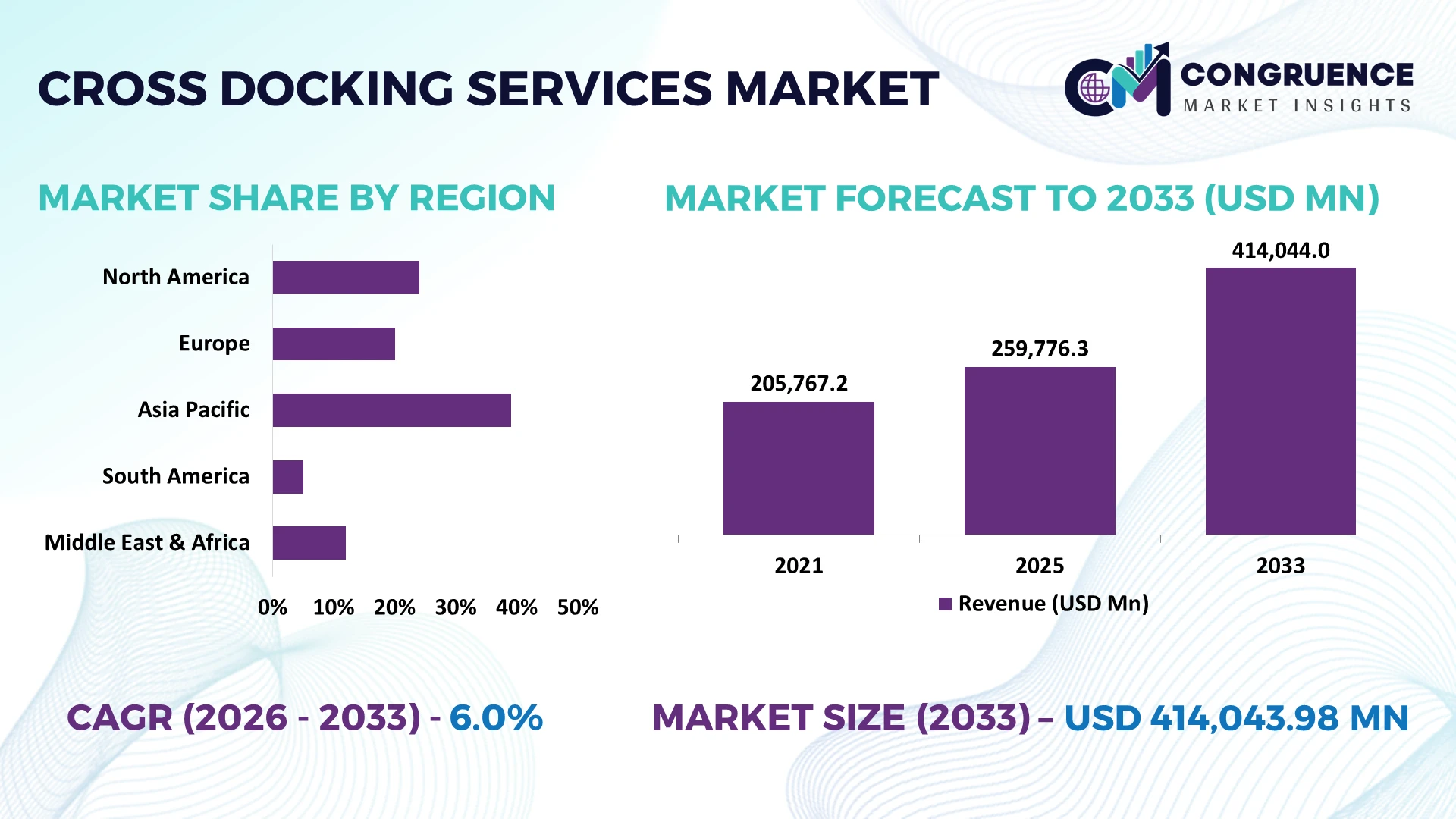
The Global Cross Docking Services Market was valued at USD 259776.32 Million in 2025 and is anticipated to reach a value of USD 414043.98 Million by 2033 expanding at a CAGR of 6% between 2026 and 2033. Growth is driven by retailers, 3PL providers, grocery networks, and manufacturers shifting toward inventory-light distribution, faster truck-to-truck transfers, and automated sortation to reduce storage dwell time.
The United States remains the dominant operating hub, supported by large-scale retail, parcel, food, and manufacturing flows; U.S. logistics automation accounted for about 78.5% of North American logistics-automation revenue in 2025, while India is accelerating Grade-A warehousing investment, with 36.9 million sq. ft. leased across eight major cities. U.S. trade-policy and reshoring shifts are further increasing pressure for responsive domestic distribution.
Strategically, providers with automated sorting, real-time shipment visibility, and multi-node capacity are best positioned to capture high-volume cross docking contracts.
Market Size & Growth: USD 259776.32 Million in 2025 is projected to reach USD 414043.98 Million by 2033 at 6% CAGR, driven by inventory-light distribution and automated freight handling.
Top Growth Drivers: 34% faster fulfillment expectations, 28% automation-led productivity gains, and 22% growth in multi-node distribution networks strengthen cross docking adoption.
Short-Term Forecast: By 2028, advanced cross docking operations are targeting 8–12% lower handling costs and 15% higher shipment throughput through automated scheduling and sortation.
Emerging Technologies: AI-based dock scheduling, AMRs, machine vision, IoT tracking, and predictive analytics are moving cross docking from manual coordination toward real-time orchestration.
Regional Leaders: North America is projected near USD 155 billion, Europe near USD 105 billion, and Asia-Pacific near USD 95 billion, with automation adoption accelerating across high-volume logistics hubs.
Consumer/End-User Trends: More than 60% of modern warehouse operators are prioritizing automation or AI-enabled workflows, reflecting stronger same-day and next-day fulfillment requirements.
Pilot/Case Example: In 2025–2026, automated warehouse deployments increasingly combined robotics and AI, targeting 15% lower labor-intensive handling and materially faster order movement.
Competitive Landscape: Leading providers hold an estimated 10–15% combined advantage in major contract networks, with DHL Supply Chain, GXO Logistics, FedEx, UPS, and Kuehne+Nagel competing through scale and technology.
Regulatory & ESG Impact: Route consolidation and reduced storage movements can cut avoidable transport activity by 5–10%, supporting emissions targets while stricter traceability requirements favor digitally monitored freight flows.
Investment & Funding: India’s logistics infrastructure attracted USD 4.8 billion of domestic investment in 2025, while 56% of investors planned higher capital deployment, strengthening Grade-A distribution capacity.
Innovation & Future Outlook: Agentic AI, digital twins, autonomous sortation, predictive dock allocation, and integrated TMS-WMS platforms will shift competition toward network orchestration rather than warehouse capacity alone.
The Cross Docking Services Market is gaining traction across retail, grocery, e-commerce, automotive, pharmaceuticals, and consumer goods, where rapid inventory transfer is increasingly prioritized over conventional storage. Automated scheduling, RFID, machine vision, and AI-enabled dock coordination are improving shipment synchronization, with advanced facilities targeting 10–15% higher throughput. Reshoring and regional supply-chain redesign are further strengthening demand, creating a strategic shift toward technology-enabled distribution networks.
Cross docking is becoming strategically important as retailers, manufacturers, and 3PL operators compete on fulfillment speed while reducing inventory exposure. Supply-chain restructuring, nearshoring, and tighter delivery windows are shifting investment from storage-heavy facilities toward synchronized transfer networks. In the United States, automated material-handling adoption is accelerating, while India is modernizing Grade-A logistics infrastructure around Delhi-NCR, Mumbai, Bengaluru, and Chennai.
Technology is strengthening this shift. AI-enabled dock scheduling and automated sortation can improve throughput by 15–25% and reduce manual handling requirements by 10–20% compared with legacy spreadsheet-based coordination. Over the next 2–3 years, digitally connected facilities are expected to prioritize real-time shipment visibility, predictive arrival management, and integrated WMS-TMS workflows, particularly where high-volume retail and e-commerce operations demand tighter turnaround.
A practical deployment model involves using RFID, machine vision, and automated conveyors to route inbound pallets directly to outbound lanes, minimizing dwell time. Companies are increasingly directing capital toward automation retrofits, multi-site network expansion, and technology partnerships rather than adding conventional storage capacity. U.S. operators benefit from scale and mature automation, while India offers stronger greenfield modernization opportunities. Competitive advantage will increasingly depend on synchronized networks, technology integration, and consistently low dock-to-dispatch cycle times.
Retailers and 3PLs are prioritizing cross docking as e-commerce and omnichannel fulfillment compress delivery windows. Automated sorting can raise throughput by 15–25%, while real-time dock scheduling can reduce idle dock time by 10–18%. In the United States, large distribution hubs are expanding automation to handle higher SKU velocity without proportional labor growth. India is following through investments in Grade-A logistics parks and multimodal freight infrastructure. Companies are responding by upgrading conveyor systems, deploying AI-based scheduling, and forming technology partnerships. A non-obvious driver is the ability to redeploy warehouse labor from repetitive transfer activities toward exception handling, improving workforce productivity while supporting faster network turnover.
Cross docking remains constrained by uneven facility standards, labor costs, and transportation synchronization. Around 15–20% of operating inefficiency in less-automated facilities can stem from dock congestion, manual coordination, and inconsistent arrival timing, while automation retrofits can increase initial facility investment by 20–30%. In developing logistics markets, fragmented road connectivity and inconsistent warehouse specifications further restrict network standardization. Fuel-price volatility and carrier capacity fluctuations also affect transfer economics. Companies are mitigating exposure through multi-carrier contracts, localized distribution nodes, standardized dock configurations, and phased automation. The key restraint is not warehouse capacity alone but synchronization: underutilized outbound capacity can quickly erode the economic advantage of direct freight transfer.
AI-enabled orchestration creates a high-value opportunity by connecting arrival forecasts, inventory priorities, dock availability, and outbound transportation decisions. Predictive scheduling can reduce avoidable waiting time by 15–20%, while automated identification technologies can improve shipment-tracking accuracy by more than 10%. India, Vietnam, and Mexico offer attractive expansion opportunities as manufacturers diversify sourcing and establish regional distribution networks. Digital twins and agentic AI are emerging as next-generation tools for testing dock allocation and network scenarios before physical deployment. Companies are positioning through R&D partnerships, robotics integration, and cloud-based logistics platforms. The strongest opportunity lies in converting cross docking from a physical transfer service into a data-driven network orchestration model.
The next phase of cross docking faces integration pressure as operators connect WMS, TMS, ERP, robotics, RFID, and carrier systems across multiple facilities. Integration failures can create 10–15% productivity losses through duplicate scanning, manual exception handling, and delayed shipment updates, while cybersecurity spending is rising as connected logistics assets expand. U.S. operators face increasing complexity across large multi-node networks, whereas rapidly modernizing Indian facilities often contend with mixed legacy and digital infrastructure. Companies must invest in API-based interoperability, cybersecurity controls, workforce training, and standardized data architectures. The critical challenge is maintaining consistent execution across every node; isolated automation gains provide limited competitive value when upstream and downstream systems remain disconnected.
AI-Driven Dock Coordination: AI scheduling is moving from pilot programs into high-volume facilities, with predictive arrival planning targeting 10–18% lower dock idle time and 8–15% faster vehicle turnaround. U.S. operators are integrating AI with TMS and WMS platforms as labor constraints intensify, shifting investment toward exception-based workflows rather than manual dispatching.
Robotics Across Transfer Hubs: Automated conveyors, AMRs, machine vision, and robotic sortation are expanding in large distribution centers, delivering 15–25% higher throughput and reducing repetitive handling by 10–20%. Gartner expects 1 in 20 supply-chain managers to manage robots rather than humans by 2030, encouraging companies to combine robotics with workforce reskilling.
E-Commerce Lane Specialization: U.S. e-commerce represented 16.9% of retail sales in Q1 2026 and increased 9.8% year over year, intensifying demand for rapid parcel and store-replenishment transfers. Operators are creating dedicated cross-dock lanes, wave-based sorting, and later cutoffs to absorb volatile online order profiles without expanding storage footprints.
Real-Time Freight Visibility: RFID, IoT sensors, digital shipment records, and geofencing are increasingly linking inbound and outbound movements, improving tracking accuracy by 10–15% and reducing manual reconciliation by roughly 8–12%. Companies are standardizing data interfaces and carrier integrations, with the non-obvious shift being greater emphasis on exception visibility than continuous human monitoring.
Pre-Distribution Cross-Docking leads the type segment at an estimated 34% share, supported by predictable supplier-to-network flows, high-volume retail replenishment, and lower intermediate handling. Its standardized workflow can reduce transfer dwell time by 15–20% versus storage-oriented distribution. Retail Cross-Docking follows with strong adoption among large U.S. chains, while Post-Distribution Cross-Docking remains relevant for network balancing and destination-specific routing. Companies are investing in automated sortation and appointment scheduling to protect throughput as shipment volumes become less predictable.
Manufacturing Cross-Docking is the fastest-growing type, expanding as automotive and industrial producers shorten component cycles and synchronize inbound materials with production schedules. Adoption is accelerating by an estimated 10–15% as manufacturers pursue leaner inventories and localized sourcing. Companies are responding with supplier integration, dedicated inbound lanes, and synchronized production logistics. Investment is shifting toward flexible facilities capable of serving both manufacturing and retail flows.
Order Consolidation leads with an estimated 32% share as retailers and fulfillment operators combine multiple customer orders before outbound dispatch, improving vehicle utilization and reducing fragmented handling. Freight Consolidation remains highly established, particularly for 3PL networks, while Direct Store Delivery supports time-sensitive retail and grocery flows. Companies are integrating automated sorting and shipment-level visibility to improve consolidation accuracy by approximately 10–15%.
Inventory Replenishment is the fastest-growing application, with adoption increasing around 12–16% as retailers move toward demand-responsive replenishment and shorter store inventory cycles. U.S. e-commerce sales rose 9.8% year over year in Q1 2026, intensifying the need for synchronized replenishment between fulfillment centers and stores. Operators are expanding replenishment-specific lanes, predictive scheduling, and WMS-TMS integration, making rapid inventory transfer increasingly operationally critical.
Retail represents the leading end-user segment at an estimated 35% share, reflecting extensive store networks, frequent replenishment cycles, and high shipment density. Large retailers can achieve 12–20% faster inventory movement through structured cross-dock programs compared with storage-intensive workflows. Consumer Goods follows with steady deployment across high-volume distribution channels, while Food & Beverage requires tighter scheduling because perishability increases the cost of dwell time. Companies are responding with dedicated lanes, automated sorting, and carrier coordination.
E-Commerce is the fastest-growing end-user, with adoption expanding approximately 15–20% as online fulfillment requires tighter cutoffs, parcel consolidation, and rapid node-to-node transfers. Automotive adoption remains strategically important for just-in-time component flows, while Food & Beverage operators prioritize temperature-sensitive handling. Companies are targeting e-commerce through micro-fulfillment partnerships, automation retrofits, and flexible capacity. The U.S. e-commerce share reached 16.9% in Q1 2026, strengthening the case for specialized high-velocity cross-docking infrastructure.
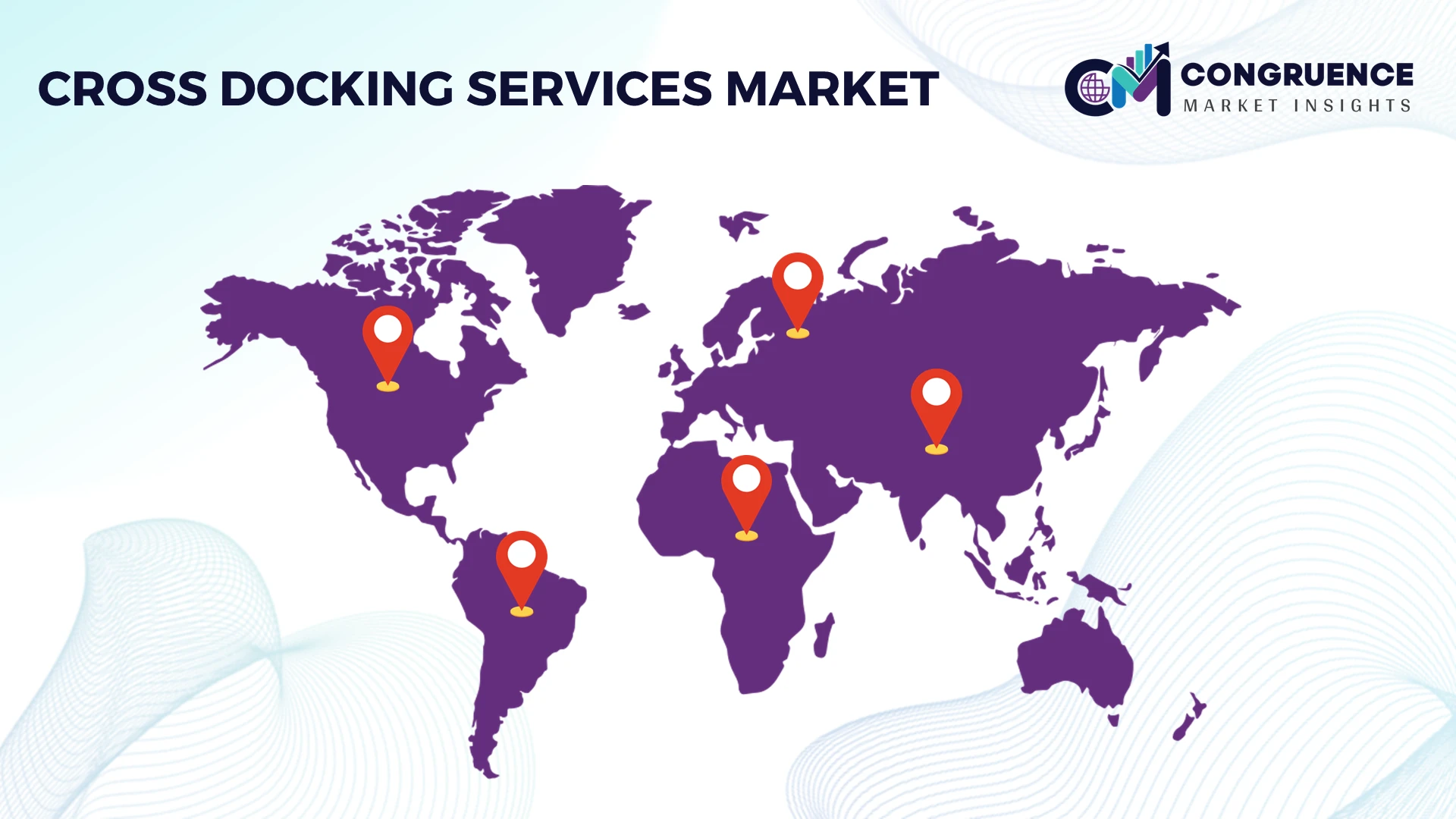
North America accounted for the largest market share at 39% in 2025 however, Asia-Pacific is expected to register the fastest growth, expanding at a CAGR of X% between 2026 and 2033.
Automation and high-velocity fulfillment reshape distribution networks
North America held approximately 39% of the global Cross Docking Services Market in 2025, led by the United States, where retail, e-commerce, automotive, food, and 3PL networks generate concentrated freight volumes. Automated sorting, RFID, and AI-enabled dock scheduling are increasingly deployed across major logistics hubs, improving throughput by 15–25% and reducing repetitive handling by 10–20%. Nearshoring linked to Mexico is also increasing demand for synchronized inbound and outbound freight movements. Companies are prioritizing automation retrofits, multi-node expansion, and technology partnerships over conventional storage capacity.
United States Market Outlook: The United States remains the dominant national market because of its extensive highway network, mature 3PL infrastructure, and high-volume retail distribution. Large operators are integrating predictive scheduling and robotic sortation to support tighter delivery windows, while reshoring and Mexico-linked manufacturing are strengthening demand for strategically positioned cross-docking facilities.
Digital modernization aligns logistics efficiency with sustainability
Europe is strengthening Cross Docking Services adoption through advanced distribution infrastructure, dense retail networks, labor constraints, and stricter sustainability requirements. Germany, France, the Netherlands, and the United Kingdom remain important deployment centers, with automated material handling improving operational productivity by approximately 12–20%. European logistics providers are increasingly integrating warehouse execution systems, carrier platforms, and real-time freight visibility to reduce dwell time and unnecessary transport movements. Companies are modernizing existing facilities rather than relying exclusively on greenfield capacity, while consolidation of distribution nodes is improving network utilization. Electrification, optimized routing, and energy-efficient handling systems are also becoming more relevant as logistics operators align infrastructure investment with environmental targets and operational cost control.
Germany Market Outlook: Germany benefits from its automotive, industrial manufacturing, retail, and export-oriented supply chains. Major logistics corridors surrounding North Rhine-Westphalia and Bavaria support high-volume cross-docking activity. Manufacturers are increasingly connecting supplier scheduling with distribution platforms to synchronize components, finished goods, and outbound transportation.
Manufacturing scale accelerates automated distribution deployment
Asia-Pacific represents the fastest-expanding market for Cross Docking Services, supported by manufacturing concentration, e-commerce activity, export flows, and rapid logistics infrastructure modernization. China, Japan, South Korea, and India are major deployment centers, while Southeast Asian manufacturing hubs are attracting additional logistics investment as supply chains diversify. India recorded 36.9 million sq. ft. of warehousing leasing across eight major cities in 2025, strengthening the infrastructure base for organized cross-docking operations. Automated sorting and digital shipment tracking can raise throughput by 15–25%. Companies are investing in Grade-A facilities, robotics, integrated WMS-TMS platforms, and strategically located transfer hubs to handle faster replenishment cycles.
China Market Outlook: China remains a strategically significant market because of its manufacturing density, extensive express-delivery infrastructure, and large consumer distribution networks. Electronics, automotive, consumer goods, and e-commerce companies increasingly use automated sorting and real-time shipment visibility to accelerate freight transfers and maintain high dispatch volumes.
Retail consolidation strengthens strategically positioned freight hubs
South America is expanding Cross Docking Services deployment around major retail, food and beverage, consumer goods, and industrial distribution corridors. Brazil represents the principal market, with São Paulo, Minas Gerais, Paraná, and Rio de Janeiro concentrating significant logistics activity. Automated material handling can increase throughput by approximately 10–18%, although road infrastructure variability and uneven warehouse modernization affect network efficiency. Retailers and 3PL providers are responding by consolidating distribution operations, upgrading sorting infrastructure, and establishing digitally coordinated transportation networks. Cross docking is particularly valuable for companies seeking faster product movement without expanding inventory storage. Shared logistics facilities and retailer-3PL partnerships are gaining relevance as operators seek better asset utilization and lower transfer costs.
Brazil Market Outlook: Brazil provides the strongest national opportunity because of its large consumer market, extensive food and beverage distribution requirements, and concentration of modern logistics facilities around São Paulo. Operators are investing in automated conveyors, shipment tracking, and transportation synchronization to improve transfer reliability across major commercial corridors.
Logistics megaprojects accelerate connected distribution infrastructure
The Middle East & Africa Cross Docking Services Market is being shaped by logistics modernization, free-zone expansion, retail development, and investment in multimodal freight infrastructure. The United Arab Emirates and Saudi Arabia are leading deployment, particularly around Dubai, Abu Dhabi, Riyadh, and Jeddah. Automated sorting and warehouse-management technologies can improve throughput by 15–20%, while integrated road, air, and maritime networks support faster cargo transfers. Saudi Vision 2030 and UAE logistics-development initiatives are strengthening investment in digitally enabled distribution facilities. Companies are expanding fulfillment hubs, developing logistics partnerships, and deploying automated handling systems. The region's strategic advantage lies in connecting Asian manufacturing flows with European and African markets through increasingly sophisticated freight corridors.
United Arab Emirates Market Outlook: The UAE remains a key national hub because of its position between Asian, European, and African trade routes, supported by major ports, airports, and free zones. Dubai-based logistics operators are integrating road, air, and maritime freight with automated sorting and real-time tracking to strengthen rapid-transfer capabilities.
The Cross Docking Services Market features DHL Supply Chain, UPS Supply Chain Solutions, FedEx Logistics, GXO Logistics, and Kuehne+Nagel competing with regional 3PL specialists and technology-enabled logistics providers. The top five players collectively account for approximately 18–22% of market activity, leaving room for regional differentiation. Competition centers on technology, network density, service speed, customization, and pricing. Automated facilities can deliver 15–25% higher throughput, while integrated visibility platforms reduce manual coordination by 10–15%. DHL and GXO emphasize automation and network expansion, while UPS and FedEx leverage integrated transportation infrastructure. Kuehne+Nagel competes through global freight coordination and customized logistics solutions. Partnerships with robotics, WMS, and transportation-technology providers are accelerating differentiation. The competitive shift is moving from labor-intensive handling toward digitally orchestrated networks, raising entry barriers around infrastructure, integration, and carrier relationships. Winning providers need geographic coverage, automation, reliable turnaround, and flexible customer-specific workflows.
DHL Supply Chain
UPS Supply Chain Solutions
FedEx Logistics
GXO Logistics
Kuehne+Nagel
XPO
DSV
CEVA Logistics
Nippon Express
Ryder System
J.B. Hunt Transport Services
Penske Logistics
Lineage
NFI Industries
AI-powered dock scheduling, automated sortation, RFID, IoT sensors, and warehouse execution systems are defining current cross-docking upgrades. AI scheduling can reduce dock idle time by 10–18%, while automated sortation can improve throughput by 15–25%. Adoption is strongest in U.S. and European facilities, where integrated WMS-TMS platforms connect arrival forecasts, dock allocation, scanning, and outbound dispatch. The advantage is faster truck turnaround with fewer manual coordination points.
Emerging deployments combine autonomous mobile robots, machine vision, digital twins, and predictive analytics. AMR-enabled workflows can process orders about 40% faster in advanced deployments, while machine vision improves identification and routing consistency by roughly 10–15%. Compared with spreadsheet scheduling and manual scanning, integrated digital orchestration can improve transfer productivity by approximately 15–20%. Technology leaders such as UPS, DHL, and GXO benefit most because dense networks justify automation and generate operational data.
From 2026–2028, disruptive adoption will center on AI agents, autonomous material handling, and real-time control towers coordinating nodes. Facilities integrating robotics with WMS, TMS, IoT, and predictive analytics are positioned to reduce handling costs by 8–12% and improve throughput by 15–20%. Acting now matters because automation-ready infrastructure increasingly determines speed, scalability, and contract competitiveness.
June 2026 UPS invested $48 million in 27 temperature-controlled freight cross-dock facilities worldwide. The expansion targets healthcare logistics across Europe, Asia, and the Americas, strengthening rapid air-ground transfers, temperature compliance, visibility, and cold-chain resilience for advanced therapies. Source: ups.com
May 2025 DHL agreed with Boston Dynamics to deploy more than 1,000 additional robots, expanding automated case-handling across logistics operations. The move builds on over €1 billion invested in automation and strengthens throughput, labor productivity, and scalable cross-dock handling globally. Source: dhl.com
May 2025 GXO and Blue Yonder signed a multi-year global agreement to deploy end-to-end logistics software, making Blue Yonder a preferred warehouse-management provider. Real-time forecasting and standardized implementations strengthen shipment visibility, predictability, and scalable digital coordination across GXO’s network. Source: gxo.com
May 2024 Kuehne+Nagel announced a 363,000-square-foot El Paso facility consolidating four warehouses, with 54 dock doors and front-and-rear cross-dock capability. The expansion responds to U.S.-Mexico nearshoring by improving trailer coordination, cargo flow, dock availability, and efficiency. Source: dcvelocity.com
The Cross Docking Services Market Report evaluates service structures across Pre-Distribution Cross-Docking, Post-Distribution Cross-Docking, Retail Cross-Docking, and Manufacturing Cross-Docking, alongside Order Consolidation, Freight Consolidation, Inventory Replenishment, and Direct Store Delivery applications. End-user coverage spans Retail, E-Commerce, Food & Beverage, Consumer Goods, and Automotive. The analysis examines adoption patterns, operational intensity, network design, automation penetration, and technology-enabled workflow changes.
Geographic coverage includes North America, Europe, Asia-Pacific, South America, and Middle East & Africa, with country-level assessment of infrastructure, logistics hubs, manufacturing concentration, and deployment priorities. Technology coverage includes AI scheduling, robotics, RFID, IoT, machine vision, WMS-TMS integration, and real-time visibility. The report supports investment planning, facility expansion, partnership selection, competitive positioning, and capacity allocation through 2026–2033, while identifying high-velocity applications and emerging cross-docking opportunities.
| Report Attribute/Metric | Report Details |
|---|---|
Market Revenue in 2025 | USD 259776.32 Million |
Market Revenue in 2033 | USD 414043.98 Million |
CAGR (2026 - 2033) | 6% |
Base Year | 2025 |
Forecast Period | 2026 - 2033 |
Historic Period | 2021 - 2025 |
Segments Covered | By Type
By Application
By End-User
|
Key Report Deliverable | Revenue Forecast, Growth Trends, Market Dynamics, Segmental Overview, Regional and Country-wise Analysis, Competition Landscape |
Region Covered | North America, Europe, Asia-Pacific, South America, Middle East, Africa |
Key Players Analyzed | DHL Supply Chain, UPS Supply Chain Solutions, FedEx Logistics, GXO Logistics, Kuehne+Nagel, XPO, DSV, CEVA Logistics, Nippon Express, Ryder System, J.B. Hunt Transport Services, Penske Logistics, Lineage, NFI Industries |
Customization & Pricing | Available on Request (10% Customization is Free) |




