
Reports
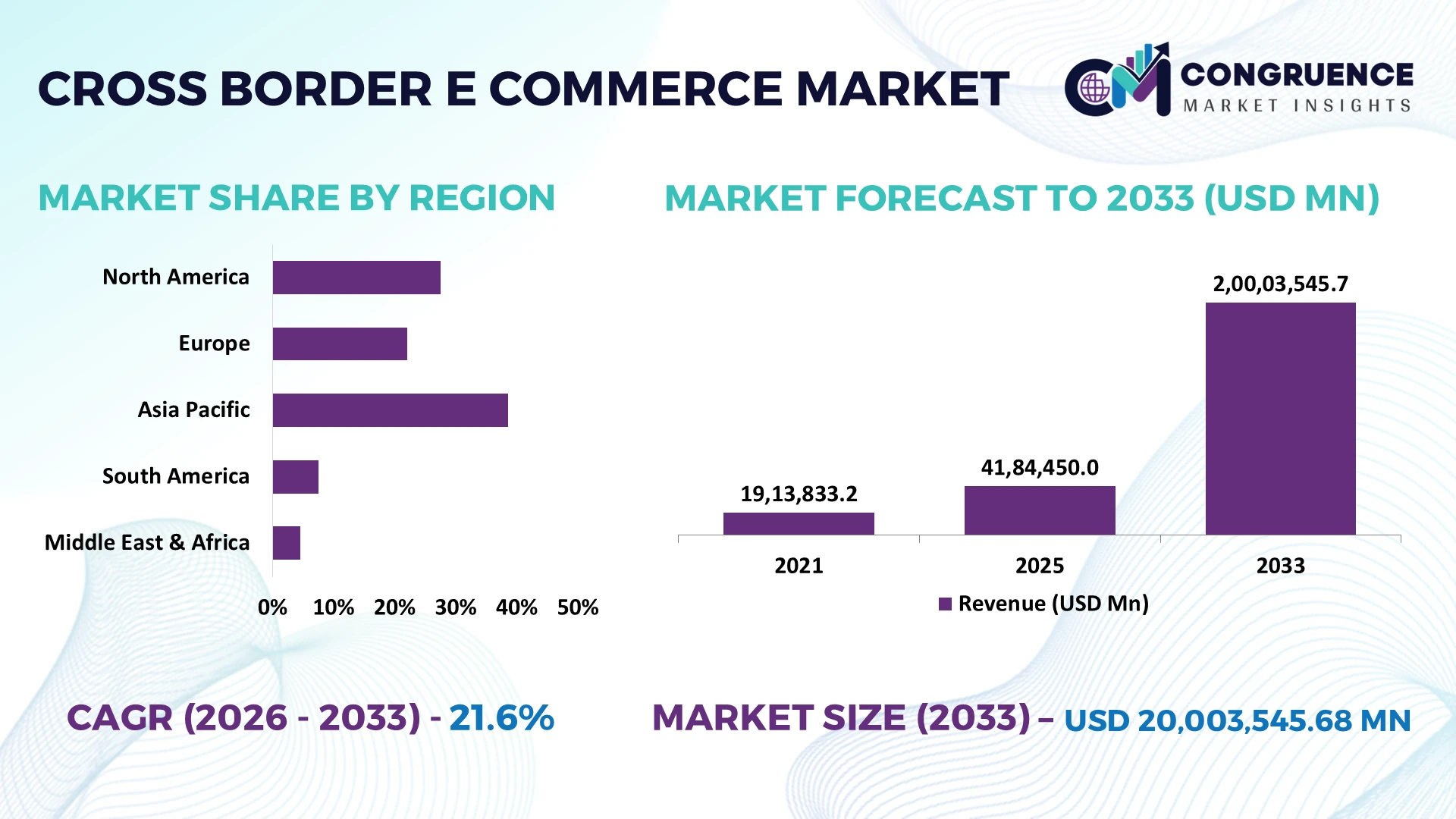
The Global Cross-border E-commerce Market was valued at USD 41,84,450.0 Million in 2025 and is anticipated to reach a value of USD 20,003,545.0 Million by 2033 expanding at a CAGR of 21.6% between 2026 and 2033. Market growth is driven by localized digital payment integration, international marketplace expansion, automated customs clearance, and increasingly efficient cross-border fulfillment networks.
China dominates the global cross-border e-commerce market, supported by an extensive manufacturing ecosystem and advanced digital retail infrastructure. In 2024, China's cross-border e-commerce trade increased by 10.8%, while its internet penetration exceeded 78%. Compared with the United States, China benefits from greater export-oriented manufacturing integration across consumer electronics, apparel, and household products, despite escalating international tariff pressures and trade restrictions.
Strategic competitiveness increasingly depends on localized fulfillment, diversified sourcing networks, regulatory compliance, and integrated international payment capabilities.
Market Size & Growth: USD 41,84,450.0 Million in 2025 to USD 20,003,545.0 Million by 2033, at 21.6% CAGR, driven by digital commerce integration.
Top Growth Drivers: Global internet adoption (68%), smartphone ownership (approximately 70%), and digital wallet penetration in online payments (53%).
Short-Term Forecast: By 2028, automated fulfillment targets 15–20% reductions in international order processing costs.
Emerging Technologies: Three transformative technologies include AI-powered localization, blockchain-enabled trade documentation, and automated customs processing.
Regional Leaders: Indicative 2033 projections include Asia Pacific (USD 8,201,453.5 Million; mobile commerce), North America (USD 5,200,921.7 Million; omnichannel retail), and Europe (USD 4,400,779.9 Million; localized payments).
Consumer/End-User Trends: Approximately 55% of surveyed online shoppers purchase internationally, prioritizing affordability and product availability.
Pilot/Case Example: In 2024, China's cross-border digital commerce ecosystem supported 10.8% annual trade growth.
Competitive Landscape: Amazon remains a leading platform; its estimated 15% share of the platform-led segment faces competition from Alibaba, Temu, eBay, and SHEIN.
Regulatory & ESG Impact: The EU's removal of the EUR 22 VAT exemption expanded compliance requirements for low-value imports.
Investment & Funding: Amazon announced investments exceeding USD 26 billion in India by 2030, strengthening its broader commercial and technology infrastructure.
Innovation & Future Outlook: Three strategic priorities include predictive inventory allocation, embedded international payments, and regional fulfillment decentralization.
The cross-border e-commerce market is experiencing concentrated demand across fashion, consumer electronics, beauty products, and household merchandise. Digital wallets account for approximately 53% of global online payment value, supporting frictionless international transactions. AI-enabled product localization, automated duty calculations, and regional warehousing are transforming fulfillment economics, while evolving customs regulations increasingly influence marketplace expansion and long-term competitive strategies.
Cross-border e-commerce is becoming a strategic channel for international market penetration, enabling manufacturers, retailers, and digital marketplaces to access overseas consumers without establishing extensive physical distribution networks. Supply-chain restructuring and changing import regulations are accelerating investment in regional warehouses, direct-to-consumer distribution, and localized merchant ecosystems. Competitive differentiation increasingly depends on landed-cost transparency, delivery reliability, and payment interoperability rather than product pricing alone.
AI-enabled customs documentation and automated order processing target efficiency improvements of 20–30% compared with manual workflows. China benefits from integrated manufacturing and export fulfillment networks, while the United States emphasizes advanced logistics infrastructure and marketplace integration. European operators prioritize regulatory compliance, multilingual storefronts, and localized payment acceptance. Through 2028, advanced fulfillment operators are targeting 15–20% reductions in processing costs through automation.
Alibaba's Cainiao logistics network demonstrates how integrated international warehousing, shipment consolidation, and digital tracking strengthen delivery performance. Amazon, Temu, and SHEIN are adjusting expansion strategies through localized inventory, logistics partnerships, and merchant onboarding initiatives. The strategic advantage increasingly belongs to platforms capable of combining scalable international distribution with country-specific compliance, predictable fulfillment costs, and consistent customer experiences.
Increasing digital payment adoption and direct-to-consumer distribution are accelerating international online transactions by reducing purchasing friction and dependence on traditional import intermediaries. Global internet penetration reached approximately 68% in 2024, while digital wallets accounted for nearly 53% of global e-commerce payment value. China's cross-border e-commerce trade expanded by 10.8% in 2024, demonstrating the commercial benefits of integrated manufacturing, digital marketplaces, and export logistics. Amazon, Alibaba, and Shopify are expanding localized payment options, multilingual storefront capabilities, and merchant enablement services. Integrated payment and fulfillment infrastructure allows smaller exporters to enter international markets without equivalent investment in physical distribution, improving customer acquisition economics and geographic scalability.
Fragmented customs regulations, import taxation, and fluctuating international shipping expenses constrain cross-border e-commerce profitability. The United Kingdom applies a standard VAT rate of 20%, while Germany and France impose standard rates of 19% and 20%, respectively. The European Union's elimination of the EUR 22 VAT exemption increased tax compliance obligations for low-value imported merchandise. These requirements disproportionately affect low-margin retailers, where administrative expenses and landed costs erode pricing advantages. Amazon, SHEIN, and Temu are strengthening regional warehousing, automated tax calculation, and localized merchant sourcing to mitigate exposure. Inventory localization reduces individual parcel clearance requirements but increases working capital commitments and demand forecasting complexity.
Rapid digital adoption across underserved consumer markets creates opportunities for international merchants to expand beyond established retail corridors. India's internet penetration reached approximately 55% in 2025, compared with approximately 84% in Brazil, highlighting differentiated opportunities for mobile-first commerce expansion. Digital wallets represented approximately 53% of global online payment value in 2024, strengthening the commercial viability of localized checkout infrastructure. AI-powered translation, predictive merchandising, and automated product catalog adaptation enable merchants to serve fragmented linguistic and cultural markets efficiently. Shopify, Alibaba, and regional payment providers are developing integrated merchant ecosystems and localized transaction capabilities. Country-specific assortment optimization offers stronger conversion potential than standardized international storefront expansion.
Maintaining secure transactions and consistent fulfillment performance across heterogeneous international markets presents a significant long-term execution challenge. Global online shopping cart abandonment averages approximately 70%, while around 19% of surveyed abandoning shoppers identify insufficient trust in payment security as a contributing factor. Approximately 21% cite slow delivery, highlighting the commercial consequences of inconsistent fulfillment performance. Europe's strong customer authentication requirements under PSD2 further increase payment integration complexity. Amazon, eBay, and Shopify are investing in AI-enabled fraud detection, identity verification, real-time shipment visibility, and integrated logistics partnerships. Sustainable international expansion requires synchronized payment authorization, inventory management, and delivery systems, as isolated technology upgrades cannot eliminate interconnected transaction and fulfillment failures.
Regional Fulfillment Network Restructuring: International marketplaces are shifting from direct parcel exports toward destination-country inventory storage. In 2024, approximately 91% of low-value consignments entering the European Union originated from China, while total low-value imports reached 4.6 billion parcels. Amazon, Temu, and SHEIN are expanding localized warehousing to consolidate shipments, shorten delivery cycles, and manage customs exposure.
Social Commerce Reshaping Product Discovery: Shoppable videos, livestream selling, and creator-led storefronts are transforming international customer acquisition. In 2025, approximately 70% of surveyed online shoppers reported purchasing through social media, while 82% indicated that viral trends influenced purchasing decisions. TikTok Shop and Alibaba are integrating creator partnerships with marketplace checkout, reducing dependence on conventional search advertising.
Reverse Logistics Becomes Operational Priority: Online product returns represent approximately 17–20% of retail purchases, creating disproportionate handling costs for international merchants. Around 79% of surveyed shoppers abandon purchases when preferred return options are unavailable. Amazon and international logistics providers are expanding local return centers, consolidated reverse shipments, and automated refund processing to protect margins and customer retention.
Digital Product Traceability Gains Momentum: The European Union's General Product Safety Regulation, effective December 2024, requires enhanced product identification and responsible economic operator information across 27 member states. With 4.6 billion low-value parcels entering the EU during 2024, marketplaces are strengthening supplier verification, digital compliance documentation, and automated listing controls to minimize product withdrawals and shipment disruptions.
Business-to-Consumer (B2C) dominates the cross-border e-commerce market, with an indicative market share of 58.5% under a retail-oriented market definition. Its leadership reflects extensive international marketplace penetration, direct-to-consumer distribution, and increasing accessibility to overseas brands. Amazon, SHEIN, and Temu continue expanding localized storefronts, merchant networks, and international fulfillment capabilities. Business-to-Business (B2B) represents the fastest-growing type within this segmentation outlook, supported by digital procurement, automated wholesale ordering, and integrated supplier management.
Approximately 61% of surveyed B2B online retailers already utilize AI across their commerce platforms. Consumer-to-Consumer (C2C) commerce maintains a specialized position through international resale, refurbished merchandise, and peer-to-peer marketplace transactions. Alibaba and other platform operators are strengthening enterprise procurement capabilities, while eBay and Vinted are expanding resale ecosystems. Investment priorities increasingly favor transaction infrastructure capable of accommodating both high-frequency consumer purchases and larger commercial orders.
Fashion and Apparel leads the application segment with an indicative market share of 29.5%, supported by international brand accessibility, frequent product replacement cycles, and competitive manufacturing costs. Consumer Electronics represents another established application, benefiting from standardized product specifications and international price differences. Beauty and Personal Care is positioned as the fastest-growing application within the segmentation outlook, driven by Korean cosmetics, international skincare brands, and personalized product discovery.
In 2025, approximately 34% of surveyed online shoppers purchased clothing internationally, compared with 23% purchasing electronics. Home and Furniture experiences selective adoption because of transportation costs, while Food and Beverages, Health and Wellness, and Others benefit from specialized consumer preferences. SHEIN, Amazon, and integrated marketplace operators are expanding category-specific fulfillment, virtual product demonstrations, and product authentication capabilities. Investment is increasingly directed toward lightweight, repeat-purchase merchandise offering attractive shipping economics and stronger customer retention.
Individual Consumers dominate the end-user segment, accounting for an indicative market share of 62.5% within the retail-oriented segmentation framework. Demand concentration reflects expanding marketplace accessibility, international product discovery, and simplified digital checkout experiences. Small and Medium-Sized Enterprises (SMEs) represent the fastest-growing end-user group within the segmentation outlook, increasingly utilizing international marketplaces to access overseas customers without establishing independent distribution infrastructure.
Approximately 64% of surveyed e-commerce retailers sell internationally, demonstrating the expanding commercial relevance of cross-border distribution. Large Enterprises maintain substantial demand through multinational retail operations, centralized inventory management, and integrated procurement networks. Unlike established corporations, SMEs prioritize flexible fulfillment contracts, simplified merchant onboarding, and transaction-based pricing. Amazon, Alibaba, and Shopify are strengthening merchant support services, automated compliance tools, and logistics partnerships. Competitive positioning increasingly depends on enabling smaller businesses to achieve international distribution capabilities previously associated with established multinational retailers.
Asia Pacific accounted for the largest market share at 38.5% in 2025 however, North America is expected to register the fastest growth, expanding at a CAGR of 23.5% between 2026 and 2033.
North America accounted for an estimated 27.5% share of the global cross-border e-commerce market in 2025, supported by advanced digital payment infrastructure, established international marketplaces, and extensive distribution networks. The United States and Canada represent major demand centers for internationally sourced fashion, consumer electronics, beauty products, and household merchandise. U.S. retail e-commerce sales increased by approximately 8.1% in 2024, reflecting sustained digital purchasing activity. Amazon, Walmart, and eBay are strengthening international seller programs, automated fulfillment capabilities, and regional inventory management. The United States-Mexico-Canada Agreement supports established commercial corridors, although evolving import regulations are encouraging merchants to reconsider direct international parcel distribution. Marketplace operators are prioritizing domestic inventory placement, consolidated shipments, and transparent landed-cost calculations. Competitive differentiation increasingly depends on delivery predictability, efficient returns management, and seamless integration between international suppliers and domestic distribution infrastructure.
U.S. Market Outlook: The United States maintains regional leadership through its extensive consumer base, sophisticated marketplace ecosystem, and established third-party logistics industry. E-commerce represented approximately 16.1% of total U.S. retail sales in 2024. Changes to de minimis import treatment are accelerating domestic fulfillment investment, supplier diversification, and automated customs documentation. International merchants increasingly prioritize local distribution partnerships to maintain competitive pricing and delivery standards.
Europe accounted for an estimated 22.0% share of the global cross-border e-commerce market in 2025, supported by established digital retail infrastructure, integrated commercial corridors, and high consumer purchasing power. Germany, France, and the United Kingdom represent significant international shopping destinations across apparel, electronics, cosmetics, and specialized consumer products. Approximately 77% of European Union internet users purchased goods or services online in 2024, demonstrating mature digital adoption. The General Product Safety Regulation is reshaping marketplace operations through stricter product traceability and economic operator requirements. Zalando, Amazon, and international logistics providers are expanding multilingual storefronts, regional fulfillment centers, and automated compliance systems. Integrated European transportation networks facilitate inventory distribution across neighboring countries. However, fragmented consumer preferences and national taxation requirements increase operational complexity, encouraging retailers to adopt country-specific merchandising and centralized regulatory management.
Germany Market Outlook: Germany represents a strategically important cross-border e-commerce destination through its advanced logistics infrastructure, established retail ecosystem, and strong demand for internationally sourced merchandise. Approximately 83% of German internet users purchased online in 2024. The country's standard VAT rate of 19% reinforces the importance of accurate tax calculation, transparent checkout pricing, and compliant international merchant operations.
Asia Pacific dominated the global cross-border e-commerce market with an estimated 38.5% share in 2025, supported by export-oriented manufacturing, extensive mobile commerce adoption, and increasingly sophisticated international logistics networks. China, Japan, South Korea, and India contribute through diversified manufacturing capabilities and expanding digital consumer ecosystems. China's cross-border e-commerce trade increased by 10.8% in 2024, demonstrating the operational advantages of integrated manufacturing and international distribution. Alibaba, JD.com, SHEIN, and Temu are expanding overseas warehouses, automated sorting facilities, and international merchant networks. South Korea's beauty industry and Japan's electronics ecosystem strengthen specialized merchandise exports, while India's digital payment infrastructure supports emerging international retail participation. Supply-chain diversification and changing Western import policies are encouraging manufacturers to establish alternative production and distribution hubs. Regional competitiveness increasingly depends on inventory flexibility, shipment consolidation, and localized international customer engagement.
China Market Outlook: China maintains market leadership through integrated manufacturing clusters, sophisticated digital marketplaces, and extensive export-oriented logistics infrastructure. The country had established 165 cross-border e-commerce comprehensive pilot zones by 2024, supporting streamlined customs procedures and merchant participation. Manufacturing hubs in Shenzhen, Guangzhou, and Yiwu enable rapid product development, flexible sourcing, and efficient international order fulfillment across multiple consumer categories.
South America accounted for an estimated 7.5% share of the global cross-border e-commerce market in 2025, supported by increasing digital connectivity, international marketplace penetration, and improving electronic payment infrastructure. Brazil, Argentina, and Chile represent important consumer markets for internationally sourced electronics, fashion, cosmetics, and household merchandise. Internet penetration in Chile exceeded 90% in 2024, supporting widespread digital purchasing participation. Mercado Libre, Amazon, and AliExpress are strengthening regional fulfillment networks, localized payment acceptance, and merchant onboarding capabilities. International retailers are increasingly integrating installment payment options and domestic collection points to improve transaction completion and delivery accessibility. Nevertheless, currency volatility, uneven transportation infrastructure, and complex import taxation constrain operational consistency. Companies are responding through regional inventory placement, partnerships with domestic logistics providers, and automated landed-cost calculations, reducing dependence on fragmented international parcel distribution.
Brazil Market Outlook: Brazil leads regional cross-border e-commerce activity through its substantial consumer population, expanding digital financial ecosystem, and established marketplace infrastructure. The country's Pix instant payment system processed approximately 63.8 billion transactions in 2024, demonstrating extensive digital payment adoption. International merchants are integrating localized checkout solutions and domestic logistics partnerships to improve payment authorization, affordability, and customer acquisition efficiency.
Middle East & Africa accounted for an estimated 4.5% share of the global cross-border e-commerce market in 2025, supported by expanding digital infrastructure, international logistics investment, and increasing demand for imported consumer merchandise. Saudi Arabia, the United Arab Emirates, and South Africa represent strategically important markets for international retailers. Saudi Arabia's electronic payments accounted for approximately 79% of retail payment transactions in 2024, reflecting substantial financial infrastructure modernization. Amazon, Noon, and international logistics providers are expanding fulfillment facilities, digital payment integration, and localized marketplace operations. Gulf transportation hubs facilitate merchandise distribution between Asian manufacturers, European suppliers, and African consumer markets. However, fragmented customs procedures, uneven last-mile connectivity, and limited banking accessibility constrain expansion across several African countries. Marketplace operators are addressing these limitations through mobile payment partnerships, consolidated shipping arrangements, and flexible delivery networks.
United Arab Emirates Market Outlook: The United Arab Emirates maintains a strategic position through its international aviation connectivity, advanced logistics infrastructure, and established free-zone ecosystem. Internet penetration exceeded 99% in 2025, supporting extensive digital commerce participation. Dubai's integrated airport, seaport, and warehousing infrastructure enables efficient international merchandise distribution, while localized payment solutions and multilingual marketplace services strengthen the country's role as a regional cross-border commerce hub.
Amazon and Alibaba compete through integrated marketplace ecosystems, while PDD Holdings, SHEIN, and eBay challenge established platforms through competitive pricing, specialized merchandise, and international seller accessibility. The market remains fragmented, with an indicative combined share of approximately 45% for leading platforms within the marketplace-led segment. Competition centers on fulfillment speed, product affordability, payment integration, and customer retention. Approximately 81% of surveyed online shoppers abandon purchases when preferred delivery options are unavailable, while 79% identify inadequate return options as a deterrent. Amazon strengthens regional fulfillment infrastructure, Alibaba expands international merchant services, and SHEIN integrates flexible manufacturing with demand forecasting. PDD Holdings prioritizes competitive sourcing and localized distribution. Competitive dynamics are shifting from direct international parcel shipping toward destination-country inventory management. Regulatory compliance, customer acquisition expenses, and logistics infrastructure create substantial entry barriers. Winning requires integrated sourcing, transparent landed costs, localized fulfillment, and scalable merchant ecosystems that consistently deliver reliable international shopping experiences.
Amazon.com, Inc.
Alibaba Group Holding Limited
PDD Holdings Inc.
SHEIN Group
eBay Inc.
JD.com, Inc.
Rakuten Group, Inc.
Walmart Inc.
MercadoLibre, Inc.
Etsy, Inc.
Shopify Inc.
Coupang, Inc.
Zalando SE
ASOS Plc
Artificial intelligence, automated fulfillment, and integrated payment technologies are transforming cross-border e-commerce operations. AI-powered recommendation engines and multilingual product localization improve merchandising relevance, with conversion optimization initiatives targeting improvements of 10–15%. Approximately 61% of surveyed B2B online retailers utilize artificial intelligence within their commerce platforms. Automated warehouse management and robotic sorting target order processing efficiency improvements of 20–30% compared with conventional manual workflows, strengthening delivery consistency and inventory accuracy.
Digital wallets, embedded currency conversion, and intelligent fraud detection are improving international transaction performance. Digital wallets represent approximately 53% of global online payment value, encouraging marketplaces to integrate country-specific checkout solutions. Machine learning-based fraud prevention targets reductions of 15–25% in false transaction declines, while automated customs classification reduces documentation workloads. Established marketplaces benefit from extensive transaction datasets, whereas smaller merchants gain operational advantages through cloud-based commerce infrastructure and integrated logistics services.
Between 2026 and 2028, predictive inventory allocation, digital product passports, and interoperable trade documentation will increasingly influence technology investment. Distributed inventory optimization targets fulfillment cost reductions of 10–20%, while automated compliance verification strengthens product traceability. Companies integrating payment intelligence, demand forecasting, and customs automation within unified platforms will establish stronger operational control, reduce international distribution complexity, and improve profitability across increasingly regulated global commerce corridors.
February 2026, SHEIN announced that it had deployed over USD 42 million through its Supplier Community Empowerment Program by December 2025, supporting manufacturing facility upgrades, innovative production solutions, and workforce welfare, thereby strengthening operational resilience across its international supplier network. Source: sheingroup.com
February 2024, Alibaba Group reported that AliExpress orders increased by over 60% year-on-year during the December quarter, driven by its Choice service, which integrates warehousing, payments, and logistics operations to simplify international merchant distribution and improve the consumer purchasing experience. Source: alibabagroup.com
The Cross-border E-commerce Market Report provides comprehensive analysis across Business-to-Consumer (B2C), Business-to-Business (B2B), and Consumer-to-Consumer (C2C) commerce models. Application coverage includes Fashion and Apparel, Consumer Electronics, Beauty and Personal Care, Home and Furniture, Food and Beverages, Health and Wellness, and Others. End-user analysis encompasses Individual Consumers, Small and Medium-Sized Enterprises, and Large Enterprises across North America, Europe, Asia Pacific, South America, and Middle East & Africa.
The report evaluates competitive positioning, regulatory developments, international fulfillment infrastructure, digital payment integration, AI-enabled commerce, automated customs clearance, and emerging resale marketplaces. Coverage includes three commerce models, seven application categories, three end-user groups, and five geographical regions. Strategic insights support investment planning, merchant expansion, technology deployment, supply-chain optimization, and international market entry strategies, enabling stakeholders to identify competitive advantages and assess evolving market opportunities between 2026 and 2033.
| Report Attribute / Metric | Details |
|---|---|
| Market Revenue (2025) | USD 41,84,450.0 Million |
| Market Revenue (2033) | USD 20,003,545.0 Million |
| CAGR (2026–2033) | 21.6% |
| Base Year | 2025 |
| Forecast Period | 2026–2033 |
| Historic Period | 2021–2025 |
| Segments Covered |
By Type
By Application
By End-User
|
| Key Report Deliverables | Revenue Forecast; Market Trends; Growth Drivers & Restraints; Technology Insights; Segmentation Analysis; Regional Insights; Competitive Landscape; Regulatory & ESG Overview; Recent Developments |
| Regions Covered | North America; Europe; Asia-Pacific; South America; Middle East & Africa |
| Key Players Analyzed | Amazon.com, Inc.; Alibaba Group Holding Limited; PDD Holdings Inc.; SHEIN Group; eBay Inc.; JD.com, Inc.; Rakuten Group, Inc.; Walmart Inc.; MercadoLibre, Inc.; Etsy, Inc.; Shopify Inc.; Coupang, Inc.; Zalando SE; ASOS Plc |
| Customization & Pricing | Available on Request (10% Customization Free) |




