
Reports
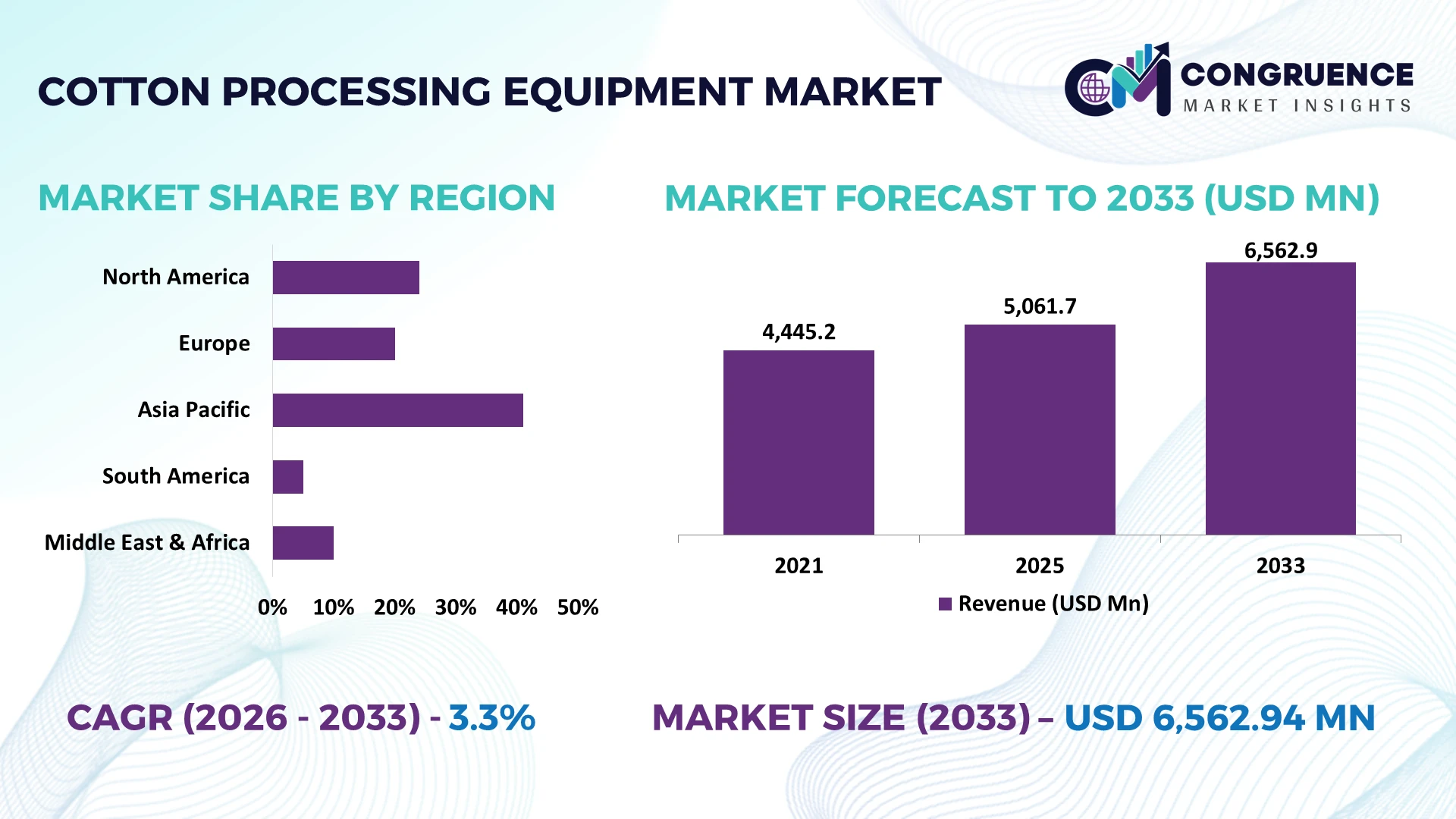
The Global Cotton Processing Equipment Market was valued at USD 5061.7 Million in 2025 and is anticipated to reach a value of USD 6562.94 Million by 2033 expanding at a CAGR of 3.3% between 2026 and 2033. Growth is driven by high-capacity gin modernization, automated contamination removal, optical fiber-quality inspection, and energy-efficient pressing systems as processors upgrade aging post-harvest infrastructure.
China remains the dominant processing-equipment demand center, supported by production exceeding 6 million metric tons of cotton and Xinjiang contributing about 90% of national output. Large ginning clusters increasingly use automated feeding, lint cleaning, bale pressing, moisture control, and machine-vision inspection to standardize fiber quality. India produces comparable raw-cotton volumes but operates through a more fragmented ginning base, creating stronger demand for incremental modernization. U.S.-China trade friction and cotton sourcing diversification are reinforcing processor focus on traceability and consistent bale specifications.
Strategically, suppliers should prioritize integrated high-throughput lines in China while targeting modular retrofits and automation upgrades across India’s decentralized processing network.
Market Size & Growth: USD 5,061.7 million in 2025 reaches USD 6,562.94 million by 2033 at 3.3% CAGR as automated ginning and quality-control upgrades replace aging machinery.
Top Growth Drivers: Gin modernization contributes approximately 36%, automation upgrades 29%, and contamination-control requirements 21% of major equipment investment momentum.
Short-Term Forecast: By 2028, optimized gin-line controls are positioned to improve processing throughput by 8–12% through synchronized feeding, cleaning, and pressing operations.
Emerging Technologies: AI vision inspection, automated moisture management, and intelligent gin controls are shifting cotton processing toward continuous quality optimization, with advanced optical systems detecting multiple contamination classes in real time.
Regional Leaders: Asia-Pacific approaches USD 3.0 billion, North America nears USD 1.2 billion, and Europe approaches USD 0.7 billion by 2033 as automation intensity differs across processing structures.
Consumer/End-User Trends: Large ginners increasingly specify integrated processing lines, with modern installations combining 5+ functions spanning pre-cleaning, drying, ginning, lint cleaning, conveying, and bale preparation.
Pilot/Case Example: In 2025, automated optical inspection deployments demonstrated contamination-detection accuracy above 95%, strengthening processor ability to protect premium fiber specifications before spinning.
Competitive Landscape: The leading supplier holds approximately 10–12% share, with Lummus, Bajaj Steel Industries, Rieter, Cherokee Fabrication, and Balkan Cotton Gin Machinery competing across processing configurations.
Regulatory & ESG Impact: Modern variable-speed drives and optimized pneumatic conveying can reduce electricity consumption by approximately 10–15%, aligning gin modernization with processor energy-efficiency targets.
Investment & Funding: More than USD 300 million in broader cotton-processing modernization and textile infrastructure investment is supporting machinery expansion, localization, automation, and integrated value-chain capacity.
Innovation & Future Outlook: Next-generation installations increasingly connect 6+ processing stages through centralized controls, shifting purchasing decisions from individual machines toward synchronized gin-line performance and lifecycle productivity.
The Cotton Processing Equipment Market is increasingly shaped by modernization of ginning plants, lint cleaning, bale pressing, drying, conveying, and fiber-quality inspection infrastructure. Processors are adopting machine vision, automated moisture regulation, variable-frequency drives, and centralized control architectures to stabilize output specifications while reducing operator intervention. Modern pneumatic and drive optimization can lower energy requirements by approximately 10–15% under suitable operating conditions. Cotton supply-chain traceability requirements are also raising the value of standardized bale information and consistent processing records, moving equipment procurement toward integrated systems and establishing the strategic priorities examined next.
Cotton processing equipment is becoming strategically important as mills demand cleaner, more consistent fiber while producing countries strengthen domestic value addition. Supply-chain restructuring is pushing ginners beyond basic seed separation toward integrated cleaning, moisture management, contamination detection, and bale traceability. India’s modernization of textile infrastructure and China’s concentration of cotton processing in Xinjiang are directing machinery investment toward facilities capable of delivering repeatable specifications to increasingly automated spinning mills.
Technology is changing gin economics. Variable-frequency pneumatic systems can consume roughly 15–25% less electricity than fixed-speed legacy configurations under optimized loads, while optical contamination detection identifies foreign material before fiber reaches downstream spinning. China favors large integrated installations; India offers deeper retrofit potential across decentralized ginning clusters. Through 2028, centralized controls and sensor-based process optimization will increasingly become standard specifications for commercially scaled modernization projects.
A practical upgrade connects seed-cotton feeding, drying, gin stands, lint cleaning, bale pressing, and quality monitoring through one control architecture, reducing production imbalances between stages. Manufacturers are consequently expanding automation engineering, retrofit services, local fabrication, and textile-industry partnerships. Competitive positioning will depend on improving whole-line productivity rather than supplying isolated machines, making integration capability the defining long-term advantage.
Higher-speed spinning machinery is raising upstream requirements for uniform lint, controlled moisture, and reduced contamination, directly influencing gin-equipment replacement. Cotton accounts for roughly 20–25% of global fiber use, while contamination-related quality deductions can reduce realized lint value by 3–8% for affected bales. India’s textile modernization drive is intensifying pressure on ginners to deliver consistent raw material to automated spinning facilities. This shifts investment toward pre-cleaners, lint cleaners, moisture-control equipment, and process instrumentation rather than simple capacity additions. Equipment manufacturers are expanding integrated gin-line engineering and developing automated quality controls that stabilize output between crop varieties. The strategic advantage lies in protecting downstream spinning efficiency: processors able to document repeatable fiber characteristics gain stronger access to quality-sensitive textile customers.
Cotton ginning assets face structurally uneven utilization because processing remains concentrated around harvest periods, limiting annual operating hours available to recover capital investment. In several producing markets, gins can remain inactive for 40–60% of the year, while electricity and labor can represent 15–25% of conversion costs during operation. Pakistan illustrates the pressure: volatile cotton availability has periodically left domestic ginning capacity substantially underutilized, weakening machinery replacement economics. Processors therefore delay comprehensive upgrades even when individual components become inefficient. Equipment suppliers are reducing exposure through modular retrofits, refurbished machinery, phased installations, and locally manufactured wear components. The non-obvious constraint is consequently not equipment price alone but annual throughput certainty; suppliers offering scalable upgrades aligned with actual crop availability can achieve stronger conversion than vendors promoting oversized turnkey capacity.
AI-enabled fiber inspection, hyperspectral sensing, automated moisture optimization, and digital bale records create an opportunity to transform ginning from mechanical processing into measurable quality management. Machine-vision platforms can achieve contamination-detection rates above 90% for clearly identifiable foreign materials, while moisture optimization can improve bale consistency by approximately 5–10% under variable incoming conditions. Brazil provides an attractive deployment environment because expanding mechanized cotton production supports large, commercially managed processing facilities with strong export-quality requirements. Through 2028, equipment suppliers can embed quality analytics directly into cleaning and pressing lines, connecting machine settings with bale-level performance records. Manufacturers are increasing R&D around cameras, sensors, automated controls, and traceability software. The strategic opportunity extends beyond equipment sales: quality-monitoring platforms can support recurring diagnostics, optimization, and maintenance services throughout the gin lifecycle.
Advanced gin lines require mechanical, electrical, pneumatic, sensor, software, and data systems to operate as one production environment, creating execution complexity beyond conventional machinery maintenance. Automated facilities can contain dozens of connected motors and control points, while unplanned downtime during a compressed harvest window can reduce seasonal processing availability by 5–10%. India’s fragmented technical-service environment intensifies this challenge outside major textile clusters, where specialist automation technicians are less accessible. Cybersecurity also becomes relevant as remote diagnostics and networked controllers connect production assets externally. Manufacturers must expand commissioning teams, operator training, remote-support capability, standardized control architectures, and predictive-maintenance tools. The decisive issue is system recoverability: sophisticated automation delivers little advantage when a single sensor or controller stops an entire line during peak intake, making service infrastructure as strategically important as equipment performance.
Compact Bales Reshape Logistics Economics: High-density pressing is gaining importance as exporters optimize container utilization and warehouse space. Modern presses can raise bale density by 15–25% and reduce storage footprint by roughly 10–20%. Brazil’s export-oriented cotton chain is encouraging standardized, transport-efficient bale formats. Equipment manufacturers are upgrading hydraulic systems, automated strapping, bale weighing, and conveyor interfaces, allowing processors to lower handling frequency while moving finished cotton faster from gin yards into export logistics.
Remote Diagnostics Enter Gin Operations: Processors are adding PLC connectivity, equipment dashboards, vibration monitoring, and remote troubleshooting to reduce dependence on emergency site visits. Condition monitoring can identify bearing or drive deterioration days before failure and cut diagnostic time by approximately 30–40%. Seasonal labor shortages make rapid technical intervention particularly valuable during peak intake. Machinery companies are expanding remote-service capabilities, connected controllers, and dealer technician support, turning aftermarket responsiveness into an increasingly important equipment-selection criterion.
Dust Control Receives Capital Priority: Gin operators are upgrading cyclones, filtration, enclosed conveying, and extraction systems as worker safety and particulate management receive greater operational attention. Improved collection configurations can capture more than 95% of larger process particulates while lowering housekeeping requirements by 20–30%. U.S. processors are increasingly incorporating dust management during facility refurbishment rather than treating extraction as auxiliary equipment. Suppliers are responding with redesigned ducting, filtration packages, enclosed transfer points, and airflow-management engineering.
Modular Retrofits Extend Asset Life: Processors are increasingly replacing individual gin stands, feeders, cleaners, controls, and press components rather than rebuilding complete facilities. Targeted retrofits can require 25–40% less capital than extensive line replacement and shorten installation shutdowns considerably. This approach is gaining relevance across fragmented Indian processing clusters where existing mechanical assets retain usable structural life. Manufacturers are expanding standardized upgrade kits, compatible control packages, and locally stocked replacement assemblies to capture modernization spending without requiring greenfield investment.
Ginning Machines represent the leading type with an estimated 32% share, reflecting their indispensable role in separating lint from seed and determining processing throughput. Modern multi-stand installations provide substantially greater hourly capacity than small legacy configurations, making ginning machinery the principal capital asset in commercial plants. Cleaning Machines remain strategically important where processors handle contamination-sensitive cotton, while Opening Machines condition compacted material before downstream processing. Baling Machines benefit from increasingly standardized storage and shipment requirements, supporting continued replacement demand across export-oriented facilities.
Carding Machines are the fastest-growing type as textile processors place greater emphasis on fiber orientation, impurity removal, and preparation consistency before spinning. Advanced carding configurations can increase usable fiber realization by approximately 3–5% compared with poorly maintained conventional equipment while reducing downstream irregularity. Drawing Machines and Combing Machines address progressively finer quality requirements, particularly in higher-count yarn production. Manufacturers are concentrating development on higher production speeds, automated settings, reduced maintenance, and interconnected controls, shifting investment toward equipment that protects fiber quality across successive processing stages.
Ginning leads application demand with an estimated 34% share because every harvested cotton stream requires seed separation before lint can enter textile manufacturing. Its capital intensity, throughput dependency, and direct effect on fiber damage concentrate equipment expenditure at this stage. Fiber Cleaning follows as mills increasingly control trash and residual impurities before subsequent processing. Bale Formation remains essential for standardized storage and transport, while Carding supports fiber individualization and alignment. Combing serves premium yarn applications where shorter fibers must be removed more selectively.
Fiber Preparation is the fastest-growing application as processors increasingly manage material characteristics before high-speed downstream machinery. Optimized opening and preparation can reduce process variability by approximately 8–12%, supporting more stable carding and spinning conditions. Spinning Preparation also gains strategic importance as automated textile plants require consistent sliver characteristics rather than correcting variation at later stages. Equipment manufacturers are responding with application-specific line configurations, automated material transfer, precision controls, and performance monitoring. Capital allocation is consequently moving toward coordinated preparation sequences rather than independently optimized processing machines.
Cotton Ginneries constitute the leading end-user group with an estimated 36% share because they operate the primary machinery required to convert harvested seed cotton into commercially tradable lint and cottonseed. Their purchasing concentrates on gin stands, cleaners, dryers, conveying systems, presses, and material-handling infrastructure. Spinning Mills prioritize preparation consistency and equipment reliability because irregular input directly affects yarn quality. Textile Mills and Textile Manufacturers purchase broader processing configurations where fiber preparation is integrated with downstream production, while Cotton Cooperatives favor equipment matched to aggregated seasonal volumes.
Fiber Processors are the fastest-growing end-user group as specialized businesses expand value-added cleaning, preparation, blending, and quality conditioning between primary ginning and textile conversion. Specialized processing can improve recoverable material utilization by approximately 4–7% when incoming cotton quality varies materially. Manufacturers are targeting these buyers through configurable lines, performance-based service packages, localized engineering, and flexible equipment combinations. Investment priorities therefore increasingly reflect the economic value captured per processed bale rather than installed capacity alone.
Asia-Pacific accounted for the largest market share at 46.8% in 2025 however, South America is expected to register the fastest growth, expanding at a CAGR of 4.6% between 2026 and 2033.
High-Capacity Ginning Defines Replacement Investment
North America accounted for approximately 20.7% of equipment demand in 2025, anchored by the United States’ highly mechanized cotton value chain. Commercial gins increasingly prioritize capacity reliability, automated material movement, moisture restoration, hydraulic pressing, and rapid turnaround during compressed harvesting windows. Texas dominates the processing footprint because it contributes more than 40% of U.S. cotton production in favorable crop years, creating concentrated requirements for heavy-duty machinery and aftermarket support. Equipment replacement increasingly targets bottlenecks between gin stands and material-handling stages rather than complete plant reconstruction. Domestic engineering capability, established parts distribution, and proximity to major cotton states give manufacturers an important service advantage. Suppliers are therefore emphasizing rebuild programs, component standardization, preventive maintenance packages, and rapid field support to protect seasonal uptime.
United States Market Outlook: U.S. cotton processing benefits from large mechanized farms, standardized bale logistics, classing infrastructure, and export-oriented production. More than 500 active cotton gins provide a substantial installed machinery base requiring recurring maintenance and component replacement. Manufacturers able to guarantee parts availability during peak harvesting periods gain stronger customer retention because lost processing hours cannot easily be recovered after crop intake accelerates.
Specialized Textile Engineering Supports Premium Systems
Europe represented approximately 10.4% of global equipment demand in 2025, with Turkey, Greece, and Spain forming the principal cotton-processing centers connected to established textile manufacturing networks. Regional purchasing emphasizes machinery precision, energy management, contamination control, and fiber preparation rather than large greenfield ginning expansion. Greece remains the European Union’s dominant raw-cotton producer, while Turkey combines domestic cotton processing with one of the region’s deepest spinning and textile manufacturing ecosystems. European machinery engineering also influences global equipment specifications through advanced carding, drawing, combing, and process-control technologies. Environmental compliance is strengthening interest in lower-energy motors, efficient extraction, and reduced process waste. Manufacturers are concentrating on premium retrofits, digitally controlled preparation equipment, and integration with existing mill infrastructure rather than competing primarily through maximum installed capacity.
Turkey Market Outlook: Turkey’s strategic strength lies in vertical connectivity between cotton processing, spinning, weaving, apparel, and export manufacturing. Domestic cotton production supplies only part of mill requirements, making processors accustomed to managing fiber from multiple origins. This encourages investment in cleaning, blending, preparation, and quality-control equipment capable of maintaining consistent downstream performance despite variable incoming material characteristics.
Processing Scale Sustains Machinery Leadership
Asia-Pacific held approximately 46.8% of global equipment demand in 2025, reflecting the concentration of cotton cultivation, ginning, spinning, and textile manufacturing across China, India, Pakistan, Bangladesh, and neighboring production economies. India operates thousands of ginning and pressing units, creating a large installed base spanning basic mechanical plants and increasingly sophisticated automated facilities. China differs through greater processing concentration and integration with industrial-scale spinning capacity, supporting demand for synchronized machinery and centralized plant controls. Pakistan’s established ginning sector generates replacement requirements but remains exposed to fluctuations in domestic crop availability. Equipment manufacturers are expanding local production, component sourcing, technical-service centers, and retrofit offerings to address sharply different customer economics. Scale therefore favors suppliers capable of serving both cost-sensitive independent ginners and highly automated textile groups without fragmenting their service networks.
India Market Outlook: India combines one of the world’s largest cotton-growing systems with a decentralized processing network and extensive spinning capacity. More than 3,000 ginning and pressing factories create unusually broad demand for replacement machinery, modernization kits, automation controls, and maintenance components. Domestic manufacturing gives equipment suppliers an advantage in pricing, customization, delivery times, and adaptation to locally cultivated cotton varieties.
Export Expansion Accelerates Greenfield Processing
South America accounted for approximately 14.2% of global demand in 2025, led decisively by Brazil’s rapidly expanding industrial cotton sector. Production growth across Mato Grosso and Bahia is increasing requirements for new gin plants, large-capacity presses, conveying infrastructure, storage systems, and export-oriented bale handling. Unlike mature replacement markets, Brazilian investment includes substantial greenfield processing capacity positioned close to expanding cultivation areas. Long transport distances between inland farms and ports increase the value of reliable compression and standardized bale preparation. Infrastructure remains a constraint because machinery, spare parts, and specialist technicians must cover geographically dispersed production zones. Suppliers are responding through Brazilian assembly, service partnerships, local inventories, and high-capacity equipment engineered for long seasonal operating schedules, making field support central to equipment selection.
Brazil Market Outlook: Brazil has become one of the world’s largest cotton exporters, creating equipment requirements directly tied to internationally traded fiber quality and logistics performance. Mato Grosso contributes roughly two-thirds of national cotton production, concentrating processing investment around large farming groups. This geographic clustering supports high-throughput installations and creates sufficient equipment density for dedicated technical-service networks and regional spare-parts inventories.
Domestic Value Addition Redirects Machinery Investment
Middle East & Africa represented approximately 7.9% of global equipment demand in 2025, with Turkey excluded from this regional classification and activity concentrated across Egypt, Benin, Côte d’Ivoire, Burkina Faso, Tanzania, and other African cotton economies. A structural transition is underway from exporting raw lint toward capturing more processing value domestically. West African governments and industrial developers are promoting local textile manufacturing, increasing requirements for modern ginning, preparation, baling, and supporting utility infrastructure. Equipment deployment remains constrained by power reliability, financing, technical skills, and access to replacement components. Manufacturers are addressing these conditions through robust machine designs, simplified controls, operator training, regional maintenance arrangements, and equipment capable of tolerating unstable utility conditions. Localization therefore matters as much as headline processing capacity.
Benin Market Outlook: Benin has emerged as a strategically important cotton-processing location through industrial development centered on the Glo-Djigbé Industrial Zone. The country produces several hundred thousand tonnes of seed cotton in strong seasons while directing investment toward domestic textile conversion. This creates equipment demand extending beyond conventional ginning into fiber preparation and integrated textile-processing infrastructure.
Lummus, Bajaj Steel Industries, Rieter, Balkan Cotton Gin Machinery, and Cherokee Fabrication compete across different processing stages, with integrated OEMs facing regional engineering specialists and cost-focused machinery suppliers. The top five participants collectively represent approximately 32–37% of equipment demand, reflecting substantial fragmentation across ginning and textile preparation. Lummus competes through gin-system engineering, while Bajaj Steel leverages manufacturing breadth and emerging-market reach; Rieter differentiates through advanced fiber preparation. Automated systems can deliver 15–20% higher operational productivity, whereas locally manufactured configurations can carry acquisition costs roughly 10–18% below imported premium machinery. Suppliers are expanding manufacturing footprints, retrofit services, distributor partnerships, and digital controls to capture modernization spending. Competition is shifting from standalone machine specifications toward whole-line compatibility, lifecycle service, and rapid parts availability. Engineering expertise, installed-base relationships, and seasonal service capacity remain critical entry barriers. Winning requires localized support, measurable processing economics, adaptable automation, and dependable lifecycle performance.
Lummus Corporation
Bajaj Steel Industries Limited
Rieter Holding AG
Balkan Cotton Gin Machinery Ltd.
Cherokee Fabrication Company, Inc.
Nipha Exports Private Limited
Jadhao Gears Limited
Bhagwati Engineering Works
Shandong Swan Cotton Industrial Machinery Stock Co., Ltd.
Toyota Industries Corporation
Trützschler Group SE
Lakshmi Machine Works Limited
A.T.E. Enterprises Private Limited
Saurer Intelligent Technology AG
Current cotton processing technology centers on sensor controlled ginning, intelligent carding, automatic material transport, and real time process monitoring. Modern cards using automatic gap regulation stabilize sliver quality while sustaining throughput; optimized platforms can lower energy use by about 30%. Adoption is strongest in integrated spinning operations, where centralized controls connect opening, cleaning, carding, and drawing, giving processors tighter quality control across changing cotton lots.
Emerging systems combine machine vision, self adjusting settings, robotic can transport, and predictive maintenance. Automated sliver movement removes manual transfers between preparation stages, while condition analytics identifies deterioration before stoppages. Compared with conventional carding equipment, current high productivity platforms can raise output by roughly 40% in suitable installations. Mills processing multiple cotton origins benefit because adaptive controls maintain consistency without repeated mechanical adjustment, strengthening utilization and delivery reliability.
Disruptive development is moving toward autonomous fiber preparation, AI assisted quality optimization, and digitally coordinated production cells. By 2026–2028, equipment decisions will favor machines exchanging quality, maintenance, and production data without operator inputs. Smart preparation lines can support labor reductions above 20% where material transport is automated. Suppliers integrating controls, analytics, diagnostics, and retrofit pathways gain advantage as processors shift from machine efficiency toward self optimizing production.
May 2024 Northern Cotton completed its Katherine gin, installing Lummus cleaning, drying, ginning, automation, and monitoring equipment. The integrated facility established new processing infrastructure for northern Australia, improving local capacity while materially reducing growers’ dependence on distant southern ginning operations.
March 2025 Bajaj Steel Industries secured a USD 5.03 million international order covering cotton ginning and processing machinery, electrical panels, spare parts, installation supervision, and prefabricated structures, expanding its turnkey export pipeline internationally with execution scheduled within nine months.
May 2025 ICAR CIRCOT and Bajaj Steel Industries deployed pre grooved roller technology across 1,000 gin units in 40 Maharashtra mills. The design raised output from 63 to 70 kilograms hourly at one operator while reducing operating costs approximately 10%.
September 2025 Rieter presented OMEGAlap E 40 for combing preparation at ITMA Asia, delivering 33% higher output and 30% lower energy consumption. The technology strengthens mill economics by increasing lap preparation productivity while reducing electricity requirements across cotton processing operations.
The Cotton Processing Equipment Market report evaluates Ginning Machines, Opening Machines, Cleaning Machines, Carding Machines, Drawing Machines, Combing Machines, and Baling Machines across ginning, fiber cleaning, fiber preparation, carding, combing, spinning preparation, and bale formation. End user coverage spans Cotton Ginneries, Textile Mills, Spinning Mills, Cotton Cooperatives, Fiber Processors, and Textile Manufacturers, distinguishing primary processing requirements from downstream fiber preparation and specialized value addition.
Regional assessment covers North America, Europe, Asia Pacific, South America, and Middle East & Africa, including established processing clusters and emerging modernization locations. Technology coverage examines intelligent controls, automated material transport, predictive maintenance, advanced fiber inspection, autonomous preparation, and equipment integration. Competitive analysis evaluates 10–14 influential manufacturers through processing specialization, manufacturing footprint, service capability, localization, and product architecture. The 2026–2033 framework supports capacity planning, equipment portfolio decisions, geographic expansion, partnership selection, modernization strategy, and competitive positioning.
| Report Attribute/Metric | Report Details |
|---|---|
Market Revenue in 2025 | USD 5061.7 Million |
Market Revenue in 2033 | USD 6562.94 Million |
CAGR (2026 - 2033) | 3.3% |
Base Year | 2025 |
Forecast Period | 2026 - 2033 |
Historic Period | 2021 - 2025 |
Segments Covered | By Type
By Application
By End-User
|
Key Report Deliverable | Revenue Forecast, Growth Trends, Market Dynamics, Segmental Overview, Regional and Country-wise Analysis, Competition Landscape |
Region Covered | North America, Europe, Asia-Pacific, South America, Middle East, Africa |
Key Players Analyzed | Lummus Corporation, Bajaj Steel Industries Limited, Rieter Holding AG, Balkan Cotton Gin Machinery Ltd., Cherokee Fabrication Company, Inc., Nipha Exports Private Limited, Jadhao Gears Limited, Bhagwati Engineering Works, Shandong Swan Cotton Industrial Machinery Stock Co., Ltd., Toyota Industries Corporation, Trützschler Group SE, Lakshmi Machine Works Limited, A.T.E. Enterprises Private Limited, Saurer Intelligent Technology AG |
Customization & Pricing | Available on Request (10% Customization is Free) |




