
Reports
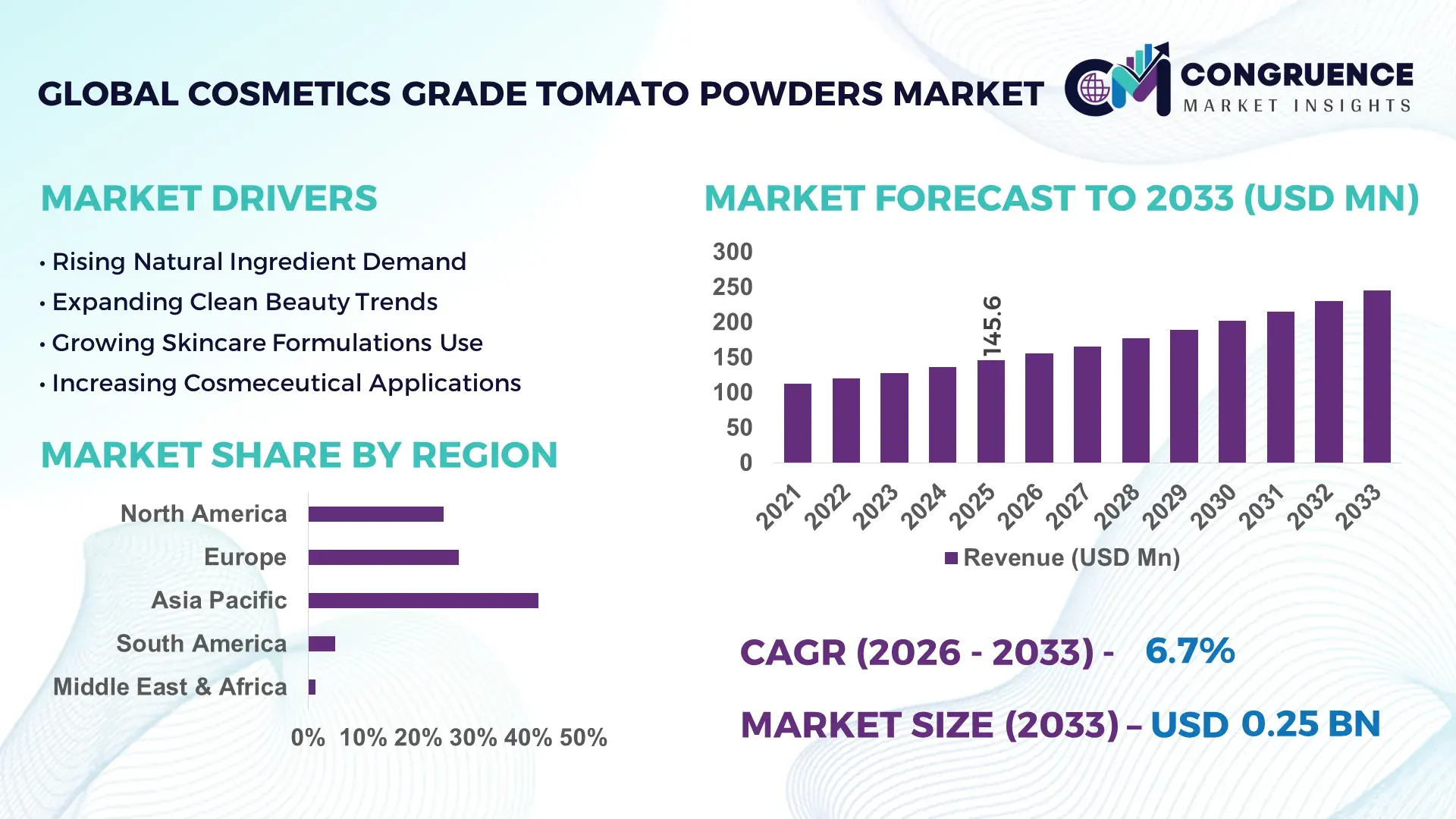
The Global Cosmetics Grade Tomato Powders Market was valued at USD 145.6 Million in 2025 and is anticipated to reach a value of USD 245.3 Million by 2033 expanding at a CAGR of 6.74% between 2026 and 2033. Growth is being driven by increasing incorporation of lycopene-rich botanical actives in anti-aging, brightening, and antioxidant skincare formulations across premium cosmetics manufacturing hubs.
China dominates the global cosmetics grade tomato powders market with an estimated 31% share of production capacity, supported by large-scale tomato processing clusters in Xinjiang and Shandong and over USD 1.2 billion invested in advanced food and botanical extraction infrastructure. In comparison, Italy accounts for nearly 12% of specialty tomato-derived cosmetic ingredient exports, benefiting from premium extraction technologies and clean-label positioning. Following supply-chain diversification trends accelerated after the Russia–Ukraine conflict, Chinese processors improved lycopene extraction yields by approximately 18%, strengthening global ingredient competitiveness.
The market’s concentration around high-capacity extraction ecosystems makes supply security, ingredient traceability, and technology partnerships critical competitive priorities.
Market Size & Growth: USD 145.6 million in 2025, reaching USD 245.3 million by 2033, supported by rising adoption of lycopene-enriched skincare ingredients and advanced botanical extraction technologies.
Top Growth Drivers: Natural ingredient adoption +22%, antioxidant-focused skincare launches +18%, and premium cosmetic formulation penetration +16% globally.
Short-Term Forecast: By 2028, extraction efficiency is projected to improve by 15% through automated processing and optimized ingredient recovery systems.
Emerging Technologies: AI-enabled quality control, supercritical extraction, and precision drying technologies are improving active compound retention by up to 20%.
Regional Leaders: Asia-Pacific approaches USD 95 million, Europe exceeds USD 62 million, and North America nears USD 48 million, driven by clean-beauty adoption and ingredient localization.
Consumer/End-User Trends: More than 44% of premium skincare launches now incorporate plant-derived antioxidants as consumers prioritize naturally sourced actives.
Pilot/Case Example: In 2024, ingredient processors deploying advanced lycopene extraction systems reported approximately 17% higher active-yield recovery rates.
Competitive Landscape: Leading suppliers collectively control nearly 38% market share, with key participants including Lycored, Givaudan, Döhler, Kanegrade, and Naturex.
Regulatory & ESG Impact: Waste valorization initiatives reduce tomato-processing byproducts by nearly 25%, supporting circular manufacturing objectives.
Investment & Funding: More than USD 350 million has been directed toward botanical ingredient expansion, extraction upgrades, and strategic partnerships since 2023.
Innovation & Future Outlook: Next-generation encapsulated lycopene formulations improve ingredient stability by 20% and support high-performance cosmetic applications.
Cosmetics Grade Tomato Powders are gaining traction across anti-aging serums, brightening creams, sun-care products, and antioxidant-rich personal care formulations due to their high lycopene concentration and natural positioning. Advanced microencapsulation technologies are improving active ingredient stability by nearly 20%, while ingredient suppliers increasingly utilize tomato-processing byproducts to enhance sustainability. Growing regulatory attention toward synthetic additive reduction is accelerating adoption of plant-derived cosmetic actives, setting the stage for deeper strategic market evolution.
The Cosmetics Grade Tomato Powders Market is becoming strategically important as beauty brands intensify competition around natural active ingredients, formulation transparency, and differentiated performance claims. Ingredient sourcing strategies are shifting toward traceable botanical supply chains, while manufacturers increasingly prioritize vertically integrated extraction capabilities. The market also benefits from broader reformulation initiatives aimed at reducing synthetic antioxidants and increasing naturally derived ingredient content in premium skincare portfolios.
Technology adoption is reshaping competitive dynamics. Modern supercritical and precision extraction systems deliver up to 18% higher lycopene recovery rates compared with conventional solvent-based methods while reducing processing losses. China maintains scale advantages through integrated processing infrastructure, whereas Italy and Spain focus on premium-grade specialty ingredients and high-purity extracts. Over the next two to three years, automated quality-control systems are expected to increase batch consistency by more than 12%, strengthening product standardization across cosmetic applications.
A practical example is the expansion of ingredient partnerships between tomato processors and cosmetic formulators to secure long-term access to standardized antioxidant ingredients. Companies are increasing investments in extraction modernization, product certification, and sustainable sourcing programs. Organizations that secure reliable raw-material networks, advanced extraction capabilities, and premium formulation partnerships will strengthen competitive positioning and create lasting operational advantages within the evolving botanical cosmetics ecosystem.
Demand for cosmetics grade tomato powders is accelerating as skincare manufacturers increase the use of naturally derived antioxidant ingredients in anti-aging and skin-protection products. Lycopene concentrations in tomato-derived ingredients can provide up to 2 times greater oxidative stability than several conventional botanical extracts, making them attractive for premium formulations. More than 44% of newly launched clean-label skincare products now feature plant-based antioxidant positioning, while natural ingredient adoption across prestige beauty categories has increased by over 20% during recent product cycles. Following tightening ingredient transparency requirements in Europe, cosmetic brands are investing in traceable botanical sourcing. In response, processors in China and Italy are expanding extraction capacity, forming supply agreements, and developing high-purity ingredient grades. The strategic outcome is stronger formulation differentiation and higher-value product positioning.
The market faces structural pressure from fluctuations in tomato harvest quality, agricultural input costs, and energy-intensive extraction processes. Tomato yields can vary by 10–15% annually due to weather disruptions, directly affecting ingredient availability and processing economics. Energy expenses account for nearly 18% of advanced drying and extraction costs, creating margin pressure for ingredient suppliers. Recent climate-related production variability in Southern Europe has highlighted supply dependency risks for specialty tomato derivatives. These conditions impact scalability, inventory planning, and long-term procurement strategies. To mitigate exposure, manufacturers are diversifying sourcing networks across China, Turkey, and Mediterranean processing hubs while securing multi-year supply contracts. Companies are also investing in yield optimization technologies to stabilize production efficiency and protect profitability during periods of agricultural volatility.
Significant opportunities are emerging from multifunctional cosmetic ingredients that combine antioxidant, anti-pollution, and skin-brightening properties. Functional skincare products account for more than 35% of premium beauty launches, while demand for naturally sourced active ingredients continues to outpace conventional formulations. Advanced encapsulation technologies improve active ingredient retention by approximately 20% and extend formulation stability, creating higher-value applications across serums and dermocosmetics. Japan and South Korea are increasingly integrating concentrated botanical actives into science-backed skincare platforms, creating opportunities for specialized ingredient suppliers. Companies are responding through R&D partnerships, customized ingredient development, and application-specific formulations. A less obvious opportunity lies in converting tomato-processing byproducts into cosmetic-grade ingredients, improving resource efficiency while creating new revenue streams and sustainability advantages.
Maintaining consistent lycopene concentration, color profile, and bioactive performance across batches remains a major execution challenge. Variations in raw material characteristics can create 12–18% differences in active compound levels, complicating formulation consistency for multinational cosmetic brands. As premium skincare manufacturers increasingly require standardized ingredient specifications, quality-control requirements continue to intensify. Different regulatory frameworks across Europe, China, and North America further increase compliance complexity and documentation burdens. Companies must also address growing customer expectations for traceability, sustainability verification, and ingredient performance validation. To overcome these barriers, suppliers are investing in digital quality-monitoring systems, laboratory testing infrastructure, and standardized extraction protocols. Organizations that achieve reliable global consistency will secure stronger supplier relationships and long-term competitive relevance in high-value cosmetic ingredient markets.
Advanced Lycopene Stabilization Technologies Cosmetic ingredient manufacturers are increasingly deploying microencapsulation and controlled-release technologies to improve lycopene stability and formulation performance. Active retention rates have improved by nearly 20%, while oxidation-related ingredient loss has declined by approximately 15%. South Korean skincare formulators are integrating stabilized tomato-derived actives into multifunctional serums and anti-pollution products. This transition enhances product shelf life and reduces reformulation cycles, prompting suppliers to expand processing partnerships and invest in proprietary encapsulation platforms.
Circular Ingredient Recovery Expansion Tomato-processing byproducts are becoming a valuable feedstock for cosmetic-grade ingredient production as sustainability targets tighten across beauty supply chains. Nearly 25% of ingredient developers have expanded waste valorization initiatives, while raw-material utilization efficiency has increased by around 18%. Italy and Spain are witnessing greater integration between food processors and cosmetic ingredient companies. The shift lowers sourcing costs, improves resource efficiency, and strengthens ESG positioning, leading manufacturers to establish dedicated recovery and extraction facilities.
Automation in Botanical Processing Automated sorting, drying, and extraction systems are transforming operational workflows across major processing hubs. Processing consistency has improved by approximately 14%, while labor-intensive quality inspection requirements have declined by nearly 12%. China-based processors are increasingly adopting AI-assisted quality monitoring following labor cost pressures and stricter ingredient standardization requirements. The result is faster batch validation, reduced production variability, and higher throughput, encouraging further investment in smart manufacturing infrastructure.
Premium Clean-Beauty Ingredient Positioning Demand for traceable botanical ingredients continues to reshape procurement strategies among global beauty brands. More than 40% of premium skincare launches now emphasize naturally sourced antioxidant actives, while certified ingredient demand has risen by roughly 17%. Regulatory scrutiny surrounding synthetic additives is accelerating qualification programs for plant-derived alternatives. Companies are responding through vertical integration, supplier audits, and long-term sourcing agreements that improve transparency, ingredient consistency, and brand differentiation.
Conventional Cosmetics Grade Tomato Powder remains the leading segment, accounting for approximately 48% of market demand due to established processing infrastructure, scalable production economics, and broad compatibility with skincare and personal care formulations. Manufacturers favor conventional grades because they offer stable lycopene content, lower procurement costs, and efficient integration into creams, lotions, and antioxidant blends. Spray-Dried Tomato Powder follows closely as a mature segment, benefiting from large-scale commercial production and consistent particle characteristics that support formulation uniformity. Organic Cosmetics Grade Tomato Powder is the fastest-growing segment as clean-label skincare and botanical ingredient certification gain strategic importance among premium brands. Organic product adoption has increased by nearly 21% across high-end cosmetic formulations, while demand for certified natural ingredients has risen by approximately 18%. Freeze-Dried Tomato Powder is also attracting investment due to superior nutrient preservation and higher active-compound retention rates. Companies are expanding organic processing capabilities, launching premium ingredient portfolios, and strengthening certification frameworks to capture higher-margin opportunities while diversifying product offerings.
Skincare Products represent the dominant application segment, contributing roughly 52% of overall demand due to widespread use of tomato-derived antioxidants in anti-aging, brightening, moisturizing, and environmental-protection formulations. The segment benefits from strong consumer preference for naturally sourced active ingredients and growing incorporation of lycopene-rich compounds into premium skincare portfolios. Haircare Products maintain steady adoption as manufacturers explore antioxidant-enriched scalp treatments and protective formulations designed to counter environmental stress factors. Color Cosmetics is emerging as the fastest-growing application segment, supported by increasing use of botanical ingredients in hybrid beauty products that combine aesthetic and skincare benefits. Adoption within multifunctional cosmetic products has increased by approximately 19%, while clean-beauty positioning has expanded by nearly 16% across premium cosmetic launches. Personal Care Products continue to gain relevance through body-care, cleansing, and wellness-focused formulations. Companies are expanding application-specific ingredient development programs and collaborating with formulators to improve performance characteristics across multiple cosmetic categories.
Cosmetic Manufacturers represent the largest end-user segment, accounting for approximately 55% of market demand due to large-scale formulation activities, extensive product portfolios, and continuous innovation pipelines. These organizations require reliable supplies of standardized botanical ingredients to support anti-aging, brightening, and premium skincare product development. Their purchasing power and long-term supplier agreements create substantial demand concentration and encourage ingredient producers to prioritize production consistency and quality assurance investments. Cosmeceutical Companies are the fastest-growing end-user segment as science-backed skincare solutions gain commercial traction. Demand from this category has expanded by nearly 22%, supported by increasing interest in antioxidant-rich ingredients with documented functional benefits. Contract Manufacturers continue expanding their role by supporting brand outsourcing strategies, while Personal Care Brands increasingly seek differentiated ingredient stories and sustainability credentials. Suppliers are responding through customized ingredient specifications, technical formulation support, strategic partnerships, and flexible supply agreements designed to strengthen customer retention and competitive positioning.
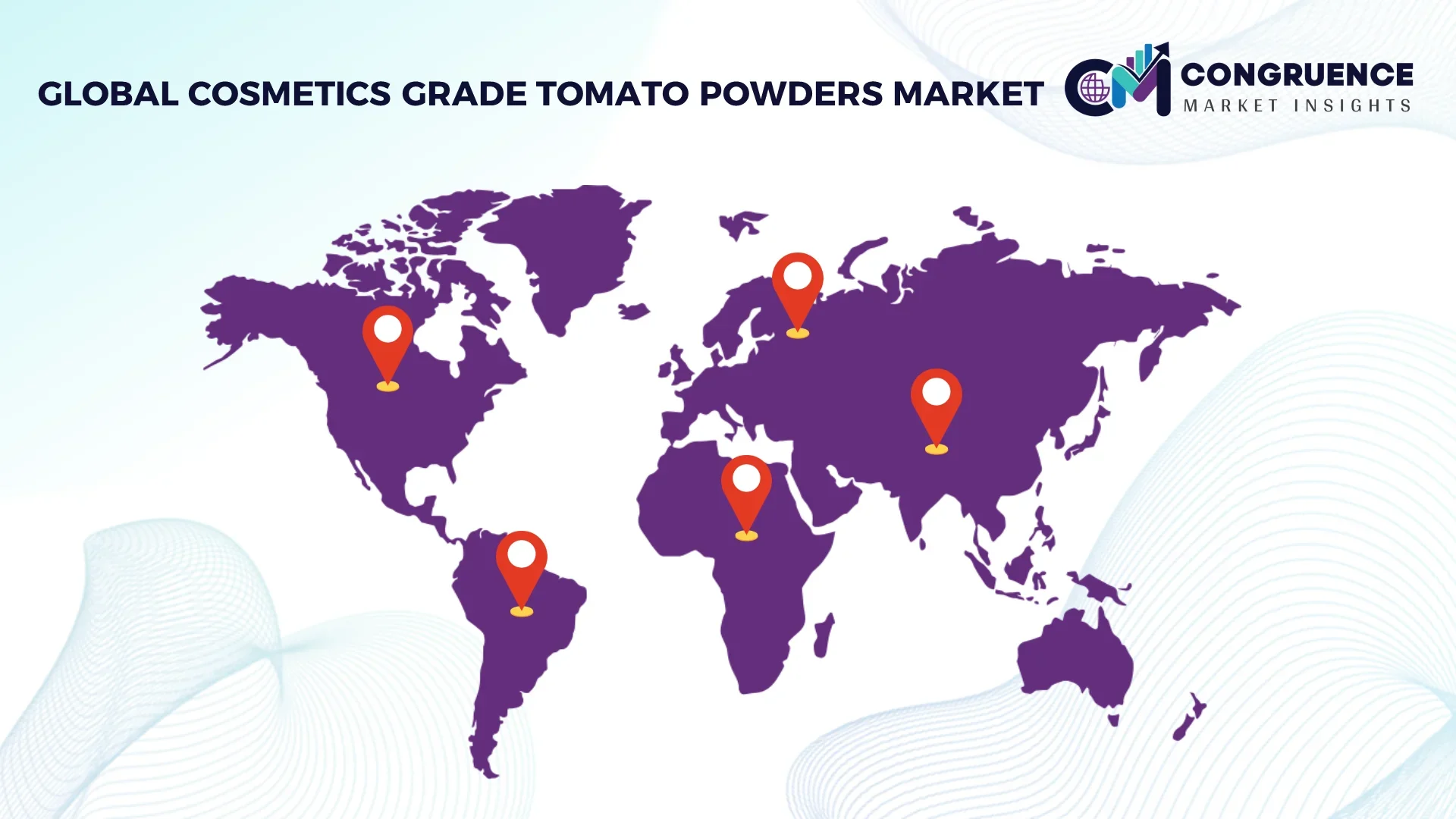
Asia-Pacific accounted for the largest market share at 41.8% in 2025 however, North America is expected to register the fastest growth, expanding at a CAGR of 7.3% between 2026 and 2033.
North America represents approximately 24.6% of the global market, supported by strong adoption of clean-label skincare ingredients, advanced cosmetic R&D capabilities, and expanding demand for antioxidant-based formulations. The region is witnessing increased deployment of plant-derived active ingredients across premium skincare and dermocosmetic product categories. More than 45% of newly introduced prestige skincare products now emphasize naturally sourced bioactive compounds. Cosmetic manufacturers are also strengthening ingredient traceability programs and supplier qualification standards. Several strategic partnerships between ingredient processors and beauty brands have reduced product development timelines by nearly 12%, improving commercialization efficiency and supporting greater integration of tomato-derived actives into high-performance formulations.
United States Market Outlook: The United States remains the dominant market within North America due to its extensive beauty and personal care manufacturing ecosystem, advanced formulation expertise, and strong consumer preference for botanical ingredients. More than 60% of regional demand originates from U.S.-based skincare and personal care brands. Companies are increasingly investing in functional cosmetic ingredients that support anti-aging and environmental protection claims. Growing collaboration between ingredient suppliers and contract manufacturers is enhancing product innovation pipelines, while premium beauty brands continue expanding portfolios featuring naturally sourced antioxidants and clean-label positioning.
Europe accounts for nearly 27.4% of global market activity and maintains a strong position through advanced botanical extraction capabilities, stringent ingredient quality standards, and sustainability-focused product development strategies. Regulatory emphasis on ingredient transparency continues to influence procurement decisions across the cosmetics sector. More than 38% of premium skincare formulations launched in key European markets now feature naturally derived antioxidant ingredients. Ingredient suppliers are increasingly integrating circular-economy practices into production workflows, improving raw-material utilization efficiency by approximately 18%. These developments are strengthening regional competitiveness while supporting premium product differentiation across established beauty markets.
Italy Market Outlook: Italy serves as the region’s most strategically important market due to its leadership in tomato processing, specialty ingredient manufacturing, and premium cosmetic formulation development. The country contributes significantly to Europe's supply of high-purity tomato-derived ingredients used in skincare applications. Advanced extraction facilities and strong integration between agricultural processors and cosmetic ingredient companies have enhanced operational efficiency. Italian manufacturers are increasingly focusing on value-added botanical ingredients, with premium natural cosmetic formulations expanding by more than 15% across leading beauty product categories.
Asia-Pacific leads the global market with a 41.8% share, supported by extensive tomato-processing infrastructure, high-volume ingredient production capabilities, and rapidly expanding cosmetics manufacturing ecosystems. China, South Korea, and Japan collectively account for a substantial share of regional cosmetic ingredient demand and innovation activity. Production efficiency improvements of nearly 20% have been achieved through automation and advanced extraction technologies. Growing domestic skincare consumption and increasing exports of botanical cosmetic ingredients continue to strengthen regional market influence. Companies are expanding processing capacity, upgrading extraction facilities, and enhancing quality-control systems to support evolving global customer requirements.
China Market Outlook: China remains the largest and most influential country market due to its extensive agricultural processing infrastructure, integrated supply chains, and large-scale botanical ingredient production capabilities. Approximately 31% of global cosmetics-grade tomato powder processing capacity is concentrated within China. Ingredient manufacturers continue investing in automation, precision extraction technologies, and export-oriented production facilities. Strong domestic beauty product demand and growing international supplier relationships are enabling Chinese companies to strengthen their position as key providers of lycopene-rich cosmetic ingredients across global markets.
South America accounts for approximately 4.9% of the global market and is gradually strengthening its position through abundant agricultural resources and increasing investment in value-added ingredient processing. The region benefits from significant tomato cultivation capacity, creating opportunities for local ingredient production and supply-chain integration. Adoption of botanical ingredients in premium personal care products has increased by nearly 14% across leading markets. However, processing infrastructure remains less developed than in major producing regions, limiting large-scale commercialization. Companies are responding through modernization initiatives, strategic processing partnerships, and targeted investments designed to improve extraction capabilities and ingredient quality consistency.
Brazil Market Outlook: Brazil represents the leading market within South America due to its large agricultural base, expanding personal care sector, and increasing focus on natural ingredient utilization. Domestic cosmetic manufacturers are actively exploring locally sourced botanical ingredients to reduce import dependency and improve supply-chain resilience. Investment in processing and ingredient refinement capabilities continues to increase, while premium skincare categories featuring natural actives have recorded double-digit adoption growth. Brazil’s combination of agricultural resources and beauty industry scale positions it as the region’s primary development hub.
The Middle East & Africa region contributes approximately 1.3% of global market activity and remains in an early-stage development phase characterized by selective investment, import dependence, and growing interest in premium personal care ingredients. Rising consumer demand for natural beauty products is encouraging greater participation from regional manufacturers. Several processing modernization initiatives have improved ingredient handling efficiency by nearly 10%, while partnerships with international suppliers are expanding access to advanced extraction technologies. Although infrastructure limitations remain, ongoing diversification strategies and industrial development programs are gradually creating new opportunities for botanical cosmetic ingredient adoption.
United Arab Emirates Market Outlook: The United Arab Emirates serves as the most strategically significant market within the region due to its advanced trade infrastructure, strong cosmetics retail ecosystem, and role as a regional distribution hub. The country facilitates the import, formulation, and redistribution of premium cosmetic ingredients across neighboring markets. Growing investment in specialty personal care manufacturing and increasing demand for clean-label beauty products are strengthening market activity. Enterprise partnerships and premium brand expansion strategies continue to support greater utilization of high-value botanical ingredients within the UAE cosmetics sector.
The Cosmetics Grade Tomato Powders Market is characterized by competition between global botanical ingredient specialists such as Lycored, Givaudan, Döhler, Kanegrade, and Naturex, and regional extract processors in China, Italy, and Turkey. The top five participants collectively account for approximately 38–42% of market activity, creating a moderately consolidated structure. Global leaders compete on extraction technology, ingredient standardization, and regulatory compliance, while regional suppliers compete aggressively on cost and processing scale.Competition increasingly centers on bioactive retention, supply-chain reliability, and customization. Advanced extraction technologies improve lycopene recovery by 15–20%, while automated quality-control systems reduce batch variability by nearly 12%. Premium suppliers are expanding through strategic partnerships with skincare brands, vertical integration into agricultural sourcing, and investment in encapsulation technologies. The competitive shift is moving toward traceable supply networks and high-performance botanical ingredients rather than commodity powders. Entry barriers include extraction expertise, certification requirements, and consistent active-content standardization. Winning requires scalable sourcing, superior ingredient functionality, and strong formulation partnerships with premium cosmetic manufacturers.
Givaudan
Döhler Group
Kanegrade Ltd.
Naturex
Symrise AG
Sensient Technologies Corporation
Kalsec Inc.
BioActor BV
LycoRed Natural Products Industries Ltd.
Nutra Green Biotechnology Co., Ltd.
Xi'an Lyphar Biotech Co., Ltd.
Shaanxi Undersun Biomedtech Co., Ltd.
Chenguang Biotech Group Co., Ltd.
Technology development is increasingly focused on maximizing lycopene stability, bioavailability, and formulation performance. Modern supercritical extraction systems deliver 15–18% higher recovery of active compounds compared with conventional solvent-based extraction while reducing residual processing contaminants. Nearly 35% of premium ingredient manufacturers have adopted advanced extraction platforms to improve ingredient consistency and support cosmetic-grade certification requirements. The result is stronger product efficacy and reduced quality variation across batches.
Emerging technologies include microencapsulation, precision drying, and AI-assisted process optimization. Encapsulation systems improve antioxidant stability by approximately 20% and extend active ingredient functionality within skincare formulations. AI-enabled monitoring platforms reduce production deviations by nearly 12%, allowing processors to achieve tighter quality specifications. Adoption rates for automated quality-control technologies now exceed 30% among leading botanical ingredient suppliers, creating a measurable operational advantage in premium cosmetic applications.
Disruptive innovation is shifting toward integrated botanical bioprocessing and circular ingredient recovery systems. Compared with traditional drying methods, next-generation low-temperature processing retains up to 25% more bioactive compounds. Large ingredient companies and technology-focused processors benefit most from these advancements through stronger differentiation and premium positioning. Between 2026 and 2028, increased deployment of smart extraction systems and bioactive-preservation technologies will accelerate product performance standards, making technology leadership a decisive competitive factor.
September 2024 – Givaudan Active Beauty launched the [N.A.S.]™ Vibrant Collection of concentrated botanical powder extracts using green fractionation technology. The portfolio includes five antioxidant-rich active powders designed for hybrid makeup applications, strengthening natural ingredient offerings and expanding botanical formulation capabilities. Source: www.givaudan.com
June 2024 – Givaudan Active Beauty introduced Silybidiol™, a 100% natural-origin active ingredient developed through advanced green fractionation processes. The innovation targets oxidative stress and inflammation pathways, supporting next-generation skin-health formulations and expanding the company's premium botanical active ingredient portfolio.
April 2025 – Givaudan Active Beauty launched PrimalHyal™ UltraReverse, an intracellular hyaluronic acid technology designed to address four of five primary aging hallmarks. The innovation strengthens advanced skincare development and reinforces investment in high-performance active ingredient platforms.
January 2026 – Lycored announced that tomato-derived beauty ingredients Lumenato™ and Lycoderm™ became commercially available across the European Union following novel food authorization. The milestone expands market access and strengthens the commercialization pathway for tomato-based beauty and wellness solutions.
The report provides comprehensive analysis of the global Cosmetics Grade Tomato Powders Market across key product categories, applications, end-user groups, and major geographic regions. Coverage includes conventional, organic, spray-dried, and freeze-dried tomato powder segments, along with applications spanning skincare, haircare, color cosmetics, and personal care products. The study evaluates demand distribution patterns, ingredient adoption trends, processing technologies, and competitive developments across North America, Europe, Asia-Pacific, South America, and the Middle East & Africa.
The analysis incorporates operational benchmarks, production trends, technology adoption rates, and competitive positioning strategies influencing industry development between 2026 and 2033. More than 40% of market demand remains concentrated within skincare-focused applications, while increasing deployment of advanced extraction and encapsulation technologies is reshaping supplier differentiation. The report further assesses investment priorities, supply-chain evolution, regulatory influences, emerging botanical ingredient opportunities, and strategic expansion pathways, providing actionable intelligence for manufacturers, investors, distributors, and cosmetic formulation companies seeking long-term competitive advantage.
| Report Attribute / Metric | Details |
|---|---|
| Market Revenue (2025) | USD 145.6 Million |
| Market Revenue (2033) | USD 245.3 Million |
| CAGR (2026–2033) | 6.74% |
| Base Year | 2025 |
| Forecast Period | 2026–2033 |
| Historic Period | 2021–2025 |
| Segments Covered |
By Type
By Application
By End-User
|
| Key Report Deliverables | Revenue Forecast; Market Trends; Growth Drivers & Restraints; Technology Insights; Segmentation Analysis; Regional Insights; Competitive Landscape; Regulatory & ESG Overview; Recent Developments |
| Regions Covered | North America; Europe; Asia-Pacific; South America; Middle East & Africa |
| Key Players Analyzed | Lycored; Givaudan; Döhler Group; Kanegrade Ltd.; Naturex; Symrise AG; Sensient Technologies Corporation; Kalsec Inc.; BioActor BV; LycoRed Natural Products Industries Ltd.; Nutra Green Biotechnology Co., Ltd.; Xi'an Lyphar Biotech Co., Ltd.; Shaanxi Undersun Biomedtech Co., Ltd.; Chenguang Biotech Group Co., Ltd. |
| Customization & Pricing | Available on Request (10% Customization Free) |




