
Reports
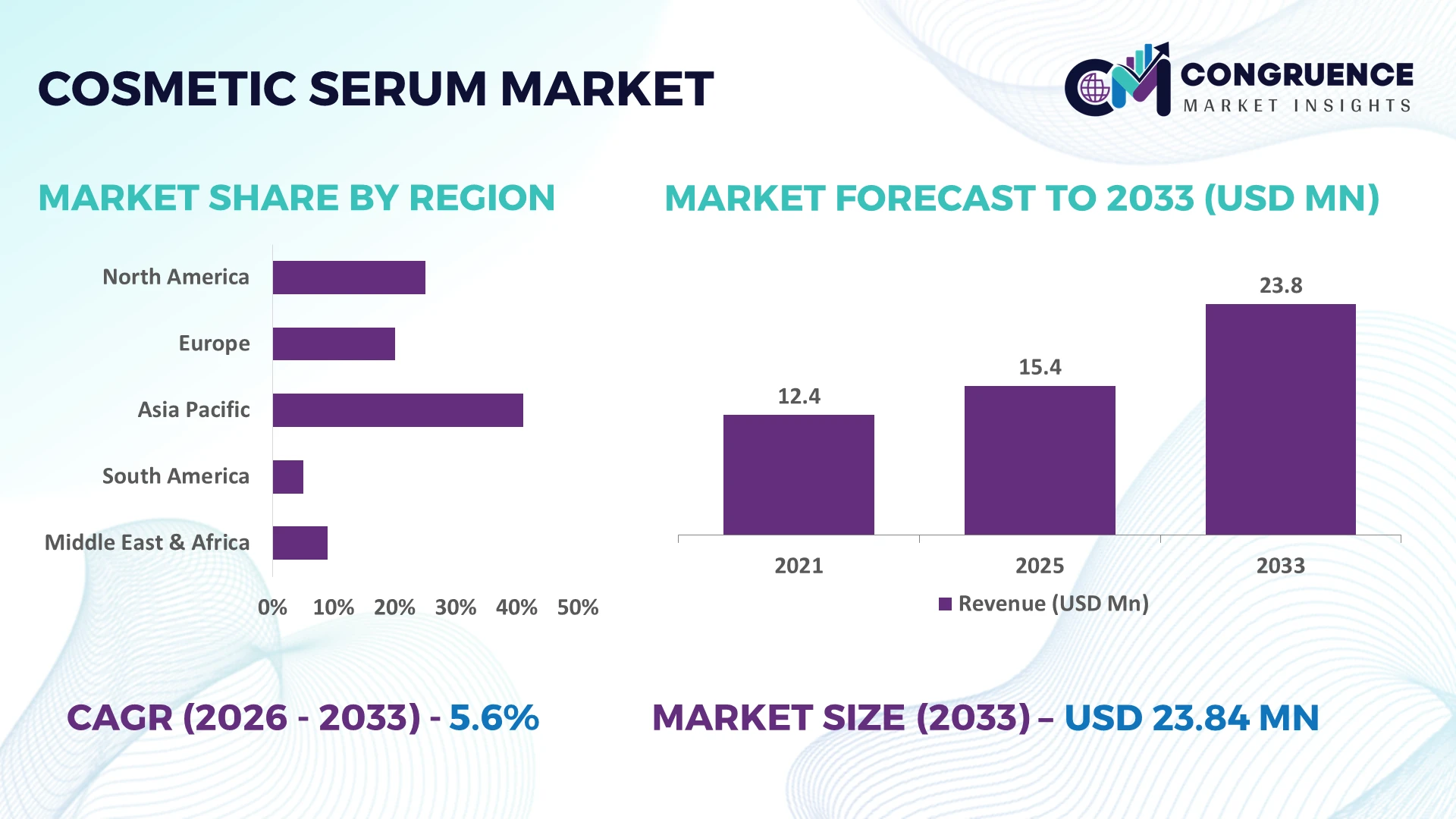
The Global Cosmetic Serum Market was valued at USD 15.41 Million in 2025 and is anticipated to reach a value of USD 23.84 Million by 2033 expanding at a CAGR of 5.6% between 2026 and 2033. Growth is supported by rising penetration of active-ingredient formulations, AI-assisted skincare personalization, and expanding premium dermocosmetic product portfolios across digital and retail distribution channels.
China remains the dominant production and consumption hub, accounting for approximately 32% of global cosmetic serum manufacturing, supported by large-scale investments in advanced cosmetic ingredients and automated production facilities. South Korea follows with nearly 14% market share, driven by biotechnology-based skincare innovation and rapid product commercialization. Continued regional supply-chain diversification after post-pandemic trade adjustments has accelerated ingredient sourcing resilience and export competitiveness.
Manufacturers prioritizing innovation-led formulations, diversified sourcing, and premium product positioning are strengthening long-term competitive advantage across high-growth global markets.
Market Size & Growth: USD 15.41 Million in 2025 to USD 23.84 Million by 2033 at 5.6% CAGR, supported by AI-driven skincare personalization and advanced active-ingredient development.
Top Growth Drivers: Peptide-based formulations (+28%), online beauty sales (+22%), and premium skincare adoption (+19%) continue accelerating global market expansion.
Short-Term Forecast: By 2027, automated formulation and packaging technologies improve production efficiency by approximately 16% while reducing manufacturing waste by 12%.
Emerging Technologies: AI skin diagnostics, encapsulation technology, and precision biotechnology improve ingredient stability by over 20% while supporting customized serum development.
Regional Leaders: Asia-Pacific exceeds USD 9 Million, Europe approaches USD 6 Million, and North America surpasses USD 5 Million, driven by premium skincare adoption and regional manufacturing expansion.
Consumer/End-User Trends: More than 58% of premium skincare consumers prefer multi-functional serums combining hydration, anti-aging, and barrier-repair benefits within one formulation.
Pilot/Case Example: In 2025, automated cosmetic filling systems improved production throughput by approximately 18% while reducing packaging defects by nearly 15%.
Competitive Landscape: Leading manufacturers collectively control around 38% of the global market, with major competition centered on L'Oréal, Estée Lauder, Shiseido, Beiersdorf, and Amorepacific.
Regulatory & ESG Impact: Sustainable packaging initiatives reduce virgin plastic consumption by nearly 30%, while stricter ingredient transparency standards strengthen consumer confidence across international markets.
Investment & Funding: More than USD 1.4 Billion in strategic investments supports biotechnology partnerships, manufacturing expansion, and regional supply-chain diversification across premium skincare.
Innovation & Future Outlook: Next-generation microbiome-friendly formulations, smart dispensing technologies, and AI-enabled product development accelerate premiumization and reinforce long-term global competitiveness.
The Cosmetic Serum Market continues to benefit from increasing demand for clinically validated skincare, high-performance botanical actives, and biotechnology-enhanced formulations. Approximately 41% of newly launched premium serums incorporate multifunctional ingredients addressing hydration, pigmentation, and skin barrier repair simultaneously. Ongoing ingredient traceability requirements and regional supply-chain optimization are reshaping product development strategies, creating a strong foundation for the strategic market assessment that follows.
The Cosmetic Serum Market has become strategically important as premium skincare shifts from product-based competition to science-driven formulation, ingredient traceability, and digital consumer engagement. Manufacturers are restructuring supply chains to reduce dependence on single-origin active ingredients while responding to stricter cosmetic ingredient disclosure requirements across major economies. This transition strengthens procurement resilience, accelerates product launches, and enables brands to differentiate through clinically validated formulations rather than marketing claims alone.
AI-assisted skin diagnostics and automated formulation platforms outperform conventional product development workflows by reducing formulation validation time by approximately 30% and lowering laboratory testing costs by nearly 18%. South Korea continues to lead in biotechnology-enabled serum innovation and rapid commercialization, while China dominates large-scale manufacturing through integrated ingredient ecosystems and advanced production capacity. Over the next two to three years, personalized skincare platforms are expected to exceed 35% adoption among premium beauty brands, supported by digital consultations and connected retail ecosystems.
A practical example is the deployment of automated ingredient dosing and quality monitoring systems that improve batch consistency while minimizing formulation waste. Companies are expanding biotechnology partnerships, investing in sustainable ingredient sourcing, and strengthening regional manufacturing networks to improve operational flexibility. Businesses that combine formulation innovation, digital consumer intelligence, and resilient production capabilities will establish stronger competitive positioning and long-term differentiation.
The rapid adoption of clinically validated active ingredients, including peptides, ceramides, and encapsulated vitamins, is reshaping product development across the Cosmetic Serum Market. More than 52% of premium serum launches now feature multi-functional formulations, while automated manufacturing improves production efficiency by approximately 17%. South Korea's biotechnology ecosystem continues to accelerate ingredient innovation, supported by collaborations between cosmetic brands and life science companies. Companies are expanding domestic formulation facilities, investing in AI-assisted product development, and forming strategic ingredient partnerships to shorten commercialization cycles. This combination of scientific validation, manufacturing modernization, and premium positioning strengthens brand competitiveness while improving supply reliability and product differentiation across global distribution networks.
Volatility in the prices of botanical extracts, peptides, and specialty active ingredients continues to pressure manufacturing economics. Certain premium cosmetic ingredients have experienced price fluctuations exceeding 20%, while regulatory compliance expenses have increased by approximately 15% as ingredient transparency requirements become more stringent. European manufacturers face additional documentation and formulation validation obligations, extending product approval timelines. These structural constraints reduce pricing flexibility and complicate portfolio expansion, particularly for smaller brands. In response, companies are diversifying supplier networks, increasing localized ingredient sourcing, and securing long-term procurement agreements to stabilize production costs while maintaining consistent formulation quality and regulatory compliance.
AI-powered skin analysis, microbiome-based formulations, and precision biotechnology are creating differentiated opportunities beyond traditional skincare categories. Around 40% of premium beauty consumers now seek personalized skincare recommendations, while automated formulation technologies reduce prototype development time by nearly 25%. Japan is accelerating investment in biotechnology research supporting advanced cosmetic ingredients with improved efficacy and stability. Companies are strengthening R&D partnerships with biotechnology firms, expanding digital consultation platforms, and integrating consumer data into formulation strategies. This evolution enables faster innovation cycles, improves inventory efficiency, and unlocks premium market segments where customized skincare solutions command stronger customer loyalty and higher product retention.
Maintaining identical product performance across geographically distributed production facilities remains a significant execution challenge. Batch-to-batch formulation variability can increase quality control costs by approximately 14%, while advanced manufacturing automation requires workforce upskilling exceeding 30% in specialized production environments. China and other major manufacturing hubs continue investing in intelligent production systems, yet harmonizing quality standards across multiple facilities remains operationally demanding. Companies must strengthen digital quality management, invest in process automation, and expand technical workforce capabilities through strategic partnerships. Organizations that standardize manufacturing intelligence and quality assurance systems will achieve stronger operational resilience, regulatory consistency, and long-term competitive differentiation.
Personalized Skincare Expansion: AI-powered skin assessment tools are becoming integrated into premium beauty platforms, with adoption increasing by nearly 35% among digital-first brands. Companies in South Korea and Japan are deploying recommendation engines and customized serum programs to improve customer retention by around 20% while reducing product mismatch rates.
Biotech Ingredient Scaling: Cosmetic manufacturers are accelerating biotechnology-based serum development, with peptide and microbiome-focused formulations growing approximately 28% in new product launches. Supply-chain pressure on natural ingredients has pushed companies to establish controlled ingredient partnerships and automated production systems that improve formulation consistency by nearly 18%.
Smart Manufacturing Adoption: Automated filling, quality monitoring, and production analytics are transforming serum manufacturing workflows, reducing operational waste by 15% and improving batch efficiency by 22%. Chinese manufacturers are expanding intelligent factories as labor availability changes and companies prioritize faster production cycles with improved quality control.
Sustainable Packaging Transition: Brands are restructuring packaging strategies as environmental regulations increase pressure on cosmetic producers. Recyclable and refillable serum packaging adoption has increased by nearly 30%, while companies are partnering with packaging innovators to reduce material usage, improve supply resilience, and strengthen sustainability positioning.
Anti-Aging Serums represent the leading product category due to strong consumer preference for clinically supported formulations, advanced peptides, and collagen-supporting ingredients. This segment captures approximately 38% of premium serum demand, supported by scalable manufacturing processes and higher consumer willingness to invest in performance-focused skincare. Companies are expanding anti-aging portfolios through biotechnology partnerships, dermatological testing, and improved ingredient delivery systems.
Hydrating Serums remain a high-volume category due to broad applicability across consumer groups, while Vitamin C Serums maintain strong demand through antioxidant-based positioning. Brightening Serums continue gaining traction in Asian markets, with adoption increasing by nearly 24% as consumers seek pigmentation solutions. Acne Treatment Serums are becoming strategically important through targeted formulations for younger consumers, supported by personalized skincare platforms. Companies are shifting investments toward multifunctional products combining hydration, anti-aging, and barrier-repair benefits to maximize market penetration.
Facial Care remains the largest application segment because serum products are primarily positioned as essential daily skincare solutions across mass and premium categories. This application accounts for approximately 45% of total usage, supported by expanding retail availability, influencer-driven education, and improved product accessibility. Companies are strengthening facial serum portfolios through targeted formulations addressing hydration, protection, and skin health maintenance.
Anti-Aging Care is the fastest-growing application area, with adoption rising nearly 27% as consumers prioritize preventive skincare solutions. Skin Brightening continues expanding in markets such as India and South Korea due to increasing demand for pigmentation management products. Acne & Blemish Care is gaining importance through dermatology-backed formulations, while Sensitive Skin Care is growing through fragrance-free and barrier-support products. Brands are adapting by developing application-specific product lines, improving clinical validation, and expanding digital consultation capabilities.
Retail Consumers represent the dominant end-user segment due to widespread availability through physical stores, digital commerce channels, and direct-to-consumer platforms. This group contributes nearly 60% of overall product consumption, supported by rising skincare awareness and increasing adoption of premium personal care routines. Companies are targeting retail buyers through personalized marketing, subscription models, and expanded online distribution networks.
E-commerce Retailers are the fastest-growing end-user group, with digital skincare sales adoption increasing by approximately 32% as brands prioritize direct customer relationships and data-driven product recommendations. Beauty Salons and Dermatology Clinics remain influential through professional recommendations and treatment-based usage, while Spas continue adopting premium serum products for specialized services. Companies are forming retail partnerships, improving online personalization tools, and creating professional-grade formulations to capture diverse purchasing channels and strengthen ecosystem-based growth.
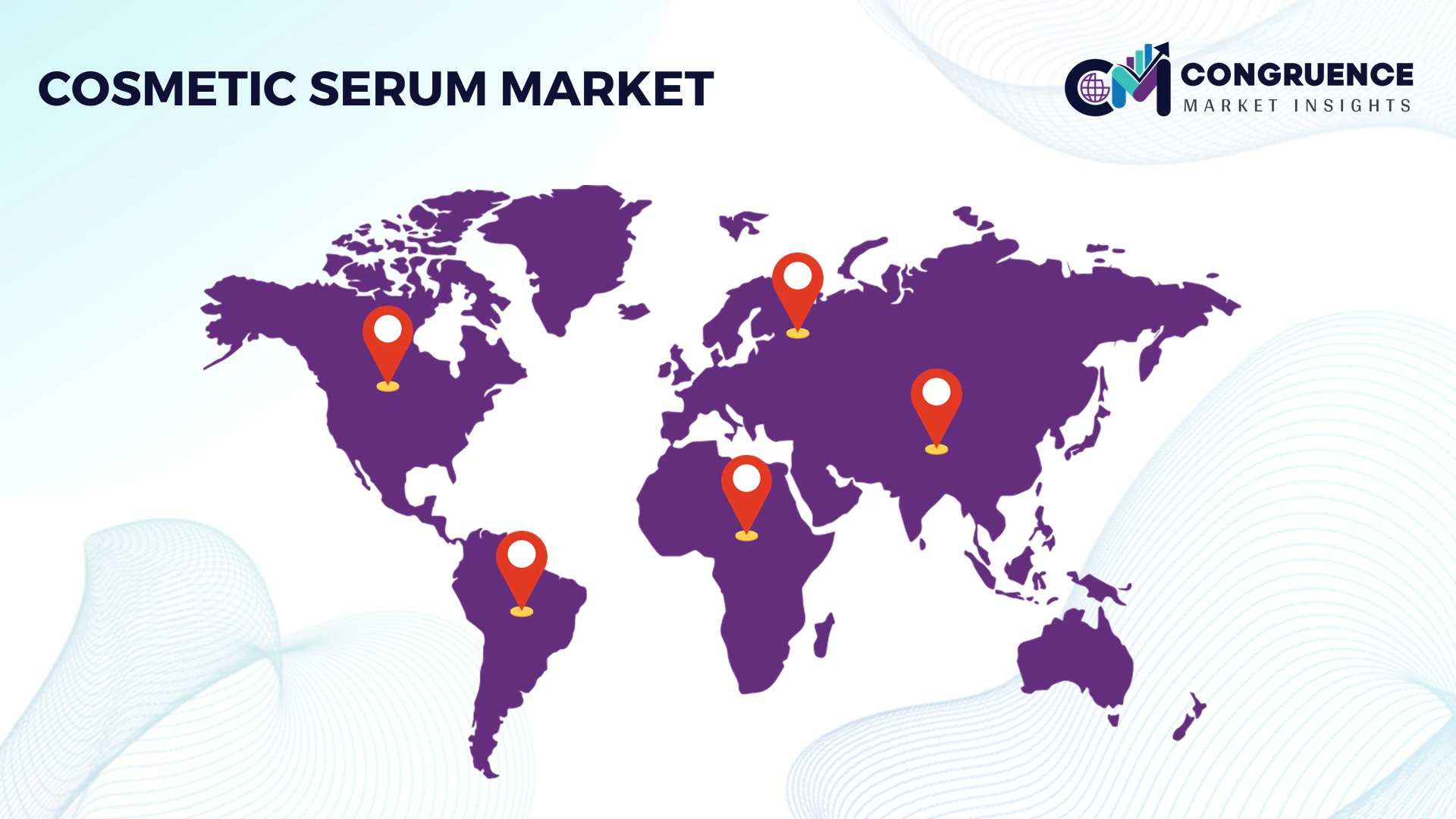
Asia-Pacific accounted for the largest market share at 42% in 2025 however, North America is expected to register the fastest growth, expanding at a CAGR of 6.4% between 2026 and 2033.
Premium skincare personalization and digital-first adoption reshape market operations
North America holds a strong position in the Cosmetic Serum Market through advanced retail infrastructure, high premium skincare penetration, and rapid adoption of personalized beauty technologies. The region contributes approximately 28% of global demand, supported by strong distribution networks across the United States and Canada. AI-powered skin analysis platforms and direct-to-consumer channels are expanding rapidly, with digital skincare consultations increasing by nearly 35% among premium brands. Companies are investing in biotechnology partnerships, automated manufacturing systems, and sustainable packaging solutions to improve product differentiation and operational efficiency.
United States Market Outlook: The United States remains the key market due to strong cosmetic innovation capabilities, established dermatology networks, and high consumer spending on advanced skincare. More than 60% of premium serum purchases occur through integrated retail and online channels, encouraging brands to expand personalized product portfolios and strengthen digital engagement strategies.
Regulatory-driven formulation upgrades and sustainable beauty transformation
Europe maintains a significant position due to strict cosmetic quality standards, advanced research capabilities, and strong demand for environmentally responsible skincare products. The region represents nearly 22% of global consumption, with France, Germany, and Italy acting as major formulation and branding centers. Sustainability regulations are accelerating recyclable packaging adoption, with several manufacturers targeting 30% reductions in packaging material usage. Companies are modernizing production facilities, improving ingredient traceability systems, and investing in clean-label formulations to meet evolving consumer and regulatory expectations.
France Market Outlook: France leads European cosmetic serum innovation through established luxury beauty manufacturing and strong export capabilities. The country’s premium skincare sector benefits from advanced research laboratories and concentrated brand ecosystems, with over 40% of luxury skincare companies increasing investment in sustainable formulation development and ingredient transparency initiatives.
Manufacturing scale and biotechnology innovation strengthen regional leadership
Asia-Pacific dominates the Cosmetic Serum Market due to extensive manufacturing capacity, advanced ingredient ecosystems, and strong consumer adoption of innovative skincare products. The region contributes approximately 42% of global market activity, led by China, South Korea, and Japan. South Korean companies are expanding biotechnology-based serum development, while Chinese manufacturers are increasing automation across production facilities. Export-oriented manufacturers have improved production efficiency by nearly 20% through intelligent manufacturing systems and supply-chain integration. Companies are strengthening partnerships with ingredient suppliers and investing in localized research capabilities.
China Market Outlook: China remains the largest operational hub with strong cosmetic manufacturing infrastructure, extensive ingredient supply networks, and rapidly expanding domestic demand. The country accounts for nearly one-third of global serum production capacity, supported by automated factories, digital commerce expansion, and increasing investment in high-performance skincare formulations.
Premium skincare penetration and retail modernization drive expansion
South America is experiencing gradual market development through rising beauty awareness, expanding e-commerce channels, and increased availability of premium skincare products. Brazil represents the regional demand center, supported by a large consumer base and established cosmetic manufacturing capabilities. The region contributes nearly 6% of global serum consumption, with online beauty purchases increasing by approximately 25% as brands improve digital distribution. Companies are expanding local partnerships, optimizing import strategies, and introducing affordable premium formulations to address diverse consumer preferences while managing supply-chain constraints.
Brazil Market Outlook: Brazil holds the strongest position in South America due to its developed beauty industry, local manufacturing ecosystem, and strong consumer engagement with skincare products. More than 50% of beauty purchases involve domestic brands, encouraging companies to expand localized production, customized formulations, and omnichannel retail strategies.
Luxury skincare investment and retail infrastructure modernization
The Middle East & Africa market is evolving through premium beauty investments, expanding retail infrastructure, and increasing demand for specialized skincare solutions. The region contributes approximately 5% of global serum demand, with the United Arab Emirates and Saudi Arabia emerging as major luxury skincare markets. Modern retail expansion and digital commerce adoption are increasing product accessibility, while premium beauty distributors are strengthening partnerships with international brands. Companies are investing in localized marketing, advanced distribution networks, and climate-specific formulations designed for regional consumer needs.
United Arab Emirates Market Outlook: The United Arab Emirates serves as a strategic luxury skincare hub due to strong retail infrastructure, international brand presence, and high premium product adoption. Over 35% of beauty sales are influenced by digital channels, pushing companies to enhance online personalization, regional partnerships, and targeted product launches.
The Cosmetic Serum Market features competition between global beauty leaders such as L'Oréal, Estée Lauder, and Shiseido against regional innovators, specialized ingredient suppliers, and agile digital-native brands. The top five players collectively control approximately 35% of market activity, creating a moderately concentrated environment. Competition is based on formulation technology, ingredient sourcing, customization, and speed, with premium brands improving product personalization by nearly 30% and automated manufacturing reducing production inefficiencies by around 18%. Companies are expanding biotechnology partnerships, integrating supply chains, and developing AI-powered skincare solutions to strengthen differentiation. Regional manufacturers compete through cost efficiency and faster localization, while global companies leverage brand equity and research capabilities. The competitive landscape is shifting toward control over advanced ingredients, digital consumer insights, and sustainable production systems. High formulation expertise, regulatory compliance capabilities, and strong distribution networks remain major entry barriers. Winning players must combine scientific innovation, operational agility, and customer-focused product strategies.
L'Oréal S.A.
Estée Lauder Companies Inc.
Shiseido Company Limited
Beiersdorf AG
Amorepacific Corporation
Unilever PLC
Procter & Gamble Co.
Kao Corporation
Coty Inc.
KOSÉ Corporation
Natura &Co Holding S.A.
Clarins Group
The Cosmetic Serum Market is advancing through AI-driven personalization, biotechnology-based ingredients, and intelligent manufacturing systems. AI skin analysis platforms are being integrated into digital beauty channels, improving recommendation accuracy by nearly 30% and increasing consumer engagement across premium segments. Biotechnology innovations, including peptide engineering and microbiome-based formulations, improve ingredient stability by approximately 20% compared with conventional active compounds, enabling brands to develop higher-performance skincare products.
Automated production technologies are replacing traditional manual processes, with smart filling, quality monitoring, and predictive analytics improving manufacturing efficiency by around 22% and reducing operational waste by nearly 15%. Adoption of digital manufacturing tools has reached approximately 40% among large cosmetic producers, giving technology-focused companies advantages in scalability, consistency, and faster product launches. Global brands benefit from advanced research capabilities, while regional manufacturers gain competitiveness through affordable automation adoption.
Between 2026 and 2028, connected skincare platforms, AI formulation engines, and sustainable ingredient technologies will influence competitive strategies. Companies adopting integrated digital ecosystems, automated production, and data-driven innovation will achieve stronger operational control, faster customization, and improved market responsiveness compared with traditional formulation models.
January 2025 L’Oréal introduced Cell BioPrint, an AI-powered skin intelligence device using advanced proteomics through a partnership with NanoEnTek, delivering personalized skin analysis within five minutes. The innovation strengthens customized serum development strategies and accelerates precision skincare adoption across premium beauty channels. Source: https://www.loreal.com
September 2024 Shiseido advanced AI-based cosmetic development by integrating its VOYAGER digital platform with proprietary formulation algorithms, enabling faster research workflows. The technology shift improved formulation efficiency by reducing development complexity and strengthened Shiseido’s competitive position in science-driven serum innovation. Source: https://corp.shiseido.com
May 2025 Shiseido launched Sengan Serum through its fibona open innovation program, introducing a washable serum concept using Droplet Membrane Emulsification Technology. The limited release targeted new skincare routines with a 580-unit availability plan, supporting rapid product validation and consumer-driven innovation.
June 2025 L’Oréal showcased technology-led beauty innovations at Viva Technology 2025, including personalized and sustainable skincare solutions. The company expanded digital beauty capabilities and demonstrated new research platforms, reinforcing its strategy to combine AI, science, and consumer data for next-generation serum development. Source: https://www.loreal.com
The Cosmetic Serum Market report provides comprehensive coverage across product types including Anti-Aging Serums, Hydrating Serums, Brightening Serums, Acne Treatment Serums, and Vitamin C Serums. The analysis evaluates applications such as Facial Care, Anti-Aging Care, Skin Brightening, Acne & Blemish Care, and Sensitive Skin Care, along with end-users including Beauty Salons, Dermatology Clinics, Spas, Retail Consumers, and E-commerce Retailers.
The report examines market dynamics across North America, Europe, Asia-Pacific, South America, and Middle East & Africa, highlighting manufacturing trends, biotechnology integration, AI-based personalization, and sustainable packaging adoption. With more than 30% growth in digital skincare engagement and increasing enterprise investment in advanced formulations, the study supports strategic planning, expansion decisions, competitive positioning, and technology-focused investment priorities through 2033.
| Report Attribute/Metric | Report Details |
|---|---|
Market Revenue in 2025 | USD 15.41 Million |
Market Revenue in 2033 | USD 23.84 Million |
CAGR (2026 - 2033) | 5.6% |
Base Year | 2025 |
Forecast Period | 2026 - 2033 |
Historic Period | 2021 - 2025 |
Segments Covered | By Type
By Application
By End-User
|
Key Report Deliverable | Revenue Forecast, Growth Trends, Market Dynamics, Segmental Overview, Regional and Country-wise Analysis, Competition Landscape |
Region Covered | North America, Europe, Asia-Pacific, South America, Middle East, Africa |
Key Players Analyzed | L'Oréal S.A., Estée Lauder Companies Inc., Shiseido Company Limited, Beiersdorf AG, Amorepacific Corporation, Unilever PLC, Procter & Gamble Co., Kao Corporation, Coty Inc., KOSÉ Corporation, Natura &Co Holding S.A., Clarins Group |
Customization & Pricing | Available on Request (10% Customization is Free) |




