
Reports
The Global Corporate Performance Management (CPM) Software Market was valued at USD 9386.79 Million in 2025 and is anticipated to reach a value of USD 26218.09 Million by 2033 expanding at a CAGR of 13.7% between 2026 and 2033. This growth is driven by accelerated enterprise adoption of integrated performance analytics and forecasting tools.
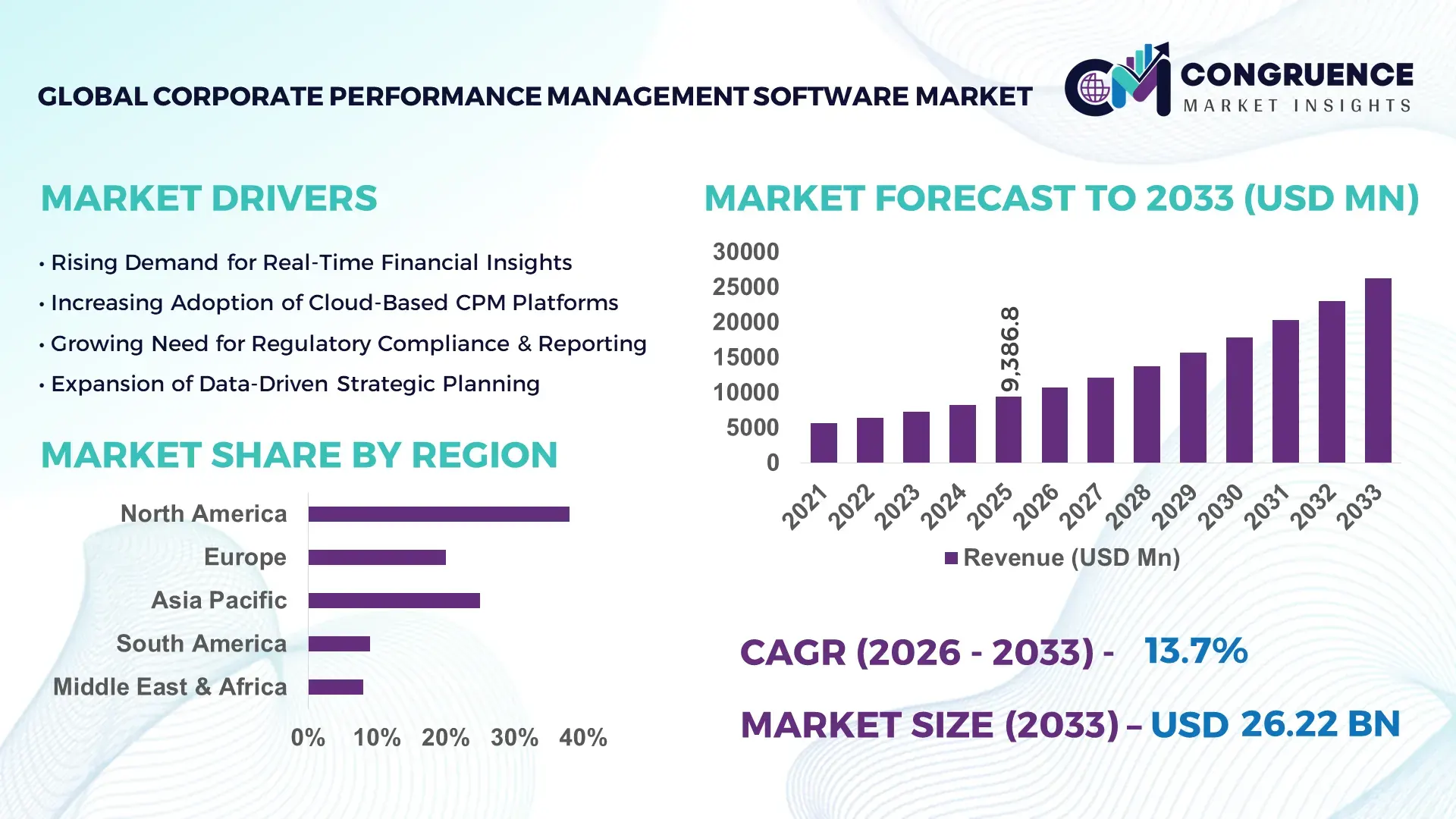
North America, particularly the United States, leads CPM software adoption with extensive investments in cloud-based solutions, advanced analytics, and digital transformation initiatives; the U.S. corporate sector reported over 65% cloud-CPM adoption with strong uptake across BFSI, healthcare, and manufacturing segments. Enterprises in the U.S. register average annual CPM-related IT expenditure increases above 8%, and demand for AI-enabled planning modules has grown over 45% year-on-year, reinforcing domestic production capacity and technological development in high-performance CPM platforms.
Market Size & Growth: Estimated at ~USD 9.39 billion in 2025; projected to reach ~USD 26.22 billion by 2033 at a 13.7% CAGR, driven by demand for real‑time performance analytics and planning tools.
Top Growth Drivers: Cloud adoption growth ~70%; AI/ML integration adoption ~45%; enterprise automation modernization ~38%.
Short-Term Forecast: By 2028, enterprises could achieve up to ~30% improvement in budgeting efficiency and ~25% reduction in forecasting cycle times.
Emerging Technologies: AI-driven predictive analytics, machine learning forecasting engines, real-time KPI dashboards.
Regional Leaders: North America ~USD 12 billion by 2033 (cloud innovation focus); Europe ~USD 7 billion by 2033 (compliance & governance integration); Asia-Pacific ~USD 4 billion by 2033 (rapid digital transformation).
Consumer/End-User Trends: Large enterprises prioritize performance management for compliance and planning; SMEs increasingly adopting scalable cloud CPM solutions.
Pilot or Case Example: 2025 pilot with AI-augmented forecasting reduced financial reporting variance by ~22% in a multinational BFSI firm.
Competitive Landscape: Market leader ~18% share (IBM), followed by SAP (~15%), Oracle, Anaplan, Workday.
Regulatory & ESG Impact: Enhanced financial reporting mandates and sustainability KPIs drive performance management platform enhancements.
Investment & Funding Patterns: Significant investments in cloud analytics and AI modules; venture funding trends support SaaS CPM innovation.
Innovation & Future Outlook: Integration with ERP/BI ecosystems, mobile-first performance interfaces, AI-assisted scenario modelling.
North America’s enduring leadership reflects extensive deployment of cloud-centric CPM platforms and robust enterprise IT spending. Europe maintains steady uptake with emphasis on regulatory compliance and hybrid deployments, while Asia-Pacific shows dynamic growth driven by fast-expanding SMEs and digital transformation initiatives. The market is increasingly shaped by AI-driven analytics, integrated planning across functions, and rising expectations for real-time operational insights within core industry verticals such as BFSI, manufacturing, and healthcare, positioning CPM software as a strategic cornerstone of corporate governance and performance optimization.
The Corporate Performance Management (CPM) Software Market plays a strategic role in enabling enterprises to align operational execution with long-term business goals through integrated planning, budgeting, and forecasting solutions. Advanced AI-driven CPM platforms deliver up to 35% faster scenario analysis compared to traditional spreadsheet-based systems, enabling data-driven decision-making at scale. North America dominates in volume, while Europe leads in adoption, with over 60% of enterprises implementing cloud-based CPM solutions. By 2028, predictive analytics and AI-assisted forecasting are expected to improve budget accuracy and financial planning efficiency by approximately 28%. Firms are committing to ESG metric improvements such as a 20% reduction in carbon footprint and increased sustainable reporting by 2027, integrating compliance directly into performance management workflows. In 2025, a leading U.S. multinational achieved a 22% reduction in reporting variance through AI-powered financial modeling, demonstrating measurable operational benefits. Strategic integration of CPM software across ERP and business intelligence ecosystems enhances enterprise resilience, streamlines compliance, and provides actionable insights for sustainable growth. Looking forward, the Corporate Performance Management (CPM) Software Market is positioned as a critical pillar for organizations seeking improved governance, operational agility, and long-term financial sustainability across diverse industries.
The adoption of AI-enabled analytics is significantly driving growth in the Corporate Performance Management (CPM) Software market. Enterprises increasingly rely on AI to automate data collection, perform predictive modeling, and generate actionable insights for decision-making. In 2025, over 45% of large enterprises integrated AI-powered forecasting engines into their CPM systems, resulting in a measurable 20–25% reduction in financial reporting errors. Sectors such as BFSI, healthcare, and manufacturing report improved operational efficiency and accelerated budgeting cycles due to AI-driven data analysis. The ability of AI-enabled CPM tools to identify anomalies, optimize resource allocation, and simulate multiple planning scenarios has positioned these solutions as essential for large-scale corporate governance. Consequently, AI adoption is shaping the future trajectory of the CPM market by enabling enterprises to achieve higher accuracy, faster decision-making, and increased scalability in performance management practices.
The Corporate Performance Management (CPM) Software market faces constraints due to complex integration requirements with existing ERP, CRM, and legacy financial systems. In many enterprises, over 60% of performance data resides in siloed or non-standardized formats, creating challenges in real-time reporting and unified analysis. The cost and time required for migration from on-premises legacy software to modern cloud-based CPM platforms can delay adoption, particularly in mid-sized organizations. Additionally, limited technical expertise in AI and predictive analytics hinders full utilization of advanced CPM functionalities. Regulatory compliance further complicates deployment, requiring extensive customization for industry-specific reporting and audit standards. These integration and infrastructure hurdles slow down adoption rates and limit the seamless execution of performance management strategies, representing a significant restraint for market growth in the short to medium term.
The adoption of cloud-based CPM solutions offers significant opportunities for market expansion. Cloud deployment reduces upfront infrastructure costs, enhances scalability, and enables faster implementation of AI-driven analytics, allowing enterprises to access real-time performance insights from multiple locations. In 2025, over 55% of multinational corporations shifted to cloud-native CPM platforms, reporting up to 30% faster budgeting cycles and improved cross-functional collaboration. Small and medium-sized enterprises (SMEs) increasingly view cloud-based CPM as a cost-effective alternative to traditional on-premises systems. Additionally, cloud solutions support continuous software updates, integration with emerging technologies, and enhanced cybersecurity measures. The growing preference for subscription-based models and Software-as-a-Service (SaaS) offerings opens opportunities for vendors to expand their market footprint, particularly in regions with rapid digital transformation initiatives such as Asia-Pacific and Latin America.
High implementation costs and stringent regulatory compliance present significant challenges for the Corporate Performance Management (CPM) Software market. Deploying enterprise-grade CPM platforms requires substantial investment in software licensing, infrastructure, and skilled personnel, which can exceed $500,000 for large organizations. Compliance with evolving financial reporting standards, ESG metrics, and data privacy regulations often necessitates extensive system customization, increasing complexity and implementation timelines. Organizations in highly regulated sectors such as banking, pharmaceuticals, and energy face additional burdens to align CPM processes with audit requirements and sustainability disclosures. Furthermore, integrating CPM systems with diverse legacy software landscapes increases operational disruption risks, demanding careful project management. These financial, technical, and regulatory hurdles limit adoption, particularly for mid-sized companies and emerging markets, posing a persistent challenge to market expansion.
• Expansion of AI-Driven Forecasting: The integration of AI in CPM software is transforming financial and operational planning. Over 48% of large enterprises have adopted AI-enabled forecasting modules, achieving up to a 22% reduction in planning cycle time and a 30% increase in predictive accuracy. North America leads in deployment volume, while Europe shows the highest adoption rate at 62% of organizations leveraging AI for scenario planning.
• Growth of Cloud-Native CPM Solutions: Cloud-based CPM platforms are driving operational flexibility and cost efficiency. In 2025, 57% of multinational companies migrated to cloud-native systems, resulting in a 28% improvement in cross-departmental data access and a 25% faster reporting cycle. Asia-Pacific is emerging as a key growth region, with 35% of mid-sized firms shifting to cloud deployments.
• Integration with ERP and BI Ecosystems: Enterprises increasingly integrate CPM software with ERP and business intelligence tools to enable real-time performance monitoring. Approximately 60% of organizations report that integrated solutions improve decision-making speed by 20–25% and reduce manual data reconciliation by 35%. The BFSI and manufacturing sectors are leading adoption due to complex operational workflows and compliance requirements.
• ESG and Sustainability Performance Tracking: CPM platforms are now used to monitor ESG metrics, helping companies meet regulatory and sustainability goals. Around 40% of enterprises have implemented CPM modules to track energy usage, carbon emissions, and waste reduction, reporting measurable reductions of 15–20% in operational inefficiencies. Europe leads ESG-focused adoption with over 55% of large firms implementing such features.
The Corporate Performance Management (CPM) Software market is structured across multiple dimensions, including types, applications, and end-users, offering a granular view of adoption patterns and sector-specific requirements. Types range from cloud-based platforms to on-premises solutions and hybrid systems, each addressing unique enterprise needs such as scalability, security, and integration flexibility. Applications include budgeting and forecasting, financial reporting, strategic planning, and performance monitoring, with varying adoption across industries like BFSI, manufacturing, healthcare, and retail. End-user segmentation highlights large enterprises, SMEs, and governmental organizations, reflecting diverse implementation scales and investment capacities. North America leads in adoption across large enterprises, while Asia-Pacific demonstrates rapid uptake among SMEs. This multi-dimensional segmentation allows stakeholders to target investments, optimize deployments, and align software capabilities with operational priorities, making segmentation analysis essential for strategic planning, competitive benchmarking, and identifying high-potential market niches.
Cloud-based CPM solutions currently account for 48% of adoption due to their scalability, lower upfront infrastructure costs, and seamless integration with AI-driven analytics, while on-premises systems hold 30%. Hybrid solutions contribute 22%, primarily in highly regulated sectors requiring controlled data environments. The fastest-growing segment is AI-embedded cloud CPM software, driven by enterprises seeking predictive analytics, automated reporting, and scenario-based planning. Adoption of AI-embedded systems has accelerated, with deployment in multinational corporations increasing by 35% in the last two years. Other types, including legacy on-premises CPM suites and mobile-first platforms, collectively account for 20% of adoption, serving niche requirements like offline operations or highly customized workflows.
Budgeting and forecasting dominate CPM software applications, representing 45% of adoption, driven by the need for precise financial planning and scenario analysis across enterprises. Strategic planning modules are the fastest-growing application, benefiting from AI-enabled scenario modeling and integration with ERP systems, with adoption increasing by 33% in recent years. Performance monitoring solutions account for 20% of applications, providing KPIs and operational dashboards for mid- and large-sized enterprises. Financial reporting tools cover 15% of use cases, particularly in sectors with strict regulatory compliance such as BFSI and healthcare.
Large enterprises remain the leading end-user segment, representing 52% of CPM software adoption, as they leverage advanced platforms to optimize multi-departmental operations and compliance reporting. SMEs are the fastest-growing end-user, with adoption rising by 28% in the past two years due to scalable cloud solutions and subscription-based models. Government and public-sector organizations account for 15% of usage, often implementing CPM systems for budget oversight and operational transparency. BFSI, healthcare, and manufacturing industries exhibit adoption rates exceeding 60% among top-tier organizations, while retail and logistics sectors show emerging uptake.
North America accounted for the largest market share at 38% in 2025; however, Asia-Pacific is expected to register the fastest growth, expanding at a CAGR of 14.5% between 2026 and 2033.
North America recorded over 65% enterprise adoption of cloud-based CPM solutions across BFSI, healthcare, and manufacturing sectors. Asia-Pacific shows rapid uptake, with China and India contributing more than 45% of total regional deployments, driven by digital transformation in SMEs and large corporates. Europe holds 25% of adoption, emphasizing compliance-driven solutions, while South America and Middle East & Africa together account for 12% of global CPM software use. Cloud-based platforms represent 48% of installations in North America and 35% in Asia-Pacific, while AI-enabled forecasting modules are deployed in over 40% of large enterprises across all major regions, highlighting a shift toward predictive and integrated performance management.
How are enterprise digital transformation trends shaping performance management strategies?
North America holds approximately 38% of the global Corporate Performance Management (CPM) Software market. The region’s demand is fueled by BFSI, healthcare, and manufacturing sectors, with over 60% of large enterprises adopting cloud-based CPM platforms. Regulatory mandates around financial reporting and ESG metrics are driving organizations to implement advanced compliance and sustainability tracking. Technological advancements include AI-enabled forecasting, real-time KPI dashboards, and integration with ERP and BI systems. A leading U.S. technology provider recently launched a cloud-native CPM platform that reduced budget cycle times by 22% across 10 major enterprises. North American companies exhibit higher adoption rates in healthcare and finance, emphasizing predictive analytics, scenario planning, and operational efficiency improvements.
What role does compliance-driven innovation play in performance management adoption?
Europe represents around 25% of the global CPM software market, with Germany, the UK, and France leading adoption. Regulatory frameworks such as IFRS standards and sustainability reporting initiatives drive demand for explainable, audit-ready CPM solutions. Adoption of AI-driven scenario planning and cloud-based platforms is increasing, with over 55% of enterprises leveraging these technologies for budgeting and forecasting. Local players, including SAP and Workday offices in Germany and France, are enhancing software capabilities with AI-powered predictive modules. European organizations prioritize regulatory compliance and operational transparency, with widespread use in BFSI and manufacturing sectors, reflecting regional consumer behavior that favors standardized, secure, and traceable performance management solutions.
How is rapid digitalization shaping enterprise performance management adoption?
Asia-Pacific accounts for approximately 22% of global CPM software deployments, with China, India, and Japan as the top consuming countries. High demand in manufacturing, e-commerce, and IT services is driving investment in cloud-native and AI-enabled CPM platforms. Digital innovation hubs in Singapore and Japan are fostering mobile-first CPM solutions and predictive analytics adoption. A leading Chinese enterprise implemented AI-augmented forecasting across multiple business units in 2025, reducing operational variance by 18%. Regional consumer behavior emphasizes cost-effective, scalable, and mobile-accessible CPM solutions, with SMEs increasingly driving adoption alongside large corporates. The focus on digital transformation and technology-driven planning is central to market expansion.
What factors are influencing performance management adoption in emerging economies?
South America holds roughly 7% of the global CPM software market, with Brazil and Argentina as key contributors. The energy, infrastructure, and media sectors are driving software adoption, while government incentives support digital transformation initiatives. Local players in Brazil are deploying cloud-based CPM systems to streamline reporting and enhance operational efficiency, achieving measurable improvements of 15–20% in financial planning accuracy. Regional consumer behavior emphasizes multilingual software support, media localization, and sector-specific customization. Enterprises are increasingly adopting AI-enabled modules for scenario-based budgeting, operational tracking, and strategic planning to compete in evolving Latin American markets.
How is performance management evolving in resource-driven and infrastructure-focused markets?
Middle East & Africa represent approximately 5% of the global CPM software market, with UAE and South Africa leading adoption. Demand is driven by oil & gas, construction, and financial services sectors, with organizations implementing AI-powered CPM modules to improve operational monitoring and budgeting accuracy. Technological modernization includes cloud deployments and integration with ERP systems, enabling real-time performance visibility. Regional regulatory reforms and trade partnerships encourage digital adoption. A South African energy company deployed predictive CPM analytics in 2025, reducing reporting errors by 18%. Consumer behavior emphasizes performance management for strategic oversight, compliance, and efficiency, with adoption skewed toward large enterprises.
United States: Market share ~32%; dominance due to high enterprise adoption, cloud infrastructure investment, and AI-driven CPM deployments across BFSI and healthcare sectors.
Germany: Market share ~11%; leadership attributed to stringent regulatory requirements, robust manufacturing sector demand, and integration of predictive performance management solutions.
The Corporate Performance Management (CPM) Software market is moderately fragmented, with over 120 active competitors globally, ranging from established enterprise software providers to emerging SaaS innovators. The top five companies—IBM, SAP, Oracle, Anaplan, and Workday—collectively account for approximately 65% of total market adoption, highlighting a concentrated presence among leading providers while leaving room for niche and specialized vendors. Competitive dynamics are shaped by continuous product innovation, with over 45% of market players introducing AI-powered analytics, cloud-native modules, and mobile-first dashboards in the last three years. Strategic initiatives include partnerships with ERP and BI platform providers, regional expansions, and acquisitions to broaden technology portfolios and accelerate digital transformation services. Product launches focusing on predictive forecasting, ESG tracking, and scenario-based planning are increasingly influencing buyer decisions. Companies are also investing in integration capabilities, cybersecurity enhancements, and automated workflow tools to differentiate themselves. The combination of legacy incumbents and agile start-ups ensures intense competition, pushing continuous technological innovation and operational efficiency improvements in the CPM software ecosystem.
Anaplan
Workday
OneStream Software
BOARD International
Tagetik (Wolters Kluwer)
Host Analytics
Vena Solutions
The Corporate Performance Management (CPM) Software market is increasingly driven by advanced technologies that enhance operational efficiency, predictive capabilities, and strategic decision-making. Cloud-based CPM platforms now account for over 48% of global deployments, enabling enterprises to scale operations, reduce IT infrastructure costs, and integrate real-time analytics across multiple departments. Artificial Intelligence (AI) and Machine Learning (ML) are key enablers, with more than 45% of large enterprises implementing AI-powered modules for predictive forecasting, anomaly detection, and automated budgeting. These systems can reduce financial reporting errors by up to 22% and accelerate scenario-based planning by approximately 28% in complex organizations.
Robotic Process Automation (RPA) is being integrated into CPM platforms to streamline repetitive tasks such as data aggregation, consolidation, and report generation, cutting manual processing time by up to 30%. Natural Language Processing (NLP) and interactive dashboards are enhancing usability, enabling executives to query data and generate insights without technical expertise. Additionally, hybrid CPM systems combining cloud and on-premises solutions are increasingly adopted in sectors requiring controlled data environments, covering 22% of installations in highly regulated industries.
Emerging technologies, such as AI-assisted scenario modeling, blockchain-enabled audit trails, and mobile-first performance interfaces, are shaping the next generation of CPM platforms. In 2025, over 55% of BFSI and manufacturing enterprises implemented AI-driven dashboards, improving cross-functional collaboration and real-time KPI monitoring. These technological trends are driving measurable gains in operational efficiency, strategic alignment, and compliance, positioning CPM software as a critical enabler of enterprise resilience and performance optimization.
• In March 2024, SAP SE announced the launch of the SAP S/4HANA Cloud Intelligent Enterprise Suite with enhanced Corporate Performance Management capabilities that unify financials, supply chain, sales, and marketing functions to deliver real‑time insights and automated reporting improvements across enterprise environments.
• In July 2024, Oracle Corporation and Microsoft Corporation entered a strategic partnership to integrate Oracle’s CPM and business intelligence solutions with Microsoft’s Power BI platform, enabling a more unified data analysis and reporting experience for enterprise users.
• In January 2025, Anaplan secured a USD150 million funding round led by major institutional investors, strengthening its balance sheet and supporting expansion of cloud‑based planning and AI‑enabled forecasting capabilities to new market segments.
• In March 2025, IBM announced the acquisition of OpenPages, a provider of performance and Governance, Risk & Compliance (GRC) solutions, enhancing IBM’s enterprise performance management portfolio with expanded risk and compliance integration.
The Corporate Performance Management (CPM) Software Market Report provides a comprehensive examination of market breadth and structure, capturing segmentation by platform type, technology integration, applications, industry verticals, and geographic regions. It covers software deployment types including cloud‑native, on‑premises, and hybrid solutions, as well as AI‑enhanced planning modules and predictive analytics tools. Technology insights include adoption rates of generative AI, machine learning algorithms for forecasting, real‑time dashboards, and integrated ERP/BI ecosystems, with quantitative measures such as percentage of enterprises adopting AI‑driven CPM tools and cloud deployments.
Geographic coverage spans North America, Europe, Asia‑Pacific, South America, and Middle East & Africa, with regional use patterns, infrastructure trends, and sectoral drivers. Application segmentation assesses the role of CPM in budgeting and forecasting, financial reporting, operational performance monitoring, strategic planning, and regulatory compliance. Industry focus areas include BFSI, manufacturing, healthcare, retail, and energy, with evaluation of sector‑specific templates, customization needs, and market penetration by end‑user category.
The report also addresses emerging niches such as mobile CPM interfaces, scenario modeling enhancements, ESG performance tracking, and industry‑specific solution frameworks. These facets equip decision‑makers with actionable insights into adoption dynamics, technology trajectories, and competitive positioning while highlighting future avenues for investment, implementation strategy, and operational optimization across diverse enterprise landscapes.
| Report Attribute/Metric | Report Details |
|---|---|
|
Market Revenue in 2025 |
USD V2025 Million |
|
Market Revenue in 2033 |
USD V2033 Million |
|
CAGR (2026 - 2033) |
13.7% |
|
Base Year |
2025 |
|
Forecast Period |
2026 - 2033 |
|
Historic Period |
2021 - 2025 |
|
Segments Covered |
By Types
By Application
By End-User
|
|
Key Report Deliverable |
Revenue Forecast, Growth Trends, Market Dynamics, Segmental Overview, Regional and Country-wise Analysis, Competition Landscape |
|
Region Covered |
North America, Europe, Asia-Pacific, South America, Middle East, Africa |
|
Key Players Analyzed |
IBM, SAP, Oracle, Anaplan, Workday, OneStream Software, BOARD International, Tagetik (Wolters Kluwer), Host Analytics, Vena Solutions |
|
Customization & Pricing |
Available on Request (10% Customization is Free) |




