
Reports
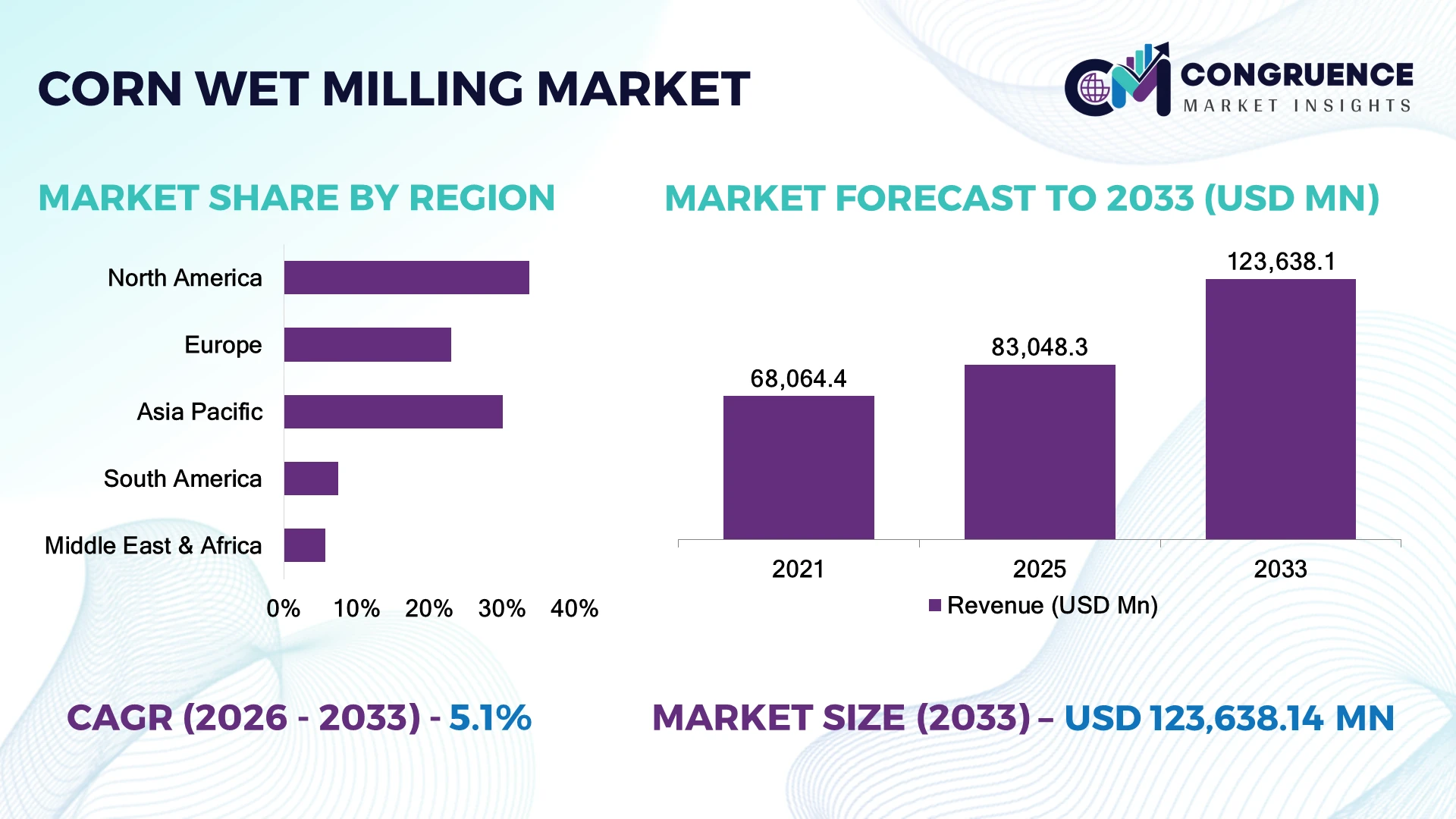
The Global Corn Wet Milling Market was valued at USD 83,048.3 Million in 2025 and is anticipated to reach a value of USD 123,638.1 Million by 2033 expanding at a CAGR of 5.1% between 2026 and 2033. Growth is driven by expanding starch, high-fructose corn syrup, corn oil, glucose, and protein fractionation capacity, alongside investments in higher-yield separation and fermentation technologies.
The United States remains the dominant corn wet milling base, accounting for approximately 30% of global corn processing capacity, supported by integrated starch, sweetener, ethanol, food, and bioproduct industries. China contributes roughly 18%, with rapid modernization of starch and sweetener plants. Advanced separation and process-control systems can improve starch recovery by 3–6%. Red Sea shipping disruptions are encouraging regional inventory and sourcing strategies for industrial starch users.
Strategically, producers with integrated fractionation, energy-efficient processing, diversified coproduct portfolios, and reliable corn procurement are best positioned to protect margins and expand capacity.
Market Size & Growth: USD 83.0 Billion in 2025 to USD 123.6 Billion by 2033 at 5.1% CAGR, supported by starch diversification and advanced fractionation.
Top Growth Drivers: 34% starch demand, 27% sweetener applications, and 19% bioproduct utilization are the leading growth contributors.
Short-Term Forecast: By 2028, automated process controls will improve extraction efficiency by 4–7% and reduce selected processing losses by 3–5%.
Emerging Technologies: AI process optimization, membrane separation, enzymatic hydrolysis, and advanced evaporation systems are improving corn fractionation economics.
Regional Leaders: North America approaches USD 28 Billion, Asia-Pacific USD 25 Billion, and Europe USD 19 Billion, with automation and higher-value coproduct processing accelerating.
Consumer/End-User Trends: Approximately 38% of food manufacturers are increasing use of functional starches for texture, stability, and reformulation requirements.
Pilot/Case Example: 2025 process-optimization programs targeting starch recovery delivered approximately 4–6% higher extraction efficiency and reduced water intensity by 8–12%.
Competitive Landscape: Leading integrated processors hold approximately 35% combined share, with Cargill, ADM, Ingredion, Tate & Lyle, and Roquette strengthening global corn-processing positions.
Regulatory & ESG Impact: Water and energy-efficiency programs are driving processing upgrades capable of reducing freshwater intensity by approximately 10–20% at optimized facilities.
Investment & Funding: More than USD 1.2 Billion is being directed toward starch expansion, sweetener capacity, coproduct valorization, and plant modernization across major processing hubs.
Innovation & Future Outlook: 2026–2028 priorities center on higher-value proteins, specialty starches, fermentation integration, low-energy separation, and closed-loop water management.
Corn Wet Milling is increasingly centered on value extraction from every corn fraction, spanning native and modified starches, sweeteners, corn oil, gluten feed, and protein-rich coproducts. Food processing remains the largest demand base, while pharmaceutical, paper, biodegradable materials, and fermentation applications are expanding specialty-grade requirements. Approximately 30% of new capacity investment increasingly targets higher-value derivatives rather than commodity starch alone. Regional inventory strategies are also gaining importance as freight disruptions affect agricultural supply chains, strengthening the case for integrated processing assets and diversified coproduct economics.
Corn wet milling is becoming strategically important because processors are shifting from commodity starch production toward integrated fractionation platforms that monetize starch, protein, oil, fiber, and fermentation streams. This improves resilience when corn prices fluctuate and allows producers to serve food, pharmaceutical, industrial, and bio-based customers from the same feedstock. Supply-chain restructuring is also encouraging processors to strengthen local corn procurement and maintain greater inventories of critical derivatives.
Modern separation and process-control technologies are improving plant economics. Advanced centrifugation, membrane filtration, and automated control can increase starch recovery by approximately 3–6% compared with less optimized legacy configurations while reducing selected water requirements by 8–15%. The United States retains strong integrated processing scale, whereas China is emphasizing capacity modernization and higher-value starch derivatives. India is increasingly relevant for food-grade starch and sweetener applications.
During 2026–2028, investment will increasingly target specialty starches, protein recovery, fermentation integration, and energy-efficient evaporation. A practical deployment combines real-time moisture and density monitoring with automated separation controls, enabling operators to adjust process conditions continuously rather than relying on periodic laboratory checks. Leading companies are therefore prioritizing plant modernization, technology partnerships, coproduct innovation, and localized capacity. Competitive advantage will increasingly depend on maximizing value per bushel while controlling water, energy, and input volatility.
Integrated corn fractionation is strengthening growth as processors maximize starch, oil, protein, fiber, and sweetener output from each bushel. Advanced separation and enzymatic processing can improve starch recovery by 3–6% and reduce process-water intensity by 8–15%, while higher-value coproducts increasingly represent 15–25% of plant economics. In the United States, processors are expanding specialty starch and protein capabilities alongside established sweetener operations. Rising demand for clean-label texture systems and fermentation feedstocks is accelerating this shift. Companies are investing in automated centrifugation, membrane filtration, and process analytics to improve yield consistency. The strategic advantage is converting fractionation efficiency into multiple revenue streams, reducing dependence on commodity starch margins.
Feedstock and energy exposure remains a major constraint because corn, natural gas, electricity, and processing chemicals directly influence wet-milling economics. Corn typically represents more than 50% of total operating cost, while energy-intensive evaporation and drying can account for approximately 15–25% of processing expenditure. In India and China, imported energy and equipment components can add 5–10% to operating-cost volatility during supply disruptions. Freight instability following Red Sea shipping disruptions has also complicated movement of specialty starches and processing inputs. Producers are responding through regional corn procurement, indexed supply contracts, energy-efficiency upgrades, and diversified supplier qualification. The strongest margin defense is geographic integration of feedstock, utilities, and processing capacity rather than relying solely on downstream price increases.
Protein and coproduct valorization presents a less-developed opportunity as food manufacturers seek functional plant proteins and processors improve utilization of corn fractions. Advanced separation can increase recoverable protein yields by approximately 10–15%, while specialty starch modification can deliver 8–12% higher functional performance in selected food applications. United States processors are developing higher-value ingredients for nutrition, fermentation, and alternative-protein formulations, while India is expanding food-grade starch and sweetener capacity. Precision fermentation and membrane-based fractionation will further improve ingredient purity. Companies are directing R&D toward protein concentrates, specialty starches, and fermentation substrates and forming partnerships with food and biotechnology developers. Future competitiveness will increasingly depend on value extracted from coproduct streams, not simply tons of starch produced.
Modern wet mills face increasing integration complexity as automated milling, separation, evaporation, quality control, and utility-management systems operate as interconnected production networks. Advanced facilities can contain dozens of critical process-control loops, while poor data integration can increase manual intervention by 10–15% and prolong troubleshooting cycles by 5–10%. U.S. and European plants are therefore moving toward industrial IoT architectures, digital twins, predictive maintenance, and centralized process historians. Skilled-operator shortages intensify the need for intuitive automation and remote diagnostics. Companies must standardize equipment interfaces, strengthen cybersecurity, and train process engineers alongside technology investments. The critical execution challenge is synchronizing biological, mechanical, and thermal processes in real time without compromising food-grade quality or plant uptime.
Water Recovery Gains Priority: U.S. processors are increasing condensate reuse and closed-loop water systems, with optimized facilities targeting 10–20% lower freshwater intensity and 8–12% lower wastewater loads. Water-management investments are increasingly linked to plant modernization rather than standalone environmental projects, improving operating resilience where discharge requirements are tightening.
Coproduct Valorization Is Expanding: Processors are placing greater emphasis on protein, oil, fiber, and fermentation streams, with higher-value coproduct initiatives improving total corn utilization by approximately 5–10%. This is changing plant economics because processors can offset commodity-starch pressure through differentiated ingredients and longer-term contracts with food and biotechnology customers.
Predictive Maintenance Enters Mills: Sensor-based monitoring of centrifuges, pumps, evaporators, and grinding equipment is expanding, with predictive systems reducing unplanned maintenance events by approximately 10–15% in digitally managed operations. Companies are integrating condition monitoring with plant historians and maintenance platforms, reducing downtime exposure while improving spare-parts planning.
Energy Optimization Reshapes Operations: High-temperature evaporation and drying remain energy-intensive, prompting greater deployment of heat recovery, variable-speed drives, and advanced boiler controls. Optimized facilities target 8–15% lower energy consumption, while volatile utility markets are accelerating investment. Producers increasingly prioritize projects that simultaneously reduce energy intensity and stabilize production costs.
Starch and starch derivatives represent approximately 38% of the Corn Wet Milling Market, maintaining leadership because they integrate across food, beverage, paper, pharmaceutical, and industrial formulations. Sweeteners account for roughly 24%, while corn oil and protein-rich coproducts contribute about 16% and 12%, respectively. Starch remains the mature, high-volume segment, whereas protein concentrates and specialty modified starches are expanding faster, with adoption increasing approximately 8–11% as manufacturers pursue higher-value ingredients and functional formulations.
Companies are shifting investment toward specialty starches, high-purity proteins, enzymatic modification, and integrated coproduct recovery. U.S. processors emphasize diversified fractionation economics, while Chinese producers are expanding starch-based deep processing and pharmaceutical-grade derivatives. The remaining segments, including corn oil, ethanol, and coproduct feeds, remain strategically important for improving whole-kernel utilization. This is pushing capital allocation away from commodity-only capacity toward plants capable of producing multiple higher-margin fractions.
USDA reported that wet-mill corn gluten feed production reached 265,970 tons in May 2025, up 10% from April, demonstrating the continuing commercial importance of coproduct recovery alongside primary starch output.
Food and beverage processing represents approximately 42% of Corn Wet Milling applications, supported by starches, glucose, dextrose, and high-fructose corn syrup used across bakery, confectionery, dairy, sauces, and beverages. Animal feed contributes about 21%, while pharmaceuticals and nutraceuticals account for roughly 13%. Industrial applications, including paper, adhesives, textiles, and biodegradable materials, represent the remaining demand and are expanding faster, with specialty starch adoption rising approximately 9–12%.
Food applications remain volume-intensive and prioritize consistency, functionality, and cost, whereas pharmaceutical and industrial users increasingly demand higher-purity and specification-controlled derivatives. Companies are responding with modified-starch portfolios, automated quality systems, and application-specific formulation partnerships. In the United States, beverage and processed-food manufacturers remain important sweetener customers, while Chinese processors are increasing emphasis on pharmaceutical ingredients and bio-based materials. The business implication is clear: processors with flexible fractionation and purification capabilities can capture more value than plants concentrated solely on commodity food starch.
USDA identifies high-fructose corn syrup, glucose, dextrose, starch, and corn oil as core wet-milling outputs, with HFCS-55 primarily serving beverages and HFCS-42 supplying processed foods, cereals, bakery, dairy, and confectionery applications.
Food and beverage manufacturers represent approximately 39% of Corn Wet Milling demand, reflecting large-scale consumption of starches, sweeteners, syrups, and functional ingredients. Animal-feed producers account for around 22%, industrial manufacturers 18%, pharmaceutical and nutraceutical companies 11%, while other end users represent the balance. Pharmaceutical and nutraceutical buyers are the fastest-growing group, with demand increasing approximately 9–12% as higher-purity starches and controlled-functionality ingredients gain importance.
Large food manufacturers prioritize supply continuity, formulation consistency, and competitive delivered cost, while pharmaceutical buyers emphasize traceability, purity, and specification control. Industrial customers increasingly seek customized starches for adhesives, paper, textiles, and bio-based materials. Companies are responding through long-term procurement agreements, dedicated production lines, application laboratories, and customized ingredient portfolios. U.S. processors benefit from integrated corn supply chains, while Chinese buyers increasingly favor domestic sourcing and localized deep-processing capacity. Future purchasing power is therefore shifting toward customers requiring differentiated specifications rather than simply the lowest-cost bulk material.
USDA reports that food, seed, and industrial uses account for close to 60% of U.S. domestic corn use, underscoring the scale of industrial and food-processing demand supporting downstream wet-milling applications.
North America accounted for the largest market share at 33.7% in 2025 however, Asia-Pacific is expected to register the fastest growth, expanding at a CAGR of 6.2% between 2026 and 2033.

Integrated fractionation and coproduct monetization strengthen processing economics
North America represents approximately 33.7% of the global Corn Wet Milling Market, supported by extensive corn availability, integrated starch and sweetener infrastructure, and established demand from food, beverage, animal nutrition, and industrial manufacturers. The United States remains the regional production center, with wet mills increasingly emphasizing higher-value starches, sweeteners, corn oil, and protein coproducts. Digital process controls, advanced centrifugation, and energy-management systems are improving extraction consistency and reducing utility intensity. U.S. corn remains particularly attractive for wet milling because of its favorable starch characteristics, with comparative processing studies indicating a 2–3% difference in extractable starch yields versus selected imported corn varieties.
United States Market Outlook: The United States combines the region's deepest corn supply base with sophisticated wet-milling infrastructure and diversified downstream demand. It is the world's largest corn producer, consumer, and exporter, with farmers planting approximately 90 million acres annually. This scale supports reliable feedstock procurement and enables processors to integrate starch, sweeteners, oils, ethanol, and feed coproducts within large industrial networks.
Efficiency-led modernization shifts plants toward specialty ingredients
Europe contributes approximately 23% of global corn wet-milling demand, with processing concentrated around food ingredients, starch derivatives, sweeteners, paper, pharmaceuticals, and industrial formulations. Energy costs, water-efficiency requirements, and sustainability expectations are accelerating modernization of separation, evaporation, drying, and wastewater systems. Producers increasingly prioritize specialty starches and higher-purity derivatives rather than competing solely on commodity volumes. Controlled wet-milling conditions can deliver starch yields of around 67%, reinforcing the commercial importance of process optimization and feedstock quality.
Germany Market Outlook: Germany remains strategically important because of its sophisticated food-processing, pharmaceutical, paper, and chemical industries, which create demand for specification-controlled starch ingredients. Buyers increasingly value traceability, consistent functionality, and lower resource intensity, encouraging processors to invest in automated quality monitoring and efficient separation systems. The country's established industrial infrastructure also supports collaboration between ingredient producers and downstream manufacturers seeking customized starch formulations.
Deep processing capacity accelerates diversification beyond commodity starch
Asia-Pacific accounts for approximately 30.1% of the global Corn Wet Milling Market and is shifting rapidly toward large-scale corn deep processing. China dominates regional capacity, while India and Indonesia are expanding food-grade starch, sweetener, pharmaceutical, and industrial ingredient applications. China's deep-processing industry increasingly incorporates biomanufacturing, bio-based materials, and pharmaceutical ingredients, creating demand for more sophisticated fractionation and purification systems. Regional processors are also expanding integrated facilities to improve coproduct utilization and reduce dependence on basic starch products. China's major corn-processing capacity reached approximately 130 million tons by the end of 2025, with more than 70% starch-based.
China Market Outlook: China provides the region's strongest combination of feedstock availability, processing scale, and downstream manufacturing depth. More than 80 million tons of corn were consumed by its deep-processing sector in 2025, equivalent to approximately 26% of total domestic corn use. New projects in Shandong, Inner Mongolia, Jilin, and Xinjiang are broadening capacity, while producers increasingly target pharmaceutical ingredients, bio-based materials, and higher-value food applications.
Abundant corn supply supports selective capacity expansion
South America represents approximately 7.5% of the global market, with Brazil and Argentina providing the strongest feedstock advantages. Brazil's expanding corn production, export infrastructure, and large food, animal-feed, and bioindustrial sectors create favorable conditions for starch and coproduct processing. However, wet-milling investment remains more selective than in North America and Asia because logistics, regional processing concentration, and domestic corn-price fluctuations can affect plant economics. Brazil's 2025/26 corn outlook points to increased planted area and production, strengthening the potential feedstock base for downstream processors.
Brazil Market Outlook: Brazil is the region's most strategically significant market because of its large agricultural base and established grain logistics. Increasing corn availability supports investment in starch, glucose, corn oil, and protein coproduct production, while proximity to food, feed, and biofuel manufacturers improves downstream integration. Wet-milling facilities can also exploit coproduct streams for animal nutrition, helping diversify plant economics when commodity starch margins tighten.
Import-linked processing and food-security investment reshape regional capacity
Middle East & Africa accounts for approximately 5.8% of the global market, with demand concentrated in food ingredients, sweeteners, animal nutrition, and industrial starches. Saudi Arabia, the UAE, Egypt, and South Africa are strengthening food-processing infrastructure, although limited domestic corn availability makes imported feedstock strategically important. Saudi Arabia illustrates this dependency, with approximately 250,000 tons of corn used annually for food-processing ingredients such as starch and sweeteners. Expanding poultry and processed-food production is encouraging investment in localized ingredient manufacturing and more efficient import-to-processing supply chains.
Saudi Arabia Market Outlook: Saudi Arabia offers the region's strongest investment case through food-security initiatives, expanding domestic processing, and a large B2B ingredient market. Imported corn remains central to industrial supply, encouraging processors to prioritize reliable procurement and efficient conversion. Starch and starch-product imports represented approximately 61.9% of the country's market in 2025, highlighting a substantial opportunity for domestic production, integrated processing, and downstream ingredient localization.
ADM, Cargill, Ingredion, Roquette and regional processors such as Gujarat Ambuja Exports compete across commodity starch, sweeteners, specialty ingredients and coproducts. The top five players are estimated to control about 35% of global capacity, leaving regional producers competitive in localized supply and cost-sensitive applications. Competition centers on feedstock security, fractionation yield, energy efficiency, specialty-grade performance and logistics; advanced process controls can improve extraction efficiency 3–6%, while water and energy optimization can reduce utility intensity 8–15%. ADM and Cargill leverage integrated grain networks, Ingredion and Roquette emphasize specialty starches, while Indian processors compete through localized sourcing and lower-cost manufacturing. Players are expanding plants, adding modified-starch lines, partnering with downstream food manufacturers and integrating coproduct recovery. The competitive shift is moving from bulk starch toward multi-product fractionation and bio-based derivatives. High capital requirements, feedstock access and technical qualification constrain entry. Winners will combine scale, reliable corn supply, efficient plants and differentiated ingredients.
Archer Daniels Midland Company (ADM)
Cargill, Incorporated
Ingredion Incorporated
Roquette Frères
Tate & Lyle PLC
Grain Processing Corporation
Tereos S.A.
AGRANA Beteiligungs-AG
Gujarat Ambuja Exports Limited
Sanstar Limited
Regaal Resources Limited
Manildra Group
Gulshan Polyols Limited
Ingrain South Africa
Advanced centrifugation, membrane filtration, automated process controls, and high-efficiency evaporation are reshaping modern wet mills. Digital monitoring can improve starch recovery by 3–6%, while heat integration and variable-speed drives can lower selected energy consumption by 8–15%. Adoption is concentrated in large U.S., European, and Chinese plants where integrated control platforms support continuous quality monitoring and faster adjustment of steeping, grinding, separation, and drying conditions.
Enzymatic processing and precision fractionation are emerging as processors seek higher-value protein, starch, oil, and fermentation streams. Enzyme-assisted separation can improve recoverable starch or protein yields by roughly 5–10% in targeted processes, while membrane systems can reduce water demand by 8–12%. Compared with conventional batch-oriented control, connected automation can raise equipment utilization by 5–10%. Larger integrated processors benefit first because they can spread technology costs across multiple product streams.
From 2026–2028, AI-based process optimization, digital twins, predictive maintenance, and continuous steeping will gain importance. Predictive systems can reduce unplanned downtime by 10–15%, while continuous processing can shorten selected residence times by 10–20%. The competitive advantage will favor ADM, Cargill, Ingredion, Roquette, and regional processors able to integrate equipment, analytics, and coproduct recovery. Acting now matters because modernization increasingly determines yield, water intensity, operating resilience, and specialty-ingredient qualification.
February 2025 Ingredion announced a $50 million modernization and expansion at Cedar Rapids, increasing specialty industrial starch capacity for packaging and papermaking. The project strengthens differentiated starch supply and supports customers seeking stronger, recyclable bio-based packaging materials. Source: ingredion.com
March 2025 Cargill opened a corn milling facility in Gwalior with Saatvik Agro Processors, starting at 500 tonnes per day and expandable to 1,000. The plant strengthens starch-derivative supply for confectionery, infant formula, and dairy manufacturers. Source: cibccm.com
May 2026 Regaal Resources doubled Kishanganj wet-milling capacity from 825 to 1,650 tonnes per day and commissioned 180-tonne-per-day glucose plus 50-tonne-per-day maltodextrin facilities. The expansion deepens specialty-product integration and strengthens eastern India sourcing and exports. Source: nsearchives.nseindia.com
May 2026 ADM approved a multimillion-dollar upgrade at Clinton, adding two receiving pits rated at 25,000 bushels per hour each. The project improves harvest intake, reduces delivery bottlenecks, and strengthens feedstock reliability for the wet mill. Source: adm.com (Adm)
The Corn Wet Milling Market Report covers product types including starch, sweeteners, ethanol, gluten meal and feed, and other coproducts; applications spanning food and beverages, pharmaceuticals, paper and packaging, animal feed, and industrial uses; and end-users across food manufacturers, feed producers, pharmaceutical companies, and industrial processors. Analysis spans North America, Europe, Asia-Pacific, South America, and Middle East & Africa, with country-level assessment of major processing hubs and emerging capacity centers.
The report evaluates fractionation, enzymatic processing, membrane separation, automation, energy optimization, water recovery, and coproduct valorization, alongside competitive positioning of leading global and regional processors. Quantitative indicators covering capacity additions, production concentration, technology adoption, and segment shares support investment planning, plant expansion, sourcing decisions, partnership strategy, and competitive positioning. The 2026–2033 outlook identifies where specialty ingredients, localized processing, and integrated value recovery are reshaping investment priorities.
| Report Attribute/Metric | Report Details |
|---|---|
|
Market Revenue in 2025 |
USD 83,048.3 Million |
|
Market Revenue in 2033 |
USD 123,638.1 Million |
|
CAGR (2026 - 2033) |
5.1% |
|
Base Year |
2025 |
|
Forecast Period |
2026 - 2033 |
|
Historic Period |
2021 - 2025 |
|
Segments Covered |
By Type
By Application
By End-User
|
|
Key Report Deliverable |
Revenue Forecast, Growth Trends, Market Dynamics, Segmental Overview, Regional and Country-wise Analysis, Competition Landscape |
|
Region Covered |
North America, Europe, Asia-Pacific, South America, Middle East, Africa |
|
Key Players Analyzed |
Archer Daniels Midland Company (ADM), Cargill, Incorporated, Ingredion Incorporated, Roquette Frères, Tate & Lyle PLC, Grain Processing Corporation, Tereos S.A., AGRANA Beteiligungs-AG, Gujarat Ambuja Exports Limited, Sanstar Limited, Regaal Resources Limited, Manildra Group, Gulshan Polyols Limited, Ingrain South Africa |
|
Customization & Pricing |
Available on Request (10% Customization is Free) |




