
Reports
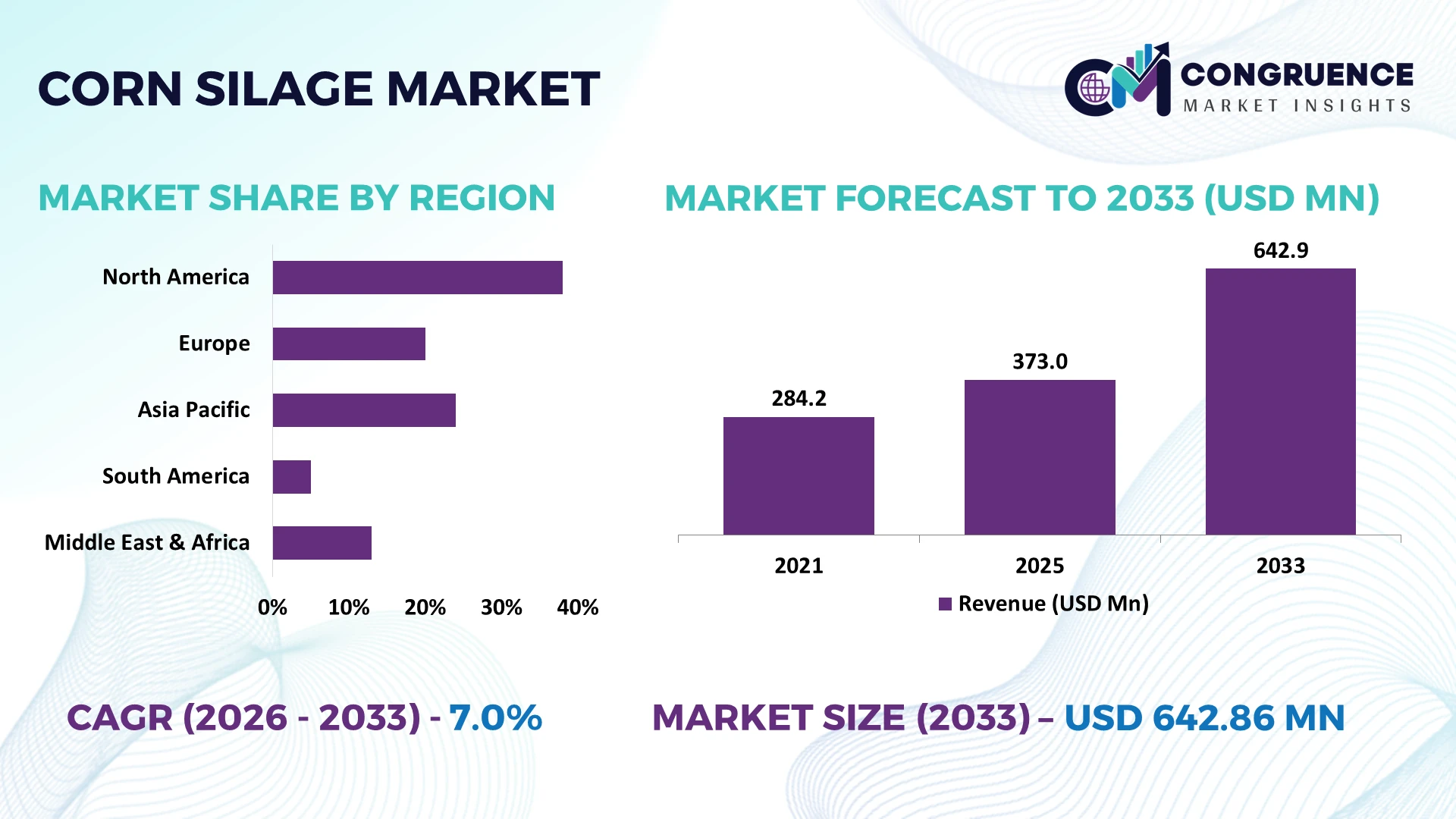
The Global Corn Silage Market was valued at USD 373.03 Million in 2025 and is anticipated to reach a value of USD 642.86 Million by 2033 expanding at a CAGR of 7.04% between 2026 and 2033. Growth is driven by precision forage harvesting, higher-yield silage hybrids, improved inoculants, and dairy farms shifting toward nutritionally consistent feed formulations.
The United States dominates corn silage production, harvesting about 6.1 million acres and producing 123.1 million tons in 2024, with silage representing roughly 6.7% of national corn acreage. Its 20.2-ton-per-acre yield outpaces several major producing states, while 94% of U.S. corn acreage uses biotech varieties. China exceeded 2 million hectares of silage corn by 2020, reinforcing Asia’s expansion. Russia-Ukraine supply disruptions continue to reinforce localized feed-security strategies and investment in efficient forage systems.
Strategically, suppliers should prioritize high-yield hybrids, precision harvesting, and regional dairy clusters where feed-efficiency gains directly strengthen farm margins.
Market Size & Growth: USD 373.03 million to USD 642.86 million at 7.04% CAGR, driven by precision harvesting and feed-quality optimization.
Top Growth Drivers: Precision farming 18%, improved hybrids 16%, dairy-feed optimization 14%.
Short-Term Forecast: By 2028, automated harvesting targets 8–12% lower operating costs and 10% higher field efficiency.
Emerging Technologies: AI yield mapping, autonomous forage harvesters, and digital ration platforms are reshaping high-growth farms.
Regional Leaders: North America ~USD 257 million; Europe ~USD 180 million; Asia-Pacific ~USD 154 million, led by mechanization and silage adoption.
Consumer/End-User Trends: Around 80% of roughage in developed-country dairy diets can comprise corn silage, supporting consistent nutritional demand.
Pilot/Case Example: 2021 Chinese integrated maize-dairy systems demonstrated 8–18% lower environmental impacts through coordinated production.
Competitive Landscape: North America leads; major players include Corteva, Bayer, Syngenta, KWS, and Limagrain.
Regulatory & ESG Impact: Integrated production can reduce resource impacts by up to 18%, strengthening low-emission dairy strategies.
Investment & Funding: More than USD 100 million in modeled technology and capacity investment is shifting toward mechanized harvesting and storage.
Innovation & Future Outlook: Next-generation hybrids, AI-assisted maturity tracking, and automated silage compaction will accelerate the shift toward data-driven forage management.
The Corn Silage Market is strengthening around large-scale dairy operations, feedlots, and integrated livestock systems seeking consistent dry-matter yield and nutrient density. Approximately 80% of roughage in developed-country dairy diets can comprise corn silage, while precision harvesting and improved hybrids increasingly target measurable feed-efficiency gains. Supply-chain disruptions since the Russia-Ukraine conflict further emphasize localized forage production, creating a transition toward technology-led strategic sourcing.
The Corn Silage Market is becoming strategically important as dairy producers prioritize feed consistency, land productivity, and lower nutrient losses rather than simply increasing forage volumes. In the United States, 2024 corn silage production reached about 123 million tons, while state yields ranged from 16 tons per acre in Texas to 23 tons in Indiana, highlighting the commercial value of agronomic optimization. Digital feed management is also restructuring procurement and farm-level decision-making.
Technology is shifting silage economics from conventional harvesting toward precision maturity monitoring, automated forage harvesting, and biological preservation. Modern inoculant systems reduced spoiled silage from 7.8% to 3.4% in a farm-scale trial, cutting spoilage by more than 50%; advanced formulations also increased aerobic stability up to 1.8-fold under suitable dry-matter conditions. Over the next 2–3 years, commercial deployment will increasingly target 5–10% lower feed-loss rates and more consistent dry-matter management.
Operationally, large U.S. dairy clusters are integrating harvesting, storage, inoculation, and ration management instead of treating silage as a standalone input. Producers are directing investment toward high-yield hybrids, precision machinery, and microbial technologies, while suppliers are expanding partnerships with dairy integrators and farm-management platforms. The strategic winners will be companies that connect genetics, harvesting intelligence, preservation, and feed analytics into one measurable productivity proposition.
Feed-quality standardization is accelerating adoption of precision corn silage practices. U.S. 2024 yields reached 23 tons per acre in Indiana versus 18 tons in Texas, a 28% productivity gap that strengthens the case for localized agronomic optimization. Precision maturity monitoring and improved hybrids can target 5–10% better harvest utilization, while biological inoculants reduce spoilage by more than 50% in farm-scale applications. Supply-chain volatility is also pushing dairy operators toward locally controlled forage production. Companies are responding with hybrid-development programs, precision harvesting partnerships, and integrated feed-management solutions. The non-obvious advantage is that yield consistency, rather than acreage expansion, increasingly determines the profitability of large dairy feeding systems.
Corn silage scalability remains constrained by storage quality, harvest timing, and uneven farm infrastructure. Farm-scale evidence shows untreated silage spoilage at 7.8%, creating direct losses in usable feed and nutrients, while inoculation reduced spoilage to 3.4%. Smaller operators also face higher per-ton costs for specialized harvesting and airtight storage. In Texas, 160,000 acres produced 2.88 million tons of corn silage in 2024, demonstrating substantial scale but also dependence on coordinated harvesting and storage capacity. Companies are mitigating exposure through contractor networks, multi-year supply arrangements, and integrated storage services. The strategic constraint is not crop availability alone; it is preserving harvested dry matter through the entire logistics chain.
The strongest opportunity lies in combining microbial preservation with digital harvest controls. Research shows inoculation improved aerobic stability 1.8-fold at 20 days and delivered substantially larger stability gains in medium- and high-dry-matter silages after 60 days. This creates a premium market for condition-specific inoculants linked to sensors measuring dry matter and fermentation conditions. Over the next 2–3 years, suppliers targeting 10–15% lower deterioration losses can differentiate beyond conventional seed sales. Companies are expanding R&D around microbial consortia, enzyme systems, and digital agronomy platforms, while dairy integrators are positioned to commercialize bundled feed-quality services. The unique opportunity is monetizing preservation performance rather than simply selling forage inputs.
Long-term competitiveness depends on synchronizing crop genetics, harvest maturity, fermentation, storage, and ration formulation. Research demonstrates that inoculant effectiveness varies materially with dry-matter content: after 60 days, stability improvement reached 261 versus 41 hours in medium-dry-matter silage and 320 versus 66 hours in high-dry-matter silage. This variability creates deployment complexity for standardized products and raises the need for farm-specific protocols. Companies must invest in sensor integration, operator training, automated application systems, and technical partnerships. The strategic challenge is building repeatable quality across diverse climates and farm sizes; suppliers that cannot connect field data with preservation decisions face weaker product differentiation and inconsistent customer outcomes.
Precision Harvesting Gains Ground: U.S. corn silage output reached a record 136 million tons in 2025, up 8%, while yield increased 7.9% to 21.8 tons per acre. Dairy operators are integrating maturity monitoring and automated harvesting to reduce field losses and improve feed consistency; equipment suppliers are increasingly bundling sensors with harvesting services.
Storage Quality Becomes Strategic: Airtight bunker management, rapid compaction, and inoculant application are moving from optional practices toward standardized workflows. Farms targeting 3–5% lower dry-matter losses are upgrading storage processes, while contractors are combining harvesting and preservation services. Labor shortages are accelerating mechanized workflows, shifting purchasing decisions toward integrated equipment packages.
High-Yield Genetics Reshape Procurement: In 2025, Minnesota and Indiana each recorded approximately 22–23 tons per acre of corn silage, reinforcing the commercial value of region-specific hybrids. Seed companies are emphasizing BMR traits, digestibility, and stress tolerance, while large dairy operators increasingly link seed selection with ration-performance targets rather than acreage yield alone.
Data-Led Feed Management Expands: Digital ration platforms and feed-quality analytics are connecting silage dry matter with livestock performance, reducing formulation variability by targeted 5–8%. U.S. feed operations are adopting integrated data workflows, while suppliers are forming partnerships across genetics, harvesting, inoculants, and nutrition. The non-obvious shift is toward selling measurable feed outcomes instead of standalone forage inputs.
Whole-Plant Silage remains the leading type, estimated at approximately 58% market share, because its combination of whole-crop energy, established harvesting infrastructure, and compatibility with large dairy feeding systems supports scalable procurement. Its mature operating model keeps adoption roughly 12–15 percentage points ahead of specialized formats. Kernel-Processed Silage holds a smaller share but improves starch availability and supports premium ration strategies, particularly where feed conversion is tightly monitored.
High-Moisture Silage is the fastest-growing type, with adoption estimated to expand around 9–11% annually as farms seek lower drying requirements and tighter grain preservation. BMR Silage is also gaining attention, particularly among high-producing dairy herds where fiber digestibility can justify premium seed costs. Companies are shifting investment toward specialty hybrids, processing partnerships, and differentiated seed portfolios, while maintaining Whole-Plant Silage as the volume anchor.
Dairy Cattle Feed leads the application landscape with an estimated 64% market share, reflecting the high forage requirements of intensive milk-production systems and the importance of consistent starch and fiber delivery. Dairy operations typically maintain more structured silage procurement than beef producers, with quality-control requirements estimated 10–15% higher. Beef Cattle Feed represents a mature secondary application, while Livestock Nutrition is gaining importance through precision ration formulation.
Ruminant Feed Formulation is the fastest-growing application, expanding approximately 9–10% as nutrition software and laboratory feed analysis improve ration precision. Companies are responding by integrating silage analytics with feed formulation platforms, expanding technical services, and developing application-specific inoculants. The strategic shift is from volume-based feed purchasing toward performance-linked formulation, allowing suppliers to capture higher-value demand from sophisticated dairy and livestock operators.
Dairy Farms represent the dominant end-user group, estimated at approximately 61% market share, because silage is deeply embedded in high-throughput feeding, storage, and ration-management infrastructure. Their purchasing intensity is roughly 15–20% higher than that of many beef-oriented operations, reflecting continuous feed requirements and tighter quality specifications. Beef Cattle Farms remain important but generally prioritize cost-efficient forage availability over advanced monitoring.
Feedlots are the fastest-growing end-user segment, with adoption estimated to increase 8–10% as operators emphasize feed conversion, controlled ration delivery, and automated mixing. Commercial Livestock Farms are also increasing centralized procurement and storage capacity. Companies are responding with customized contracts, equipment partnerships, inoculant bundles, and feed-management services. The competitive opportunity is shifting toward integrated solutions that reduce operational variability rather than standalone silage products.
North America accounted for the largest market share at 38% in 2025 however, Asia-Pacific is expected to register the fastest growth, expanding at a CAGR of 8.7% between 2026 and 2033.
Precision dairy feeding is reshaping established silage infrastructure
North America remains the largest Corn Silage Market, supported by concentrated dairy operations, mechanized harvesting, established bunker infrastructure, and advanced forage genetics. The United States alone produced about 123 million tons of corn silage in 2025, with Iowa generating 6.25 million tons and achieving 25 tons per acre. Large dairy enterprises are integrating harvest scheduling, inoculant application, storage monitoring, and ration analytics into unified workflows. Equipment and seed suppliers are expanding partnerships with nutrition specialists and custom harvesting contractors. The operational priority is shifting from acreage expansion toward higher usable dry-matter recovery, giving technology-enabled producers a measurable cost advantage.
United States Market Outlook: The United States provides the strongest deployment base because large dairy clusters combine high-capacity forage machinery with sophisticated feed-management infrastructure. Texas harvested 265,000 acres of corn for silage in 2025 and produced 5.83 million tons, demonstrating substantial commercial scale outside the Midwest.
Sustainability metrics are reshaping forage procurement
Europe is moving toward higher-quality silage systems where digestibility, nutrient retention, farm efficiency, and environmental performance increasingly influence procurement. Germany, France, Italy, and the Netherlands remain important commercial centers because intensive dairy systems require consistent forage specifications. Precision harvesting and feed-analysis adoption is increasing, while tighter environmental expectations encourage farms to reduce nutrient losses and improve land productivity. Suppliers are emphasizing high-digestibility hybrids, BMR genetics, biological preservation, and advisory services rather than commodity seed positioning. Cooperative purchasing and integrated dairy networks also strengthen supplier relationships. The strategic shift is toward measurable feed efficiency: producers increasingly evaluate silage inputs against milk output, ration stability, storage losses, and resource utilization instead of tonnage alone.
Germany Market Outlook: Germany offers a strong combination of intensive dairy production, advanced agricultural machinery, and established forage-management practices. Its sophisticated farm machinery ecosystem supports precision harvesting and automated documentation, while tighter environmental management encourages producers to prioritize nutrient efficiency and controlled storage. Suppliers with localized agronomy and performance-based contracts are well positioned.
Dairy modernization is accelerating commercial silage adoption
Asia-Pacific represents the most significant expansion opportunity as commercial dairy systems modernize and livestock producers move from fragmented forage sourcing toward standardized feed programs. China is the principal scale market, while India is developing rapidly through organized dairy clusters and mechanized forage production. China’s large-scale dairy operations increasingly use silage corn to improve feed consistency, while India’s adoption remains more uneven because farm structures and harvesting infrastructure vary considerably. Suppliers are responding through localized hybrids, contract cultivation, custom harvesting, and dairy-integrator partnerships. The key deployment shift is from small-scale forage preparation toward centralized silage production serving multiple livestock units. This improves equipment utilization and reduces per-ton processing costs where logistics are coordinated.
China Market Outlook: China combines the region’s strongest commercial dairy infrastructure with significant silage-corn cultivation potential. Large dairy groups increasingly favor contracted forage production and standardized ration systems, creating opportunities for seed suppliers, machinery providers, and preservation-technology companies. Domestic breeding capabilities and localized hybrid development are also improving product adaptation.
Integrated dairy and beef systems are expanding forage demand
South America is developing as a strategically important Corn Silage Market because Brazil and Argentina combine large maize-growing bases with expanding dairy and intensive beef operations. Brazil offers particularly strong production economics because silage corn can be integrated into established maize systems and year-round livestock feeding programs. Commercial farms are increasing use of high-biomass hybrids, mechanized chopping, bunker storage, and outsourced harvesting. Brazil’s forage-seed ecosystem is also becoming more competitive as international and regional suppliers target localized genetics. Infrastructure remains uneven outside major agricultural corridors, making contractor networks and distributed storage important. Companies are responding through local seed trials, dealer partnerships, custom-harvesting agreements, and integrated feed solutions. The strongest opportunity lies in converting abundant maize production into higher-value livestock productivity.
Brazil Market Outlook: Brazil is the region’s most strategically significant country because its maize production scale, beef-feedlot concentration, and expanding dairy infrastructure support diversified silage demand. Large commercial farms increasingly use mechanized harvesting and high-energy hybrids, while local partnerships help suppliers overcome fragmented technical-service coverage.
Water efficiency is driving controlled forage production
Middle East & Africa remains an emerging Corn Silage Market where commercial dairy modernization, controlled-environment agriculture, and feed-security strategies are reshaping procurement. Saudi Arabia, the United Arab Emirates, Egypt, and South Africa are important activity centers, although water availability and forage-production economics vary sharply. Large dairy enterprises are increasingly favoring contracted forage supply, precision irrigation, and imported or locally adapted silage hybrids to stabilize feed availability. Companies are emphasizing drought-tolerant genetics, irrigation optimization, storage systems, and long-term supply contracts. In water-constrained markets, the competitive metric is increasingly usable nutrients per unit of water rather than harvested tonnage. This favors suppliers capable of combining genetics, agronomy, irrigation management, and preservation technology into integrated livestock-feed solutions.
Saudi Arabia Market Outlook: Saudi Arabia has strong strategic relevance because large-scale dairy operators require controlled, reliable forage systems despite severe water constraints. Commercial farms therefore prioritize high-efficiency irrigation, contracted feed supply, and storage optimization. Suppliers that reduce water intensity while maintaining consistent dry-matter quality gain a stronger position in enterprise dairy procurement.
Competition is led by Bayer, Corteva, Syngenta, KWS, and Limagrain, with global seed leaders competing against regional breeders, forage specialists, and cost-focused suppliers. The top five are estimated to control about 52% of the competitive market. Technology differentiates premium offerings, with advanced hybrids targeting 5–10% better forage utilization, while customized agronomy services improve procurement efficiency by 4–7%. Regional players compete more aggressively on price, local adaptation, and distributor reach, typically undercutting premium offerings by 8–12%. Competition is shifting toward vertical integration: leading companies combine genetics, field trials, advisory services, and distribution rather than selling seed alone. Partnerships with dairy networks and feed-management providers are strengthening customer lock-in, while regional expansion in China, Brazil, and India raises competitive pressure. Entry barriers remain high because breeding pipelines, regulatory approvals, field validation, and farmer trust require substantial time and capital. Winning requires differentiated genetics, dependable supply, local agronomy, and measurable feed-performance economics consistently.
Bayer AG
Corteva Agriscience
Syngenta AG
KWS SAAT SE & Co. KGaA
Limagrain Group
RAGT Semences
DLF Seeds A/S
Royal Barenbrug Group
Advanta Seeds
Longping High-Tech
AgReliant Genetics
Beck’s Hybrids
Precision harvesting is becoming the core current technology, combining NIR dry-matter sensing, satellite field mapping, automated chopping, and digital harvest records. Satellite-based monitoring targets the optimal 30–35% dry-matter window, while automated forage systems can improve harvesting efficiency by 5–8%. Adoption is concentrated among large dairy farms and custom harvesters, creating stronger feed consistency and lower field-loss exposure.
Emerging systems integrate AI cameras, IoT sensors, inoculant dosing, and feed analytics. AGCO’s ForageQualityCam monitors kernel processing in real time, enabling operators to adjust harvester settings immediately. Compared with manual post-harvest inspection, real-time control improves quality-response speed by roughly 10–15%; deployment is still early but strategically important for premium dairy operations.
Disruptive technology is shifting toward biological nitrogen optimization and connected forage ecosystems. Pivot Bio’s 2026 commercial studies reported 0.91 additional ton per acre and 954 additional pounds of milk per acre across more than 90 silage studies. Through 2026–2028, integrated AI, biological inputs, autonomous machinery, and digital rationing will favor large farms and technology-enabled suppliers, strengthening productivity, resource efficiency, and competitive differentiation.
March 2024 KWS sold its South American corn businesses and licensed breeding material to GDM, retaining its European silage-corn position. The transaction covered Argentina, Brazil, Uruguay, and Paraguay, enabling portfolio concentration and regional restructuring. Source: kws.com
November 2024 Syngenta partnered with McDonald’s and Lopez Foods to advance Enogen corn across the U.S. beef supply chain. Silage or grain feeding delivered about 5% better feed efficiency, supporting lower resource intensity and scalable sustainability targets.
November 2025 AGCO’s Fendt ForageQualityCam received the AGRITECHNICA Innovation Award Silver Medal and Farm Machine 2026 recognition. The retrofit AI-camera system analyzes grain-processing quality in real time, enabling immediate harvester adjustments and strengthening automated forage-quality control. Source: agcocorp.com
June 2026 ICAR-IIMR expanded its maize-based silage initiative across Punjab and Haryana, reporting a 15% fodder-yield increase across nearly 400 demonstration acres. More than 1,000 farmers were trained, accelerating mechanized silage adoption and strengthening decentralized fodder supply chains. Source: icar.gov.in
The Corn Silage Market Report covers Whole-Plant Silage, Kernel-Processed Silage, High-Moisture Silage, and BMR Silage across Dairy Cattle Feed, Beef Cattle Feed, Livestock Nutrition, and Ruminant Feed Formulation applications. End-user analysis includes Dairy Farms, Beef Cattle Farms, Feedlots, and Commercial Livestock Farms, with comparative assessment of established and emerging adoption patterns.
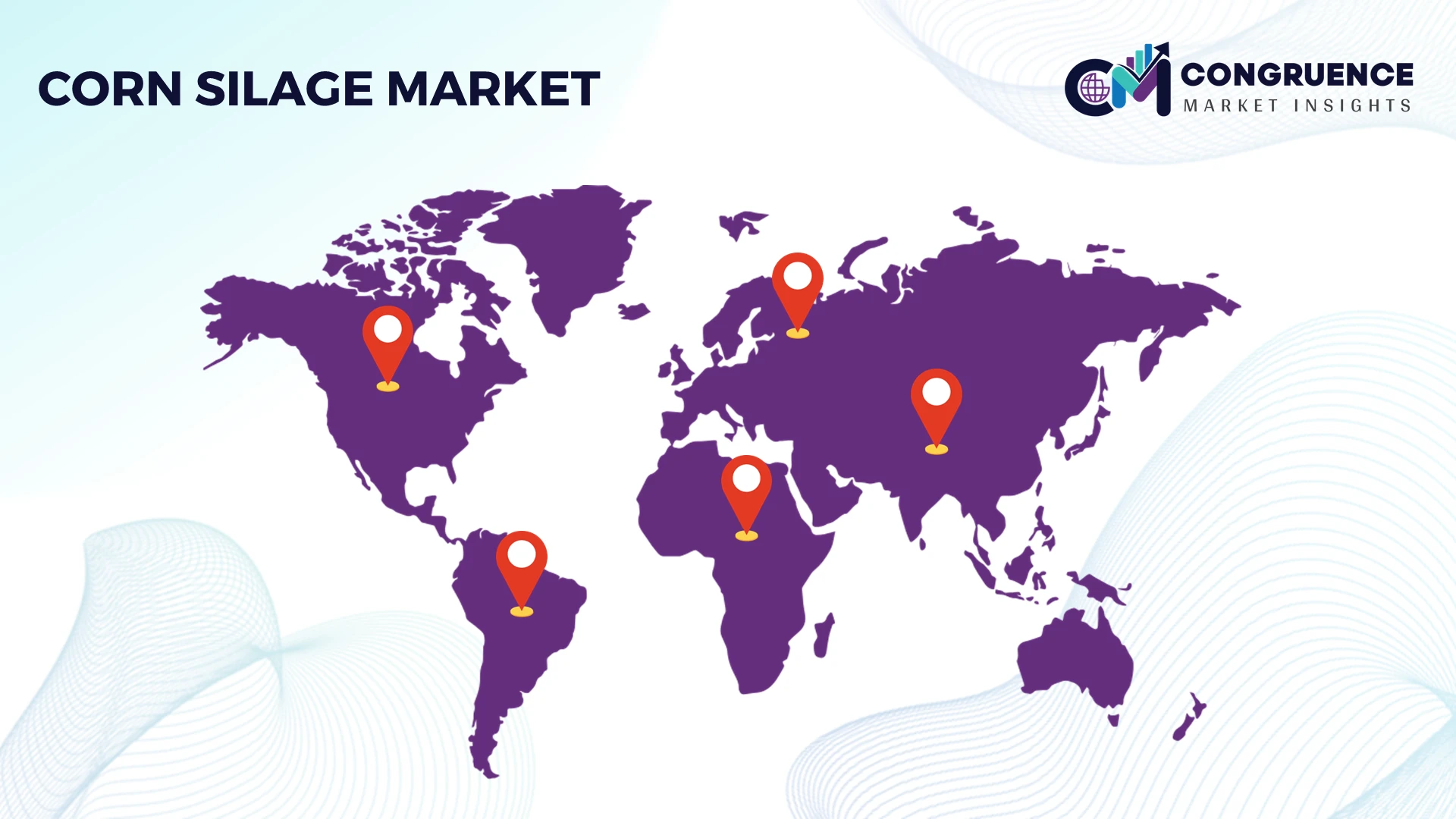
Geographic coverage spans North America, Europe, Asia-Pacific, South America, and Middle East & Africa, with country-level analysis emphasizing production concentration, mechanization, storage infrastructure, and feed-management deployment. Technology coverage includes precision harvesting, NIR sensing, AI-based quality monitoring, biological inoculants, automated baling, and digital ration integration. The report supports investment planning, expansion priorities, partnership evaluation, competitive positioning, technology selection, and strategic market decisions through 2026–2033.
| Report Attribute/Metric | Report Details |
|---|---|
Market Revenue in 2025 | USD 373.03 Million |
Market Revenue in 2033 | USD 642.86 Million |
CAGR (2026 - 2033) | 7.04% |
Base Year | 2025 |
Forecast Period | 2026 - 2033 |
Historic Period | 2021 - 2025 |
Segments Covered | By Type
By Application
By End-User
|
Key Report Deliverable | Revenue Forecast, Growth Trends, Market Dynamics, Segmental Overview, Regional and Country-wise Analysis, Competition Landscape |
Region Covered | North America, Europe, Asia-Pacific, South America, Middle East, Africa |
Key Players Analyzed | Bayer AG, Corteva Agriscience, Syngenta AG, KWS SAAT SE & Co. KGaA, Limagrain Group, RAGT Semences, DLF Seeds A/S, Royal Barenbrug Group, Advanta Seeds, Longping High-Tech, AgReliant Genetics, Beck’s Hybrids |
Customization & Pricing | Available on Request (10% Customization is Free) |




