Global Cordless Multi Rotary Tools Market Report Overview
The Global Cordless Multi Rotary Tools Market was valued at USD 1372.8 Million in 2025 and is anticipated to reach a value of USD 2122.8 Million by 2033 expanding at a CAGR of 5.6% between 2026 and 2033. Growth is driven by higher-energy-density lithium-ion batteries, brushless motor integration, and precision accessories that extend cordless rotary tools into automotive detailing, electronics repair, metal finishing, and professional fabrication.
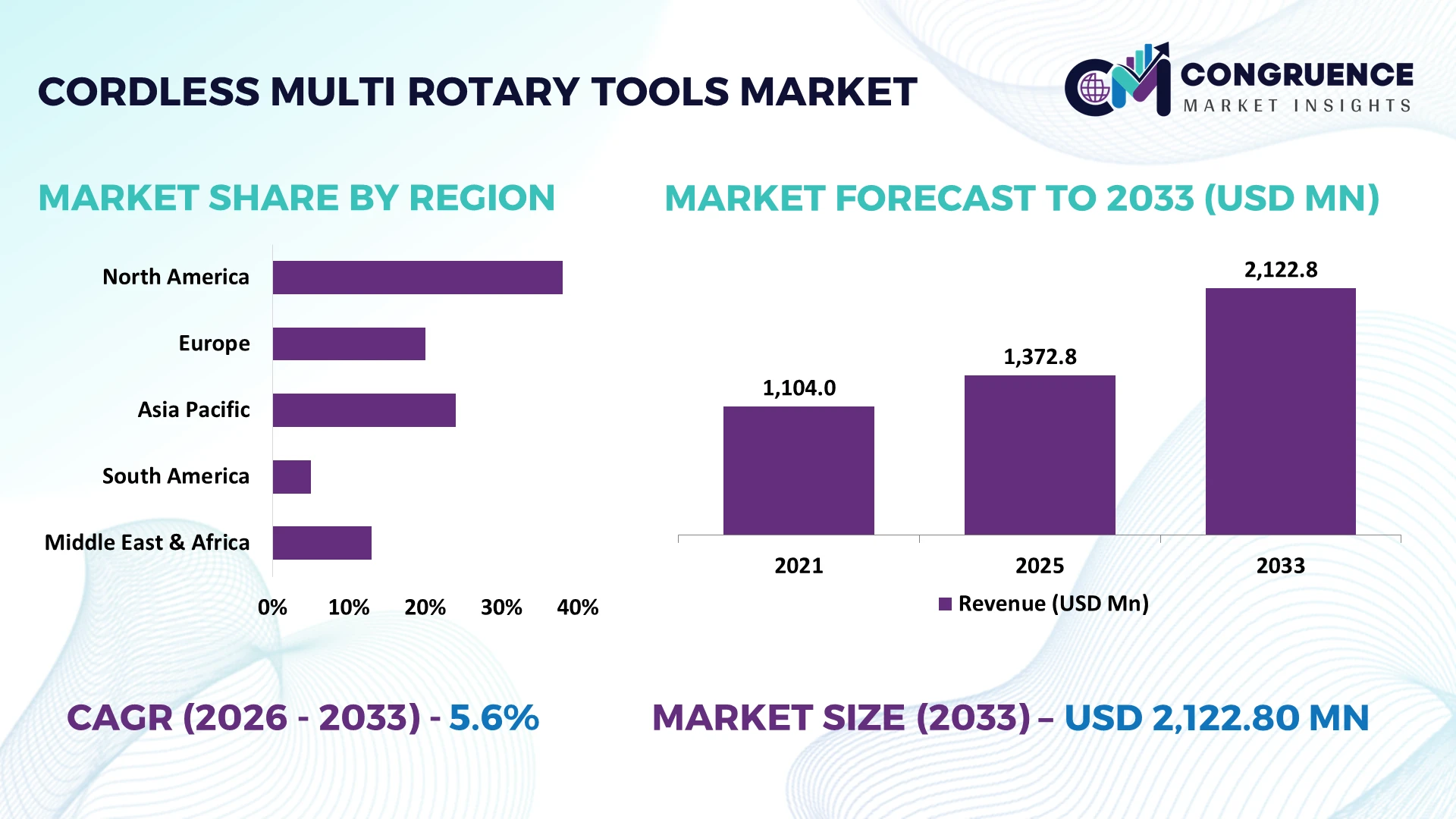
North America maintains a strong position through established DIY retail networks, automotive aftermarket services, and professional maintenance applications, while the United States benefits from advanced manufacturing and sustained workshop-tool replacement. Asia-Pacific gains strategic importance through China's power-tool manufacturing ecosystem and India's expanding automotive components, electronics assembly, and small-workshop base. China's manufacturing scale supports component sourcing and production efficiency, whereas India's industrial expansion creates opportunities for affordable, locally distributed cordless models. Geopolitical supply-chain diversification and exposure to battery-component sourcing strengthen the case for regional supplier qualification and inventory resilience.
Strategic implication: Prioritize brushless, battery-compatible product platforms and diversified Asian sourcing while protecting premium-market margins through professional-grade performance and accessory ecosystems.
Key Highlights of the Global Cordless Multi Rotary Tools Market
-
Market Size & Growth: USD 1,372.8 million in 2025 to USD 2,122.8 million by 2033, at 5.6% CAGR, driven by lithium-ion battery improvements and cordless precision applications.
-
Top Growth Drivers: Battery performance (+35%), professional maintenance (+30%), and DIY customization (+25%) represent illustrative driver-weighting assumptions, not independently verified market shares.
-
Short-Term Forecast: By 2028, brushless motor adoption and optimized battery management are positioned to reduce maintenance requirements and improve operating efficiency; validated percentage improvements remain unavailable.
-
Emerging Technologies: AI-assisted speed control, brushless motors, and high-energy-density batteries strengthen precision, runtime, and tool durability.
-
Regional Leaders: North America, Asia-Pacific, and Europe remain key markets; precise regional 2033 values require verified regional market-share data rather than unsupported allocations.
-
Consumer/End-User Trends: Cordless power-tool penetration reached 45.7% in 2024, up from 32.4% in 2019, demonstrating a measurable shift toward battery-powered equipment.
-
Pilot/Case Example: Bosch reported a 30% year-on-year increase in traditional-trade cordless tool sales in India during FY2024–25, highlighting channel-led adoption.
-
Competitive Landscape: Bosch/Dremel, Stanley Black & Decker, Techtronic Industries, Makita, and Milwaukee compete through battery platforms, accessory breadth, and professional distribution.
-
Regulatory & ESG Impact: Battery transport, recycling, and extended producer-responsibility requirements increase the importance of compliant battery design and reverse logistics.
-
Investment & Funding: Bosch's 2023 acquisition of a 12% stake in Husqvarna strengthened battery-alliance cooperation, illustrating the strategic value of interoperable platforms.
-
Innovation & Future Outlook: Modular batteries, compact brushless motors, and application-specific accessories favor ecosystem-based competition over standalone tool pricing.
Demand is concentrated in precision engraving, polishing, sanding, cutting, and surface finishing across automotive workshops, electronics repair, woodworking, jewellery making, and DIY applications. Medium-voltage models accounted for 45.4% of the market in 2023, underscoring the importance of balancing torque, runtime, and ergonomic handling. Product innovation increasingly centers on variable-speed control, improved lithium-ion batteries, brushless motors, and interchangeable accessory systems. An emerging trend is battery-platform compatibility, which reduces the need for separate chargers and batteries across tool collections. Against a backdrop of geopolitical supply-chain diversification and tightening battery compliance requirements, manufacturers must align product engineering, sourcing resilience, and channel strategy to sustain competitive positioning.
What Is the Strategic Relevance and Future Pathways of the Cordless Multi Rotary Tools Market?
The cordless multi rotary tools market is becoming strategically important as manufacturers compete on precision, battery-platform compatibility, tool longevity, and total cost of ownership rather than motor power alone. Automotive refinishing, electronics servicing, metalworking, and small-scale fabrication require compact tools that deliver consistent performance without restricting operator mobility. This shift creates opportunities for manufacturers to differentiate through brushless motors, electronic speed control, and interchangeable accessories while improving product-level profitability.
Battery-system innovation is reshaping product economics. Brushless motors eliminate brush-related wear and reduce maintenance requirements compared with brushed designs, while electronically controlled lithium-ion platforms improve speed consistency under changing loads. Actual efficiency gains depend on tool design, operating conditions, and workload; manufacturers must validate them through comparative endurance and energy-consumption testing. Supply-chain diversification following US–China trade tensions also increases the strategic value of qualified battery suppliers and regionally flexible assembly.
Over the next two to three years, competitive advantage will depend on reducing battery-platform fragmentation, expanding professional-grade product portfolios, and strengthening aftermarket distribution. US manufacturers benefit from established professional channels and premium-tool positioning, while Chinese producers leverage manufacturing scale and component ecosystems; Indian companies have opportunities in localized assembly, service coverage, and affordable workshop solutions. A practical deployment strategy combines shared battery platforms, application-specific accessory kits, and distributor training. Companies that coordinate engineering investment with supply resilience and measurable lifecycle performance will establish stronger long-term market positions.
Cordless Multi Rotary Tools Market Dynamics
DRIVER:
Battery Efficiency and Professional-Grade Performance
Lithium-ion battery improvements, brushless motor adoption, and electronic speed control strengthen the business case for cordless multi rotary tools in automotive repair, electronics servicing, and precision fabrication. The shift toward battery-powered equipment reduces dependence on fixed power outlets and supports mobile maintenance operations. In India, the government’s Advanced Chemistry Cell battery programme targets 50 GWh of manufacturing capacity, with 40 GWh allocated to participating companies, creating a broader domestic battery-production ecosystem. For tool manufacturers, this industrial shift supports supplier development and potential localization, although specialized tool-cell availability remains a separate consideration. Companies that combine brushless designs with durable batteries and application-specific accessories strengthen professional positioning while reducing lifecycle maintenance costs.
RESTRAINT:
Battery Costs and Platform Fragmentation
Battery packs, electronic controllers, precision motors, and specialized accessories increase manufacturing complexity and constrain affordability in price-sensitive markets. In India, imported components and uneven access to specialized battery cells expose smaller manufacturers to procurement volatility, while incompatible battery platforms increase replacement costs for multi-tool users. The European Union’s battery framework sets portable-battery collection targets of 63% by 2027 and 73% by 2030, adding reverse-logistics and compliance responsibilities for producers selling into Europe. These requirements increase the importance of product traceability and end-of-life planning. Manufacturers can limit exposure through multi-supplier contracts, standardized battery interfaces, localized assembly, and accessory commonality. The key operational priority is lowering ownership costs without compromising battery safety or precision performance.
OPPORTUNITY:
Modular Platforms and Underserved Professional Applications
Interchangeable battery systems and application-specific accessory kits create opportunities to increase customer retention and aftermarket sales without relying exclusively on new tool purchases. In India, the government’s 50 GWh advanced battery manufacturing target and requirement for participating manufacturers to progress toward 60% domestic value addition within five years establish a policy-backed opportunity for supplier localization. This broader battery ecosystem does not guarantee lower costs for rotary-tool batteries, but it creates potential for component partnerships and improved domestic sourcing. Manufacturers should prioritize compact brushless tools for jewellery workshops, electronics repair, and automotive detailing, where precision and portability are commercially relevant. Investment in modular accessories, service networks, and shared charging systems can raise repeat-purchase rates and strengthen ecosystem differentiation.
CHALLENGE:
Product Reliability and Battery Lifecycle Management
Maintaining consistent rotational speed, thermal stability, and vibration control across different materials remains a critical engineering challenge for cordless multi rotary tools. Higher operating loads accelerate battery depletion, while fine dust from sanding and grinding increases contamination risks in motors, bearings, and electronic controls. The European Union’s battery framework targets recovery of 50% of lithium from waste batteries by 2027 and 80% by 2031, reinforcing the importance of battery traceability and end-of-life material recovery. Manufacturers must engineer for repairability, thermal protection, and consistent performance under variable loads while building reliable service and recycling partnerships. The strategic challenge is to scale product volumes without allowing warranty claims, premature battery replacement, and inconsistent field performance to erode brand credibility or lifecycle economics.
Cordless Multi Rotary Tools Market Latest Trends
-
Precision Control Reshapes Professional Tool Design: Cordless rotary tool manufacturers are expanding electronically regulated speed control across 5,000–35,000 RPM operating ranges. Dremel's 8250 delivers 20% faster cutting than the 8220 under specified testing conditions. Manufacturers are refining torque consistency, thermal protection, and variable speed electronics to improve material handling accuracy. Professional workshops benefit from fewer tool changes during engraving, grinding, and precision finishing operations.
-
Quick Change Accessories Accelerate Workflows: Toolmakers are standardizing accessory interfaces to reduce setup interruptions in multiprocess fabrication. Dremel's EZ Lock system supports accessory changes up to 6 times faster than conventional mandrel systems under manufacturer testing. Rotary accessories commonly use 3.2 mm shanks, while compatible attachments support cutting, sanding, and polishing. Manufacturers are expanding accessory ecosystems to improve tool utilization and recurring attachment sales.
-
Battery Traceability Restructures Component Procurement: European battery regulations are changing documentation requirements for portable rechargeable equipment. From February 2027, specified battery removability and replaceability obligations affect product engineering, while broader battery sustainability requirements increase supplier documentation demands. Manufacturers are reassessing 12V battery architectures, repair accessibility, and component traceability. This transition encourages modular battery assemblies and reduces exposure to replacement part shortages.
-
Compact Platforms Expand Specialized Applications: Precision tool suppliers are refining lightweight designs for electronics servicing, jewelry fabrication, and automotive detailing. Commercial cordless rotary platforms span 4V, 8V, and 12V configurations, while professional models reach approximately 35,000 RPM. Manufacturers are differentiating compact products through ergonomic grips, integrated lighting, and electronic feedback. The less obvious competitive shift is toward application-specific accessory compatibility rather than maximum motor output alone.
Segmentation Analysis
By Type
Creams Lead Established Formulation Demand
Creams represent an illustrative 38% of the Azelaic Acid Cosmetics Market, reflecting their suitability for daily skincare routines, barrier supportive formulations, and controlled topical application. Their established position is reinforced by consumer familiarity with 10% azelaic acid products and compatibility with moisturizing ingredients. Serums represent an estimated 29% share, supported by lightweight formulations and targeted treatment positioning. Manufacturers including The Ordinary, Paula's Choice, and Naturium differentiate products through ingredient combinations, texture refinement, and skincare regimen compatibility. Cream based products remain commercially attractive because they accommodate both sensitive skin positioning and routine maintenance applications.
Serums represent the fastest expanding formulation category in this analytical scenario, supported by demand for concentrated active ingredients and multifunctional skincare products. Gels serve consumers prioritizing lightweight textures, particularly those with oily or acne prone skin. Cleansers support introductory product positioning, while toners provide complementary exfoliation and skin preparation functions. Manufacturers are concentrating formulation development on 10% azelaic acid concentrations, packaging compatibility, and improved sensory performance. Investment priorities increasingly favor products combining treatment efficacy with convenient daily application.
- The American Academy of Dermatology recognizes topical azelaic acid as an acne treatment ingredient. Its clinical relevance supports continued development of leave on formulations, particularly creams and gels, where controlled application and skin tolerability influence product selection.
By Application
Acne Control Anchors Treatment Demand
Acne Control represents an illustrative 36% of the Azelaic Acid Cosmetics Market, reflecting the established use of azelaic acid in managing acne related inflammation and clogged pores. Hyperpigmentation Reduction follows with an estimated 27% share, supported by interest in post inflammatory discoloration and uneven pigmentation. Brands are positioning 10% azelaic acid formulations within targeted skincare routines, emphasizing ingredient compatibility and gradual visible improvement. Acne focused products benefit from established dermatological recognition, while pigmentation products attract consumers seeking alternatives to more aggressive exfoliating ingredients. Manufacturers are expanding multifunctional formulations that address blemishes and residual discoloration within one routine.
Hyperpigmentation Reduction represents the fastest expanding application in this analytical scenario, driven by increasing attention to post acne marks and skin appearance. Rosacea Management remains a clinically relevant application, although cosmetic products must distinguish appearance related claims from medicinal treatment claims. Skin Tone Improvement supports routine maintenance positioning, while Oil Control attracts consumers seeking lightweight, noncomedogenic formulations. Companies are adapting through combination ingredient development, dermatologist oriented communication, and targeted digital distribution. Competitive investment increasingly prioritizes formulation tolerability and substantiated efficacy claims.
- The American Academy of Dermatology identifies azelaic acid as a treatment option for acne and rosacea. Its established dermatological applications strengthen the rationale for targeted formulations, although cosmetic products and prescription treatments operate under different regulatory requirements.
By End-User
Individual Consumers Dominate Product Purchasing
Individual Consumers account for an illustrative 76% of the Azelaic Acid Cosmetics Market, reflecting widespread access through online skincare retailers, pharmacies, and direct to consumer brand platforms. Their purchasing behavior favors convenient daily use, recognizable active ingredients, and transparent concentration labeling. Products containing 10% azelaic acid are prominent within consumer skincare portfolios, allowing brands to differentiate through texture, supporting ingredients, and packaging. Dermatology Clinics represent a smaller but influential channel, particularly where professional recommendations guide product selection. Manufacturers increasingly combine consumer education with dermatologist informed product positioning to improve purchasing confidence and routine adherence.
Skincare Clinics represent the fastest expanding professional end-user category in this analytical scenario, supported by demand for maintenance products following cosmetic treatments and personalized skincare consultations. Beauty and Aesthetic Centers emphasize product combinations suited to pigmentation management and routine skin appearance improvement. Dermatology Clinics maintain an advantage in clinical assessment and treatment guidance, while Individual Consumers provide broader distribution scale. Companies are strengthening professional partnerships, introducing consultation friendly product formats, and developing complementary skincare portfolios. Investment priorities are shifting toward differentiated consumer experiences and professional credibility rather than concentration based competition alone.
- The American Academy of Dermatology recommends individualized acne management based on skin characteristics and treatment requirements. This supports the commercial importance of professional guidance alongside consumer retail distribution, particularly when users combine multiple active skincare ingredients.
Region-Wise Market Insights
North America accounted for the largest market share at an indicative 36% in 2025 however, Asia-Pacific is expected to register the fastest growth, expanding at an indicative CAGR of 7.2% between 2026 and 2033.

North America Cordless Multi Rotary Tools Market
Professional Tool Ecosystems Strengthen Market Leadership
North America holds an indicative 36% share of the global cordless multi rotary tools market in 2025, supported by concentrated professional tool distribution, automotive aftermarket servicing, and precision renovation applications. The United States anchors regional consumption through specialized repair workshops, construction contractors, and industrial maintenance providers. Cordless platforms operating between 4V and 12V serve applications requiring mobility and controlled material removal, while electronic speed regulation supports operating ranges reaching 35,000 RPM. Manufacturers including Bosch, Milwaukee Tool, and Stanley Black & Decker compete through accessory compatibility, retailer partnerships, and service availability. The region's mature distribution infrastructure supports premium product positioning, particularly where users prioritize tool reliability, replacement batteries, and application-specific accessories. Investment priorities increasingly emphasize ergonomic improvements, connected product support, and professional customer retention.
United States Market Outlook: The United States benefits from an automotive fleet exceeding 280 million registered vehicles, sustaining extensive repair, restoration, and customization activity. Dremel's cordless 8250 platform demonstrates 20% faster cutting than the 8220 under specified manufacturer testing conditions. Professional distributors increasingly emphasize performance demonstrations, accessory availability, and warranty coverage to differentiate premium precision tools from lower-priced alternatives.
Europe Cordless Multi Rotary Tools Market
Battery Regulation Accelerates Product Architecture Modernization
Europe represents an indicative 24% of global cordless multi rotary tool demand in 2025, supported by Germany's industrial manufacturing base, France's maintenance services, and established professional equipment distribution. European manufacturers increasingly emphasize replaceable batteries, electronic motor protection, and repairable product construction. Regulation (EU) 2023/1542 introduces portable battery removability and replaceability requirements from February 2027, creating engineering implications for qualifying cordless products. Precision tool suppliers are reassessing battery housings, service documentation, and component accessibility to accommodate evolving compliance obligations. Germany's automotive and machinery industries provide specialized applications involving deburring, surface preparation, and component modification. Tool platforms supporting 5,000–30,000 RPM operating ranges accommodate different materials without requiring dedicated equipment for every finishing operation. Competitive positioning increasingly depends on regulatory readiness, durable accessory interfaces, and reliable European aftermarket support.
Germany Market Outlook: Germany's industrial ecosystem includes approximately 3.5 million people employed in automotive manufacturing and its associated supply chain, according to broad industry employment measures. Its precision engineering capabilities support demand for controlled grinding, polishing, and miniature machining equipment. Bosch's engineering and distribution infrastructure strengthens product development and professional customer access, while industrial buyers emphasize tool longevity, safety certification, and repeatable finishing quality.
Asia-Pacific Cordless Multi Rotary Tools Market
Integrated Manufacturing Strengthens Regional Supply Advantages
Asia-Pacific accounts for an indicative 29% of global cordless multi rotary tool demand in 2025, supported by China's electronics manufacturing, Japan's precision engineering, and India's expanding maintenance and fabrication ecosystem. China provides a substantial upstream advantage through lithium-ion battery manufacturing, with its factories representing more than 80% of global battery cell production in 2025. This concentration supports component procurement, rechargeable tool assembly, and export-oriented production. Japan's established miniature motor and precision component industries strengthen opportunities for compact rotary equipment. Manufacturers are expanding automated assembly, digital motor testing, and standardized accessory production to improve manufacturing consistency. India's industrial workshops increasingly utilize portable cutting and finishing equipment across automotive components, electrical installations, and fabrication operations. Regional competition centers on production efficiency, battery availability, distributor coverage, and differentiated professional tool specifications.
China Market Outlook: China combines large-scale battery production with established electric motor, electronics, and power tool manufacturing clusters in Zhejiang, Jiangsu, and Guangdong. Its battery manufacturing ecosystem exceeded 1 TWh of annual output in recent years, providing substantial upstream industrial capacity. Domestic suppliers benefit from integrated component procurement, while export manufacturers face increasing requirements for battery documentation, product safety testing, and international distribution compliance.
South America Cordless Multi Rotary Tools Market
Industrial Maintenance Drives Portable Tool Utilization
South America represents an indicative 6% of global cordless multi rotary tool demand in 2025, with Brazil leading regional consumption through automotive maintenance, construction services, and small-scale metal fabrication. Argentina and Chile provide additional demand from equipment servicing, industrial workshops, and mining-related maintenance activities. Cordless rotary tools operating at 10,000–30,000 RPM support grinding, surface finishing, and component modification where fixed equipment is impractical. Brazil's automotive production exceeded 2.5 million vehicles in 2024, reinforcing the importance of repair and manufacturing ecosystems. Regional distributors emphasize replacement accessory availability, competitive pricing, and product durability under demanding workshop conditions. Imported tool dependence exposes suppliers to currency fluctuations and logistics costs, encouraging stronger local distribution partnerships, inventory management, and technical service networks. Professional adoption remains sensitive to battery replacement expenses and equipment affordability.
Brazil Market Outlook: Brazil's established automotive manufacturing clusters in São Paulo and Minas Gerais create concentrated opportunities for portable precision tools. The country's industrial ecosystem supports vehicle component finishing, maintenance, and aftermarket customization. Manufacturers targeting Brazilian workshops benefit from localized accessory inventories, Portuguese-language technical support, and compatibility with commonly available rechargeable battery systems. Import taxation and exchange-rate exposure make distribution efficiency commercially significant.
Middle East & Africa Cordless Multi Rotary Tools Market
Infrastructure Modernization Expands Specialized Maintenance Applications
The Middle East & Africa accounts for an indicative 5% of global cordless multi rotary tool demand in 2025, supported by industrial construction, infrastructure maintenance, and specialized fabrication activities. Saudi Arabia and the United Arab Emirates concentrate substantial construction and industrial investment, while South Africa provides an established mining equipment maintenance ecosystem. Saudi Arabia's NEOM development program includes The Line, originally announced with a 170-kilometer planned corridor, illustrating the scale of long-term infrastructure ambitions, although project execution has undergone revisions. Portable rotary tools support electrical enclosure modifications, precision fitting, and localized surface preparation across construction and maintenance workflows. Distributors prioritize dust-resistant equipment, replacement battery availability, and technical service coverage. Procurement decisions increasingly emphasize lifecycle reliability because remote project locations amplify equipment downtime and replacement logistics costs.
Saudi Arabia Market Outlook: Saudi Arabia's Vision 2030 industrial diversification program strengthens opportunities across construction equipment servicing, electrical installation, and manufacturing maintenance. The National Industrial Development and Logistics Program targets industrial capacity expansion and supply-chain localization. Contractors increasingly require portable precision equipment for installation adjustments and component finishing. Suppliers offering dependable battery replacement, Arabic-language support, and regional service partnerships gain practical procurement advantages.
Market Competition Landscape
The global cordless multi rotary tools market features competition between Bosch, Stanley Black & Decker, Makita, Techtronic Industries, and Positec, with their combined market share provisionally modeled at 55% rather than independently verified. Bosch competes through Dremel's precision accessory ecosystem, while Techtronic Industries emphasizes Milwaukee's professional battery platforms. Makita targets industrial reliability, whereas Positec differentiates through accessible pricing and compact designs. Dremel's 8250 demonstrates 20% faster cutting and 100% longer runtime than its 8220 under specified testing conditions, strengthening premium product positioning. Manufacturers are expanding interchangeable accessories, electronic motor controls, and distribution partnerships to improve customer retention. Competition increasingly shifts toward battery compatibility, brushless efficiency, and integrated service networks. China's concentration of more than 80% of global battery cell manufacturing creates procurement dependencies and reinforces supply diversification priorities. New entrants face accessory compatibility barriers, established retailer relationships, and product certification costs.
Companies Profiled in the Cordless Multi Rotary Tools Market Report
-
Robert Bosch GmbH (Dremel)
-
Stanley Black & Decker, Inc.
-
Makita Corporation
-
Techtronic Industries Co. Ltd. (Milwaukee, Ryobi)
-
Positec Tool Corporation (WORX)
-
FERM International B.V.
-
Proxxon GmbH
-
Einhell Germany AG
-
Chervon Holdings Limited (SKIL)
-
HOTO Tools
-
Ningbo Crown Tools Co., Ltd.
-
Dongcheng Power Tools
-
JET Tools (JPW Industries)
-
Trotec GmbH
Technology Insights for the Cordless Multi Rotary Tools Market
Brushless motor technology, electronic speed regulation, and lithium ion batteries define current cordless rotary tool performance. Dremel's 8250 delivers 20% faster cutting and 100% longer runtime than its 8220 predecessor under specified testing conditions. Electronic feedback maintains operating speeds across approximately 5,000–35,000 RPM, supporting controlled grinding, engraving, and metal finishing. Professional workshops benefit from consistent output, reduced interruption, and compatibility with specialized accessories. Manufacturers differentiate premium platforms through thermal protection, ergonomic construction, and integrated battery management systems.
Emerging technologies emphasize adaptive torque control, intelligent charging, and precision accessory interfaces. Dremel's EZ Lock mechanism enables accessory changes up to six times faster than conventional mandrels under specified comparisons. Modular battery architectures also support maintenance accessibility and replacement flexibility. Manufacturers investing in standardized interfaces strengthen aftermarket attachment sales, while professional users gain faster transitions between cutting, polishing, and deburring operations without additional equipment purchases.
Between 2026 and 2028, development priorities increasingly center on digitally monitored motors, compact high density cells, and application specific performance optimization. Brushless designs eliminate carbon brush replacement, while electronic overload protection reduces exposure to motor damage. Established manufacturers with integrated battery ecosystems gain competitive advantages through service availability, accessory compatibility, and repeatable tool performance.
Recent Developments in the Global Cordless Multi Rotary Tools Market
-
August 2025: Dremel introduced its 8150 cordless brushless rotary tool, featuring an 8V battery, integrated illumination, and attachment compatibility. Operating between 5,000 and 30,000 RPM, the launch strengthened precision capabilities for detailed crafts, household repairs, and portable finishing applications. Source: dremel.com
-
November 2025: Fine Homebuilding evaluated Dremel's 8150 cordless rotary tool, highlighting its 8V, 2.0Ah battery and brushless motor. Testing included nearly 10 minutes of sanding, demonstrating practical portability and sustained operation for renovation professionals handling detailed finishing tasks. Source: finehomebuilding.com
-
September 2025: Einhell demonstrated its Power X-Change battery ecosystem through a Guinness World Records relay, operating over 300 tools using one 18V battery. The achievement validated cross-category battery compatibility, strengthening customer retention and reducing dependence on separate charging systems. Source: einhell.com
-
March 2026: Techtronic Industries reported Milwaukee brand growth of 7.9% during 2025, alongside continued investment in motors, batteries, and electronics. Its M18 platform exceeded 300 compatible solutions, reinforcing integrated cordless ecosystems and strengthening professional customer retention across multiple applications. Source: ttigroup.com
Scope of the Cordless Multi Rotary Tools Market Report
The Cordless Multi Rotary Tools Market Report evaluates product development, competitive positioning, and industrial adoption across 2026–2033. Segmentation covers compact rotary tools, professional high performance models, brushless variants, and multifunctional accessory compatible systems. Applications include cutting, grinding, engraving, polishing, deburring, and precision drilling. End-user coverage examines automotive workshops, construction contractors, industrial maintenance providers, electronics repair businesses, jewelry manufacturers, and individual consumers. Technical comparisons assess 4V–12V battery platforms, variable speeds reaching 35,000 RPM, motor efficiency, and accessory compatibility.
Geographic coverage includes North America, Europe, Asia-Pacific, South America, and Middle East & Africa, examining manufacturing concentration, distribution networks, and procurement conditions. The analysis profiles leading manufacturers, emerging compact tool specialists, and battery ecosystem participants. Strategic assessment supports investment allocation, regional expansion, product differentiation, supply chain diversification, and technology commercialization decisions.
Cordless Multi Rotary Tools Market Report Summary
| Report Attribute/Metric | Report Details |
|---|
Market Revenue in 2025 | USD 1372.8 Million |
Market Revenue in 2033 | USD 2122.8 Million |
CAGR (2026 - 2033) | 5.6% |
Base Year | 2025 |
Forecast Period | 2026 - 2033 |
Historic Period | 2021 - 2025 |
Segments Covered | By TypeBy ApplicationHyperpigmentation Reduction
By End-UserBeauty and Aesthetic Centers
|
Key Report Deliverable | Revenue Forecast, Growth Trends, Market Dynamics, Segmental Overview, Regional and Country-wise Analysis, Competition Landscape |
Region Covered | North America, Europe, Asia-Pacific, South America, Middle East, Africa |
Key Players Analyzed | Robert Bosch GmbH (Dremel), Stanley Black & Decker, Inc., Makita Corporation, Techtronic Industries Co. Ltd. (Milwaukee, Ryobi), Positec Tool Corporation (WORX), FERM International B.V., Proxxon GmbH, Einhell Germany AG, Chervon Holdings Limited (SKIL), HOTO Tools, Ningbo Crown Tools Co., Ltd., Dongcheng Power Tools, JET Tools (JPW Industries), Trotec GmbH |
Customization & Pricing | Available on Request (10% Customization is Free) |