
Reports
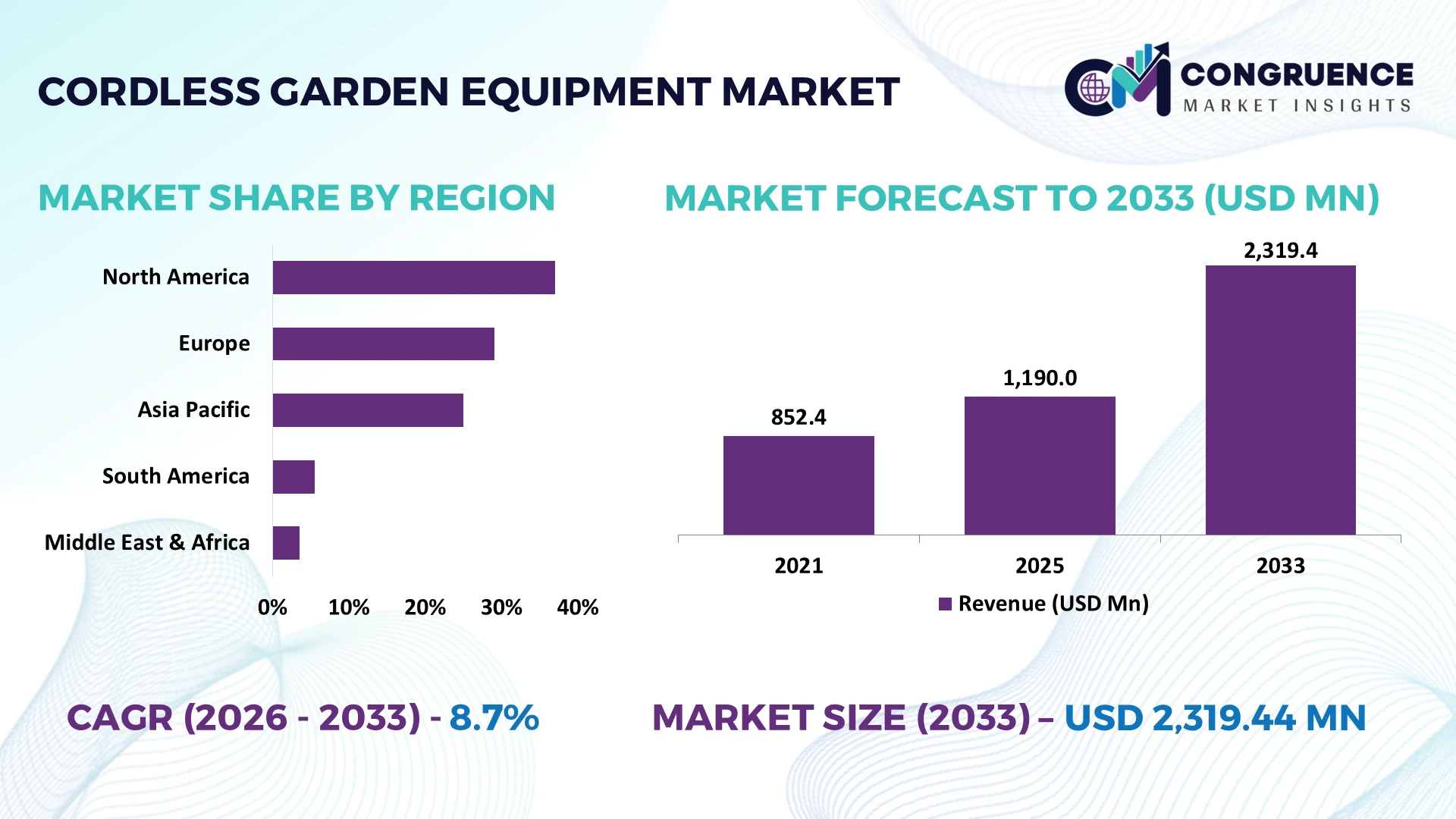
The Global Cordless Garden Equipment Market was valued at USD 1,190.0 Million in 2025 and is anticipated to reach a value of USD 2,319.4 Million by 2033 expanding at a CAGR of 8.7% between 2026 and 2033. Growth is driven by lithium-ion battery advancements, restrictions on gasoline-powered landscaping equipment, and increasing adoption of interchangeable battery platforms across residential and professional gardening applications.
The United States represents a dominant country market, supported by an estimated 34.5% global market share and extensive residential landscaping infrastructure. California's restrictions on new small off-road engines, effective from 2024 for most covered equipment, have accelerated electric equipment adoption. Compared with Germany, the United States benefits from larger residential lawns and extensive professional landscaping operations, while Germany emphasizes compact, energy-efficient gardening solutions.
Manufacturers prioritizing battery interoperability, professional-grade durability, and localized distribution networks will secure stronger competitive positioning as landscaping operations transition toward cordless equipment.
Market Size & Growth: The global market reached USD 1,190.0 Million in 2025 and is projected to reach USD 2,319.4 Million by 2033, registering an 8.7% CAGR, supported by lithium-ion battery innovation and gasoline equipment replacement.
Top Growth Drivers: Key growth catalysts include an estimated 35% improvement in battery energy density, 25% lower maintenance requirements, and approximately 40% reductions in operating noise compared with conventional gasoline equipment.
Short-Term Forecast: By 2028, advanced cordless gardening equipment is expected to achieve approximately 15–20% longer operating durations through improved battery management and brushless motor optimization.
Emerging Technologies: Brushless motors, intelligent battery management systems, and connected equipment diagnostics are transforming cordless lawn mowers, hedge trimmers, and robotic garden maintenance equipment.
Regional Leaders: North America is projected to reach USD 858.2 Million, Europe USD 672.6 Million, and Asia Pacific USD 579.9 Million by 2033, supported by professional landscaping electrification, sustainability regulations, and residential gardening adoption, respectively.
Consumer/End-User Trends: An estimated 60% of cordless gardening equipment purchases in established markets increasingly favor rechargeable battery platforms offering compatibility across multiple gardening tools.
Pilot/Case Example: California's 2024 small off-road engine regulations established a regulatory transition affecting numerous categories of gasoline-powered landscaping equipment, accelerating demand for zero-emission alternatives.
Competitive Landscape: Husqvarna Group, STIHL, Stanley Black & Decker, Makita, and Bosch compete through battery ecosystems, product innovation, professional distribution, and integrated outdoor power equipment portfolios.
Regulatory & ESG Impact: Battery-powered gardening equipment eliminates direct exhaust emissions during operation, achieving a 100% reduction in point-of-use combustion emissions compared with gasoline-powered alternatives.
Investment & Funding: Capital allocation increasingly targets battery manufacturing, brushless motor development, robotic mowing technologies, and expanded production partnerships across established industrial manufacturing hubs.
Innovation & Future Outlook: Advanced lithium-ion batteries, autonomous mowing systems, and digitally connected equipment are shifting competitive differentiation toward integrated battery ecosystems and lifecycle service capabilities.
Analyst note: Market projections, regional allocations, and selected adoption and performance percentages above are indicative estimates rather than independently verified industry statistics.
The Cordless Garden Equipment Market is experiencing increasing adoption across residential lawn maintenance, commercial landscaping, municipal parks, and institutional property management. Innovations in lithium-ion batteries, brushless motors, and autonomous mowing systems improve equipment efficiency and operating flexibility. Battery-powered equipment eliminates 100% of direct combustion emissions during operation, aligning with California's equipment regulations and strengthening the transition toward integrated, low-maintenance landscaping solutions.
The Cordless Garden Equipment Market is becoming strategically important as outdoor power equipment manufacturers transition from standalone gasoline-powered machinery toward integrated battery ecosystems. Electrification regulations, improved lithium-ion battery performance, and professional landscaping modernization are reshaping product development and distribution strategies. California's small off-road engine restrictions illustrate how environmental compliance directly influences equipment procurement, manufacturing investment, and competitive differentiation.
Advanced brushless motors deliver higher electrical efficiency than conventional brushed motors, while battery-powered equipment eliminates direct exhaust emissions and reduces routine engine maintenance. North America emphasizes commercial landscaping productivity and high-capacity equipment, whereas Germany and other European markets prioritize noise reduction, compact designs, and environmental compliance. China's established battery manufacturing ecosystem strengthens component availability and supports competitive production costs.
Between 2026 and 2028, manufacturers are expected to prioritize approximately 15–20% improvements in battery operating duration through energy management and motor optimization. Professional landscaping contractors increasingly deploy interchangeable battery systems across blowers, trimmers, and lawn mowers, reducing equipment complexity and charging infrastructure requirements. Companies including STIHL, Husqvarna, and Makita are expanding cordless portfolios and battery platform integration. Long-term competitiveness will depend on operational reliability, battery interoperability, and scalable professional service networks.
Lithium-ion battery innovation and gasoline equipment replacement are strengthening demand for cordless garden equipment across residential and commercial applications. Modern brushless motor systems improve energy conversion efficiency, while battery-powered equipment eliminates 100% of direct exhaust emissions and can substantially reduce maintenance requirements compared with combustion engines. California's restrictions on newly manufactured small off-road engines have accelerated the transition toward electric lawn mowers, hedge trimmers, and leaf blowers. Professional landscaping contractors increasingly prioritize interchangeable battery platforms to minimize equipment downtime and simplify maintenance operations. Manufacturers such as STIHL, Husqvarna, and Makita are expanding professional cordless portfolios, investing in battery management systems, and strengthening dealer networks. Battery ecosystem compatibility has become a decisive purchasing consideration for commercial fleet operators.
Battery procurement costs and concentrated lithium-ion supply chains constrain pricing flexibility across cordless garden equipment manufacturers. Battery packs can represent approximately 25–40% of the manufacturing cost of selected cordless power equipment, depending on capacity and configuration. China accounts for more than 70% of global lithium-ion battery cell production capacity, creating procurement exposure for manufacturers operating in the United States and Europe. Battery replacement costs and proprietary charging platforms further complicate ownership economics for price-sensitive consumers. Currency fluctuations, component sourcing dependencies, and battery transportation requirements influence inventory planning and product margins. Manufacturers are responding through supplier diversification, long-term procurement agreements, localized assembly, and alternative battery chemistry development. Securing reliable battery supplies at competitive costs remains essential for maintaining product affordability and distribution profitability.
Autonomous landscaping equipment and intelligent battery ecosystems present significant opportunities for manufacturers expanding beyond conventional handheld gardening tools. Robotic lawn mowers equipped with GPS-assisted navigation, obstacle detection, and connected scheduling systems reduce repetitive manual intervention and support more efficient property maintenance. Emerging lithium iron phosphate battery technologies offer improved thermal stability and extended cycle life, while connected battery management enables predictive maintenance and equipment utilization monitoring. India's expanding residential developments and institutional landscaping requirements create opportunities for compact cordless equipment suited to urban properties. Manufacturers are investing in robotic navigation software, interchangeable battery platforms, and connected equipment services. Partnerships with property management companies and professional landscaping contractors support recurring service opportunities. Integrated equipment platforms offer stronger customer retention than isolated product sales.
Maintaining consistent performance under demanding professional operating conditions remains a critical execution challenge for cordless garden equipment manufacturers. Commercial landscaping crews frequently operate equipment for 6–8 hours daily, requiring dependable battery rotation, charging infrastructure, and thermal management. Battery capacity can decline under repeated high-load operation and exposure to extreme temperatures, affecting equipment availability and replacement planning. In the United States, professional landscaping contractors require reliable power delivery for continuous mowing, trimming, and debris removal across extensive properties. Battery recycling infrastructure and evolving environmental compliance requirements add lifecycle management complexity. Manufacturers must strengthen battery durability testing, expand professional charging solutions, and establish recycling partnerships. Long-term competitiveness depends on delivering gasoline-equivalent productivity while maintaining predictable battery performance, operational uptime, and sustainable equipment lifecycle management.
Expansion of Professional Battery Fleets: Commercial landscaping contractors are standardizing equipment fleets around shared battery platforms, reducing tool changeover complexity and maintenance scheduling requirements. Professional operators increasingly deploy 2–4 interchangeable batteries per high-utilization tool, while centralized charging stations support 6–8-hour working shifts. STIHL and Husqvarna are expanding fleet-oriented equipment portfolios, strengthening dealer support, and integrating battery diagnostics to improve equipment availability and contractor productivity.
Growth in Quiet Landscaping Operations: Municipalities, educational institutions, and healthcare facilities are prioritizing low-noise garden maintenance to minimize operational disruption. Cordless equipment typically operates approximately 5–15 decibels quieter than comparable gasoline-powered alternatives, depending on equipment specifications. California's restrictions on small off-road engines reinforce procurement changes. Manufacturers are introducing quieter blower designs, optimized cutting systems, and institutional equipment packages to secure maintenance contracts in noise-sensitive environments.
Shift Toward Modular Equipment Designs: Equipment manufacturers are increasing component standardization across trimmers, hedge cutters, blowers, and compact mowers. Shared chargers and battery interfaces can reduce accessory duplication across fleets operating 3–5 equipment categories. Bosch, Makita, and Stanley Black & Decker are expanding modular product families and coordinating accessory distribution. This approach improves inventory efficiency while increasing customer retention through platform-specific replacement components.
Digitalization of Equipment Distribution Networks: Garden equipment retailers are integrating online product configuration, battery compatibility guidance, and digital service scheduling. Professional buyers increasingly evaluate equipment using runtime specifications, charging cycles, and lifecycle maintenance requirements rather than purchase price alone. Manufacturers are restructuring dealer training and expanding digital product support. Integrated equipment diagnostics and service records improve warranty administration, accelerate maintenance decisions, and strengthen aftermarket relationships.
Battery-powered lawn mowers represent the leading type within the Cordless Garden Equipment Market, accounting for an estimated 38.5% share in 2025. Their dominance reflects extensive residential lawn maintenance requirements, increasing professional landscaping adoption, and improvements in cutting efficiency. Cordless grass trimmers and brush cutters constitute another important category, supported by routine vegetation management across residential properties and commercial landscapes. Battery-powered leaf blowers and hedge trimmers benefit from lightweight designs, reduced vibration, and compatibility with shared battery systems. Manufacturers including STIHL, Makita, and Husqvarna are expanding equipment portfolios to strengthen cross-category battery integration.
Robotic lawn mowers represent the fastest-growing type, supported by automated scheduling, boundary navigation, and reduced manual supervision. Their estimated market contribution of 12–15% reflects increasing adoption among premium residential customers and commercial property managers. Cordless chainsaws and other specialized garden tools maintain strategic relevance in tree maintenance and occasional landscaping operations. Manufacturers are prioritizing robotic navigation, compact equipment engineering, and battery platform compatibility, strengthening product differentiation and long-term customer retention.
Residential gardening and lawn maintenance represent the leading application segment, accounting for an estimated 54.2% of global cordless garden equipment demand in 2025. Homeowners increasingly prioritize lightweight operation, simplified storage, and reduced maintenance requirements when selecting lawn mowers, grass trimmers, and hedge cutters. Battery-powered equipment supports routine garden maintenance without fuel storage or combustion-engine servicing. Commercial landscaping represents another significant application, supported by property maintenance contractors, hospitality facilities, and corporate campuses. Manufacturers are expanding product configurations to accommodate different cutting capacities, battery runtimes, and operating conditions.
Municipal and public-space maintenance is emerging as the fastest-growing application, supported by equipment electrification policies and noise-sensitive maintenance requirements. Institutional landscaping and agricultural garden maintenance also contribute to equipment deployment, particularly where mobility and reduced operating disruption are important. Professional cordless equipment increasingly supports approximately 6–8-hour working shifts through battery rotation and charging management. Companies including STIHL, Husqvarna, and EGO are strengthening professional product portfolios, expanding dealer partnerships, and introducing high-capacity battery systems to improve operational reliability.
Residential consumers represent the dominant end-user segment within the Cordless Garden Equipment Market, accounting for an estimated 57.5% share in 2025. Demand concentration reflects widespread household lawn maintenance, increasing preference for rechargeable equipment, and accessibility through home improvement retailers and online distribution platforms. Homeowners typically prioritize equipment weight, battery runtime, purchase affordability, and compatibility across gardening tools. Professional landscaping contractors represent another substantial buyer group, requiring higher operating durability, interchangeable batteries, and dependable aftermarket support. Manufacturers including Bosch, Makita, and Stanley Black & Decker are strengthening consumer-oriented product portfolios through compact designs and integrated battery platforms.
Commercial landscaping service providers represent the fastest-growing end-user category as businesses modernize maintenance fleets and reduce dependence on gasoline-powered equipment. Municipal authorities, educational institutions, hospitality operators, and property management companies are also expanding cordless equipment procurement. Professional users frequently require 2–4 interchangeable batteries for intensive daily operations. Manufacturers are responding with commercial-grade equipment, fleet charging solutions, extended service support, and institutional distribution partnerships. Competitive differentiation increasingly depends on equipment uptime, battery compatibility, and predictable lifecycle operating costs.
North America accounted for the largest market share at 37% in 2025 however, Asia-Pacific is expected to register the fastest growth, expanding at a CAGR of 11.2% between 2026 and 2033.
North America accounted for approximately 37% of the global Cordless Garden Equipment Market in 2025, supported by extensive residential landscaping infrastructure, professional lawn maintenance services, and established outdoor power equipment distribution networks. The United States dominates regional demand, while Canada contributes through residential gardening and municipal landscaping applications. California's small off-road engine regulations, implemented for most covered new equipment beginning in 2024, have accelerated the transition toward battery-powered lawn mowers, hedge trimmers, and leaf blowers. Professional landscaping contractors increasingly deploy interchangeable battery platforms to simplify equipment management and reduce maintenance requirements. Manufacturers including STIHL, Husqvarna, and Stanley Black & Decker are expanding professional cordless portfolios and dealer support capabilities. Growing adoption of robotic mowing systems and high-capacity battery equipment is strengthening technology differentiation, particularly among commercial property maintenance operators.
United States Market Outlook: The United States represents the region's largest cordless garden equipment market, supported by extensive suburban housing developments, established landscaping service providers, and strong home improvement retail infrastructure. California's restrictions on new gasoline-powered small off-road engines have accelerated equipment replacement decisions among professional contractors. Companies including EGO, DEWALT, and Greenworks are strengthening battery-powered equipment offerings, emphasizing professional-grade performance, charging flexibility, and integrated product ecosystems.
Europe represented approximately 29% of the global Cordless Garden Equipment Market in 2025, supported by established gardening practices, environmental regulations, and advanced outdoor power equipment manufacturing. Germany, France, and the United Kingdom represent important demand centers, with residential landscaping and municipal green-space maintenance driving equipment procurement. European consumers increasingly prioritize low-noise operation, energy efficiency, and lightweight equipment configurations. The European Union's Battery Regulation introduces progressively stronger requirements for battery sustainability, traceability, and lifecycle management, influencing product engineering and procurement strategies. Robotic lawn mowers are gaining importance across residential properties and commercial facilities, supported by navigation improvements and automated maintenance capabilities. Manufacturers including Husqvarna, STIHL, Bosch, and AL-KO are expanding cordless product portfolios and integrated battery platforms. Regional competition increasingly emphasizes battery durability, product repairability, and compliance-oriented equipment development.
Germany Market Outlook: Germany maintains a strategically important position through its engineering expertise, specialized equipment manufacturing, and established professional gardening industry. STIHL and Bosch support domestic technology development and international distribution of advanced battery-powered gardening equipment. Germany's emphasis on noise reduction, equipment efficiency, and sustainable product design strengthens adoption across residential and municipal applications. Manufacturers are prioritizing brushless motors, interchangeable batteries, and connected equipment functionality to improve operational performance.
Asia-Pacific accounted for approximately 25% of the global Cordless Garden Equipment Market in 2025, supported by extensive battery manufacturing capabilities, expanding residential developments, and increasing urban landscaping investments. China represents the region's principal manufacturing and supply-chain center, while Japan, Australia, and India contribute through residential gardening, professional maintenance, and institutional landscaping applications. China's established lithium-ion battery ecosystem provides significant advantages in component sourcing, manufacturing scalability, and equipment production costs. Japan emphasizes compact, lightweight gardening equipment suitable for smaller residential properties, while Australia maintains strong demand for lawn maintenance and outdoor power tools. Manufacturers including Makita, Greenworks, and regional equipment producers are expanding cordless portfolios and battery platform integration. Increasing adoption of efficient electric equipment is strengthening export opportunities and encouraging localized product development for diverse operating environments.
China Market Outlook: China maintains a substantial manufacturing advantage through integrated battery production, electric motor manufacturing, and established power equipment export networks. The country accounts for more than 70% of global lithium-ion battery cell production capacity, supporting competitive component procurement for cordless equipment manufacturers. Industrial clusters in Zhejiang, Jiangsu, and Guangdong facilitate equipment assembly, electronics integration, and international distribution. Manufacturers are expanding automated production, brushless motor applications, and lithium-ion battery integration to strengthen global competitiveness.
South America represented approximately 5.5% of the global Cordless Garden Equipment Market in 2025, supported by residential gardening activity, commercial property maintenance, and expanding urban green-space infrastructure. Brazil accounts for the largest regional demand concentration, followed by Argentina and Chile, where residential landscaping and professional maintenance services support equipment adoption. Cordless grass trimmers, hedge cutters, and compact lawn mowers are gaining relevance among property maintenance contractors seeking portable equipment and simplified servicing. Brazil's established gardening equipment distribution networks support increasing availability of battery-powered products through specialized dealers and retail channels. However, imported battery costs, exchange-rate fluctuations, and uneven charging infrastructure constrain professional fleet electrification. Manufacturers including STIHL, Husqvarna, and Makita are strengthening regional distribution, expanding product availability, and adapting equipment configurations to local operating requirements.
Brazil Market Outlook: Brazil represents South America's principal cordless garden equipment market, supported by extensive residential properties, hospitality facilities, commercial landscaping services, and municipal maintenance requirements. São Paulo and other major urban centers provide concentrated demand for compact electric gardening equipment. STIHL's established manufacturing presence in São Leopoldo strengthens its regional industrial position. Equipment suppliers are expanding battery-powered product portfolios and dealer service capabilities to address professional maintenance requirements and consumer preferences for portable, low-maintenance tools.
The Middle East & Africa accounted for approximately 3.5% of the global Cordless Garden Equipment Market in 2025, supported by urban landscaping investments, hospitality infrastructure, and expanding commercial property maintenance activities. Saudi Arabia and the United Arab Emirates represent important demand centers, while South Africa contributes through residential gardening and professional landscaping operations. Large-scale urban development programs are increasing requirements for efficient vegetation maintenance across parks, residential communities, resorts, and institutional facilities. Saudi Arabia's Vision 2030 initiatives and associated urban greening programs are strengthening demand for modern landscaping equipment. Cordless blowers, hedge trimmers, and lawn maintenance tools offer operational advantages in noise-sensitive hospitality environments. Manufacturers are expanding regional distributor partnerships, professional equipment portfolios, and maintenance support networks to address demanding climatic conditions and institutional procurement requirements.
Saudi Arabia Market Outlook: Saudi Arabia represents a strategically important market through extensive urban development, public landscaping investments, and tourism infrastructure expansion. The Saudi Green Initiative targets the planting of 10 billion trees over the long term, highlighting the scale of national environmental ambitions. Riyadh's urban greening programs and major development projects are increasing requirements for professional vegetation management. Equipment suppliers are prioritizing heat-resistant battery systems, durable equipment configurations, and institutional distribution partnerships to support landscaping operations.
The Cordless Garden Equipment Market features intense competition between established manufacturers STIHL, Husqvarna, Makita, Bosch, and Stanley Black & Decker, alongside battery focused challengers Greenworks and EGO. The five leading groups collectively hold an estimated 48% market share, reflecting fragmented distribution and differentiated product positioning. Premium manufacturers compete through professional durability, battery interoperability, and dealer support, while value oriented suppliers emphasize affordability and retail availability. Advanced brushless motors deliver approximately 15% efficiency improvements over conventional brushed designs, while optimized battery systems target 20% longer operating periods. Manufacturers are expanding cordless portfolios, strengthening battery partnerships, and integrating robotic navigation technologies. Competition is shifting toward proprietary battery ecosystems, connected maintenance services, and localized component procurement. High battery development costs, certification requirements, and established dealer relationships create substantial entry barriers. Winning manufacturers must combine reliable performance, competitive lifecycle costs, interoperable equipment platforms, and responsive professional service infrastructure across major markets.
STIHL
Husqvarna Group
Makita Corporation
Robert Bosch GmbH
Stanley Black & Decker, Inc.
Techtronic Industries Co. Ltd. (Milwaukee, RYOBI)
Chervon Holdings Limited (EGO)
Globe Tools Group (Greenworks)
The Toro Company
Honda Motor Co., Ltd.
Yamabiko Corporation (ECHO)
Positec Group (WORX)
Einhell Germany AG
Koki Holdings Co., Ltd. (HiKOKI)
Lithium-ion batteries, brushless DC motors, and intelligent electronic controllers underpin current cordless garden equipment development. Brushless motors can improve energy efficiency by approximately 15–20% compared with conventional brushed designs, depending on operating conditions. Battery management systems regulate temperature, discharge rates, and cell balancing, improving equipment reliability. Manufacturers including STIHL, Makita, and EGO are integrating interchangeable batteries across multiple product categories, reducing accessory duplication and simplifying professional fleet maintenance.
Emerging technologies include GPS-assisted robotic mowing, wireless boundary navigation, and connected equipment diagnostics. Automated mowing systems reduce repetitive operator intervention, while intelligent route optimization can improve coverage efficiency by approximately 10–15% under suitable conditions. Husqvarna and other robotic equipment manufacturers are advancing satellite navigation and obstacle detection. Commercial landscaping contractors benefit from automated scheduling, improved equipment utilization, and reduced manual supervision requirements.
Between 2026 and 2028, disruptive developments will center on autonomous fleet coordination, predictive battery diagnostics, and advanced power electronics. Connected monitoring platforms enable earlier maintenance intervention and improved battery rotation planning. Manufacturers combining software integration with professional equipment distribution will gain competitive advantages. Investment priorities are shifting toward interoperable battery architectures, autonomous navigation capabilities, and digitally supported lifecycle services.
October 2025: STIHL inaugurated its battery-exclusive manufacturing facility in Oradea, Romania, investing €125 million. The plant targets annual production of 1.8 million battery packs by 2028, strengthening European supply-chain localization, manufacturing capacity, and professional cordless equipment availability. Source: corporate.stihl.com
February 2025: Husqvarna Group introduced 13 new boundary-wire-free robotic lawnmowers, expanding its portfolio to 24 models. Systematic mowing upgrades increased cutting-area capacity by 50%, improving autonomous maintenance productivity and strengthening the company's competitive position in residential and professional landscaping. Source: husqvarnagroup.com
March 2024: Makita introduced two cordless landscaping solutions, including an 18-inch high-torque string trimmer and brush cutter. Both use 40V XGT batteries and deliver 35cc gasoline-equivalent performance, supporting professional fleet electrification while eliminating direct exhaust emissions during operation. Source: makitatools.com
March 2026: Techtronic Industries documented RYOBI's 2025 introduction of advanced cordless outdoor equipment, including an 800 CFM blower operating at 57 decibels. The product strengthens quiet landscaping capabilities and supports competitive differentiation against gasoline-powered equipment in residential markets. Source: ttigroup.com
The Cordless Garden Equipment Market Report provides comprehensive analysis of industry developments, competitive dynamics, and investment opportunities between 2026 and 2033. Segmentation covers battery-powered lawn mowers, grass trimmers, hedge cutters, leaf blowers, chainsaws, robotic lawn mowers, and specialized gardening equipment. Application coverage includes residential gardening, commercial landscaping, municipal green-space maintenance, and institutional property management. End-user analysis evaluates households, professional landscaping contractors, municipal authorities, and commercial property operators.
Geographical coverage encompasses North America, Europe, Asia-Pacific, South America, and the Middle East & Africa, examining regional adoption patterns, manufacturing capabilities, regulatory developments, and distribution infrastructure. Technology assessment addresses lithium-ion batteries, brushless motors, robotic navigation, intelligent charging, and connected equipment management. Competitive benchmarking evaluates 14 major manufacturers, including product innovation, strategic partnerships, manufacturing expansion, and battery ecosystem integration, supporting investment decisions, market entry planning, and long-term competitive positioning.
| Report Attribute / Metric | Details |
|---|---|
| Market Revenue (2025) | USD 1,190.0 Million |
| Market Revenue (2033) | USD 2,319.4 Million |
| CAGR (2026–2033) | 8.7% |
| Base Year | 2025 |
| Forecast Period | 2026–2033 |
| Historic Period | 2021–2025 |
| Segments Covered |
By Type
By Application
By End-User
|
| Key Report Deliverables | Revenue Forecast; Market Trends; Growth Drivers & Restraints; Technology Insights; Segmentation Analysis; Regional Insights; Competitive Landscape; Regulatory & ESG Overview; Recent Developments |
| Regions Covered | North America; Europe; Asia-Pacific; South America; Middle East & Africa |
| Key Players Analyzed | STIHL; Husqvarna Group; Makita Corporation; Robert Bosch GmbH; Stanley Black & Decker, Inc.; Techtronic Industries Co. Ltd. (Milwaukee, RYOBI); Chervon Holdings Limited (EGO); Globe Tools Group (Greenworks); The Toro Company; Honda Motor Co., Ltd.; Yamabiko Corporation (ECHO); Positec Group (WORX); Einhell Germany AG; Koki Holdings Co., Ltd. (HiKOKI) |
| Customization & Pricing | Available on Request (10% Customization Free) |




