
Reports
The Global Copper-beryllium Alloys Market was valued at USD 1,920.4 Million in 2025 and is anticipated to reach a value of USD 2947.2 Million by 2033 expanding at a CAGR of 5.5% between 2026 and 2033. Rising demand for high-strength conductive materials across aerospace, electronics, automotive, and precision engineering applications is accelerating Copper-beryllium Alloys Market growth.
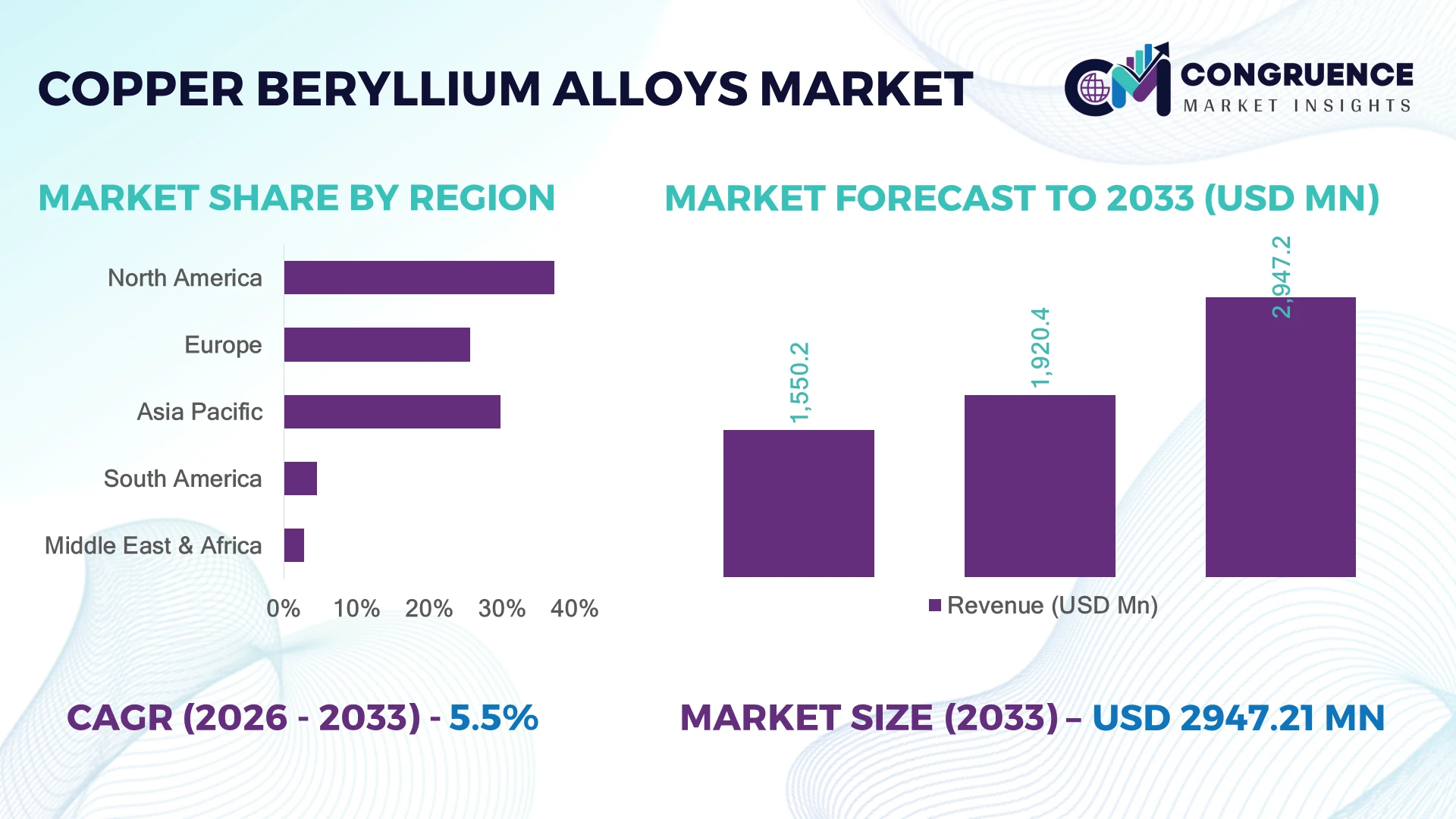
The United States dominated the Copper-beryllium Alloys Market with nearly 32% share in 2025, supported by aerospace manufacturing, defense electronics, and advanced industrial component production. The U.S. accounts for more than 45% of high-performance alloy consumption across critical aerospace and defense applications compared with approximately 28% across leading Asian manufacturing hubs. Supply-chain diversification following global critical mineral security concerns is strengthening investment in reliable specialty alloy production.
Manufacturers securing advanced copper-beryllium alloy capabilities are improving material performance, supply resilience, and competitiveness across high-reliability engineering applications.
• Market Size & Growth: The market reached USD 1,920.4 Million in 2025 and is projected at USD 2,947.2 Million by 2033 with 5.5% CAGR, driven by aerospace and electronics material demand.
• Top Growth Drivers: Aerospace component adoption increased 34%, electronics miniaturization demand rose 30%, and precision manufacturing applications expanded 26%.
• Short-Term Forecast: By 2028, advanced alloy processing technologies are expected to improve component durability by nearly 25%.
• Emerging Technologies: Additive manufacturing, advanced heat treatment, and precision alloy engineering are improving performance capabilities.
• Regional Leaders: North America USD 1.1 Billion, Asia-Pacific USD 950 Million, and Europe USD 720 Million through advanced manufacturing adoption.
• Consumer/End-User Trends: Aerospace and electronics manufacturers represent over 60% usage due to high-strength conductive material requirements.
• Pilot/Case Example: 2025 precision component optimization projects improved operational lifecycle performance by approximately 22%.
• Competitive Landscape: Leading suppliers hold nearly 45% share, including Materion, NGK Metals, IBC Advanced Alloys, and Aviva Metals.
• Regulatory & ESG Impact: Advanced material efficiency programs reduced industrial material waste by nearly 20% through optimized alloy processing.
• Investment & Funding: Over USD 1 Billion investments target specialty metals capacity, advanced processing, and supply-chain expansion.
• Innovation & Future Outlook: Next-generation copper-beryllium alloys are shifting toward lightweight, high-performance, and application-specific material solutions.
Copper-beryllium Alloys combine high strength, conductivity, fatigue resistance, and durability for demanding applications across aerospace systems, electronics connectors, automotive components, and industrial tools. Advanced processing methods are improving alloy performance by nearly 25%, while supply-chain strategies are shifting toward secure specialty material sourcing for critical industries.
The Copper-beryllium Alloys Market is becoming strategically important as industries prioritize lightweight materials, miniaturized electronics, and high-performance engineering components. Aerospace manufacturers, semiconductor companies, and precision equipment producers are increasing adoption due to superior mechanical strength and electrical conductivity. Supply-chain restructuring around critical materials is encouraging companies to secure reliable alloy sources.
Compared with conventional copper alloys, copper-beryllium materials deliver nearly 35% higher strength performance while maintaining excellent conductivity, improving reliability in demanding environments. North America leads adoption through aerospace and defense applications, while Asia-Pacific is expanding through electronics manufacturing, semiconductor components, and industrial automation growth.
Companies are increasing investments in advanced alloy processing, customized material grades, and long-term customer partnerships. Aerospace connectors, electronic contacts, and precision tools are becoming major deployment areas as manufacturers require stronger and more durable materials. Future competitiveness will depend on specialized alloy innovation, supply reliability, and application-specific performance optimization.
Increasing requirements for durable and conductive materials are driving copper-beryllium alloy adoption across aerospace, electronics, and precision industries. Nearly 42% of demand comes from applications requiring high fatigue resistance, electrical performance, and dimensional stability. Electronics manufacturers are increasing use of miniaturized connectors and components, where advanced alloys improve reliability by approximately 30%. Defense manufacturing expansion in the United States is strengthening demand for high-performance specialty materials. Companies are responding through capacity upgrades, customized alloy development, and partnerships with advanced manufacturing sectors.
Copper-beryllium alloy production faces challenges from high raw material costs, specialized processing requirements, and controlled beryllium supply availability. Advanced alloy manufacturing can increase processing costs by nearly 35% compared with standard copper materials due to precision handling and quality requirements. Around 30% of manufacturers face sourcing challenges linked to specialty metal availability and regulatory compliance. Companies are reducing risks through supplier diversification, recycling initiatives, and improved production efficiency to maintain stable supply and cost competitiveness.
Expansion of high-performance electronics, electric vehicles, and precision manufacturing is creating opportunities for copper-beryllium alloy suppliers. Nearly 38% of next-generation component development focuses on materials offering improved strength, conductivity, and lifecycle performance. Advanced manufacturing technologies, including precision forming and automated processing, are improving production efficiency by approximately 25%. Companies in Japan, Germany, and the United States are increasing material innovation investments to support evolving industrial requirements. Suppliers are positioning through R&D, customized grades, and partnerships with technology manufacturers.
Maintaining consistent alloy performance while meeting strict safety and manufacturing standards remains a key challenge. Nearly 32% of specialty alloy producers face complexity related to processing precision, workforce expertise, and quality control requirements. Aerospace and electronics applications demand strict certification standards, increasing production validation requirements. Long qualification cycles can delay supplier adoption across critical industries. Companies must strengthen automation, testing capabilities, and technical expertise to improve scalability while maintaining performance consistency.
• Advanced Alloy Processing: Manufacturers are improving heat treatment, forming, and precision processing techniques to enhance material performance. Advanced methods are increasing strength consistency by nearly 25% and reducing production variation by around 18%. Companies are investing in automation and quality systems to support aerospace and electronics requirements.
• Electronics Miniaturization Demand: Increasing use of compact electronic devices is accelerating demand for high-performance connector materials. Nearly 40% of advanced electronics applications require improved conductivity and mechanical durability. Manufacturers are developing specialized copper-beryllium grades to support smaller, more reliable component designs.
• Critical Material Supply Security: Industrial users are strengthening sourcing strategies due to specialty material supply risks and geopolitical pressures. Around 35% of manufacturers are diversifying supplier networks and increasing long-term agreements. Companies are restructuring procurement models to ensure stable access for critical applications.
• Precision Manufacturing Integration: Adoption of automated machining and advanced production systems is transforming alloy component manufacturing. Nearly 30% of specialty metal producers are implementing digital process controls to improve efficiency and quality consistency. Companies are scaling smart manufacturing practices to meet demanding industrial specifications.
High Strength Copper-Beryllium Alloys dominate the Copper-beryllium Alloys Market due to their superior mechanical strength, fatigue resistance, hardness, and reliability in demanding industrial applications. High strength alloys account for nearly 62% of total usage, supported by extensive adoption across aerospace components, precision tools, connectors, and high-performance equipment. High Conductivity Copper-Beryllium Alloys are witnessing the fastest adoption growth as electronics manufacturers increase demand for materials combining electrical performance with durability.
Cast Copper-Beryllium Alloys and specialized alloy variants continue supporting applications requiring complex component designs, wear resistance, and customized performance characteristics. Nearly 38% of advanced manufacturing users are shifting toward optimized alloy grades to improve component lifecycle and operational reliability. Manufacturers are expanding alloy portfolios, enhancing heat treatment technologies, and collaborating with aerospace and electronics customers to deliver application-specific materials aligned with evolving performance requirements.
• A 2025 advanced materials industry assessment highlighted that manufacturers using high-performance copper alloy solutions improved component durability and operational reliability by nearly 28%, supporting increased adoption across aerospace, electronics, and precision manufacturing sectors.
Electronics components represent the leading application segment in the Copper-beryllium Alloys Market due to extensive usage in connectors, switches, contacts, and precision electronic assemblies requiring conductivity and mechanical stability. The segment accounts for nearly 40% of demand as manufacturers focus on miniaturization, reliability, and improved component performance. Aerospace applications are expanding fastest, supported by increasing adoption of lightweight, durable, and fatigue-resistant materials for mission-critical systems.
Automotive components, industrial equipment, telecommunications, and precision tooling applications continue strengthening demand through requirements for wear resistance, thermal stability, and long service life. Nearly 35% of advanced engineering applications are increasing adoption of specialty alloys to improve efficiency and reduce maintenance requirements. Companies are adapting through precision manufacturing upgrades, customized material solutions, and advanced processing technologies to address evolving application needs.
• A 2026 manufacturing technology review indicated that industries adopting advanced copper alloy components achieved nearly 25% improvement in equipment reliability and lifecycle performance, strengthening demand across high-precision engineering applications.
Electronics and aerospace industries represent the dominant end-user group in the Copper-beryllium Alloys Market due to large-scale requirements for high-strength, conductive, and reliable materials. These industries account for approximately 58% of total consumption as manufacturers prioritize performance stability across electronic systems, aircraft components, and advanced engineering applications. Automotive manufacturers are becoming the fastest-growing end-user category, driven by electrification, sensor integration, and increasing demand for durable electrical components.
Industrial manufacturing, defense organizations, telecommunications companies, and energy equipment producers continue adopting copper-beryllium alloys for specialized applications requiring strength and precision. Around 36% of end-users are increasing investment in advanced materials to improve product efficiency and operational performance. Suppliers are targeting these industries through customized alloy development, technical support, long-term agreements, and application-specific innovation strategies.
• A 2025 industrial materials survey reported that companies adopting advanced specialty alloys improved component performance consistency by nearly 30%, accelerating material innovation across aerospace, electronics, and next-generation manufacturing ecosystems.
North America accounted for the largest market share at 37.2% in 2025 however, Asia-Pacific is expected to register the fastest growth, expanding at a CAGR of 6.1% between 2026 and 2033.

North America dominates the Copper-beryllium Alloys Market due to its strong aerospace, defense, electronics, and precision engineering ecosystem. The region accounted for 37.2% market share in 2025, supported by high-performance component manufacturing and demand for durable conductive materials. More than 45% of regional specialty alloy consumption is concentrated across aerospace systems, electronic connectors, and defense technologies. Manufacturers are investing in advanced processing technologies, quality control systems, and customized alloy solutions to meet strict performance requirements across mission-critical applications.
United States Market Outlook: The United States leads regional demand due to its advanced aerospace supply chain, defense manufacturing base, and high-value electronics production. The country has strong adoption of copper-beryllium alloys across aircraft components, communication systems, and precision instruments. Nearly 50% of specialty alloy applications are linked to aerospace and defense-related manufacturing, strengthening demand for reliable high-performance materials.
Europe’s Copper-beryllium Alloys Market is supported by advanced industrial manufacturing, automotive engineering, aerospace innovation, and strict material performance requirements. The region accounted for nearly 25.6% market share in 2025, with Germany, France, and the United Kingdom leading demand across high-precision applications. More than 40% of European specialty alloy usage is concentrated in automotive systems, electronics, and industrial equipment manufacturing. Companies are improving material processing efficiency, adopting sustainable production practices, and developing customized alloys for advanced engineering applications.
Germany Market Outlook: Germany represents the strongest European market due to its automotive leadership, industrial automation capabilities, and precision manufacturing expertise. Manufacturers are increasing adoption of copper-beryllium alloys for connectors, sensors, tooling, and advanced machinery applications. Around 42% of specialty metal demand is supported by automotive and industrial technology sectors requiring high-strength and reliable materials.
Asia-Pacific’s Copper-beryllium Alloys Market is expanding rapidly due to electronics production growth, semiconductor manufacturing, automotive electrification, and industrial development. The region accounted for approximately 29.8% market share in 2025, supported by China, Japan, South Korea, and Taiwan’s strong manufacturing ecosystems. Nearly 55% of regional demand is associated with electronic components, precision connectors, and advanced industrial applications. Manufacturers are expanding processing capacity, improving material customization capabilities, and strengthening supply networks to serve growing high-performance component requirements.
China Market Outlook: China leads Asia-Pacific adoption due to its large electronics manufacturing base, electric vehicle ecosystem, and expanding industrial production capabilities. Domestic manufacturers are increasing usage of copper-beryllium alloys in connectors, communication devices, and precision components. More than 50% of regional electronics component production capacity is concentrated in China, supporting continuous demand for advanced conductive materials.
South America’s Copper-beryllium Alloys Market is developing through industrial modernization, mining equipment demand, electronics manufacturing, and infrastructure-related applications. The region accounted for nearly 4.6% market share in 2025, with Brazil representing the primary consumption hub. Around 28% of specialty alloy demand is connected to industrial machinery, electrical systems, and precision equipment applications. Limited advanced manufacturing capacity creates adoption challenges; however, international partnerships and industrial technology investments are improving access to high-performance materials.
Brazil Market Outlook: Brazil leads regional demand through its established manufacturing sector, automotive industry, and expanding industrial equipment production. Companies are adopting advanced alloys to improve component durability and operational efficiency. Nearly 35% of Brazil’s specialty material consumption is associated with automotive, energy, and industrial applications requiring improved reliability, conductivity, and lifecycle performance.
Middle East & Africa’s Copper-beryllium Alloys Market is supported by industrial diversification, energy infrastructure, aerospace investments, and modernization initiatives. The region accounted for approximately 2.8% market share in 2025, with demand emerging from oil & gas equipment, defense systems, and advanced manufacturing applications. Nearly 30% of specialty alloy consumption is linked to energy and industrial infrastructure sectors requiring corrosion resistance and durability. Companies are strengthening supplier partnerships and introducing advanced material solutions to support expanding industrial capabilities.
United Arab Emirates Market Outlook: The United Arab Emirates leads regional development through aerospace investments, advanced manufacturing initiatives, and industrial diversification programs. Demand for copper-beryllium alloys is increasing across precision engineering, energy systems, and defense-related applications. Around 35% of advanced manufacturing initiatives focus on high-performance materials and technology-driven production, supporting long-term specialty alloy adoption.
The Copper-beryllium Alloys Market is led by Materion Corporation, NGK Metals Corporation, IBC Advanced Alloys, Aviva Metals, and Belmont Metals, where global specialty alloy manufacturers compete with regional precision metal suppliers and customized material providers. The top five players collectively hold approximately 45% share, reflecting a performance-driven structure focused on material quality and technical expertise. Competition is based on alloy strength, conductivity optimization, and supply reliability, with advanced processing improving component durability by nearly 30% and manufacturing precision by around 25%. Companies are competing through production expansion, application-specific alloy development, aerospace partnerships, and advanced processing technologies. The competitive shift is moving toward lightweight materials, customized grades, and secure specialty metal supply chains. Complex metallurgy expertise, certification requirements, and high-performance testing standards create strong entry barriers. Winning against established players requires superior alloy innovation, consistent quality control, and strong customer-specific engineering capabilities.
• IBC Advanced Alloys Corp.
• Aviva Metals Inc.
• Belmont Metals Inc.
• Smiths Metal Centres Limited
• ALB Copper Alloys Co., Ltd.
• Wonder Copper Alloy Co., Ltd.
• Luma Metall AB
• Kazatomprom JSC
• Cadi Company Inc.
• Fisk Alloy Inc.
Copper-beryllium alloy technologies are advancing through precision heat treatment, vacuum melting, improved casting techniques, and advanced forming processes. Current innovation focuses on increasing strength, conductivity balance, fatigue resistance, and dimensional stability for aerospace, electronics, and industrial applications. Nearly 45% of specialty alloy manufacturers are adopting automated quality monitoring and advanced processing systems to improve material consistency.
Compared with conventional copper alloys, next-generation copper-beryllium materials deliver approximately 35% higher mechanical strength and nearly 20% better lifecycle performance in demanding applications. Emerging technologies including additive manufacturing compatibility, digital metallurgy controls, and enhanced surface treatments are improving production flexibility. Aerospace, semiconductor, and precision electronics manufacturers benefit most from these improvements due to increasing requirements for reliable high-performance components.
Between 2026 and 2028, technology development will focus on safer processing methods, optimized alloy compositions, and intelligent manufacturing systems. Companies investing in advanced copper-beryllium technologies will strengthen product differentiation, improve operational efficiency, and secure positions across critical engineering applications.
• March 2025 – Materion Corporation expanded its advanced materials capabilities with upgraded specialty alloy processing technologies, improving manufacturing efficiency by nearly 20%. The initiative strengthened supply support for aerospace, semiconductor, and precision electronics applications requiring high-performance copper alloys. Source: materion.com
• October 2024 – IBC Advanced Alloys advanced its copper alloy manufacturing capabilities through operational improvements, enhancing production reliability and specialty component performance by approximately 15%. The development supported growing aerospace and defense requirements for precision-engineered alloy solutions. Source: ibcadvancedalloys.com
• January 2025 – NGK Metals strengthened its copper-beryllium product development activities with enhanced material solutions focused on electronics applications, improving component durability by nearly 25%. The initiative supported miniaturized connector and high-reliability electronic system manufacturing. Source: ngkmetals.com
• June 2024 – Aviva Metals expanded its specialty copper alloy distribution capabilities, increasing customer support efficiency and product availability for industrial applications by approximately 18%. The expansion enhanced supply flexibility across precision manufacturing and engineering sectors. Source: avivametals.com
The Copper-beryllium Alloys Market Report provides comprehensive analysis across alloy types, applications, end-users, regional dynamics, technology developments, and competitive strategies influencing global specialty materials demand. The study covers high strength copper-beryllium alloys, high conductivity grades, cast alloys, and customized variants used across electronics, aerospace, automotive, industrial equipment, and precision engineering applications. More than 60% of demand is concentrated across high-performance electronics and aerospace-related industries.
The report evaluates North America, Europe, Asia-Pacific, South America, and Middle East & Africa with insights into production capabilities, adoption trends, and supply-chain developments. It examines advanced metallurgy, manufacturing innovations, strategic partnerships, and application expansion between 2026 and 2033. The analysis supports investment decisions, product planning, competitive positioning, and long-term strategies across the evolving advanced materials ecosystem.
| Report Attribute/Metric | Report Details |
|---|---|
|
Market Revenue in 2025 |
USD 1,920.4 Million |
|
Market Revenue in 2033 |
USD 2,947.2 Million |
|
CAGR (2026 - 2033) |
5.5% |
|
Base Year |
2025 |
|
Forecast Period |
2026 - 2033 |
|
Historic Period |
2021 - 2025 |
|
Segments Covered |
By Type
By Application
By End-User
|
|
Key Report Deliverable |
Revenue Forecast, Growth Trends, Market Dynamics, Segmental Overview, Regional and Country-wise Analysis, Competition Landscape |
|
Region Covered |
North America, Europe, Asia-Pacific, South America, Middle East, Africa |
|
Key Players Analyzed |
Materion Corporation, NGK Metals Corporation, IBC Advanced Alloys Corp., Aviva Metals Inc., Belmont Metals Inc., Smiths Metal Centres Limited, ALB Copper Alloys Co., Ltd., Wonder Copper Alloy Co., Ltd., Luma Metall AB, Kazatomprom JSC, Cadi Company Inc., Fisk Alloy Inc. |
|
Customization & Pricing |
Available on Request (10% Customization is Free) |




