
Reports
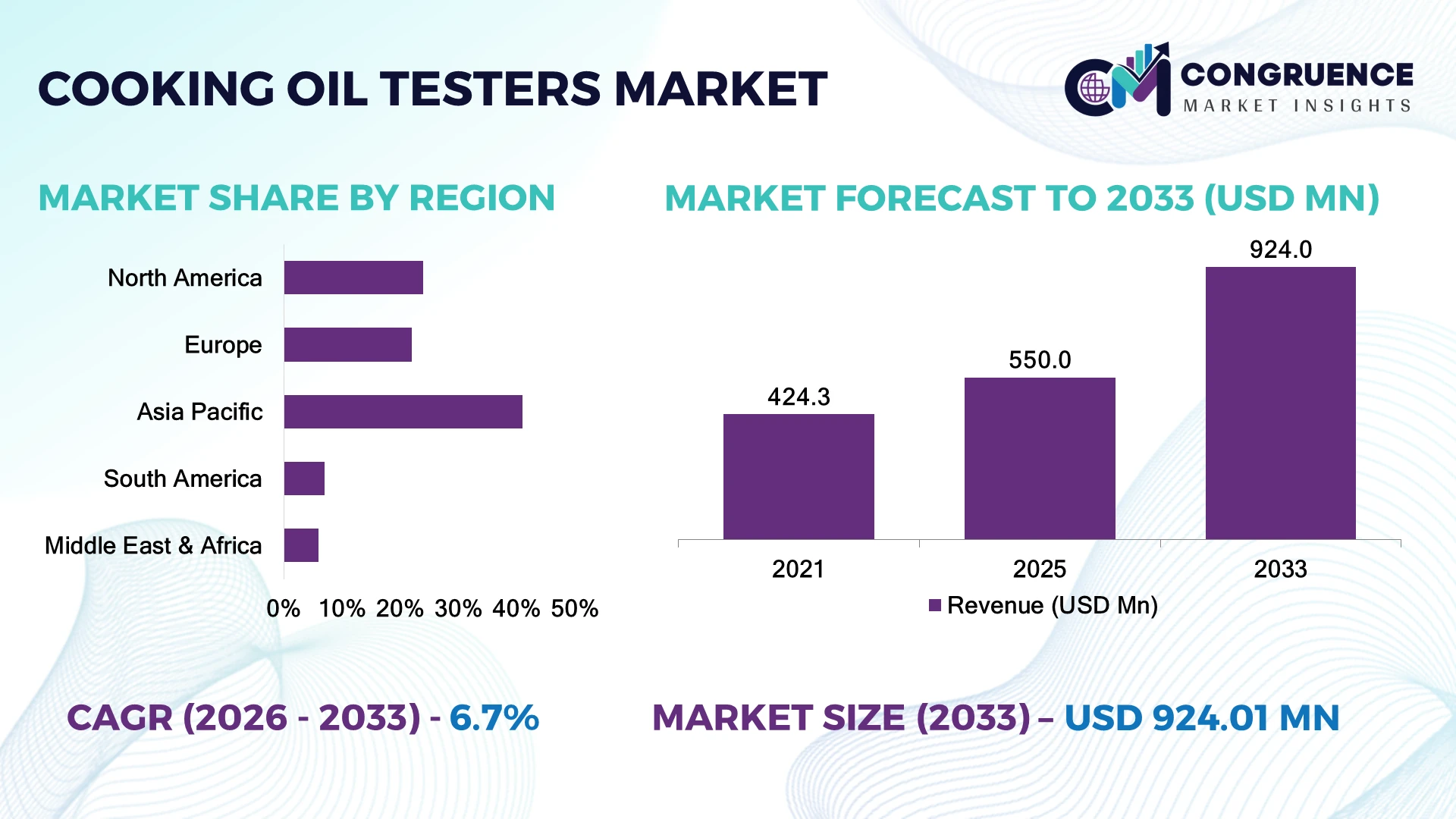
The Global Cooking Oil Testers Market was valued at USD 550 Million in 2025 and is anticipated to reach a value of USD 924.0 Million by 2033 expanding at a CAGR of 6.7% between 2026 and 2033. Growth is being driven by stricter food safety compliance in commercial kitchens, rising monitoring of total polar compounds (TPC), and rapid deployment of digital oil-quality testing systems across quick-service restaurant chains.
China leads the global market with approximately 28% of total demand, supported by over 6 million food-service establishments and large-scale adoption of automated frying operations. Germany accounts for nearly 9% of demand, benefiting from stringent edible-oil quality regulations and high penetration of digital food inspection systems. Compared with Germany, China deploys more than 3x the volume of cooking oil monitoring devices across industrial food-processing facilities. Increased inspection intensity following global food safety scrutiny has accelerated adoption rates by over 20% among organized restaurant operators.
Strategic implication Companies prioritizing digital compliance tools, sensor accuracy, and large-scale food-service partnerships are positioned to secure long-term competitive advantage.
Market Size & Growth: USD 550 Million in 2025, reaching USD 924.0 Million by 2033 at 6.7% CAGR, supported by digital food-safety monitoring and automated kitchen operations.
Top Growth Drivers: Food safety compliance (+32%), quick-service restaurant expansion (+24%), and smart sensor adoption (+28%) are accelerating deployment.
Short-Term Forecast: By 2028, oil-quality testing time is expected to decline by 35%, improving operational efficiency across commercial kitchens.
Emerging Technologies: AI-assisted analytics, IoT-enabled testers, and advanced TPC sensors are improving accuracy and workflow automation.
Regional Leaders: Asia Pacific (~USD 340 Million), Europe (~USD 245 Million), and North America (~USD 210 Million) benefit from regulatory adoption and organized food-service growth.
Consumer/End-User Trends: Over 60% of large restaurant chains now conduct routine frying-oil quality assessments to improve food consistency.
Pilot/Case Example: In 2024, a multinational food-service operator reduced oil replacement frequency by 18% through digital tester deployment.
Competitive Landscape: Testo holds an estimated 18% share, alongside Ebro, PCE Instruments, VITO, and SKF.
Regulatory & ESG Impact: Oil-waste reduction programs have lowered premature oil disposal by nearly 25% in regulated commercial kitchens.
Investment & Funding: More than USD 120 Million has been directed toward sensor innovation, food-tech partnerships, and inspection automation initiatives.
Innovation & Future Outlook: Cloud-connected testing platforms and predictive oil-management systems are reshaping procurement and kitchen optimization strategies.
Cooking Oil Testers are becoming essential tools across quick-service restaurants, industrial food processors, and hospitality chains seeking higher food-quality consistency and compliance assurance. Recent innovation focuses on real-time TPC measurement, wireless data logging, and mobile-app integration. More than 40% of newly deployed systems now include digital connectivity features. Growing regulatory oversight of frying-oil quality and heightened supply-chain accountability are accelerating adoption across emerging food-service markets, creating a foundation for broader strategic investment and operational modernization.
Cooking oil testing technologies are becoming strategically important as food-service operators face increasing pressure to improve food safety, reduce operational waste, and maintain consistent product quality. Regulatory enforcement, digital kitchen transformation, and standardized food-quality protocols are elevating oil-monitoring systems from optional equipment to operational necessities. Organized restaurant chains and industrial food manufacturers increasingly view oil-quality data as a measurable performance indicator.
Modern digital cooking oil testers deliver results up to 70% faster than traditional laboratory sampling methods while reducing manual inspection requirements by approximately 50%. Germany and Japan emphasize compliance-driven deployment and precision monitoring, whereas China focuses on large-scale implementation across commercial food-service networks. Over the next two to three years, connected testing platforms are expected to account for more than 45% of new installations as operators integrate oil-quality monitoring into broader kitchen management systems.
A practical example is the deployment of wireless oil-testing devices across multi-location restaurant networks, enabling centralized monitoring and standardized replacement schedules. Companies are expanding partnerships with food-service technology providers and investing in cloud-based analytics. Organizations that integrate testing accuracy, digital reporting, and compliance management into a unified platform will strengthen competitive positioning and achieve superior operational efficiency.
Food safety enforcement and standardized frying-oil quality monitoring are driving rapid adoption of cooking oil testers. More than 65% of organized restaurant chains now maintain structured oil-management programs, while digital food-safety audits have increased by approximately 30% across major food-service markets. Regulatory frameworks in Germany, Japan, and South Korea increasingly emphasize measurable oil-quality parameters, encouraging investment in automated testing solutions. This shift improves food consistency, reduces contamination risks, and lowers unnecessary oil replacement costs. In response, manufacturers are expanding sensor portfolios, developing wireless monitoring systems, and partnering with commercial kitchen equipment providers. A notable operational insight is that data-driven oil management can reduce oil wastage by nearly 20%, creating a direct link between compliance performance and profitability.
Despite rising adoption, equipment costs and fragmented purchasing behavior continue to limit penetration among small and independent food-service businesses. In many developing markets, nearly 55% of restaurants still rely on visual inspection methods rather than instrument-based testing. Calibration and maintenance expenses can add 10–15% to total ownership costs, creating procurement barriers for smaller operators. Supply-chain disruptions affecting electronic sensors and semiconductor components have also increased lead times by over 12% in certain markets. These limitations slow deployment consistency and reduce scalability. To mitigate risk, manufacturers are introducing modular devices, localized assembly strategies, and flexible service contracts. A key strategic insight is that affordability and simplified operation increasingly influence purchasing decisions as much as measurement accuracy.
The convergence of IoT, cloud analytics, and food-service automation creates substantial opportunities for advanced cooking oil management solutions. More than 45% of new commercial kitchen technology investments now include digital monitoring capabilities, while connected equipment utilization has increased by approximately 35% among large restaurant chains. Smart testers capable of transmitting real-time data enable predictive oil replacement scheduling and centralized compliance reporting. In China, rapid restaurant digitization and expanding smart-kitchen initiatives are accelerating demand for integrated monitoring systems. Companies are investing heavily in software ecosystems, cloud dashboards, and AI-assisted analytics to differentiate their offerings. A less obvious opportunity lies in subscription-based monitoring services that convert one-time equipment sales into recurring operational revenue streams.
Long-term market expansion depends on solving deployment consistency challenges across diverse food-service environments. Variations in cooking practices, oil types, and testing protocols can create measurement discrepancies exceeding 15% between facilities. Multi-location operators often struggle to standardize data collection and compliance reporting across hundreds of kitchens. Workforce training remains another critical challenge, with nearly 40% of food-service staff requiring periodic retraining on quality-control procedures. The growing integration of connected devices also introduces cybersecurity and data-management requirements that many operators are still developing. Companies must invest in standardized calibration frameworks, workforce education programs, and secure digital infrastructure. Organizations that successfully harmonize testing accuracy and enterprise-wide reporting will establish stronger operational resilience and long-term competitive differentiation.
Smart Connectivity Becomes Standard Commercial kitchens are rapidly shifting toward Bluetooth and cloud-connected cooking oil testers, with connected-device penetration exceeding 42% among large restaurant chains. Digital reporting has reduced manual compliance documentation by nearly 35%, while centralized monitoring has improved multi-site visibility by over 25%. Rising food-safety audits and workforce efficiency targets are accelerating deployment. Companies are integrating testing platforms with kitchen management software and expanding partnerships with restaurant technology providers to streamline operational workflows.
Predictive Oil Management Adoption Operators are moving beyond periodic testing toward predictive oil replacement models. Advanced monitoring systems have reduced unnecessary oil disposal by approximately 18% while improving fryer utilization rates by more than 15%. Large quick-service restaurant groups in China and Japan are embedding oil-quality analytics into standardized operating procedures. This shift lowers procurement volatility and enhances consistency across locations. Manufacturers are scaling AI-assisted diagnostics and automated alert functions to strengthen operational decision-making.
Regulation-Driven Testing Expansion Stricter food inspection protocols are increasing routine oil-quality verification across organized food-service networks. Compliance-related testing frequency has risen by nearly 30% in regulated commercial kitchens, while digital record retention adoption has surpassed 45%. Enhanced scrutiny of frying-oil quality and food handling practices is prompting enterprises to standardize testing procedures. Companies are responding through calibration automation, workforce training programs, and expanded service support networks to improve deployment consistency.
Portable Devices Gain Traction Compact handheld testers are experiencing strong uptake, particularly among independent restaurants and catering operators. Portable device adoption has increased by over 28%, while testing cycle times have fallen by nearly 40% compared with conventional inspection workflows. Labor constraints and the need for faster operational decisions are driving demand for lightweight, easy-to-use equipment. Suppliers are expanding portable product portfolios, improving battery performance, and introducing ruggedized designs suited for high-volume food-service environments.
Digital cooking oil testers account for approximately 62% of total market demand, making them the dominant segment due to superior accuracy, rapid measurement capabilities, and seamless integration with food-safety management systems. Their ability to provide instant Total Polar Compound (TPC) readings and digital recordkeeping supports compliance-intensive environments. Adoption among organized restaurant chains exceeds 55%, reflecting strong demand for standardized quality control. Analog testers continue to serve smaller operators because of lower acquisition costs and straightforward operation. Digital testers are also the fastest-growing segment as food-service operators prioritize data-driven kitchen management and multi-location monitoring. Portable digital models have achieved adoption growth exceeding 25% among franchise restaurant networks. Meanwhile, analog devices retain relevance in cost-sensitive markets where advanced connectivity remains a lower priority. Manufacturers are focusing investments on wireless functionality, cloud integration, and enhanced sensor precision while maintaining entry-level product lines to address diverse customer requirements. This shift highlights increasing investment toward intelligent monitoring solutions capable of supporting broader operational digitization initiatives.
Commercial kitchens represent the largest application segment with an estimated 48% market share, supported by high-volume frying operations and strict food-quality requirements. Restaurant chains, hotels, and catering providers rely on frequent oil-quality monitoring to maintain consistency, optimize replacement cycles, and reduce waste. More than 60% of organized food-service operators conduct structured oil testing programs, reinforcing demand concentration within this segment. Food processing facilities also contribute significant demand through continuous production environments requiring standardized quality controls. Food processing applications are emerging as the fastest-growing segment due to increasing automation and traceability requirements. Deployment of integrated monitoring systems has increased by approximately 22% among industrial food manufacturers seeking tighter process control. Institutional kitchens, including healthcare and educational facilities, continue expanding adoption as compliance requirements become more stringent. Companies are enhancing product portfolios with workflow integration features, automated reporting capabilities, and enterprise-level analytics. Demand is increasingly shifting toward environments where operational efficiency, documentation, and quality consistency are becoming mission-critical performance indicators.
Restaurant chains constitute the leading end-user segment, accounting for approximately 46% of market demand due to extensive fryer utilization, standardized operating procedures, and large-scale deployment requirements. Multi-location operators increasingly rely on cooking oil testers to maintain food quality and ensure compliance consistency. Adoption rates exceed 60% among major quick-service brands, reflecting the operational importance of continuous oil monitoring. Hotels and catering providers represent established buyer groups that prioritize quality assurance and cost optimization across food-service operations. Food processing companies are the fastest-growing end-user segment as manufacturers invest in automation, traceability, and process standardization. Adoption within industrial production environments has increased by more than 20% as enterprises strengthen quality-control frameworks. Institutional food-service operators are also expanding purchases to support compliance-driven kitchen management. Suppliers are targeting these segments through customized solutions, service agreements, and integrated monitoring platforms. Competitive positioning increasingly depends on providing scalable systems that address both enterprise-wide reporting requirements and facility-level operational efficiency objectives.
Asia-Pacific accounted for the largest market share at 41% in 2025 however, North America is expected to register the fastest growth, expanding at a CAGR of 7.4% between 2026 and 2033.

North America represents approximately 24% of global market demand, supported by advanced food-service infrastructure, strict food safety standards, and widespread adoption of digital quality-control systems. Large restaurant chains and food-processing facilities are increasingly integrating cooking oil testers into enterprise-level compliance programs. More than 65% of major quick-service restaurant operators have implemented standardized oil-monitoring procedures across multiple locations. The region is also witnessing growing deployment of cloud-connected testing devices that enable centralized reporting and operational benchmarking. Recent investments in kitchen automation and digital audit systems have accelerated integration of real-time monitoring technologies. Companies continue expanding partnerships with food-service technology providers to improve workflow efficiency, reduce oil waste, and strengthen regulatory compliance across distributed operations.
United States Market Outlook: The United States remains the largest market within North America due to its extensive restaurant industry, advanced food-processing sector, and high technology adoption rates. Organized food-service operators increasingly deploy connected monitoring systems to standardize quality management across national networks. More than 70% of large restaurant brands utilize structured oil-management protocols, creating sustained demand for advanced testing solutions. Strong investment in kitchen digitization and operational analytics continues to reinforce the country’s leadership position.
Europe accounts for nearly 22% of global demand, supported by stringent food-quality regulations and mature commercial food-service networks. Regulatory emphasis on frying-oil quality management is encouraging broader deployment of digital testing equipment across restaurants, catering operations, and institutional kitchens. Adoption of automated testing systems has increased by approximately 28% among large food-service enterprises seeking stronger compliance documentation and operational consistency. Sustainability initiatives focused on reducing food waste and optimizing resource utilization are also supporting implementation. Market participants are prioritizing precision measurement technologies, calibration accuracy, and digital recordkeeping capabilities to meet evolving operational requirements. Enterprise-level procurement increasingly favors integrated monitoring solutions capable of supporting multi-site compliance management.
Germany Market Outlook: Germany serves as the region’s strategic center for food-quality monitoring technologies due to its strong industrial base, regulatory rigor, and advanced food-service ecosystem. Commercial kitchens increasingly utilize digital cooking oil testers to support structured quality-control programs and audit readiness. More than 60% of organized food-service operators employ standardized oil-monitoring procedures. The country’s focus on operational efficiency and traceability continues to encourage adoption of intelligent testing systems and advanced sensor technologies.
Asia-Pacific holds the leading position with approximately 41% of global market demand, driven by expanding restaurant networks, rapid urbanization, and growing food-processing activity. The region benefits from a large concentration of commercial kitchens and industrial food manufacturers requiring consistent frying-oil quality management. Adoption of digital testing devices has increased by over 30% among organized food-service operators seeking standardized quality assurance. Rapid expansion of quick-service restaurant chains and modernization of food-production facilities are supporting deployment at scale. Companies are expanding distribution networks, introducing localized product offerings, and investing in service capabilities to address diverse operational requirements across major economies.
China Market Outlook: China remains the most influential market due to its vast food-service sector, extensive restaurant infrastructure, and accelerating digital transformation initiatives. Large franchise operators increasingly integrate cooking oil testing into centralized quality-control frameworks. The country accounts for more than one-quarter of global deployment activity, supported by millions of food-service establishments and expanding food-processing operations. Continued investment in smart kitchen technologies and operational standardization strengthens long-term demand for advanced monitoring solutions.
South America accounts for approximately 7% of global market activity, with demand concentrated in organized restaurant chains, food-processing facilities, and institutional kitchens. Modernization initiatives within the food-service sector are encouraging broader adoption of structured oil-quality monitoring programs. Deployment of digital testing equipment has increased by nearly 20% among large restaurant operators seeking greater consistency and waste reduction. However, infrastructure disparities and varying compliance standards continue to influence adoption rates across individual markets. Companies are responding through distributor partnerships, localized support services, and cost-effective product offerings designed for mid-sized operators. Demand remains strongest where food-service modernization aligns with operational efficiency initiatives.
Brazil Market Outlook: Brazil represents the largest market in South America owing to its extensive restaurant industry, large food-processing sector, and expanding organized food-service landscape. Commercial operators increasingly adopt testing technologies to improve frying-oil management and support quality assurance objectives. Adoption among large restaurant groups has risen steadily as businesses pursue greater operational consistency. The country's sizable hospitality and catering sectors continue to create favorable conditions for expanded deployment of digital monitoring solutions.
The Middle East & Africa region accounts for approximately 6% of global demand and is increasingly influenced by hospitality expansion, food-service modernization, and investment in commercial kitchen infrastructure. Large hospitality projects and growing tourism activity are encouraging adoption of food-quality monitoring technologies. Deployment of digital cooking oil testers has increased by more than 18% within premium hospitality and catering operations. Food-service operators are prioritizing compliance, consistency, and resource optimization as competitive differentiation becomes more important. Suppliers are expanding regional partnerships, strengthening technical support networks, and introducing solutions tailored to high-volume food-service environments. Infrastructure modernization programs continue to create opportunities for advanced monitoring technologies.
Saudi Arabia Market Outlook: Saudi Arabia leads regional demand through large-scale hospitality investments, expanding restaurant networks, and ongoing food-service modernization initiatives. Major commercial operators increasingly implement structured quality-control procedures to support operational excellence and international service standards. Adoption of digital monitoring technologies has accelerated across premium dining, catering, and hospitality facilities. Strong investment in tourism-related infrastructure and commercial food-service development continues to support long-term deployment opportunities for advanced cooking oil testing solutions.
The market is characterized by competition between global measurement technology leaders such as Testo, Ebro Electronic, and PCE Instruments, and specialized frying-oil management providers including VITO AG and SKF. The top five players collectively control approximately 58% of global market activity, with competition centered on measurement accuracy, digital connectivity, compliance documentation, and lifecycle cost optimization. Global technology leaders compete through advanced sensor performance and integrated software platforms, while regional suppliers emphasize pricing flexibility and localized service support. Digital-enabled products improve reporting efficiency by nearly 35%, while automated documentation reduces compliance administration time by over 25%, creating clear differentiation. Companies are expanding through distributor partnerships, food-service technology integrations, and connected monitoring ecosystems. The competitive shift is moving toward cloud-enabled quality management and enterprise-wide monitoring rather than standalone testing devices. Regulatory compliance requirements and calibration credibility remain significant entry barriers. Success increasingly depends on combining measurement precision, digital workflow integration, scalability, and strong food-service customer relationships.
VITO AG
Ebro Electronic GmbH
PCE Instruments
SKF Group
ATAGO Co., Ltd.
Hanna Instruments
Lovibond (Tintometer Group)
Anton Paar GmbH
KERN & SOHN GmbH
A.KRÜSS Optronic GmbH
Labtron Equipment Ltd.
Mettler Toledo International Inc.
Modern cooking oil testers are increasingly built around advanced Total Polar Material (TPM) sensing, digital calibration systems, and wireless data transfer capabilities. Current-generation devices provide objective oil-quality measurements within seconds while supporting automated compliance documentation. Adoption of connected testing platforms has surpassed 40% among large food-service operators, while digital reporting systems reduce administrative workload by approximately 30%. These technologies help operators optimize oil replacement schedules, improve food consistency, and strengthen audit readiness across multiple facilities.
Emerging innovation is focused on cloud connectivity, mobile application integration, and predictive analytics. Compared with conventional manual inspection methods, connected digital testers improve decision accuracy by nearly 45% and reduce unnecessary oil disposal by approximately 20%. Companies operating large restaurant networks benefit most because centralized monitoring enables standardized quality management across hundreds of locations. AI-assisted trend analysis and automated alerts are increasingly being incorporated into premium solutions.
Between 2026 and 2028, the market will move toward intelligent oil-management ecosystems combining IoT sensors, enterprise dashboards, and compliance automation. Deployment of connected monitoring technologies is expected to exceed 55% among organized food-service enterprises. Companies that invest early in integrated monitoring platforms will gain operational advantages through lower waste, faster decision-making, stronger compliance performance, and enhanced multi-site quality control.
January 2025 – VITO AG launched the VITO FT CONNECT smart frying oil tester featuring automatic HACCP-compliant digital documentation and TPM percentage monitoring. The platform-enabled solution strengthened workflow automation and quality-control efficiency for commercial kitchens. Source: www.vito.ag.com
December 2025 – VITO AG’s FT CONNECT received the Silver Catering Star Award 2025 after industry voting. The solution automates oil-quality monitoring and compliance recording, supporting improved operational efficiency and standardized quality management across food-service operations. Source: www.vito.ag.com
May 2025 – VITO AG announced it had surpassed 50,000 customers across more than 150 countries, highlighting expanding deployment of frying-oil management technologies. The milestone strengthened its international market position and supported broader commercial adoption initiatives. Source: www.vito.ae
2025 – Testo expanded promotion of the testo 270 BT platform with app-connected digital documentation capabilities. The solution helps reduce frying-oil consumption by up to 20%, enabling improved cost control, quality assurance, and operational standardization for professional kitchens.
This report provides comprehensive analysis of the Cooking Oil Testers Market across key product types, applications, end-user groups, and major geographic regions. The assessment covers digital and analog testing technologies, commercial kitchen deployments, food processing applications, institutional food-service operations, and emerging monitoring use cases. Regional evaluation spans North America, Europe, Asia-Pacific, South America, and the Middle East & Africa, highlighting deployment concentration, technology adoption patterns, operational trends, and competitive positioning. More than 60% of organized food-service enterprises now utilize structured oil-quality management programs, reinforcing the strategic importance of testing technologies.
The report further examines connected monitoring systems, TPM sensing innovations, cloud-based documentation platforms, and workflow automation developments shaping market evolution between 2026 and 2033. Analysis includes competitive benchmarking, enterprise adoption strategies, digital transformation initiatives, and investment priorities. It supports decision-making related to expansion planning, technology selection, partnership development, operational optimization, and long-term competitive positioning within increasingly compliance-driven food-service and food-processing environments.
| Report Attribute / Metric | Details |
|---|---|
| Market Revenue (2025) | USD 550 Million |
| Market Revenue (2033) | USD 924.0 Million |
| CAGR (2026–2033) | 6.7% |
| Base Year | 2025 |
| Forecast Period | 2026–2033 |
| Historic Period | 2021–2025 |
| Segments Covered |
By Type
By Application
By End-User
|
| Key Deliverables | Revenue Forecast; Market Trends; Growth Drivers & Restraints; Technology Insights; Segmentation Analysis; Regional Insights; Competitive Landscape; Regulatory & ESG Overview; Recent Developments |
| Regions Covered | North America; Europe; Asia-Pacific; South America; Middle East & Africa |
| Companies Profiled | Testo SE & Co. KGaA; VITO AG; Ebro Electronic GmbH; PCE Instruments; SKF Group; ATAGO Co., Ltd.; Hanna Instruments; Lovibond (Tintometer Group); Anton Paar GmbH; KERN & SOHN GmbH; A.KRÜSS Optronic GmbH; Labtron Equipment Ltd.; Mettler Toledo International Inc. |
| Customization & Pricing | Available on Request (10% Customization Free) |




