
Reports
The Global Conversational AI Chatbot Market was valued at USD 13,475.7 Million in 2025 and is anticipated to reach a value of USD 72,455.7 Million by 2033 expanding at a CAGR of 23.4% between 2026 and 2033. Growth is driven by enterprise-wide generative AI adoption, multilingual customer engagement automation, and AI-powered workflow orchestration across banking, healthcare, retail, and public services.
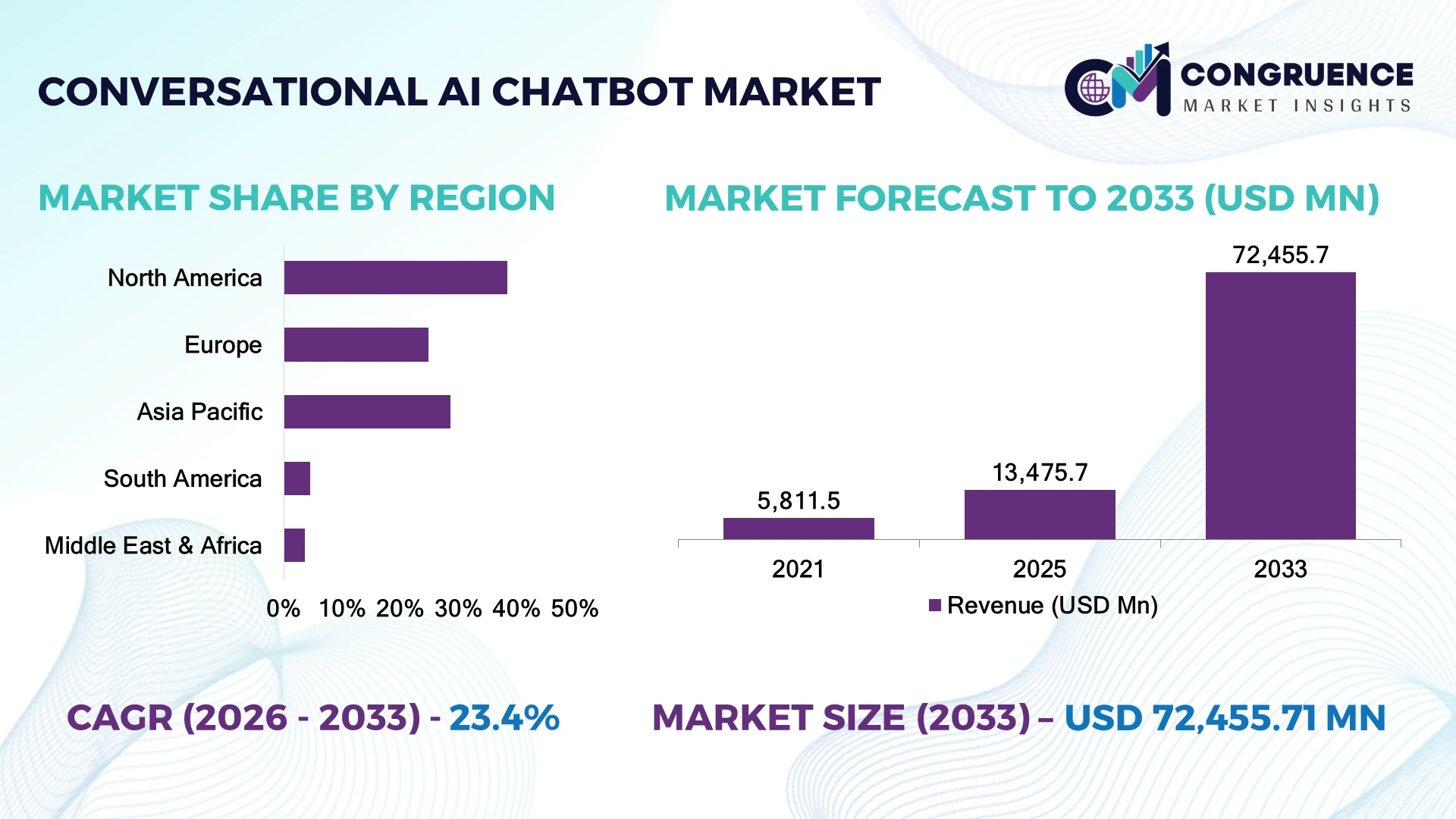
The United States accounts for approximately 36% of global enterprise conversational AI deployments, supported by extensive investments in cloud AI infrastructure, large language model integration, and digital transformation initiatives across financial services and healthcare. Compared with the United Kingdom, the United States operates nearly 42% more enterprise-scale AI chatbot implementations, while over 68% of Fortune 500 organisations have integrated conversational AI into customer or employee support. Ongoing AI governance frameworks introduced across major economies are accelerating trusted enterprise deployment.
Organisations investing in secure AI architectures, industry-specific models, and scalable automation platforms will strengthen long-term competitive advantage in enterprise conversational intelligence.
Market Size & Growth: USD 13,475.7 million in 2025 to USD 72,455.7 million by 2033 at 23.4% CAGR, driven by enterprise generative AI adoption and workflow automation.
Top Growth Drivers: Generative AI (+47%), customer automation (+39%), multilingual support (+31%).
Short-Term Forecast: By 2028, customer service resolution time declines by approximately 34% through AI automation.
Emerging Technologies: Large language models, AI agents, retrieval-augmented generation, and multimodal conversational interfaces accelerate deployment.
Regional Leaders: North America (~USD 28.4 billion), Asia-Pacific (~USD 21.3 billion), Europe (~USD 15.8 billion), supported by enterprise AI modernisation.
Consumer/End-User Trends: Approximately 71% of enterprises prioritise AI chatbots for always-on customer engagement.
Pilot/Case Example: 2026 enterprise deployment reduced support ticket handling time by nearly 41%.
Competitive Landscape: Leading platform holds approximately 18% share alongside Microsoft, Google, Salesforce, IBM, and AWS.
Regulatory & ESG Impact: AI governance programmes improve model transparency by approximately 27% across regulated industries.
Investment & Funding: More than USD 18 billion invested in enterprise generative AI platforms, partnerships, and infrastructure expansion.
Innovation & Future Outlook: Autonomous AI agents and domain-specific models are redefining enterprise digital operations.
The Conversational AI Chatbot Market is expanding across customer support, employee assistance, healthcare engagement, banking, and e-commerce as enterprises prioritise intelligent automation over rule-based interactions. Approximately 58% of new deployments incorporate generative AI capabilities with retrieval-based knowledge systems, while evolving AI governance standards are encouraging secure, explainable implementations, setting the stage for deeper strategic enterprise adoption.
Conversational AI chatbots have become a strategic enterprise capability as organisations seek to automate customer engagement, internal support, and knowledge management while improving service quality. Competitive differentiation increasingly depends on AI-enabled digital experiences rather than traditional contact centre scale. Enterprise AI adoption, stricter governance requirements, and cloud infrastructure modernisation are reshaping procurement priorities, encouraging vendors to deliver secure, industry-specific conversational platforms instead of generic chatbot solutions.
Generative AI chatbots resolve complex customer queries approximately 44% faster than legacy rule-based systems while reducing agent workload by nearly 36% through contextual reasoning and automated workflow execution. North America leads large-scale enterprise deployment through advanced AI ecosystems, whereas Asia-Pacific demonstrates faster implementation across banking, telecommunications, and digital commerce. Over the next two to three years, more than 65% of enterprise chatbot deployments are expected to integrate retrieval-augmented generation, multimodal interfaces, and workflow orchestration to improve operational accuracy and business productivity.
Financial institutions increasingly deploy AI chatbots for onboarding, fraud support, and personalised customer assistance, while healthcare providers automate appointment scheduling and patient engagement. Technology providers are expanding strategic partnerships with cloud infrastructure companies, cybersecurity specialists, and industry software vendors to strengthen enterprise adoption. Organisations combining secure AI governance, domain-specific intelligence, and seamless business application integration will establish stronger competitive positioning as conversational AI evolves into a core enterprise productivity platform.
Enterprise-wide integration of generative AI into customer service, employee support, and business workflows is the primary catalyst for conversational AI chatbot adoption. Approximately 69% of large enterprises have prioritised AI assistants within digital transformation programmes, while organisations deploying conversational AI report nearly 38% faster customer response times and approximately 29% lower service operating costs. The United States continues expanding enterprise AI infrastructure following stronger AI governance initiatives and accelerated cloud investments. This shift is driving organisations to embed conversational AI across CRM, ERP, and collaboration platforms. Technology providers are responding through industry-specific language models, strategic cloud partnerships, and expanded AI agent capabilities, creating higher-value automation beyond conventional customer support while strengthening long-term enterprise platform adoption.
Stringent data privacy regulations, fragmented enterprise systems, and high-quality data requirements remain significant structural barriers to conversational AI chatbot deployment. Approximately 46% of enterprises identify data integration challenges as the primary implementation constraint, while nearly 33% of AI projects require additional governance controls before production deployment. Germany's tightening enterprise AI compliance expectations have increased demand for secure, regionally hosted AI infrastructure, extending implementation timelines for regulated sectors. These constraints affect deployment scalability, increase operational costs, and slow return on technology investments. Vendors are reducing risk through hybrid deployment models, sovereign AI infrastructure, long-term cloud partnerships, and privacy-preserving model architectures that improve regulatory alignment without compromising enterprise performance.
The next wave of growth is emerging from domain-specific conversational AI agents capable of executing business workflows rather than simply answering questions. Approximately 57% of new enterprise AI investments target industry-specific assistants for healthcare, banking, manufacturing, and legal services, while intelligent workflow automation improves operational productivity by nearly 31%. Japan is accelerating enterprise AI adoption through advanced automation initiatives supporting workforce efficiency amid demographic pressures. Companies are expanding research into autonomous AI agents, multimodal interfaces, and retrieval-augmented enterprise knowledge systems while forming ecosystem partnerships with software vendors. A significant opportunity lies in AI platforms that combine conversational intelligence with business process execution, creating measurable productivity gains beyond customer engagement.
Maintaining consistent accuracy, security, and governance across enterprise-scale conversational AI deployments remains the market's most significant long-term execution challenge. Approximately 41% of organisations continue refining AI guardrails to minimise hallucinations, while nearly 27% report integration complexity across legacy enterprise applications. Financial institutions in the United Kingdom require increasingly rigorous AI validation before production deployment, increasing operational demands on technology providers. Inconsistent outputs, fragmented enterprise architectures, and cybersecurity risks directly influence user trust and deployment consistency. Companies must strengthen model evaluation frameworks, invest in AI observability platforms, expand cybersecurity partnerships, and develop continuous monitoring capabilities to sustain enterprise-grade reliability and competitive differentiation.
Multimodal AI Becomes Standard: Nearly 52% of new enterprise chatbot deployments now combine text, voice, and image understanding, improving customer interaction accuracy by approximately 26% while reducing average handling time by nearly 18%. Organisations are integrating multimodal capabilities into customer service and field support as workforce productivity expectations continue rising, prompting vendors to expand AI platform partnerships and deployment ecosystems.
Industry-Specific Models Expand: Around 48% of enterprise buyers now prioritise domain-trained conversational AI over general-purpose chatbots, achieving approximately 22% higher response relevance in regulated industries. Financial services and healthcare organisations increasingly deploy sector-specific language models following stronger AI governance requirements, encouraging technology providers to accelerate vertical product development and specialised implementation services.
AI Governance Drives Procurement: Enterprise procurement increasingly favours explainable conversational AI platforms, with approximately 44% of organisations requiring built-in governance and audit capabilities before deployment. Regulatory developments across the European Union are accelerating demand for transparent AI lifecycle management, leading vendors to embed compliance controls, model monitoring, and secure deployment frameworks into commercial offerings.
Workflow Automation Deepens Integration: Approximately 61% of enterprise chatbot projects now connect directly with CRM, ERP, and IT service management platforms, reducing manual workflow steps by nearly 32%. Rather than replacing support teams, organisations are redesigning operational processes around AI-assisted decision-making, prompting providers to strengthen automation capabilities, enterprise integrations, and strategic alliances with business software vendors.
AI-Powered Chatbots account for approximately 56% of the global Conversational AI Chatbot market owing to their ability to understand context, support multilingual interactions, integrate with enterprise applications, and continuously improve through machine learning. Their scalability across customer service, employee assistance, and digital commerce makes them the preferred solution for large enterprises. Hybrid Chatbots represent the fastest-growing segment as organisations combine rule-based workflows with generative AI to balance accuracy, compliance, and conversational flexibility. Rule-Based Chatbots continue serving structured use cases such as FAQs, transaction tracking, and appointment scheduling, while Voice-Enabled Chatbots gain traction in contact centres and automotive applications where hands-free interaction enhances user experience.
Hybrid deployments have improved enterprise task completion rates by approximately 24%, while AI-powered chatbots reduce live-agent escalations by nearly 31%. Technology providers are investing in multimodal AI, retrieval-augmented generation, and domain-specific models while expanding partnerships with cloud providers and enterprise software vendors. Investment priorities are shifting from standalone chatbot platforms toward intelligent AI assistants capable of executing business workflows, creating stronger competitive differentiation through automation and enterprise integration.
According to a 2026 enterprise assessment published by the International Data Corporation (IDC), organisations increasingly favour hybrid conversational AI architectures that combine deterministic workflows with generative AI to improve governance, response accuracy, and enterprise scalability.
Customer Support accounts for approximately 41% of global Conversational AI Chatbot deployments as organisations prioritise round-the-clock customer engagement, reduced response times, and operational cost optimisation. AI chatbots have become integral to banking, retail, telecommunications, and travel operations where rapid issue resolution directly influences customer retention. Employee Support is the fastest-growing application as enterprises automate HR services, IT helpdesks, onboarding, and internal knowledge management. Sales & Marketing, Virtual Assistants, Healthcare Support, and Financial Advisory applications continue expanding as conversational AI evolves beyond customer interactions into revenue generation and operational decision support.
Employee support deployments have increased by approximately 29%, while AI-enabled self-service platforms resolve nearly 63% of routine enterprise queries without human intervention. Vendors are integrating conversational AI into CRM, ERP, and collaboration platforms while expanding industry-specific capabilities through automation, analytics, and secure knowledge retrieval. Demand is increasingly strengthening where conversational AI becomes embedded within daily enterprise operations rather than functioning as a standalone communication tool.
A 2025 enterprise technology survey conducted by Deloitte reported that organisations deploying conversational AI for internal employee services achieved measurable improvements in service responsiveness, knowledge accessibility, and operational productivity across business functions.
Large Enterprises account for approximately 62% of the global Conversational AI Chatbot market because of their extensive customer engagement requirements, complex IT ecosystems, and substantial investment in AI-driven digital transformation. Their deployment scale spans customer service, employee productivity, finance, cybersecurity, and knowledge management, making conversational AI an enterprise-wide strategic asset. Small & Medium Enterprises represent the fastest-growing end-user segment as cloud-native AI platforms reduce implementation complexity and subscription-based pricing improves accessibility. Government organisations, healthcare providers, educational institutions, and financial services firms continue expanding deployments to improve service delivery, regulatory compliance, and operational efficiency.
Cloud-based conversational AI adoption among SMEs has increased by approximately 34%, while AI-enabled customer interaction volumes have grown by nearly 28% across regulated industries. Platform vendors are addressing these markets through industry-specific templates, managed AI services, flexible pricing models, and strategic partnerships with cloud providers and systems integrators. Competitive positioning increasingly depends on delivering secure, scalable, and customisable AI solutions tailored to each industry's operational priorities.
A 2026 enterprise study by the World Economic Forum observed that large organisations are accelerating conversational AI investment to improve workforce productivity, automate knowledge-intensive processes, and strengthen digital service delivery across multiple business units.
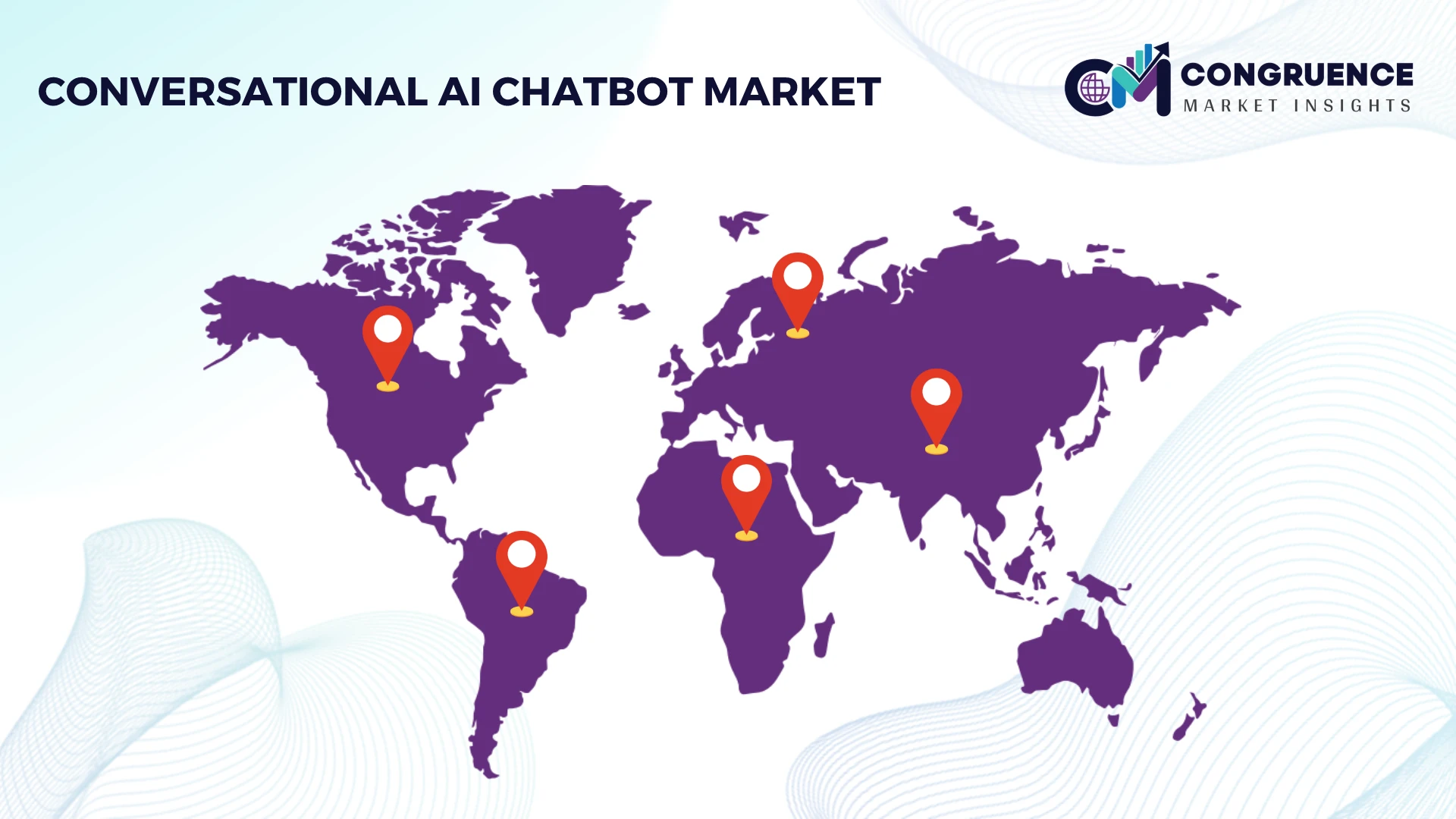
North America accounted for the largest market share at 38.4% in 2025 however, Asia-Pacific is expected to register the fastest growth, expanding at a CAGR of 26.2% between 2026 and 2033.
Enterprise Generative AI Reshapes Digital Customer Operations
North America contributes approximately 38.4% of the global Conversational AI Chatbot market, driven by mature cloud infrastructure, widespread enterprise AI adoption, and strong investment in generative AI platforms. Financial services, healthcare, retail, and technology companies continue integrating conversational AI into customer support, employee productivity, and workflow automation. Nearly 71% of large enterprises have deployed AI-powered virtual assistants across at least one business function, while enterprise chatbot integration with CRM and ERP platforms has increased by approximately 36% over the past two years. Technology vendors are expanding hyperscale cloud partnerships, industry-specific AI models, and AI governance capabilities, enabling organisations to scale conversational intelligence while maintaining security and regulatory compliance.
United States Market Outlook: The United States leads the regional market through its concentration of AI platform developers, hyperscale cloud providers, and enterprise software companies. Financial institutions, healthcare providers, and technology enterprises continue investing in conversational AI to automate customer interactions and internal operations. Approximately 74% of Fortune 500 companies have incorporated generative AI-enabled conversational platforms into business workflows, reinforcing the country's leadership in enterprise AI deployment, infrastructure expansion, and commercial innovation.
AI Governance Drives Enterprise Adoption
Europe accounts for approximately 24.8% of the global market, supported by enterprise digital transformation and increasing emphasis on trustworthy AI deployment. Organisations prioritise conversational AI solutions offering explainability, multilingual capabilities, and compliance-ready architectures across banking, public administration, healthcare, and telecommunications. Nearly 52% of enterprise deployments now incorporate governance and audit features alongside AI assistants. Vendors continue expanding sovereign cloud partnerships, regional data infrastructure, and language-specific AI models to address operational requirements while strengthening enterprise confidence in large-scale AI implementation.
Germany Market Outlook: Germany remains the region's leading enterprise AI market owing to its strong industrial software ecosystem, manufacturing digitalisation, and advanced enterprise IT infrastructure. Large organisations increasingly deploy conversational AI across customer service, procurement, and industrial knowledge management. Approximately 49% of large enterprises have integrated AI assistants into business operations, encouraging technology providers to expand local AI engineering, enterprise consulting, and secure cloud deployment capabilities.
Digital Enterprise Expansion Accelerates AI Deployment
Asia-Pacific represents approximately 28.6% of the global Conversational AI Chatbot market, supported by rapid enterprise digitalisation, expanding cloud infrastructure, and increasing investment in AI-driven customer engagement. Banking, e-commerce, telecommunications, and public sector organisations continue deploying conversational AI to improve service accessibility and operational efficiency. More than 61% of new enterprise AI projects in the region include conversational interfaces, while multilingual chatbot deployment has increased by approximately 33% to support diverse customer populations. Platform providers are expanding regional AI infrastructure, language model development, and implementation partnerships to meet accelerating enterprise demand.
China Market Outlook: China leads regional deployment through large-scale AI infrastructure investment, a strong digital economy, and widespread adoption across finance, retail, logistics, and government services. Enterprise AI platforms increasingly integrate conversational intelligence with workflow automation and predictive analytics. Approximately 68% of major digital enterprises have implemented AI chatbots supporting customer engagement or operational processes, encouraging continued investment in domestic AI models and enterprise-grade intelligent automation.
Customer Engagement Automation Gains Momentum
South America is steadily increasing adoption of conversational AI chatbots as enterprises modernise customer service operations and expand digital banking, retail, and telecommunications platforms. Brazil and Chile are leading enterprise deployments, with organisations focusing on multilingual support and AI-assisted service automation. Approximately 37% of medium and large enterprises have introduced conversational AI into customer-facing operations, while cloud-based chatbot implementations have expanded by nearly 28%. Technology providers are strengthening regional implementation partnerships and managed AI services while addressing connectivity differences and enterprise integration challenges across diverse industries.
Brazil Market Outlook: Brazil represents the largest conversational AI market in South America due to its advanced financial services sector, rapidly expanding digital commerce ecosystem, and strong enterprise cloud adoption. Banks, insurers, and retailers continue investing in AI-powered customer engagement platforms to improve operational efficiency. Nearly 46% of large customer service organisations have integrated conversational AI with omnichannel communication systems, creating sustained demand for scalable and secure enterprise AI solutions.
Digital Government Initiatives Strengthen AI Investment
The Middle East & Africa market is expanding through government-led digital transformation programmes, smart city initiatives, and increasing enterprise AI investment. Financial institutions, public agencies, healthcare providers, and telecommunications companies are deploying conversational AI to improve citizen services and customer engagement. Approximately 34% of newly launched digital service platforms incorporate AI-powered conversational interfaces, while enterprise cloud migration continues supporting broader deployment. Technology providers are establishing regional AI delivery centres, expanding strategic alliances, and strengthening local implementation capabilities to accelerate intelligent automation across public and private sectors.
United Arab Emirates Market Outlook: The United Arab Emirates leads regional conversational AI adoption through ambitious national AI strategies, advanced digital infrastructure, and significant investment in smart government services. Public sector organisations, airlines, banks, and healthcare providers increasingly deploy AI assistants for multilingual customer engagement and service automation. Approximately 55% of government digital service programmes now include conversational AI capabilities, reinforcing the country's position as a regional innovation hub for enterprise artificial intelligence.
Enterprise AI leaders including Microsoft, Google, IBM, Salesforce, and Amazon compete through foundation models, cloud ecosystems, and enterprise integrations, while specialist vendors such as Kore.ai and Cognigy differentiate through vertical expertise and rapid deployment. The top five providers collectively hold approximately 58% of the global market. Competition centres on model accuracy, orchestration capabilities, and ecosystem depth rather than pricing alone. AI agents improve workflow automation by approximately 34%, while retrieval-augmented generation increases response accuracy by nearly 27% and reduces implementation time by around 22%. Vendors are expanding through cloud alliances, domain-specific AI models, acquisitions, and platform integration across CRM, ERP, and productivity suites. The competitive shift is moving from standalone chatbots toward autonomous AI agents executing business processes. High computing infrastructure costs, enterprise trust, and regulatory compliance create significant entry barriers. Winning requires secure agentic AI, seamless enterprise integration, measurable productivity gains, and continuous model innovation.
Microsoft Corporation
Google LLC
IBM Corporation
Salesforce, Inc.
Amazon Web Services, Inc.
OpenAI
Kore.ai
Cognigy GmbH
Yellow.ai
LivePerson, Inc.
Rasa Technologies Inc.
Verint Systems Inc.
Amelia (SoundHound AI)
ServiceNow, Inc.
Large language models, retrieval-augmented generation, and AI agent orchestration have become the core technologies transforming conversational AI chatbots. Approximately 67% of enterprise deployments now integrate retrieval-based knowledge systems to improve factual accuracy, while multimodal interfaces increase user engagement by nearly 24%. AI chatbots embedded within CRM, ERP, and collaboration platforms deliver greater operational value by automating customer interactions, employee assistance, and business workflows through unified enterprise ecosystems.
Compared with conventional intent-based chatbots, generative AI platforms improve complex query resolution by approximately 46% while reducing manual agent intervention by nearly 33%. Around 59% of newly deployed enterprise chatbots now support AI agents capable of executing tasks rather than only answering questions. Large enterprises, financial institutions, healthcare providers, and software vendors gain the strongest competitive advantage by integrating conversational AI with workflow automation, cybersecurity controls, and enterprise knowledge management platforms.
Between 2026 and 2028, autonomous AI agents, memory-enabled assistants, multimodal reasoning, and agent-to-agent collaboration will redefine enterprise automation. More than 72% of enterprise conversational AI platforms are expected to incorporate advanced orchestration and governance capabilities, reducing repetitive operational workloads by approximately 28%. Organisations investing now in secure AI infrastructure, domain-specific models, and intelligent workflow integration will achieve stronger scalability, higher employee productivity, and sustained competitive differentiation as enterprise AI rapidly evolves.
May 2024 IBM and Salesforce expanded their strategic partnership to integrate watsonx with the Salesforce AI platform, enabling trusted enterprise AI and zero-copy data connectivity. The initiative broadened enterprise AI deployment flexibility and strengthened secure conversational AI capabilities. Source: Salesforce
October 2024 Microsoft announced autonomous AI agents in Copilot Studio, including ten prebuilt business agents for customer service, supply chain, and finance workflows, enabling organisations to automate routine enterprise processes with minimal supervision. Source: Reuters
May 2025 Microsoft introduced Copilot Tuning and multi-agent orchestration, reporting that more than 230,000 organisations, including 90% of Fortune 500 companies, had already used Copilot Studio to build AI agents. The release accelerated enterprise conversational AI adoption. Source: Microsoft
September 2024 Salesforce launched the Agentforce Platform, transforming Einstein Copilot into an autonomous AI agent framework capable of operating across enterprise channels. The platform improved workflow automation while expanding enterprise deployment flexibility for conversational AI applications. Source: Salesforce Help.
The report delivers comprehensive coverage of the Conversational AI Chatbot market across chatbot types, enterprise applications, end-user industries, deployment models, and major geographic regions. It evaluates AI-powered, rule-based, hybrid, and voice-enabled chatbots deployed across customer support, employee assistance, sales, healthcare, financial services, and virtual assistant applications. Regional assessment spans North America, Europe, Asia-Pacific, South America, and the Middle East & Africa, while analysing adoption patterns across large enterprises, SMEs, governments, healthcare providers, and financial institutions. More than 60% of the assessment focuses on enterprise-grade AI deployments integrated with cloud platforms and business applications.
The report further analyses large language models, retrieval-augmented generation, AI agents, multimodal interfaces, orchestration platforms, and enterprise governance technologies shaping market evolution. It benchmarks leading technology providers, evaluates deployment maturity, competitive positioning, and innovation strategies, and identifies emerging opportunities across industry-specific AI assistants and workflow automation. Strategic insights support investment planning, platform selection, partnership development, geographic expansion, and long-term competitive decision-making for organisations operating in the global Conversational AI Chatbot market between 2026 and 2033.
| Report Attribute/Metric | Report Details |
|---|---|
|
Market Revenue in 2025 |
USD 13,475.7 Million |
|
Market Revenue in 2033 |
USD 72,455.7 Million |
|
CAGR (2026 - 2033) |
23.4% |
|
Base Year |
2025 |
|
Forecast Period |
2026 - 2033 |
|
Historic Period |
2021 - 2025 |
|
Segments Covered |
By Type
By Application
By End-User
|
|
Key Report Deliverable |
Revenue Forecast, Growth Trends, Market Dynamics, Segmental Overview, Regional and Country-wise Analysis, Competition Landscape |
|
Region Covered |
North America, Europe, Asia-Pacific, South America, Middle East, Africa |
|
Key Players Analyzed |
Microsoft Corporation, Google LLC, IBM Corporation, Salesforce, Inc., Amazon Web Services, Inc., OpenAI, Kore.ai, Cognigy GmbH, Yellow.ai, LivePerson, Inc., Rasa Technologies Inc., Verint Systems Inc., Amelia (SoundHound AI), ServiceNow, Inc. |
|
Customization & Pricing |
Available on Request (10% Customization is Free) |




