
Reports
The Global Controlled Substance Market was valued at USD 96124.8 Million in 2025 and is anticipated to reach a value of USD 146406.49 Million by 2033 expanding at a CAGR of 5.4% between 2026 and 2033. Growth is being driven by rising utilization of controlled pharmaceuticals in pain management, oncology, ADHD treatment, and anesthesia, alongside stricter digital prescription monitoring and secure pharmaceutical distribution requirements.
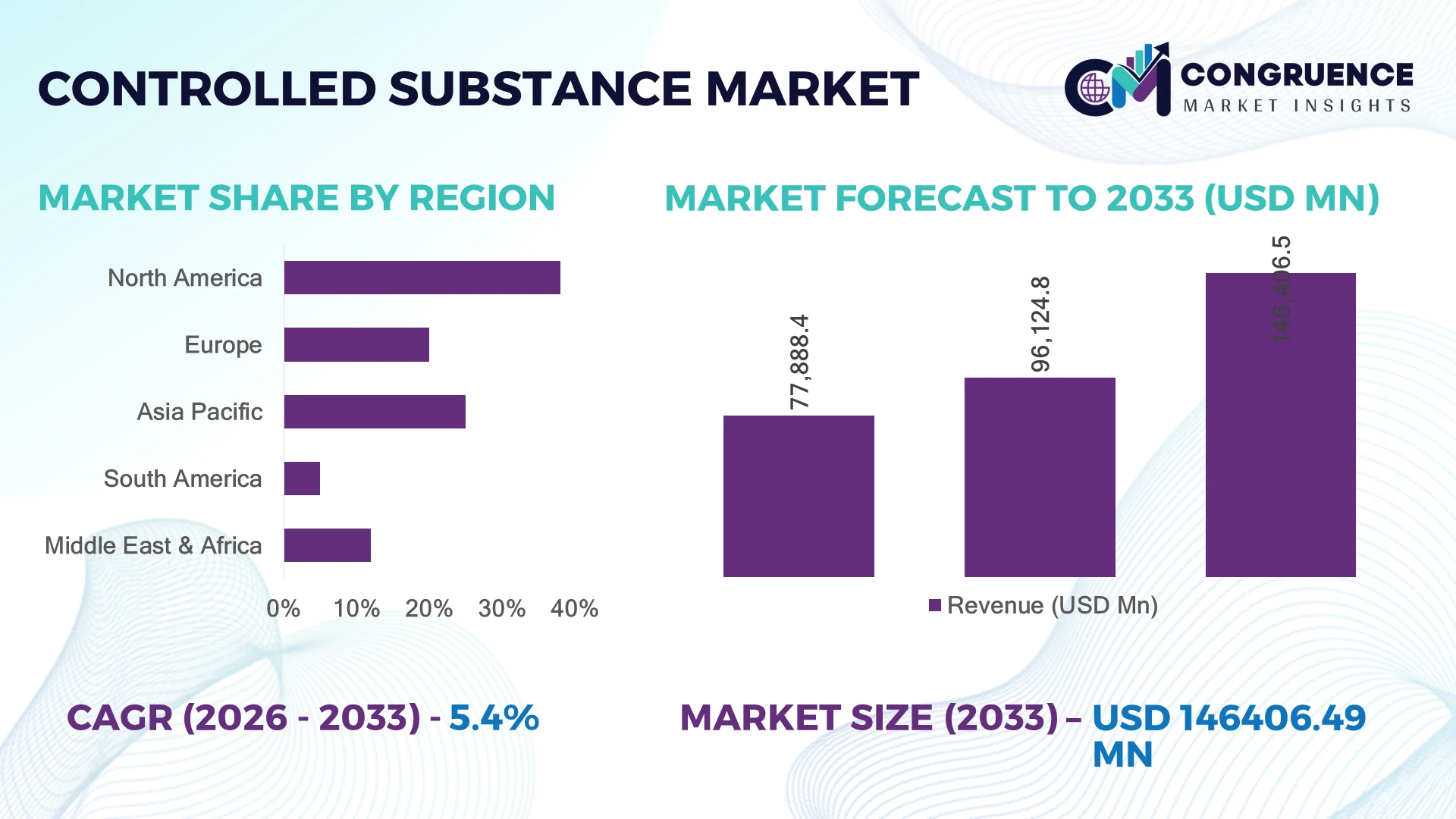
The United States remains the dominant market, accounting for approximately 38% of global controlled substance consumption, supported by advanced healthcare infrastructure, nationwide prescription monitoring programs, and over USD 4 billion in annual investments across regulated pharmaceutical manufacturing and compliance technologies. In comparison, China holds an estimated 14% share, driven by expanding pharmaceutical production capacity and increasing adoption of track-and-trace systems exceeding 60% among major manufacturers. Ongoing regulatory scrutiny linked to opioid control policies continues to influence global supply strategies and market access decisions.
Organizations that strengthen compliance automation, supply-chain visibility, and controlled inventory management are positioned to secure long-term competitive advantages in this highly regulated market.
Market Size & Growth: USD 96.1 billion in 2025 rising to USD 146.4 billion by 2033 at 5.4% CAGR, supported by digital prescription control and regulated pharmaceutical expansion.
Top Growth Drivers: Pain management demand (+18%), ADHD therapy adoption (+14%), and compliance technology deployment (+21%) drive market momentum.
Short-Term Forecast: By 2028, inventory tracking efficiency improves by 22% while compliance-related operational costs decline by 11%.
Emerging Technologies: AI-based prescription analytics, blockchain traceability, and automated dispensing systems improve monitoring accuracy by 15–25%.
Regional Leaders: North America exceeds USD 58 billion, Europe approaches USD 39 billion, and Asia-Pacific surpasses USD 31 billion, driven by digital compliance adoption.
Consumer/End-User Trends: More than 65% of large healthcare providers use electronic monitoring systems for controlled medication management.
Pilot/Case Example: In 2026, automated dispensing deployments reduced medication handling errors by approximately 28% in selected hospital networks.
Competitive Landscape: Top manufacturers collectively control nearly 45% market share, with leadership concentrated among major branded and generic pharmaceutical producers.
Regulatory & ESG Impact: Advanced compliance systems reduce reporting gaps by 20% while supporting stricter controlled-substance governance requirements.
Investment & Funding: More than USD 6 billion is directed toward manufacturing upgrades, supply-chain security, and regulatory technology expansion.
Innovation & Future Outlook: Next-generation digital tracking platforms and predictive compliance analytics are increasing operational visibility by over 30% across global networks.
The Controlled Substance Market continues to expand across pain therapeutics, surgical anesthesia, neurological disorders, and specialty pharmaceutical applications. Advanced dispensing technologies, AI-enabled prescription monitoring, and serialization platforms are improving medication traceability and reducing diversion risks. More than 60% of large healthcare systems now prioritize digital compliance infrastructure, while evolving regulatory frameworks and supply-chain security requirements are accelerating investment in controlled inventory management, creating a strong foundation for the strategic discussion ahead.
The Controlled Substance Market has become strategically important as healthcare systems, pharmaceutical manufacturers, and regulators prioritize secure medication access, diversion prevention, and supply-chain transparency. Competition is increasingly shaped by compliance capabilities rather than production scale alone. A major market shift is the expansion of digital prescription monitoring and electronic controlled-substance tracking, with adoption across large healthcare networks exceeding 65% in 2026. This transition is strengthening audit readiness, reducing inventory discrepancies, and improving regulatory compliance across high-risk therapeutic categories.
Technology modernization is creating measurable operational advantages. AI-enabled monitoring platforms can reduce prescription review times by nearly 30% compared with legacy manual verification systems while lowering compliance administration costs by approximately 15%. The United States leads in deployment scale through integrated monitoring infrastructure, whereas China is accelerating pharmaceutical serialization and track-and-trace implementation across manufacturing hubs. Over the next two to three years, automated dispensing and digital inventory management utilization is expected to expand by more than 20% among large healthcare providers seeking tighter control and improved operational efficiency.
A practical example is the deployment of automated dispensing cabinets integrated with prescription monitoring databases, reducing medication handling errors by nearly 25%. Companies are responding through compliance technology investments, strategic partnerships, and controlled-distribution network expansion. Organizations that combine regulatory excellence with advanced supply-chain visibility will secure stronger competitive positioning and long-term operational resilience.
The strongest growth driver is the rapid modernization of controlled-substance management systems across healthcare and pharmaceutical ecosystems. More than 65% of major healthcare providers now utilize electronic prescription monitoring platforms, while automated dispensing technologies have reduced medication handling errors by approximately 25%. In the United States, stricter opioid oversight frameworks have accelerated investment in compliance technologies, increasing digital tracking deployment by nearly 20% over the past few years. This regulatory and technology shift improves inventory accuracy, reduces diversion risk, and strengthens audit performance. In response, pharmaceutical companies are expanding secure distribution capabilities, investing in real-time monitoring platforms, and partnering with healthcare technology providers. A notable strategic insight is that compliance infrastructure is increasingly becoming a competitive differentiator rather than a regulatory obligation, influencing purchasing decisions and long-term supplier selection.
Regulatory fragmentation remains a significant limitation for market participants operating across multiple jurisdictions. Compliance expenditures account for approximately 8–12% of operational budgets among large controlled-substance distributors, while product registration timelines can vary by more than 30% between major markets. Differences in prescribing rules, reporting standards, and quota management systems create operational inefficiencies and delay market access. In Canada and the United States, evolving controlled-drug oversight requirements continue to increase documentation and monitoring obligations. These factors directly affect deployment speed, profitability, and inventory planning. To reduce exposure, companies are localizing compliance functions, strengthening legal and regulatory teams, and adopting centralized monitoring platforms. A key operational insight is that regulatory adaptability increasingly determines expansion success in highly controlled pharmaceutical segments.
A major opportunity is emerging through AI-powered compliance analytics, predictive inventory optimization, and next-generation track-and-trace technologies. Advanced monitoring systems can improve inventory visibility by over 30% while reducing stock discrepancies by nearly 20%. China and India are expanding pharmaceutical digitalization initiatives, creating favorable conditions for scalable compliance technology deployment. Another high-potential area involves blockchain-enabled serialization, which enhances product authentication and supply-chain transparency. Companies are increasing R&D spending, forming technology partnerships, and developing integrated compliance ecosystems that combine monitoring, reporting, and distribution functions. A non-obvious strategic advantage lies in the ability to transform regulatory data into operational intelligence, enabling faster decision-making, lower inventory carrying costs, and stronger customer retention across controlled therapeutic categories.
Long-term growth depends on the ability to integrate fragmented healthcare, pharmacy, and regulatory systems into unified controlled-substance management networks. Nearly 40% of healthcare organizations still operate partially disconnected medication management environments, creating interoperability constraints and data-sharing inefficiencies. Cybersecurity risks are also increasing, with healthcare-targeted attacks rising by more than 20% in recent years as digital prescription platforms expand. In Germany and the United States, organizations face growing pressure to maintain data security while ensuring uninterrupted compliance reporting. These challenges affect deployment consistency, operational scalability, and stakeholder trust. Companies must invest in secure cloud infrastructure, interoperability standards, workforce training, and collaborative technology partnerships. A critical strategic insight is that scalable integration capabilities will increasingly determine leadership positions within the controlled-substance value chain.
Digital Prescription Monitoring Expansion: Healthcare providers are accelerating deployment of electronic prescribing and monitoring platforms, with adoption exceeding 65% among large hospital systems and compliance-processing times declining by nearly 30%. Regulatory oversight and controlled dispensing requirements are driving workflow modernization. Pharmaceutical distributors are integrating real-time reporting systems and automated audit tools, reducing administrative burden by approximately 15% while improving inventory visibility across controlled drug networks.
Automated Dispensing Infrastructure Growth: Hospitals and specialty care facilities are increasing deployment of automated dispensing cabinets, with utilization rising more than 20% since 2025 and medication handling errors declining by roughly 25%. Workforce shortages and stricter inventory controls are pushing automation investments. Companies are expanding software partnerships and secure dispensing ecosystems to improve operational accuracy, reduce diversion risks, and strengthen medication accountability throughout healthcare environments.
Serialization and Traceability Adoption: Pharmaceutical manufacturers are scaling track-and-trace capabilities, with serialization coverage exceeding 60% across major production facilities and inventory reconciliation efficiency improving by nearly 18%. Supply-chain security concerns and counterfeit prevention initiatives are accelerating implementation. A notable non-obvious trend is the use of compliance-generated data for forecasting distribution patterns, enabling companies to optimize stock allocation and reduce supply disruptions.
Specialty Therapeutics Demand Shift: Controlled substances used in neurological, ADHD, and palliative care applications are recording prescription volume increases of 12–18% in several developed healthcare markets. Treatment personalization and improved diagnostic pathways are expanding utilization. Companies are responding through targeted portfolio expansion, specialized distribution agreements, and clinical support programs that improve patient access while maintaining strict regulatory compliance standards.
Opioids remain the leading segment due to their critical role in pain management, surgical recovery, and palliative care. The category accounts for an estimated 40% of controlled substance utilization, supported by established prescribing infrastructure, broad healthcare integration, and extensive clinical familiarity. Despite tighter regulatory oversight, demand remains resilient because alternative therapies often cannot fully replace opioid efficacy in severe pain settings. Pharmaceutical companies continue investing in abuse-deterrent formulations, digital monitoring tools, and controlled distribution programs to strengthen compliance and sustain market access.
Stimulants represent the fastest-growing segment, driven by rising ADHD diagnosis rates and expanded treatment coverage across adult populations. Prescription volumes in several developed healthcare systems have increased by more than 15% over recent years. Sedatives and anxiolytics maintain relevance in acute care and psychiatric treatment pathways, while hypnotics support sleep disorder management under stricter prescribing controls. Companies are reallocating development budgets toward stimulant innovation and precision-dosing technologies while maintaining selective investments across established categories. This shift highlights changing therapeutic priorities and increasing focus on long-term neurological and behavioral health management.
Pain Management remains the dominant application, representing approximately 45% of controlled substance demand due to extensive use in post-surgical care, chronic pain treatment, oncology, and palliative services. Hospitals and specialty clinics continue prioritizing controlled analgesics because they provide rapid therapeutic effectiveness in high-acuity settings. Growing surgical volumes and aging patient populations are sustaining utilization, while integrated monitoring systems have improved prescribing oversight by nearly 20%, helping providers balance treatment outcomes with regulatory compliance requirements.
ADHD Treatment is emerging as the fastest-growing application, supported by increased diagnosis rates, broader adult treatment adoption, and improved screening protocols. Prescription activity has expanded by more than 15% across several developed healthcare markets. Anxiety Disorders and Sleep Disorders remain significant segments supported by specialty behavioral healthcare services, while Neurological Disorders are creating new demand pathways through specialized treatment programs. Companies are expanding manufacturing capacity, strengthening distribution partnerships, and deploying digital patient-support platforms. Demand is increasingly shifting toward long-term therapeutic management models where treatment continuity and compliance monitoring are becoming operationally critical.
Hospitals remain the largest end-user segment, accounting for nearly 50% of controlled substance consumption due to intensive medication requirements across emergency care, surgery, oncology, and inpatient treatment settings. Their extensive infrastructure, dispensing capacity, and compliance resources enable large-scale deployment of controlled medications. More than 65% of major hospital systems have implemented advanced medication monitoring technologies, strengthening inventory control and reducing dispensing discrepancies. Pharmaceutical suppliers continue prioritizing hospital-focused partnerships, integrated compliance solutions, and secure distribution programs.
Specialty Clinics are the fastest-growing end-user category as neurological, behavioral health, pain management, and outpatient treatment services expand. Patient volumes in specialized care settings have increased by roughly 18%, creating greater demand for targeted controlled-substance therapies. Ambulatory Surgical Centers are strengthening their role through procedural growth and shorter treatment cycles, while Long-Term Care Facilities require controlled medications for chronic disease management. Research Institutes support clinical development activities, and Pharmaceutical Companies remain significant purchasers for manufacturing and testing purposes. Vendors are increasingly offering customized compliance platforms and service-based distribution models tailored to specialized healthcare environments.
North America accounted for the largest market share at 38% in 2025 however, Asia-Pacific is expected to register the fastest growth, expanding at a CAGR of 6.8% between 2026 and 2033.
Digital Compliance and Controlled Distribution Leadership
North America maintains the largest market position due to its advanced healthcare infrastructure, strict controlled-substance monitoring frameworks, and extensive pharmaceutical manufacturing ecosystem. The region accounts for approximately 38% of global demand, supported by widespread deployment of electronic prescribing systems and integrated medication tracking platforms. More than 65% of major healthcare networks utilize automated controlled-substance monitoring solutions, improving inventory accuracy and regulatory compliance. Pharmaceutical companies continue expanding secure distribution partnerships and investing in data-driven compliance technologies. The market is increasingly shaped by operational transparency, prescription oversight, and supply-chain security initiatives that strengthen controlled medication management across hospitals, pharmacies, and specialty care facilities.
United States Market Outlook: The United States remains the dominant country market due to its large healthcare spending base, extensive pharmaceutical production capabilities, and mature prescription monitoring infrastructure. More than 90% of states operate integrated prescription drug monitoring programs that support real-time oversight and diversion prevention. Leading pharmaceutical companies are investing in advanced serialization, automated dispensing systems, and compliance analytics. The country's strong regulatory framework and technology adoption continue to position it as the benchmark market for controlled-substance governance and operational efficiency.
Regulatory Modernization and Traceability Expansion
Europe represents a highly regulated controlled-substance market characterized by pharmaceutical quality standards, digital healthcare integration, and cross-border compliance coordination. The region accounts for roughly 27% of global market activity, with strong concentration across Germany, France, and the United Kingdom. Pharmaceutical serialization coverage exceeds 70% among major manufacturers, enhancing supply-chain visibility and product authentication. Companies are investing in digital prescription systems, automated inventory controls, and secure distribution networks. Increasing focus on traceability, patient safety, and standardized reporting procedures continues to support operational modernization throughout the controlled-substance value chain.
Germany Market Outlook: Germany serves as the region's strategic pharmaceutical hub, supported by advanced manufacturing infrastructure and strong healthcare digitization initiatives. The country has accelerated adoption of electronic prescription systems and integrated medication management platforms across hospital networks. Pharmaceutical manufacturers continue expanding compliance-focused production capabilities and secure logistics operations. Germany's combination of regulatory rigor, technological sophistication, and pharmaceutical expertise strengthens its role as a key market for controlled-substance distribution, monitoring, and innovation.
Manufacturing Scale and Healthcare Access Expansion
Asia-Pacific is emerging as the fastest-developing market due to expanding pharmaceutical production, healthcare infrastructure investments, and growing access to specialized therapies. The region contributes approximately 24% of global market activity and continues strengthening its role in pharmaceutical manufacturing. Track-and-trace deployment across major production facilities has exceeded 60%, while healthcare digitalization programs are accelerating controlled-substance monitoring capabilities. Pharmaceutical companies are expanding regional production capacity, forming technology partnerships, and strengthening distribution networks. The combination of manufacturing scale and healthcare modernization is creating substantial opportunities across both mature and developing healthcare systems.
China Market Outlook: China leads the regional market through its extensive pharmaceutical manufacturing ecosystem and large-scale healthcare modernization initiatives. Major producers are implementing advanced serialization technologies and digital compliance platforms to improve supply-chain transparency. More than 60% of large pharmaceutical facilities have adopted enhanced track-and-trace systems to support regulatory requirements and operational efficiency. Continued investment in pharmaceutical innovation, manufacturing expansion, and healthcare digitization reinforces China's position as a critical growth engine within the controlled-substance market.
Healthcare Expansion Driving Demand Growth
South America is experiencing gradual market development supported by expanding healthcare access, improving pharmaceutical distribution infrastructure, and increased treatment availability for chronic conditions. The region accounts for nearly 6% of global controlled-substance demand, with activity concentrated in larger healthcare economies. Pharmaceutical companies are strengthening regional supply networks and investing in secure medication distribution systems. Hospital modernization programs and digital prescribing initiatives are improving medication oversight, although infrastructure limitations and regulatory complexity continue to influence deployment speed. Market participants are balancing growth opportunities with operational efficiency improvements and compliance investments.
Brazil Market Outlook: Brazil represents the largest controlled-substance market in South America due to its sizeable healthcare system and growing pharmaceutical sector. The country is expanding electronic prescription adoption and strengthening medication monitoring programs across public and private healthcare facilities. Pharmaceutical manufacturers continue increasing local production capabilities and distribution capacity to improve treatment accessibility. Brazil's ongoing healthcare infrastructure improvements and regulatory modernization efforts support its position as the primary regional market for controlled-substance deployment and consumption.
Healthcare Infrastructure Investment Accelerates Modernization
The Middle East & Africa market is advancing through healthcare infrastructure expansion, pharmaceutical investment programs, and modernization of medication management systems. The region contributes approximately 5% of global market activity, with demand concentrated in countries undertaking large-scale healthcare transformation initiatives. Hospital construction projects, digital healthcare deployment, and specialized treatment center development are increasing controlled-substance utilization. Several healthcare providers have improved medication tracking capabilities by more than 20% through integrated digital systems. Companies are responding through distribution partnerships, compliance-focused solutions, and localized operational strategies that address evolving healthcare requirements.
Saudi Arabia Market Outlook: Saudi Arabia is the most strategically significant market in the region due to extensive healthcare investment, hospital expansion projects, and digital transformation programs. The country continues implementing advanced healthcare technologies, including electronic prescribing and centralized medication monitoring platforms. Large healthcare providers are increasing adoption of automated pharmacy management systems to strengthen inventory control and compliance oversight. Government-backed healthcare modernization efforts and growing pharmaceutical investments position Saudi Arabia as a leading market for controlled-substance infrastructure development and operational innovation.
The Controlled Substance Market is led by established pharmaceutical manufacturers including Mallinckrodt Pharmaceuticals, Hikma Pharmaceuticals, Viatris, Teva Pharmaceutical Industries, and Johnson & Johnson, competing directly with specialized controlled-medicine suppliers and regional generic producers. The top five participants collectively account for approximately 42% of market activity. Competition is centered on regulatory compliance, manufacturing reliability, product portfolio breadth, and secure distribution capabilities rather than pricing alone. Companies achieving 15–20% faster regulatory approvals and 10–15% higher supply-chain visibility gain measurable operational advantages. Global leaders compete through manufacturing expansion, controlled-distribution partnerships, and investment in digital compliance infrastructure, while regional players focus on cost efficiency and localized regulatory expertise. A significant competitive shift involves advanced tracking technologies and serialization systems that improve inventory accuracy by over 20%. High compliance costs and regulatory barriers remain major entry pressures. Success increasingly depends on combining compliance excellence, supply security, scalable manufacturing, and technology-enabled operational transparency.
Mallinckrodt Pharmaceuticals
Hikma Pharmaceuticals
Teva Pharmaceutical Industries
Viatris Inc.
Johnson & Johnson
Pfizer Inc.
Endo International
Purdue Pharma
Sun Pharmaceutical Industries
Dr. Reddy's Laboratories
Cipla Limited
Lupin Limited
AbbVie Inc.
Amneal Pharmaceuticals Inc.
Controlled substance management is increasingly driven by electronic prescribing platforms, automated dispensing cabinets, and real-time inventory monitoring systems. More than 65% of large healthcare providers now utilize digital controlled-substance tracking, reducing inventory discrepancies by approximately 18% and lowering compliance administration costs by 12%. Integration between prescription monitoring databases and hospital pharmacy systems is improving medication accountability while accelerating dispensing workflows. Organizations adopting centralized compliance platforms are achieving stronger regulatory performance and reducing operational delays across distribution and clinical settings.
Emerging technologies are centered on AI-powered prescription analytics, blockchain-enabled traceability, and predictive inventory optimization. AI monitoring tools improve prescription review efficiency by nearly 30%, while blockchain-based serialization enhances supply-chain visibility by approximately 20%. Deployment of advanced track-and-trace systems has surpassed 60% among major pharmaceutical manufacturers. These technologies allow companies to identify diversion risks faster, optimize stock allocation, and improve audit readiness. Pharmaceutical firms are increasingly forming technology partnerships to integrate compliance, reporting, and distribution functions into unified operational ecosystems.
Disruptive innovation is shifting from reactive compliance to predictive control. Compared with legacy manual verification processes, AI-enabled monitoring platforms deliver roughly 35% faster exception detection and 15% lower operating costs. Between 2026 and 2028, automated compliance workflows are expected to expand by more than 25% across regulated healthcare networks. Early adopters, particularly large pharmaceutical manufacturers and integrated healthcare systems, will benefit from superior supply-chain transparency, reduced regulatory exposure, and stronger competitive positioning in highly regulated controlled-substance environments.
March 2025 – Mallinckrodt announced a combination agreement with Endo to create a larger diversified pharmaceutical platform. The transaction targeted operational synergies and broader controlled-medicine capabilities, strengthening manufacturing scale and portfolio reach. Expected synergy benefits exceeded USD 150 million annually, enhancing competitive positioning. Source: ir.mallinckrodt.com
October 2025 – The U.S. Drug Enforcement Administration adjusted production quotas for selected stimulant ingredients used in controlled ADHD therapies. D-amphetamine quota allocations for product development activities increased by approximately 25%, supporting manufacturing flexibility and future supply planning. Source: regulations.gov Federal Register coverage
January 2026 – The Drug Enforcement Administration released final 2026 aggregate production quotas for Schedule I and II controlled substances, including higher allocations for selected stimulant categories. Certain stimulant quotas increased by up to 22%, supporting medical demand forecasting and inventory stability. Source: dea.gov
April 2026 – The U.S. Department of Justice and DEA issued a final order reclassifying specific FDA-approved cannabis-related products to Schedule III. The policy shift affected regulated medical-cannabis pathways across 40 states, creating new compliance and commercialization opportunities. Source: reuters.com
This report provides comprehensive analysis of the Controlled Substance Market across key types including opioids, stimulants, sedatives, anxiolytics, and hypnotics. It evaluates major applications such as pain management, ADHD treatment, anxiety disorders, sleep disorders, palliative care, and neurological disorders while assessing demand patterns across hospitals, specialty clinics, ambulatory surgical centers, research institutes, pharmaceutical companies, and long-term care facilities. The study covers more than 10 major industry participants and analyzes deployment trends, prescribing shifts, compliance modernization, and digital monitoring adoption exceeding 60% among large healthcare organizations.
The report delivers detailed regional assessment across North America, Europe, Asia-Pacific, South America, and the Middle East & Africa, highlighting operational dynamics, manufacturing concentration, regulatory developments, and technology deployment. It examines emerging technologies including AI-driven prescription analytics, automated dispensing infrastructure, blockchain traceability, and advanced inventory monitoring systems. Strategic insights support investment prioritization, expansion planning, partnership evaluation, competitive benchmarking, and identification of high-impact opportunities expected to influence market direction between 2026 and 2033.
| Report Attribute/Metric | Report Details |
|---|---|
Market Revenue in 2025 | USD 96124.8 Million |
Market Revenue in 2033 | USD 146406.49 Million |
CAGR (2026 - 2033) | 5.4% |
Base Year | 2025 |
Forecast Period | 2026 - 2033 |
Historic Period | 2021 - 2025 |
Segments Covered | By Type
By Application
By End-User
|
Key Report Deliverable | Revenue Forecast, Growth Trends, Market Dynamics, Segmental Overview, Regional and Country-wise Analysis, Competition Landscape |
Region Covered | North America, Europe, Asia-Pacific, South America, Middle East, Africa |
Key Players Analyzed | Mallinckrodt Pharmaceuticals, Hikma Pharmaceuticals, Teva Pharmaceutical Industries, Viatris Inc., Johnson & Johnson, Pfizer Inc., Endo International, Purdue Pharma, Sun Pharmaceutical Industries, Dr. Reddy's Laboratories, Cipla Limited, Lupin Limited, AbbVie Inc., Amneal Pharmaceuticals Inc. |
Customization & Pricing | Available on Request (10% Customization is Free) |




