
Reports
The Global Contract Research Organization Solution Market was valued at USD 2,655.2 Million in 2025 and is anticipated to reach a value of USD 5,368.8 Million by 2033 expanding at a CAGR of 9.2% between 2026 and 2033. Growth is driven by decentralized clinical trials, AI-enabled clinical data management, expanding biologics pipelines, and increasing outsourcing of regulatory, laboratory, and clinical development services.
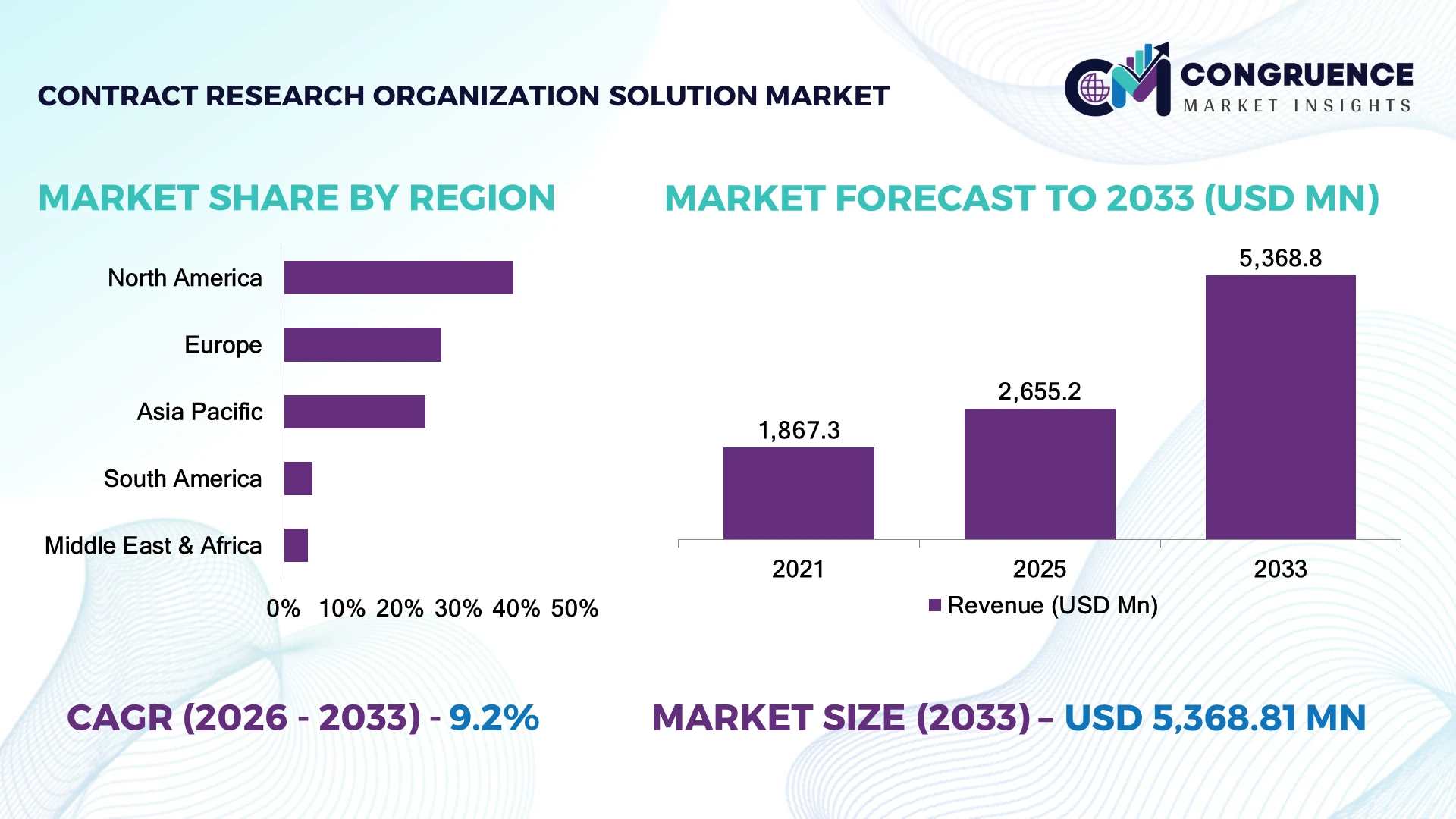
The United States dominates the Contract Research Organization Solution market with approximately 36% of global outsourced clinical research activity, supported by advanced biopharmaceutical R&D, strong regulatory infrastructure, and extensive digital trial adoption. Compared with India, the United States manages nearly 2.4 times more Phase III clinical programs, while approximately 64% of sponsors deploy AI-assisted clinical operations platforms. Continuing supply-chain diversification and cross-border clinical research strategies following geopolitical healthcare realignment have accelerated investment in distributed research ecosystems.
Organizations investing in integrated digital research platforms, global trial capabilities, and regulatory expertise are strengthening long-term competitive positioning.
Market Size & Growth: USD 2,655.2 million in 2025 to USD 5,368.8 million by 2033 at 9.2% CAGR, driven by clinical research outsourcing.
Top Growth Drivers: Decentralized trials (+38%), biologics development (+31%), AI-powered clinical operations (+27%).
Short-Term Forecast: By 2028, clinical study start-up timelines decline by approximately 24%.
Emerging Technologies: AI analytics, decentralized trial platforms, and digital biomarkers improve research efficiency.
Regional Leaders: North America, Europe, and Asia-Pacific lead through biopharmaceutical R&D expansion.
Consumer/End-User Trends: Approximately 61% of pharmaceutical sponsors increase functional outsourcing.
Pilot/Case Example: A 2026 decentralized oncology study improved patient retention by nearly 22%.
Competitive Landscape: Leading CRO providers collectively hold approximately 48% market share.
Regulatory & ESG Impact: Digital monitoring reduces paper-based documentation by approximately 34%.
Investment & Funding: More than USD 2.3 billion supports clinical technology platforms and strategic partnerships.
Innovation & Future Outlook: AI-enabled trial management and precision medicine services redefine outsourced research.
The Contract Research Organization Solution market is advancing through AI-powered protocol optimization, decentralized clinical trial platforms, and integrated real-world evidence solutions. Approximately 52% of newly initiated multinational clinical studies now incorporate digital patient engagement technologies to improve recruitment and retention. Strengthening regulatory harmonization and resilient clinical supply-chain strategies continue reshaping outsourced research operations, setting the stage for the strategic transformation discussed below.
Contract Research Organization Solution platforms have become strategically important as pharmaceutical, biotechnology, and medical device companies accelerate external collaboration to improve research productivity and shorten development timelines. Digital clinical operations, decentralized trials, and regulatory modernization are reshaping outsourcing strategies, while diversified global trial networks reduce operational concentration risks and improve patient recruitment across multiple countries. This structural transition is increasing competition among CRO providers offering integrated end-to-end development capabilities.
AI-assisted clinical trial management reduces protocol development time by approximately 29% while improving patient recruitment efficiency by nearly 26% compared with conventional manual trial coordination. The United States leads advanced digital clinical operations, whereas India continues strengthening its position through cost-efficient research infrastructure and expanding therapeutic expertise. Over the next two to three years, approximately 58% of multinational clinical programs are expected to integrate AI-enabled analytics, decentralized monitoring, and remote patient engagement into routine research workflows.
Leading CRO providers are expanding laboratory networks, investing in advanced data platforms, and forming partnerships with biotechnology innovators to strengthen therapeutic specialization. Companies are prioritizing integrated regulatory services, real-world evidence capabilities, and digital clinical ecosystems to improve sponsor outcomes. Organizations combining technology-enabled execution, therapeutic expertise, and globally diversified research operations will establish stronger competitive positioning as outsourced clinical development becomes increasingly data-driven and operationally integrated.
Increasing outsourcing of clinical development, regulatory affairs, biometrics, and laboratory services is accelerating adoption of Contract Research Organization Solution platforms. Approximately 63% of pharmaceutical sponsors now outsource multiple development functions, while integrated digital trial management improves operational efficiency by nearly 28% and shortens study activation timelines by around 23%. The United States continues strengthening decentralized clinical research frameworks, encouraging sponsors to expand partnerships with technology-enabled CRO providers. This shift enables faster global patient recruitment, standardized compliance, and better resource utilization. Leading organizations are expanding therapeutic expertise, investing in AI-enabled clinical operations, and acquiring specialist service providers to deliver end-to-end research capabilities. Competitive advantage increasingly depends on integrated execution rather than isolated functional outsourcing.
Contract research organizations operate under diverse regulatory frameworks, creating significant compliance and operational challenges for multinational studies. Regulatory compliance, quality management, and validation activities account for approximately 31% of project operational expenditure, while protocol amendments increase trial management costs by nearly 18%. Japan's evolving regulatory requirements for advanced therapies require additional documentation and localized expertise, extending implementation timelines for global sponsors. These complexities reduce operational scalability and increase project management overhead. CRO providers are addressing these pressures through regional regulatory centers, standardized digital documentation platforms, long-term compliance partnerships, and harmonized quality management systems that improve consistency across international clinical programs.
Artificial intelligence, predictive analytics, and digital biomarkers are creating new opportunities beyond traditional clinical trial execution. Approximately 49% of global sponsors now evaluate AI-assisted protocol optimization, while predictive patient recruitment models improve enrollment efficiency by nearly 27%. India is expanding digital health infrastructure and specialized research capabilities, enabling technology-enabled clinical operations across multiple therapeutic areas. CRO providers are investing in AI platforms, real-world evidence capabilities, and strategic collaborations with health technology companies to strengthen service portfolios. A significant strategic opportunity lies in combining clinical execution with data intelligence, allowing providers to deliver measurable development insights rather than operational support alone.
Managing large-scale clinical research across multiple digital platforms, healthcare systems, and geographic jurisdictions remains a significant execution challenge. Approximately 42% of multinational studies experience delays linked to fragmented data environments, while cross-platform integration increases operational complexity by nearly 24%. Germany's expanding digital healthcare ecosystem is intensifying expectations for interoperable clinical research systems capable of securely exchanging patient and trial information. Inconsistent data standards affect study visibility, monitoring efficiency, and regulatory readiness. CRO providers must strengthen interoperable data architectures, cybersecurity frameworks, cloud-native clinical platforms, and technology partnerships to maintain operational consistency while supporting increasingly decentralized and digitally connected research programs.
Decentralized Trials Expand Rapidly: Approximately 46% of newly initiated multinational studies now incorporate decentralized trial components, while remote patient monitoring improves participant retention by nearly 21%. Digital health adoption and evolving regulatory acceptance are reshaping clinical workflows. CRO providers are expanding virtual site networks, telehealth capabilities, and decentralized operational models to improve study accessibility.
AI Enhances Clinical Operations: AI-assisted protocol design and automated data review have increased by approximately 34%, reducing manual data processing by nearly 26% and accelerating operational decision-making. Sponsors increasingly prioritize intelligent automation over conventional workflow management. CRO organizations are integrating machine learning, natural language processing, and predictive analytics into clinical operations platforms.
Specialized Therapeutic Networks Grow: Oncology, rare disease, and cell and gene therapy research now represent approximately 39% of strategic CRO expansion initiatives. Complex clinical programs require specialized laboratories, experienced investigators, and integrated biomarker capabilities. Providers are strengthening partnerships with biotechnology companies and expanding dedicated therapeutic research centers to improve execution quality.
Regional Delivery Models Evolve: Approximately 31% of multinational sponsors are restructuring clinical operations through diversified regional delivery hubs to improve resilience and regulatory responsiveness. Geopolitical supply-chain adjustments continue influencing trial planning and resource allocation. CRO companies are localizing operational teams, strengthening country-specific regulatory expertise, and deploying unified digital platforms to support globally coordinated research execution.
Clinical Research Services account for approximately 47% of the Contract Research Organization Solution market due to their comprehensive role in Phase I–IV trial execution, patient recruitment, site management, clinical monitoring, and regulatory coordination. Pharmaceutical and biotechnology companies increasingly prefer integrated clinical service models because they reduce operational complexity, improve global trial consistency, and accelerate development timelines. Laboratory services remain essential for biomarker analysis and bioanalytical testing, while regulatory affairs and pharmacovigilance solutions continue gaining importance as compliance requirements become more stringent across multinational studies.
Clinical data management and decentralized clinical technology solutions represent the fastest-growing segment as sponsors transition toward digitally enabled research ecosystems. Approximately 51% of newly outsourced clinical programs now incorporate cloud-based data management platforms, while AI-assisted data review reduces manual verification effort by nearly 26%. CRO providers are expanding digital service portfolios, investing in advanced analytics platforms, and partnering with health technology companies to strengthen integrated research capabilities. Investment priorities increasingly favor scalable, technology-enabled service models that combine operational execution with advanced data intelligence.
A 2026 enterprise assessment released by the Society for Clinical Data Management reported that digital clinical data platforms are becoming standard across multinational trials, improving data quality, regulatory readiness, and operational efficiency.
Clinical trials represent approximately 54% of total demand, driven by increasing outsourcing of patient recruitment, trial management, site monitoring, and regulatory documentation across pharmaceutical and biotechnology development programs. Sponsors continue consolidating multiple research functions within single CRO partnerships to improve execution efficiency and reduce administrative complexity. Preclinical research maintains strong demand for toxicology, bioanalysis, and laboratory services, while post-marketing surveillance is expanding steadily as regulators require stronger long-term safety monitoring and real-world evidence generation.
Decentralized and hybrid clinical trials are the fastest-growing application as digital health technologies transform patient engagement and study execution. Approximately 43% of newly initiated multinational studies now include remote patient monitoring or virtual site capabilities, while digital recruitment platforms improve enrollment efficiency by nearly 24%. CRO providers are expanding decentralized trial infrastructure, integrating AI-powered operational tools, and strengthening partnerships with healthcare providers to improve study accessibility. Demand is shifting toward applications requiring continuous digital engagement, real-time analytics, and globally coordinated clinical operations.
A 2025 enterprise survey conducted by the Association of Clinical Research Professionals indicated that decentralized operational models continue improving participant retention and accelerating multicenter clinical study execution.
Pharmaceutical companies account for approximately 49% of Contract Research Organization Solution demand because they manage extensive global development pipelines requiring specialized clinical operations, regulatory expertise, laboratory services, and post-approval support. Large pharmaceutical organizations increasingly outsource complex research functions to improve operational flexibility while focusing internal resources on strategic product development. Biotechnology companies remain a major customer group, while medical device manufacturers and academic research organizations continue expanding outsourcing for specialized therapeutic programs and regulatory support.
Biotechnology companies represent the fastest-growing end-user segment as precision medicine, cell therapy, gene therapy, and rare disease programs require specialized scientific expertise and flexible development models. Approximately 46% of emerging biotechnology firms now outsource multiple clinical development functions, while integrated CRO partnerships reduce operational overhead by nearly 22%. Service providers are strengthening therapeutic specialization, offering customized pricing models, and building long-term innovation partnerships to attract high-value biotechnology clients. Competitive positioning increasingly depends on scientific expertise, technology integration, and global execution capabilities rather than traditional project management alone.
A 2026 industry survey published by the Drug Information Association found that biotechnology sponsors increasingly favor strategic CRO partnerships offering integrated clinical, regulatory, and data management capabilities throughout product development.
North America accounted for the largest market share at 39.4% in 2025 however, Asia-Pacific is expected to register the fastest growth, expanding at a CAGR of 10.8% between 2026 and 2033.

Integrated Clinical Research Ecosystems Strengthen Outsourcing
North America represents approximately 39.4% of the global Contract Research Organization Solution market, supported by advanced biopharmaceutical research, extensive clinical trial infrastructure, and strong adoption of decentralized clinical technologies. Pharmaceutical companies increasingly outsource integrated research functions spanning clinical operations, biometrics, regulatory affairs, and laboratory services to improve development efficiency. Nearly 62% of newly initiated multinational clinical programs in the region utilize AI-enabled clinical management platforms for protocol optimization and remote monitoring. CRO providers continue expanding therapeutic specialization, digital infrastructure, and laboratory capacity while strengthening strategic partnerships with biotechnology innovators to accelerate complex clinical development programs.
United States Market Outlook: The United States remains the largest regional market due to its extensive pharmaceutical innovation ecosystem, large investigator network, and advanced regulatory framework. Leading CRO providers continue expanding clinical laboratories, digital trial platforms, and precision medicine capabilities to support increasingly complex therapeutic programs. Approximately 68% of global oncology-focused outsourced clinical studies involve operational activities coordinated through the United States, reinforcing its leadership in advanced clinical research services.
Regulatory Excellence Drives Research Quality
Europe maintains a strong position through harmonized clinical research standards, advanced healthcare systems, and expanding investment in biotechnology innovation. The region accounts for approximately 27.1% of global market activity, with increasing demand for integrated regulatory consulting, biometrics, and decentralized clinical trial services. Approximately 49% of multinational studies conducted across Europe now incorporate digital patient engagement technologies to improve enrollment and study continuity. CRO providers continue strengthening regional laboratory capabilities and expanding therapeutic expertise in oncology, rare diseases, and advanced biologics.
Germany Market Outlook: Germany leads the regional market through its advanced pharmaceutical manufacturing sector, highly developed research hospitals, and strong clinical investigator network. Biotechnology collaborations and precision medicine initiatives continue increasing outsourced research demand across multiple therapeutic areas. Approximately 38% of Germany's late-stage clinical development programs involve integrated CRO partnerships supporting regulatory, clinical, and data management activities.
Cost Efficiency Meets Digital Innovation
Asia-Pacific is the fastest-expanding regional market, supported by competitive clinical development costs, expanding biotechnology investment, and rapidly improving digital healthcare infrastructure. The region contributes approximately 24.3% of global outsourced clinical research activity, with multinational sponsors increasingly selecting regional delivery hubs for patient recruitment, biometrics, and laboratory operations. Nearly 45% of newly established CRO facilities within the region incorporate cloud-based clinical management platforms and AI-assisted data processing. Service providers continue expanding specialized therapeutic capabilities and regional delivery networks to support global clinical programs.
India Market Outlook: India has become the region's strategic outsourcing hub through its large patient population, skilled scientific workforce, expanding biotechnology ecosystem, and competitive operational environment. Global sponsors increasingly utilize India for clinical operations, statistical programming, pharmacovigilance, and medical writing services. Approximately 41% of regional outsourced data management activities are now executed through India, strengthening its position within the global CRO value chain.
Clinical Trial Expansion Supports Market Development
South America continues strengthening its position through growing pharmaceutical investment, improved clinical trial infrastructure, and increasing participation in multinational research programs. Regional healthcare providers and research institutions are expanding investigator networks to support faster patient enrollment across therapeutic areas including oncology, infectious diseases, and metabolic disorders. Approximately 28% of multinational studies entering the region now utilize decentralized patient engagement tools to improve recruitment and retention. CRO providers are expanding regional partnerships and operational capabilities while addressing infrastructure variation across individual countries.
Brazil Market Outlook: Brazil represents the largest Contract Research Organization Solution market in South America due to its extensive healthcare network, large patient population, and growing pharmaceutical industry. International sponsors increasingly select Brazilian research centers for multicenter clinical studies requiring diverse patient recruitment. Approximately 47% of regional outsourced clinical trial activity is concentrated in Brazil, reinforcing its leadership in Latin American clinical research operations.
Healthcare Modernization Expands Research Capacity
The Middle East & Africa market is advancing through healthcare modernization, pharmaceutical investment, and government initiatives supporting biomedical research infrastructure. Clinical research capabilities continue expanding across specialty hospitals, academic institutions, and biotechnology innovation centers seeking greater participation in multinational development programs. Approximately 26% of recently established clinical research facilities now integrate digital trial management platforms to improve operational efficiency and regulatory readiness. CRO providers are expanding regional partnerships and strengthening local regulatory expertise to support increasingly sophisticated clinical programs.
Saudi Arabia Market Outlook: Saudi Arabia leads the regional market through sustained healthcare investment, expanding biotechnology initiatives, and national strategies supporting clinical research development. Research hospitals and academic medical centers continue strengthening capabilities in oncology, rare diseases, and precision medicine studies. Approximately 34% of new clinical research infrastructure investments across the Gulf region are concentrated in Saudi Arabia, positioning the country as the primary regional hub for advanced outsourced research services.
| Report Attribute/Metric | Report Details |
|---|---|
|
Market Revenue in 2025 |
USD 2,655.2 Million |
|
Market Revenue in 2033 |
USD 5,368.8 Million |
|
CAGR (2026 - 2033) |
9.2% |
|
Base Year |
2025 |
|
Forecast Period |
2026 - 2033 |
|
Historic Period |
2021 - 2025 |
|
Segments Covered |
By Type
By Application
By End-User
|
|
Key Report Deliverable |
Revenue Forecast, Growth Trends, Market Dynamics, Segmental Overview, Regional and Country-wise Analysis, Competition Landscape |
|
Region Covered |
North America, Europe, Asia-Pacific, South America, Middle East, Africa |
|
Key Players Analyzed |
IQVIA, ICON plc, Parexel, Medpace, Syneos Health, Fortrea, Charles River Laboratories, PSI CRO, Novotech, Ergomed, Worldwide Clinical Trials, Premier Research, Veristat |
|
Customization & Pricing |
Available on Request (10% Customization is Free) |




