
Reports
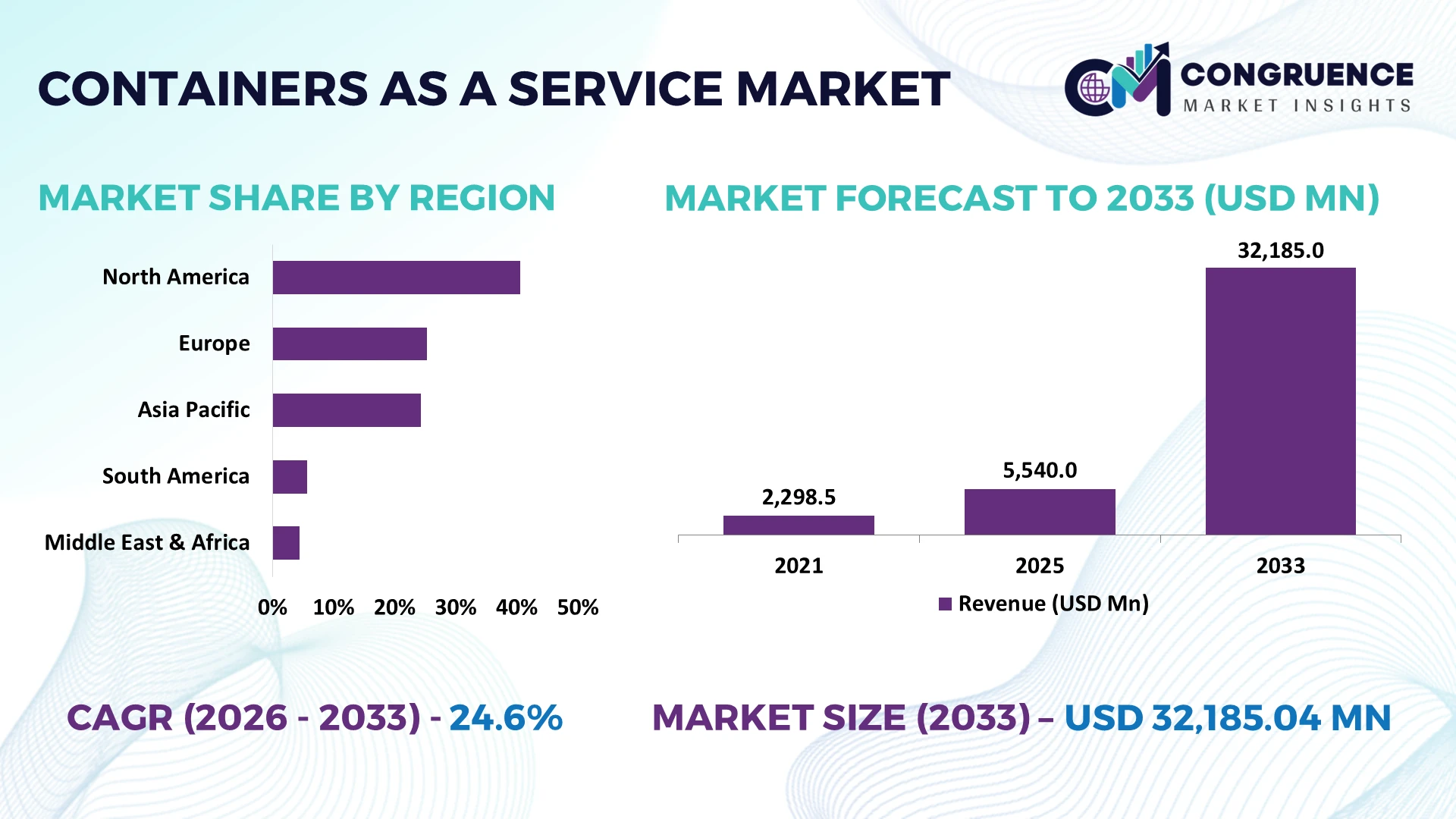
The Global Containers as a Service Market was valued at USD 5,540.0 Million in 2025 and is anticipated to reach a value of USD 32,185.0 Million by 2033 expanding at a CAGR of 24.6% between 2026 and 2033. The market is driven by enterprise migration toward microservices architectures, managed Kubernetes platforms, automated application deployment, and scalable infrastructure for artificial intelligence workloads.
The United States dominates the Containers as a Service Market, supported by hyperscale cloud infrastructure, advanced software ecosystems, and substantial technology investments. Approximately 38% of global cloud data center capacity is concentrated in the United States, compared with around 10% in China. Kubernetes adoption across cloud-native organizations exceeds 75%, while U.S.–China technology competition accelerates domestic cloud infrastructure investments across banking, healthcare, and technology industries.
Strategically, enterprises prioritizing automated container orchestration, hybrid cloud interoperability, and infrastructure optimization are better positioned to accelerate software commercialization and strengthen operational competitiveness.
Market Size & Growth: Valued at USD 5,540.0 million in 2025, reaching USD 32,185.0 million by 2033 at 24.6% CAGR, driven by cloud-native modernization.
Top Growth Drivers: Kubernetes adoption exceeding 75%, cloud-native development exceeding 80%, and multi-cloud adoption approaching 89% among surveyed cloud users.
Short-Term Forecast: By 2028, advanced container orchestration targets infrastructure cost reductions of 20–30%.
Emerging Technologies: AI-powered orchestration, serverless containers, and automated scaling target 25% improvements in resource utilization.
Regional Leaders: Estimated 2033 values: North America USD 12,230.3 million (enterprise modernization), Asia Pacific USD 9,333.7 million (digitalization), and Europe USD 7,724.4 million (sovereign cloud).
Consumer/End-User Trends: Approximately 80% of surveyed cloud-native organizations utilize Kubernetes for application management.
Pilot/Case Example: Spotify's 2019 Kubernetes migration reduced service provisioning time from approximately one hour to seconds.
Competitive Landscape: AWS holds an estimated 30% of the broader cloud infrastructure market, competing with Microsoft, Google, IBM, and Oracle.
Regulatory & ESG Impact: Automated workload consolidation targets 15–25% lower infrastructure energy consumption, supporting European sustainability objectives.
Investment & Funding: Microsoft announced approximately USD 80 billion in AI-enabled data center investments for fiscal 2025, supporting scalable cloud ecosystems.
Innovation & Future Outlook: GPU-enabled containers and autonomous orchestration target 30% faster deployment cycles, accelerating intelligent infrastructure transformation.
The Containers as a Service Market supports application modernization across financial services, telecommunications, healthcare, retail, and software development industries. Managed Kubernetes, container security platforms, and serverless deployment technologies are transforming enterprise infrastructure management. With approximately 89% of surveyed cloud users adopting multi-cloud strategies, growing data sovereignty requirements are accelerating portable container architectures, establishing a foundation for strategic infrastructure diversification and operational resilience.
Containers as a Service is becoming strategically important as enterprises shift from infrastructure-intensive software delivery toward modular, cloud-native operating models. Containerized applications enable organizations to standardize deployment across development, testing, and production environments while reducing dependency on underlying infrastructure. Digital infrastructure modernization and rising data sovereignty requirements are accelerating investments in portable application architectures, particularly across regulated financial services and telecommunications industries.
Unlike conventional virtual machines, containers share operating system resources, enabling higher workload density and potential infrastructure savings of 20–30% under optimized configurations. The United States leads hyperscale platform innovation, while Germany emphasizes sovereign cloud deployment and India expands container adoption through digital banking and technology outsourcing. By 2028, automated orchestration and intelligent resource scheduling are expected to reduce manual infrastructure management requirements by approximately 25%.
Spotify's Kubernetes migration demonstrates how containerized infrastructure accelerates service provisioning and supports independent software development teams. AWS, Microsoft, and Google are expanding managed orchestration capabilities, integrated security services, and hybrid deployment partnerships. Competitive advantage increasingly depends on combining application portability, predictable infrastructure expenditure, automated governance, and accelerated software delivery within unified container management ecosystems.
Enterprise migration from monolithic applications toward microservices architectures is accelerating demand for managed container infrastructure. Kubernetes adoption exceeds 75% among surveyed cloud-native organizations, while approximately 89% of surveyed cloud users implement multi-cloud strategies. In the United States, financial institutions and technology companies are restructuring legacy application environments to support continuous software delivery and independent service scaling. Containerized workloads offer potential infrastructure utilization improvements of 20–30% through dynamic resource allocation and automated orchestration. AWS, Microsoft, and Google are expanding managed Kubernetes capabilities, serverless container services, and integrated development ecosystems. This transition shifts enterprise technology expenditure from maintaining dedicated infrastructure toward application innovation, reducing deployment bottlenecks and strengthening software commercialization capabilities.
Unpredictable cloud operating expenses and proprietary platform dependencies restrict the scalability of Containers as a Service deployments. Approximately 27% of cloud expenditure is estimated to be wasted through inefficient provisioning, while more than 80% of surveyed enterprises identify cloud spending management as a significant concern. Data transfer charges, persistent storage requirements, and cross-region networking expenses further increase container operating costs. In Germany, stringent data residency requirements restrict infrastructure selection for regulated enterprises, limiting access to lower-cost deployment alternatives. Service providers are introducing consumption-based pricing, committed-use discounts, and automated resource optimization tools. Enterprises increasingly prioritize open-source orchestration and standardized deployment interfaces to reduce vendor dependency and protect long-term operating margins.
Artificial intelligence inference, distributed computing, and edge application deployment create substantial opportunities for specialized container services. GPU-enabled container orchestration targets resource utilization improvements of 20–30%, while optimized edge deployments offer potential latency reductions exceeding 30% compared with centralized processing configurations. Japan's smart manufacturing initiatives and India's expanding 5G infrastructure are creating deployment opportunities for localized analytics, industrial automation, and real-time application processing. NVIDIA, Red Hat, and hyperscale cloud providers are developing GPU-aware scheduling, lightweight Kubernetes distributions, and integrated AI deployment platforms. The emerging opportunity extends beyond conventional application hosting toward workload-specific infrastructure services, enabling providers to differentiate through hardware acceleration, localized processing, and performance-based service models.
Maintaining consistent security governance across distributed container environments represents a critical execution challenge. Industry surveys indicate that approximately 67% of organizations have delayed application deployments because of container security concerns, while around 90% report experiencing Kubernetes-related security incidents. Increasing software supply-chain vulnerabilities expose enterprises to compromised container images, excessive access permissions, and insecure third-party dependencies. In the United States, federal software security requirements are strengthening expectations for vulnerability management and software component transparency. IBM, Red Hat, and cloud security specialists are integrating automated image scanning, runtime protection, and policy enforcement into orchestration platforms. Long-term competitiveness requires embedding security throughout application lifecycles without compromising deployment velocity or increasing dependence on scarce Kubernetes specialists.
Platform Engineering Standardizes Developer Workflows: Internal developer platforms are replacing fragmented container management processes with standardized deployment templates and self-service environments. Enterprises implementing platform engineering target 20–30% shorter application onboarding cycles and 25% fewer infrastructure support requests. Red Hat and VMware are expanding integrated developer portals, enabling software teams to deploy applications without extensive infrastructure expertise.
GitOps Reshapes Infrastructure Change Management: Declarative configuration management is replacing manual infrastructure updates through automated reconciliation and version-controlled deployment workflows. Optimized GitOps implementations target 30–40% fewer configuration-related incidents and 20% faster recovery cycles. Companies are integrating Argo CD and Flux into managed container environments, improving deployment consistency, operational traceability, and rollback capabilities.
Container FinOps Refines Workload Economics: Enterprises are shifting from cluster-level expenditure monitoring toward namespace-level and workload-specific cost allocation. With estimated cloud expenditure waste approaching 27%, automated rightsizing targets 15–25% infrastructure savings. Kubecost and cloud platform providers are expanding granular cost attribution capabilities, allowing individual business units to manage application profitability more effectively.
Software Provenance Strengthens Deployment Governance: European Cyber Resilience Act requirements are accelerating adoption of signed container images, software bills of materials, and automated compliance verification. Enterprises are targeting 100% traceability for approved production images and 30% shorter compliance review cycles. Docker and security platform providers are integrating provenance verification directly into container registries and continuous delivery pipelines.
The Management and Orchestration segment dominates the Containers as a Service Market, accounting for an estimated 30.5% market share in 2025. Its leadership reflects increasing reliance on centralized workload scheduling, automated resource allocation, load balancing, and container lifecycle management. Enterprises implementing optimized orchestration configurations target infrastructure utilization improvements of 20–30%, reducing dependence on manual provisioning. AWS, Microsoft, and Google are strengthening managed Kubernetes offerings through automated cluster upgrades, integrated networking, and workload portability features.
Monitoring and Analytics is expected to register the fastest growth as distributed microservices increase demand for real-time application visibility, performance diagnostics, and predictive incident management. Security services are gaining importance through runtime protection and vulnerability management, while Storage and Networking solutions support persistent workloads. Continuous Integration and Continuous Deployment (CI/CD) enables automated release management, targeting deployment cycle reductions of approximately 25%. Training and Consulting and Support and Maintenance remain essential for enterprise onboarding and operational continuity. Providers are increasingly bundling these capabilities into unified container management platforms to strengthen customer retention and service differentiation.
The Microservices Deployment segment dominates the Containers as a Service Market, accounting for an estimated 39.2% market share in 2025. Demand concentration reflects enterprise migration toward modular application architectures that enable independent service scaling, fault isolation, and accelerated software updates. Optimized microservices environments target infrastructure utilization improvements of 20–30%, particularly across digital banking, e-commerce, and telecommunications platforms. Web Applications and API Management remain established application segments, benefiting from fluctuating traffic volumes and flexible resource provisioning requirements.
Machine Learning Workloads are expected to register the fastest growth as enterprises transition artificial intelligence models from experimentation toward production deployment. Database Management is gaining traction through persistent container storage, while Data Analytics applications benefit from distributed processing and scalable computing environments. DevOps and CI/CD applications support automated software delivery, with optimized workflows targeting release cycle reductions of approximately 30%. AWS, Google, and Microsoft are expanding specialized deployment templates, managed databases, and GPU-compatible container environments. Investment priorities are shifting toward application-specific infrastructure that combines operational flexibility, processing efficiency, and predictable performance.
The Large Enterprises segment dominates the Containers as a Service Market, accounting for an estimated 65.8% market share in 2025. Its leadership reflects extensive application portfolios, complex infrastructure requirements, distributed development teams, and substantial cloud modernization investments. Large organizations increasingly integrate container orchestration with enterprise governance, identity management, and disaster recovery systems. Optimized workload consolidation targets infrastructure expenditure reductions of 20–30%, creating operational advantages across financial services, telecommunications, manufacturing, and technology industries.
Small and Medium Enterprises (SMEs) are expected to register the fastest growth as subscription-based container platforms reduce upfront infrastructure expenditure and specialized workforce requirements. Unlike large enterprises investing in customized hybrid cloud environments, SMEs prioritize simplified deployment, consumption-based pricing, and preconfigured application management capabilities. Managed services offer potential infrastructure administration workload reductions of approximately 25%, allowing smaller development teams to concentrate on product innovation. AWS, Microsoft, Google, and DigitalOcean are targeting these businesses through flexible pricing, automated cluster management, and developer-focused ecosystems. Future demand increasingly favors platforms that deliver enterprise-grade scalability without imposing extensive infrastructure management responsibilities.
North America accounted for the largest market share at 40.5% in 2025 however, Asia-Pacific is expected to register the fastest growth, expanding at a CAGR of 28.7% between 2026 and 2033.
North America accounted for 40.5% of the global Containers as a Service Market in 2025, supported by extensive hyperscale cloud infrastructure, established software development ecosystems, and enterprise application modernization initiatives. Financial institutions, healthcare organizations, telecommunications operators, and technology companies are increasingly deploying managed container platforms to improve application portability and operational scalability. The presence of AWS, Microsoft, Google, and IBM strengthens regional capabilities in container orchestration, automated infrastructure management, and integrated security. Microsoft's announced investment of approximately USD 80 billion in AI-enabled data centers during fiscal 2025 supports infrastructure expansion for advanced computing workloads. Canadian enterprises are also adopting managed Kubernetes platforms to modernize financial services and government applications. Regional competition increasingly centers on integrated developer ecosystems, workload-specific infrastructure, and automated governance, enabling enterprises to accelerate application delivery while maintaining operational consistency.
U.S. Market Outlook: The United States leads regional demand through its concentration of hyperscale cloud providers, enterprise software developers, and advanced digital infrastructure. AWS operates more than 30 geographic cloud regions globally, supporting the international deployment requirements of U.S.-based enterprises. Domestic financial institutions and technology companies increasingly prioritize managed container environments to streamline software releases, strengthen application resilience, and standardize infrastructure management across distributed operations.
Europe accounted for 25.2% of the global Containers as a Service Market in 2025, driven by enterprise modernization, sovereign cloud infrastructure development, and increasing regulatory requirements for digital operational resilience. Germany, France, and the United Kingdom represent major deployment centers, particularly across manufacturing, banking, telecommunications, and public administration. The Digital Operational Resilience Act, applicable from January 2025, strengthens requirements for technology risk management across financial institutions, encouraging standardized and auditable container environments. AWS announced a planned investment of EUR 7.8 billion in its European Sovereign Cloud infrastructure in Germany through 2040. Regional enterprises increasingly favor hybrid container platforms that maintain workload portability while addressing jurisdiction-specific data governance requirements. Service providers are expanding localized infrastructure, automated compliance capabilities, and enterprise partnerships, positioning regulatory alignment as a competitive differentiator rather than solely an operational obligation.
Germany Market Outlook: Germany's advanced manufacturing ecosystem and industrial digitalization initiatives strengthen demand for containerized applications supporting factory automation, supply-chain analytics, and enterprise resource planning. Microsoft announced a EUR 3.2 billion investment in German cloud and AI infrastructure in 2024. Industrial enterprises are increasingly integrating container platforms with existing operational technology systems, creating opportunities for secure application modernization without disrupting established manufacturing processes.
Asia-Pacific accounted for 24.3% of the global Containers as a Service Market in 2025, supported by expanding digital economies, cloud infrastructure investments, and enterprise technology modernization. China, India, Japan, and South Korea are strengthening demand for containerized applications across e-commerce, digital payments, manufacturing, and telecommunications. Microsoft announced a USD 3 billion investment in India's cloud and AI infrastructure over two years in January 2025, reinforcing regional computing capacity. Japanese manufacturers are adopting containerized industrial applications to improve production monitoring and distributed software management, while South Korean telecommunications operators are modernizing network functions through cloud-native architectures. Regional providers increasingly offer localized managed Kubernetes services, flexible pricing, and integrated development tools. Rapid application deployment requirements and expanding digital service ecosystems are shifting enterprise investment toward scalable container infrastructure capable of supporting fluctuating transaction volumes and geographically distributed operations.
China Market Outlook: China represents a major regional demand center through its extensive e-commerce platforms, digital payment infrastructure, and domestic cloud computing ecosystem. The country had more than 4.25 million 5G base stations by the end of 2024, strengthening distributed application deployment capabilities. Alibaba Cloud, Huawei Cloud, and Tencent Cloud are expanding managed container platforms to support industrial digitalization, intelligent logistics, and high-volume consumer applications.
South America accounted for 5.6% of the global Containers as a Service Market in 2025, supported by digital banking expansion, e-commerce modernization, and increasing availability of localized cloud infrastructure. Brazil, Chile, and Colombia are emerging as important deployment centers for containerized financial applications, retail platforms, and enterprise software services. In September 2024, Microsoft announced a BRL 14.7 billion investment in Brazilian cloud and AI infrastructure over three years, strengthening regional computing capabilities. Financial technology companies increasingly utilize managed container platforms to handle fluctuating transaction volumes and accelerate application updates. However, uneven network infrastructure, currency volatility, and limited availability of specialized cloud engineering professionals constrain deployment consistency. Service providers are responding through localized hosting, simplified orchestration tools, and regional technology partnerships. These initiatives strengthen accessibility for medium-sized enterprises seeking application modernization without substantial dedicated infrastructure expenditure.
Brazil Market Outlook: Brazil dominates regional demand through its extensive digital banking ecosystem, established technology service providers, and expanding cloud infrastructure. The country's Pix instant payment system processed more than 60 billion transactions in 2024, demonstrating the operational scale of digital financial services. Banks, payment processors, and online retailers increasingly require scalable container infrastructure to maintain application availability, manage transaction-intensive workloads, and accelerate software innovation.
Middle East & Africa accounted for 4.4% of the global Containers as a Service Market in 2025, supported by national digital transformation programs, cloud infrastructure expansion, and enterprise modernization across financial services, energy, telecommunications, and government administration. Saudi Arabia, the United Arab Emirates, and South Africa represent strategically important deployment centers. AWS announced plans to invest more than USD 5.3 billion in Saudi Arabian cloud infrastructure, with a new infrastructure region planned for 2026. Government organizations and energy companies increasingly require localized container environments to support application modernization while maintaining data sovereignty. Infrastructure disparities and limited technical workforce availability remain operational constraints across several African markets. Cloud providers are expanding regional partnerships, managed orchestration services, and technical training programs. Investment priorities increasingly emphasize localized computing capacity and standardized application management to support critical digital infrastructure.
Saudi Arabia Market Outlook: Saudi Arabia's Vision 2030 program is accelerating demand for cloud-native infrastructure across government services, financial institutions, smart cities, and energy enterprises. Google Cloud launched its Dammam cloud region in 2023 with three availability zones, strengthening domestic infrastructure resilience. Local enterprises are increasingly adopting managed container services to support digital service integration, improve application scalability, and satisfy national data governance requirements.
AWS, Microsoft, and Google compete through hyperscale infrastructure and integrated Kubernetes services, while IBM and Oracle differentiate through hybrid cloud interoperability and enterprise customization. The market exhibits moderate concentration, with the five leading providers collectively accounting for an estimated 65.5% market share. Competition centers on orchestration automation, pricing flexibility, deployment reliability, and security integration. Optimized container platforms target infrastructure savings of 20–30%, while automated deployment workflows target 25% shorter release cycles. AWS and Microsoft are expanding localized cloud infrastructure, whereas Google strengthens Kubernetes integration and IBM targets regulated enterprises through hybrid deployment capabilities. Oracle leverages database integration to capture enterprise workloads. Competition is shifting toward unified platforms combining container management, observability, security, and workload optimization. High infrastructure investment requirements, specialized engineering expertise, and enterprise compliance certifications restrict market entry. Winning requires delivering predictable operating costs, seamless application portability, automated governance, and differentiated workload performance without increasing operational complexity for enterprise customers.
Amazon Web Services (AWS)
Microsoft Corporation
Google LLC
IBM Corporation
Oracle Corporation
Alibaba Cloud
Huawei Technologies Co., Ltd.
Tencent Cloud
DigitalOcean Holdings, Inc.
Broadcom Inc. (VMware)
Mirantis, Inc.
SUSE S.A.
Akamai Technologies, Inc.
Docker, Inc.
Managed Kubernetes, container runtimes, and declarative orchestration technologies underpin modern Containers as a Service platforms. Compared with conventional virtual machine environments, optimized container deployments target 20–30% higher infrastructure utilization through shared operating system resources and dynamic workload scheduling. Kubernetes production adoption reached 82% among surveyed container users in 2025, reinforcing its position as the dominant orchestration standard. Automated cluster management reduces administrative workloads, enabling enterprises to redirect engineering resources toward application development.
Emerging technologies include serverless containers, eBPF networking, intelligent autoscaling, and GPU-aware orchestration. Serverless container environments target 20–25% lower idle infrastructure expenditure, while optimized eBPF implementations target networking overhead reductions of 15–20%. GPU-aware scheduling improves accelerator allocation across artificial intelligence workloads. Integrated observability platforms combine infrastructure telemetry, application diagnostics, and automated incident detection, strengthening operational visibility across distributed computing environments.
Between 2026 and 2028, autonomous orchestration, confidential containers, and policy-driven deployment automation will increasingly influence enterprise infrastructure decisions. Automated configuration management targets 30% fewer deployment errors, while predictive resource allocation supports more consistent application performance. Hyperscale providers benefit from integrated infrastructure ecosystems, whereas specialized vendors differentiate through platform neutrality and security customization. Enterprises adopting interoperable container technologies gain stronger workload portability, improved expenditure control, and greater flexibility when negotiating infrastructure contracts.
May 2026, DigitalOcean enabled high availability by default for Kubernetes clusters created through its API using version 1.36.0 or later. This infrastructure enhancement strengthens application resilience, simplifies production cluster configuration, and reduces manual intervention for enterprises managing distributed container environments. Source: docs.digitalocean.com
December 2025, Docker made more than 1,000 Docker Hardened Images freely available under the Apache 2.0 license. This strategic licensing shift reduces barriers to secure container adoption, improves software supply chain transparency, and expands access to maintained enterprise container images. Source: docker.com
November 2025, Google Cloud demonstrated an experimental Google Kubernetes Engine cluster containing 130,000 nodes, doubling its officially supported capacity. The achievement validates advanced orchestration scalability for computationally intensive artificial intelligence workloads, strengthening Google's competitive positioning in large-scale container infrastructure services. Source: cloud.google.com
December 2024, Amazon Web Services introduced Amazon EKS Auto Mode, supporting Kubernetes version 1.29 and above, to automate computing, storage, and networking management. The service reduces infrastructure administration requirements, simplifies cluster maintenance, and enables enterprises to concentrate on application development. Source: aws.amazon.com
The Containers as a Service Market Report provides comprehensive coverage of service types, including Management and Orchestration, Security, Monitoring and Analytics, Storage and Networking, CI/CD, Training and Consulting, and Support and Maintenance. Application coverage includes Microservices Deployment, Web Applications and API Management, Machine Learning Workloads, Database Management, Data Analytics, and DevOps and CI/CD. End-user analysis evaluates adoption across Large Enterprises and Small and Medium Enterprises (SMEs).
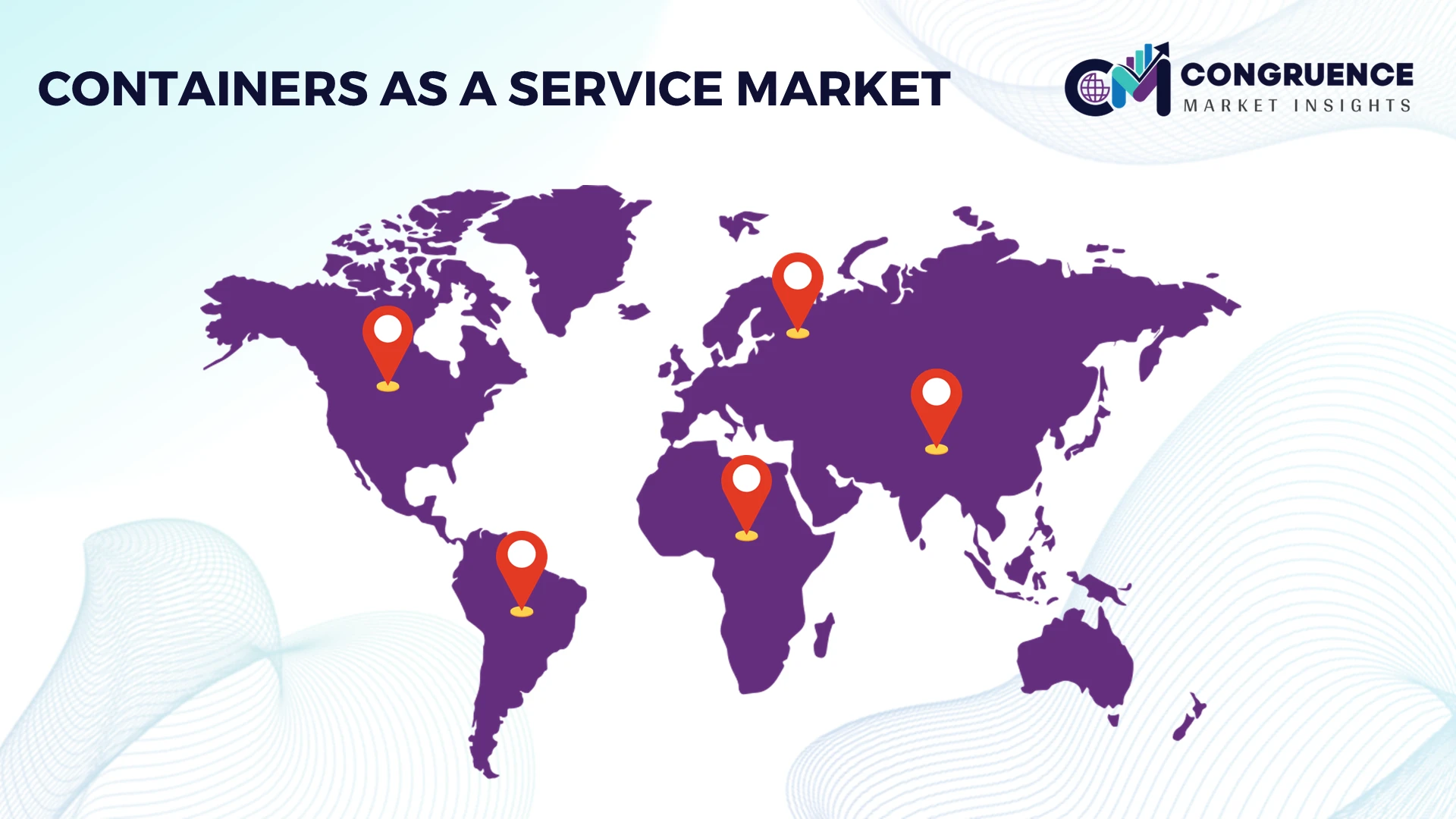
The report examines five major geographic regions, covering North America, Europe, Asia-Pacific, South America, and Middle East & Africa, alongside country-specific deployment patterns and infrastructure investments. It profiles 14 influential companies and evaluates competitive positioning, managed Kubernetes technologies, serverless containers, GPU-enabled orchestration, and emerging security solutions. Strategic assessments support investment planning, product differentiation, geographic expansion, partnership development, and enterprise infrastructure decisions between 2026 and 2033.
| Report Attribute / Metric | Details |
|---|---|
| Market Revenue (2025) | USD 5,540.0 Million |
| Market Revenue (2033) | USD 32,185.0 Million |
| CAGR (2026–2033) | 24.6% |
| Base Year | 2025 |
| Forecast Period | 2026–2033 |
| Historic Period | 2021–2025 |
| Segments Covered |
By Type
By Application
By End-User
|
| Key Report Deliverables | Revenue Forecast; Market Trends; Growth Drivers & Restraints; Technology Insights; Segmentation Analysis; Regional Insights; Competitive Landscape; Regulatory & ESG Overview; Recent Developments |
| Regions Covered | North America; Europe; Asia-Pacific; South America; Middle East & Africa |
| Key Players Analyzed | Amazon Web Services (AWS); Microsoft Corporation; Google LLC; IBM Corporation; Oracle Corporation; Alibaba Cloud; Huawei Technologies Co., Ltd.; Tencent Cloud; DigitalOcean Holdings, Inc.; Broadcom Inc. (VMware); Mirantis, Inc.; SUSE S.A.; Akamai Technologies, Inc.; Docker, Inc. |
| Customization & Pricing | Available on Request (10% Customization Free) |




