
Reports
The Global Containerized Data Center Market was valued at USD 12039.23 Million in 2025 and is anticipated to reach a value of USD 38842.95 Million by 2033 expanding at a CAGR of 13.9% between 2026 and 2033. Growth is driven by rapid AI infrastructure deployment, edge computing expansion, modular cloud facilities, and faster hyperscale capacity additions that reduce deployment timelines while improving energy-efficient digital infrastructure.
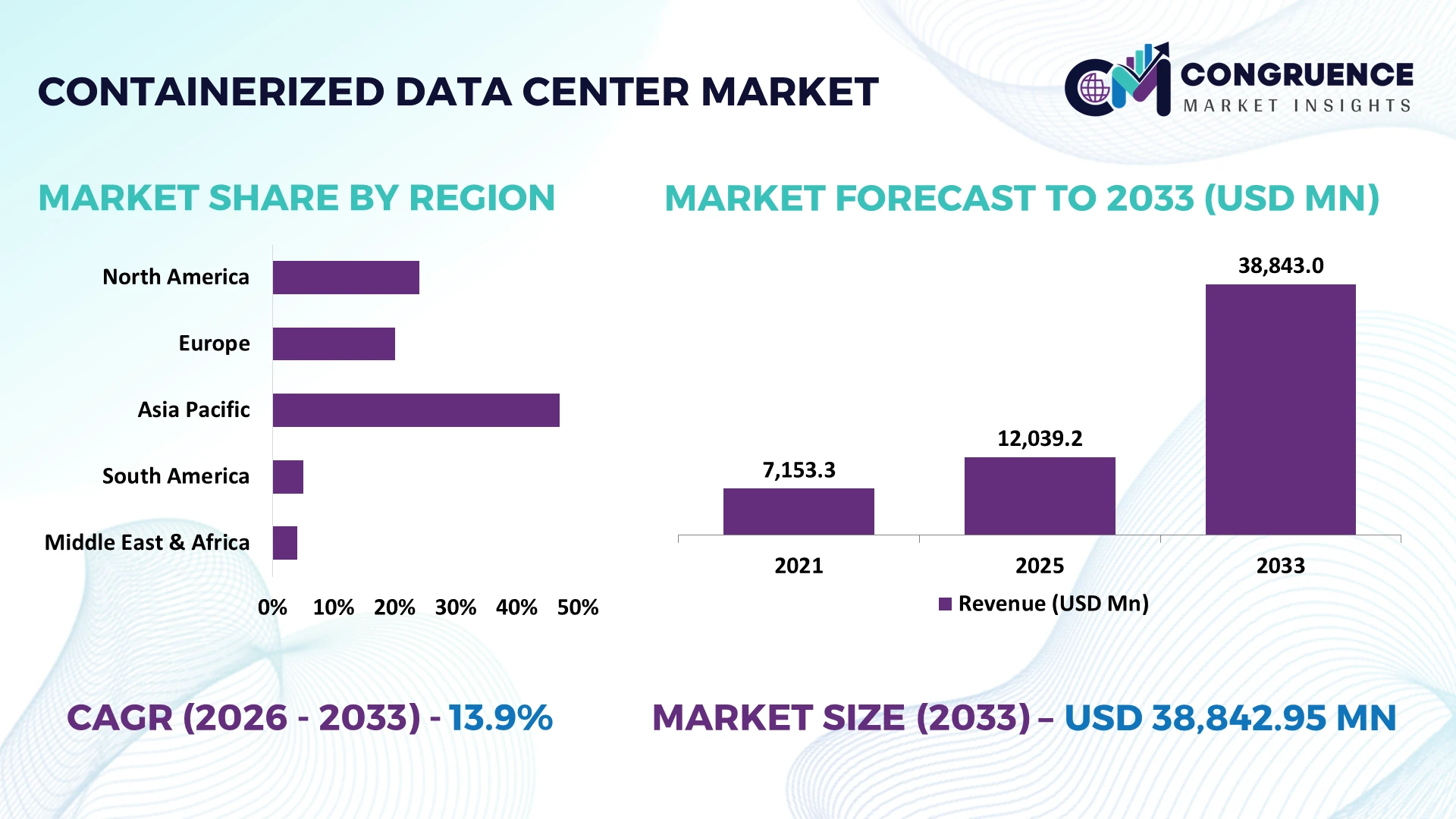
The United States remains the dominant market, accounting for approximately 34% of global deployments, supported by multi-billion-dollar AI infrastructure investments, expanding hyperscale cloud campuses, and defense applications. China follows with nearly 24% share, backed by large-scale digital infrastructure programs and manufacturing capacity, while stricter semiconductor export controls continue reshaping regional supply chains. North American deployment density exceeds several Asia-Pacific markets, reflecting stronger enterprise adoption and higher edge computing investments.
Organizations should prioritize modular, energy-efficient containerized solutions in high-growth regions to accelerate deployment, strengthen operational resilience, and optimize digital infrastructure expansion strategies.
Market Size & Growth: USD 12039.23 Million (2025) to USD 38842.95 Million (2033) at 13.9% CAGR, driven by accelerated AI-ready modular infrastructure deployment.
Top Growth Drivers: AI workloads (+38%), edge computing adoption (+31%), and hyperscale expansion (+27%) continue reshaping global infrastructure investments.
Short-Term Forecast: By 2028, deployment time declines by nearly 40%, while energy efficiency improves approximately 25% through modular integration.
Emerging Technologies: AI-enabled monitoring, liquid cooling, and advanced DCIM platforms improve operational efficiency by over 30%.
Regional Leaders: North America exceeds USD 13 Billion, Asia-Pacific surpasses USD 11 Billion, Europe approaches USD 8 Billion, supported by cloud and edge expansion.
Consumer/End-User Trends: More than 55% of enterprise edge deployments favor modular containerized facilities for faster implementation.
Pilot/Case Example: In 2026, an AI edge deployment reduced commissioning time by 45% while improving infrastructure utilization by 28%.
Competitive Landscape: Leading vendors collectively control around 48% of the market, including Schneider Electric, Vertiv, Huawei, Eaton, and Dell Technologies.
Regulatory & ESG Impact: High-efficiency cooling and power optimization reduce facility energy consumption by nearly 20% under evolving sustainability requirements.
Investment & Funding: More than USD 10 Billion supports global expansion through strategic partnerships, hyperscale projects, and regional manufacturing investments.
Innovation & Future Outlook: Prefabricated AI-ready designs, intelligent automation, and resilient supply-chain localization strengthen next-generation digital infrastructure.
The Containerized Data Center Market continues gaining momentum across hyperscale cloud facilities, telecom edge networks, industrial automation, and defense applications where rapid deployment is critical. AI-optimized cooling, integrated power management, and high-density computing designs improve operational performance by approximately 30%. Ongoing supply-chain diversification and stricter energy-efficiency requirements are accelerating modular infrastructure adoption, setting the foundation for the following strategic market assessment.
Containerized data centers have become a strategic infrastructure choice as enterprises prioritize rapid digital deployment, AI processing capacity, and resilient edge computing. Infrastructure modernization and ongoing supply-chain restructuring are encouraging organizations to replace conventional construction with modular facilities that can be commissioned in months rather than years. This shift strengthens competitive positioning by reducing deployment delays while supporting scalable digital operations across manufacturing, telecommunications, defense, and energy sectors.
Compared with conventional brick-and-mortar facilities, containerized data centers typically reduce deployment time by nearly 50% and lower on-site construction activities by approximately 35%, while standardized prefabrication improves operational consistency. The United States leads large-scale hyperscale and defense deployments, whereas India is expanding modular infrastructure for telecom networks and industrial digitalization, reflecting faster adoption among emerging digital economies. Over the next two to three years, edge deployments are expected to account for more than 40% of new modular installations as AI-enabled applications and distributed computing requirements accelerate.
A practical example is telecom operators deploying containerized facilities to extend low-latency services in remote locations without constructing permanent buildings. Technology providers are expanding manufacturing capacity, forming infrastructure partnerships, and integrating intelligent energy management to improve lifecycle performance. Companies that combine rapid deployment capabilities with resilient, energy-efficient infrastructure will strengthen long-term competitive advantage and secure higher-value digital infrastructure opportunities.
Growing enterprise investment in AI computing and distributed digital infrastructure is transforming containerized data center deployment strategies. More than 60% of new edge computing initiatives prioritize modular facilities because installation cycles are significantly shorter than conventional builds, while integrated cooling systems improve energy efficiency by nearly 25%. The United States continues expanding AI infrastructure following major semiconductor and digital infrastructure investments, encouraging localized deployment models. In response, technology providers are increasing prefabrication capacity, forming strategic alliances with telecom operators, and integrating intelligent monitoring platforms. The structural shift toward decentralized computing enables faster service delivery, strengthens disaster recovery capabilities, and creates a durable operational advantage for organizations requiring scalable, mission-critical infrastructure.
The market continues to face structural constraints from dependence on specialized electrical systems, cooling equipment, and high-density power components. Critical equipment costs have remained approximately 15% above pre-disruption levels in several supply categories, while project lead times can extend by nearly 20% because of transformer and power distribution shortages. Germany and other industrial manufacturing hubs continue experiencing procurement pressure for advanced electrical components, affecting deployment schedules. Companies are responding by diversifying supplier networks, increasing regional sourcing, and negotiating long-term procurement agreements to stabilize delivery timelines. Organizations with localized supply strategies gain stronger project predictability and reduce exposure to infrastructure cost volatility.
Demand for AI-ready containerized facilities is creating new opportunities beyond traditional cloud deployments. Advanced liquid cooling technologies can improve rack density by approximately 40%, while intelligent power optimization reduces operating energy consumption by nearly 18%. India is expanding digital infrastructure through large-scale data localization initiatives, creating favorable conditions for modular deployments supporting financial services, healthcare, and public-sector digital platforms. Industry participants are accelerating R&D, partnering with software providers, and developing standardized AI-ready container designs for rapid deployment. An important strategic opportunity lies in integrating renewable power and intelligent automation into modular facilities, enabling differentiated infrastructure offerings for sustainability-focused enterprise customers.
Managing large distributed fleets of containerized data centers presents execution challenges beyond initial deployment. Organizations operating multiple edge locations report infrastructure management workloads increasing by approximately 30%, while cybersecurity incidents targeting distributed operational technology environments have risen by nearly 25%. Japan's advanced manufacturing sector illustrates the growing need for unified monitoring across geographically dispersed facilities supporting industrial automation. Companies must strengthen centralized infrastructure management, expand cybersecurity investment, and develop skilled technical workforces capable of operating AI-enabled infrastructure. Success increasingly depends on standardized architectures, interoperable software platforms, and long-term ecosystem partnerships that ensure consistent operational performance across expanding digital infrastructure networks.
AI-Optimized Modular Architectures AI-ready containerized platforms are becoming standard as rack densities increase by nearly 35% and intelligent cooling improves thermal efficiency by approximately 28%. Rising GPU deployment and stricter power management requirements are accelerating integrated design adoption. Vendors are standardizing liquid-ready configurations, expanding manufacturing capacity, and partnering with chip ecosystem providers to shorten deployment cycles and improve operational consistency.
Localized Manufacturing Expansion Supply-chain diversification is shifting production closer to demand centers, reducing logistics lead times by around 22% while improving component availability by nearly 18%. Manufacturing investments in the United States and India reflect growing preference for regional assembly. Companies are restructuring procurement strategies, qualifying multiple suppliers, and expanding localized production to strengthen delivery reliability and reduce project execution risks.
Automation-Driven Remote Operations Automated infrastructure management platforms now reduce manual maintenance requirements by approximately 30% while predictive monitoring lowers unplanned downtime by nearly 25%. Workforce shortages and distributed edge deployments are accelerating remote operations across enterprise networks. Providers are embedding AI-based diagnostics, centralized orchestration, and digital twins into modular facilities to improve service quality with fewer on-site interventions.
Sustainability-Centered Infrastructure Design High-efficiency power distribution, smart energy controls, and advanced cooling technologies reduce facility energy consumption by roughly 20% while improving power utilization effectiveness by nearly 15%. Corporate sustainability targets and stricter environmental compliance are reshaping procurement priorities. Manufacturers are integrating renewable-energy compatibility, recyclable construction materials, and modular upgrade pathways to extend asset life and strengthen long-term infrastructure value.
40-Foot Containers account for approximately 41% of market demand because they deliver higher equipment density, simplified integration, and lower infrastructure cost per computing unit. Their ability to support hyperscale edge deployments and enterprise workloads makes them the preferred option for telecom operators and cloud providers. Customized Containers represent the fastest-growing segment, with adoption increasing by nearly 24% as organizations seek application-specific cooling, security, and power configurations. Vendors continue expanding configurable product portfolios and collaborating with enterprise customers to address specialized deployment requirements.
20-Foot Containers remain strategically important for remote industrial facilities, defense sites, and space-constrained deployments where mobility is prioritized over computing density. Modular Containers are gaining traction through standardized prefabricated architectures that reduce deployment complexity by approximately 35% while improving installation consistency. Manufacturers are investing in scalable modular platforms, standardized interfaces, and integrated monitoring capabilities, reflecting a broader investment shift toward flexible infrastructure capable of supporting diverse operational environments.
Edge Computing leads the application landscape with an estimated 38% market share as enterprises require low-latency infrastructure for AI processing, industrial automation, and connected devices. High-Performance Computing is the fastest-growing application, supported by increasing GPU-intensive workloads and advanced simulation environments. Organizations report workload efficiency improvements approaching 30% after deploying modular edge facilities integrated with intelligent infrastructure management, encouraging broader adoption across manufacturing, telecommunications, and digital services.
Cloud Computing remains a mature segment supporting distributed capacity expansion, while Disaster Recovery continues serving mission-critical business continuity strategies with rapid deployment capabilities. Temporary Data Centers maintain strategic relevance for large events, construction projects, and emergency response operations requiring immediate digital infrastructure. Companies are expanding integrated deployment services, strengthening software interoperability, and automating infrastructure management to support increasingly distributed computing environments and evolving enterprise resilience strategies.
IT & Telecom remains the largest end-user segment, representing approximately 46% of market demand due to extensive cloud expansion, edge computing deployment, and continuous network modernization. Healthcare is the fastest-growing end-user as digital diagnostics, connected medical systems, and AI-assisted clinical platforms require resilient modular infrastructure. Healthcare-related deployments have increased by nearly 22%, while intelligent infrastructure management improves service availability by approximately 20%. Vendors are introducing industry-specific configurations and strengthening partnerships with telecom operators and healthcare technology providers.
BFSI continues investing in containerized infrastructure to enhance disaster recovery and support digital banking operations with secure distributed computing. Government agencies prioritize modular facilities for defense communications and emergency response capabilities, while the Energy sector expands deployments across remote production assets and smart grid environments. Companies are tailoring solutions through sector-focused product customization, long-term service agreements, and ecosystem partnerships to strengthen customer retention and address increasingly specialized operational requirements.
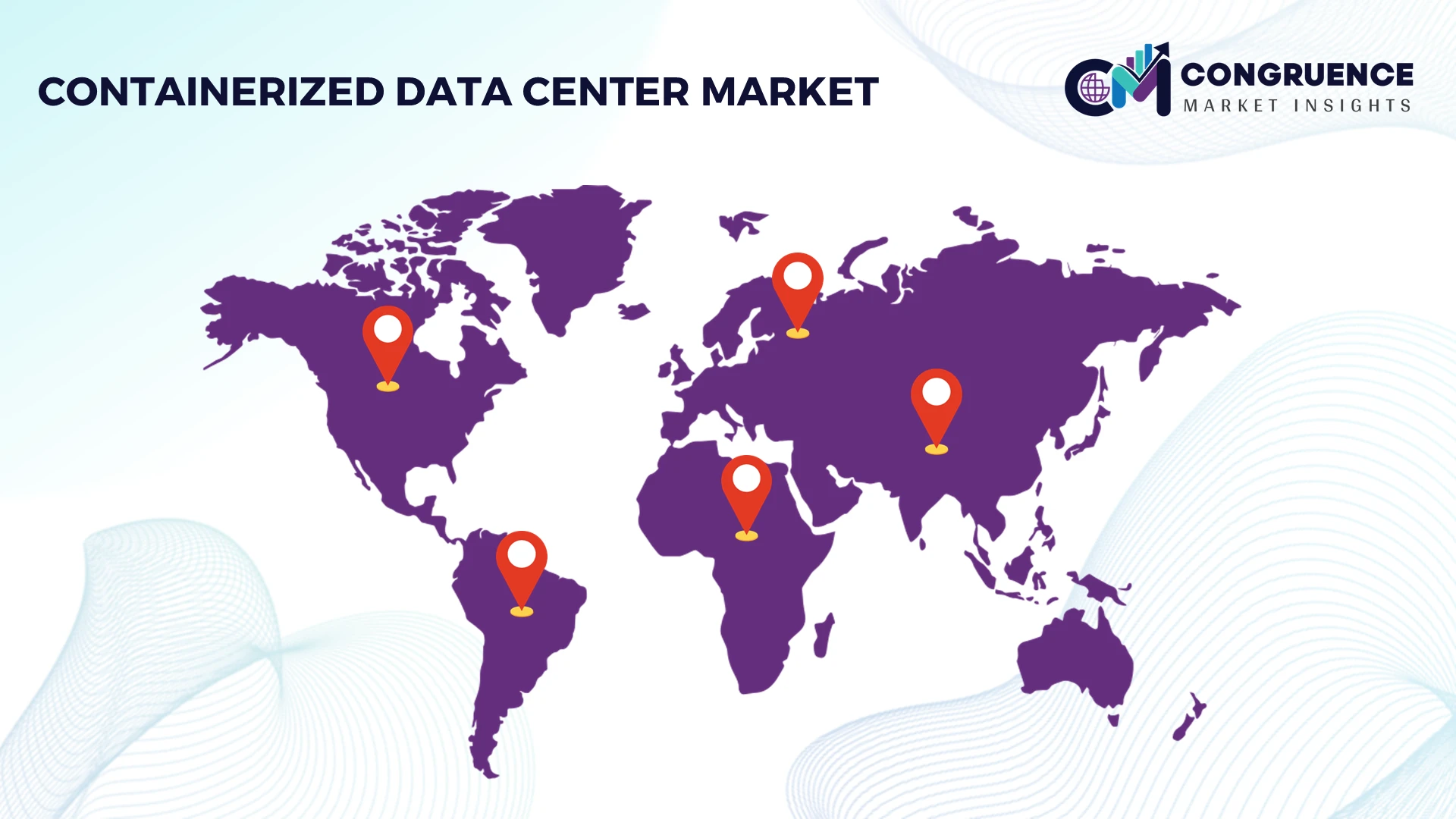
North America accounted for the largest market share at 37.8% in 2025 however, Asia-Pacific is expected to register the fastest growth, expanding at a 15.6% CAGR between 2026 and 2033.
Rapid AI Infrastructure and Edge Deployment Leadership
North America maintains the largest share of the Containerized Data Center Market through hyperscale cloud investments, AI infrastructure expansion, and mature digital ecosystems. The region accounts for nearly 38% of global deployments, supported by enterprise modernization, telecom edge rollouts, and defense infrastructure programs. Standardized modular facilities are increasingly replacing conventional construction for latency-sensitive applications, reducing deployment schedules by approximately 45%. Major cloud providers continue expanding distributed computing capacity, while utility-grade power infrastructure and advanced cooling technologies improve operational efficiency. Strategic partnerships between infrastructure providers, equipment manufacturers, and software vendors are accelerating turnkey deployment models, enabling organizations to expand computing capacity with greater operational flexibility and lower implementation complexity.
United States Market Outlook: The United States leads regional deployment through large hyperscale campuses, AI computing clusters, and advanced semiconductor ecosystems. More than 60% of North America's large-scale modular deployments are concentrated in the country, supported by cloud providers, telecommunications operators, and federal digital infrastructure initiatives. Enterprise demand for edge computing, cybersecurity resilience, and AI-ready facilities continues driving investment in standardized modular platforms, while manufacturers expand domestic production capacity and strengthen strategic technology partnerships to improve deployment speed and infrastructure reliability.
Sustainability-Led Digital Infrastructure Modernization
Europe continues strengthening its position through energy-efficient digital infrastructure, industrial automation, and stricter environmental compliance requirements. The region contributes approximately 27% of global deployments, with enterprises increasingly selecting modular facilities to improve energy utilization and accelerate infrastructure modernization. Advanced cooling technologies and intelligent energy management reduce operational electricity consumption by nearly 18%, supporting sustainability objectives across industrial and public-sector deployments. Cloud service providers, colocation operators, and manufacturing companies continue integrating containerized infrastructure into decentralized computing strategies. Ongoing modernization of telecommunications networks and industrial digitalization programs reinforces demand for standardized, rapidly deployable facilities across multiple sectors.
Germany Market Outlook: Germany remains Europe's strategic leader through advanced industrial manufacturing, cloud infrastructure expansion, and Industry 4.0 implementation. Industrial enterprises increasingly deploy modular data centers near production facilities to support automation and real-time analytics. Approximately 30% of Germany's new industrial digital infrastructure projects incorporate prefabricated or modular computing environments, encouraging technology suppliers to expand localized engineering capabilities, intelligent cooling solutions, and integrated infrastructure management platforms.
Large-Scale Digital Expansion and Manufacturing Advantage
Asia-Pacific is experiencing the fastest market expansion as governments and enterprises accelerate cloud infrastructure, edge computing, and digital industrialization. The region represents approximately 29% of global deployments, supported by strong manufacturing capabilities and expanding telecommunications infrastructure. Large-scale investments in AI computing, smart manufacturing, and digital public services continue increasing modular infrastructure adoption. Installation timelines have declined by nearly 35% through standardized prefabrication, improving project execution across rapidly developing digital economies. Technology vendors are expanding regional manufacturing facilities, strengthening local supply chains, and establishing strategic partnerships to address increasing enterprise infrastructure requirements.
China Market Outlook: China remains the region's largest operational market due to extensive cloud infrastructure, advanced manufacturing capacity, and nationwide digital transformation initiatives. More than half of the region's modular manufacturing capability is concentrated in China, supporting domestic deployment and export activities. Local technology companies continue investing in AI-ready modular facilities, intelligent energy management, and localized component production to improve supply-chain resilience and accelerate enterprise infrastructure deployment.
Telecom Expansion Drives Modular Adoption
South America is steadily increasing adoption through telecommunications modernization, cloud expansion, and enterprise digital transformation. The region contributes approximately 5% of global market activity, with modular infrastructure increasingly supporting remote connectivity and distributed computing requirements. Telecom operators continue deploying containerized facilities to extend digital services into underserved locations while reducing implementation time by nearly 30%. Infrastructure limitations and power availability remain operational constraints, encouraging greater investment in efficient power systems and localized deployment strategies. Vendors are expanding channel partnerships and regional service capabilities to improve implementation efficiency and long-term operational support.
Brazil Market Outlook: Brazil leads regional demand through expanding cloud infrastructure, financial services digitalization, and telecommunications investments. Enterprise adoption continues increasing as organizations modernize IT infrastructure to support edge applications and disaster recovery operations. Approximately 45% of South America's modular deployments are concentrated in Brazil, prompting technology providers to strengthen local integration partnerships, engineering support, and infrastructure lifecycle services for enterprise customers.
Infrastructure Investment Accelerates Digital Transformation
The Middle East & Africa market is advancing through smart city initiatives, energy-sector modernization, and expanding digital government programs. The region accounts for roughly 4% of global deployments while recording increasing investment in modular computing infrastructure for mission-critical applications. Integrated containerized facilities reduce deployment schedules by approximately 40%, making them suitable for remote industrial sites and rapidly developing urban projects. Investments in renewable-powered infrastructure, advanced telecommunications, and digital public services continue supporting broader market adoption. Companies are strengthening regional partnerships, expanding technical service capabilities, and developing localized deployment models to improve operational resilience.
United Arab Emirates Market Outlook: The United Arab Emirates serves as the regional technology hub through advanced digital infrastructure, smart city programs, and hyperscale cloud investments. Large enterprise projects increasingly integrate modular data centers to support AI applications, government platforms, and financial services. More than 35% of new Gulf modular infrastructure deployments are concentrated in the UAE, encouraging international technology providers to establish regional engineering centers, strategic alliances, and localized support operations.
The competitive landscape is led by Schneider Electric, Vertiv, Huawei Digital Power, Eaton, and Dell Technologies, competing directly against regional modular infrastructure integrators and specialized prefabricated data center providers. The top five players collectively control approximately 48% of the market, while regional manufacturers compete through faster localization and lower deployment costs. Competition increasingly centers on deployment speed, integrated cooling, intelligent power management, and supply-chain resilience rather than hardware pricing alone. AI-ready modular platforms reduce commissioning time by nearly 45%, while standardized manufacturing lowers installation costs by around 20% and improves operational efficiency by approximately 25%. Leading vendors are expanding regional production, forming cloud and telecom partnerships, vertically integrating power and cooling technologies, and acquiring engineering capabilities to strengthen delivery control. The competitive shift favors complete infrastructure ecosystems over standalone equipment as customers demand turnkey deployment. High certification requirements, engineering expertise, and resilient component sourcing remain major entry barriers. Winning requires rapid deployment, AI-optimized infrastructure, localized manufacturing, and lifecycle service excellence.
Schneider Electric
Vertiv
Huawei Digital Power
Eaton
Dell Technologies
Hewlett Packard Enterprise (HPE)
Rittal
ZTE Corporation
Delta Electronics
Cannon Technologies
Baselayer Technology
PCX Holding LLC
Containerized data center technology is rapidly evolving toward AI-ready, software-defined, and highly automated infrastructure. Intelligent DCIM platforms, predictive maintenance, and AI-driven workload orchestration now support approximately 55% of new enterprise deployments, while advanced liquid cooling improves thermal efficiency by nearly 30% compared with conventional air-cooling systems. Integrated monitoring enables faster fault detection, reducing service interruptions and strengthening operational continuity for mission-critical facilities.
Emerging technologies include digital twins, modular battery energy storage, intelligent power distribution, and edge-native automation platforms. Compared with traditional brick-built data centers, prefabricated modular systems reduce deployment time by approximately 50% and decrease on-site construction activities by nearly 35%. Hyperscale cloud operators, telecom providers, and industrial enterprises gain the greatest competitive advantage because standardized infrastructure accelerates expansion while improving utilization and infrastructure consistency across distributed networks.
Between 2026 and 2028, AI-enabled infrastructure optimization, autonomous operations, and liquid-cooled high-density computing will become the primary differentiators. More than 65% of newly deployed modular facilities are expected to integrate intelligent automation for energy optimization, predictive asset management, and remote orchestration. Companies investing now in interoperable software platforms, advanced cooling architectures, and standardized modular designs will strengthen deployment flexibility, reduce lifecycle operating costs, and secure a lasting competitive advantage as enterprise digital infrastructure becomes increasingly decentralized and performance driven.
August 2025 Schneider Electric launched the EcoStruxure Prefabricated Modular Pod Data Center for high-density AI environments, integrating liquid cooling and OCP-inspired rack systems supporting accelerated compute deployments and higher rack power density. The solution improves deployment flexibility for AI infrastructure. Source: (Schneider Electric)
August 2025 Vertiv introduced Vertiv™ OneCore, a factory-assembled prefabricated infrastructure platform supporting AI, HPC, and high-density 5+ MW data centers. The integrated modular architecture simplifies deployment while reducing on-site construction complexity, enabling faster project execution for hyperscale and enterprise customers. Source: (Vertiv Holdings)
November 2025 Vertiv and Caterpillar announced a strategic collaboration to integrate power generation, cooling, and energy optimization for AI data centers. The initiative combines end-to-end infrastructure with pre-designed architectures to accelerate deployment timelines while improving operational resilience for high-density computing facilities.
March 2026 Vertiv partnered with Generate Capital to deliver Bring Your Own Power & Cooling (BYOP&C) solutions, combining modular infrastructure with financing for power-constrained markets. The offering supports integrated battery storage, fuel cells, and modular cooling, accelerating U.S. data center capacity deployment. Source: (Vertiv)
The report provides a comprehensive assessment of the global Containerized Data Center Market across technology evolution, deployment models, competitive positioning, and operational developments between 2026 and 2033. It evaluates four major product types, five key application segments, and five end-user industries while examining adoption patterns across North America, Europe, Asia-Pacific, South America, and the Middle East & Africa. The analysis also covers AI-ready infrastructure, modular power systems, intelligent cooling, edge computing, and prefabricated deployment strategies.
The study benchmarks leading technology providers and infrastructure specialists, covering more than 12 major market participants and identifying shifts in deployment priorities, enterprise investment, and supply-chain strategies. It highlights segment-level adoption trends, regional deployment concentration, emerging niche opportunities, and evolving customer requirements. Strategic insights support market entry decisions, portfolio expansion, competitive benchmarking, partnership evaluation, infrastructure planning, and long-term investment prioritization in an increasingly modular and distributed digital infrastructure ecosystem.
| Report Attribute/Metric | Report Details |
|---|---|
Market Revenue in 2025 | USD 12039.23 Million |
Market Revenue in 2033 | USD 38842.95 Million |
CAGR (2026 - 2033) | 13.9% |
Base Year | 2025 |
Forecast Period | 2026 - 2033 |
Historic Period | 2021 - 2025 |
Segments Covered | By Type
By Application
By End-User
|
Key Report Deliverable | Revenue Forecast, Growth Trends, Market Dynamics, Segmental Overview, Regional and Country-wise Analysis, Competition Landscape |
Region Covered | North America, Europe, Asia-Pacific, South America, Middle East, Africa |
Key Players Analyzed | Schneider Electric, Vertiv, Huawei Digital Power, Eaton, Dell Technologies, Hewlett Packard Enterprise (HPE), Rittal, ZTE Corporation, Delta Electronics, Cannon Technologies, Baselayer Technology, PCX Holding LLC |
Customization & Pricing | Available on Request (10% Customization is Free) |




