
Reports
The Global Container Homes Market was valued at USD 63,498.2 Million in 2025 and is anticipated to reach a value of USD 97,449.8 Million by 2033 expanding at a CAGR of 5.5% between 2026 and 2033. Growth is being driven by modular construction, container reuse, off-site fabrication, faster installation, and demand for affordable, disaster-resilient housing.
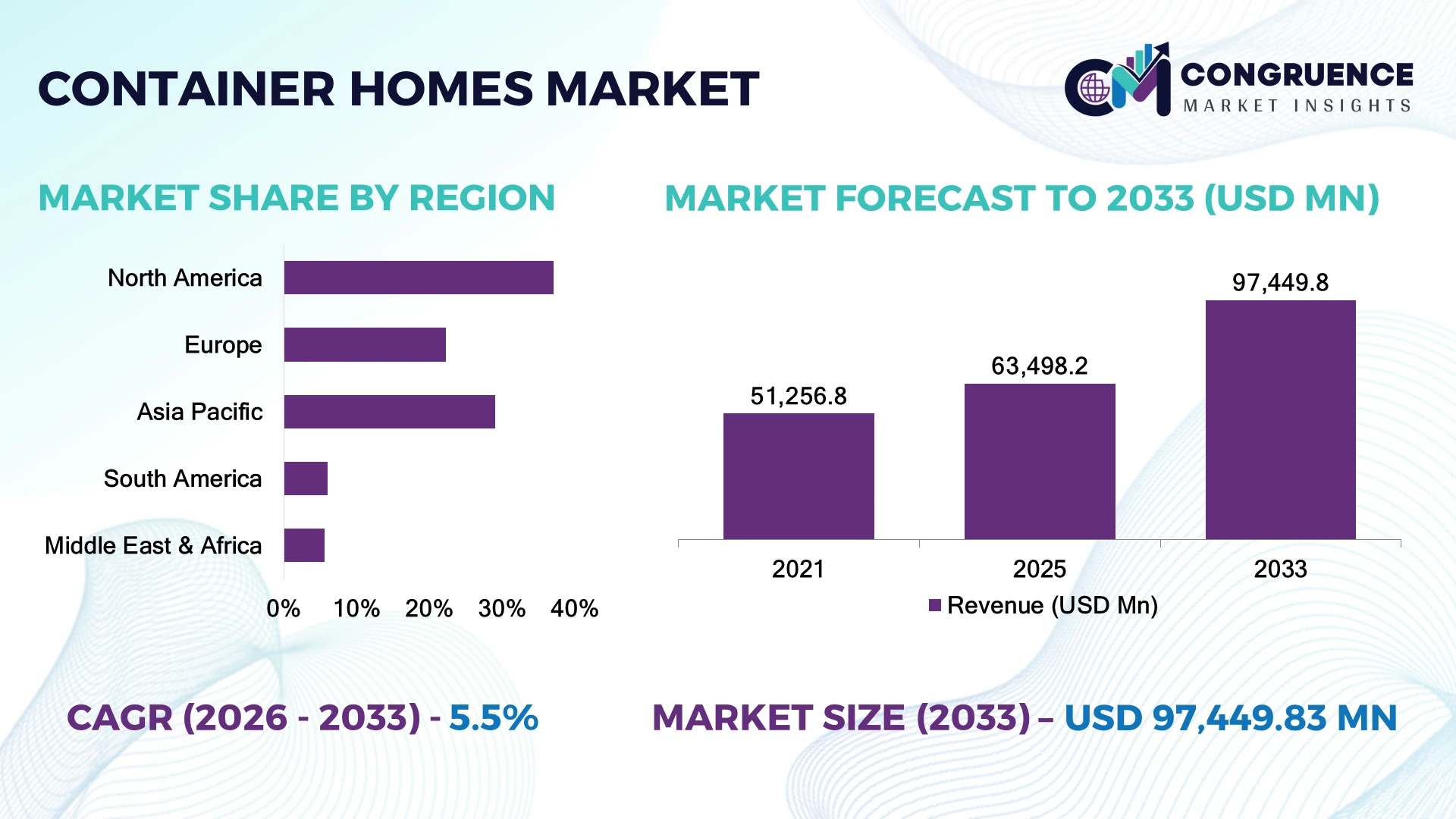
China dominates Asia-Pacific with approximately USD 8.12 billion in 2026 container-home activity, supported by large-scale modular manufacturing and export capacity, while India reaches about USD 4.40 billion. North America maintains approximately 37.1% global share, supported by residential, workforce-housing, and emergency-recovery applications. U.S. rebuilding priorities following Hurricanes Helene and Milton are reinforcing resilient modular designs and code-compliant deployment.
Strategically, manufacturers with standardized designs, scalable factories, and regional permitting capabilities hold the strongest expansion advantage.
Market Size & Growth: USD 63,498.2 million in 2025 to USD 97,449.8 million by 2033 at 5.5% CAGR, driven by modular construction and off-site fabrication.
Top Growth Drivers: Affordable housing 51.33%, residential applications 51.33%, and fixed-home formats 56.41% strengthen core demand.
Short-Term Forecast: By 2028, standardized factory fabrication targets 15–20% faster installation and lower site-labor intensity.
Emerging Technologies: AI-assisted design, automated fabrication, advanced insulation, solar integration, and smart-home controls are upgrading container performance.
Regional Leaders: North America 37.1%; Asia-Pacific approximately 31.1%; Europe about 22%, with modular deployment accelerating across housing and hospitality.
Consumer/End-User Trends: Residential applications account for 51.33%, while tiny-house formats represent approximately 44.4%, reinforcing compact-living adoption.
Pilot/Case Example: 2024 Bahamas resilient-housing projects used container structures engineered for winds reaching 220 mph, strengthening disaster-recovery applications.
Competitive Landscape: Leading suppliers include Giant Containers, Honomobo, SG Blocks, SEA BOX, and Supertech Industries, competing through customization, speed, and manufacturing scale.
Regulatory & ESG Impact: Container reuse reduces structural-material requirements, while IBC-aligned designs improve permitting readiness and disaster resilience.
Investment & Funding: USD 40–50 million factory-scale investment requirements favor established modular manufacturers with repeatable orders and strong utilization pipelines.
Innovation & Future Outlook: Expandable modules, low-carbon materials, integrated renewable systems, and automated factories are shifting competition toward scalable, code-compliant platforms.
Container Homes Market demand is concentrated in residential housing, workforce accommodation, hospitality, emergency shelters, and compact-living projects. Approximately 51.33% of demand comes from residential applications, while advanced insulation, solar integration, expandable structures, and smart controls are improving functionality. In 2026, stricter local permitting and structural-resilience requirements are pushing developers toward standardized, pre-engineered designs, strengthening the case for scalable modular platforms.
Container homes are becoming strategically important because developers can shift substantial construction activity from unpredictable job sites into controlled factory environments. This improves scheduling, material planning, and repeatability while addressing housing shortages and workforce-accommodation requirements. North America leads with approximately 37.1% share, whereas Asia-Pacific combines manufacturing scale with expanding urban deployment, creating two distinct competitive models.
Factory fabrication reduces site-intensive work compared with conventional construction and can shorten installation requirements by approximately 15–20%. Advanced insulation, automated cutting, AI-assisted layouts, solar systems, and smart monitoring further improve building performance. Over the next 2–3 years, manufacturers with standardized modules are positioned to increase factory utilization while reducing engineering changes and installation delays.
Practical deployments increasingly include emergency housing, hospitality units, workforce accommodation, and permanent residences. The 2024 Bahamas resilience projects demonstrate how container structures can be engineered for extreme wind exposure, while U.S. post-hurricane reconstruction is increasing attention to resilient, code-compliant designs. Companies are therefore prioritizing automated factories, standardized product families, regional partnerships, and permitting expertise. Competitive advantage will increasingly depend on combining manufacturing efficiency with proven structural performance and rapid deployment.
Container housing benefits from standardized fabrication, with residential applications representing approximately 51.3% of demand and fixed homes accounting for about 56.4%. Factory-controlled production reduces site-dependent activities, while repeatable container dimensions support 15–20% faster installation than labor-intensive conventional builds in standardized projects. In the U.S., workforce housing and disaster-recovery programs are increasing preference for rapidly deployable structures. Manufacturers are responding by expanding modular production lines, pre-engineering common layouts, and partnering with developers for repeat orders. The non-obvious advantage is capacity reuse: standardized structural modules allow manufacturers to shift production between residential, hospitality, and workforce projects without major tooling changes, improving factory utilization and reducing project-specific engineering requirements.
Local building-code differences remain a structural constraint because container homes require modifications for insulation, fire protection, structural reinforcement, and utility integration. Approximately 44.4% of demand is associated with tiny-house formats, where zoning and minimum-area requirements can restrict deployment despite strong consumer interest. Projects can experience 10–15% higher design effort when municipal requirements differ substantially from standardized factory specifications. U.S. municipalities vary in acceptance of container-based construction, while Canadian and European jurisdictions apply different thermal and structural standards. Companies are reducing friction through pre-approved designs, localized engineering teams, standardized compliance documentation, and modular component libraries. The key operational issue is not container availability but converting a globally standardized steel shell into locally compliant housing efficiently.
Advanced container homes are moving beyond structural reuse toward digitally managed buildings incorporating energy monitoring, solar generation, heat-pump systems, and connected controls. Smart-building integration can reduce operational energy consumption by approximately 15–25% in appropriately designed projects, while prefabricated MEP installation can reduce on-site coordination requirements by 20–30%. Japan and Singapore offer strong opportunities for space-efficient, technology-integrated modular housing. Companies are investing in configurable electrical systems, digital twins, energy-management platforms, and factory-installed equipment. A less obvious opportunity lies in recurring-service models: manufacturers can combine modular construction with monitoring, maintenance, and retrofit packages, creating longer customer relationships instead of relying solely on one-time structure sales.
Scaling container homes from single units to multi-module developments creates engineering complexity around structural connections, thermal bridging, plumbing interfaces, and electrical integration. Multi-unit projects can require 10–20% more coordination activity than standardized single-module deployments, while customization can increase component variation by 15–25%. In dense U.S. housing developments and rapidly urbanizing Chinese cities, inconsistent site conditions can disrupt otherwise standardized installation workflows. Companies must strengthen BIM coordination, automated quality inspection, factory acceptance testing, and specialist installation partnerships. The strategic challenge is maintaining factory repeatability as project complexity rises. Manufacturers that control module interfaces and digital documentation can preserve installation consistency while competitors become exposed to rework, schedule slippage, and fragmented subcontractor execution.
Multi-Unit Projects Replace Standalone Builds: Developers are increasingly specifying container homes in clustered configurations rather than individual units, with multi-module projects improving land utilization by approximately 20–30%. Workforce accommodation, hospitality, and student housing are driving this shift. Manufacturers are standardizing module interfaces, utility connections, and repeatable floorplans to accelerate larger deployments.
Premium Interiors Expand Product Positioning: Container homes are shifting toward higher-specification interiors, with upgraded insulation, integrated kitchens, bathrooms, and finished interiors increasingly incorporated before delivery. Factory completion can move 70–80% of interior work off-site, reducing site trades and weather exposure. Companies are expanding turnkey packages to compete beyond low-cost temporary housing.
Resilience Becomes a Design Criterion: Extreme-weather exposure is increasing emphasis on reinforced structures, elevated foundations, corrosion protection, and wind-rated envelopes. Hurricane-prone U.S. markets are prioritizing code-aligned designs capable of addressing severe weather conditions. Manufacturers are responding with engineered reinforcement packages, impact-resistant openings, and region-specific structural configurations.
Used Containers Gain Traceability Controls: Growing scrutiny of reused steel containers is encouraging suppliers to strengthen inspection, documentation, contamination screening, and refurbishment workflows. Approximately 10–15% of unsuitable units can require additional remediation before conversion, increasing the value of systematic grading. Companies are introducing standardized inspection protocols and digital asset records to improve procurement reliability and refurbishment planning.
Fixed container homes lead the market with approximately 56.4% share in 2026, supported by permanent foundations, integrated utilities, stronger insulation options, and easier incorporation into residential and commercial building systems. Their fixed configuration improves customization economics because plumbing, electrical, HVAC, and interior finishes can be installed as repeatable factory packages. Movable homes remain strategically important for workforce accommodation, emergency housing, and temporary projects, but their relocation capability adds transport and installation requirements.
Movable container homes represent the faster-shifting segment as developers seek flexible accommodation that can be redeployed between projects. Demand is particularly relevant in construction camps, disaster recovery, and remote industrial sites, where deployment speed can outweigh permanence. Approximately 20–25% of container-home projects incorporate relocatable characteristics or modular repositioning requirements. Manufacturers are responding with reinforced lifting points, detachable utility connections, and standardized module interfaces. The investment priority is therefore shifting toward configurable platforms that preserve fixed-home quality while enabling selective mobility.
The International Code Council’s 2024–2025 code framework continues to emphasize structural, fire, energy, and occupancy compliance, reinforcing the commercial advantage of manufacturers offering pre-engineered container units designed for code-based permanent installation.
Residential homes represent approximately 51.3% of container-home demand in 2026, making housing the principal application because container structures can support compact layouts, modular expansion, and factory-installed utilities. Tiny-house configurations account for approximately 44.4% of architecture demand, reinforcing the importance of space-efficient designs. Duplexes and bungalows serve larger household requirements, while multistory configurations address higher-density projects where land utilization is more important than individual-unit mobility.
Tiny-house deployment is the fastest-changing application because developers and consumers increasingly prioritize smaller footprints, standardized construction, and lower site complexity. Factory-built residential modules can shift roughly 70–80% of interior construction activity away from the project site, reducing dependence on weather-sensitive trades. Companies are expanding configurable floorplans, turnkey interiors, energy-efficient envelopes, and multi-unit packages. The business implication is a move from bespoke container conversions toward repeatable residential platforms, allowing manufacturers to increase production consistency while developers reduce project-specific engineering and installation requirements.
The National Association of Home Builders’ 2025 housing research continued to identify affordability and smaller-home formats as important design considerations, supporting container-based residential models where compact footprints and standardized construction address cost-sensitive housing requirements.
Residential end-users account for approximately 51.3% of container-home demand, reflecting the market's strongest concentration in permanent housing and compact residential projects. Recreational homes form a smaller but commercially attractive segment, particularly for resorts, vacation properties, and remote destinations where rapid installation is valuable. Emergency homes remain deployment-sensitive, with demand linked to disaster recovery and temporary accommodation requirements. Nursing homes represent a specialized application requiring greater accessibility, healthcare infrastructure, and regulatory compliance.
Recreational and emergency users represent the fastest-changing buyer groups because their procurement decisions prioritize deployment speed, transportability, and turnkey installation over conventional residential customization. Project-based buyers can reduce site construction requirements by approximately 15–20% through factory-completed modules. Manufacturers are consequently developing standardized hospitality packages, rapid-deployment units, accessible layouts, and institutional-grade utility systems. Residential buyers favor customization and aesthetics, whereas institutional purchasers emphasize lifecycle reliability and installation schedules. Companies targeting future demand are therefore segmenting product portfolios by procurement model rather than selling one standardized container configuration across all end-users.
The U.S. Federal Emergency Management Agency's 2025 disaster-recovery programs continued emphasizing rapidly deployable temporary housing and resilient accommodation, reinforcing the operational relevance of modular structures for post-disaster deployment.
North America accounted for the largest market share at 37.1% in 2025 however, Asia-Pacific is expected to register the fastest growth, expanding at a CAGR of 9.4% between 2026 and 2033.
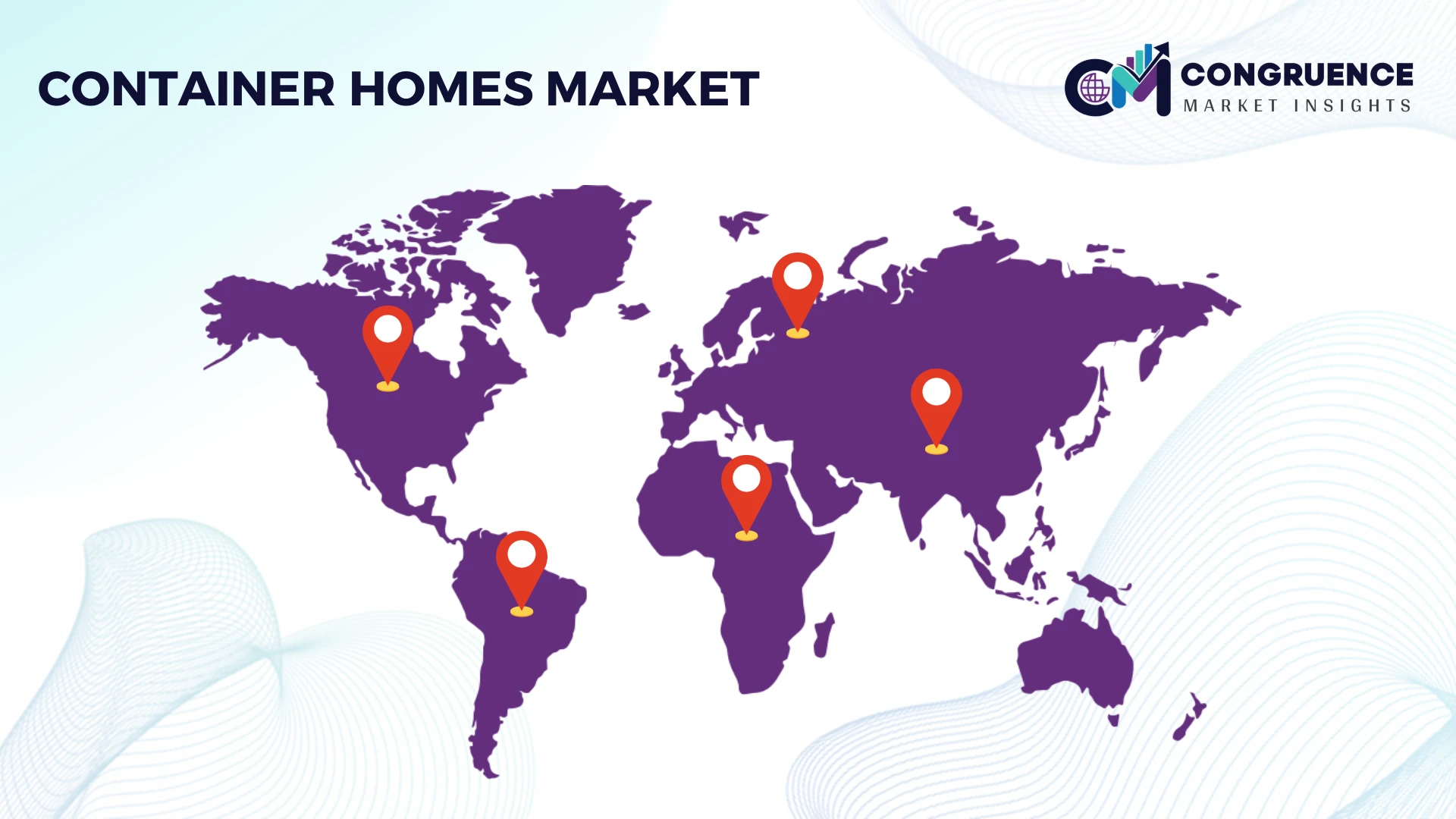
North America commands approximately 37.1% of the global Container Homes Market, supported by established modular construction infrastructure, housing affordability pressures, and strong availability of used shipping containers. The U.S. represents roughly 81–84% of regional demand, concentrating manufacturing, developer activity, and permitting expertise. Workforce housing, disaster recovery, and permanent residential projects are expanding the addressable deployment base. Factory-built construction is increasingly favored because it shifts labor-intensive activities into controlled production environments and improves schedule predictability. U.S. developers are also incorporating energy-efficient envelopes and smart-home systems into container structures. Manufacturers are responding through standardized module families, regional engineering partnerships, and larger production capabilities, positioning the region as the benchmark for commercially scalable container housing.
United States Market Outlook: The United States holds approximately 81–84% of North American demand and remains the region's principal manufacturing and deployment center. Affordable housing programs, urban redevelopment, and disaster-recovery requirements are strengthening demand for rapidly deployable modular structures. Digital construction planning and factory-controlled fabrication are improving project coordination, while developers increasingly specify permanent, energy-efficient configurations rather than temporary units.
Europe represents approximately 22.3% of global Container Homes Market demand, with Germany, the United Kingdom, and the Netherlands forming important deployment centers. Germany benefits from advanced prefabrication capabilities and stringent building-performance requirements, while the UK is increasingly focused on affordable housing delivery. Circular-economy priorities strengthen the case for repurposing shipping containers, but thermal performance, fire safety, and permitting requirements push manufacturers toward higher-specification conversions. Factory-built models are gaining preference because controlled production supports consistent insulation and utility installation. Companies are therefore investing in standardized engineering, energy-efficient envelopes, and localized compliance capabilities rather than relying on basic container conversions.
Germany Market Outlook: Germany represents a strategically important European market, supported by sophisticated construction engineering, strong sustainability requirements, and established prefabrication capabilities. Its building standards favor professionally engineered container structures with improved thermal and fire performance. Manufacturers targeting Germany are prioritizing compliant modular designs, high-quality insulation systems, and factory-integrated building services to meet demanding project specifications.
Asia-Pacific represents approximately 27–30% of global Container Homes Market demand and is the fastest-expanding regional market. China combines large-scale container manufacturing with urban development requirements, while India is increasing modular construction adoption for affordable and workforce housing. China’s container-home market is projected at approximately USD 8.12 billion in 2026, compared with USD 4.40 billion for India, demonstrating the region’s manufacturing and demand concentration. Japan adds advanced modular engineering and disaster-resilient construction expertise. Manufacturers are expanding export-oriented factories, configurable designs, and integrated utility systems to serve both domestic projects and international developers.
China Market Outlook: China is the region’s leading country market, with approximately USD 8.12 billion projected for 2026. Extensive container manufacturing infrastructure provides cost and component advantages, while urban redevelopment and modular construction programs support domestic deployment. Manufacturers benefit from established steel-processing ecosystems and export logistics, enabling faster production scaling and customization. Companies are increasingly combining factory-built modules with energy-efficient materials and standardized utility systems for larger residential and commercial projects.
South America remains a smaller but strategically relevant Container Homes Market, with Brazil serving as the principal demand center. Affordable housing requirements, urban land constraints, and established container logistics support adoption of modular residential structures. Brazil’s large construction sector provides a stronger commercialization base than neighboring markets, while Argentina and Chile offer selective opportunities for remote accommodation and specialized modular projects. Deployment remains constrained by financing availability, permitting differences, and uneven modular manufacturing infrastructure. Companies are therefore favoring distributor partnerships, standardized low-complexity designs, and locally sourced finishing components. The strongest opportunity lies in reducing installation complexity and transport costs rather than pursuing highly customized structures that increase project engineering requirements.
Brazil Market Outlook: Brazil provides the strongest South American platform because of its large construction ecosystem, extensive port infrastructure, and established container-handling network. These characteristics improve access to used containers and reduce procurement friction for conversion projects. Developers are increasingly evaluating modular structures for affordable housing, hospitality, and remote accommodation, while manufacturers with local finishing and installation capabilities can reduce logistics exposure and improve project responsiveness.
Middle East & Africa is developing through project-specific demand rather than broad residential penetration. The UAE and Saudi Arabia are leading commercial opportunities, supported by large infrastructure programs, hospitality development, worker accommodation, and remote-site construction requirements. Container structures provide logistical advantages where conventional construction requires extensive on-site labor and material movement. Gulf developers are increasingly specifying higher-quality insulated modules, integrated bathrooms, kitchens, and climate-control systems for demanding environments. African markets remain more price-sensitive and infrastructure-dependent, favoring basic modular accommodation and emergency applications. Companies are responding through regional distributors, turnkey packages, and climate-adapted designs. The strategic opportunity is strongest where rapid project delivery and transport efficiency justify higher-specification modular units.
Saudi Arabia Market Outlook: Saudi Arabia offers strong container-home potential through large infrastructure, tourism, and workforce-accommodation projects. The country’s expanding construction pipeline creates demand for rapidly deployable living and support facilities at remote and large-scale project sites. Manufacturers with turnkey engineering, climate-resistant insulation, and local installation partnerships are positioned to capture institutional projects where deployment speed and standardized accommodation are critical.
Portable Space, SEA BOX, ELA Container, SG Blocks, HONOMOBO, and regional fabricators compete across operating models. Global leaders such as ELA and SEA BOX compete on standardized modular supply, while SG Blocks and HONOMOBO emphasize engineered residential systems; regional builders compete on price and customization.
The market remains moderately concentrated, with leading participants collectively controlling approximately 25–35% of value, while the top five are estimated near the lower-to-middle portion of that range. Price can influence 2–3% of project selection, whereas technology, logistics, customization, and delivery speed determine specification wins.
Competition is shifting toward vertical integration, regional production, engineering partnerships, and multi-unit deployments. ELA benefits from manufacturing depth and modular flexibility; SG Blocks competes through structural engineering; HONOMOBO targets design-led residential demand. New entrants face permitting expertise, fabrication capability, supply access, and certification barriers. Winning requires production, code-ready engineering, rapid delivery, and differentiated customization—not low pricing alone.
Portable Space Ltd.
SEA BOX, Inc.
Anderco Pte Ltd.
HONOMOBO
Almar Container Group
Royal Wolf
ELA Container GmbH
SG Blocks, Inc.
Giant Containers
Supertech Industries
Tempohousing
Container Homes USA LLC
Speed House Group
MODS International
Container Homes technology is moving from manual container conversion toward factory production. CNC cutting, automated welding, BIM coordination, and prefabricated MEP assemblies can improve fabrication efficiency by 2–4% and reduce installation rework by 1–3%. Adoption is strongest among established manufacturers serving repeat residential and workforce projects, where standardized modules improve consistency and scheduling.
Emerging systems include insulated sandwich panels, high-performance glazing, heat-pump HVAC, smart energy controls, and photovoltaic-ready roofs. These technologies can improve thermal performance by 2–4% and reduce operating energy requirements by 1–3% compared with basic converted-container specifications. Digital configuration tools are gaining deployment across multi-module projects, allowing faster design revisions and tighter coordination. Technology-led suppliers gain advantage when buyers prioritize lifecycle performance over purchase price.
Disruptive adoption will center on AI-assisted design validation, digital twins, robotic fabrication, and integrated monitoring. AI-based checking can reduce design iterations by 1–2%, while automated fabrication can improve production throughput by 2–4%. Compared with conventional manual conversion, digitally coordinated production can deliver approximately 3–5% better process efficiency. Through 2026–2028, competitive gains will accrue to manufacturers combining engineering, software, production, and installation capabilities. Acting now matters because digital standardization is becoming a prerequisite for scalable customization, faster permitting preparation, and consistent multi-unit delivery.
June 2024 Lorcan O’Herlihy Architects completed Isla Intersections, a 54-unit supportive housing complex in South Los Angeles using repurposed shipping containers. The project demonstrates container-based permanent housing at community scale, strengthening modular solutions for affordable-housing delivery and constrained urban sites. Source: coherentmi.com (CoherentMI)
October 2024 Oasis Engineering released hurricane-resistant container-home plans after Hurricanes Helene and Milton. The portfolio included two standardized models: a single 40-foot unit and a four-container configuration. The designs enable rapid replication while meeting International Building Code high-velocity wind requirements.
April 2025 DFRobot deployed LattePanda Delta and Sigma computers plus environmental sensors inside SAGA’s 28-square-meter FLEXHab at ESA’s LUNA facility. Two ODIN smart terminals enable real-time cabin monitoring, demonstrating integrated digital controls for containerized habitat applications and astronaut training.
May 2025 ELA Container expanded its northern German presence with a new Trappenkamp location and a two-story showroom built from five containers. The investment supports expansion across Northern Europe and Scandinavia, strengthening regional customer access, demonstration capability, and modular sales. Source: wab.net (WAB)
The Container Homes Market Report evaluates fixed and movable construction across new/idle and old/scrap container solutions, factory-built and on-site-built offerings, and architecture formats including tiny houses, duplexes, bungalows, and multistory buildings. End-user coverage spans residential, recreational, emergency, nursing, commercial, and industrial applications, with fixed construction representing about 56.4% of the measured segment.
Regional analysis covers North America, Europe, Asia-Pacific, South America, and the Middle East & Africa, with country-level assessment of manufacturing capacity, deployment patterns, permitting, logistics, and competitive positioning. Technology coverage includes advanced insulation, smart-home systems, energy-efficient HVAC, digital design, automation, and resilient structural engineering. The report supports investment planning, regional expansion, product prioritization, partnership strategy, and competitive differentiation while identifying niche opportunities in workforce housing, disaster recovery, hospitality, and remote-site accommodation through 2026–2033.
| Report Attribute/Metric | Report Details |
|---|---|
|
Market Revenue in 2025 |
USD 63,498.2 Million |
|
Market Revenue in 2033 |
USD 97,449.8 Million |
|
CAGR (2026 - 2033) |
5.5% |
|
Base Year |
2025 |
|
Forecast Period |
2026 - 2033 |
|
Historic Period |
2021 - 2025 |
|
Segments Covered |
By Type
By Application
By End-User
|
|
Key Report Deliverable |
Revenue Forecast, Growth Trends, Market Dynamics, Segmental Overview, Regional and Country-wise Analysis, Competition Landscape |
|
Region Covered |
North America, Europe, Asia-Pacific, South America, Middle East, Africa |
|
Key Players Analyzed |
Portable Space Ltd., SEA BOX, Inc., Anderco Pte Ltd., HONOMOBO, Almar Container Group, Royal Wolf, ELA Container GmbH, SG Blocks, Inc., Giant Containers, Supertech Industries, Tempohousing, Container Homes USA LLC, Speed House Group, MODS International |
|
Customization & Pricing |
Available on Request (10% Customization is Free) |




