Global Container Handling Equipment Market Report Overview
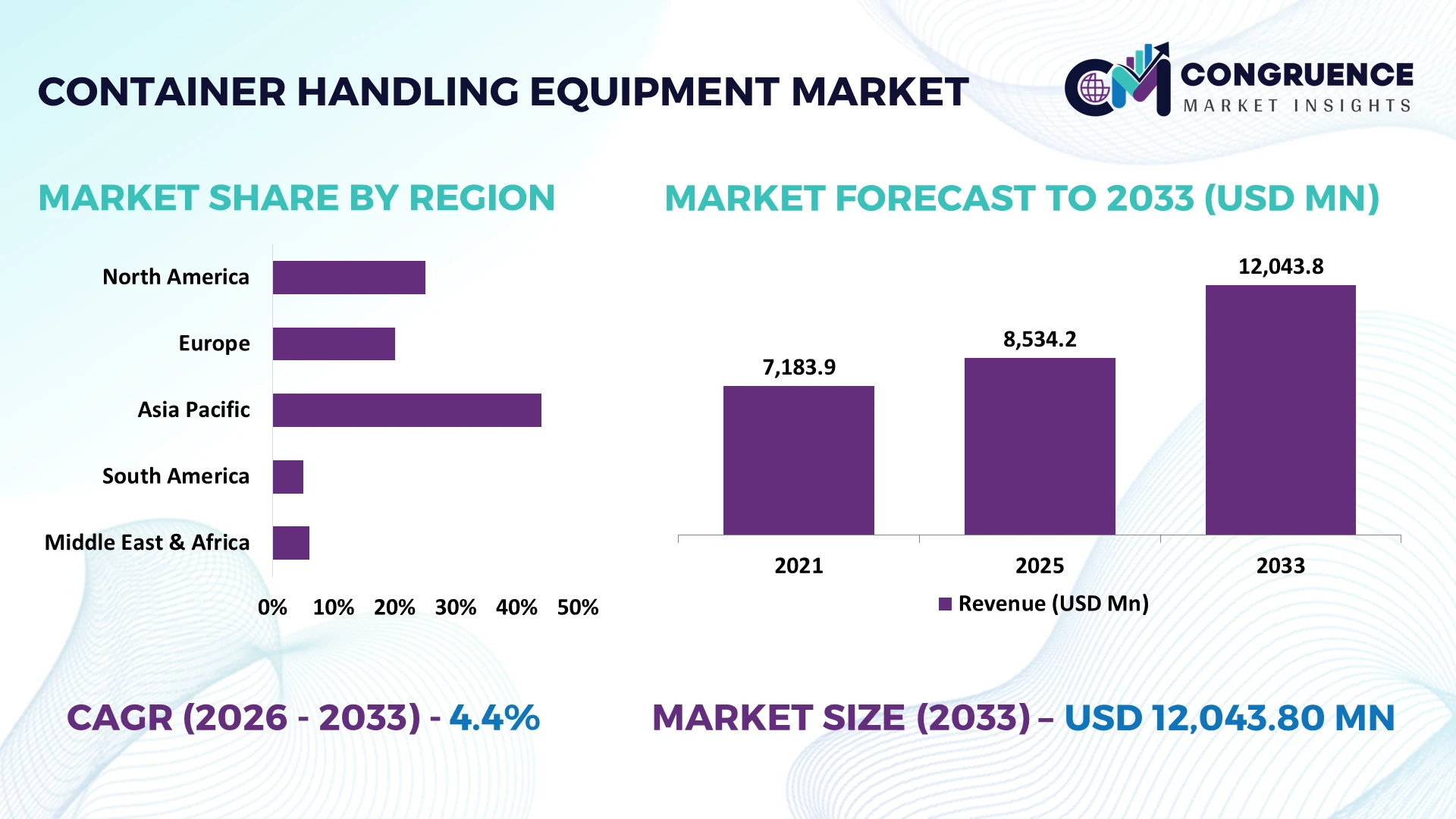
The Global Container Handling Equipment Market was valued at USD 8534.19 Million in 2025 and is anticipated to reach a value of USD 12043.8 Million by 2033 expanding at a CAGR of 4.4% between 2026 and 2033. Growth is driven by automated terminal expansion, electrification of rubber-tired gantry cranes, and rising equipment replacement requirements across high-throughput container ports.
China dominates global container handling equipment demand through extensive port infrastructure, domestic crane manufacturing, and export-oriented logistics operations. Shanghai Port handled approximately 51.5 million TEUs in 2024, compared with Singapore's 41.12 million TEUs, representing approximately 25% higher throughput. Chinese manufacturers, including ZPMC, support automated ship-to-shore crane deployment and intelligent terminal operations. China's approximately USD 19 billion investment in coastal port infrastructure during 2024 strengthened equipment procurement opportunities, while US scrutiny of Chinese-made port cranes is reshaping international sourcing decisions.
Strategic implication: Equipment suppliers must prioritize automated crane integration, electrified terminal fleets, and geographically diversified manufacturing to secure long-term port modernization contracts.
Key Highlights of the Global Container Handling Equipment Market
-
Market Size & Growth: USD 8,534.19 million in 2025, reaching USD 12,043.8 million by 2033 at 4.4% CAGR, supported by automated crane procurement and terminal modernization.
-
Top Growth Drivers: Three priorities include crane electrification targeting 100% elimination of onsite diesel combustion, automation-led productivity, and equipment lifecycle optimization.
-
Short-Term Forecast: By 2028, the implied market value reaches approximately USD 9,709 million, strengthening procurement requirements for electric drives and automated stacking systems.
-
Emerging Technologies: Three innovations include AI-assisted crane scheduling, autonomous straddle carriers, and battery-electric reach stackers with regenerative braking.
-
Regional Leaders: Asia-Pacific, Europe, and North America lead strategic deployment; their individual 2033 USD forecasts require validated regional market allocations.
-
End-User Trends: Shanghai's approximately 51.5 million TEUs in 2024 demonstrate equipment intensity at major container terminals and the importance of reliable crane availability.
-
Pilot/Case Example: Singapore's Tuas Port handled approximately 10 million TEUs in 2024, demonstrating scaled deployment of automated container handling infrastructure.
-
Competitive Landscape: ZPMC competes with Konecranes, Kalmar, Liebherr, and SANY; its frequently reported 70% global share concerns ship-to-shore cranes, not the entire equipment market.
-
Regulatory & ESG Impact: The IMO's 2023 strategy targets at least 20% international shipping emissions reduction by 2030, supporting broader port decarbonization investments.
-
Investment & Funding: The US Port Infrastructure Development Program received approximately USD 580 million in fiscal 2024 funding, supporting modernization and infrastructure improvements.
-
Innovation & Future Outlook: Tuas Port targets 65 million TEUs of annual handling capacity upon completion, reinforcing demand for automated, remotely operated equipment.
The container handling equipment market is shifting toward automated, electrified, and digitally coordinated terminal operations as ports manage larger vessels and concentrated cargo arrivals. Ship-to-shore cranes, rubber-tired gantry cranes, reach stackers, and automated guided vehicles remain central to terminal productivity. Advanced equipment increasingly integrates remote operation, predictive maintenance, and regenerative drive systems to improve availability and energy efficiency. Shanghai's 2024 throughput exceeded Singapore's by approximately 25%, highlighting differences in equipment deployment intensity. Meanwhile, US port cybersecurity measures and procurement scrutiny are influencing crane sourcing strategies, establishing equipment interoperability and supply-chain resilience as critical strategic priorities.
What Is the Strategic Relevance and Future Pathways of the Container Handling Equipment Market?
Container handling equipment is becoming strategically critical as port operators prioritize terminal productivity, supply-chain resilience, and automated cargo movement. Increasing vessel sizes and concentrated shipping schedules are accelerating investment in automated stacking cranes, electric rubber-tired gantry cranes, and integrated terminal operating systems. Singapore's Tuas Port is designed for an eventual annual capacity of 65 million TEUs, demonstrating the infrastructure scale required for next-generation maritime logistics. Meanwhile, US restrictions and cybersecurity scrutiny involving Chinese-manufactured port cranes are encouraging procurement diversification and stronger equipment security requirements.
Electrified container handling equipment provides measurable operational advantages over diesel-powered machinery. Battery-electric systems eliminate 100% of direct diesel exhaust emissions during operation, while regenerative braking reduces energy losses during lifting and lowering cycles. China dominates crane manufacturing and high-volume terminal deployment, whereas European operators emphasize equipment electrification, remote operation, and energy management. Singapore demonstrates advanced automation through coordinated deployment of autonomous vehicles and remotely controlled yard cranes.
Between 2026 and 2028, port investment will increasingly target predictive maintenance, automated equipment dispatch, and standardized charging infrastructure. At Tuas Port, automated guided vehicles and remotely operated cranes demonstrate integrated container movement across terminal operations. Konecranes, Kalmar, and ZPMC are strengthening automation capabilities and equipment service partnerships. Competitive advantage will depend on reliable equipment availability, interoperable control systems, and lower lifecycle operating costs.
Container Handling Equipment Market Dynamics
DRIVER:
Automated Terminal Expansion and Equipment Electrification
Increasing container throughput and larger vessel calls are accelerating investment in high-capacity cranes and automated terminal equipment. Shanghai handled approximately 51.5 million TEUs in 2024, around 25% more than Singapore, highlighting the scale of equipment utilization at major ports. Electrified gantry cranes eliminate 100% of direct diesel combustion emissions during operation, supporting terminal decarbonization strategies. Singapore's Tuas Port development is restructuring container handling around automated guided vehicles and remotely controlled cranes. These technologies reduce dependence on manual equipment dispatch and improve operational coordination. Manufacturers including Konecranes and Kalmar are expanding electric equipment portfolios and integrating predictive maintenance systems. Suppliers offering automation-ready machinery and reliable charging infrastructure gain stronger positioning in long-term terminal modernization contracts.
RESTRAINT:
High Capital Requirements and Infrastructure Compatibility
Container handling equipment procurement faces substantial constraints from electrical infrastructure limitations, equipment replacement costs, and dependence on specialized components. Electrifying a diesel-powered terminal fleet requires high-capacity electrical connections, charging systems, and equipment-compatible power distribution. A terminal replacing 20 diesel machines with electric alternatives must accommodate 100% fleet conversion while maintaining cargo handling continuity. China's concentration in ship-to-shore crane manufacturing also creates sourcing exposure, particularly as the United States increases scrutiny of foreign-manufactured port equipment. Import duties, equipment certification, and local service availability influence procurement decisions. Operators are reducing financial and operational exposure through phased fleet replacement, diversified supplier contracts, and infrastructure assessments. Equipment manufacturers are responding with retrofit packages, modular power systems, and localized maintenance partnerships.
OPPORTUNITY:
Autonomous Equipment and Predictive Fleet Optimization
Automated equipment coordination offers substantial opportunities to improve container terminal productivity without proportional expansion of physical yard infrastructure. Singapore's Tuas Port is designed for 65 million TEUs of annual capacity upon completion, creating demand for synchronized automated cranes and horizontal transport systems. Predictive maintenance platforms can target 10–15% reductions in unplanned equipment downtime when supported by reliable condition-monitoring data and effective maintenance execution. Automated dispatch algorithms can also be evaluated against 5–10% improvements in equipment utilization through reduced idle movement and optimized job sequencing. These figures represent operational improvement targets rather than universal industry outcomes. Manufacturers are investing in digital twins, fleet management software, and terminal operating system partnerships. The strategic opportunity lies in upgrading existing equipment through software-enabled productivity improvements.
CHALLENGE:
Cybersecurity Integration and Automated Fleet Reliability
Integrating automated container handling equipment with terminal operating systems introduces cybersecurity, interoperability, and operational continuity challenges. A terminal operating 50 connected cranes and transport vehicles creates multiple industrial control endpoints requiring coordinated access management and security monitoring. Equipment availability targets of 99.5% permit approximately 43.8 hours of annual downtime per continuously operated machine, illustrating the importance of redundancy and preventive maintenance. In the United States, heightened scrutiny of port crane communication systems has increased attention to remote access controls and equipment cybersecurity. Mixed fleets also create integration complexity when proprietary control platforms use different communication protocols. Manufacturers must strengthen secure software architectures, standardized interfaces, technician training, and remote diagnostics. Sustained competitiveness depends on maintaining terminal productivity while preventing equipment failures from disrupting interconnected cargo handling operations.
Container Handling Equipment Market Latest Trends
-
Remote Crane Operations Gain Operational Scale: Container terminals are expanding remote operation centers to separate crane control from quay-side working environments. Singapore's Tuas Port is designed for 65 million TEUs of eventual annual capacity, integrating remotely controlled cranes with automated transport systems. Equipment suppliers are standardizing camera systems, operator interfaces, and low-latency communications. Centralized supervision improves workforce deployment flexibility while reducing exposure to hazardous operating zones.
-
Battery Charging Infrastructure Reshapes Fleet Procurement: Electric reach stackers and terminal tractors increasingly require coordinated charging infrastructure rather than isolated equipment purchases. A fleet containing 20 machines with 200 kWh batteries represents 4 MWh of installed storage capacity. Operators are evaluating charging schedules, transformer capacity, and equipment duty cycles before procurement. Manufacturers are developing battery management integration and service agreements that support predictable operating availability.
-
Port Crane Cybersecurity Changes Procurement Standards: United States authorities introduced additional scrutiny of Chinese-manufactured ship-to-shore cranes following 2024 cybersecurity directives. Equipment operators are strengthening remote access controls, network segmentation, and industrial control system monitoring. A terminal operating 40 connected cranes must maintain security governance across 40 equipment endpoints. Manufacturers are responding through secure communications architecture, software documentation, and expanded technical support arrangements.
-
Condition Monitoring Strengthens Equipment Lifecycle Planning: Crane operators increasingly deploy vibration sensors, motor temperature monitoring, and digital maintenance records to identify component deterioration. Equipment availability of 99% corresponds to approximately 87.6 annual downtime hours under continuous operation, compared with 43.8 hours at 99.5%. Suppliers are integrating diagnostics with maintenance scheduling platforms. This approach improves spare parts planning and reduces disruption from unexpected mechanical failures.
Segmentation Analysis
By Type
Container Cranes Lead Heavy-Duty Equipment Deployment
Container Cranes represent the leading equipment category in high-capacity maritime terminals, although a verified global market share percentage across the specified equipment types is unavailable. Ship-to-shore cranes and gantry systems dominate critical lifting operations because they accommodate large container vessels and intensive quay-side workloads. Modern ship-to-shore cranes can achieve lifting capacities exceeding 65 tonnes under twin-lift configurations, supporting higher handling productivity. Reach Stackers provide flexible container movement across smaller terminals and inland facilities, while Container Handlers support specialized container positioning. Forklift Trucks remain relevant where cargo handling requirements favor compact equipment and lower acquisition complexity.
Automated Guided Vehicles (AGVs) represent an emerging high-priority equipment category as terminal operators modernize horizontal container transport. Straddle Carriers compete through flexible stacking and transfer capabilities, particularly where terminal layouts do not justify extensive fixed infrastructure. Automated transport platforms reduce dependence on manually coordinated vehicle dispatch and support standardized movement sequences. Manufacturers are expanding autonomous navigation capabilities, electrified drivetrains, and fleet management integration. Investment decisions increasingly depend on equipment utilization, maintenance accessibility, and compatibility with existing terminal layouts rather than lifting capacity alone.
- The Port of Singapore Authority's 2025 operational developments at Tuas Port demonstrate large-scale deployment of automated terminal technologies, including remotely operated cranes and autonomous transport equipment. These installations reinforce the commercial relevance of integrated container handling systems.
By Application
Container Loading and Unloading Leads Equipment Utilization
Container Loading and Unloading represents the principal application for high-capacity container handling equipment, reflecting the operational importance of ship-to-shore cargo transfer. Its exact global market share remains unverified. Large container terminals depend on coordinated quay crane deployment to minimize vessel turnaround times and berth congestion. Shanghai Port handled approximately 51.5 million TEUs in 2024, demonstrating the intensity of equipment operations at major maritime gateways. Container Stacking and Retrieval represents another equipment-intensive application, requiring gantry cranes, reach stackers, and automated yard management systems. Intermodal Container Transfer supports movement between maritime terminals, road networks, and rail infrastructure.
Yard and Terminal Operations represent a strategically important emerging application as automation extends beyond individual lifting machines toward coordinated equipment fleets. Empty Container Handling remains essential for managing repositioning requirements and storage utilization. Equipment manufacturers are developing integrated control platforms, automated job allocation, and advanced positioning systems to improve operational consistency. Terminal operators increasingly prioritize equipment that reduces unnecessary container movements and supports predictable cargo flow across interconnected handling activities.
- Singapore's Maritime and Port Authority reported container throughput of approximately 41.12 million TEUs in 2024, reinforcing the importance of coordinated loading, stacking, and transfer operations in high-volume maritime logistics infrastructure.
By End-User
Seaports and Container Terminals Dominate Equipment Procurement
Seaports and Container Terminals represent the leading end-user category because large maritime facilities require substantial investments in ship-to-shore cranes, stacking equipment, and horizontal transport systems. Their precise global market share across the specified end-user groups is not independently established. Major ports operate equipment fleets designed to handle continuous vessel arrivals and concentrated container movements. Singapore's Tuas Port development illustrates the scale of infrastructure modernization, with planned eventual handling capacity of 65 million TEUs annually. Inland Container Depots rely more heavily on reach stackers and flexible container handling systems, reflecting lower equipment density and different operational requirements.
Rail Freight Terminals represent an important expansion area as intermodal logistics networks seek faster container transfers between rail and road infrastructure. Logistics and Warehousing Companies prioritize compact equipment, efficient yard utilization, and flexible fleet deployment. Shipping and Freight Operators increasingly evaluate handling equipment partnerships to improve container turnaround and reduce storage delays. Manufacturers are adapting through equipment leasing, modular automation packages, and localized service networks. Competitive differentiation increasingly depends on matching equipment capabilities with terminal throughput, operating schedules, and infrastructure limitations.
- UNCTAD's Review of Maritime Transport 2025 highlighted continued pressure on global maritime logistics from trade disruptions and changing shipping routes. These developments strengthen the operational importance of resilient port infrastructure, efficient container handling, and coordinated intermodal transportation systems.
Region-Wise Market Insights
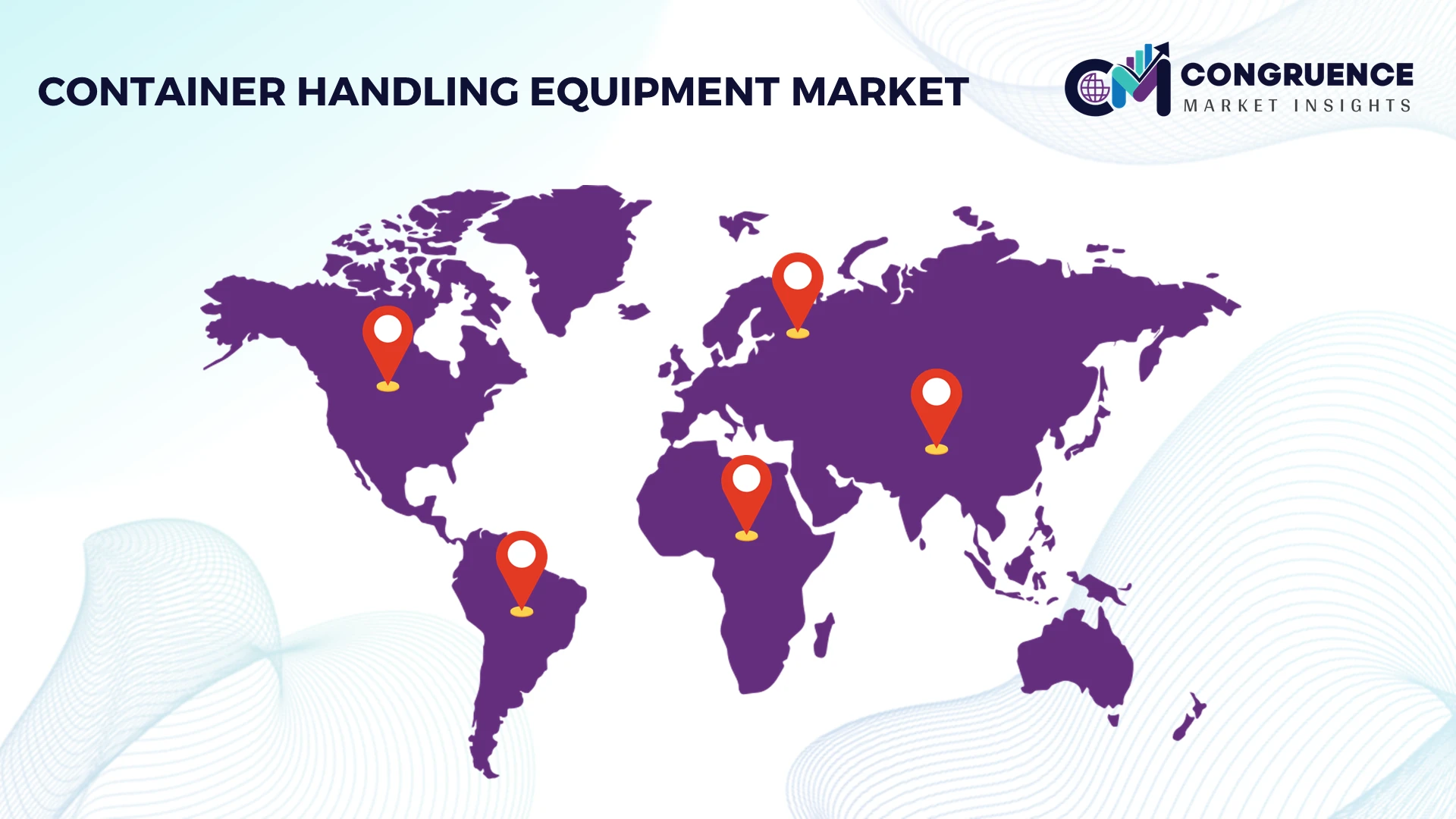
Asia-Pacific accounted for the largest market share at an estimated 46% in 2025 however, Middle East & Africa is expected to register the fastest growth, expanding at an indicative CAGR of 6.2% between 2026 and 2033.
North America Container Handling Equipment Market
Port Modernization and Procurement Security Reshape Equipment Investment
North America accounted for an estimated 19% of the global container handling equipment market in 2025, supported by established maritime gateways, intermodal logistics networks, and terminal modernization programs. The United States leads regional procurement through container terminals in Los Angeles, Long Beach, New York, and Savannah. The Port of Los Angeles handled approximately 10.3 million TEUs in 2024, demonstrating substantial equipment utilization across ship-to-shore cranes and terminal transport systems. Federal cybersecurity directives concerning foreign-manufactured cranes are influencing procurement requirements and equipment monitoring practices. Canada contributes through Vancouver and Prince Rupert, where rail connectivity supports integrated container movement. Equipment manufacturers are strengthening domestic service capabilities, remote diagnostics, and electrification portfolios. Operators increasingly prioritize crane availability, equipment cybersecurity, and terminal operating system compatibility when selecting machinery for infrastructure upgrades.
United States Market Outlook: The United States benefits from extensive maritime infrastructure and federal port modernization funding. The Environmental Protection Agency announced approximately USD 3 billion in Clean Ports Program awards in October 2024, supporting zero-emission equipment and infrastructure projects. This investment strengthens procurement opportunities for electric yard tractors, container handling machinery, charging systems, and associated terminal power infrastructure.
Europe Container Handling Equipment Market
Terminal Electrification and Automation Drive Fleet Replacement
Europe represented an estimated 25% of global container handling equipment demand in 2025, supported by established maritime logistics infrastructure and advanced port automation capabilities. Rotterdam, Antwerp-Bruges, Hamburg, and Valencia represent important equipment deployment centers. The Port of Rotterdam handled approximately 13.8 million TEUs in 2024, reinforcing demand for high-capacity container cranes and automated yard equipment. European terminal operators increasingly prioritize battery-electric machinery, automated guided vehicles, and energy-efficient lifting systems. The European Union's Alternative Fuels Infrastructure Regulation strengthens the broader transition toward lower-emission maritime infrastructure. Manufacturers including Konecranes, Kalmar, and Liebherr compete through equipment electrification, automation software, and lifecycle service agreements. Regional procurement increasingly evaluates total operating costs alongside equipment acquisition prices. Established engineering capabilities and sophisticated terminal management systems support deployment of integrated equipment fleets across major European container gateways.
Netherlands Market Outlook: The Netherlands benefits from Rotterdam's advanced automated terminal infrastructure and strong maritime engineering ecosystem. Rotterdam's Maasvlakte terminals demonstrate coordinated operation of automated stacking cranes and driverless transport systems. Dutch terminal operators prioritize efficient land utilization, digital equipment scheduling, and integrated logistics connectivity, creating opportunities for automation suppliers and specialized maintenance providers.
Asia-Pacific Container Handling Equipment Market
High-Volume Port Operations Strengthen Automated Equipment Manufacturing
Asia-Pacific dominated the global container handling equipment market with an estimated 46% share in 2025, supported by extensive port infrastructure, concentrated container throughput, and established equipment manufacturing capabilities. China, Singapore, South Korea, Japan, and India represent major operational and investment centers. Shanghai Port handled approximately 51.5 million TEUs in 2024, reflecting the equipment intensity of high-volume maritime gateways. China's ZPMC maintains substantial manufacturing capabilities in ship-to-shore cranes and automated terminal equipment, while Singapore is developing integrated container handling infrastructure at Tuas Port. India's Sagarmala initiative supports port modernization and improved logistics connectivity. Equipment manufacturers are expanding automated crane portfolios, electrified yard machinery, and integrated fleet control systems. Regional competitive advantages include proximity to component suppliers, established heavy engineering capacity, and large domestic infrastructure projects supporting equipment manufacturing economies of scale.
China Market Outlook: China combines large-scale crane manufacturing with extensive maritime logistics infrastructure. Ningbo-Zhoushan Port handled approximately 39.3 million TEUs in 2024, reinforcing demand for high-capacity lifting systems and automated yard equipment. Domestic manufacturers benefit from established steel fabrication, electric drive production, and industrial automation supply chains, supporting integrated equipment manufacturing and international export competitiveness.
South America Container Handling Equipment Market
Port Concession Investments Support Equipment Fleet Modernization
South America accounted for an estimated 6% of the global container handling equipment market in 2025, supported by port concession investment, agricultural exports, and mining-related logistics requirements. Brazil, Chile, Peru, and Colombia represent important equipment procurement markets. Brazil's Port of Santos handled approximately 5.4 million TEUs in 2024, demonstrating substantial demand for container cranes, reach stackers, and terminal transport machinery. Peru's Chancay Port, inaugurated in November 2024, introduced new deepwater container handling infrastructure and advanced terminal equipment. Regional operators increasingly prioritize equipment reliability, flexible yard operations, and maintenance accessibility. Imported machinery and fluctuating exchange rates influence acquisition costs, encouraging longer equipment service agreements and localized technical support. Manufacturers are strengthening distributor networks and offering equipment configurations suited to different terminal sizes and operating conditions.
Brazil Market Outlook: Brazil benefits from established port infrastructure and extensive agricultural export logistics. Santos remains the country's principal container gateway, while Paranaguá and Itajaí support additional maritime cargo movements. Brazil's Novo PAC infrastructure program emphasizes transportation modernization, creating opportunities for crane replacement, terminal electrification, and intermodal equipment investment. Suppliers offering domestic maintenance support and reliable spare parts availability gain procurement advantages.
Middle East & Africa Container Handling Equipment Market
Strategic Port Expansion Accelerates Automated Terminal Investment
The Middle East & Africa represented an estimated 4% of global container handling equipment demand in 2025, with infrastructure investment concentrated in the United Arab Emirates, Saudi Arabia, Morocco, and South Africa. Saudi Arabia's logistics transformation under Vision 2030 is supporting port modernization and increased container handling capacity. The UAE maintains advanced maritime infrastructure through Jebel Ali and Khalifa Port, where terminal operators deploy sophisticated cargo handling systems. Morocco's Tanger Med complex handled approximately 10.24 million TEUs in 2024, highlighting the importance of transshipment infrastructure. Equipment suppliers are expanding regional partnerships, automated crane installations, and maintenance service capabilities. In African markets, electricity infrastructure limitations and equipment financing constraints influence modernization schedules. Operators increasingly prioritize reliable machinery, phased automation, and equipment configurations compatible with local operating conditions and maintenance resources.
United Arab Emirates Market Outlook: The UAE benefits from established logistics infrastructure and international terminal operating expertise. DP World operates Jebel Ali Port, a major maritime gateway connecting Asian, European, and African trade routes. Khalifa Port's expanding container terminal infrastructure supports advanced crane deployment and automated cargo movement. The country's industrial diversification strategy encourages investment in port technology, digital logistics, and equipment service ecosystems.
Market Competition Landscape
ZPMC, Konecranes, Kalmar, Liebherr, and SANY compete through crane manufacturing, equipment electrification, automation integration, and global service networks. ZPMC dominates ship-to-shore crane manufacturing, with an estimated 70% share of that specific segment; the combined share of the five largest suppliers across all container handling equipment remains unverified. Konecranes and Kalmar emphasize automated terminal solutions, while Liebherr competes through heavy-duty lifting engineering. SANY targets competitive equipment pricing and manufacturing scale. Electric equipment eliminates 100% of direct diesel combustion emissions during operation, while automated fleet management supports improved equipment utilization. Manufacturers are expanding regional service operations, developing battery-electric portfolios, and integrating predictive maintenance platforms. Procurement scrutiny of Chinese-manufactured cranes is encouraging supply-chain diversification. High manufacturing capital requirements, specialized engineering expertise, and extensive aftersales infrastructure create entry barriers. Competitive leadership requires reliable equipment, integrated automation, competitive lifecycle costs, and dependable maintenance capabilities across international terminals.
Companies Profiled in the Container Handling Equipment Market Report
-
Shanghai Zhenhua Heavy Industries Co., Ltd. (ZPMC)
-
Konecranes Plc
-
Kalmar Corporation
-
Liebherr Group
-
SANY Heavy Industry Co., Ltd.
-
Hyster-Yale, Inc.
-
Toyota Industries Corporation
-
Mitsubishi Logisnext Co., Ltd.
-
CVS Ferrari S.p.A.
-
Hyundai Heavy Industries Co., Ltd.
-
Terex Corporation
-
Anhui Heli Co., Ltd.
-
Lonking Holdings Limited
-
Doosan Bobcat Inc.
Technology Insights for the Container Handling Equipment Market
Container handling equipment increasingly integrates electric drivetrains, remote crane controls, and automated positioning systems to improve terminal productivity. Battery electric reach stackers eliminate 100% of direct diesel exhaust emissions, while regenerative lifting systems recover energy during load lowering. Modern ship to shore cranes employ optical sensors, anti sway controls, and automated landing assistance to improve positioning accuracy. Singapore's Tuas Port demonstrates commercial deployment of remotely operated cranes and autonomous transport vehicles. Compared with conventional diesel equipment, electric alternatives eliminate onsite fuel combustion and reduce mechanical servicing requirements, strengthening operational predictability across intensive container handling schedules.
Emerging technologies include AI assisted dispatch, digital twins, and predictive maintenance analytics. Sensor networks monitor motor vibration, hydraulic pressure, and component temperatures, enabling maintenance decisions based on equipment condition. Improving equipment availability from 99% to 99.5% reduces annual downtime by 50%, assuming continuous operation. Konecranes and Kalmar benefit from integrated automation capabilities, while smaller manufacturers compete through modular retrofits and specialized equipment configurations. Automated guided vehicles also improve coordination between quay operations and container stacking areas.
Between 2026 and 2028, investment will prioritize interoperable control software, battery charging integration, and secure industrial communications. Manufacturers combining autonomous operation with dependable maintenance support will strengthen procurement competitiveness and terminal reliability.
Recent Developments in the Global Container Handling Equipment Market
-
July 2026: Kalmar secured an agreement with Brazilian terminal operator Portonave to supply five electric reachstackers for its Navegantes facility. Scheduled for fourth-quarter delivery, the equipment supports fleet electrification, reduces diesel dependence, and strengthens operational sustainability at Brazil's container gateway. Source: kalmarglobal.se
-
June 2025: Liebherr delivered two ship-to-shore container cranes to Jacksonville Port Authority, each featuring 65-long-ton lifting capacity and regenerative power systems. The equipment strengthens handling capability for wider vessels, improves energy recovery during lowering operations, and supports terminal modernization. Source: jaxport.com
-
April 2025: ZPMC dispatched the final crane shipment for Colombo East Container Terminal, completing equipment deliveries comprising 12 ship-to-shore cranes and 40 automated rail-mounted gantry cranes. The installation expands vessel-handling capability and strengthens Sri Lanka's position in regional transshipment logistics. Source: seatrade-maritime.com
-
September 2025: ZPMC supplied two Post-Panamax quay cranes to Johor Port, Malaysia, under an RM71.2 million equipment investment. The additional lifting infrastructure improves handling capacity for larger container vessels, strengthens terminal productivity, and supports the port's competitive positioning. Source: mmcports.com.my
Scope of the Container Handling Equipment Market Report
The Container Handling Equipment Market Report examines industry developments from 2026 to 2033 across six equipment categories: Reach Stackers, Container Cranes, Straddle Carriers, Container Handlers, Automated Guided Vehicles, and Forklift Trucks. Application coverage includes Container Loading and Unloading, Container Stacking and Retrieval, Intermodal Container Transfer, Yard and Terminal Operations, and Empty Container Handling. Five end-user categories are evaluated, including Seaports and Container Terminals, Inland Container Depots, Logistics and Warehousing Companies, Rail Freight Terminals, and Shipping and Freight Operators.
Regional assessment covers North America, Europe, Asia-Pacific, South America, and the Middle East & Africa, examining equipment procurement, manufacturing capacity, and port modernization. Competitive analysis evaluates 14 major manufacturers, alongside technologies including electrified drivetrains, autonomous navigation, predictive maintenance, and remote crane operations. Findings support equipment investment, supplier selection, fleet modernization, and strategic expansion planning.
Container Handling Equipment Market Report Summary
| Report Attribute/Metric | Report Details |
|---|
Market Revenue in 2025 | USD 8534.19 Million |
Market Revenue in 2033 | USD 12043.8 Million |
CAGR (2026 - 2033) | 4.4% |
Base Year | 2025 |
Forecast Period | 2026 - 2033 |
Historic Period | 2021 - 2025 |
Segments Covered | By TypeAutomated Guided Vehicles (AGVs)
By ApplicationContainer Loading and Unloading Container Stacking and Retrieval Intermodal Container Transfer Yard and Terminal Operations
By End-UserSeaports and Container Terminals Logistics and Warehousing Companies Shipping and Freight Operators
|
Key Report Deliverable | Revenue Forecast, Growth Trends, Market Dynamics, Segmental Overview, Regional and Country-wise Analysis, Competition Landscape |
Region Covered | North America, Europe, Asia-Pacific, South America, Middle East, Africa |
Key Players Analyzed | Shanghai Zhenhua Heavy Industries Co., Ltd. (ZPMC), Konecranes Plc, Kalmar Corporation, Liebherr Group, SANY Heavy Industry Co., Ltd., Hyster-Yale, Inc., Toyota Industries Corporation, Mitsubishi Logisnext Co., Ltd., CVS Ferrari S.p.A., Hyundai Heavy Industries Co., Ltd., Terex Corporation, Anhui Heli Co., Ltd., Lonking Holdings Limited, Doosan Bobcat Inc. |
Customization & Pricing | Available on Request (10% Customization is Free) |





