
Reports
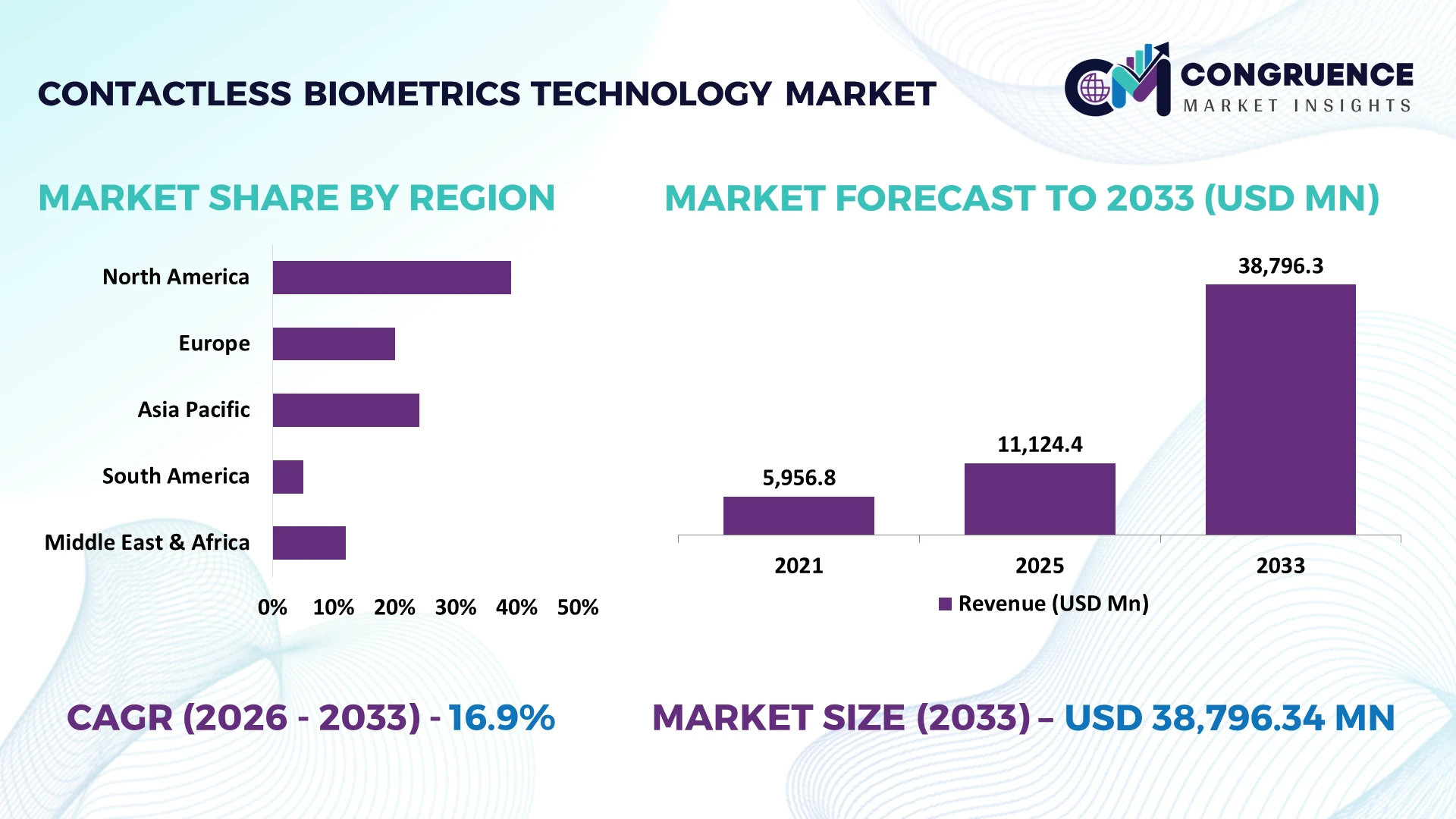
The Global Contactless Biometrics Technology Market was valued at USD 11124.35 Million in 2025 and is anticipated to reach a value of USD 38796.34 Million by 2033 expanding at a CAGR of 16.9% between 2026 and 2033. Growth is driven by AI-enabled facial authentication, automated airport identity verification, touchless payment security, and government digital-ID infrastructure replacing physical credentials across high-volume authentication environments.
The United States dominates country-level adoption, supported by airport security, BFSI, government identity, and enterprise access control, while India is rapidly scaling contactless authentication. India surpassed 200 crore Aadhaar face-authentication transactions by August 2025, doubling from 100 crore within six months. The U.S. maintains stronger commercial deployment, whereas India demonstrates faster national-scale digital-ID adoption, reinforced by expanding biometric infrastructure and regulatory modernization.
Strategic decisions should prioritize scalable AI-biometric platforms, privacy-compliant architectures, and high-volume authentication infrastructure.
Market Size & Growth: USD 11.12 billion in 2025 to USD 38.80 billion by 2033 at a 16.9% CAGR, driven by AI facial recognition and automated identity verification.
Top Growth Drivers: AI integration contributes 16%; airport automation 14%; digital-ID expansion 12%.
Short-Term Forecast: By 2030, automated biometric verification targets 25% faster processing and 15% lower authentication costs.
Emerging Technologies: AI facial recognition, contactless fingerprint imaging, multimodal biometrics, and edge authentication are accelerating advanced deployments.
Regional Leaders: North America leads commercial adoption; Europe expands privacy-compliant systems; Asia Pacific accelerates government digital-ID deployment.
Consumer & End-User Trends: India reached 200 crore Aadhaar face-authentication transactions, doubling from 100 crore within six months.
Pilot & Case Example: 2025 U.S. airport biometric deployments delivered approximately 46% faster passenger processing in selected operational environments.
Competitive Landscape: Leading companies include HID Global, NEC, IDEMIA, Thales, and Fujitsu, competing across high-volume identity and authentication deployments.
Regulatory & ESG Impact: EU AI Act biometric provisions applicable from February 2025 are increasing emphasis on privacy-by-design and controlled biometric processing.
Investment & Funding: Airport and government identity programs are directing billions of dollars into biometric infrastructure, supporting partnerships, modernization, and geographic expansion.
Innovation & Future Outlook: AI, multimodal recognition, edge processing, and privacy controls are shifting competition toward secure, interoperable identity ecosystems.
Contactless Biometrics Technology is expanding across airports, BFSI, government services, healthcare, retail, and enterprise access control, with facial recognition remaining the leading high-volume application. AI-driven verification, edge processing, and multimodal authentication are strengthening accuracy and operational speed, while India’s 200-crore face-authentication milestone demonstrates rapid deployment at national scale. The EU’s 2025 biometric-AI restrictions reinforce privacy-compliant innovation, supporting the next phase of strategic technology investment.
Contactless biometrics is becoming strategically important because organizations are replacing physical credentials and touch-based authentication with faster, scalable identity verification. Facial recognition, iris scanning, and contactless fingerprint technologies are strengthening airport throughput, financial security, healthcare access, and government digital identity. By 2028, enterprise deployments are expected to prioritize multimodal authentication, with AI-based verification increasingly integrated into existing identity-management infrastructure.
A major market shift is infrastructure modernization: governments and enterprises are redesigning identity systems around mobile credentials, cloud platforms, edge computing, and privacy-by-design architectures. Compared with legacy card-and-PIN authentication, AI-enabled contactless verification can reduce authentication time by approximately 30–50% while lowering credential-management requirements. The United States remains a major commercial deployment market, whereas India is advancing faster in population-scale digital identity, demonstrated by more than 200 crore Aadhaar face-authentication transactions by 2025.
Over the next 2–3 years, companies will focus on improving interoperability, reducing false-match rates, and integrating biometric engines with access-control and payment platforms. Airports provide a practical deployment model, using automated facial verification to reduce passenger processing friction. Competitive advantage will increasingly depend on secure integration, deployment scale, and the ability to combine convenience with regulatory compliance.
AI-enabled facial recognition and multimodal authentication are accelerating enterprise adoption, with automated verification capable of reducing authentication time by 30–50% versus conventional credential checks. India’s Aadhaar ecosystem surpassed 200 crore face-authentication transactions in 2025, demonstrating population-scale acceptance. In the United States, airports continue expanding biometric passenger processing to modernize identity infrastructure. The shift toward edge AI also reduces dependency on centralized processing and improves response speed. Companies are investing in computer-vision algorithms, biometric sensors, and interoperable identity platforms while forming partnerships with airports, financial institutions, and government agencies. The sharpest strategic advantage is moving from standalone biometric devices toward integrated identity ecosystems that generate recurring software and service opportunities.
High-performance contactless biometric systems require specialized cameras, sensors, edge processors, network infrastructure, and secure data environments, creating deployment costs that can remain 20–40% above basic credential-based systems in complex installations. Interoperability remains another constraint, particularly where organizations operate fragmented access-control and identity databases. In India, rapid digital-ID expansion contrasts with uneven modernization across smaller enterprises, while European deployments face stricter biometric-data governance. Supply-chain exposure for imaging sensors and specialized processing components can also delay installations. Companies are responding through modular hardware, multi-year procurement contracts, localized integration, and software-based upgrades. The key operational issue is not biometric accuracy alone but achieving consistent performance across heterogeneous infrastructure without escalating lifecycle costs.
Edge AI, privacy-preserving biometrics, and multimodal authentication create high-value opportunities beyond conventional facial recognition. On-device processing can reduce data-transfer requirements by approximately 30–50%, while multimodal systems can improve authentication resilience by combining facial, iris, voice, or fingerprint signals. India offers substantial opportunities through digital public infrastructure, while Japan and Singapore are advancing smart-airport and automated identity applications. Companies are increasing R&D investment in low-light recognition, liveness detection, and privacy-enhancing computation, while technology providers are building partnerships across airports, banks, healthcare networks, and border-control systems. A less visible opportunity lies in biometric-as-a-service models, allowing smaller enterprises to access advanced authentication without owning extensive infrastructure and accelerating adoption through subscription-based deployment.
Scaling contactless biometrics across complex environments requires consistent recognition performance, cybersecurity controls, and integration with legacy identity platforms. False-rejection rates below 2% are increasingly important for high-throughput environments, while authentication latency targets below 1 second are becoming operational benchmarks. Deepfake attacks and presentation attacks add further pressure as generative AI improves spoofing capabilities. U.S. airports and financial institutions therefore require continuous liveness detection, encrypted biometric templates, and real-time monitoring rather than one-time deployment. Companies must increase investment in cybersecurity, AI model validation, workforce training, and automated system testing. The critical challenge is sustaining reliable authentication across millions of interactions while meeting evolving privacy requirements without sacrificing speed, user experience, or operational continuity.
AI Facial Recognition Scaling: Facial recognition is moving from isolated verification to continuous, AI-assisted authentication, with deployment accuracy increasingly exceeding 95% in controlled environments. U.S. enterprises are integrating liveness detection and edge processing, reducing verification latency by 30–50% while improving throughput and limiting centralized data exposure.
Airport Biometrics Accelerating: Airport biometric usage reached 50% of surveyed passengers in 2025, up from 46% in 2024, while 85% reported satisfaction with biometric processing. Airlines are expanding interoperable digital-ID workflows, shifting investment from individual checkpoints toward connected passenger journeys and reducing repetitive document handling.
Privacy Controls Reshaping Deployment: China’s 2025 facial-recognition rules require consent, visible notification, and alternative authentication, while European compliance requirements are tightening deployment governance. Providers are responding with privacy-preserving architectures, encrypted biometric templates, and localized processing, making compliance capability a differentiator alongside recognition accuracy.
Contactless Payments Expanding: South Korea’s facial-payment ecosystem has reached 4.8 million users and approximately 330,000 retail locations, demonstrating commercial-scale adoption beyond security applications. Payment providers are combining facial authentication with encrypted transaction credentials, while retailers prioritize faster checkout and reduced dependence on physical cards.
Facial Recognition remains the leading type, accounting for approximately 45% of contactless biometric deployment value, supported by camera availability, smartphone compatibility, passive authentication, and straightforward integration with existing video infrastructure. Its scalability makes it particularly strong across airports, financial services, government identity, and enterprise access control. Iris Recognition is the fastest-growing type, gaining traction where higher authentication assurance and low-contact verification justify specialized imaging infrastructure. Iris deployments are increasingly attractive in border control and high-security environments, while Voice Recognition retains relevance for remote authentication and call-center workflows. Gait Recognition remains comparatively niche, but its ability to identify individuals from movement patterns supports surveillance and continuous authentication applications.
Investment is therefore shifting toward multimodal platforms rather than single-modality systems. Companies are improving facial liveness detection, iris imaging, and voice anti-spoofing, with multimodal architectures targeting 20–30% stronger authentication resilience than isolated biometric methods. The strategic implication is clear: facial recognition secures scale, while iris and multimodal systems capture higher-value security applications.
Identity Verification leads the application landscape with an estimated 38% share, reflecting concentrated demand across government digital identity, banking onboarding, remote KYC, and enterprise authentication. Its strength comes from replacing manual document checks with automated biometric matching, reducing verification time by approximately 30–50%. Payment Authentication is the fastest-growing application as financial institutions and merchants introduce biometric transaction approval, particularly in digitally mature markets such as South Korea. Access Control remains a mature, recurring deployment area, while Border Control is gaining importance as governments modernize passenger processing and integrate biometric identity with digital travel credentials.
Companies are increasingly connecting identity verification with access control and payment ecosystems rather than deploying isolated applications. Payment authentication adoption is estimated to be advancing 15–20% faster than conventional biometric access-control deployments, driven by mobile commerce and tokenized credentials. The business impact is a shift toward unified identity platforms capable of serving multiple workflows, improving infrastructure utilization and strengthening customer retention.
Government is the dominant end-user, representing approximately 31% of deployment value, supported by national identity programs, border management, public security, and citizen-service infrastructure. Large government databases create substantial demand for scalable biometric matching and interoperability. Transportation is the fastest-growing end-user as airports and transit operators modernize passenger processing. Transportation deployments increasingly combine facial and iris recognition across check-in, security, immigration, and boarding, producing workflow efficiencies of roughly 20–40% in targeted processes. Banking & Finance remains a major commercial buyer, while Healthcare and Retail are expanding selectively where identity assurance and frictionless customer experiences justify investment.
Companies are tailoring solutions to buyer-specific requirements, with government contracts emphasizing interoperability and sovereignty, financial institutions prioritizing fraud prevention, and transportation operators demanding high-throughput processing. Healthcare increasingly favors privacy-preserving authentication, while retailers focus on rapid customer identification. The investment shift toward transportation is strategically significant because one biometric platform can support multiple operational touchpoints, improving asset utilization and creating broader ecosystem partnerships.
North America accounted for the largest market share at 32.9% in 2025 however, Asia-Pacific is expected to register the fastest growth, expanding at a CAGR of 19.8% between 2026 and 2033.
U.S. airport modernization is shifting biometrics toward integrated identity workflows
North America held the leading position in 2025, supported by established biometric technology providers, airport security modernization, financial authentication, and enterprise access-control deployment. The United States represents the region’s primary deployment center, with facial recognition increasingly integrated across airport check-in, security, immigration, and boarding processes. More than 80 U.S. airports have implemented or expanded biometric passenger-processing capabilities, strengthening demand for interoperable platforms. Financial institutions are also integrating AI-driven identity verification into remote onboarding and fraud-control workflows. Companies are responding through airport partnerships, cloud integration, edge processing, and multimodal authentication rather than standalone hardware expansion. The competitive shift favors suppliers that can connect biometric engines with existing identity, security, and passenger-management infrastructure.
United States Market Outlook: The United States remains the dominant country-level market because of its mature airport infrastructure, enterprise-security ecosystem, and sustained biometric deployment activity. More than 80 airports have implemented or expanded biometric passenger-processing capabilities, creating a substantial installed base for system upgrades. Federal border programs and private-sector identity verification are further strengthening demand for scalable, interoperable solutions.
Regulatory modernization is restructuring biometric deployment across borders
Europe is transitioning toward standardized biometric identity infrastructure through border modernization, digital identity programs, and stricter data-governance requirements. The Entry/Exit System is reshaping deployment priorities across Schengen countries by requiring biometric registration and verification for non-EU travelers. Germany, France, Italy, and Spain represent important deployment centers because of their substantial passenger volumes and border infrastructure. The European operating environment increasingly favors privacy-preserving architectures, encrypted biometric templates, and transparent processing controls. Companies are therefore adapting products around regulatory compliance rather than treating privacy as an add-on feature. Airport operators and technology providers are also emphasizing interoperability to prevent fragmented deployment across national systems. This creates a structural advantage for vendors combining biometric accuracy with certification, integration expertise, and secure identity-management capabilities.
Germany Market Outlook: Germany provides a strong deployment base through major international airports, advanced industrial infrastructure, and established digital identity capabilities. Frankfurt Airport is a major international passenger hub, supporting demand for automated border processing and biometric verification. German buyers place strong emphasis on data sovereignty, interoperability, cybersecurity, and regulatory compliance when selecting biometric infrastructure.
Population-scale digital identity is driving high-volume biometric deployment
Asia-Pacific is gaining strategic importance through large-scale digital identity programs, smart-city infrastructure, airport modernization, and biometric payment adoption. India, China, Japan, and South Korea are leading deployment activity across government services, transportation, financial services, and retail authentication. India surpassed 200 crore Aadhaar face-authentication transactions in 2025, demonstrating exceptional utilization at population scale. China continues to integrate facial recognition into commercial and public-service workflows, while Japan and South Korea are advancing automated travel and payment authentication. Companies are responding with edge AI, multimodal recognition, scalable biometric databases, and localized processing. The region’s distinctive advantage is infrastructure reuse: national identity platforms increasingly support financial, mobility, and citizen-service authentication, creating larger deployment ecosystems than isolated security projects.
India Market Outlook: India is the strategically significant country because its national digital identity infrastructure supports biometric authentication at exceptional scale. Aadhaar face authentication crossed 200 crore transactions in 2025, encouraging investment in high-throughput biometric processing, domestic technology capabilities, cloud infrastructure, and identity-linked digital services across banking, government, and consumer applications.
Brazil is expanding biometrics through financial and public-security modernization
South America remains a developing deployment market, with Brazil serving as the primary commercial and institutional center for contactless biometric adoption. Banking authentication, digital identity, public security, airport modernization, and remote customer verification are strengthening demand. Brazil’s sophisticated financial infrastructure creates an important installed base for facial authentication and liveness detection, while Argentina, Chile, and Colombia are advancing government identity and border-control applications. Companies are emphasizing software integration and localized deployment because infrastructure quality varies substantially between major metropolitan areas and secondary markets. Financial institutions increasingly connect biometric authentication with fraud-management platforms rather than operating it as an isolated security layer. This approach reduces duplication and improves infrastructure utilization. The strategic opportunity lies in extending established banking and government identity systems into transportation and public services.
Brazil Market Outlook: Brazil leads South American adoption through its large banking ecosystem, advanced digital-payment infrastructure, and growing public-security requirements. Financial institutions provide a strong commercial base for facial recognition, liveness detection, and remote identity verification. Technology providers are increasingly targeting integrated platforms that connect banking authentication with broader government and transportation identity workflows.
Airport investment and smart-city programs are accelerating premium deployments
The Middle East & Africa market is being shaped by airport modernization, national digital identity programs, smart-city infrastructure, and high-security applications. The UAE is the principal deployment center, while Saudi Arabia is expanding biometric infrastructure across border management, pilgrimage services, and digital government. Dubai International is strengthening contactless passenger processing through biometric-enabled checkpoints and integrated identity workflows. Emirates announced an AED 85 million investment covering more than 200 biometric cameras at Dubai International, demonstrating the scale of airport-focused deployment. African markets remain more fragmented, with activity concentrated around national identity, banking, border management, and public security. Companies are responding through public-private partnerships, turnkey infrastructure, and systems integration. The region’s key advantage is the ability to deploy biometrics alongside newly modernized digital infrastructure rather than relying entirely on legacy systems.
United Arab Emirates Market Outlook: The UAE combines advanced airport infrastructure, smart-government programs, and strong investment capacity, creating a favorable environment for large-scale biometric deployment. Dubai International’s more than 200 biometric cameras supported by an AED 85 million Emirates investment demonstrate integrated deployment across passenger-processing touchpoints. The country is positioning biometrics as core infrastructure for seamless travel and digital identity.
The competitive landscape pits IDEMIA, NEC, Thales, HID Global, and Fujitsu against specialized biometric technology providers and regional innovators. The top five players collectively hold approximately 35–40% share, leaving meaningful space for differentiated suppliers. Competition centers on recognition accuracy, processing speed, interoperability, cybersecurity, customization, and deployment economics. Advanced platforms increasingly target 95%+ operational accuracy and 30–50% faster verification than manual workflows, while edge processing can reduce centralized data-transfer requirements by about 30%. Leading companies compete through airport contracts, government partnerships, cloud integration, multimodal authentication, and product localization. Regional players counter with customized deployments and lower integration costs, while global leaders emphasize scale, certification, and international interoperability. The competitive shift is moving from hardware differentiation toward integrated identity ecosystems and recurring software services. High barriers remain around algorithms, datasets, certifications, cybersecurity, and large-scale deployment experience. Winning requires secure technology, rapid integration, proven scalability, and strong infrastructure partnerships.
IDEMIA
NEC Corporation
Thales
HID Global
Fujitsu Limited
ASSA ABLOY
Aware, Inc.
M2SYS Technology
Touchless Biometric Systems AG
TECH5
Suprema Inc.
Innovatrics
FacePhi
BioID
AI-powered facial recognition now leads contactless deployment, with modern systems achieving over 99% recognition accuracy in real-world conditions. Edge processing cuts latency, while multispectral imaging improves performance in difficult lighting. These capabilities are replacing card-and-PIN workflows, with airport and enterprise deployments prioritizing faster, frictionless identity verification. By 2026, biometric airport use has reached 50% of surveyed travelers, reinforcing adoption beyond pilots into passenger processing.
Emerging multimodal face-and-iris authentication strengthens high-assurance verification by combining independent biometric signals. Walk-through systems can authenticate moving users from three meters, eliminating stopping requirements. Adoption is advancing through airports, border control, and secure facilities, while privacy-preserving biometric signatures reduce stored facial-data exposure and support regulatory compliance. Compared with single-factor credentials, multimodal systems improve authentication resilience by approximately 20–30% in high-security workflows, benefiting infrastructure operators and regulated enterprises.
Disruptive architectures will increasingly combine AI, edge computing, digital identity, liveness detection, and cloud orchestration through 2026–2028. Compared with manual verification, automated biometric workflows can deliver 30–50% faster processing, while edge matching reduces dependence on centralized data transfer. Competitive benefits favor vendors with interoperable platforms, while privacy-by-design and multimodal authentication become decisive procurement criteria. Companies acting now can secure integration advantages before fragmented legacy systems become costlier to modernize.
February 2026 IDEMIA partnered with Elenium to unify biometric passenger processing and AI baggage identification across airport touchpoints. Elenium’s automation has supported more than 1.7 billion passengers, strengthening scalable contactless workflows and reducing congestion through integrated curb-to-gate identity infrastructure worldwide. Source: idemia.com
December 2025 NEC partnered with emaratech to deploy six biometric smart gates for flydubai crew immigration in Dubai. The deployment replaced manual checks with automated contactless verification, improving clearance efficiency and strengthening integrated airport identity infrastructure at Dubai International Airport. Source: nec.com
April 2025 HID launched Amico facial-recognition readers for secure, contactless access control, targeting real-time identity verification. The NIST-tested technology supports enterprise deployments across Latin America, strengthening demand for frictionless authentication while reducing dependence on physical credentials across regulated enterprise environments. Source: hidglobal.com
November 2025 IATA reported that 50% of surveyed travelers had used airport biometrics, up from 46% in 2024. The adoption shift validates contactless identity workflows, with 85% reporting satisfaction and 74% willing to share biometrics for faster journeys across airports. Source: iata.org
The Contactless Biometrics Technology Market Report covers Facial Recognition, Iris Recognition, Voice Recognition, and Gait Recognition across Identity Verification, Access Control, Border Control, and Payment Authentication. End-user coverage includes Government, Banking & Finance, Healthcare, Retail, and Transportation, providing a structured view of deployment intensity, technology maturity, and evolving purchasing priorities. The report evaluates current contactless authentication adoption, multimodal integration, AI-enabled verification, edge processing, and privacy-preserving biometric architectures.
Regional assessment spans North America, Europe, Asia-Pacific, South America, and the Middle East & Africa, with country-level analysis emphasizing deployment concentration, infrastructure modernization, digital identity expansion, and airport automation. The study supports investment planning by identifying high-value applications, emerging technology pathways, competitive positioning, partnership opportunities, and expansion priorities. It also evaluates adoption patterns through 2026–2033, helping companies align product development, infrastructure investment, and market-entry strategies with changing authentication requirements.
| Report Attribute/Metric | Report Details |
|---|---|
Market Revenue in 2025 | USD 3309 Million |
Market Revenue in 2033 | USD 8796.79 Million |
CAGR (2026 - 2033) | 13% |
Base Year | 2025 |
Forecast Period | 2026 - 2033 |
Historic Period | 2021 - 2025 |
Segments Covered | By Type
By Application
By End-User
|
Key Report Deliverable | Revenue Forecast, Growth Trends, Market Dynamics, Segmental Overview, Regional and Country-wise Analysis, Competition Landscape |
Region Covered | North America, Europe, Asia-Pacific, South America, Middle East, Africa |
Key Players Analyzed | E Ink Holdings, DuPont, Molex, Ynvisible Interactive, TactoTek, Thin Film Electronics, NovaCentrix, Agfa-Gevaert, Optomec, Elephantech, Canatu, Nissha, LG Display, BASF |
Customization & Pricing | Available on Request (10% Customization is Free) |




