
Reports
The Global Contact Center Software Market was valued at USD 22525.6 Million in 2025 and is anticipated to reach a value of USD 44229.05 Million by 2033 expanding at a CAGR of 8.8% between 2026 and 2033. Growth is driven by AI-powered agent assistance, cloud-based omnichannel migration, automated quality management, and integration of contact-center platforms with CRM and enterprise workflow systems.
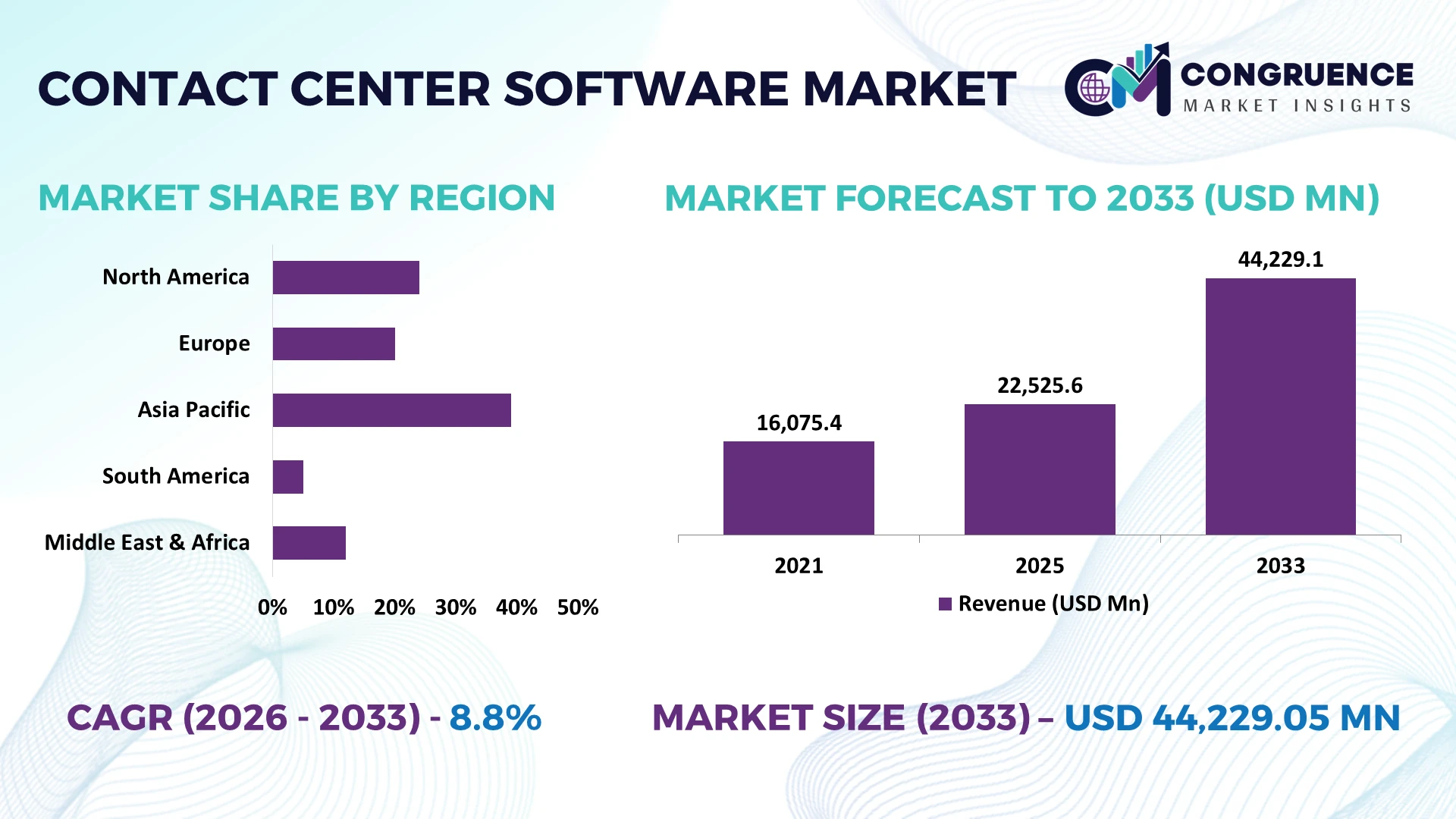
The United States dominates the market, accounting for approximately 54% of North America's contact center software value, supported by heavy enterprise cloud investment across BFSI, healthcare, retail, telecom, and technology. North America represented about 36.4% of the global market, while Asia-Pacific is expanding faster through digital-service expansion and large-scale cloud adoption. The EU AI Act is also accelerating demand for governed, auditable AI deployments.
Strategic implication: vendors prioritizing secure AI automation, omnichannel orchestration, and measurable agent productivity gains are best positioned for enterprise-scale expansion.
Market Size & Growth: USD 22.53 billion in 2025 and USD 44.23 billion by 2033 at 8.8% CAGR, driven by AI-enabled automation and cloud migration.
Top Growth Drivers: AI adoption 85%, cloud migration 60%, and omnichannel deployment 66% strengthen enterprise modernization.
Short-Term Forecast: By 2028, AI-assisted workflows are positioned to reduce routine agent workload by 15–25%.
Emerging Technologies: Generative AI, agentic AI, speech analytics, and real-time agent assistance are reshaping advanced platforms.
Regional Leaders: North America holds 36.4%, Europe prioritizes compliant AI, while Asia-Pacific delivers the strongest digital-service expansion.
Consumer/End-User Trends: 85% of service leaders planned customer-facing GenAI exploration or pilots in 2025.
Pilot/Case Example: 2025 AI deployments increasingly connected conversational automation with CRM and workflow systems, targeting 15–20% faster resolution.
Competitive Landscape: NiCE holds about 22.3% CCaaS share, competing with Genesys, Five9, Cisco, and Amazon Web Services.
Regulatory & ESG Impact: EU AI governance is increasing demand for explainability, audit trails, privacy controls, and compliant AI deployment.
Investment & Funding: AI customer-service funding reached USD 110 million in a major 2026 Series C transaction, reinforcing capital flows toward automation.
Innovation & Future Outlook: Agentic AI is shifting contact centers from assisted interactions toward autonomous resolution across CRM, billing, logistics, and back-office workflows.
Contact Center Software Market demand is concentrating across BFSI, retail, healthcare, telecom, and technology-driven service operations, where automation directly targets agent workload and resolution speed. AI voicebots, real-time sentiment analytics, agent-assist platforms, and workflow automation are moving deeper into production environments, with 85% of service leaders pursuing GenAI exploration or pilots. Regulatory scrutiny and cross-border data requirements are simultaneously pushing enterprises toward secure, governed, interoperable platforms, strengthening the strategic case for AI-native contact-center architectures.
Contact Center Software is becoming a strategic technology layer because customer interactions increasingly influence retention, service economics, and brand differentiation. Enterprises are replacing fragmented voice infrastructure with cloud-based omnichannel platforms that unify voice, chat, email, social messaging, CRM, and workforce analytics. AI-assisted routing and agent guidance can reduce handling effort by 15–25% versus legacy workflows, while automation shifts investment toward higher-value service operations.
The market is also being reshaped by data-sovereignty requirements, AI governance, and infrastructure modernization. The United States continues to lead large-scale enterprise deployments, while India and Southeast Asian markets emphasize cloud contact centers, multilingual automation, and cost-efficient delivery models. By 2028, enterprise adoption of generative and conversational AI across customer-service workflows is expected to move beyond pilot programs, with automated interactions increasingly handling 20–30% of routine requests.
Operationally, banks can deploy AI agents for authentication, transaction-status queries, and escalation before transferring complex cases to specialists. Vendors are responding through CRM integrations, AI partnerships, regional data centers, and vertical-specific platforms. Strategically, companies that combine automation with secure data architecture and measurable service productivity will gain stronger competitive positioning and lower operating complexity.
AI-led automation is the strongest structural driver as enterprises prioritize lower service costs and faster resolution. Generative AI adoption in customer service reached an 85% exploration or pilot intention level among service leaders entering 2025, while automated workflows can address roughly 20–30% of repetitive interactions in mature deployments. The United States is accelerating adoption through cloud-native CCaaS and CRM integration, while India is expanding multilingual AI-assisted service operations. The shift from rule-based IVR to conversational AI improves routing precision and reduces repetitive agent workloads. Vendors are responding with agent-assist, voicebot, sentiment analytics, and autonomous workflow partnerships, making AI capability a core differentiator rather than an optional platform feature.
Legacy integration remains a structural constraint because enterprises frequently operate fragmented CRM, telephony, workforce-management, and knowledge systems. Around 30–40% of large contact-center environments still require substantial integration or modernization work before advanced AI workflows can operate consistently. Data residency and privacy requirements also increase deployment complexity, particularly for companies serving European customers under stricter AI and data-governance frameworks. These constraints raise implementation workloads and prolong migration cycles. Companies are reducing exposure through API-first architectures, phased cloud migration, regional data hosting, and standardized integration contracts. The non-obvious impact is that interoperability, rather than software licensing cost alone, increasingly determines the economic value and deployment speed of enterprise contact-center modernization.
Agentic AI creates a high-value opportunity by moving contact centers from assisted conversations toward automated task completion. Advanced platforms can potentially automate 25–35% of routine service workflows when connected to CRM, billing, logistics, and knowledge systems. India, the Philippines, and other major service-delivery markets offer strong opportunities for multilingual conversational AI because large agent populations can be supplemented rather than simply expanded. Emerging voice AI, real-time translation, and predictive next-best-action engines are broadening addressable use cases. Vendors are investing in R&D partnerships and ecosystem integrations that connect customer-service software with enterprise applications. The strongest opportunity lies in automating the entire resolution journey rather than optimizing individual agent interactions.
Scaling AI across thousands of customer interactions creates execution challenges involving accuracy, cybersecurity, workforce adaptation, and governance. AI-generated responses require high-quality knowledge bases and monitoring because even a 2–5% error rate across high-volume interactions can generate significant escalation and compliance exposure. Enterprises also face growing cybersecurity pressure as contact-center platforms connect customer identity, payment, and CRM data. In the United States and Europe, evolving AI governance requirements are increasing the need for explainability, audit trails, access controls, and human escalation. Companies are addressing these pressures through model monitoring, zero-trust security, human-in-the-loop workflows, and specialized AI governance teams. Long-term competitiveness will depend on scaling automation without sacrificing trust, accuracy, or operational control.
Cloud Migration Is Accelerating: Cloud-based platforms are gaining ground as 34.0% of companies already use CCaaS, while 18.9% planned adoption by end-2025. Enterprises are replacing fixed infrastructure with scalable seat management and faster feature deployment, shifting budgets toward subscription-based architectures.
AI Is Moving Into Production: Gartner reported that 85% of customer-service leaders planned to explore or pilot customer-facing GenAI in 2025, including voicebots, while 5% already had deployments. Companies are moving beyond experimentation toward automated summaries, real-time assistance, and quality monitoring, reducing manual post-call workloads.
Unified Platforms Gain Preference: Integrated communications and contact-center environments are becoming procurement priorities as 69.1% of companies support at least some hybrid working. Enterprises increasingly consolidate telephony, messaging, CRM, workforce tools, and analytics to simplify administration, while vendors expand unified-platform partnerships and interoperability.
India’s AI Usage Is Surging: In 2025, 80% of surveyed Indian consumers reported using AI chatbots for service-related activities, while 82% said AI tools increased their service expectations. Enterprises are responding with multilingual automation, self-service, and faster escalation workflows, creating a less visible shift: customer expectations are now accelerating platform upgrades as much as cost reduction.
Cloud-Based contact center software represents the leading type, with approximately 45–50% share of deployments as enterprises prioritize elastic capacity, remote-agent support, CRM integration, and faster software updates. On-Premise platforms remain strategically important for highly regulated organizations, but their installed base is declining as infrastructure ownership becomes less attractive. Hybrid deployments retain roughly 15–20% adoption where companies require local control for sensitive workloads while shifting customer-facing applications to cloud environments.
AI-Powered software is the fastest-shifting type, with adoption accelerating as enterprises embed agent assistance, conversational automation, summarization, and predictive analytics into existing platforms. Omnichannel solutions remain critical, particularly for enterprises coordinating voice, chat, email, and social interactions. Companies are therefore directing product investment toward cloud-native AI and unified engagement rather than standalone telephony, while hybrid architectures serve as a transition mechanism for complex legacy environments.
Customer Service leads application demand at approximately 40–45% share because it handles the highest interaction volumes and directly influences retention, satisfaction, and resolution costs. Sales Support and Technical Support remain important secondary workloads, particularly for telecom, technology, and complex product businesses. Outbound Calling retains concentrated use in financial services and collections, while Workforce Management is gaining importance as enterprises optimize staffing across distributed and hybrid teams.
Technical Support is among the fastest-changing applications as AI knowledge retrieval, automated diagnostics, and agent-assist capabilities reduce dependence on manual escalation. Advanced platforms can redirect routine requests toward self-service while preserving specialist capacity for complex cases. Companies are integrating knowledge bases, CRM records, and interaction analytics to improve first-contact resolution and agent utilization. The operational shift is significant: application investment is moving from simply managing interaction volume toward orchestrating complete resolution workflows.
Banking represents the leading end-user group at approximately 25–30% share because high interaction volumes, authentication requirements, transaction support, and regulatory controls require sophisticated contact-center infrastructure. Telecommunications and Retail remain major adopters, while Healthcare is expanding through secure scheduling, patient support, and service coordination. E-commerce is increasingly focused on automated order, delivery, return, and account-related interactions.
E-commerce is the fastest-shifting end-user segment, supported by high digital interaction frequency and consumer expectations for immediate resolution. India provides a strong example, where 80% of surveyed consumers reported using AI chatbots for service-related activities in 2025. Healthcare buyers prioritize security and compliance, while telecom operators emphasize automation and large-scale workflow orchestration. Vendors are responding with vertical-specific AI, compliance controls, flexible pricing, and ecosystem partnerships. Competitive advantage is increasingly determined by how effectively platforms adapt automation to industry-specific workflows rather than by basic communication functionality.
North Americabold accounted for the largest market share at 36.4% in 2025 however, Asia-Pacificbold is expected to register the fastest growth, expanding at a CAGR of 11.2% between 2026 and 2033.
AI-led cloud migration is replacing fragmented enterprise contact infrastructure
North America maintains the strongest Contact Center Software Market position, supported by extensive cloud infrastructure, mature enterprise CRM ecosystems, and high adoption of AI-enabled customer-service platforms. The United States represents the regional deployment center, particularly across banking, telecommunications, healthcare, retail, and technology. Cloud-based contact-center adoption is accelerating as enterprises consolidate voice, messaging, analytics, and workforce management into unified environments. More than 34% of companies used CCaaS platforms in 2025, demonstrating a substantial shift away from infrastructure-intensive deployments. Large technology vendors are expanding AI partnerships and integrating generative AI, real-time transcription, and agent-assistance capabilities. Canada complements the market through financial services and public-sector modernization, while U.S. enterprises increasingly prioritize domestic data processing and cybersecurity controls.
United States Market Outlook: The United States remains the region’s principal technology and deployment hub, with sophisticated enterprise cloud infrastructure and concentrated investment from banking, healthcare, retail, and telecommunications companies. More than 80% of large U.S. enterprises operate hybrid or distributed workforces, strengthening requirements for centralized workforce management, secure remote-agent access, and AI-assisted customer interactions.
AI governance is reshaping compliant customer-service modernization
Europe is advancing Contact Center Software adoption through cloud modernization, workforce digitization, and stricter requirements for responsible AI and customer-data management. Germany, the United Kingdom, and France represent important enterprise deployment centers, with banking, insurance, telecommunications, and public services driving sophisticated use cases. The EU AI Act is increasing attention toward explainability, monitoring, human oversight, and auditable AI workflows, pushing vendors to strengthen governance capabilities. Approximately 40% of European enterprises are actively integrating AI into business processes, supporting demand for agent assistance and automated interaction analytics. Companies are increasingly selecting platforms that combine omnichannel engagement with regional data controls. The operational consequence is distinctive: compliance functionality is becoming a procurement differentiator rather than a back-office requirement.
Germany Market Outlook: Germany provides a strong industrial and enterprise technology base, supported by large banking, insurance, automotive, and manufacturing organizations with complex customer-service workflows. Enterprises increasingly prioritize private-cloud and hybrid architectures for sensitive information. Germany’s emphasis on data protection and controlled AI deployment is strengthening demand for auditable contact-center platforms with localized data governance.
High-volume digital services are accelerating cloud contact-center deployment
Asia-Pacific is becoming the most dynamic deployment environment as India, China, Japan, Australia, and Southeast Asian economies combine expanding digital services with large customer-support operations. India is particularly important because its IT-BPM ecosystem provides extensive contact-center expertise while enterprises rapidly adopt multilingual conversational AI. Approximately 80% of surveyed Indian consumers reported using AI chatbots for service activities in 2025, demonstrating strong behavioral readiness for automated engagement. China emphasizes domestic cloud and AI ecosystems, while Japan prioritizes automation amid workforce constraints. Vendors are expanding through regional cloud infrastructure, local partnerships, and language-specific AI models. The region’s strategic advantage is the combination of large interaction volumes and comparatively strong technical talent, allowing enterprises to scale automation while preserving human escalation for complex cases.
India Market Outlook: India is the region’s strongest operational growth hub, combining a large IT-BPM workforce, expanding enterprise cloud adoption, and extensive multilingual service requirements. In 2025, 80% of surveyed consumers reported using AI chatbots for service activities. This behavioral shift is encouraging banks, telecom operators, retailers, and technology companies to expand conversational AI and automated self-service.
Cloud adoption is overcoming fragmented legacy service infrastructure
South America is shifting from traditional voice-centric contact centers toward cloud-based omnichannel platforms, led by Brazil, Mexico-linked service operations, Colombia, and Chile. Brazil provides the largest enterprise opportunity through banking, telecommunications, retail, utilities, and e-commerce, where high interaction volumes encourage automation. Cloud deployment is particularly valuable for companies seeking flexible capacity without extensive local infrastructure investment. More than 60% of Brazilian enterprises have accelerated digital transformation initiatives, strengthening demand for CRM-integrated customer-service technologies. Economic volatility and uneven connectivity remain practical constraints, particularly for smaller operators. Vendors are responding through subscription pricing, localized implementation partnerships, and hybrid architectures. A key strategic shift is the increasing use of AI to handle repetitive Portuguese-language interactions while specialist agents focus on complex customer cases.
Brazil Market Outlook: Brazil is the region’s principal enterprise market, supported by its large banking, retail, telecommunications, and e-commerce ecosystems. Major service organizations require scalable platforms capable of managing high interaction volumes and distributed operations. Increasing cloud adoption is reducing dependence on dedicated contact-center infrastructure, while Portuguese-language conversational AI is improving automated self-service and agent productivity.
Digital infrastructure investment is creating new AI-ready service capacity
Middle East & Africa adoption is being shaped by large-scale digital infrastructure programs, customer-experience modernization, and investments in cloud-enabled enterprise services. The United Arab Emirates and Saudi Arabia are leading deployment activity through banking, telecommunications, government services, aviation, tourism, and smart-city programs. Saudi Arabia’s Vision 2030 transformation is accelerating digital customer-service infrastructure, while the UAE continues investing in AI-enabled government and commercial services. Cloud and AI deployments are increasingly integrated with CRM, identity management, analytics, and multilingual conversational interfaces. More than 70% of enterprises in leading Gulf markets have accelerated digital initiatives, supporting technology procurement. African markets remain more infrastructure-sensitive, encouraging hybrid and lightweight cloud architectures. Vendors are responding through local partnerships, regional data centers, and Arabic-language AI capabilities.
United Arab Emirates Market Outlook: The UAE provides the region’s strongest technology environment through advanced cloud infrastructure, government digitization, financial-services modernization, and smart-city investment. Its highly connected enterprise ecosystem supports sophisticated omnichannel deployment and AI-enabled service automation. Government and aviation applications are particularly important, with multilingual conversational systems increasingly integrated into high-volume customer-service workflows.
Global leaders such as NICE, Genesys, Cisco, Five9, and Amazon compete with regional cloud specialists and AI-native innovators including Talkdesk and Twilio. The market is moderately concentrated, with the top five players estimated to control about 50% of global CCaaS value. Competition centers on AI functionality, platform integration, deployment speed, pricing, and vertical customization. AI-enabled automation can reduce routine handling effort by 15–25%, while cloud migration can lower infrastructure administration costs by 10–20%. NICE and Genesys are expanding AI capabilities and enterprise partnerships; Five9 emphasizes intelligent automation, while Cisco leverages communications infrastructure integration. Regional providers compete through localization, multilingual support, and lower implementation costs. The competitive shift is moving from standalone contact-center software toward AI-orchestrated customer operations, raising interoperability and data-governance barriers. Winning requires scalable AI, secure integrations, rapid deployment, measurable productivity gains, and deep vertical workflows rather than basic omnichannel functionality alone.
NICE
Genesys
Cisco Systems
Five9
Talkdesk
Twilio
Amazon Web Services
Microsoft
Salesforce
Avaya
RingCentral
Cloud-native CCaaS remains the shift, replacing fixed telephony with elastic infrastructure, API connectivity, and administration. Cloud platforms can reduce infrastructure-management costs by 10–20% and accelerate feature deployment by 15–25% versus legacy on-premise environments. AI-assisted routing, speech analytics, automated summaries, and workforce optimization are moving into production. Around 34% of companies used CCaaS in 2025, creating an installed base for AI and CRM upgrades.
Generative AI and conversational AI are becoming the next layer, supporting agent assistance, knowledge retrieval, sentiment detection, and automated self-service. Mature deployments can reduce post-interaction work by 20–30% and improve agent productivity by 10–15%. Agentic AI represents the disruptive stage, linking conversations with CRM, billing, scheduling, and fulfillment systems to complete tasks rather than recommend actions. Technology leaders with strong data ecosystems gain a competitive advantage.
From 2026–2028, contact centers will combine cloud, AI, analytics, and automation into unified platforms. Enterprises are prioritizing model governance, cybersecurity, multilingual AI, and low-latency processing with productivity. Vendors are responding through partnerships, embedded AI, and vertical workflows. The strategic priority is shifting from purchasing features to building an intelligent operations layer capable of scaling automation while preserving human escalation for complex cases.
March 2024 Five9 launched GenAI Studio, enabling customized generative-AI models for contact-center applications. The platform served more than 2,500 organizations and supported over 1,400 partners, expanding enterprise customization and strengthening Five9’s AI differentiation across enterprise contact-center deployments worldwide. Source: five9.com
July 2025 Genesys secured $1.5 billion from Salesforce and ServiceNow, deepening strategic partnerships around agentic AI. Genesys Cloud had nearly $2.1 billion ARR and over 35% year-over-year growth, strengthening funding and ecosystem positioning for connected enterprise customer-experience transformation. Source: genesys.com
February 2026 NiCE reported enterprises deploying Agentic AI with containment rates above 80% and deployments 3x faster. The findings validated production-scale autonomous service, supporting faster automation, lower contact costs, and stronger customer-satisfaction performance across customer journeys and channels. Source: nice.com
November 2024 Intradiem partnered with Five9 to combine real-time automation with contact-center technology. Five9 represented more than 3,000 customers and 350,000 concurrent agent seats, extending automation reach and improving workforce capacity utilization across contact-center operations and teams.
The Contact Center Software Market Report covers cloud, on-premises, and hybrid deployment models, alongside core capabilities including omnichannel engagement, workforce optimization, interactive voice response, analytics, quality management, conversational AI, generative AI, and agentic automation. Segmentation spans enterprises and SMEs, with applications across customer service, sales, technical support, collections, and healthcare, financial, retail, and telecommunications environments.
Regional analysis covers North America, Europe, Asia-Pacific, South America, and the Middle East & Africa, while assessing emerging opportunities in AI-native platforms, digital-first contact centers, vertical-specific solutions, and integrated CRM ecosystems. The report evaluates adoption patterns, deployment preferences, technology integration, competitive participation, and enterprise modernization priorities, supporting investment planning, geographic expansion, product positioning, partnership strategies, and competitive decision-making through 2026–2033.
| Report Attribute/Metric | Report Details |
|---|---|
Market Revenue in 2025 | USD 22525.6 Million |
Market Revenue in 2033 | USD 44229.05 Million |
CAGR (2026 - 2033) | 8.8% |
Base Year | 2025 |
Forecast Period | 2026 - 2033 |
Historic Period | 2021 - 2025 |
Segments Covered | By Type
By Application
By End-User
|
Key Report Deliverable | Revenue Forecast, Growth Trends, Market Dynamics, Segmental Overview, Regional and Country-wise Analysis, Competition Landscape |
Region Covered | North America, Europe, Asia-Pacific, South America, Middle East, Africa |
Key Players Analyzed | NICE, Genesys, Cisco Systems, Five9, Talkdesk, Twilio, Amazon Web Services, Microsoft, Salesforce, Avaya, RingCentral |
Customization & Pricing | Available on Request (10% Customization is Free) |




