
Reports
The Global Consumer Network Attached Storage Market was valued at USD 10930.17 Million in 2025 and is anticipated to reach a value of USD 25738.81 Million by 2033 expanding at a CAGR of 11.3% between 2026 and 2033. Growth is driven by 4K/8K media libraries, creator workflows, multi-device backup, private-cloud adoption, surveillance storage, and higher-capacity HDD availability that makes centralized home data ownership increasingly practical.
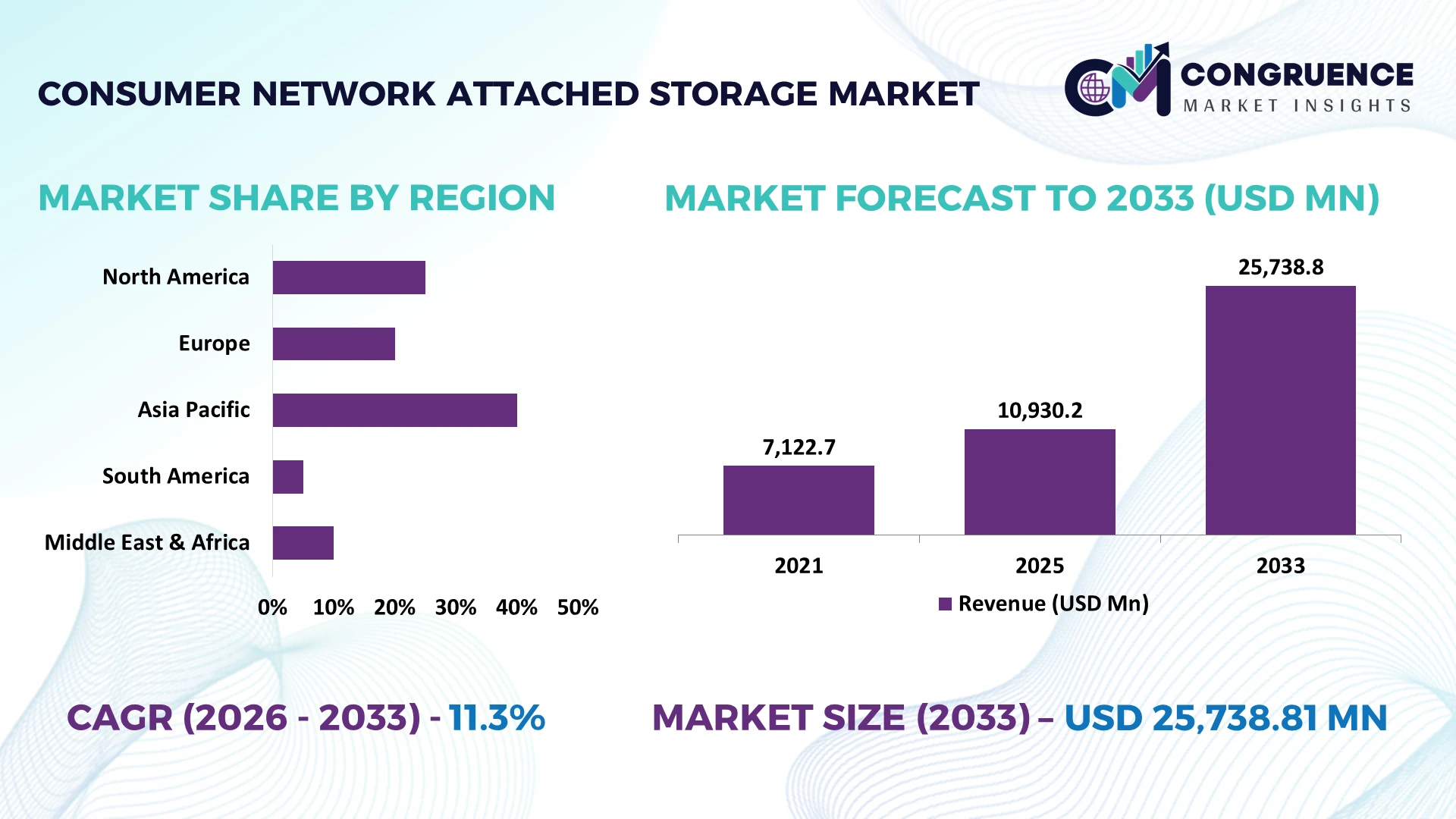
The United States represents an estimated 30% of global consumer NAS demand, supported by high broadband penetration, connected households, content creators, prosumers, and home-office users. Approximately 96% of U.S. adults use the internet, while gigabit broadband availability enables remote NAS access and media streaming. China offers a strong comparison, combining more than 1.1 billion internet users with expanding domestic private-cloud hardware ecosystems. U.S.–China semiconductor and technology restrictions remain relevant to processors and electronics supply chains, reinforcing multi-supplier hardware strategies and regional sourcing diversification.
Strategically, vendors combining high-capacity storage, automated backup, cybersecurity, AI-assisted media management, and simple private-cloud deployment will capture the strongest consumer and prosumer upgrade cycles.
Market Size & Growth: USD 10.93 billion in 2025 reaches USD 25.74 billion by 2033 at 11.3%, driven by private-cloud storage and high-capacity media workflows.
Top Growth Drivers: Home broadband penetration above 90%, 4K content storage growth exceeding 25%, and multi-device backup adoption above 60% strengthen NAS deployment.
Short-Term Forecast: By 2028, 2.5GbE/10GbE networking and SSD caching can improve large-file transfer performance by 50–200% versus legacy gigabit configurations.
Emerging Technologies: AI photo indexing, NVMe caching, containerized applications, and 10GbE connectivity are moving advanced NAS functions beyond enterprise environments.
Regional Leaders: Applying estimated shares to 2033 value places North America near USD 8.0 billion, Asia-Pacific USD 9.0 billion, and Europe USD 5.9 billion, led by prosumer, private-cloud, and privacy-focused adoption respectively.
Consumer/End-User Trends: More than 90% broadband penetration across major developed markets supports always-connected backup, synchronization, streaming, and remote-access workflows.
Pilot/Case Example: Synology’s 2025 BeeStation Plus increased memory to 4 GB and delivered roughly 4.8× higher performance for selected workloads than its predecessor.
Competitive Landscape: Synology holds an estimated 30% share of branded consumer/prosumer NAS activity, competing with QNAP, Western Digital, ASUSTOR, TerraMaster, and UGREEN.
Regulatory & ESG Impact: EU right-to-repair rules target repairs within reasonable timeframes and prices, strengthening design incentives for serviceable storage hardware and longer device lifecycles.
Investment & Funding: Seagate committed up to USD 1 billion to expand Thailand storage manufacturing, reinforcing HDD capacity and supply-chain infrastructure serving data-intensive applications.
Innovation & Future Outlook: HDD roadmaps exceeding 30 TB per drive and multi-gigabit networking enable fewer-drive systems to deliver higher capacity, lower footprint, and stronger home private-cloud economics.
Consumer Network Attached Storage Market demand is concentrating among content creators, photographers, home-office users, media collectors, surveillance users, and households seeking local control over expanding digital libraries. Modern platforms integrate NVMe caching, 2.5GbE/10GbE networking, container applications, automated backup, ransomware protection, and AI-assisted photo indexing. High-capacity HDDs exceeding 30 TB are also raising usable storage per enclosure, reducing expansion complexity. With broadband penetration above 90% across several developed economies, remote private-cloud access is increasingly practical, while semiconductor supply-chain localization is pushing vendors toward diversified hardware architectures, setting up the market’s strategic technology and competitive discussion.
Consumer NAS is becoming strategically important as households, creators, and home-office users shift from fragmented cloud subscriptions toward controllable private-cloud infrastructure. Expanding 4K/8K libraries, multi-device backup, surveillance footage, and AI-generated content increase local capacity requirements, while privacy regulation strengthens data-sovereignty awareness. U.S.–China semiconductor restrictions are simultaneously encouraging storage vendors to diversify processor, networking-component, and manufacturing supply chains.
Multi-gigabit networking materially changes NAS economics: 2.5GbE provides up to 150% more theoretical bandwidth than legacy 1GbE, while NVMe caching improves responsiveness for metadata-intensive workloads. North America leads prosumer adoption, China combines massive connected-user scale with domestic NAS ecosystems, and Europe emphasizes privacy-controlled storage. Through 2028, 2.5GbE, AI indexing, container applications, and 20TB-plus drives will become increasingly standard in midrange systems.
A creator using a four-bay NAS can centralize video editing, automated laptop backup, and remote file delivery instead of maintaining separate storage devices and cloud repositories. Vendors are investing in simplified operating systems, cybersecurity, AI media management, and HDD partnerships. Competitive positioning increasingly depends on delivering secure private-cloud functionality without enterprise-level administration complexity.
Rapid expansion of household data is moving consumer NAS from specialist storage toward persistent digital infrastructure. U.S. internet usage exceeds 95% among adults, while broadband adoption above 90% in digitally mature households supports continuous synchronization, remote access, and automated backup. Meanwhile, 4K video requires roughly four times the pixel data of 1080p, increasing storage pressure for creators and media-heavy households. Growing concern over recurring cloud fees and platform dependency reinforces local ownership. Vendors such as Synology, QNAP, UGREEN, and TerraMaster are responding with simplified setup, mobile backup, photo management, and remote-access services. The strategic shift is software-led: hardware capacity attracts buyers, but automated data management and accessible private-cloud interfaces increasingly determine retention, upgrades, and ecosystem loyalty.
Consumer NAS adoption remains constrained by upfront enclosure, HDD, networking, and backup-power expenditure compared with immediately accessible cloud subscriptions. A populated four-bay system can require several times the initial spending of a basic external drive, while upgrading from 1GbE to 10GbE can increase theoretical networking capacity by 900% but often requires new switches, adapters, and cabling. HDD supply also remains geographically concentrated across a small manufacturing base in Thailand and other Asian hubs, exposing pricing to logistics and component disruption. Vendors are reducing friction through diskless configurations, two-bay entry systems, expandable storage pools, 2.5GbE interfaces, and tiered product families. A key commercial restraint is utilization: consumers frequently purchase capacity for future needs, leaving expensive drive space idle during early ownership.
Consumer NAS vendors have an opportunity to reposition systems from passive storage appliances into private AI-enabled data platforms. High-capacity HDDs exceeding 30TB allow a four-bay enclosure to provide more than 100TB of raw capacity, while 2.5GbE offers 150% greater theoretical bandwidth than 1GbE and local AI indexing eliminates repeated cloud uploads for supported workloads. China provides an important deployment opportunity through more than 1.1 billion internet users and rapidly expanding domestic private-cloud ecosystems. Through 2028, semantic photo search, local AI assistants, automated media classification, and edge inference will broaden NAS utility. Vendors are investing in faster processors, memory expansion, NVMe storage, application ecosystems, and AI partnerships. The non-obvious opportunity is privacy-priced AI: local inference can become a premium feature without recurring cloud-compute dependency.
As NAS systems become remotely accessible private clouds, cybersecurity becomes a long-term execution requirement rather than an optional feature. Ransomware can encrypt entire shared storage pools, while internet-facing administration interfaces expand attack surfaces; consequently, immutable snapshots, multifactor authentication, encryption, and isolated backups are increasingly essential. 10GbE delivers up to 10 times 1GbE bandwidth, but higher throughput also exposes CPU, drive-array, and software bottlenecks that complicate performance consistency. European privacy requirements add responsibility around account security and personal-data handling. Vendors must maintain firmware patches for multi-year device lifecycles, harden remote-access services, automate backup verification, and improve security defaults. The critical strategic challenge is trust: one high-profile vulnerability can undermine years of ecosystem investment because NAS buyers centralize photographs, documents, credentials, and irreplaceable personal archives on a single platform.
Multi-Gigabit Networking Moves Downmarket: Consumer NAS platforms are rapidly replacing 1GbE with 2.5GbE, delivering 150% more theoretical bandwidth, while premium systems increasingly offer 10GbE at 10× legacy throughput. Vendors are redesigning two-bay and four-bay portfolios around faster Ethernet, NVMe caching, and multi-core processors. The shift improves large-file transfers and creator workflows without requiring enterprise storage infrastructure.
Drive Density Reduces Bay Requirements: HDD capacities above 30TB are changing enclosure economics, allowing a four-bay NAS to exceed 100TB of raw storage. Compared with 10TB drives, 30TB models provide 200% greater capacity per bay while limiting chassis expansion. Vendors are validating higher-capacity HDDs and improving storage-pool flexibility. Non-obviously, rising drive density strengthens compact NAS demand because capacity expansion increasingly occurs inside existing enclosures.
Creator Workflows Become NAS-Native: 4K video contains four times the pixels of 1080p, while 8K increases pixel count another fourfold over 4K, intensifying editing and archival requirements. Content creators increasingly centralize footage, project files, proxies, and automated backups on multi-bay systems. NAS vendors are responding with 10GbE connectivity, SSD caching, media indexing, and application integrations that reduce file duplication across workstations.
Security Defaults Become Product Differentiators: Ransomware pressure and privacy regulation are moving snapshots, encryption, multifactor authentication, and automated backup verification into consumer configurations. Three-copy backup strategies increasingly combine NAS, external media, and off-site storage, while 256-bit encryption remains standard across advanced platforms. Vendors are extending firmware support, automating security updates, and hardening remote-access services as buyers increasingly evaluate lifecycle protection alongside storage capacity.
2-Bay Systems lead the type segment with an estimated 38% share, balancing affordability, compact dimensions, RAID capability, and sufficient capacity for household backup, multimedia libraries, and home-office workflows. Two drives enable RAID 1 protection without the acquisition cost or power requirements of larger enclosures. 1-Bay Systems represent the entry tier but lack drive-level redundancy, limiting appeal where data resilience matters. 4-Bay Systems account for approximately 27% and provide greater RAID flexibility, capacity expansion, and concurrent workload performance.
4-Bay Systems are the fastest-growing type as creators and professional users consolidate larger video libraries, surveillance archives, and workstation backups. With 30TB-class HDDs, four bays can exceed 100TB of raw capacity, substantially extending replacement cycles. 5-Bay Systems address users requiring additional RAID flexibility, while 6-Bay Systems target storage-intensive professional deployments. Manufacturers are strengthening 2-Bay affordability while adding 2.5GbE, NVMe caching, expandable memory, and higher-capacity drive certification to 4-Bay platforms, shifting investment toward scalable prosumer configurations.
Data Backup leads applications with an estimated 34% share because centralized protection across computers, smartphones, photographs, documents, and connected devices remains the fundamental NAS purchase case. Automated scheduling, versioning, snapshots, and redundant storage differentiate NAS from standalone external drives. Personal Data Storage accounts for approximately 25%, supported by households seeking direct ownership of expanding digital archives rather than exclusive dependence on subscription cloud platforms.
Remote Access is the fastest-growing application as gigabit broadband, mobile applications, encrypted connections, and vendor-managed relay services transform NAS devices into personal cloud infrastructure. Multimedia Storage remains important as 4K video carries four times the pixel count of 1080p, increasing library capacity requirements. File Sharing is expanding among households and distributed professional teams requiring centralized permissions and synchronization. Vendors are integrating automated backup, mobile synchronization, media servers, secure sharing links, and browser-based remote administration. Business differentiation increasingly depends on software simplicity because application integration determines whether storage capacity becomes continuously usable infrastructure.
Home Users represent the largest end-user group with an estimated 42% share, driven by household photographs, personal documents, device backups, entertainment libraries, and demand for centralized storage accessible across televisions, computers, tablets, and smartphones. Their purchasing behavior favors affordable 1-Bay and 2-Bay systems with simplified applications and low administration requirements. Home Offices represent approximately 18%, placing greater emphasis on automated backup, secure remote access, and file synchronization across business devices.
Content Creators are the fastest-growing end-user segment as 4K/8K production, RAW photography, collaborative editing, and long-term project archiving increase capacity and throughput requirements. Small Offices prioritize multi-user permissions and backup reliability, while Professional Users increasingly require 4-Bay to 6-Bay configurations, 10GbE, SSD caching, and expandable memory. Vendors are differentiating entry pricing for households while developing creator-oriented ecosystems around media indexing, high-speed networking, application containers, and certified high-capacity drives. Future competitive value is shifting toward seamless progression from basic storage to professional workflows.
Asia-Pacific accounted for the largest market share at 35% in 2025 however, Asia-Pacific is expected to register the fastest growth, expanding at a CAGR of 13.2% between 2026 and 2033.
High-Capacity Private Clouds Gain Ground
North America accounted for approximately 30% of consumer NAS demand in 2025, with the United States concentrating creator, home-office, prosumer, and connected-household deployments. Fixed broadband availability, multi-device ownership, 4K/8K content production, and home surveillance are increasing centralized storage requirements. Multi-gigabit infrastructure is becoming operationally relevant as 2.5GbE delivers 150% more theoretical bandwidth than legacy 1GbE, supporting faster workstation backup and media transfer. NAS suppliers are therefore moving 2.5GbE, NVMe caching, container applications, and automated photo management into mainstream systems. High-capacity HDD availability also allows compact four-bay devices to exceed 100TB raw capacity. Storage vendors are strengthening cybersecurity, mobile synchronization, and remote-access functionality as consumers increasingly evaluate NAS platforms as persistent private-cloud infrastructure rather than standalone backup appliances.
United States Market Outlook: The United States remains North America's principal deployment market, supported by internet usage above 95% among adults and extensive high-speed broadband infrastructure. A large creator economy, widespread home-office computing, multi-device households, and connected security systems support higher storage intensity. Demand increasingly favors 2-Bay and 4-Bay systems combining RAID protection, automated backup, 2.5GbE connectivity, and secure remote access.
Privacy Priorities Reshape Storage Choices
Europe represented approximately 23% of consumer NAS activity in 2025, supported by Germany, the United Kingdom, France, the Netherlands, and Nordic countries. Strong fixed-broadband infrastructure enables remote file synchronization and personal-cloud access, while GDPR-driven privacy awareness strengthens the value proposition for locally controlled data. EU right-to-repair policy is also increasing attention to device longevity, software support, serviceability, and storage-product lifecycle management. Germany and the Netherlands provide particularly favorable environments for advanced home networking, while creative professionals in the UK and France sustain multimedia-storage requirements. Vendors are responding with encrypted volumes, multifactor authentication, snapshots, longer software-support cycles, and energy-management functions. 2.5GbE interfaces provide 150% more theoretical bandwidth than 1GbE, encouraging performance upgrades without requiring costly 10GbE infrastructure and supporting wider adoption among technically capable households and professionals.
Germany Market Outlook: Germany combines approximately 93% household internet access with strong consumer awareness of privacy, cybersecurity, and local data control. High broadband availability supports remote NAS operation, while photographers, home offices, technical professionals, and multimedia households generate sustained backup requirements. Vendors emphasizing encrypted storage, low-power operation, RAID protection, and long device-support cycles align particularly well with German purchasing priorities.
Hardware Ecosystems Accelerate NAS Adoption
Asia-Pacific held approximately 35% of the market in 2025, supported by China's enormous connected population, Japan's advanced home-networking environment, South Korea's high-speed broadband penetration, and Taiwan's storage-hardware ecosystem. China has more than 1.1 billion internet users, creating substantial addressable demand for personal cloud storage, multimedia management, and multi-device backup. Taiwan provides a critical supply-side advantage through NAS brands, electronics manufacturing, motherboard expertise, and semiconductor integration. Chinese vendors are expanding aggressively with x86 and ARM-based platforms, 2.5GbE connectivity, NVMe slots, mobile applications, and competitive multi-bay pricing. Japan and South Korea favor high-performance storage for photography, gaming, and connected households. The region's distinctive advantage is proximity between product development, component sourcing, electronics manufacturing, and final assembly, enabling faster platform refreshes and tighter hardware-software integration.
China Market Outlook: China combines massive digital-data creation with domestic NAS brands and increasingly sophisticated home networking. Internet penetration exceeds 78%, while more than one billion connected users generate expanding photo, video, gaming, and device-backup workloads. Domestic suppliers are competing through aggressive pricing, AI-enabled media organization, mobile-first interfaces, high-capacity HDD support, and integrated private-cloud services designed around local digital ecosystems.
Broadband Expansion Unlocks Local Storage
South America accounted for approximately 5% of consumer NAS demand in 2025, with Brazil providing the strongest deployment base, followed by Argentina, Chile, and Colombia. Fiber broadband expansion, creator activity, home businesses, surveillance deployments, and increasing household data volumes are broadening NAS use beyond technical enthusiasts. Brazil has more than 180 million internet users, providing significant potential for centralized backup and multimedia storage. However, imported hardware taxation, currency volatility, limited local NAS manufacturing, and comparatively high HDD pricing increase ownership costs. Vendors and channel partners therefore emphasize compact 2-Bay platforms, scalable diskless configurations, remote management, and bundled backup software. The operational opportunity centers on users graduating from external drives and fragmented cloud accounts, while affordability remains more decisive than maximum bay count or enterprise-class networking performance.
Brazil Market Outlook: Brazil combines internet penetration above 80% with a large base of digital creators, home-office workers, gamers, photographers, and connected households. Fiber expansion improves remote NAS accessibility, but imported equipment costs favor value-focused configurations. Distributors can gain traction through 2-Bay systems, flexible drive bundles, local technical support, installment purchasing, and simplified mobile-based backup and remote-access services.
Digital Infrastructure Expands Storage Access
Middle East & Africa represented approximately 7% of consumer NAS activity in 2025, with the UAE, Saudi Arabia, Israel, and South Africa providing the strongest addressable environments. Gulf countries combine high household connectivity, affluent technology consumers, smart-home deployment, and expanding creator ecosystems, supporting premium multi-bay NAS configurations. Saudi Arabia's internet penetration exceeds 99%, while UAE connectivity similarly approaches universal coverage, enabling continuous remote access and cloud-like NAS functionality. South Africa provides a broader but more price-sensitive consumer base where backup resilience is increasingly important for home offices and professional users. Vendors are expanding through electronics distributors, e-commerce channels, localized applications, and high-capacity storage bundles. Gulf demand favors 2.5GbE/10GbE performance and multimedia functionality, whereas African deployment remains more dependent on broadband quality, equipment affordability, and reliable power infrastructure.
Saudi Arabia Market Outlook: Saudi Arabia offers a digitally intensive consumer environment supported by near-universal internet adoption, expanding fiber connectivity, smart homes, gaming, digital content creation, and home-based businesses. Premium NAS demand increasingly centers on high-capacity multimedia libraries, surveillance storage, secure family backup, and remote access. Retailers benefit from bundling multi-bay hardware with preconfigured drives, cybersecurity features, and simplified private-cloud applications.
Synology and QNAP compete for software-rich mainstream and prosumer deployments, while UGREEN, TerraMaster, and ASUSTOR challenge through aggressive hardware specifications, pricing, and multi-gigabit connectivity. The top five suppliers represent an estimated 62% of branded consumer NAS activity, creating concentrated ecosystem competition despite broad hardware availability. Synology differentiates through integrated software and backup applications; challengers increasingly offer 2.5GbE providing 150% greater theoretical bandwidth than 1GbE, while premium 10GbE systems deliver 10× legacy throughput. High-capacity HDD support exceeding 30TB per bay further shifts competition toward platform scalability rather than enclosure size. Vendors are expanding AI media management, NVMe caching, container support, mobile applications, and cybersecurity while partnering with drive manufacturers and distribution channels. Competition is shifting from hardware specifications toward complete private-cloud ecosystems. Entry barriers center on operating-system maturity, security maintenance, application development, drive compatibility, and user trust. Winning requires competitive hardware, dependable software, sustained cybersecurity updates, simple deployment, and seamless capacity expansion globally.
Synology
QNAP Systems
ASUSTOR
TerraMaster
UGREEN
Western Digital
Buffalo
Netgear
Seagate Technology
Lenovo
Zyxel
ioSafe
Promise Technology
D-Link
Current consumer NAS technology centers on multi-gigabit Ethernet, RAID, NVMe caching, Btrfs-class file systems, and backup. Moving from 1GbE to 2.5GbE raises theoretical network bandwidth by 150%, while 10GbE provides tenfold throughput for creator workflows. NVMe cache reduces latency during metadata-heavy operations, and modern four-bay platforms increasingly combine dual 2.5GbE with M.2 slots. These integrations improve file transfers, backup windows, and concurrent media access without enterprise storage complexity.
Emerging systems combine local AI, semantic media search, hardware acceleration, containerization, and all-flash storage. On-device AI eliminates repeated cloud processing for supported indexing tasks, strengthening privacy and reducing external compute dependency. Compared with legacy 1GbE NAS, current 2.5GbE platforms offer 150% higher theoretical bandwidth, while SSD-assisted arrays materially improve random-access responsiveness. Creators, prosumers, and vendors with mature software ecosystems benefit most because performance improvements translate directly into faster editing, retrieval, and synchronization.
Between 2026 and 2028, integrated NPUs, local large-language models, USB4 networking, higher-density HDDs, and automated ransomware defenses will reshape consumer NAS. AI-capable platforms are already reaching 16 TOPS of local compute, while 30TB-class drives enable compact systems to exceed 100TB raw capacity. Vendors investing now in secure AI, application ecosystems, and faster networking gain stronger upgrade economics and platform differentiation.
April 2024 UGREEN showcased its first NASync series at NAB after launching on Kickstarter. The campaign had already exceeded $5 million from 10,000 backers, demonstrating substantial consumer demand for scalable private-cloud storage and accelerating UGREEN’s entry into NAS. Source: UGREEN.
June 2024 UGREEN’s NASync Kickstarter campaign closed with $6,678,664 pledged by 13,285 backers against a $20,000 target. The exceptional crowdfunding result validated consumer appetite for alternative NAS platforms and gave UGREEN substantial launch momentum against established storage brands. Source: Kickstarter.
April 2025 Synology launched the four-bay DS925+ with dual 2.5GbE and two M.2 slots, delivering 149% faster SMB downloads and 150% faster uploads than its predecessor. The upgrade materially strengthened performance for home-office, multimedia, and prosumer workloads. Source: Synology.
April 2026 ASUSTOR announced Flashstor Gen3 for Computex, integrating an AMD Ryzen 5 Pro 8640U six-core processor delivering 16 TOPS of AI compute. Local AI and USB4 networking extend NAS beyond storage toward private intelligent processing for creators. Source: ASUSTOR.
The Consumer Network Attached Storage Market Report evaluates 1-Bay, 2-Bay, 4-Bay, 5-Bay, and 6-Bay Systems across Personal Data Storage, Multimedia Storage, Data Backup, File Sharing, and Remote Access. End-user coverage includes Home Users, Content Creators, Small Offices, Home Offices, and Professional Users. 2-Bay Systems represent approximately 38% of type-level activity, while Data Backup accounts for nearly 34% of application demand.
Regional analysis covers North America, Europe, Asia-Pacific, South America, and Middle East & Africa, incorporating broadband infrastructure, consumer deployment patterns, channel development, and private-cloud adoption. Technology assessment examines 2.5GbE/10GbE networking, NVMe caching, RAID, local AI, containerization, high-density HDDs, all-flash storage, and cybersecurity. The 2026–2033 outlook supports investment planning, geographic expansion, product positioning, partnership decisions, portfolio development, and competitive strategy across mainstream household and performance-intensive prosumer NAS deployments.
| Report Attribute/Metric | Report Details |
|---|---|
Market Revenue in 2025 | USD 10930.17 Million |
Market Revenue in 2033 | USD 25738.81 Million |
CAGR (2026 - 2033) | 11.3% |
Base Year | 2025 |
Forecast Period | 2026 - 2033 |
Historic Period | 2021 - 2025 |
Segments Covered | By Type
By Application
By End-User
|
Key Report Deliverable | Revenue Forecast, Growth Trends, Market Dynamics, Segmental Overview, Regional and Country-wise Analysis, Competition Landscape |
Region Covered | North America, Europe, Asia-Pacific, South America, Middle East, Africa |
Key Players Analyzed | Synology, QNAP Systems, ASUSTOR, TerraMaster, UGREEN, Western Digital, Buffalo, Netgear, Seagate Technology, Lenovo, Zyxel, ioSafe, Promise Technology, D-Link |
Customization & Pricing | Available on Request (10% Customization is Free) |




