
Reports
The Global Consumer IAM Market was valued at USD 1,412.0 Million in 2025 and is anticipated to reach a value of USD 2,961.3 Million by 2033 expanding at a CAGR of 9.7% between 2026 and 2033. Growing deployment of passwordless authentication, privacy-first identity governance, and AI-powered fraud detection across digital banking, retail, healthcare, and public services is accelerating enterprise adoption of advanced Consumer IAM platforms.
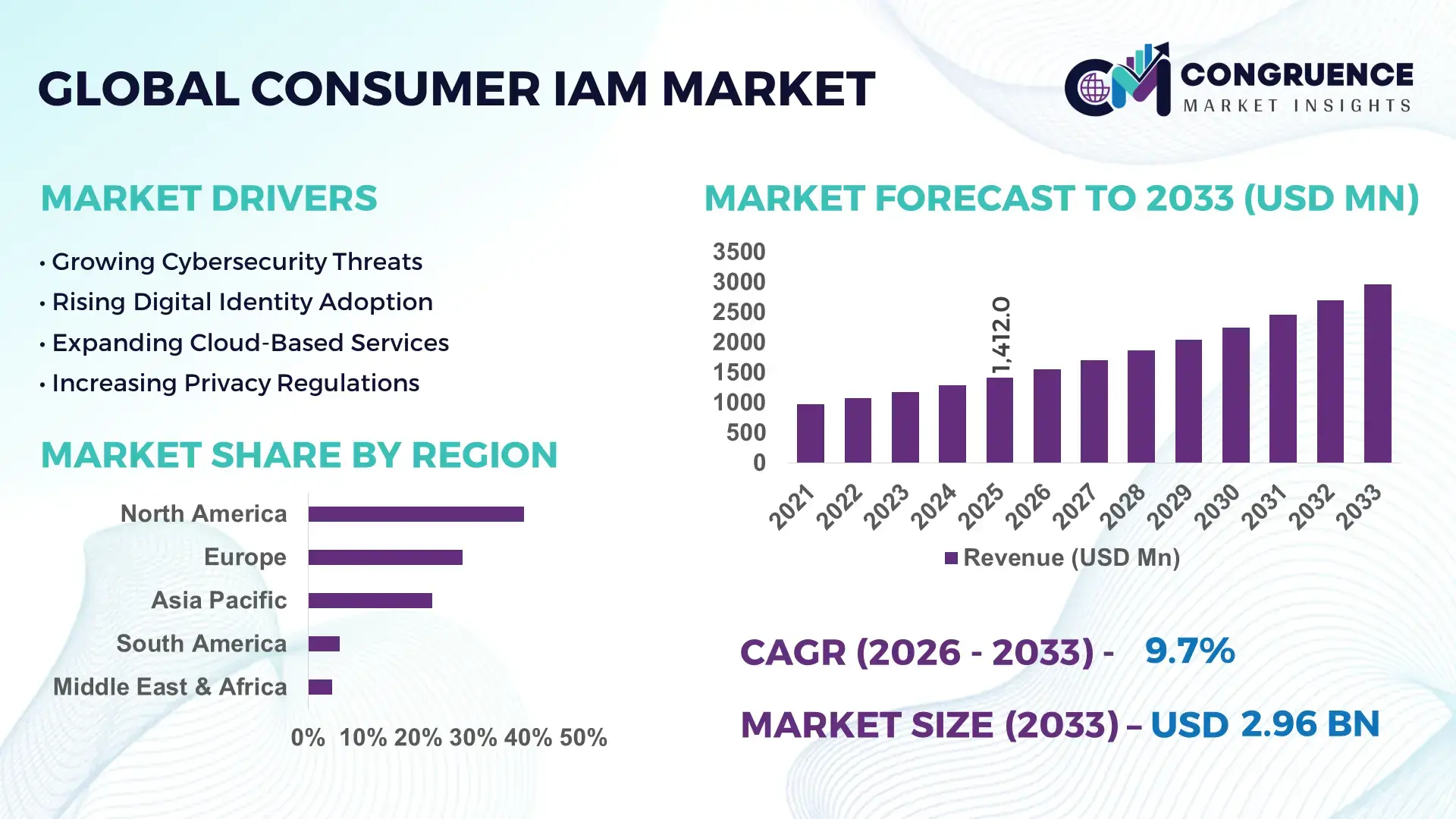
The United States dominates the global Consumer IAM market with an estimated 38% share, supported by large-scale digital service ecosystems, cybersecurity investments exceeding USD 20 billion annually, and widespread cloud identity deployments across financial services, healthcare, and e-commerce. Compared with Germany, where stricter privacy regulations accelerate consent management innovation, the U.S. leads in AI-driven identity orchestration and customer-scale authentication following expanding compliance initiatives influenced by evolving global data protection frameworks.
Organizations prioritizing scalable, regulation-ready Consumer IAM platforms gain stronger digital trust, lower fraud exposure, and greater competitive differentiation across customer-facing ecosystems.
Market Size & Growth: USD 1,412.0 Million in 2025, projected to reach USD 2,961.3 Million by 2033 at 9.7% CAGR, driven by rapid passwordless authentication and AI-enabled identity verification.
Top Growth Drivers: Passwordless authentication adoption +48%, cloud identity deployment +42%, privacy compliance initiatives +35%.
Short-Term Forecast: By 2028, automated identity lifecycle management is expected to reduce account recovery costs by approximately 30%.
Emerging Technologies: AI-based risk analytics, decentralized identity, and behavioral biometrics improve authentication accuracy by over 40%.
Regional Leaders: North America (~USD 1.1 Billion), Europe (~USD 760 Million), Asia-Pacific (~USD 640 Million) supported by cloud-first security modernization and digital identity expansion.
Consumer/End-User Trends: More than 68% of enterprises prioritize seamless omnichannel identity experiences to improve customer retention.
Pilot/Case Example: In 2024, enterprise passwordless authentication deployments reduced login-related support tickets by nearly 50%.
Competitive Landscape: Top vendors collectively control about 45% of the global market, led by Microsoft, Okta, Ping Identity, IBM, and ForgeRock.
Regulatory & ESG Impact: Privacy regulations improved enterprise consent management adoption by approximately 32%, strengthening digital governance worldwide.
Investment & Funding: More than USD 3 Billion in cybersecurity and identity investments supports cloud partnerships and platform expansion amid global digital infrastructure modernization.
Innovation & Future Outlook: AI-driven adaptive authentication and decentralized identity frameworks are reshaping customer trust strategies and enterprise digital ecosystems.
Consumer IAM platforms are becoming essential across banking, retail, healthcare, telecommunications, and public digital services as organizations strengthen secure customer engagement while minimizing authentication friction. AI-enabled identity proofing, behavioral analytics, and passwordless authentication continue to improve user experience, with passwordless adoption increasing by nearly 48%. Expanding global privacy regulations and cross-border digital service delivery are further encouraging enterprises to modernize identity architectures, setting the stage for broader strategic transformation.
Consumer IAM has become a strategic business capability as digital engagement increasingly defines customer acquisition, retention, and brand trust. Organizations are replacing fragmented identity systems with unified platforms that support secure omnichannel experiences while addressing stricter privacy regulations and accelerating digital transformation initiatives. This shift is strengthening competitive positioning across financial services, retail, healthcare, telecommunications, and government digital services.
Modern AI-enabled Consumer IAM platforms process identity verification and adaptive authentication significantly faster than legacy rule-based systems, reducing authentication time by nearly 40% while lowering manual identity verification costs by approximately 25%. North America continues to lead large-scale enterprise deployment through mature cloud ecosystems, whereas Asia-Pacific is expanding rapidly through digital banking, mobile-first commerce, and government-backed digital identity programs. Over the next two to three years, passwordless authentication adoption is expected to exceed 60% among large enterprises, improving customer experience and fraud resilience.
Large retailers and financial institutions are deploying AI-powered identity orchestration to strengthen fraud prevention while simplifying customer onboarding across digital channels. Technology vendors are expanding cloud partnerships, integrating decentralized identity capabilities, and prioritizing regional compliance features to support multinational deployments. Organizations investing in scalable Consumer IAM platforms today will establish stronger operational resilience, trusted digital ecosystems, and lasting competitive advantage in increasingly identity-centric markets.
Accelerating enterprise migration toward passwordless authentication and AI-driven identity verification is fundamentally reshaping Consumer IAM deployment strategies. More than 68% of large enterprises now prioritize unified customer identity platforms, while passwordless authentication adoption has increased by nearly 48%, reducing credential-based attacks and support costs. The enforcement of stronger digital privacy requirements in the United States and expanding digital identity initiatives across the European Union are pushing organizations to modernize legacy authentication infrastructures. This regulatory and technology convergence is driving platform consolidation and API-first architecture adoption. In response, leading vendors are expanding cloud-native identity services, investing in behavioral analytics, and forming strategic partnerships with cybersecurity providers to deliver scalable, low-friction customer authentication while improving fraud resilience and operational efficiency.
Complex integration with legacy IT environments and fragmented global privacy regulations continue to limit large-scale Consumer IAM deployment. Nearly 57% of enterprises operate hybrid identity environments, while approximately 41% report interoperability challenges between legacy applications and cloud identity platforms. Diverging regulatory frameworks across the United States, Germany, and other major digital markets increase compliance complexity, requiring separate consent, identity governance, and data residency controls. These structural limitations extend deployment timelines, elevate implementation costs, and complicate multinational identity management. To reduce operational exposure, technology providers are expanding localized cloud infrastructure, strengthening standards-based interoperability, and introducing modular identity architectures that simplify migration without disrupting mission-critical customer-facing applications.
The integration of AI, decentralized identity, and verifiable digital credentials is creating high-value opportunities beyond traditional authentication. Organizations deploying AI-enabled identity analytics have achieved fraud detection improvements exceeding 40%, while automated identity verification reduces onboarding time by nearly 35%. India's expanding digital public infrastructure and identity ecosystem demonstrate how secure digital credentials can accelerate financial inclusion and digital service delivery. Enterprises are increasingly investing in decentralized identity frameworks, reusable digital credentials, and ecosystem partnerships to enable trusted cross-platform customer interactions. A notable strategic opportunity lies in embedding Consumer IAM capabilities directly into digital commerce, healthcare, and financial platforms, transforming identity management from a security function into a revenue-enabling customer engagement capability.
Maintaining consistent identity assurance across expanding multi-cloud and omnichannel environments remains a critical long-term execution challenge. Around 62% of organizations manage customer identities across multiple cloud platforms, while identity-related security incidents continue to account for more than 30% of reported enterprise cybersecurity breaches. The rapid expansion of AI-generated synthetic identities and increasingly sophisticated credential attacks is placing sustained pressure on authentication accuracy and risk assessment. In the United Kingdom, organizations are strengthening zero-trust identity strategies to address evolving cyber threats while maintaining user convenience. Companies must invest in continuous authentication, advanced identity orchestration, interoperable standards, and cybersecurity talent to ensure scalable, resilient Consumer IAM deployments that preserve customer trust and long-term competitive advantage.
AI-Powered Identity Verification Expands Enterprise adoption of AI-driven identity verification has increased by nearly 44%, while behavioral authentication deployment has risen 36% across digital banking and e-commerce platforms. Following stricter privacy enforcement in the European Union, organizations are integrating adaptive risk engines into customer onboarding workflows, reducing manual verification efforts and accelerating account approvals. Vendors are scaling AI partnerships and embedding real-time analytics to improve fraud prevention without increasing authentication friction.
Passwordless Authentication Becomes Standard Passwordless authentication implementation has grown approximately 48%, with biometric login usage exceeding 55% among large consumer-facing enterprises. Organizations in the United States are replacing password-dependent systems with FIDO-based authentication to reduce credential attacks and help-desk workloads. Identity platform providers are expanding ecosystem integrations and cloud-native deployment models, improving login speed while lowering operational support costs across high-volume digital channels.
Cloud Identity Consolidation Accelerates More than 61% of enterprises are consolidating multiple identity tools into unified cloud-based Consumer IAM platforms, while API-enabled integrations have increased nearly 40%. Ongoing digital infrastructure modernization is driving organizations to simplify identity governance and consent management. Technology providers are restructuring product portfolios through strategic acquisitions and platform integration, enabling faster deployment, centralized administration, and improved interoperability across customer applications.
Privacy-Centric Consent Management Evolves Privacy-first identity governance has become a strategic operational priority, with automated consent management adoption increasing by around 34% and identity lifecycle automation improving compliance efficiency by 29%. Regulatory developments in Germany and other digital economies are encouraging enterprises to redesign customer data management processes. Companies are investing in decentralized identity capabilities and policy automation to strengthen compliance while creating trusted digital experiences across expanding consumer ecosystems.
Solutions represent the leading segment of the Consumer IAM market because organizations increasingly require integrated identity governance, authentication, consent management, and customer lifecycle administration through unified cloud-native platforms. Approximately 68% of enterprise deployments prioritize comprehensive software solutions that support API integration, AI-driven authentication, and regulatory compliance across multiple digital channels. Vendors continue expanding platform capabilities with passwordless authentication, behavioral analytics, and adaptive access controls, making integrated solutions the preferred investment for large customer-facing organizations. Services are emerging as the fastest-growing segment as enterprises seek implementation support, migration consulting, managed identity operations, and continuous compliance management. Nearly 46% of organizations rely on external service providers to modernize legacy identity environments while reducing deployment complexity. Technology vendors are expanding professional services, managed security offerings, and strategic consulting partnerships to accelerate cloud migration and enterprise-scale identity transformation. This shift reflects growing demand for operational expertise alongside software innovation, particularly among organizations managing complex hybrid IT environments.
BFSI remains the dominant application segment because financial institutions require advanced authentication, fraud prevention, and regulatory compliance across millions of digital customer interactions. More than 72% of large financial organizations continue expanding adaptive authentication capabilities, while AI-supported fraud analytics improve identity verification efficiency by approximately 40%. Retail & E-commerce follows closely with growing investments in frictionless checkout and customer identity orchestration, whereas Healthcare continues strengthening secure patient identity management under evolving privacy requirements.Government represents the fastest-growing application as digital public services and national identity modernization accelerate secure citizen access. IT & Telecom organizations are expanding unified identity management across cloud services, while Media & Entertainment providers increasingly deploy Consumer IAM to personalize digital subscriptions and content access. The Others category continues broadening through education, travel, and online service platforms. Vendors are responding with industry-specific identity solutions, AI-driven automation, and deeper cloud ecosystem integrations that improve operational scalability across diverse customer environments.
Large Enterprises account for the largest share of Consumer IAM deployments because they manage extensive digital customer ecosystems requiring high availability, regulatory compliance, and advanced identity orchestration. Around 70% of multinational organizations continue investing in unified identity platforms that integrate AI-powered authentication, fraud detection, and customer consent management. Their extensive cloud adoption and complex digital infrastructures support greater investment in scalable Consumer IAM architectures, while technology providers prioritize enterprise-grade security, analytics, and API integration capabilities. Small & Medium Enterprises (SMEs) represent the fastest-growing end-user segment as cloud-native subscription models reduce implementation complexity and infrastructure costs. Adoption among SMEs has increased by nearly 38%, supported by simplified deployment models and managed identity services. Vendors are introducing modular pricing, industry-focused solutions, and channel partnerships to improve accessibility for smaller organizations. This transition is expanding Consumer IAM adoption beyond large enterprises, creating broader opportunities across digital commerce, online services, healthcare providers, and technology startups seeking secure yet cost-efficient customer identity management.
North America accounted for the largest market share at 39.2% in 2025 however, Asia-Pacific is expected to register the fastest growth, expanding at a 11.8% CAGRbetween 2026 and 2033.
North America remains the largest Consumer IAM market due to extensive cloud adoption, mature cybersecurity ecosystems, and large-scale digital customer engagement across banking, healthcare, retail, and telecommunications. The region contributes approximately 39.2% of global demand, supported by widespread deployment of passwordless authentication, AI-driven fraud analytics, and Zero Trust identity frameworks. More than 70% of Fortune 500 enterprises have accelerated modernization of customer identity infrastructure, while strategic collaborations between cloud providers and cybersecurity vendors continue expanding enterprise-scale identity orchestration. Financial institutions and digital commerce companies remain the primary adopters, strengthening operational resilience through continuous authentication and automated identity governance.
United States Market Outlook: The United States serves as the operational center of the Consumer IAM market through its concentration of leading identity software vendors, hyperscale cloud providers, and enterprise cybersecurity investment. More than 68% of large organizations have deployed adaptive authentication or passwordless technologies across customer-facing platforms. Expanding federal cybersecurity initiatives, AI innovation, and strong digital banking penetration continue encouraging identity platform modernization, while technology companies strengthen ecosystem partnerships to accelerate secure cloud-native identity deployments across multiple industries.
Europe continues strengthening Consumer IAM adoption through rigorous privacy regulation, digital sovereignty initiatives, and enterprise-wide identity modernization. The region accounts for nearly 28.1% of global market activity, supported by extensive deployment of consent management platforms, identity governance solutions, and cloud-based authentication. Financial institutions, healthcare organizations, and public-sector agencies are accelerating modernization programs to improve regulatory compliance and digital service delivery. Enterprise demand is further supported by increasing adoption of decentralized identity technologies and interoperability frameworks that simplify secure customer authentication while reducing administrative complexity across multinational operations.
Germany Market Outlook: Germany remains Europe's most strategically significant Consumer IAM market due to its advanced industrial base, strong cybersecurity ecosystem, and strict data protection environment. More than 60% of major enterprises have expanded identity modernization initiatives supporting secure digital services and privacy-centric customer engagement. Continued investment in cloud infrastructure, Industry 4.0 initiatives, and enterprise digital transformation enables technology providers to introduce highly compliant identity platforms that meet evolving operational and regulatory requirements.
Asia-Pacific is emerging as the fastest-expanding Consumer IAM market through accelerating digital banking, mobile commerce, and government-backed digital identity initiatives. The region represents approximately 22.6% of global market activity, with enterprise cloud adoption and AI-enabled identity verification increasing rapidly across financial services and telecommunications. National digital infrastructure investments continue supporting identity modernization, while technology providers expand regional cloud availability and localized identity services. Large consumer populations and expanding online ecosystems create substantial deployment opportunities for scalable authentication and customer identity platforms.
India Market Outlook: India has become a strategic growth engine for Consumer IAM through rapid digital public infrastructure expansion, fintech innovation, and enterprise cloud transformation. More than 750 million internet users increasingly access digital financial and public services requiring secure identity verification and customer authentication. Strong digital identity infrastructure, expanding API ecosystems, and continuous enterprise investment encourage technology vendors to deliver scalable Consumer IAM solutions tailored to financial institutions, healthcare providers, retail platforms, and government digital services.
South America is steadily increasing Consumer IAM deployment as financial inclusion initiatives, digital commerce, and cloud migration reshape enterprise identity strategies. The region contributes approximately 5.8% of global market demand, supported by expanding online banking, mobile payment adoption, and digital customer engagement. Identity modernization projects increasingly focus on fraud reduction, secure onboarding, and automated customer verification. Although infrastructure consistency varies across countries, cloud partnerships and enterprise cybersecurity investments continue strengthening regional deployment capabilities and supporting broader digital transformation initiatives.
Brazil Market Outlook: Brazil leads the South American Consumer IAM market through its expanding digital banking ecosystem, strong fintech sector, and accelerating enterprise cybersecurity investment. More than 80% of banking transactions now occur through digital channels, increasing demand for advanced customer authentication and fraud prevention technologies. Organizations continue integrating AI-enabled identity verification and cloud-native identity platforms to improve operational efficiency while supporting secure digital service expansion across financial, retail, and telecommunications industries.
The Middle East & Africa Consumer IAM market is advancing through government-led digital transformation programs, expanding cloud infrastructure, and increasing cybersecurity investment. The region accounts for approximately 4.3% of global market activity, with enterprise demand strengthening across banking, government, telecommunications, and healthcare. National digital economy strategies are encouraging deployment of secure identity platforms supporting citizen services and commercial digital ecosystems. Cloud service providers continue expanding regional infrastructure through strategic investments, improving deployment efficiency and regulatory compliance for identity-centric applications.
United Arab Emirates Market Outlook: The United Arab Emirates remains the region's most strategically significant Consumer IAM market because of its advanced smart government initiatives, cloud-first policies, and strong cybersecurity investment. More than 90% of government services are available digitally, creating sustained demand for secure customer identity verification and access management. Continuous investment in AI, digital infrastructure, and enterprise cloud ecosystems positions the country as a regional hub for next-generation Consumer IAM deployment and cybersecurity innovation.
The Consumer IAM market is led by Microsoft, Okta, Ping Identity, IBM, and SAP, with the top five vendors collectively controlling approximately 58% of the global market. Competition is primarily between cloud-native identity leaders and enterprise platform providers, while regional specialists differentiate through deployment flexibility and localized compliance capabilities. Vendors compete on authentication accuracy, API integration speed, AI-powered threat detection, and identity orchestration rather than price alone. Passwordless authentication deployments reduce login friction by nearly 45%, while AI-based fraud analytics improve detection efficiency by approximately 40%, making technology leadership the primary differentiator. Companies continue strengthening their positions through cloud expansion, strategic acquisitions, developer ecosystem partnerships, and integrated identity security platforms. The competitive landscape is shifting toward unified identity fabrics combining governance, authentication, and threat intelligence. High regulatory compliance requirements, enterprise integration complexity, and long sales cycles remain significant entry barriers. Winning requires scalable cloud architecture, continuous innovation, regulatory readiness, and extensive enterprise integration capabilities.
Okta
Ping Identity
IBM
SAP
Salesforce
Cisco
Broadcom
HID Global
Thales
LoginRadius
WSO2
OneLogin
Modern Consumer IAM platforms increasingly combine artificial intelligence, behavioral biometrics, passwordless authentication, and decentralized identity into unified cloud-native architectures. AI-powered risk engines improve fraud detection by nearly 40%, while behavioral authentication reduces unnecessary user verification events by approximately 30%. More than 60% of enterprise deployments now prioritize API-first identity platforms capable of supporting omnichannel digital experiences and continuous authentication across cloud applications.
Passwordless authentication based on FIDO standards is rapidly replacing traditional password-centric models. Compared with legacy password authentication, passwordless identity verification reduces login time by around 50% while significantly lowering credential-related support requests. Large financial institutions, digital retailers, and technology providers benefit most from these capabilities because stronger customer authentication simultaneously improves security, user experience, and operational efficiency. Integration with identity governance, threat intelligence, and Zero Trust frameworks is becoming standard enterprise practice.
Between 2026 and 2028, decentralized identity, verifiable credentials, and AI-driven identity orchestration will reshape enterprise identity ecosystems. Organizations are expanding machine identity management and adaptive authorization capabilities to secure AI-enabled digital services. Companies adopting unified identity fabrics early will achieve faster customer onboarding, improved regulatory compliance, lower operational costs, and stronger competitive differentiation as digital identity becomes the foundation of secure customer engagement.
June 2025 – Microsoft expanded Microsoft Defender for Identity by extending Identity Threat Detection and Response capabilities to protect Okta identities, enabling unified protection across hybrid identity environments and strengthening enterprise identity visibility for multi-vendor deployments. Source: www.techcommunity.microsoft.com
September 2025 – Okta introduced the Identity Security Fabric, AI agent identity management, phishing-resistant passkeys, and Cross App Access standards at Oktane 2025, alongside new data centers in Canada and India, strengthening secure AI adoption and global platform scalability.
August 2023 (market impact continuing through 2024–2026) – Ping Identity completed the operational integration of ForgeRock, consolidating customer identity and workforce identity portfolios into a unified platform that expands enterprise deployment flexibility and strengthens competition with leading cloud IAM providers.
April 2026 – Research and Markets highlighted expanding enterprise adoption of cloud-delivered Consumer IAM platforms, identifying Microsoft, Okta, IBM, Ping Identity, and Salesforce among key strategic vendors as organizations accelerate managed identity deployments and automated compliance capabilities.
The report provides comprehensive analysis of the Consumer IAM market across Solutions and Services, covering key applications including BFSI, Retail & E-commerce, Healthcare, Government, IT & Telecom, Media & Entertainment, and Others, alongside end-user assessment for Large Enterprises and Small & Medium Enterprises. It evaluates adoption patterns across North America, Europe, Asia-Pacific, South America, and the Middle East & Africa while examining deployment strategies, identity modernization initiatives, authentication technologies, and enterprise implementation trends. More than 60% of current enterprise deployments emphasize cloud-native identity architectures and AI-enabled authentication capabilities.
The study delivers strategic insights into competitive positioning, technology innovation, regional deployment dynamics, regulatory influences, and evolving customer identity requirements between 2026 and 2033. It supports investment prioritization, market expansion planning, partnership evaluation, product development, and competitive benchmarking through detailed segmentation, company profiling, operational trends, and emerging identity technologies, enabling stakeholders to identify high-value opportunities, strengthen enterprise security strategies, and improve long-term business decision-making across the global Consumer IAM ecosystem.
| Report Attribute / Metric | Details |
|---|---|
| Market Revenue (2025) | USD 1,412.0 Million |
| Market Revenue (2033) | USD 2,961.3 Million |
| CAGR (2026–2033) | 9.7% |
| Base Year | 2025 |
| Forecast Period | 2026–2033 |
| Historic Period | 2021–2025 |
| Segments Covered |
By Type
By Application
By End-User
|
| Key Report Deliverables | Revenue Forecast; Market Trends; Growth Drivers & Restraints; Technology Insights; Segmentation Analysis; Regional Insights; Competitive Landscape; Regulatory & ESG Overview; Recent Developments |
| Regions Covered | North America; Europe; Asia-Pacific; South America; Middle East & Africa |
| Key Players Analyzed | Microsoft; Okta; Ping Identity; IBM; SAP; Salesforce; Cisco; Broadcom; HID Global; Thales; LoginRadius; WSO2; OneLogin |
| Customization & Pricing | Available on Request (10% Customization Free) |




