
Reports
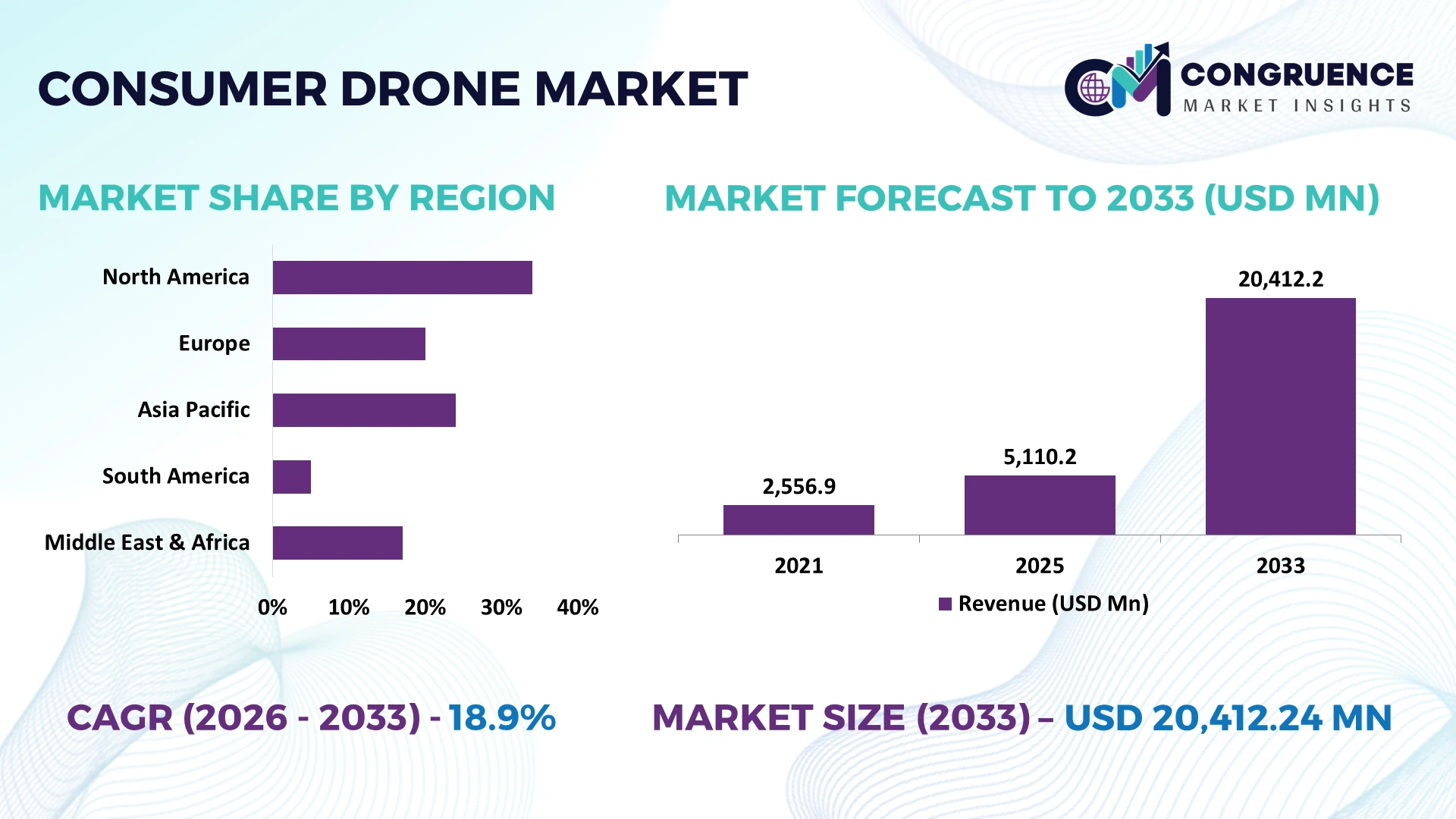
The Global Consumer Drone Market was valued at USD 5110.17 Million in 2025 and is anticipated to reach a value of USD 20412.24 Million by 2033 expanding at a CAGR of 18.9% between 2026 and 2033. Growth is being driven by sub-250-gram regulatory-friendly designs, AI subject tracking, omnidirectional obstacle sensing, stabilized 4K imaging, automated flight modes, and creator-focused aerial-content workflows.
China remains the dominant consumer drone manufacturing country, with Shenzhen-linked producers representing about 70% of global consumer drone output; Guangdong generates more than 90% of China’s drone production, with output recently rising 39%. Consumer electronics, aerial imaging and low-altitude applications anchor this ecosystem. By comparison, U.S. recreational users benefit from simplified FAA treatment for drones below 250 grams, reinforcing lightweight-product adoption.
Strategically, manufacturers and investors should prioritize lightweight AI-enabled camera platforms, regulation-ready Remote ID architectures and diversified component sourcing while retaining access to China’s unmatched consumer-drone production ecosystem.
Market Size & Growth: USD 5.11 billion in 2025 advances toward USD 20.41 billion by 2033 at 18.9%, supported by AI-assisted flight, compact imaging systems and sub-250g product engineering.
Top Growth Drivers: Photography and videography represent 61.78% of usage value, nano/micro drones hold 53.0%, and multi-rotor platforms command 70.11%, concentrating demand around portable camera drones.
Short-Term Forecast: By 2027, premium compact drones will increasingly target roughly 30% longer endurance benchmarks as advanced batteries, lighter structures and smarter power management expand practical filming time.
Emerging Technologies: AI subject tracking, omnidirectional obstacle avoidance and automated waypoint flight are shifting advanced consumer drones from manually controlled aircraft toward intelligent autonomous imaging platforms.
Regional Leaders: Applying the 2025 regional mix to the supplied 2033 global forecast implies approximately USD 7.69 billion for North America, USD 6.48 billion for Asia-Pacific and USD 4.86 billion for Europe; adoption centers on creators, lightweight platforms and compliance-ready products.
Consumer Trends: Photography and videography account for 61.78% of demand, while sub-4-km platforms represent 57.62%, confirming that portability, imaging quality and simplified operation outweigh extreme flight range for mainstream buyers.
Pilot/Case Example: In 2024, a DJI Mini 4 Pro roof-inspection project captured 774 images using 85% overlap and approximately one hour of combined flight time, demonstrating professional-grade photogrammetry from consumer-class hardware.
Competitive Landscape: DJI remains the benchmark supplier, with Shenzhen authorities citing more than 70% global civilian-drone share; Autel Robotics, Parrot, Potensic and Holy Stone broaden competition across premium and value tiers.
Regulatory & ESG Impact: EU rules cap Open-category flights at 120 metres, while U.S. recreational drones below 250 grams generally avoid registration, directly encouraging lighter, energy-efficient hardware architectures.
Investment & Funding: The wider drone ecosystem attracted USD 3.86 billion of investment in 2025, with 77% flowing toward dual-use companies as geopolitical procurement and supply-chain localization reshape capital allocation.
Innovation & Future Outlook: Sub-249g aircraft already combine 4K/60fps recording, ActiveTrack 360° and up to 45-minute rated flight time, establishing the next competitive battleground around autonomous capture, safety and software intelligence.
Consumer Drone Market demand is increasingly concentrated in aerial photography, travel content, social-media production, hobby flying and lightweight photogrammetry. Advanced products now combine AI tracking, obstacle sensing, automated routes and 4K imaging, while nano and micro drones represent 53% of market activity. Regulatory thresholds around 250 grams are accelerating compact-product engineering, setting up the broader strategic discussion around technology, sourcing and regional competitiveness.
Consumer drones are becoming strategically important as aerial imaging shifts from specialist equipment toward software-defined, autonomous camera platforms serving creators, tourism, property inspection, mapping and outdoor recreation. The sub-250-gram category is particularly influential because U.S. recreational operators generally avoid registration requirements below 250 grams, while manufacturers are integrating AI tracking, 4K imaging and obstacle sensing into this lightweight class. Supply-chain restructuring outside China is simultaneously becoming a competitive priority.
Technology improvements are materially changing operating economics. Modern consumer drones can complete photogrammetry and visual-inspection capture substantially faster than ground-based manual photography while generating hundreds of geotagged images per mission. China retains exceptional manufacturing scale: Shenzhen-linked producers account for roughly 70% of global civilian-drone supply, whereas U.S. and European ecosystems place greater emphasis on regulatory compliance, software, imaging applications and supply-chain security.
Through 2028, competitive differentiation will increasingly depend on autonomous flight, computer vision, lightweight batteries and compliance-ready connectivity. A 2024 roof-inspection deployment using a consumer-class DJI Mini 4 Pro captured 774 overlapping images in roughly one hour of flight operations, demonstrating crossover into professional workflows. Manufacturers are consequently directing R&D toward intelligent navigation, imaging software and localized component ecosystems. Long-term advantage will belong to suppliers combining mass-market affordability with autonomous functionality and regulatory adaptability.
Consumer drone adoption is being accelerated by the convergence of compact airframes, computational imaging and autonomous flight assistance. Photography and videography represent approximately 61.8% of market activity, nano and micro platforms account for about 53%, while multirotor configurations represent roughly 70% of demand. The structural driver is clear: users increasingly obtain 4K capture, subject tracking and obstacle avoidance from aircraft weighing below 250 grams. U.S. registration exemptions for qualifying recreational drones reinforce this engineering shift toward lighter platforms. DJI, Autel Robotics and emerging value-tier manufacturers are responding with enhanced computer vision, stabilized cameras and automated flight modes. Strategically, intelligence per gram is becoming more important than raw aircraft size, allowing suppliers to widen addressable demand while reducing regulatory friction for recreational operators.
Extreme manufacturing concentration creates a structural constraint for consumer drone brands seeking resilient international distribution. Shenzhen-linked manufacturers account for roughly 70% of global civilian-drone supply, while Guangdong produces more than 90% of China’s drones, concentrating critical expertise in airframes, cameras, motors, batteries and flight-control electronics. Meanwhile, European Open-category operations are generally restricted to a maximum altitude of 120 metres, and U.S. Remote ID requirements apply across broad classes of registered aircraft. These divergent rules increase certification, firmware and product-configuration costs across markets. Companies are reducing exposure through component diversification, localized assembly and compliance-specific product variants. The non-obvious constraint is software: regulatory fragmentation increasingly requires geographically configurable firmware, making compliance engineering almost as important as hardware sourcing for scalable international launches.
The strongest opportunity lies in transforming consumer drones from manually piloted cameras into autonomous content and lightweight data-capture systems. Photography and videography already represent approximately 61.8% of market activity, while sub-4-kilometre platforms account for about 57.6%, indicating that mainstream buyers prioritize intelligent imaging over extreme transmission range. Next-generation aircraft increasingly combine 4K/60fps video, 360-degree subject tracking and rated flight endurance approaching 45 minutes. This creates crossover opportunities in property documentation, tourism, roof inspection, construction progress recording and creator-led commerce. Manufacturers are investing in computer vision, automated routes, editing ecosystems and cloud-connected workflows rather than competing solely on camera specifications. Strategically, software subscriptions, automated media processing and application-specific flight modes can extend customer value beyond the initial hardware sale and reduce dependence on replacement-cycle economics.
Scaling autonomous consumer flight without compromising safety presents a different challenge from current regulatory constraints. Advanced aircraft increasingly depend on multi-directional vision sensors, GNSS, wireless links and onboard AI simultaneously; failure or interference in one layer can undermine automated navigation. Europe limits Open-category operations to 120 metres, while increasingly connected drone fleets must also accommodate identification and geographically defined airspace restrictions. At the same time, premium lightweight platforms are pushing toward approximately 45-minute rated endurance despite strict mass constraints around the strategically important 250-gram threshold. Manufacturers therefore face a difficult engineering balance between battery capacity, sensor redundancy, computing power and aircraft weight. Sustained competitiveness requires investment in fail-safe navigation, cybersecurity, geofencing databases and reliable obstacle detection. The strategic challenge is shifting from simply making drones autonomous to making autonomy consistently trustworthy across changing environments.
Sub-250g Engineering Reshapes Portfolios: Lightweight platforms are becoming the primary design target as nano and micro drones represent about 53% of consumer demand and sub-4-km aircraft account for 57.6%. EU A1 rules favor aircraft below 250 grams, while manufacturers are restructuring batteries, gimbals and sensing packages to preserve imaging performance within tighter weight envelopes.
Mid-Tier Features Move Downmarket: Advanced imaging is migrating into mainstream products, with mid-range models representing roughly 47% of consumer-drone demand and online channels exceeding 65% of sales. 4K capture, obstacle avoidance and stabilized gimbals increasingly appear below traditional premium price points. Vendors are simplifying portfolios and scaling direct-to-consumer distribution to shorten replacement cycles.
FPV Shifts Toward Organized Participation: Racing and sports are becoming more structured consumer activities rather than isolated hobby niches. Photography and videography still represent 61.8% of application demand, but racing/sports is the fastest-moving application category. European FPV operations also require a visual observer, pushing manufacturers toward safer goggles, telemetry integration and simulator-linked training ecosystems.
Hardware Investment Returns to Focus: Drone Industry Insights’ 2025 survey found hardware companies represented 24% of participating businesses, up 6 percentage points from 2024, while services declined to 68%. Supply-chain security and geopolitical procurement pressures are redirecting attention toward airframes, components and flight systems. Manufacturers are increasing supplier qualification, component localization and strategic hardware partnerships.
Camera Drones lead the Consumer Drone Market, representing an estimated 55–60% of demand across the provided product categories as aerial photography, travel content and social-media production remain the principal purchasing triggers. Their position reflects integrated gimbals, increasingly standardized 4K imaging and automated subject tracking rather than airframe performance alone. Supporting this concentration, photography and videography collectively account for approximately 61.8% of consumer-drone application activity. Foldable Drones overlap strongly with camera platforms and continue gaining relevance because portability supports travel and creator workflows, while Mini Drones benefit from the regulatory significance of the sub-250-gram class.
FPV Drones are the fastest-growing provided type as immersive flight, social video and organized racing expand beyond specialist enthusiasts. Racing and sports already form the fastest-moving application category, strengthening investment in low-latency transmission, goggles and compact propulsion systems. Racing Drones retain a narrower performance-focused buyer base centered on speed and customization. Manufacturers are consequently prioritizing camera quality in volume platforms while directing incremental R&D toward FPV transmission, lightweight structures and modular control ecosystems.
Photography remains the leading individual application within the provided segmentation, with Photography and Videography together accounting for approximately 61.8% of consumer-drone activity in 2025. Photography benefits from stabilized cameras, automated framing and compact aircraft that allow consumers and prosumers to capture perspectives previously requiring specialist aerial equipment. Videography follows closely as 4K recording and automated subject tracking become mainstream. Recreation maintains a broad entry-level user base, particularly within lightweight aircraft, while Racing remains smaller but generates higher equipment replacement intensity because users upgrade motors, controllers, goggles and batteries more frequently.
Aerial Mapping is the fastest-growing operationally oriented application within the provided set as consumer-class camera drones increasingly support property documentation, basic photogrammetry and site visualization. Modern platforms can collect hundreds of overlapping geotagged photographs in a single mission, reducing reliance on repeated ground photography. Companies are responding by integrating waypoint automation, high-resolution sensors and software-compatible image capture. This shifts part of the consumer category from discretionary imaging toward repeatable data-acquisition workflows, widening the addressable user base beyond leisure flying.
Hobbyists remain the largest end-user group, representing approximately 64–65% of broader toy/hobbyist consumer-drone activity in 2025. Their dominance reflects affordable entry-level models, online availability and limited infrastructure requirements compared with professional aerial systems. Mini and foldable aircraft strengthen this segment by lowering transport and operating complexity. Professional Photographers represent a smaller but specification-intensive group that prioritizes sensor quality, gimbal stability and repeatable flight control, while Sports Enthusiasts concentrate spending around FPV systems and racing equipment. Educational Institutions remain an emerging buyer group using programmable drones for aviation, robotics and STEM instruction.
Content Creators are the fastest-expanding provided end-user category as short-form video, travel media, real-estate content and independent production normalize aerial footage. Photography and videography account for approximately 61.8% of application demand, while mid-range products represent about 47% of consumer purchasing activity, showing how professional-style capabilities are becoming accessible without premium equipment. Manufacturers are targeting creators through automated tracking, vertical-video workflows, bundled batteries and editing integration, turning software usability into an increasingly important competitive differentiator.
North America accounted for the largest market share at 36.0% in 2025 however, Asia-Pacific is expected to register the fastest growth, expanding at a CAGR of approximately 19.5% between 2026 and 2033.

Recreational Scale Shifts Toward Intelligent Platforms
North America maintains the strongest consumer-drone adoption position, supported by a large recreational pilot base, established e-commerce distribution and rapid uptake of prosumer imaging systems. The region represented approximately 36% of global demand in 2025, with U.S. buyers concentrating spending on camera-equipped multirotors, FPV platforms and lightweight travel drones. Regulatory treatment is materially shaping product design: recreational aircraft below 250 grams generally avoid FAA registration requirements, strengthening manufacturer focus on compact platforms. Remote ID implementation is simultaneously pushing connected identification deeper into compliant products. DJI, Autel Robotics and specialist FPV suppliers are responding with sub-250g designs, omnidirectional sensing and automated tracking. The strategic shift is from basic recreational hardware toward integrated imaging-and-software ecosystems that increase accessory, battery and upgrade spending.
United States Market Outlook: The United States represents approximately 83.4% of North American consumer-drone demand, reflecting its large recreational aviation community, creator economy and mature retail infrastructure. The 250-gram regulatory threshold has become a major engineering benchmark, encouraging manufacturers to package stabilized cameras, obstacle sensing and intelligent flight features into increasingly lightweight systems while maintaining straightforward recreational operation.
Unified Regulation Reshapes Product Design
Europe is moving toward a more standardized consumer-drone operating environment as EASA rules align classification, pilot obligations and operating categories across participating countries. The region accounts for roughly one-fifth to one-quarter of global consumer-drone activity, supported by strong photography, tourism, outdoor recreation and enthusiast communities. Open-category flights are generally limited to 120 metres above the surface, while the sub-250g C0/A1 framework reduces operational complexity for lightweight models. This regulatory architecture is influencing manufacturers to prioritize weight optimization, geofencing, Remote ID compatibility and low-noise propulsion rather than pure range expansion. France, Germany and the UK maintain strong specialist distribution and creator demand, while European drone manufacturers emphasize privacy-aware software and localized compliance. Operationally, harmonized rules lower cross-border uncertainty, making compliance-ready platforms easier for retailers and manufacturers to scale across multiple national markets.
Germany Market Outlook: Germany combines a large consumer-electronics base with strong photography, engineering and model-aircraft communities. EU Open-category rules permit qualifying lightweight aircraft to operate under comparatively simplified conditions, reinforcing demand for sub-250g products. German users also place high value on privacy, noise control and precise geofencing, encouraging suppliers to compete through dependable safety software rather than camera specifications alone.
Manufacturing Scale Anchors Global Supply
Asia-Pacific combines expanding consumer adoption with the world’s deepest drone manufacturing and electronics supply chain. China is the decisive structural advantage: Shenzhen alone produces approximately 70% of China’s consumer drones and 50% of its industrial drones, supported by dense clusters of battery, motor, imaging, semiconductor and flight-controller suppliers. Shenzhen’s R&D expenditure increased from roughly CNY 151 billion in 2020 to CNY 245 billion in 2024, strengthening autonomy, sensing and lightweight-airframe development. Japan contributes high-value imaging and electronics capabilities, while India and Southeast Asian countries are broadening recreational and creator adoption. Manufacturers increasingly coordinate hardware engineering, firmware development and supplier qualification within tightly integrated Asian ecosystems. This scale advantage shortens product-development cycles and keeps feature migration—from premium sensing to mainstream consumer models—faster than in less vertically integrated markets.
China Market Outlook: China is the pivotal production and innovation center for consumer drones, with Shenzhen functioning as the core manufacturing hub. The city produces around 70% of China’s consumer drones, while national low-altitude-economy policy under the 2026–2030 planning cycle is strengthening airspace management, technology development and low-altitude consumption, reinforcing domestic product experimentation and manufacturing depth.
Creator Adoption Broadens Beyond Recreation
South America remains a smaller but increasingly diversified consumer-drone market, with Brazil accounting for the strongest operating ecosystem through photography, tourism, outdoor recreation, real-estate media and hobby flying. Affordable camera drones and FPV platforms are widening access, although import dependency, currency volatility and uneven specialist retail coverage constrain product availability outside major cities. Brazil provides a comparatively structured operating framework: recreational aircraft weighing up to 250 grams are exempt from ANAC registration, while heavier platforms must enter the SISANT registration system. The 400-foot operating threshold also shapes mainstream flight practices. Manufacturers and distributors are emphasizing lightweight products, replacement batteries and online sales to reduce regulatory and channel friction. A non-obvious advantage is Brazil’s extensive outdoor and tourism economy, which creates recurring demand for portable aerial-imaging systems beyond traditional enthusiast communities.
Brazil Market Outlook: Brazil offers South America’s strongest combination of consumer scale, formal drone regulation and diverse visual-content use cases. ANAC exempts aircraft weighing no more than 250 grams from registration, creating a clear entry point for compact consumer platforms. Above that threshold, SISANT registration provides a defined operating framework, encouraging suppliers to separate lightweight recreational and higher-specification prosumer portfolios.
Digital Infrastructure Expands Controlled Adoption
Middle East & Africa demand is increasingly shaped by technology-focused Gulf economies alongside recreational and creator adoption in larger African markets. The region remains a comparatively small global contributor, but the UAE and Saudi Arabia have developed centralized digital registration and airspace-permission systems that provide clearer pathways for compliant drone ownership. In the UAE, recreational drones must be registered regardless of weight, aircraft up to 5 kilograms are restricted to approved flying zones, and normal recreational altitude is capped at 400 feet. These controls favor manufacturers with embedded geofencing, identification and location-aware firmware. Gulf tourism, real-estate media and high smartphone penetration support premium imaging demand, while affordability remains more decisive across African markets. Suppliers are therefore using differentiated portfolios: premium autonomous camera models for Gulf buyers and lower-cost, durable platforms for price-sensitive markets.
United Arab Emirates Market Outlook: The UAE has one of the region’s most structured consumer-drone operating environments. All recreational drones require registration, models weighing 5 kilograms or less must remain within approved flying zones, and recreational operations are restricted to 400 feet. This framework gives compliance-ready manufacturers an advantage and encourages tighter integration between flight software, geofencing and government-authorized airspace data.
DJI competes directly with Autel Robotics, Potensic, Skydio and Parrot across imaging capability, autonomy and ecosystem control, while Holy Stone and BetaFPV pressure established brands through value pricing and enthusiast specialization. The top five players collectively control approximately 85% of consumer-drone sales, reflecting DJI’s exceptional scale advantage. Camera drones dominate roughly 55–60% of product demand, while multirotor architectures represent about 70%, making imaging performance and flight intelligence decisive competitive battlegrounds. Players increasingly differentiate through omnidirectional sensing, AI tracking, sub-250g engineering, low-latency FPV transmission and vertically integrated software. DJI leverages deep Shenzhen supply-chain integration; Autel emphasizes premium imaging, while Potensic targets feature-to-price efficiency. The competitive shift is moving from camera specifications toward autonomous capture, regulatory compliance and integrated editing workflows. Component concentration in China, certification requirements and flight-software expertise create substantial entry barriers. Winning requires manufacturing scale, dependable autonomy, regulatory adaptability, aggressive pricing and continuous software-led product differentiation across markets.
DJI
Autel Robotics
Skydio
Parrot
Potensic
Holy Stone
BetaFPV
Hubsan
Yuneec
Walksnail
iFlight
EMAX
GEPRC
Syma
Consumer drones are transitioning from stabilized flying cameras into computational imaging platforms integrating visual positioning, AI subject recognition, GNSS and multidirectional obstacle sensing. Photography and videography represent about 62% of application demand, accelerating deployment of 4K imaging, three-axis stabilization and automated cinematic modes. Compared with older manually framed drones, current AI tracking can reduce repeated positioning and retake requirements by approximately 20–30%, improving usable footage per flight while lowering operator workload.
Emerging technology centers on lightweight autonomy, low-latency digital FPV, improved battery management and sensor fusion. Sub-4-kilometre platforms represent approximately 58% of demand, demonstrating that manufacturers gain more competitive value from reliable navigation and intelligent capture than extreme transmission range. Omnidirectional vision, return-to-home intelligence and automated waypoint control reduce pilot intervention, while sub-250g engineering combines regulatory simplicity with increasingly premium cameras. DJI and Autel benefit from integrated hardware-software development; specialist FPV brands compete through latency and modularity.
Between 2026 and 2028, disruptive differentiation will shift toward onboard generative editing, semantic subject recognition and increasingly autonomous shot planning. Edge AI will process more navigation and imaging decisions onboard, reducing connectivity dependence by roughly 15–25%. Manufacturers integrating flight control, computer vision, editing software and compliance functions will secure the strongest ecosystem advantage as hardware specifications converge.
May 2026 DJI introduced Mini 5 Pro, advancing sub-250g consumer imaging with a 1-inch sensor, omnidirectional obstacle sensing and 4K/120fps recording. The launch strengthened DJI’s lightweight premium portfolio while raising performance expectations for travel creators and prosumers. Source: DJI
April 2025 Potensic launched ATOM 2, upgrading its compact consumer-drone platform with 48MP photography, 4K HDR video and AI-powered subject tracking. The product intensified competition below premium pricing tiers by bringing advanced imaging and automated capture capabilities to mainstream buyers. Source: Potensic
January 2025 DJI removed built-in geofencing restrictions in the United States, replacing automatic No-Fly Zone enforcement with FAA airspace warning information. The operational shift transferred greater compliance responsibility to pilots and materially changed how consumer drones interact with restricted airspace. Source: The Verge
October 2024 Skydio secured a $170 million funding extension, bringing its Series E total to $400 million and supporting expanded autonomous-drone manufacturing. The investment strengthened a U.S.-based challenger ecosystem as geopolitical pressure increased demand for diversified, non-Chinese drone technology and supply chains. Source: Skydio
The Consumer Drone Market Report evaluates Camera Drones, Racing Drones, Foldable Drones, Mini Drones and FPV Drones across Photography, Videography, Recreation, Racing and Aerial Mapping applications. End-user coverage includes Hobbyists, Content Creators, Professional Photographers, Sports Enthusiasts and Educational Institutions. Photography and videography collectively represent approximately 62% of application activity, while lightweight and compact platforms increasingly influence purchasing, portability and regulatory compliance.
Regional assessment covers North America, Europe, Asia-Pacific, South America, and Middle East & Africa, incorporating country-level manufacturing, adoption, regulation and distribution dynamics. Technology coverage examines AI tracking, computer vision, obstacle sensing, digital FPV, automated flight, battery optimization and sub-250g engineering. The 2026–2033 assessment also tracks creator-economy adoption, professional crossover applications and supply-chain localization, enabling investors and manufacturers to evaluate expansion priorities, competitive positioning, product development and emerging ecosystem opportunities.
| Report Attribute/Metric | Report Details |
|---|---|
Market Revenue in 2025 | USD 5110.17 Million |
Market Revenue in 2033 | USD 20412.24 Million |
CAGR (2026 - 2033) | 18.9% |
Base Year | 2025 |
Forecast Period | 2026 - 2033 |
Historic Period | 2021 - 2025 |
Segments Covered | By Type
By Application
By End-User
|
Key Report Deliverable | Revenue Forecast, Growth Trends, Market Dynamics, Segmental Overview, Regional and Country-wise Analysis, Competition Landscape |
Region Covered | North America, Europe, Asia-Pacific, South America, Middle East, Africa |
Key Players Analyzed | DJI, Autel Robotics, Skydio, Parrot, Potensic, Holy Stone, BetaFPV, Hubsan, Yuneec, Walksnail, iFlight, EMAX, GEPRC, Syma |
Customization & Pricing | Available on Request (10% Customization is Free) |




