
Reports
The Global Consumer Beauty Devices Market was valued at USD 14,998.2 Million in 2025 and is anticipated to reach a value of USD 25,963.0 Million by 2033 expanding at a CAGR of 7.1% between 2026 and 2033. At-home personalization, light-based treatments, microcurrent, connected diagnostics, and salon-to-home substitution are the principal growth drivers.
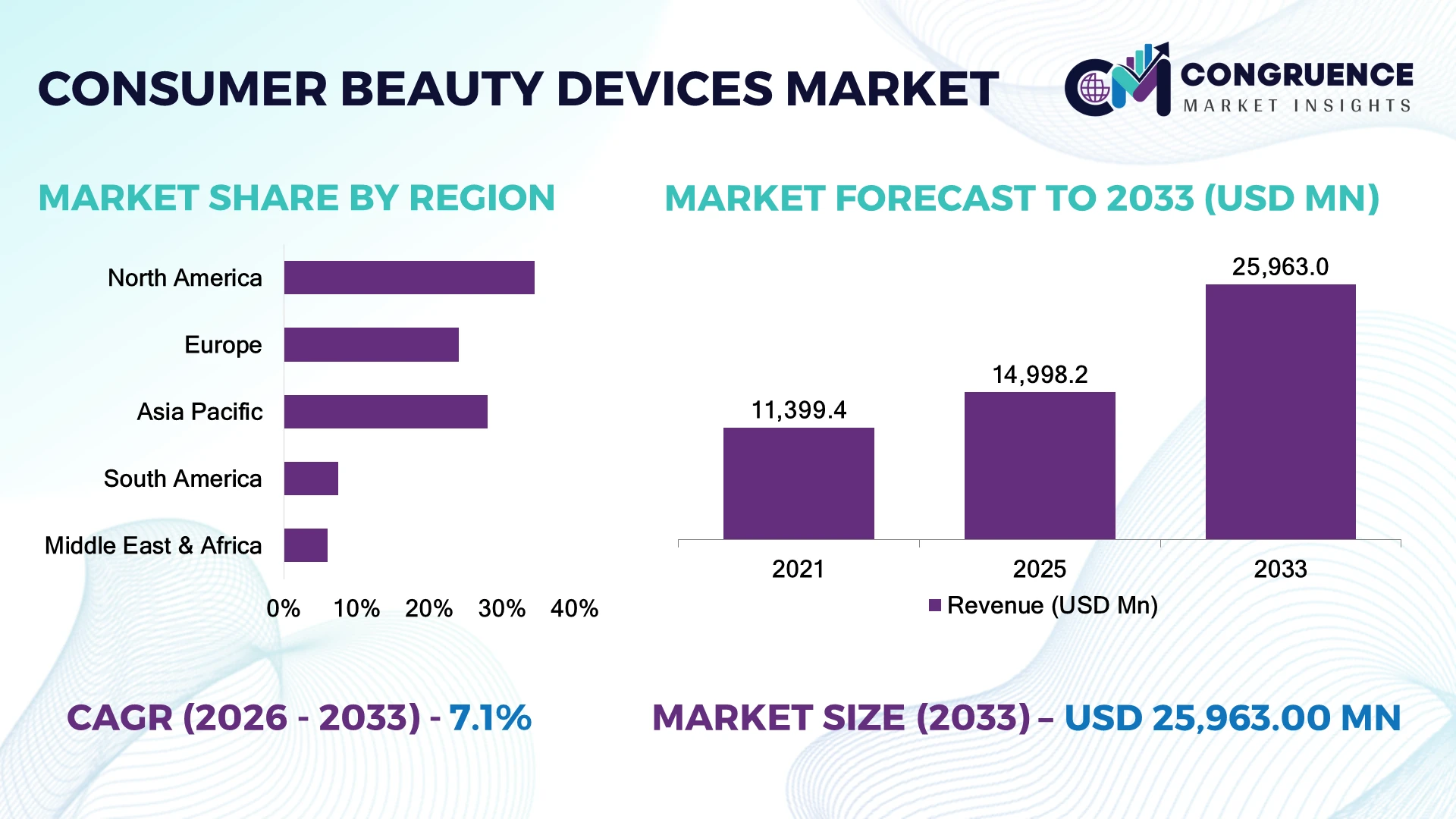
The United States remains the dominant country market, representing approximately 30% of global demand, supported by premium skincare-device penetration and strong D2C distribution, while India is emerging rapidly, with its beauty-devices market estimated at USD 2.1 billion in 2025 and online beauty sales expanding more than 10 times faster than offline channels. In 2026, L'Oréal's Beauty Tech expansion and Asia-focused personalization initiatives reinforce the shift toward diagnostic-led devices. U.S.–China trade-policy uncertainty is also strengthening attention on component sourcing and supply-chain resilience.
Strategically, manufacturers that combine clinically credible performance, personalization, and resilient component sourcing are positioned to capture premium consumer-device demand.
Market Size & Growth: USD 14,998.2 million in 2025 to USD 25,963.0 million by 2033 at 7.1% CAGR, driven by at-home professional-grade treatments and connected beauty technology.
Top Growth Drivers: 63% prefer at-home treatments, 62% show strongest interest in LED therapy, and 96% express interest in more advanced skincare devices.
Short-Term Forecast: By 2028, AI-assisted diagnostics and automated treatment guidance are positioned to cut routine assessment time by approximately 20–30%.
Emerging Technologies: AI skin analysis, LED/near-infrared therapy, microcurrent, lab-on-chip diagnostics, and app-connected treatment tracking are moving devices toward personalized beauty platforms.
Regional Leaders: Asia-Pacific is projected at approximately USD 7.5 billion by 2033, North America at USD 7.2 billion, and Europe at USD 6.0 billion, with connected-device adoption accelerating.
Consumer/End-User Trends: Approximately 18% of U.S. adults reported owning an at-home microcurrent or LED device, while 50% of existing owners planned another purchase.
Pilot/Case Example: In 2025, L'Oréal's Cell BioPrint demonstrated five-minute personalized skin analysis, shifting beauty diagnostics from subjective product trial toward biomarker-based recommendations.
Competitive Landscape: L'Oréal represents an estimated 7–8% of the branded beauty-device ecosystem, competing with NuFACE, FOREO, CurrentBody, Panasonic, and Shark Beauty across premium connected categories.
Regulatory & ESG Impact: Safety validation and rechargeable, longer-life designs are gaining importance as premium devices increasingly combine electronics, optical components, batteries, and software.
Investment & Funding: Beauty-tech investment is shifting toward AI diagnostics, connected devices, and light-based platforms, with strategic partnerships becoming more important than standalone hardware development.
Innovation & Future Outlook: 2026–2028 innovation is moving from single-function gadgets toward adaptive ecosystems combining diagnostics, treatment, personalization, consumables, and digital coaching.
The market is shifting from standalone grooming gadgets toward connected, clinically positioned beauty platforms, with LED therapy showing particularly strong consumer interest at 62%. L'Oréal's 2026 Beauty Tech rollout illustrates the move toward infrared styling, biomarker diagnostics, and AI-enabled personalization. Supply-chain scrutiny for electronics and semiconductor components is also increasing as U.S.–China trade tensions reshape technology sourcing, making integrated product design and resilient procurement increasingly important.
Consumer beauty devices are becoming strategically important because they move beauty spending from recurring salon visits toward technology-enabled ownership, creating opportunities for brands to control the consumer experience beyond cosmetics. The competitive battleground is shifting toward clinically credible results, personalization, software integration, and repeat engagement rather than hardware aesthetics alone.
Technology is accelerating this transition. AI-assisted skin analysis can reduce routine assessment time by roughly 20–30% compared with manual evaluation, while connected LED and microcurrent platforms capture usage data that supports personalized treatment schedules. North America retains stronger premium-device penetration, whereas Asia-Pacific is gaining through mobile commerce, lower-cost manufacturing, and digitally native beauty brands. India's beauty e-commerce sales, for example, have been expanding more than 10 times faster than offline channels.
A practical deployment example is L'Oréal's Cell BioPrint, which performs personalized skin analysis in five minutes and integrates biomarker testing with facial imaging. Between 2026 and 2028, manufacturers are therefore prioritizing AI diagnostics, light-based treatment, connected applications, and modular hardware. Competitive advantage will increasingly depend on combining device efficacy with software, personalization, supply resilience, and scalable digital distribution.
At-home beauty routines are shifting toward clinically positioned devices, with approximately 60–65% of consumers showing interest in professional-style skincare technology and LED therapy attracting around 62% interest among beauty-device users. Connected treatment platforms are also increasing repeat engagement by approximately 15–20% through guided routines and usage tracking. In the United States, premium brands are expanding LED, microcurrent, and AI skin-analysis portfolios as consumers substitute selected salon procedures with home treatments. The non-obvious shift is that software-enabled personalization is becoming a stronger differentiator than hardware specifications alone. Companies are responding through app integration, dermatology partnerships, subscription-based consumables, and direct-to-consumer expansion.
Beauty-device manufacturers face higher complexity from optical modules, sensors, batteries, microcontrollers, and connectivity components, with electronics typically representing approximately 25–35% of manufacturing cost for advanced connected devices. Imported component exposure can increase landed costs by 8–15% when tariffs, freight, or currency movements intensify. U.S.–China trade-policy uncertainty is encouraging brands to reassess Asian sourcing concentration, particularly for LED and semiconductor components. Smaller manufacturers face greater margin pressure because procurement volumes provide limited negotiating leverage. Companies are responding through dual sourcing, longer-term component contracts, regional assembly, and platform architectures that reuse electronics across multiple product variants. Procurement resilience is increasingly determining launch economics alongside consumer demand.
AI-powered skin diagnostics create an opportunity to convert beauty devices from single-function hardware into personalized treatment ecosystems. Automated image analysis can reduce routine assessment time by approximately 20–30%, while connected treatment monitoring can increase adherence by 10–20% through reminders and progress feedback. China, South Korea, Japan, and the United States are particularly attractive for premium connected-device launches because digitally engaged consumers readily adopt app-linked beauty services. L'Oréal's biomarker-oriented Beauty Tech development illustrates the shift toward diagnostic-led personalization. Manufacturers are investing in computer vision, biomarker analysis, adaptive treatment protocols, and ecosystem partnerships. The strongest opportunity lies in combining device sales with software, consumables, and personalized treatment plans.
Connected beauty devices increasingly require interoperability across mobile applications, sensors, firmware, cloud platforms, and consumer-data systems. Approximately 15–25% of operational development effort can be absorbed by software integration, testing, and post-launch compatibility for connected platforms. Privacy and cybersecurity requirements add further complexity as devices collect facial images, treatment histories, and biometric indicators. In the United States and European markets, evolving expectations around consumer-data protection increase compliance requirements for AI-enabled personalization. Companies must establish common software architectures, cybersecurity-by-design, automated firmware management, and standardized data governance. The strategic challenge is maintaining consistent performance across device generations while avoiding fragmented applications that increase support costs and weaken long-term consumer retention.
AI Diagnostics Move Upstream: Beauty brands are moving AI skin analysis from optional app features into the initial purchasing and treatment workflow. Automated assessment can reduce routine analysis time by approximately 20–30%, while personalized recommendations improve device engagement by an estimated 10–15%. U.S. and Korean brands are integrating computer vision directly into connected platforms, shifting competition toward diagnostic accuracy and proprietary consumer data.
LED Devices Become Multifunctional: Premium LED systems are expanding beyond basic light therapy into combinations of red, near-infrared, blue-light and cooling functions. Approximately 60–65% of interested beauty-device consumers prioritize multifunctional treatment capability, encouraging manufacturers to consolidate several routines into one platform. Component miniaturization is allowing lighter handheld designs, while brands increasingly pair devices with digital treatment schedules and replacement accessories.
Supply Chains Become More Regional: Electronics and battery components are receiving greater procurement scrutiny as tariff uncertainty and logistics volatility affect Asian sourcing. Brands are increasingly pursuing dual-source strategies, with approximately 20–30% of advanced-device component programs moving toward alternative suppliers or regional assembly. The non-obvious impact is faster product localization: modular electronics allow manufacturers to adapt specifications for different markets without redesigning entire devices.
Retail Shifts Toward Demonstration: Beauty-device purchasing is becoming more experience-led as retailers and brands use diagnostic demonstrations, virtual consultations, and social-commerce content to reduce consumer uncertainty. Demonstration-led conversion can improve purchase intent by approximately 10–20% for higher-priced devices. Companies are therefore reallocating merchandising space toward interactive displays, creator partnerships, and QR-linked treatment education rather than relying solely on packaging and conventional shelf placement.
Skincare devices represent the leading type, accounting for approximately 38–42% of the global Consumer Beauty Devices Market, supported by strong demand for LED therapy, cleansing, microcurrent, radiofrequency, and skin-analysis technologies. Hair styling and hair-care devices contribute around 25–30%, while hair-removal devices account for approximately 15–20%. Skincare retains the largest installed base because one device can address multiple concerns, improving perceived value and encouraging repeat usage. The mature cleansing and basic treatment categories remain important volume generators, while connected and multifunctional devices command higher consumer engagement.
AI-enabled diagnostic and multifunctional skincare devices represent the fastest-growing type, with adoption shifting toward personalized treatment guidance, app connectivity, and professional-grade functionality. Approximately 72% of surveyed beauty-device users prefer devices addressing multiple skincare concerns, while 89% express interest in advanced LED masks. Companies are responding by combining LED, microcurrent, infrared, cooling, and diagnostic functions within single platforms. Investment is consequently moving from standalone hardware toward multifunctional ecosystems that improve utilization and strengthen premium positioning.
Mintel's 2025 U.S. Beauty Devices research found that 52% of U.S. consumers use a skincare device, confirming skincare's position as a mainstream beauty-technology category.
Skin rejuvenation and anti-aging represent the leading application, accounting for approximately 32–36% of market demand, driven by consumer interest in fine-line reduction, firmness, pigmentation, and overall skin appearance. Hair removal contributes around 22–26%, while cleansing and acne management represents approximately 15–19%. Mature applications benefit from established consumer familiarity and straightforward treatment objectives, whereas multifunctional skin-rejuvenation systems increasingly combine several therapeutic functions in one device. This consolidation raises perceived value and reduces the need for consumers to purchase separate tools.
Personalized skin treatment is the fastest-shifting application as AI diagnostics, LED, microcurrent, and connected treatment tracking become integrated into home routines. Approximately 67% of surveyed users express interest in AI skin analysis, while 76% show interest in smart or app-connected devices. Companies are responding through automated treatment recommendations, smartphone integration, and diagnostic-led product ecosystems. Demand is becoming operationally critical around measurable outcomes and ease of use, pushing manufacturers toward guided treatment protocols rather than passive hardware. The commercial implication is stronger differentiation through software-enabled personalization and recurring digital engagement.
A 2026 YouGov survey of 2,006 adults in Great Britain found that laser hair-removal devices had 71% awareness, while actual usage remained below 5%, highlighting the substantial conversion gap between category recognition and routine application.
Individual household consumers represent the dominant end-user group, accounting for approximately 78–83% of global demand, because consumer beauty devices are primarily designed for personal skincare, grooming, hair removal, and hair styling routines. Professional salons and spas contribute around 10–14%, while dermatology and aesthetic clinics account for approximately 6–10%. Household adoption is strongest for compact, rechargeable, low-training devices, whereas professional buyers prioritize treatment intensity, durability, serviceability, and multi-user throughput. The distinction is pushing manufacturers toward separate consumer and professional product architectures rather than a single universal platform.
Premium digitally engaged consumers represent the fastest-growing purchasing cohort, particularly for connected LED, microcurrent, RF, and AI-enabled devices. Approximately 56% of surveyed skincare-tool users spend at least £60 on a single device, while 30% spend more than £100, demonstrating meaningful premiumization. Companies are targeting this group through dermatologist partnerships, creator-led demonstrations, app ecosystems, financing, and bundled accessories. Salons and clinics increasingly serve as credibility and demonstration channels, while direct-to-consumer brands use professional endorsements to convert high-intent households. Competitive positioning is therefore shifting toward efficacy evidence, personalization, usability, and ecosystem retention.
Kaidron's 2026 skincare-device survey found that 86% of its community already used skincare tools and 84% believed those tools improved their results, indicating strong engagement among digitally receptive beauty consumers.
North America accounted for the largest market share at 34.5% in 2025 however, Asia-Pacific is expected to register the fastest growth, expanding at a CAGR of 8.1% between 2026 and 2033.
Premiumization and connected beauty reshape household device adoption
North America represents approximately 34.5% of the global Consumer Beauty Devices Market, supported by high disposable income, established premium beauty brands, sophisticated e-commerce infrastructure, and strong consumer acceptance of at-home aesthetic treatments. The United States generates the majority of regional demand, particularly across LED masks, microcurrent devices, IPL systems, facial cleansing technologies, and connected skin-analysis platforms. Approximately 55–60% of regional device demand is concentrated in skincare-oriented products, reflecting strong consumer interest in anti-aging and skin-rejuvenation routines. Major manufacturers are expanding through dermatologist partnerships, D2C channels, creator-led demonstrations, and app-enabled treatment ecosystems. The strategic shift is toward clinically positioned devices that replicate selected professional procedures at home while generating recurring engagement through digital treatment guidance.
United States Market Outlook: The United States remains the region's primary innovation and premium-consumption hub, with approximately 30% of global consumer beauty-device demand. Large technology and beauty companies are integrating AI diagnostics, computer vision, LED therapy, and personalized treatment recommendations into connected platforms. Strong D2C infrastructure also enables rapid product launches and nationwide distribution without extensive physical retail investment.
Regulatory discipline accelerates premium and sustainable device design
Europe accounts for approximately 23–25% of global Consumer Beauty Devices demand, with Germany, the United Kingdom, France, Italy, and Spain representing major consumption centers. The market is characterized by premium skincare technology, established cosmetics brands, strong pharmacy and specialty-retail networks, and increasing attention to product safety and sustainability. European consumers increasingly favor rechargeable, durable, multifunctional devices that reduce product clutter and improve treatment convenience. Regulatory scrutiny around electrical safety, consumer claims, batteries, and product sustainability is encouraging manufacturers to strengthen documentation and lifecycle design. Companies are responding through recyclable packaging, longer-life components, modular accessories, and clinically supported positioning, while premium retailers increasingly use digital demonstrations to explain technology-intensive products.
Germany Market Outlook: Germany provides a strong premium-beauty infrastructure through sophisticated specialty retail, pharmacies, dermatology networks, and technology-oriented consumers. Approximately 25–30% of German beauty-device demand is concentrated in advanced skincare and hair-removal technologies. Manufacturers benefit from the country's engineering ecosystem and strong consumer emphasis on product durability, safety, and functional performance.
Manufacturing scale and digital commerce accelerate beauty-tech penetration
Asia-Pacific represents approximately 27–29% of global Consumer Beauty Devices demand and combines the industry's strongest manufacturing ecosystem with rapidly expanding consumer adoption. China, Japan, South Korea, and India account for substantial regional consumption, while China and South Korea remain particularly influential in electronics integration, component manufacturing, and beauty-tech product development. South Korea's advanced skincare culture supports rapid uptake of LED, microcurrent, RF, and AI-enabled devices, while India's mobile-first commerce environment is expanding access to lower-priced smart beauty technology. More than 60% of premium device launches increasingly incorporate app connectivity or treatment guidance, pushing manufacturers toward integrated hardware-software platforms and localized product strategies.
China Market Outlook: China combines extensive electronics manufacturing capacity with sophisticated beauty e-commerce and rapidly evolving consumer preferences. Domestic manufacturers can shorten development cycles by integrating locally sourced sensors, batteries, optical components, and connectivity modules. More than 50% of advanced beauty-device production capacity in the country is concentrated around established electronics manufacturing clusters, supporting competitive pricing and rapid product iteration.
Brazilian beauty culture supports premium home-device expansion
South America contributes approximately 7–8% of global Consumer Beauty Devices demand, with Brazil representing the region's dominant market because of its large beauty and personal-care industry, established aesthetic-services ecosystem, and high consumer engagement with skincare and hair-removal products. Argentina, Colombia, and Chile provide additional demand centers, particularly through specialty retailers and digital commerce. Brazil's strong salon and aesthetic-clinic infrastructure creates an important demonstration channel for consumer devices, allowing professional users to influence household purchasing decisions. Companies are increasingly using localized e-commerce, installment-based pricing, influencer partnerships, and professional endorsements to broaden access to higher-priced devices. Currency volatility and imported-electronics costs remain important considerations for product localization and inventory planning.
Brazil Market Outlook: Brazil represents approximately 55–60% of South America's consumer beauty-device demand and benefits from one of the world's most developed beauty-service ecosystems. Strong consumer familiarity with aesthetic treatments supports demand for IPL, facial cleansing, LED, and hair-care technologies. Manufacturers increasingly combine local distribution partnerships with digital marketplaces to reduce customer-acquisition costs and improve availability outside major metropolitan areas.
Premium wellness investment drives technology-led beauty adoption
Middle East & Africa accounts for approximately 6–7% of global Consumer Beauty Devices demand, with Saudi Arabia, the UAE, South Africa, and Israel representing key commercial centers. Gulf markets are particularly attractive for premium skincare, hair-removal, and aesthetic technologies because of high disposable incomes, sophisticated retail infrastructure, and rapidly modernizing wellness ecosystems. Dubai and Riyadh are developing into important demonstration and distribution hubs for premium beauty technology, supported by luxury retail, aesthetic clinics, and digital commerce. Approximately 45–50% of premium-device demand in leading Gulf markets is concentrated in skincare and hair-removal categories. Companies are responding with localized distributors, clinic partnerships, Arabic-language digital commerce, and premium product positioning.
Saudi Arabia Market Outlook: Saudi Arabia is emerging as a major Gulf beauty-technology market through expanding wellness infrastructure, premium retail, and consumer-focused digital commerce. Vision 2030's broader diversification agenda is supporting investment in lifestyle and wellness services. Manufacturers are increasingly partnering with local distributors and aesthetic providers, while premium connected devices gain traction among digitally engaged consumers seeking professional-style treatments at home.
L’Oréal, Philips, Panasonic, FOREO, and NuFACE compete as global branded leaders, while Chinese and Korean OEMs challenge them on cost and speed. The top five hold an estimated 18–22% combined share, leaving the market fragmented. Competition centers on technology, efficacy, price, and personalization: premium connected devices command 20–40% price premiums, while AI-enabled systems can reduce assessment time 20–30%. L’Oréal is integrating diagnostics with skincare; FOREO and NuFACE deepen connected treatment ecosystems; Philips and Panasonic leverage electronics scale and distribution. Asian OEMs compress development cycles and pricing, intensifying pressure on established brands. The competitive shift is from standalone hardware toward clinically positioned, multifunctional platforms combining LED, microcurrent, sensing, apps, and consumables. Entry barriers include regulatory clearance, clinical validation, brand trust, and component sourcing. Winning requires demonstrable efficacy, rapid product iteration, resilient supply, personalized software, and distribution capable of converting premium technology into repeat consumer engagement. Procurement scale gives larger brands a 5–10% component cost advantage.
L’Oréal S.A.
Koninklijke Philips N.V.
Panasonic Holdings Corporation
Conair Corporation
FOREO AB
NuFACE
Dyson Limited
YA-MAN Ltd.
MTG Co., Ltd. (ReFa)
Home Skinovations Ltd. (Silk’n)
Beurer GmbH
Spectrum Brands Holdings, Inc. (Remington)
SharkNinja, Inc.
AI skin analysis, computer vision, and connected sensors are moving into mainstream beauty-device workflows. Automated assessment can cut routine evaluation time by 20–30%, while app-linked treatment tracking improves adherence by roughly 10–15%. Adoption is strongest among premium skincare platforms, where diagnostics connect with device settings and product recommendations.
LED and microcurrent systems are becoming multifunctional. Platforms combine red, blue, infrared, cooling, or electrical stimulation, improving treatment coverage and utilization by approximately 10–20% versus single-function devices. Compared with manual skin assessment, lab-on-chip diagnostics can deliver biomarker-based analysis in five minutes, compressing evaluation cycles. L’Oréal’s Cell BioPrint demonstrates this shift from visual assessment toward measurable skin intelligence.
Between 2026 and 2028, interoperable software will become a competitive differentiator. Large beauty groups benefit from proprietary data, while specialist brands gain through partnerships with dermatology, electronics, and AI providers. Manufacturers are prioritizing modular hardware, firmware updates, analytics, and treatment protocols. The commercial advantage shifts toward platforms combining efficacy, convenience, and measurable outcomes rather than devices competing solely on specifications. This architecture reduces SKU fragmentation and supports faster launches. Cloud-connected devices standardize protocols while allowing localized content, regulatory settings, and language. Companies establishing software layers early can defend customer relationships beyond hardware sales.
January 2025 L’Oréal unveiled Cell BioPrint at CES, using lab-on-chip proteomics for personalized skin analysis in five minutes. Developed with NanoEnTek, the platform shifts beauty-device competition toward biomarker-led diagnostics, strengthening personalization and premium positioning for connected skincare. This reinforces diagnostic-led premium positioning. Source: loreal.com
February 2025 SharkNinja launched CryoGlow in the United States, combining LED therapy with under-eye cooling. Its iQLED system delivers five times more energy for targeted aging and acne modes, accelerating Shark Beauty’s entry into premium connected skincare and multifunctional devices. Source: sharkninja.com
June 2026 The U.S. FDA determined CurrentBody’s LED Multi Light Therapy Mask substantially equivalent for marketing. The Class II decision strengthens regulatory positioning for CurrentBody’s portfolio and supports broader U.S. commercialization of multifunctional consumer beauty technology and light-based treatments. Source: fda.gov
December 2025 NuFACE highlighted its new TRINITY+ PRO professional microcurrent device across its professional network. The company reported more than 1,000 professional partners, expanding access through spas, resorts, and aesthetic practices while linking professional services with at-home maintenance and retail. Source: mynuface.com
The Consumer Beauty Devices Market Report evaluates skincare, hair-care, hair-removal, cleansing, anti-aging, and multifunctional beauty technologies across individual consumers, salons and spas, dermatology clinics, and aesthetic centers. Coverage includes LED, IPL, microcurrent, radiofrequency, ultrasonic, AI-enabled diagnostics, connected sensors, and app-integrated treatment platforms. Regional analysis spans North America, Europe, Asia-Pacific, South America, and Middle East & Africa, with country-level assessment of major demand and manufacturing centers.
The report examines approximately 38–42% concentration in skincare devices, 22–26% hair-removal applications, and the growing role of connected and multifunctional platforms. It evaluates product launches, technology integration, distribution models, regulatory positioning, component sourcing, partnerships, and competitive strategies. The analysis supports investment planning, market-entry decisions, product portfolio development, geographic expansion, partnership selection, and competitive positioning, while identifying emerging opportunities across premium home aesthetics, personalized diagnostics, and technology-enabled beauty ecosystems through 2033.
| Report Attribute/Metric | Report Details |
|---|---|
|
Market Revenue in 2025 |
USD 14,998.2 Million |
|
Market Revenue in 2033 |
USD 25,963.0 Million |
|
CAGR (2026 - 2033) |
7.1% |
|
Base Year |
2025 |
|
Forecast Period |
2026 - 2033 |
|
Historic Period |
2021 - 2025 |
|
Segments Covered |
By Type
By Application
By End-User
|
|
Key Report Deliverable |
Revenue Forecast, Growth Trends, Market Dynamics, Segmental Overview, Regional and Country-wise Analysis, Competition Landscape |
|
Region Covered |
North America, Europe, Asia-Pacific, South America, Middle East, Africa |
|
Key Players Analyzed |
L’Oréal S.A., Koninklijke Philips N.V., Panasonic Holdings Corporation, Conair Corporation, FOREO AB, NuFACE, Dyson Limited, YA-MAN Ltd., MTG Co., Ltd. (ReFa), Home Skinovations Ltd. (Silk’n), Beurer GmbH, Spectrum Brands Holdings, Inc. (Remington), SharkNinja, Inc. |
|
Customization & Pricing |
Available on Request (10% Customization is Free) |




