
Reports
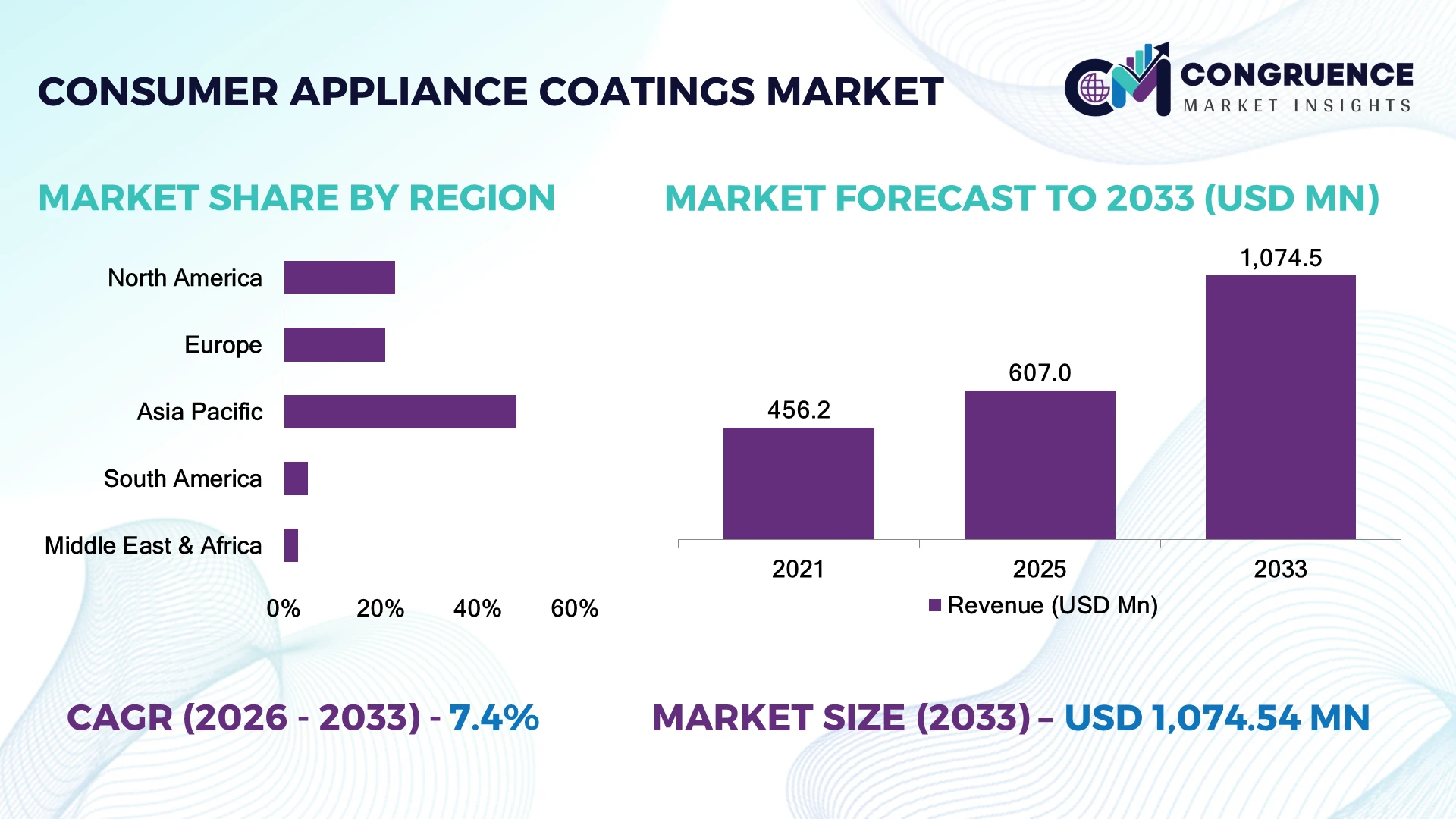
The Global Consumer Appliance Coatings Market was valued at USD 607.0 Million in 2025 and is anticipated to reach a value of USD 1,074.5 Million by 2033 expanding at a CAGR of 7.4% between 2026 and 2033. Growth is driven by increasing adoption of durable low-VOC powder coatings, smart appliance manufacturing, and stricter environmental compliance across global production facilities.
China dominates the market with approximately 36% of global appliance manufacturing capacity, supported by more than USD 18 billion in manufacturing investments and advanced automated coating lines serving white goods and kitchen appliances. In comparison, India accounts for nearly 8% of production while recording faster factory expansion under the "Make in India" initiative, strengthening regional supply capabilities and coating technology adoption.
This positions manufacturers to prioritize regional production hubs, advanced coating technologies, and localized supply-chain partnerships for long-term competitiveness.
Market Size & Growth: USD 607.0 Million in 2025, reaching USD 1,074.5 Million by 2033 at 7.4% growth, supported by advanced powder coating adoption and appliance manufacturing expansion.
Top Growth Drivers: Low-VOC coatings adoption (+32%), smart appliance production (+28%), automated coating lines (+24%).
Short-Term Forecast: By 2028, coating material utilization efficiency improves by approximately 18% through robotic application systems.
Emerging Technologies: AI-enabled coating inspection, electrostatic powder coating, and nano-ceramic protective coatings improve quality and consistency.
Regional Leaders: Asia-Pacific approaches USD 510 Million through manufacturing expansion, North America exceeds USD 220 Million with premium appliance production, while Europe reaches nearly USD 195 Million through sustainable coating adoption.
Consumer/End-User Trends: More than 58% of premium appliances incorporate fingerprint-resistant and scratch-resistant coating solutions.
Pilot/Case Example: In 2024, an automated appliance coating facility reduced coating waste by approximately 22% while improving production throughput.
Competitive Landscape: AkzoNobel holds an estimated 14% market share alongside PPG Industries, Axalta Coating Systems, Sherwin-Williams, and Nippon Paint.
Regulatory & ESG Impact: Low-emission coating technologies reduce VOC emissions by over 35%, supporting stricter environmental compliance across manufacturing plants.
Investment & Funding: More than USD 2.3 Billion has been directed toward coating plant modernization, strategic partnerships, and regional manufacturing expansion.
Innovation & Future Outlook: Self-healing coatings, antimicrobial finishes, and digital process monitoring are strengthening next-generation appliance manufacturing competitiveness.
Consumer Appliance Coatings Market demand is expanding across refrigerators, washing machines, air conditioners, and premium kitchen appliances as manufacturers focus on durable, corrosion-resistant, and aesthetically advanced finishes. Powder coating technologies now represent more than 48% of new appliance coating applications due to improved material efficiency and reduced emissions. Ongoing supply-chain localization and stricter environmental regulations continue to accelerate innovation, creating a stronger foundation for long-term strategic market development.
Consumer appliance coatings have become strategically important as appliance manufacturers compete on durability, energy-efficient production, premium aesthetics, and environmental performance. Industry investment is increasingly directed toward automated coating facilities, regional supply-chain restructuring, and sustainable manufacturing to improve production resilience while meeting evolving environmental standards. These developments are strengthening competitive differentiation across global appliance brands.
Modern electrostatic powder coating systems achieve coating transfer efficiency above 90%, compared with nearly 65–70% for many conventional liquid coating processes, reducing material consumption and operational waste while improving finish consistency. Asia-Pacific continues to lead high-volume manufacturing and production scale, whereas Europe emphasizes environmentally compliant coating technologies and premium product innovation. During the next two to three years, automated inspection systems and digital production monitoring are expected to expand across more than 40% of newly commissioned coating lines.
Manufacturers are deploying robotic coating cells and AI-assisted quality inspection to improve productivity, minimize defects, and shorten production cycles. Companies are also strengthening partnerships with coating technology providers while expanding regional manufacturing footprints to reduce logistics risks and improve delivery responsiveness. These strategic initiatives are reinforcing operational efficiency, strengthening competitive positioning, and supporting long-term industrial sustainability across the global consumer appliance coatings market.
The transition toward environmentally compliant appliance manufacturing is accelerating demand for advanced powder and waterborne coatings that deliver higher durability with lower emissions. More than 60% of newly installed appliance coating lines now incorporate automated electrostatic application systems, while powder coating transfer efficiency exceeds 90%, reducing material waste by nearly 25%. China continues expanding smart manufacturing clusters under industrial modernization programs, encouraging coating suppliers to develop high-performance, low-VOC formulations. This operational shift improves production consistency, lowers rework rates, and strengthens compliance with tightening environmental standards. Leading coating manufacturers are responding through capacity expansion, formulation innovation, and partnerships with appliance OEMs to integrate digital process monitoring, creating stronger production flexibility and differentiated premium finishing capabilities.
Price fluctuations in epoxy resins, polyester resins, titanium dioxide, and specialty additives continue to pressure production economics across appliance coating manufacturers. Titanium dioxide costs have experienced periodic swings exceeding 20%, while imported specialty resin dependence remains above 35% for several manufacturers operating in India and Southeast Asia. Shipping disruptions through major global trade corridors have also increased procurement lead times, affecting production planning and inventory optimization. These constraints reduce pricing flexibility and compress operating margins for coating suppliers serving long-term OEM contracts. Companies are mitigating exposure through localized sourcing strategies, multi-supplier procurement agreements, regional warehousing, and increased adoption of alternative resin technologies that improve supply resilience without compromising coating performance.
Growing consumer preference for premium household appliances is creating demand for intelligent surface technologies that combine aesthetics with enhanced functionality. Fingerprint-resistant finishes now account for more than 40% of premium appliance launches, while antimicrobial coatings demonstrate bacterial reduction rates above 99% under standardized testing. Japan and South Korea continue investing in advanced materials research to commercialize nano-enabled protective coatings and self-healing surface technologies. Coating manufacturers are expanding R&D partnerships with appliance brands to develop multifunctional formulations that improve durability, simplify maintenance, and reduce lifecycle costs. A less explored opportunity lies in digital color customization and rapid formulation platforms that enable shorter production cycles and greater manufacturing flexibility for appliance OEMs.
Deploying advanced coating technologies consistently across geographically distributed manufacturing facilities remains a significant execution challenge. Automated coating systems can reduce defect rates by nearly 30%, yet more than 40% of small and mid-sized production plants continue operating with conventional application equipment requiring extensive modernization. Maintaining uniform coating thickness, curing performance, and color consistency across multiple factories demands skilled technicians, digital quality control, and standardized production protocols. Germany and other advanced manufacturing economies continue addressing workforce shortages in industrial automation, increasing implementation complexity. Companies must strengthen operator training, expand AI-enabled inspection systems, and invest in connected manufacturing infrastructure to ensure consistent product quality, operational efficiency, and long-term competitiveness across global production networks.
Low-VOC Coatings Gain Momentum Environmental compliance and OEM sustainability targets are accelerating the transition toward powder and waterborne coatings, with low-VOC technologies accounting for nearly 62% of new appliance coating installations. Automated electrostatic application improves transfer efficiency above 90% while reducing overspray by approximately 25%. Manufacturers in China and Germany are modernizing production lines and restructuring coating workflows to lower operating costs and meet stricter environmental requirements without compromising finish quality.
Smart Manufacturing Integration Expands Digital production management is becoming standard across appliance coating facilities as AI-driven inspection systems reduce coating defects by nearly 30% and predictive maintenance lowers equipment downtime by around 18%. Labor shortages and higher quality expectations are encouraging companies in Japan and South Korea to accelerate factory automation. Coating suppliers are partnering with appliance manufacturers to integrate real-time monitoring, improving throughput, production consistency, and traceability across high-volume manufacturing operations.
Premium Functional Finishes Increase Consumer preference for longer-lasting appliances is driving adoption of fingerprint-resistant, antimicrobial, and scratch-resistant coatings, now incorporated into more than 55% of premium appliance launches. Multi-functional coating formulations reduce cleaning frequency and extend product appearance throughout operational life. Companies are expanding specialty coating portfolios while optimizing formulation chemistry to balance aesthetics, durability, and production efficiency without increasing manufacturing complexity.
Regional Supply Chains Diversify Global manufacturers are shifting coating material sourcing closer to production facilities, reducing average procurement lead times by approximately 20% while improving inventory stability. India and Vietnam continue attracting new appliance manufacturing investments as companies diversify production beyond traditional hubs. This localization strategy strengthens supply resilience, shortens delivery cycles, and enables coating suppliers to establish regional technical support centers for faster product qualification and customer collaboration.
Powder coatings dominate the Consumer Appliance Coatings Market with an estimated 46% market share due to superior material utilization, excellent corrosion resistance, and environmentally compliant application processes. Their high transfer efficiency, reduced solvent emissions, and durability make them the preferred solution for refrigerators, washing machines, and cooking appliances. Liquid coatings remain a mature segment where complex colors and decorative finishes are required, while UV-cured coatings represent the fastest-growing category as manufacturers seek faster curing cycles and lower energy consumption. Nearly 65% of new appliance production facilities prioritize powder coating systems during capacity expansion because of their operational efficiency. UV-cured coatings are expanding rapidly as production automation increases and manufacturers target shorter production cycles. Waterborne coatings continue strengthening their position in premium appliances through improved environmental performance, while specialty hybrid coatings address demanding performance requirements. Leading coating companies are investing in advanced resin technologies, customized formulations, and localized production capabilities to strengthen customer relationships and improve manufacturing flexibility.
Refrigerators account for approximately 34% of total coating demand owing to high production volumes, strict corrosion protection requirements, and continuous consumer replacement cycles. Washing machines remain another established application where moisture resistance and surface durability are operational priorities. Air conditioners represent the fastest-growing application as premium residential cooling equipment increasingly adopts weather-resistant and energy-efficient coating systems. Nearly 58% of premium appliance launches now incorporate advanced protective coatings that improve durability and visual appearance throughout the product lifecycle. Microwave ovens, dishwashers, and cooking appliances continue adopting specialized coatings that provide heat resistance, stain protection, and improved cleanability. Manufacturers are expanding automated coating operations and integrating digital quality inspection to improve consistency across multiple appliance categories. Product development increasingly focuses on multifunctional surface technologies that combine decorative finishes with enhanced operational performance.
Original Equipment Manufacturers (OEMs) represent the largest end-user segment with approximately 72% market share, supported by large-scale appliance production, standardized coating specifications, and long-term procurement agreements. Their demand is concentrated around automated manufacturing lines where production efficiency and coating consistency directly influence operating performance. Contract manufacturers are emerging as the fastest-growing end-user category as global appliance brands diversify manufacturing locations and expand outsourced production capacity. More than 45% of newly established appliance production facilities now integrate advanced automated coating systems from the commissioning stage. Aftermarket refurbishment providers continue gaining relevance as appliance life extension becomes an important sustainability objective, while specialty industrial appliance manufacturers increasingly require customized high-performance coating formulations. Coating suppliers are strengthening technical service capabilities, collaborative product development, and regional manufacturing support to improve customer retention and accelerate product qualification across diverse production environments.
Asia-Pacific accounted for the largest market share at 48% in 2025 however, North America is expected to register the fastest growth, expanding at a CAGR of 8.1% between 2026 and 2033.
North America represents approximately 23% of the global Consumer Appliance Coatings Market, supported by advanced appliance manufacturing, automated coating technologies, and stringent environmental compliance standards. Premium household appliance production continues shifting toward powder and waterborne coating systems to improve durability and manufacturing efficiency. More than 70% of large appliance manufacturing facilities in the region operate automated coating lines with integrated robotic application and digital inspection systems. Strategic investments in production modernization and regional supply-chain localization are strengthening operational resilience while reducing material waste and production downtime. Manufacturers are expanding partnerships with specialty coating suppliers to develop customized finishes, corrosion-resistant formulations, and premium surface technologies for high-value consumer appliances.
United States Market Outlook: The United States remains the regional leader due to its extensive appliance manufacturing infrastructure, advanced industrial automation, and strong investment in sustainable production technologies. More than 65% of premium appliance production integrates high-performance powder or waterborne coatings, while manufacturers continue expanding AI-enabled quality inspection and automated finishing systems. Ongoing investments in domestic manufacturing and localized supply networks further strengthen production efficiency and product innovation.
Europe accounts for nearly 21% of the global market, driven by advanced environmental regulations, premium appliance production, and continuous modernization of industrial coating facilities. Manufacturers increasingly prioritize low-emission coating technologies and energy-efficient curing systems to support sustainable manufacturing objectives. More than 60% of newly upgraded appliance coating facilities now utilize environmentally compliant powder coating processes with advanced recovery systems. Companies continue investing in digital production control, formulation innovation, and circular manufacturing practices to improve operational efficiency while meeting evolving environmental standards. The focus on premium appliance exports also strengthens demand for durable, decorative, and multifunctional coating solutions.
Germany Market Outlook: Germany leads the European market through its highly automated manufacturing sector, advanced engineering capabilities, and established appliance production ecosystem. Industrial facilities continue integrating robotic coating systems and digital process optimization to improve production consistency and reduce operational waste. Approximately 75% of large-scale appliance manufacturers utilize advanced automated finishing technologies, reinforcing Germany's position as a center for premium appliance coating innovation and sustainable industrial manufacturing.
Asia-Pacific holds the largest regional position with approximately 48% of the global market, supported by high-volume appliance manufacturing, integrated supply chains, and expanding domestic consumption. China, India, South Korea, and Southeast Asian manufacturing hubs continue increasing production capacity to serve both domestic and export markets. More than 55% of global household appliance production is concentrated within this region, encouraging continuous expansion of coating production facilities and localized raw material supply. Manufacturers are deploying automated finishing lines, digital process monitoring, and high-efficiency powder coating technologies to improve productivity while supporting premium appliance manufacturing.
China Market Outlook: China remains the dominant country through its unmatched appliance manufacturing capacity, integrated industrial ecosystem, and extensive supplier network. Nearly 36% of global appliance manufacturing capacity is located in China, supported by continuous investment in automated production facilities and advanced coating technologies. Manufacturers continue expanding smart factories and localized coating production capabilities to improve operational efficiency, export competitiveness, and product quality across multiple appliance categories.
South America contributes approximately 5% of the global market as appliance manufacturers continue strengthening regional production capabilities and reducing dependence on imported finished products. Growing domestic appliance consumption and industrial modernization are encouraging investment in localized coating operations and manufacturing infrastructure. More than 40% of regional appliance production is concentrated within integrated industrial clusters supporting refrigerators, cooking appliances, and laundry equipment. Companies continue optimizing regional logistics networks while expanding partnerships with coating suppliers to improve product availability, manufacturing flexibility, and production efficiency despite infrastructure constraints.
Brazil Market Outlook: Brazil leads the regional market through its established household appliance manufacturing base, large domestic consumer market, and expanding industrial modernization initiatives. Major appliance production facilities continue adopting automated coating technologies to improve product durability and manufacturing efficiency. Increasing investment in regional manufacturing capabilities and supplier localization is strengthening production stability while supporting premium appliance development across domestic and export markets.
The Middle East & Africa accounts for approximately 3% of the global market, supported by industrial diversification, expanding consumer appliance demand, and increasing investment in localized manufacturing capabilities. Governments continue encouraging domestic industrial development through infrastructure expansion and manufacturing incentives, creating new opportunities for appliance coating suppliers. Modern production facilities increasingly incorporate automated coating equipment to improve operational efficiency and product quality. Strategic partnerships between appliance manufacturers and specialty coating providers are supporting technology transfer while strengthening regional production capabilities and reducing import dependence.
Saudi Arabia Market Outlook: Saudi Arabia represents the most strategically significant market within the region due to its industrial diversification strategy, expanding manufacturing investments, and infrastructure modernization programs. New industrial projects continue supporting domestic appliance assembly and advanced coating technology deployment. Manufacturing operators are integrating automated finishing systems and environmentally compliant coating processes to improve production efficiency, strengthen regional supply capabilities, and support long-term industrial competitiveness.
The competitive landscape is led by AkzoNobel, PPG Industries, Sherwin-Williams, Axalta Coating Systems, and Nippon Paint, competing directly against regional coating manufacturers and specialized formulation providers for long-term appliance OEM contracts. The top five players collectively account for approximately 58% of the global market, while regional suppliers compete through localized manufacturing, shorter lead times, and customized formulations. Competition is driven by coating durability, environmental compliance, color consistency, and production efficiency rather than price alone. Premium powder coating technologies improve material utilization by over 90%, while automated digital inspection reduces coating defects by nearly 30%, creating clear operational advantages. Leading companies continue expanding regional manufacturing, strengthening raw material integration, forming technology partnerships, and accelerating low-VOC product innovation to secure strategic OEM relationships. Industry consolidation, increasing sustainability requirements, and supply-chain control are raising competitive pressure. Success increasingly depends on advanced coating technology, localized production capabilities, technical collaboration with appliance manufacturers, and consistent manufacturing performance.
PPG Industries, Inc.
The Sherwin-Williams Company
Axalta Coating Systems Ltd.
Nippon Paint Holdings Co., Ltd.
Kansai Paint Co., Ltd.
BASF Coatings GmbH
Jotun A/S
Beckers Group
TIGER Coatings GmbH & Co. KG
Hempel A/S
Asian Paints Limited
Manufacturers are rapidly integrating powder coatings, waterborne technologies, and AI-enabled process control to improve appliance finish quality and production efficiency. Powder coating systems now achieve transfer efficiency above 90%, reducing coating waste by nearly 25% compared with conventional solvent-based processes. More than 60% of newly commissioned appliance coating lines incorporate robotic application and automated curing controls, enabling consistent film thickness and shorter production cycles. These technologies strengthen operational productivity while supporting compliance with stricter environmental standards.
Advanced nano-ceramic coatings, antimicrobial surface technologies, and digital inspection platforms are becoming mainstream across premium appliance manufacturing. AI-powered vision systems reduce coating defects by approximately 30%, while predictive maintenance lowers equipment downtime by nearly 18%. Compared with conventional manual inspection, automated quality monitoring improves inspection speed by more than 40% and minimizes production variability. Global coating leaders and appliance OEMs benefit most through improved manufacturing consistency, reduced warranty claims, and faster product qualification.
Between 2026 and 2028, digital twins, intelligent curing systems, and multifunctional coating formulations are expected to accelerate industrial adoption across high-volume manufacturing facilities. Self-healing protective coatings, smart color management platforms, and low-temperature curing technologies will improve energy efficiency and production flexibility. Companies investing early in integrated coating automation, advanced material science, and connected manufacturing ecosystems will strengthen competitive positioning through faster deployment, superior product quality, and more resilient manufacturing operations.
November 2025 AkzoNobel and Axalta announced an all-stock merger of equals creating a coatings business serving more than 160 countries with identified annual run-rate synergies of approximately USD 600 million, significantly strengthening global innovation and manufacturing scale. Source: www.akzonobel.com
February 2025 Axalta expanded its industrial coatings portfolio through continued execution of its manufacturing strategy, achieving a 22% adjusted EBITDA margin while reinforcing investments in advanced coatings technologies and global production capabilities for industrial customers. Source: www.newsroom.axalta.com
February 2025 AkzoNobel reported continued efficiency improvements through operational optimization, increasing its adjusted EBITDA margin to 14.2% while accelerating productivity initiatives and supporting future coatings technology investments across global manufacturing operations. Source: www.akzonobel.com
April 2024 PPG Industries introduced expanded industrial coating solutions emphasizing improved durability and process efficiency, enabling manufacturers to enhance application productivity and product performance while supporting evolving sustainability objectives across industrial finishing operations.
The Consumer Appliance Coatings Market Report provides comprehensive analysis across major coating technologies, appliance applications, end-user groups, competitive positioning, and regional industry performance. The study evaluates powder, liquid, waterborne, UV-cured, and specialty coating technologies while assessing demand across refrigerators, washing machines, air conditioners, cooking appliances, and other household equipment. Regional assessment spans North America, Europe, Asia-Pacific, South America, and the Middle East & Africa, supported by operational trends, manufacturing developments, and technology adoption patterns.
The report analyzes competitive strategies, technology innovation, sustainability initiatives, manufacturing modernization, and evolving procurement priorities across leading coating suppliers and appliance OEMs. More than 70% of the assessment focuses on operational performance, product innovation, deployment trends, and strategic manufacturing developments between 2026 and 2033. It supports investment planning, market entry evaluation, expansion strategies, supplier benchmarking, product portfolio optimization, and competitive positioning by identifying high-opportunity segments, emerging technologies, regional manufacturing shifts, and evolving enterprise purchasing priorities.
| Report Attribute / Metric | Details |
|---|---|
| Market Revenue (2025) | USD 607.0 Million |
| Market Revenue (2033) | USD 1,074.5 Million |
| CAGR (2026–2033) | 7.4% |
| Base Year | 2025 |
| Forecast Period | 2026–2033 |
| Historic Period | 2021–2025 |
| Segments Covered |
By Type
By Application
By End-User
|
| Key Deliverables | Revenue Forecast; Market Trends; Growth Drivers & Restraints; Technology Insights; Segmentation Analysis; Regional Insights; Competitive Landscape; Regulatory & ESG Overview; Recent Developments |
| Regions Covered | North America; Europe; Asia-Pacific; South America; Middle East & Africa |
| Companies Profiled | AkzoNobel N.V.; PPG Industries, Inc.; The Sherwin-Williams Company; Axalta Coating Systems Ltd.; Nippon Paint Holdings Co., Ltd.; Kansai Paint Co., Ltd.; BASF Coatings GmbH; Jotun A/S; Beckers Group; TIGER Coatings GmbH & Co. KG; Hempel A/S; Asian Paints Limited |
| Customization & Pricing | Available on Request (10% Customization Free) |




