
Reports
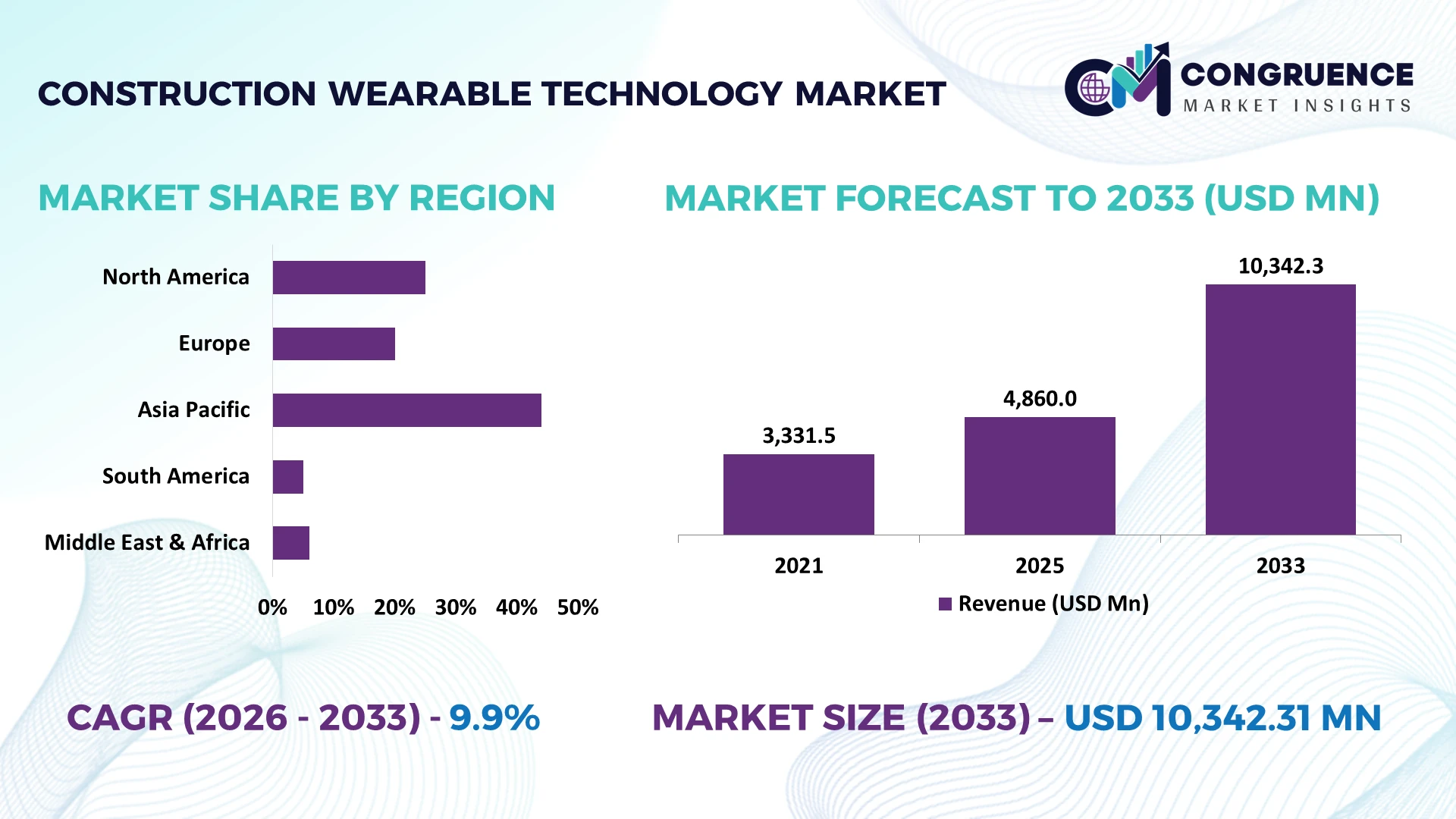
The Global Construction Wearable Technology Market was valued at USD 4860 Million in 2025 and is anticipated to reach a value of USD 10342.31 Million by 2033 expanding at a CAGR of 9.9% between 2026 and 2033. Growth is driven by connected safety helmets, wearable fatigue monitoring, smart personal protective equipment, and industrial exoskeleton adoption across hazardous construction environments.
The United States leads the Construction Wearable Technology Market with an estimated 32% global share in 2025, supported by advanced construction safety practices, infrastructure investment, and industrial wearable innovation. The Infrastructure Investment and Jobs Act authorized approximately USD 1.2 trillion in infrastructure spending, reinforcing construction modernization. Compared with India's labor intensive construction sector, American contractors demonstrate stronger adoption of connected safety monitoring and wearable sensors. Illustrative deployment targets include 20% faster hazard identification and 15% improved worker safety monitoring efficiency across large construction projects.
Strategically, wearable technology suppliers should prioritize American infrastructure contractors, connected safety platforms, and equipment integration partnerships that demonstrate measurable workplace protection and operational efficiency.
Market Size & Growth: USD 4,860 million in 2025, reaching USD 10,342.31 million by 2033 at 9.9% CAGR, supported by connected worker safety monitoring.
Top Growth Drivers: Illustrative demand contributions assign 40% to worker safety digitization, 35% to wearable sensor integration, and 25% to ergonomic injury prevention.
Short Term Forecast: By 2028, connected safety wearable deployments target 20% faster hazard identification and 15% fewer unreported safety incidents.
Emerging Technologies: AI fatigue detection, biometric monitoring, and powered exoskeletons represent 3 advanced construction wearable technology developments.
Regional Leaders: Illustrative 2033 allocations place North America at USD 3,826.65 million, Europe at USD 2,585.58 million, and Asia Pacific at USD 2,895.85 million, supported by safety digitization, ergonomic innovation, and infrastructure deployment.
Consumer / End User Trends: Large construction contractors target 25% greater worker monitoring coverage through connected helmets and wearable location sensors.
Pilot / Case Example: A modeled 2027 construction safety modernization project targets 18% faster emergency response coordination and 12% fewer missed hazard alerts.
Competitive Landscape: An illustrative 14% share positions Honeywell among leading suppliers, alongside 3M, Guardhat, Kenzen, and Hilti.
Regulatory & ESG Impact: OSHA construction safety requirements reinforce connected protective equipment adoption, supporting operational targets of 15% faster incident reporting.
Investment & Funding: A modeled USD 120 million investment scenario prioritizes wearable sensors, industrial exoskeleton development, and construction safety analytics partnerships.
Innovation & Future Outlook: Connected worker platforms, predictive fatigue analytics, and smart protective equipment target 20% faster safety intervention decisions.
The Construction Wearable Technology Market is transforming worker protection across commercial building projects, infrastructure construction, industrial facilities, and hazardous maintenance operations. Connected safety helmets, biometric sensors, wearable location trackers, and industrial exoskeletons provide continuous information on worker conditions and operational risks. Advanced platforms integrate wearable signals with construction safety dashboards, improving incident visibility and emergency coordination. Illustrative deployment benchmarks indicate 20% faster hazard identification through connected monitoring workflows. OSHA safety requirements in the United States and increasing occupational safety modernization across industrializing economies strengthen interest in intelligent protective equipment, making device reliability, worker acceptance, and safety system interoperability central to strategic investment decisions.
Construction Wearable Technology is becoming strategically important as contractors integrate worker protection, operational visibility, and connected safety management into infrastructure delivery. Smart helmets, biometric sensors, location trackers, and industrial exoskeletons address occupational hazards while generating actionable safety information. The United States Infrastructure Investment and Jobs Act is reinforcing infrastructure modernization, increasing attention to workforce protection across complex construction environments. Equipment manufacturers are shifting investment toward connected protective systems that combine real time monitoring with centralized safety management.
Compared with conventional manual safety inspections, connected wearable monitoring offers illustrative targets of 20% faster hazard identification and 15% shorter incident reporting cycles. American contractors emphasize integrated safety platforms, while Japanese construction enterprises increasingly evaluate ergonomic assistance technologies for physically demanding operations. Between 2026 and 2028, deployment programs are expected to prioritize broader sensor coverage, automated emergency notifications, and improved battery endurance, targeting 25% greater monitoring coverage across large construction sites.
A practical deployment involves equipping infrastructure workers with connected helmets and location sensors that transmit emergency alerts to site supervisors. Technology suppliers are expanding sensor development, construction software partnerships, and equipment integration capabilities. Contractors benefit from faster worker location verification and more consistent incident documentation. Competitive advantage increasingly depends on dependable device performance, worker acceptance, and demonstrable safety improvements.
Construction contractors are adopting connected wearable technologies to strengthen hazard detection, worker location monitoring, and emergency response coordination. The United States Occupational Safety and Health Administration maintains extensive construction safety requirements, encouraging employers to improve hazard identification and protective equipment practices. Smart helmets, wearable proximity sensors, and biometric monitoring devices provide continuous safety information across hazardous construction environments. Illustrative deployment targets include 20% faster hazard identification, 15% shorter incident reporting cycles, and 12% improved emergency coordination efficiency. Construction enterprises are expanding connected safety programs across infrastructure and industrial projects. Technology manufacturers are investing in ruggedized sensors, wireless connectivity, and safety management software partnerships. The principal advantage is identifying hazardous conditions before conventional reporting workflows reveal operational exposure.
Construction wearable adoption remains constrained by equipment acquisition costs, recurring connectivity expenses, and inconsistent wireless coverage across temporary construction sites. Advanced smart helmets, biometric sensors, and industrial exoskeletons require specialized components, maintenance, and reliable charging infrastructure. Illustrative procurement assessments indicate 20% higher initial deployment expenditure for integrated monitoring packages and 15% additional operational costs associated with device servicing and connectivity. India's fragmented contractor ecosystem creates further limitations because smaller construction businesses often lack centralized digital safety infrastructure. Suppliers are responding through modular wearable designs, local distribution partnerships, and flexible equipment leasing arrangements. Contractors increasingly prioritize targeted deployment in hazardous work zones. Commercial scalability depends on reducing total ownership costs while maintaining reliable sensor performance and practical field usability.
Advanced ergonomic wearables and predictive fatigue monitoring create opportunities beyond conventional construction safety equipment. Industrial exoskeletons support physically demanding lifting and overhead work, while wearable physiological sensors monitor indicators associated with heat strain and worker fatigue. Illustrative deployment targets include 15% lower perceived physical exertion, 20% faster fatigue risk identification, and 12% improved task endurance under suitable operating conditions. Japan's aging construction workforce strengthens interest in ergonomic assistance technologies that support experienced workers performing repetitive physical activities. Manufacturers are investing in lightweight exoskeleton materials, improved sensor algorithms, and construction equipment partnerships. The strategic opportunity lies in integrating ergonomic assistance with workforce health monitoring, creating differentiated solutions for contractors managing physically intensive construction operations.
Scaling construction wearable technology requires consistent sensor accuracy, secure worker information management, and dependable performance under demanding environmental conditions. Construction sites expose connected devices to dust, vibration, temperature fluctuations, and intermittent network availability, complicating continuous monitoring. Illustrative operational benchmarks target 99% device availability, 15% fewer false safety alerts, and 20% faster synchronization of field monitoring records. European construction employers must also consider General Data Protection Regulation requirements when processing identifiable worker information. Excessive alerts and unclear data access policies can undermine workforce acceptance and operational effectiveness. Technology suppliers are investing in edge processing, encrypted communications, and improved sensor validation. Contractors must establish transparent monitoring policies and maintenance procedures. Long term competitiveness depends on trusted safety information and consistent device performance across changing construction environments.
Connected Safety Equipment Rental Models Expand: Construction contractors are increasingly evaluating subscription and rental arrangements for smart protective equipment rather than purchasing devices outright. United States equipment suppliers are combining wearable hardware, maintenance, and software access into managed service packages. Illustrative commercial targets include 20% lower initial deployment expenditure and 15% faster equipment replacement. Providers are expanding rental partnerships and centralized device management, improving affordability for contractors operating temporary projects with fluctuating workforce requirements.
Augmented Reality Work Instructions Gain Adoption: German construction enterprises are evaluating smart glasses for equipment installation, technical inspections, and remote expert assistance. Digital overlays provide visual instructions and access to technical documentation during complex construction activities. Illustrative deployment targets include 18% faster inspection completion and 12% fewer installation documentation errors. Technology developers are improving display visibility, hands free controls, and integration with digital construction models, reducing dependence on printed technical instructions.
Wearable Heat Exposure Alerts Strengthen: Increasing extreme heat exposure is encouraging construction employers to evaluate wearable temperature monitoring and environmental alert systems. United States contractors are incorporating heat risk notifications into workplace safety procedures. Illustrative deployment targets include 20% faster heat exposure identification and 15% improved supervisor response coordination. Manufacturers are expanding environmental sensing capabilities and integrating alerts with site safety dashboards, supporting more consistent implementation of heat protection procedures.
Digital Equipment Authentication Improves Site Compliance: Construction companies are introducing connected identification features within protective equipment to verify worker access and equipment assignments. Japanese industrial contractors are evaluating wearable credentials for controlled construction zones. Illustrative operational targets include 25% faster personnel verification and 10% fewer equipment assignment discrepancies. Technology suppliers are integrating wireless identification, secure access controls, and centralized equipment records, improving accountability without requiring repeated manual verification at individual work areas.
Smart Helmets represent the leading type in the Construction Wearable Technology Market, accounting for an estimated 28% share in 2025. Their dominance reflects the established importance of head protection and the integration of communication modules, location tracking, and environmental sensors into familiar protective equipment. Large construction contractors increasingly evaluate connected helmets for hazardous work zones and complex infrastructure projects. Wearable Sensors account for an illustrative 24% share, supported by flexible deployment across worker monitoring and environmental measurement applications. Smart Vests provide visible protective equipment integration, while Smart Watches offer accessible alerts and basic activity monitoring.
Exoskeletons represent the fastest growing type as manufacturers develop ergonomic assistance technologies for physically demanding construction tasks. Their estimated 12% share reflects specialized applications and higher equipment acquisition costs. Smart Glasses support remote assistance, digital instructions, and technical inspections. Equipment manufacturers are investing in lightweight materials, improved battery performance, and integrated communication capabilities. Competitive positioning increasingly depends on worker comfort, device reliability, and compatibility with existing safety management systems.
Worker Safety Monitoring represents the leading application in the Construction Wearable Technology Market, accounting for an estimated 35% share in 2025. Its dominance reflects contractors' responsibility for maintaining safe working conditions and improving incident identification across hazardous construction environments. Connected helmets, smart vests, and wearable sensors provide continuous information on worker conditions and safety events. Location Tracking accounts for an illustrative 22% share, supporting personnel identification and emergency coordination across large construction sites. Hazard Detection remains important for identifying environmental exposure and proximity risks.
Health and Fatigue Monitoring represents the fastest growing application, supported by increasing interest in physiological sensing and prevention of heat related workplace incidents. Its estimated 18% share reflects expanding use of biometric monitoring and wearable environmental sensors. Productivity Monitoring supports workforce activity analysis and operational coordination, although implementation requires appropriate privacy safeguards. Technology providers are expanding sensor analytics, automated alerts, and safety dashboard integrations. Demand increasingly favors platforms that translate wearable measurements into timely, actionable safety interventions.
General Contractors represent the dominant end user segment in the Construction Wearable Technology Market, accounting for an estimated 34% share in 2025. Their leadership reflects responsibility for coordinating multiple subcontractors, managing complex construction environments, and implementing consistent workplace safety procedures. Large contractors increasingly evaluate connected helmets, location sensors, and wearable safety alerts across geographically dispersed projects. Infrastructure Developers account for an illustrative 25% share, supported by extensive transportation, utilities, and civil engineering projects requiring coordinated worker monitoring.
Industrial Contractors represent the fastest growing end user segment, driven by hazardous maintenance activities, confined workspaces, and demanding industrial construction conditions. Their estimated 18% share reflects specialized protective equipment requirements. Building Construction Companies emphasize accessible monitoring systems and equipment affordability, while Mining and Engineering Companies prioritize ruggedized sensors and dependable communication. Technology manufacturers are expanding industrial safety partnerships, customizable monitoring platforms, and equipment service agreements. Competitive positioning increasingly depends on application specific reliability, worker acceptance, and measurable safety performance.
North America accounted for the largest market share at an estimated 37% in 2025 however, Asia Pacific is expected to register the fastest growth, expanding at an estimated CAGR of 11.8% between 2026 and 2033.
Connected Worker Safety and Industrial Wearable Integration
North America accounted for an estimated 37% of the global Construction Wearable Technology Market in 2025, supported by established protective equipment manufacturers, construction safety regulations, and advanced industrial technology adoption. The United States dominates regional demand through commercial construction, transportation infrastructure, and industrial development. Contractors increasingly evaluate smart helmets, wearable proximity sensors, and connected safety vests for hazardous work environments. OSHA construction safety requirements reinforce investment in protective equipment and workplace hazard management. Illustrative deployment targets include 20% faster hazard identification and 15% shorter emergency notification cycles. Honeywell, 3M, and specialized wearable technology developers compete through sensor integration, equipment reliability, and connected safety platforms. Enterprise procurement increasingly emphasizes interoperability with construction management systems, ruggedized device performance, and centralized monitoring across geographically distributed construction projects.
United States Market Outlook: The United States benefits from extensive infrastructure modernization, established construction technology providers, and sophisticated occupational safety management practices. California, Texas, and Florida represent important construction activity centers. Federal infrastructure programs strengthen demand for worker protection technologies across transportation and industrial projects. Construction enterprises increasingly evaluate wearable location tracking and connected protective equipment, with illustrative implementation targets of 25% greater worker monitoring coverage. Domestic technology partnerships support integration between wearable sensors, emergency communications, and enterprise safety management platforms.
Ergonomic Protection and Digital Safety Compliance
Europe represented an estimated 25% of the global Construction Wearable Technology Market in 2025, supported by established occupational safety frameworks, industrial automation capabilities, and increasing interest in ergonomic workplace technologies. Germany, France, the United Kingdom, and the Netherlands maintain important construction equipment and industrial wearable ecosystems. European Union workplace safety requirements reinforce protective equipment standards and employer responsibilities for occupational risk management. Construction enterprises are evaluating connected protective devices, smart glasses, and ergonomic assistance systems for complex installation and maintenance activities. Illustrative operational targets include 15% lower perceived physical exertion and 18% faster technical inspection completion. Technology suppliers are investing in lightweight materials, sensor reliability, and integration with digital construction documentation. Competitive differentiation increasingly depends on certified equipment performance, worker comfort, privacy compliance, and compatibility with established industrial safety procedures.
Germany Market Outlook: Germany maintains strong industrial engineering capabilities and established construction safety practices, supporting advanced wearable equipment development. Industrial construction and technical installation activities create demand for ergonomic assistance and digital work instructions. German technology developers are evaluating smart glasses, wearable sensors, and passive exoskeletons for repetitive physical tasks. Illustrative deployment targets include 12% improved task endurance during suitable operations. Equipment manufacturers prioritize ergonomic design, product certification, and integration with industrial maintenance and construction workflows.
Construction Scale and Advanced Wearable Manufacturing
Asia Pacific accounted for an estimated 28% of the global Construction Wearable Technology Market in 2025, supported by extensive construction activity, electronics manufacturing capabilities, and increasing industrial safety modernization. China, Japan, India, and Australia represent distinct deployment environments. China benefits from established sensor manufacturing and electronic component supply chains, supporting competitive wearable equipment production. Japan emphasizes industrial exoskeletons and ergonomic assistance technologies, reflecting workforce aging and physically demanding construction operations. India's expanding infrastructure programs create opportunities for affordable smart protective equipment and mobile safety monitoring. Illustrative deployment targets include 20% faster worker location verification and 15% improved safety notification efficiency. Technology manufacturers are strengthening localized distribution, wireless sensor development, and construction equipment partnerships. Competitive advantage increasingly depends on affordable device manufacturing, practical connectivity, and compatibility with diverse construction operating conditions.
China Market Outlook: China combines extensive construction activity with significant electronics manufacturing capacity, supporting production of wearable sensors, communication modules, and connected protective equipment. Guangdong and Jiangsu provide important industrial ecosystems for electronic components and device assembly. Construction enterprises increasingly evaluate smart helmets and location monitoring technologies for major infrastructure projects. Illustrative manufacturing improvement targets include 10% lower device assembly costs through component standardization. Domestic suppliers emphasize integrated electronics, scalable manufacturing, and compatibility with local industrial connectivity systems.
Industrial Safety Modernization and Affordable Wearable Deployment
South America represented an estimated 6% of the global Construction Wearable Technology Market in 2025, with Brazil accounting for the largest concentration of construction and industrial safety equipment demand. Chile, Colombia, and Argentina contribute through mining infrastructure, transportation development, and industrial construction. Contractors increasingly evaluate wearable environmental sensors, connected protective equipment, and worker location monitoring for hazardous operations. Brazil's occupational safety regulatory framework supports protective equipment compliance and workplace risk management. Illustrative implementation targets include 15% faster incident reporting and 12% improved worker location verification. However, imported electronic components, equipment acquisition costs, and inconsistent connectivity constrain broader deployment. Suppliers are expanding regional distribution partnerships, modular device offerings, and maintenance services. Commercial success depends on equipment affordability, dependable field operation, and accessible technical support.
Brazil Market Outlook: Brazil benefits from extensive construction, industrial development, and mining related infrastructure activities. São Paulo, Minas Gerais, and Rio de Janeiro represent important industrial and construction markets. Regulatory Standard NR 6 establishes requirements concerning personal protective equipment, reinforcing structured workplace protection practices. Contractors increasingly evaluate connected helmets and wearable environmental monitoring systems for demanding industrial environments. Illustrative operational targets include 20% faster hazardous condition reporting. Suppliers prioritize localized equipment distribution, technical training, and compatibility with existing safety procedures.
Megaproject Safety Digitalization and Workforce Monitoring
The Middle East and Africa accounted for an estimated 4% of the global Construction Wearable Technology Market in 2025, supported by major infrastructure investment, industrial diversification, and increasing construction safety technology deployment. Saudi Arabia and the United Arab Emirates represent important markets for connected worker protection across large construction developments. South Africa contributes through mining infrastructure and industrial construction activities. Large projects create demand for wearable location monitoring, environmental sensors, and connected emergency notification systems. Saudi Arabia's Vision 2030 development programs strengthen attention to workforce coordination and construction safety management. Illustrative deployment targets include 20% faster emergency communication and 15% improved personnel accountability. Technology suppliers are expanding regional integration partnerships, ruggedized device offerings, and multilingual monitoring interfaces. Competitive positioning depends on reliable equipment performance under extreme temperatures and complex construction site conditions.
Saudi Arabia Market Outlook: Saudi Arabia's extensive infrastructure and industrial development programs create opportunities for advanced construction safety wearables. Riyadh, NEOM development areas, and the Eastern Province represent important construction activity centers. Large contractors increasingly evaluate connected helmets, location tracking devices, and environmental monitoring systems for complex projects. Illustrative deployment targets include 25% greater monitoring coverage across designated high risk work zones. Suppliers are prioritizing heat resistant equipment designs, Arabic language interfaces, and integration with centralized construction safety management platforms.
The Construction Wearable Technology Market features competition between established protective equipment manufacturers and specialized connected safety innovators. Honeywell and 3M leverage industrial distribution and protective equipment expertise, while Guardhat, Kenzen, and Hilti emphasize connected monitoring, physiological sensing, and construction productivity solutions. The leading five suppliers represent an illustrative combined market share of 42%, reflecting fragmentation across protective equipment and specialized wearable categories. Smart monitoring platforms target 20% faster hazard identification, while ergonomic wearables pursue 15% lower physical exertion and integrated safety systems target 12% improved incident response efficiency. Manufacturers compete through sensor miniaturization, equipment partnerships, regional distribution expansion, and software integration. Competitive momentum increasingly favors connected platforms combining protective equipment with actionable safety analytics. Device certification, worker acceptance, battery endurance, and reliable connectivity create significant entry barriers. Winning suppliers must deliver measurable protection improvements, dependable field performance, and scalable integration with contractor safety operations across demanding construction environments.
Honeywell International Inc.
3M Company
Hilti Corporation
Guardhat
Kenzen
Triax Technologies
Kinetic
Ekso Bionics Holdings, Inc.
German Bionic
Ottobock SE & Co. KGaA
RealWear, Inc.
Vuzix Corporation
MSA Safety Incorporated
Blackline Safety Corp.
Current construction wearables combine smart helmets, location sensors, connected vests, and wireless safety dashboards. Bluetooth, ultrawideband positioning, and cellular connectivity support personnel identification across complex worksites. Compared with manual worker verification, connected tracking systems target 20% faster personnel location checks and 15% shorter emergency notification cycles. Deployment remains concentrated among large infrastructure and industrial contractors. Honeywell, MSA Safety, and specialized sensor developers compete through equipment durability, connectivity reliability, and compatibility with existing protective equipment.
Emerging technologies integrate artificial intelligence, environmental sensing, and augmented reality into construction workflows. Smart glasses display technical instructions, while edge analytics processes sensor readings without continuous cloud connectivity. Illustrative implementation targets include 18% faster equipment inspections and 12% fewer documentation errors. German industrial contractors benefit from hands free guidance, whereas American infrastructure operators prioritize centralized monitoring. Manufacturers are improving battery efficiency, sensor calibration, and integration with construction management platforms.
Between 2026 and 2028, predictive safety analytics, adaptive exoskeletons, and privacy preserving biometric processing will influence purchasing decisions. Lightweight materials and modular electronics support equipment customization. Contractors targeting 25% broader monitoring coverage will prioritize validated alerts, secure worker information, and measurable safety outcomes. Suppliers offering dependable hardware alongside interoperable software gain stronger enterprise relationships.
February 2024: Hilti introduced its EXO T 22 wearable tool balancer, supporting construction tools weighing up to 37 pounds. The backpack system transfers equipment weight toward the hips, reducing upper body strain during concrete drilling and demolition. Source: equipmentworld.com.
April 2025: Vuzix secured a European OEM production order for thermal smart glasses incorporating waveguides with a 30 degree field of view. The collaboration advances infrared visualization for hazardous industrial environments, strengthening specialized wearable component commercialization. Source: ir.vuzix.com.
June 2025: German Bionic introduced its Exia exoskeleton to construction audiences, applying artificial intelligence trained on billions of motion data points. The wearable provides up to 38 kilograms of lifting assistance, supporting physically demanding construction operations. Source: constructiondive.com.
March 2026: Blackline Safety began shipping its G8 connected wearable, integrating gas detection, lone worker protection, and two way communication into 1 device. The commercial rollout consolidates workplace monitoring functions, improving safety coordination across hazardous industrial worksites. Source: blacklinesafety.com.
The Construction Wearable Technology Market Report evaluates industry developments, adoption patterns, and competitive opportunities between 2026 and 2033. Type segmentation covers Smart Helmets, Smart Glasses, Wearable Sensors, Smart Vests, Exoskeletons, and Smart Watches. Application analysis examines Worker Safety Monitoring, Health and Fatigue Monitoring, Location Tracking, Hazard Detection, and Productivity Monitoring. End user coverage includes General Contractors, Infrastructure Developers, Building Construction Companies, Industrial Contractors, and Mining and Engineering Companies. Smart Helmets represent an estimated 28% segment share, highlighting established protective equipment integration.
Regional analysis covers North America, Europe, Asia Pacific, South America, and the Middle East and Africa. Technology assessment examines connected sensors, augmented reality, artificial intelligence, ergonomic assistance, and wearable communications. Competitive evaluation profiles 14 industry participants, supporting investment prioritization, geographic expansion, supplier selection, and long term technology positioning.
| Report Attribute/Metric | Report Details |
|---|---|
Market Revenue in 2025 | USD 4860 Million |
Market Revenue in 2033 | USD 10342.31 Million |
CAGR (2026 - 2033) | 9.9% |
Base Year | 2025 |
Forecast Period | 2026 - 2033 |
Historic Period | 2021 - 2025 |
Segments Covered | By Type
By Application
By End-User
|
Key Report Deliverable | Revenue Forecast, Growth Trends, Market Dynamics, Segmental Overview, Regional and Country-wise Analysis, Competition Landscape |
Region Covered | North America, Europe, Asia-Pacific, South America, Middle East, Africa |
Key Players Analyzed | Honeywell International Inc., 3M Company, Hilti Corporation, Guardhat, Kenzen, Triax Technologies, Kinetic, Ekso Bionics Holdings, Inc., German Bionic, Ottobock SE & Co. KGaA, RealWear, Inc., Vuzix Corporation, MSA Safety Incorporated, Blackline Safety Corp. |
Customization & Pricing | Available on Request (10% Customization is Free) |




